Introduction
Suicide is the second leading cause of death worldwide for individuals aged 15–29 years [World Health Organization (WHO), 2016], and a growing subpopulation of these young people consists of college students (Organisation for Economic Co-operation & Development, 2012). Related to this, an increasing amount of research has focused on suicidal thoughts and behaviours (STB; i.e. suicidal ideation, suicide plans, and suicide attempts) among college students. This is important, as in addition to being risk factors for suicide (Ribeiro et al. Reference Ribeiro, Franklin, Fox, Bentley, Kleiman, Chang and Nock2016), STB are also markers of extreme psychological distress (Garlow et al. Reference Garlow, Rosenberg, Moore, Haas, Koestner, Hendin and Nemeroff2008), are associated with low educational attainment (Mortier et al. Reference Mortier, Demyttenaere, Auerbach, Green, Kessler, Kiekens, Nock and Bruffaerts2015; De Luca et al. Reference De Luca, Franklin, Yueqi, Johnson and Brownson2016), and are linked to reduced rates of professional help-seeking for mental health problems (Hom et al. Reference Hom, Stanley and Joiner2015). In addition, various long-term adverse outcomes, such as persistent mental and physical health problems, unemployment, loneliness, and low life satisfaction are associated with STB (Goldman-Mellor et al. Reference Goldman-Mellor, Caspi, Harrington, Hogan, Nada-Raja, Poulton and Moffitt2014).
One important issue in ongoing research is that prevalence estimates of STB in surveys of college students vary widely. Published estimates of lifetime suicidal ideation prevalence are in the 8.1–53.0% range (Drum et al. Reference Drum, Brownson, Burton Denmark and Smith2009; Paul et al. Reference Paul, Tsypes, Eidlitz, Ernhout and Whitlock2015), and of lifetime suicide attempts 1.0–11.2% (Engin et al. Reference Engin, Gurkan, Dulgerler and Arabaci2009; Wang et al. Reference Wang, He, Yu, Qiu, Yang, Qiao, Sui, Zhu and Yang2014), precluding a validated point of reference. Possible explanations include study methodological differences (Barendregt et al. Reference Barendregt, Doi, Lee, Norman and Vos2013), true differences in prevalence according to geographical location (Marusic, Reference Marusic2005), sociodemographic differences (Nock et al. Reference Nock, Green, Hwang, McLaughlin, Sampson, Zaslavsky and Kessler2013), differences in exposure to STB risk factors (Kraemer et al. Reference Kraemer, Gardner, Brooks and Yesavage1998), and differences in college-specific factors (Eisenberg et al. Reference Eisenberg, Hunt and Speer2013). Two previous studies have addressed this issue by applying meta-analytical techniques to a large number of systematically searched college student samples (Li et al. Reference Li, Li, Lei, Zhang, Liu, Tang and Chen2014; Yang et al. Reference Yang, Zhang, Sun, Sun and Ye2015). However, these studies were restricted to samples recruited in China. Consequently, the exact magnitude of STB among college students around the world is currently unknown.
The primary objective of this study is to obtain pooled prevalence estimates of STB among college students worldwide. In order to ensure the representativeness of our findings, we restricted our search to student samples that were recruited by probability sampling methods (Groves et al. Reference Groves, Fowler, Couper, Lepkowski, Singer and Tourangeau2004a ). This approach is warranted to avoid overrepresentation of data from so-called participant pools of (psychology or sociology) students who participate in research in exchange for course credit (Henrich et al. Reference Henrich, Heine and Norenzayan2010). A secondary objective of this meta-analysis is to explore the heterogeneity in worldwide STB prevalence estimates according to relevant sample and study characteristics.
Methods
We conducted a meta-analysis of published reports that include prevalence estimates of STB among college students. Established guidelines for conducting systematic reviews and meta-analyses in epidemiology (Stroup et al. Reference Stroup, Berlin, Morton, Olkin, Williamson, Rennie, Moher, Becker, Sipe and Thacker2000) and mental health research (Cuijpers, Reference Cuijpers2016) were utilized.
Identification and selection of studies
A systematic review of the literature was conducted to identify English language papers that reported the lifetime or 12-month prevalence of STB (i.e. suicidal ideation, suicide plans, and/or suicide attempts) among college students. The following databases were searched (1980–2016): CINAHL, EMBASE, MEDLINE (through PubMed), PSYCINFO, and WEB OF SCIENCE. Protocol details for this systematic review were registered on PROSPERO (see: www.crd.york.ac.uk/PROSPERO/display_record.asp?ID=CRD42012003288). An overview of search terms is provided in the online Supplementary Materials 1. Primary search terms included (‘students’ OR ‘college students’ OR ‘higher education’ OR …) AND (‘epidemiology’ OR ‘prevalence’ OR ‘occurr*’ OR …) AND (‘suicid*’). Studies were included if they met all of the following criteria:
-
(1) The study reported lifetime or 12-month prevalence of suicidal ideation, plans, and/or attempts.
-
(2) The sample consisted of students enrolled in post-secondary education (i.e. college/university).
-
(3) Participants were recruited through a probability sampling mechanism (random or census sampling). In multi-campus studies, no restriction was placed on the sampling method of the institutions (this means that we did not require that the institutions themselves were sampled at random; however, students within each institution had to be recruited using a probability sampling mechanism).
The following studies were excluded:
-
(1) Qualitative, clinical, and psychometric studies.
-
(2) Studies with sample sizes <100. This was done to avoid excess between-study heterogeneity in sample estimates, given the relatively uncommon nature of STB.
References of included papers were hand-searched for further studies. Authors of the included studies were contacted by e-mail with a request to provide missing information, and were asked for any additional studies to be included in the meta-analysis. College mental health studies with multiple published reports were contacted to provide the most recent data on the full sample. The initial searches and shortlizting were undertaken by M.P. Subsequent searches and checking were completed by M.P., K.G., and B.R. Disagreements pertaining to study inclusion were resolved through consensus.
Data collected
Based on a preliminary exploration of the included studies, the following study and sample characteristics were extracted:
-
(1) The number of events (i.e. the absolute number of students that reported the outcome of interest), and the total sample size. If no absolute number of events could be obtained, this was calculated by multiplying the reported proportion with the total sample size. Whenever available, the sample size adjusted for missing data was used. If weights were applied upon the data, we used the weighted frequencies and/or proportions.
-
(2) The sample size and response rate of the study as reported by the authors.
-
(3) The gender distribution of the sample.
-
(4) The average age of the sample.
-
(5) Whether the sample consisted of (under)graduate students, or both.
-
(6) The geographical location of the included institutions in the study (i.e. North-American continent, Asia, Europe, and the African continent).
-
(7) The instrument used to assess suicidality, including the exact phrasing of how suicidality was assessed.
Data quality assessment
The methodological quality of the included studies was evaluated using the modified Newcastle–Ottawa Scale (Stang, Reference Stang2010; Mata et al. Reference Mata, Ramos, Bansal, Khan, Guille, Di Angelantonio and Sen2015), which assesses sample representativeness and size, respondent/non-respondent comparability, measures used to assess STB, and descriptive statistics of the study population. Scores range from 0 to 5; full details regarding scoring are provided in online Supplementary Materials 2.
Statistical analysis
The meta() package available for R (Schwarzer, Reference Schwarzer2016) was used for all analyses. A random-effects model for the meta-analysis was chosen a priori, as we did not assume that the true population prevalence of STB was equal across studies (due to both study methodological differences as well as true differences in STB prevalence between college student populations). Random effects, random effect variance, and between-study variance (τ 2) was calculated through the method of moments estimate by DerSimonian and Laird (DerSimonian & Laird, Reference DerSimonian and Laird1986). The Freeman–Tuckey variant of the arcsine square root transformation of proportions was used to avoid variance instability when handling proportions close to zero (Barendregt et al. Reference Barendregt, Doi, Lee, Norman and Vos2013; Trikalinos et al. Reference Trikalinos, Trow and Schmid2013). Between-study heterogeneity is reported by Higgins’ and Thompson's I 2 (which is interpreted as the percentage of variability in STB prevalence estimates attributable to heterogeneity between studies rather than sampling error). Forest and funnel plots were created, and publication bias was assessed by Egger's regression test and Begg–Mazumdar's rank correlation test for funnel plot asymmetry. To evaluate the influence of each included study on the pooled prevalence estimates, sensitivity analyses were conducted using the leave-one-out method, i.e. iteratively leaving out one study each time and repeating the analysis (Bartoli et al. Reference Bartoli, Carra, Crocamo, Carretta, La Tegola, Tabacchi, Gamba and Clerici2016). Multivariate meta-regression was used to investigate the between-study heterogeneity in STB prevalence estimates according to sample and study characteristics (i.e. sample gender distribution, mean sample age, geographical location, undergraduate-graduate status, study quality, and response rate). To avoid over-fit of the meta-regression models, manual backward elimination was used by each time dropping the least significant predictor until the most parsimonious models remained, i.e. those including significant predictors only. Finally, meta-analysis of risk ratios was performed to study the female v. male prevalence ratio for the different STB outcomes.
Results
Literature search
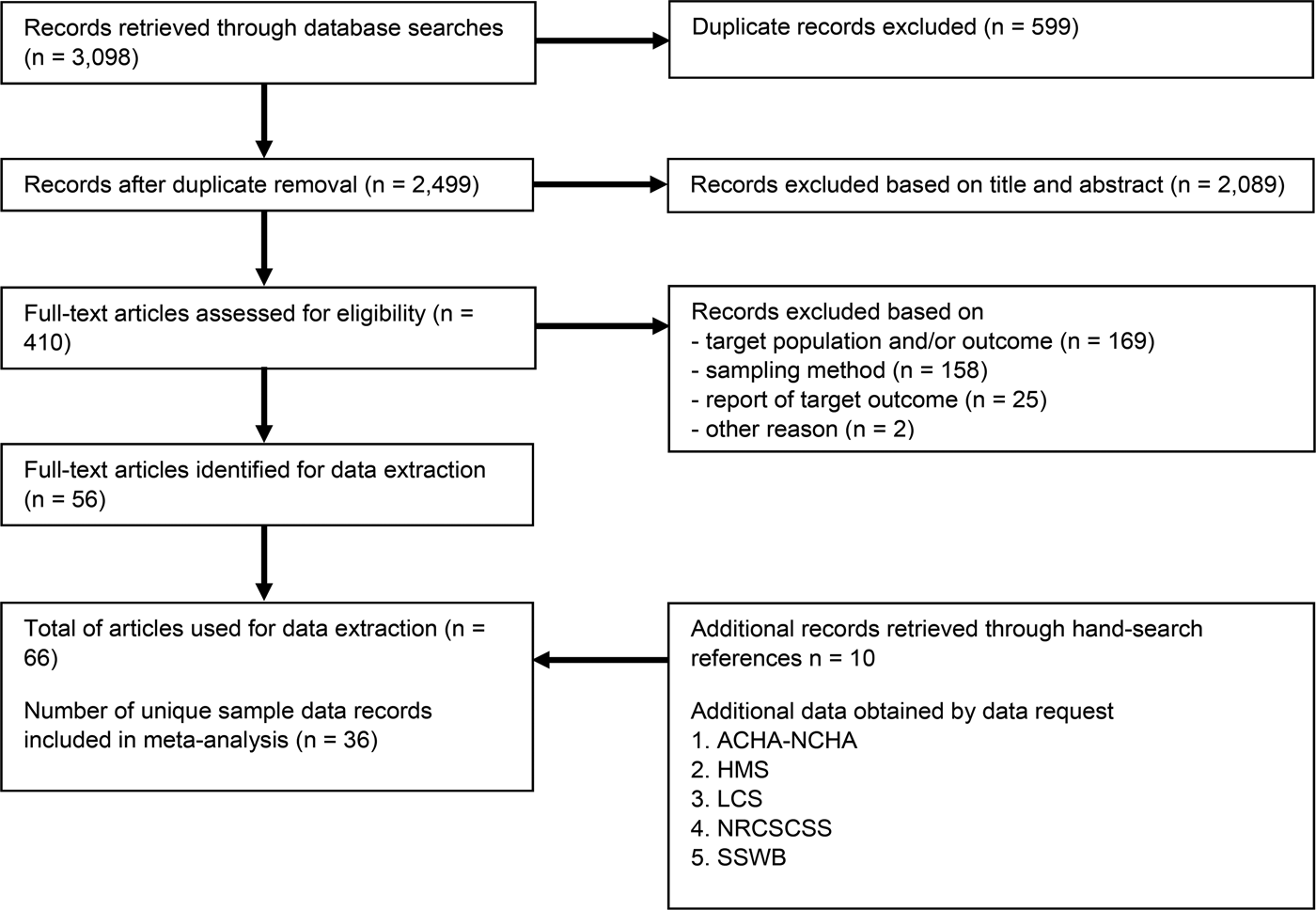
The flowchart of the systematic literature search is presented in Fig. 1. We identified 36 college student samples that met the inclusion criteria (online Supplementary Materials 3), representing a total population size of 634 662 students. A total of 25 samples were surveyed on lifetime suicidal ideation, eight samples on lifetime suicide plans, and 21 samples on lifetime suicide attempts; for 12-month STB outcomes there were 19, 8, and 14 samples, respectively. Of the included samples, 16 were recruited on the North-American continent (15 in the USA, one in Canada), 12 came from Asia, six from Europe, and one study reporting on two samples was conducted on the African continent (Uganda). The median sample size was 2082 (IQR = 353–5200). For response rate, sample percentage of females, and average age the median values were 74% (IQR = 37–89%), 56% (IQR = 50–63%), and 21.4 years (IQR = 20.0–22.8), respectively. A total of 15 samples consisted of undergraduate students, four samples of graduate students, and 11 samples of both undergraduate and graduate students (for six samples, this was unknown).
Flow chart of the systematic review of the literature. ACHA–NCHA, American College Health Association – National College Health Assessment; HMS, Healthy Minds Study; LCS, Leuven College Surveys; NRCSCSS, National Research Consortium Survey of College Student Suicidality; SSWB, Survey of Student Wellbeing.

Bivariate association measures (online Supplementary Materials 4) between the extracted sample characteristics revealed that sample sizes correlated negatively with the obtained response rates (Spearman ρ −0.514; p = 0.005). More specifically, the median response rate dropped to 63% (IQR 25–80%) for sample sizes >2500, and to 25% (IQR 24–74%) for sample sizes >5000. In addition, response rates correlated negatively with the sample percentage of females (Spearman ρ −0.414; p = 0.032) and were lower in samples in the North-American continent as compared with both Asia (38% v. 86%; p = 0.002) and Europe (38% v. 90%; p = 0.005).
Pooled lifetime and 12-month STB prevalence estimates
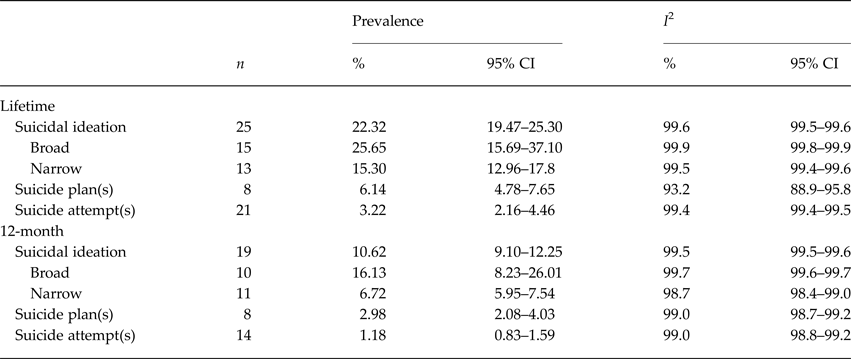
Random effect prevalence estimates, presented in Table 1, ranged from 22.3% for lifetime suicidal ideation to 1.2% for 12-month suicide attempt. After extracting all measures used to assess STB across the included studies, including the exact phrasing of the suicidality items, we decided to categorize suicidal ideation into ‘broad suicidal ideation’ (e.g. thoughts of taking your own life, thoughts of better being off death), and ‘narrow suicidal ideation’ (i.e. measures phrased as ‘seriously considering to commit suicide’ and measures that specifically differentiate between a death wish and suicidal ideation). A full overview of studies categorized according to the specific phrasing of ideation is provided in online Supplementary Materials 3c. We did this to allow for a more fine-grained analysis in terms of ideation severity; this approach was supported by significant tests for subgroup difference (Q = 8.60; df = 1; p = 0.003 for lifetime suicidal ideation; Q = 30.89; df = 1; p < 0.001 for 12-month suicidal ideation). Pooled estimates of broad and narrow suicidal ideation are included in Table 1. Note that confidence intervals are substantially less wide for narrow, as compared with broad ideation. Measures of heterogeneity were high for all outcomes (I 2 = 93.2–99.9%), indicating substantial between-study heterogeneity in estimated proportions not due to sampling error. Forest plots for each STB outcome are provided in the online Supplementary Materials (5a–14a), as well as funnel plots and publication bias tests (5b–14b). Leave-one-out analyses (5c–14c) revealed that no single study had a substantial effect on the final pooled estimates.
Pooled random effect estimates of lifetime and 12-month STB prevalence among college students

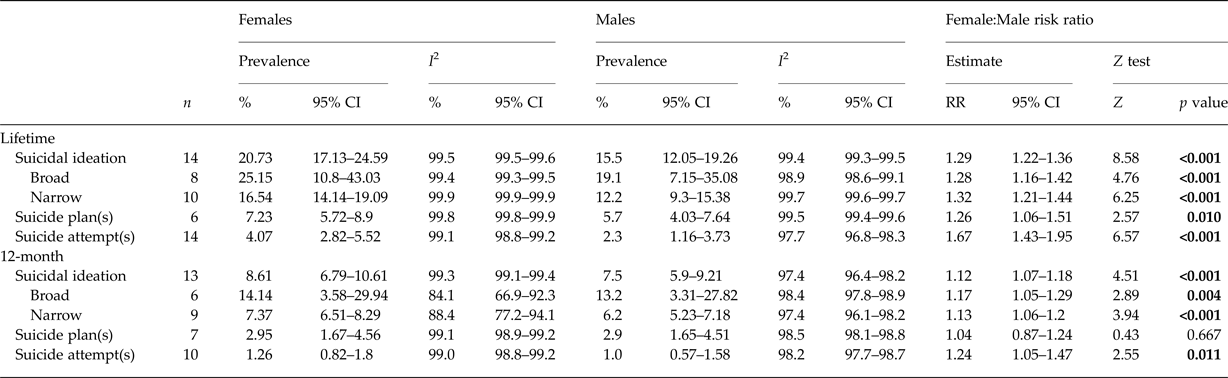
Detailed data were available for a total of 23 samples (total population size = 559 691 students) that allowed us to compare pooled STB estimates according to gender and to estimate prevalence ratios (Table 2). We found that pooled estimates were consistently higher for females, as compared with males (RR range 1.12–1.67), except for lifetime suicide plans, where no significant difference was found. Very few studies provided detailed and/or comparable data that allowed for the pooling of STB estimates by the age or student status. In addition, no study included student data from more than one country or continent, precluding the direct comparison of STB prevalence by geographical location.
Pooled random effect estimates by gender

Note: Significant p values (α = 0.05) are marked in bold.
Multivariate meta-regression of pooled estimates
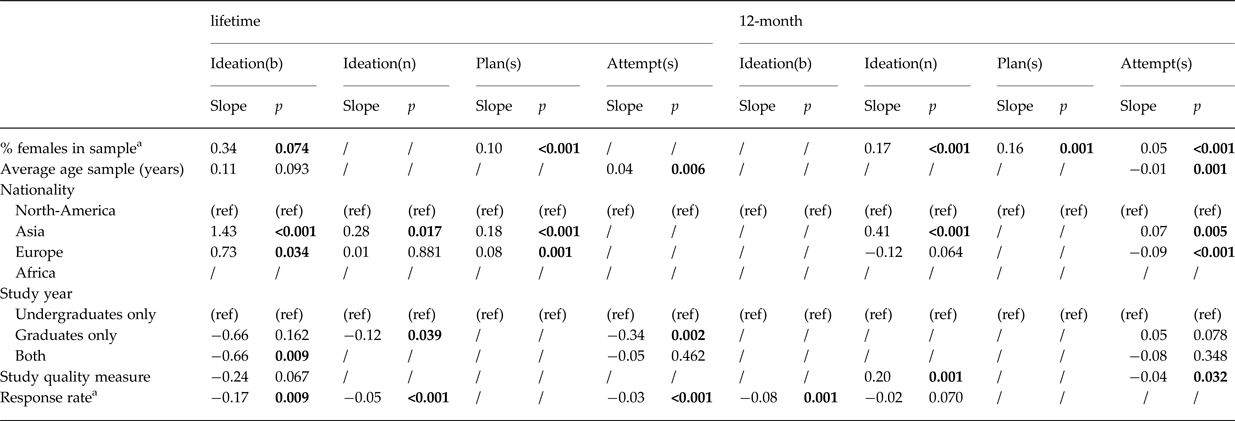
The multivariate meta-regression model for each STB outcome is presented in Table 3. Three principal findings emerged. First, samples including more females resulted in higher STB estimates for four to five of the eight outcomes (the effect for lifetime broad suicidal ideation trended toward significance; p = 0.074). In detail, the increase in STB for an increase of 10% in sample percentage of females is expected to be in the range 0.03% for 12-month suicide attempt up to 2.9% for broad lifetime suicidal ideation, based on our model. Second, STB prevalence estimates were significantly higher in Asia, as compared with North-America, for five of the eight outcomes. Significant differences were estimated in the range 0.8–1.9% for lifetime STB, and 0.1–4.2% for 12-month STB. Third, higher response rates were independently associated with reduced prevalence estimates of lifetime and 12-month suicidal ideation, and lifetime suicide attempts (the effect for 12-month narrow suicidal ideation trended toward significance; p = 0.070). The independent reduction in STB prevalence per 10% increase in response rate, however, was small (i.e. 0.0–0.1%).
Multivariate meta-regression models of STB prevalence estimates

(b), broad; (n), narrow; NA, not applicable; /, predictor was dropped (backward elimination) or could not be estimated; (ref), reference category.
a % females in sample and response rate were divided by 10 to obtain more stable predictors. Slope values indicate the Freeman–Tuckey variant of the arcsine square root transformation of proportions. Significant p-values (α=0.05) are marked in bold.
Finally, we also estimated the difference in prevalence as a function of a broad v. narrow definition of suicidal ideation. We estimated that a narrower definition of suicidal ideation is associated with reductions of 3.6% (lifetime) and 6.1% (12-month) in prevalence estimates of suicidal ideation independent of other predictors (see online Supplementary Materials 15).
Discussion
Prevalence of college student STB worldwide
Based on currently available probability samples worldwide, we found that about one out of four college students have experienced some form of suicidal ideation, with almost 65% of those who have reporting experiencing it in the year prior to the assessment. When restricting to a more narrow definition of suicidal ideation, this was still the case for one out of six students, with about 45% of those students reporting it in the past year. As such, our study provides the first substantial meta-analytic evidence that young people attending colleges are at marked risk for STB. Indeed, the pooled estimates we obtained are consistently higher than figures from the general adult population (Hintikka et al. Reference Hintikka, Viinamaki, Tanskanen, Kontula and Koskela1998; Kjoller & Helweg-Larsen, Reference Kjoller and Helweg-Larsen2000; Ramberg & Wasserman, Reference Ramberg and Wasserman2000; Renberg, Reference Renberg2001; Gunnell et al. Reference Gunnell, Harbord, Singleton, Jenkins and Lewis2004; Crawford et al. Reference Crawford, Nur, McKenzie and Tyrer2005; Bernal et al. Reference Bernal, Haro, Bernert, Brugha, de Graaf, Bruffaerts, Lepine, de Girolamo, Vilagut, Gasquet, Torres, Kovess, Heider, Neeleman, Kessler, Alonso and Investigators2007; Bromet et al. Reference Bromet, Havenaar, Tintle, Kostyuchenko, Kotov and Gluzman2007; Nock et al. Reference Nock, Borges, Bromet, Alonso, Angermeyer, Beautrais, Bruffaerts, Chiu, de Girolamo, Gluzman, de Graaf, Gureje, Haro, Huang, Karam, Kessler, Lepine, Levinson, Medina-Mora, Ono, Posada-Villa and Williams2008a ; Reference Nock, Borges and Ono2012). In addition, STB transition proportions are in line with adult suicide research (Nock et al. Reference Nock, Borges, Bromet, Alonso, Angermeyer, Beautrais, Bruffaerts, Chiu, de Girolamo, Gluzman, de Graaf, Gureje, Haro, Huang, Karam, Kessler, Lepine, Levinson, Medina-Mora, Ono, Posada-Villa and Williams2008a ), as considerable proportions of students with ideation also reported suicide plans (about 40–45%), or suicide attempts (about 20%). Overall, these findings reveal an important threat to our increasingly knowledge-driven global economy and to society's human capital in general (Organisation for Economic Co-operation & Development, 2013). It is therefore of pressing concern that currently available prevention interventions for college student suicidality are largely ineffective (Harrod et al. Reference Harrod, Goss, Stallones and DiGuiseppi2014), and our findings strongly endorse previous calls (Hunt & Eisenberg, Reference Hunt and Eisenberg2010) to keep college mental health issues high on the research agenda.
It is unclear, however, whether college students are at increased risk compared with same-aged peers not in college. Only one study compared STB between these groups, and this study found lower rates of 12-month attempts among college students [0.9% v. 1.4%, respectively (Han et al. Reference Han, Compton, Eisenberg, Milazzo-Sayre, McKeon and Hughes2016)]. This result is in line with our pooled estimates being consistently lower when comparing with figures from adolescent samples (Evans et al. Reference Evans, Hawton, Rodham and Deeks2005; Sidhartha & Jena, Reference Sidhartha and Jena2006; Dervic et al. Reference Dervic, Akkaya-Kalayci, Kapusta, Kaya, Merl, Vogel, Pellegrini and Friedrich2007; Waldrop et al. Reference Waldrop, Hanson, Resnick, Kilpatrick, Naugle and Saunders2007; Nock et al. Reference Nock, Borges, Bromet, Cha, Kessler and Lee2008b ; Reference Nock, Borges and Ono2012, Reference Nock, Green, Hwang, McLaughlin, Sampson, Zaslavsky and Kessler2013) or high school students worldwide (Hoffman & Marsiglia, Reference Hoffman and Marsiglia2014; Lowry et al. Reference Lowry, Crosby, Brener and Kann2014; Benatov et al. Reference Benatov, Nakash, Chen-Gal and Brunstein Klomek2017; Chan et al. Reference Chan, Denny, Fleming, Fortune, Peiris-John and Dyson2017; Lee & Shin, Reference Lee and Shin2017), which was the case for both lifetime and 12-month prevalence rates. Selection effects at college entrance (Fletcher, Reference Fletcher2010) may, in part, account for these differences, as early-onset adverse mental health is linked with lower educational attainment, including the failure to enter college (Breslau et al. Reference Breslau, Lane, Sampson and Kessler2008; Mojtabai et al. Reference Mojtabai, Stuart, Hwang, Eaton, Sampson and Kessler2015; Mortier et al. Reference Mortier, Demyttenaere, Auerbach, Green, Kessler, Kiekens, Nock and Bruffaerts2015). Selection effects during college are also likely to be relevant, as 12-month mental disorders are especially high among college attritters (Auerbach et al. Reference Auerbach, Alonso, Axinn, Cuijpers, Ebert, Green, Hwang, Kessler, Liu, Mortier, Nock, Pinder-Amaker, Sampson, Aguilar-Gaxiola, Al-Hamzawi, Andrade, Benjet, Caldas-De-Almeida, Demyttenaere, Florescu, De Girolamo, Gureje, Haro, Karam, Kiejna, Kovess-Masfety, Lee, Mcgrath, O'neill, Pennell, Scott, Ten Have, Torres, Zaslavsky, Zarkov and Bruffaerts2016), a subgroup potentially underrepresented in college mental health surveys. Another explanation may be differential rates in disclosure of STB. While this remains to be investigated, several findings point towards that direction: the high rates of college students that would not disclose depression to primary care providers (Meyer et al. Reference Meyer, Morrison, Lombardero, Swingle and Campbell2016), the preference of college students to seek help from friends or family, as opposed to professionals (Arria et al. Reference Arria, Winick, Garnier-Dykstra, Vincent, Caldeira, Wilcox and O'Grady2011), mandatory referrals when disclosing STB in some surveys (Wilcox et al. Reference Wilcox, Arria, Caldeira, Vincent, Pinchevsky and O'Grady2010), and campus policies in which students with STB are barred from campus (Appelbaum, Reference Appelbaum2006).
Whether being enrolled in college has a true protective effect on the onset of STB remains an open question. Natural experiments based on compulsory schooling laws have found significant reductions in the prevalence of depression in the general population (Chevalier & Feinstein, Reference Chevalier and Feinstein2007; Crespo et al. Reference Crespo, López-Noval and Mira2013). In addition, studies using propensity score methods have documented protective effects of college education on self-rated health (Bauldry, Reference Bauldry2014), and cardiovascular health and mortality (Schafer et al. Reference Schafer, Wilkinson and Ferraro2013) after the college years. Whereas these studies provide evidence for an association between obtaining a college degree and beneficial outcomes in later life, the direct causal effect of being in college on mental health – including STB – remains unstudied. In this respect, it is intriguing that a recent prospective study of incoming freshmen without any history of STB still found first-onset incidence proportions of STB in the range 5–6% annually (Mortier et al. Reference Mortier, Demyttenaere, Auerbach, Cuijpers, Green, Kiekens, Kessler, Nock, Zaslavsky and Bruffaerts2016). In addition, one study found that, once adjusted for relevant sociodemographic variables, rates of suicide death among young adults do not differ according to college student status (Lamis & Lester, Reference Lamis and Lester2011).
Methodological considerations
A striking finding of our study is the relative lack of representative studies. Indeed, despite the fact that college students form the bulk of respondents in behavioural sciences studies (Henrich et al. Reference Henrich, Heine and Norenzayan2010), we identified only 36 probability samples that were surveyed on STB. Studies mainly focused on undergraduate students, pointing to the need of assessing STB in the later college years when suicide rates are higher (Lamis & Lester, Reference Lamis and Lester2011). More research is also needed on the onset of suicide plans, as they may mark an important, yet still preventable transition from ideation to attempt (Nock et al. Reference Nock, Borges and Ono2012). Another striking aspect of our study was the unbalanced geographical spread of the included studies, with the larger part originating from the USA. In the USA, large multi-institutional research projects on college mental health – including STB – have been conducted for over more than two decades (American College Health Association, 2000; Brown & Blanton, Reference Brown and Blanton2002; Drum et al. Reference Drum, Brownson, Burton Denmark and Smith2009; Eisenberg et al. Reference Eisenberg, Hunt and Speer2013; Paul et al. Reference Paul, Tsypes, Eidlitz, Ernhout and Whitlock2015). More recently, such studies have also begun to emerge in China (Zhao et al. Reference Zhao, Yang, Xiao, Zhang, Aguilera and Zhao2012; Wang et al. Reference Wang, He, Yu, Qiu, Yang, Qiao, Sui, Zhu and Yang2014; Tang et al. Reference Tang, Xue and Qin2015), Taiwan (Chou et al. Reference Chou, Ko, Wu and Cheng2013), and South Korea (Kwak et al. Reference Kwak, Jung and Kim2015). Well-powered representative studies from other continents or countries, however, are scarce to non-existing, and constitutes a call to expand the scope towards college STB worldwide.
An important warning that our study entails – in particular for future college STB research – is that methodological limitations may lead to overestimation of STB prevalence. First, lower response rates were associated with higher sample percentages of females, which, in turn, were independently associated with higher STB estimates. This can be explained by both the higher survey response propensity (Garlow et al. Reference Garlow, Rosenberg, Moore, Haas, Koestner, Hendin and Nemeroff2008; Gollust et al. Reference Gollust, Eisenberg and Golberstein2008) and the higher STB prevalence among females. Although the relationship between a study's response rate and its representativeness is not necessarily strong (Groves, Reference Groves2006), our findings do suggest that sufficiently high response rates are an important step in avoiding overestimation. Second, the use of appropriate suicidality measures, including clearly defined items on suicidal ideation, lead to substantially lower – and presumably more realistic – estimates of lifetime and 12-month ideation. Differentiating according to degree of ideation among young people also has clear clinical consequences, with depressive and behavioural symptoms being higher among those with suicidal ideation, compared to death ideation (Scott et al. Reference Scott, Hermens, Naismith, White, Whitwell, Guastella, Glozier and Hickie2012). Third, it is also worth noting that recent research has shown that single-item self-report questions, consistently used in the included studies from this meta-analysis to assess STB, are prone to misclassification error, and may also lead to overestimation of STB prevalence (Millner et al. Reference Millner, Lee and Nock2015). Last, we found that with increasing overall study quality, estimates of 12-month suicide attempts are also expected to lower substantially, independent from other predictors under study.
Taken together, our findings are in contrast with studies from the general population, where mental disorders are traditionally higher among non-respondents in epidemiological studies (Allgulander, Reference Allgulander1989; Kessler et al. Reference Kessler, McGonagle, Zhao, Nelson, Hughes, Eshleman, Wittchen and Kendler1994; Hansen et al. Reference Hansen, Jacobsen and Arnesen2001; Haapea et al. Reference Haapea, Miettunen, Laara, Joukamaa, Jarvelin, Isohanni and Veijola2008). Risk of overestimation of adverse mental health outcomes among college students is also supported by one study that directly assessed depression among non-respondents and found depression was lower compared with the original respondents [6.1% v. 14.4% (Eisenberg et al. Reference Eisenberg, Gollust, Golberstein and Hefner2007)]. This suggests that mental health surveys may be particularly salient for students with STB or other mental health problems [cf. the effect of survey topic interest on participation (Groves et al. Reference Groves, Presser and Dipko2004b )], and points to the need of using refusal conversion strategies in epidemiological surveys, a strategy that is currently lacking in most college STB studies. Similarly, studies with larger sample sizes generally obtain lower response rates, and hence, are potentially at risk for overestimating STB. Again, this finding underscores the importance of investing an adequate amount of resources into increasing study participation within each unique college setting, a strategy that may be more difficult in large multi-institutional studies.
Limitations
Several limitations of our meta-analysis warrant attention. First, prevalence estimates, as compared with association estimates, are subject to more variation due to factors such as measurement and study design (Barendregt et al. Reference Barendregt, Doi, Lee, Norman and Vos2013). Hence, from a conceptual perspective, single pooled STB prevalence estimates may be regarded overly reductionist, and should be interpreted with caution (Saha et al. Reference Saha, Chant and McGrath2008). We addressed this by using random-effect models when pooling estimates, and by explicitly exploring the variation in estimates using multivariate meta-regression techniques. Second, only English-written studies were included, which may have resulted in a bias towards findings from Western industrialized countries. However, generally speaking, language restricted meta-analyses do not lead to bias (Moher et al. Reference Moher, Pham, Klassen, Schulz, Berlin, Jadad and Liberati2000; Juni et al. Reference Juni, Holenstein, Sterne, Bartlett and Egger2002; Kim et al. Reference Kim, Kong, Choi, Choi, Shin, McDonald and Lee2012). Moreover, in a recent meta-analysis of non-suicidal self-injury prevalence in non-clinical samples (Swannell et al. Reference Swannell, Martin, Page, Hasking and St John2014), which also included studies written in Spanish, no Spanish-only written studies were identified, and no studies were identified on the American continent, except from the USA, and Canada. Third, due to a lack in available studies or to incomparability between studies, several sample characteristics could not be tested in the multivariate meta-regression models. Potential candidate predictors for STB include ethnicity (Wilcox et al. Reference Wilcox, Arria, Caldeira, Vincent, Pinchevsky and O'Grady2010), sexual orientation (Whitlock & Knox, Reference Whitlock and Knox2007), and living situation [e.g. living with parents (Eisenberg et al. Reference Eisenberg, Gollust, Golberstein and Hefner2007)]. To address this, future studies should carefully describe sample sociodemographic characteristics when reporting on college samples assessed for STB. In addition, regional differences in STB prevalence may be better explained by college-specific characteristics (e.g. private v. public institutions, religious v. non-religious schools, urbanicity) than by geographical location on continents alone, to which we were restricted.
Conclusions
College students worldwide report high prevalence rates of STB. Based on our review, two concrete recommendations for future research include: (1) the use of probability sampling and refusal conversion strategies to obtain more representative data, and (2) the use of fine-grained STB measures that are able to clearly differentiate between more and less severe levels of suicidal ideation. Obtaining fine-grained estimates in terms of STB severity may also help to more efficiently manage the limited mental health resources on campus. Apart from obtaining reliable prevalence estimates, methodologically sound studies may also be necessary to close the gap between prevalence estimates of STB on the one hand and effective prevention efforts on the other. To that extent, it is encouraging that the WHO has set up the World Mental Health International College Student Project (The WHO World Mental Health Surveys International College Student Project, 2015), which aims to prospectively follow-up students throughout their academic career, focusing on adverse mental health issues and treatment-seeking behaviour.
Supplementary material
The supplementary material for this article can be found at https://doi.org/10.1017/S0033291717002215
Acknowledgements
We would like to thank the following organizations and persons to kindly provide missing information and most recent data for the included samples in this meta-analysis: Mary T. Hoban, Ph.D., and Christine Kukich, M.S., from the American College Health Association (ACHA-NCHA data); Kimberly M. Caldeira, M.S., and Amelia M. Arria, Ph.D., from the University of Maryland School of Public Health (College Life Study data); Adam Kern, and Daniel Eisenberg, Ph.D., from the Institute for Social Research of the University of Michigan (Healthy Minds Study data); David Klonsky, Ph.D., from the Department of Psychology of the University of British Columbia; Erika Jonietz, and Chris Brownson, from the National Research Consortium of Counseling Centers in Higher Education from the University of Texas at Austin (National Research Consortium Survey of College Student Suicidality data); Adelino António Gonçalves Pereira from the Centro de Psicologia da Força Aérea, Lisboa, Portugal; Janis Whitlock Ph.D., MPH, from the Bronfenbrenner Center for Translational Research (BCTR), Cornell University (Survey of Student Well-Being data); Patricia Otero Otero, and Fernando Lino Vázquez González, Ph.D., from the Department of Psychology of the University of Coruña, Spain; Tracy Witte, Ph.D., from the Department of Psychology of Auburn University. The opinions, findings, and conclusions presented/reported in this article/presentation are those of the author(s), and are in no way meant to represent the corporate opinions, views, or policies of the American College Health Association (ACHA). ACHA does not warrant nor assume any liability or responsibility for the accuracy, completeness, or usefulness of any information presented in this article/presentation. This meta-analysis was supported by the Belgian Fund for Scientific Research (grant numbers 11N0514N, 11N0516N). The funding sources had no role in the design and conduct of the study; collection, management, analysis, interpretation of the data; preparation, review, or approval of the manuscript; and decision to submit the manuscript for publication.
Declaration of Interest
In the past 3 years, Dr. Kessler received support for his epidemiological studies from Sanofi Aventis; was a consultant for Johnson & Johnson Wellness and Prevention, Shire, Takeda; and served on an advisory board for the Johnson & Johnson Services Inc. Lake Nona Life Project. Kessler is a co-owner of DataStat, Inc., a market research firm that carries out healthcare research. The other authors report no biomedical financial interests or potential conflicts of interest.