Scholars interested in the social, political, and cultural meaning of the 1928 Alphabet Law, beyond its immediate linguistic consequences, have generally viewed the alphabet reform within either a nationalist/ideological framework or a modernist/developmentalist framework. Recent works such as that of Birol Caymaz and Emmanuel Szurek have provided a more theoretically grounded account of the alphabet reform as a political project aimed at establishing state authority through cultural domination, yet their analysis does not extend beyond the goals and the initial stages of the alphabet reform.Footnote 1 Meanwhile, works such as Bilal Şimşir's Türk Yazı Devrimi have located it almost exclusively in the sphere of literacy and education, leaving aside its political and ideological nature.Footnote 2 Scholars have explained the goals of the alphabet reform in the context of the state's nationalizing and secularizing language reformsFootnote 3 and in the context of the modernist goals of the early republican state that required a literate society. But they have rarely considered the implementation and the social processes of alphabet change. Rather than maintaining the conventional scholarly focus on the state, then, this article explores the social life of the alphabet change as experienced by Turkish citizens in their everyday lives and their encounters with state authorities.
Drawing on archival evidence, published narratives, and oral interviews,Footnote 4 the article delves into the social world of this political project of the Kemalist state, exploring how it initiated a process of cultural transformations whose terms were not entirely determined by the state but were shaped in part by the perceptions, decisions, and actions of Turkish citizens as well as by the structural conditions of the times. It strives to provide a more nuanced understanding of the social and cultural impact of the alphabet reform by paying attention to the everyday experiences of those who were its targets. After a brief consideration of the historical context of the alphabet reform, I examine the varied social experiences of teaching and learning the new alphabet, focusing on the experiences of and the roles played by private learning, the Millet Mektepleri (the Nation's Schools), the press, and the army. Then I turn to the question of what happened after the initial stages of teaching and learning the new script. Both oral and written historical evidence indicates a remarkable degree of persistence of the old script among adult citizens that was not accompanied by any form of open opposition or resistance to the state and was in fact tolerated by state authorities despite government rhetoric to the contrary. I argue that both the experiences of learning and using the new Turkish alphabet and the persistence of the old letters should be understood as part of a larger process of Turkish citizens coping with change in their everyday lives, of Ottomans becoming Turks. I suggest that reactions to Kemalist reforms often had to do with cultural and habitual change on an individual level and were not determined by ideologically oriented resistance or opposition.
THE ALPHABET REFORM: A BRIEF HISTORICAL OVERVIEW
The alphabet reform debate emerged in the 19th century from within Ottoman intellectual and political debates about literacy and education. In the 1920s, alphabet reform increasingly became a part of the ideological project of Turkish nation building and a precursor to and facilitator of further language reforms. The new alphabet facilitated the standardization of Turkish grammar and spelling; it also eased the process of Turkish language purification (i.e., the purging of Arabic and Persian vocabulary and grammar from Turkish) and contributed to the vernacularization of Turkish. More broadly, it contributed to the building of a secular national language and culture.
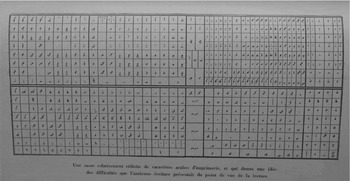
The alphabet debates in Turkey go back to the Tanzimat period. Ottoman statesmen such as Ahmet Cevdet Paşa and Münif Paşa raised the question of alphabet reform in the 1850s and 1860s.Footnote 5 The question revolved around the suitability of Arabic letters for Turkish and the difficulty of learning to read and write Turkish in Arabic letters. The Arabic alphabet, with only three vowels (a, u, i), does not have letters to express all of the vowel sounds in Turkish. Furthermore, it has a number of consonants that Turkish does not have and that were written in borrowed words only. All of this complicated both the reading and the writing of Ottoman Turkish.Footnote 6 The absence of punctuation marks, the lack of standardized rules for the spelling of Turkish words, and the omission of short vowels in Arabic writing led to additional difficulties and ambiguities. The early proposals for reform focused on bringing Arabic orthography and Turkish phonology into closer alignment by adding symbols to the alphabet to represent the Turkish vowels. The main argument for reform was that a modified writing system would help fight illiteracy, which was seen as a major barrier to progress. Of course, the problems of literacy were not simply a consequence of the difficulty or unsuitability of the Arabic script for Turkish, although scholars agree that the difficulty of a script can have an effect on the ease of learning to read and write. The scarcity of schools, cultural attitudes toward literacy and reading, methods of teaching literacy (memorization, particularly of the Qurʾan), the content of reading materials (including the late introduction of Turkish language texts in the school system), and the gap between spoken and written Turkish all contributed to the literacy problem.Footnote 7 Nevertheless, the expansion of literacy was a genuine goal of the proponents of alphabet reform. A related argument for reform had to do with the unsuitability of the existing alphabet for printing presses, necessitating, as can be seen in Figure 1, more than 400 pieces of type (including various forms of all the letters and several letter combinations). A more functional and simpler alphabet would make printing more convenient and less expensive, thus contributing to increased literacy and readership.
A Turkish type case using modified Arabic characters. Histoire de la Republique Turque, Redige par la Societe pour l'etude de l'histoire Turque (Istanbul: Devlet Basımevi, 1935), 255.

By the 1870s the debates had shifted from reforming the existing alphabet to adopting a Latin-based alphabet. By this time Ottoman Albanian intellectuals were in the process of making Latin the shared alphabet for all Albanians, contributing to the argument in favor of a Latin alphabet for Turkish.Footnote 8 The alphabet debate continued in the Young Turk period (1908–18), as the proponents of Westernizing reforms argued for the adoption of the Latin alphabet. With the adoption of the Latin alphabet by Azerbaijan in 1922 and with the decision of the First Turcology Congress in Baku in 1926 on the adoption of the Latin letters for all Turkic languages in the Soviet Union, the pan-Turkist nationalist view shifted toward the adoption of Latin letters.
Mustafa Kemal personally led the propaganda campaign for the new alphabet in the months leading up to the passage of the Alphabet Law by the parliament on 1 November 1928. On 9 August 1928 he made the first public announcement of the decision to adopt a new Turkish alphabet, in a speech in Gülhane, the site where Mustafa Reşit Paşa had read the famous Tanzimat Fermanı in 1839. In the following days he participated in the debates among intellectuals, journalists, and politicians on the new alphabet. He attended the meetings in Dolmabahçe Palace that brought together the alphabet commission and some of the leading writers, poets, journalists, professors, parliamentarians, and officers of the republic, including some who had objections to the reform. These meetings provided a forum for the teaching and the debate of the new alphabet and for building a consensus in its favor. On 29 August the congress in Dolmabahçe unanimously agreed that “in order to save the nation from illiteracy and ignorance [cehalet] there is no solution other than to abandon the Arab letters that do not suit her language and to adopt Turkish letters taken from the Latin alphabet.” The assembly further agreed that “the alphabet proposed by the Commission is truly the Turkish alphabet and is definite. It is sufficient to meet all the needs of the Turkish nation.”Footnote 9
While working to build a consensus among educated elites in Istanbul, Atatürk embarked on a tour of Anatolia in August and September to promote the new alphabet. In every town he visited he stood by a blackboard in the role of head teacher, demonstrating the new letters to the gathered crowd and testing administrators, teachers, and civil servants on the new alphabet. In acts approaching theatrical performances, he would ask the crowd, “Have you learned the new Turkish letters?” Among cries of “we have” and “we are,” he would pick someone from the crowd—a butcher, a drayman, or a hoca—and ask him to write or read something on the board or teach him a few letters to demonstrate how easy they were to learn. He would encourage the crowd to learn the new letters and then to teach them to others. Mustafa Kemal employed his personal charisma as liberator of the nation and leader of the postindependence modernist, nationalist drive. This connection between Mustafa Kemal's use of his charismatic leadership and the nationalist reform program became most obvious in the alphabet reform. Mustafa Kemal characterized the alphabet reform as a war on ignorance and predicted that the victory would be greater than previous victories won on the battlefields.
Following this period of intense preparations in the summer and fall of 1928, the parliament unanimously passed the Alphabet Law on 1 November 1928.Footnote 10 The law declared the adoption of a new Turkish alphabet based on the Latin alphabet to replace the Arabic letters. After 1 December 1928, all newspapers, magazines, advertisements, film subtitles, and other signs had to be in the new letters. By 1 January 1929, all Turkish books had to be published in the new alphabet, and all government offices, banks, and other social and political associations and institutions were required to use the new letters in all their transactions. Members of the public were allowed to use the old letters in their transactions with these institutions until 1 June 1929. The law asked all Turkish schools to begin educating students in the new Turkish letters immediately, and it forbade the use of textbooks in the old letters. The law set June 1930 as the absolute deadline for all public and private transactions, including all printed matter such as laws and circulars, to be in the new letters.
“SAVING THE NATION FROM ILLITERACY AND IGNORANCE”: TEACHING AND LEARNING THE NEW LETTERS
The process of teaching and learning the new letters involved multiple channels, including the army, the education system, the Nation's Schools (Millet Mektepleri, a nation-wide new alphabet and adult literacy program), and the press, as well as large-scale participation by members of the public as teachers and students. The success of state initiatives such as the Millet Mektepleri depended on the voluntary participation of citizens. State propaganda focused on the benefits of literacy in the new letters in an attempt to persuade citizens to participate in the process.
Although the majority of the population did not have the means to do so, some were able to use their own financial or family resources to learn the new alphabet. Meliha (Peker) Tanyeli was born in the provincial center of Trabzon in 1921 to a comfortable urban family. Her father, Ali Salim Peker, was a local merchant with business connections throughout the province and elsewhere in Anatolia. Meliha Hanım and her siblings grew up and went to school in Trabzon. In our conversation, she recalled that everyone in her family learned the new alphabet quickly. She and her sisters learned the new letters in school. She had already attended two years of pre-school and the first year of elementary school by the fall of 1928. She had learned the Ottoman script but had not had much experience reading and writing in Ottoman by the time she learned the new alphabet in her second year of grade school. Her father and mother, both of whom were literate in Ottoman, learned the new letters by taking alphabet lessons at home from Lütfi Bey, a teacher at the Cudibey elementary school.Footnote 11
Mualla Eyuboğlu Anhegger also learned the new alphabet in Trabzon. Born in 1919, she was already in the third year of elementary school at the time of the alphabet reform. Her father, Rahmi Eyuboğlu, was a member of the parliament whom Anhegger recalled as an ardent Kemalist.Footnote 12 She remembered that at the time of the alphabet reform he brought home a blackboard on which he taught his children the new letters. She noted that her mother Lütfiye Hanım joined the children in these lessons and learned to read the new Turkish alphabet, even though she could not write it.Footnote 13 It appears that Rahmi Eyuboğlu fulfilled his duty as a parliamentarian to promote the new alphabet by teaching his immediate family, but it is not clear if his role teaching the new letters extended beyond his wife and children to relatives, servants, or the residents of Trabzon.
MİLLET MEKTEPLERİ: THE NATION'S SCHOOLS
Given the illiteracy of the majority of Turkish citizens, learning the new alphabet in practice meant learning to read and write for the first time. According to the 1927 census, only 8.16 percent of Turkey's total population of more than 13,600,000 were literate, including 12.99 percent of men and 3.67 percent of women.Footnote 14 While the regular school system had the task of teaching children the new alphabet, the government initiated a comprehensive education project for adult citizens aimed at teaching them the new letters while simultaneously expanding literacy. Millet Mektepleri, or the Nation's Schools, became the symbols and engines of the “mass mobilization for literacy,” speeding the transition from Ottoman to the new Turkish letters.Footnote 15 The literacy rate of the population over the age of seven increased to 20.4 percent by 1935 (31% male, 10.5% female) and to 30.2 percent by 1945 (43.7% male and 16.8% female).Footnote 16
The Nation's Schools were founded by the Regulation on Nation's Schools (Millet Mektepleri Talimatnamesi, hereafter Talimatname), a decision of the Council of Ministers on 11 November 1928, only ten days after the parliament passed the Alphabet Law, and the first schools opened on 1 January 1929.Footnote 17 Their purpose, as stated in the Talimatname, was to rapidly extend literacy to the masses. Every Turkish citizen was to be considered a member of the Nation's Schools with Mustafa Kemal as the head teacher. The regulation mandated attendance in the Nation's Schools for all male and female citizens between the ages of sixteen and forty who could not read and write the new letters. There would be two types of schools: four-month schools for adult citizens who had never learned to read and write and two-month schools to teach the new letters to those who were literate in Ottoman. Citizens who claimed to have learned the new letters could be exempted from these classes by passing a literacy test.
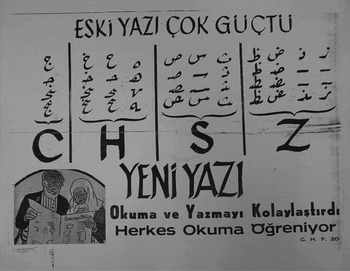
The effectiveness of the Nation's Schools depended on the cooperation of large segments of the society: teachers, common citizens (as voluntary students),Footnote 18 the press, education committees, the Ministry of Education, and various other public and private agencies and individuals. The ruling Republican People's Party (RPP) propaganda campaign for the Nation's Schools focused on the need to combat illiteracy throughout the nation and emphasized how easy it was to learn the new alphabet. An RPP poster highlighted the simplicity of the new letters in contrast to the old letters, by illustrating how a single letter in the new alphabet represented several letters and their different forms in the old alphabet (see Figure 2). The poster reads: “The old writing was very difficult. The new writing made it easier to learn to read and write. Everybody is learning to read.” The peasant couple reading the paper Hakimiyet-i Milliye in this poster, like other images of men and women reading that were frequently used in RPP propaganda materials, signaled an invitation to all citizens—from all backgrounds, male and female—to learn the new letters.
“Everybody is learning to read.” Başbakanlık Cumhuriyet Arşivi 030.10.198.352.13.

Halk, a weekly magazine published by the Ministry of Education shortly after the opening of the Nation's Schools, promoted the literacy campaign, and especially women's participation in it, through frequent images of women reading, women learning to read, or women using their literacy skills at work. Such images included an urban woman reading Halk while waiting for the ferry; a group of women walking cheerfully to their Millet Mektebi class with books in hand despite the cold and the snow; female students in a literacy class; female secretaries working as productive citizens thanks to their ability to read, write, and type; and, on the cover of the very first issue of Halk, a mother learning to read while holding her small child in one arm.Footnote 19
While government propaganda underscored the inclusive nature of a literacy campaign that embraced women and the rural population, both statistical and oral historical evidence reveal a more complicated picture of the reception and implementation of the Millet Mektepleri program. One of my informants, the late Mehmet Baltacı, recalled learning the new alphabet in a Millet Mektebi course.Footnote 20 Born in 1910 in a remote village in the Black Sea province of Kastamonu, Baltacı had access to some schooling in a nearby village before the foundation of the republic and before the Alphabet Law. Baltacı remembered that after the law was promulgated, a class was opened in the village mosque, which he attended with other students of all ages, both literate and illiterate in the old letters. Baltacı was not a privileged child; after his father's death at Gallipoli, he was raised by his mother under the difficult circumstances of the war years. It appears that the class he attended was open to different groups as dictated by the Alphabet Law and the Regulation on the Nation's Schools, with one major exception. Asked about women's participation in the alphabet school, Baltacı told me that women did not attend these classes: “In those days there were no women [in public], they could not even go outside.”Footnote 21 Government statistics also reveal the existence of significant gender as well as urban/rural differences in the accessibility and success of the Nation's Schools despite the intent of the state to create a fully literate society. In the first five years of the Millet Mektepleri—a period by the end of which Turkey's population exceeded 15 million—of the 2.3 million adults who attended a literacy class, about 1.25 million graduated successfully. In the rural areas, only 35 percent of the female students successfully completed the literacy course, compared to 51 percent of their male counterparts.Footnote 22
The main function of the Nation's Schools, and a primary goal of the alphabet reform, was to create a literate society, but it was hoped they would also contribute to the larger goal of creating a national culture. In addition to teaching literacy in the new alphabet, the curriculum of Millet Mektepleri included subjects such as history, geography, and citizenship. Moreover, increased literacy in the new alphabet, which was based on the Istanbul dialect, would work toward the elimination of regional dialects and the creation and standardization of a shared colloquial Turkish. Millet Mektebi classes could also help disseminate Turkish as a spoken language among communities that did not speak Turkish. Through the expansion of the regular school system, especially of elementary and boarding schools, greater numbers of young citizens would experience a nationalist education program, a process that for some students would entail learning the national language. By the early 1930s, the ability and willingness to speak Turkish become a key requirement of full acceptance as a member of the Turkish nation. This emphasis on learning and speaking Turkish in defining the boundaries of the nation found expression in speeches by leading statesmen, in intellectual and political debates, and in the streets through “Citizen Speak Turkish” (Vatandaş Türkçe Konuş) campaigns.Footnote 23
M. Şakir Ülkütaşır cites the memoirs of an elementary school teacher, M. Adil Özer, who witnessed firsthand the overlapping processes of teaching literacy and teaching Turkish in a village in Northeast Anatolia on the Turkish–Soviet border.Footnote 24 The village where Özer taught one year after the alphabet reform was a community of Acara speakers.Footnote 25 Özer recalled teaching reading and writing to first graders who spoke very little Turkish. He also recalled that the women of the village, who knew very little Turkish, learned the new letters in a few months in a Millet Mektebi taught by a traveling teacher (seyyar muallim). Özer's account focuses on the role of the new alphabet and the Nation's Schools in expanding literacy, yet it also shows that learning to read and write and learning the national language were interrelated matters. Government officials in the provinces were well aware of the connections between literacy, language, and national identity. Soner Çağaptay mentions a 1939 communication from the governor of Hakkari, a province in Southeast Anatolia of predominantly Kurdish speakers, reporting that men and women in the province had registered for the Nation's Schools and were being taught the Turkish language and the Turkish letters.Footnote 26
NEWSPAPERS
The use of Latin letters in Turkish newspapers was not entirely new in 1928. Istanbul periodicals had used Latin characters in a limited way since the late 19th century. For example, newspaper advertisements of imported and upscale goods were often in two or three different languages and different alphabets. Another use of Latin characters was in the rendering of foreign words; sometimes Western-language, especially French, words appeared in the original orthography in late 19th-century Ottoman books and magazines, similar to the way classical Greek quotations were displayed in the original script in English-language books in the 19th century. By the early 20th century, newspapers such as Sabah and İkdam printed their mastheads in both Ottoman and French.
Newspapers contributed to the transition to the new alphabet in a number of ways. For literate citizens with a habit of reading newspapers, the appearance of Turkish newspapers in Latin script meant learning the new alphabet in order to be able to continue reading the news. The shift to the Latin alphabet in newspapers along with books and magazines published in Turkey after 1928, as well as in street names, signs, and subtitles in foreign films, meant that people had to learn to read the new letters in order for their literacy to be meaningful and functional. Learning to read the new alphabet acquired significance beyond simply following a law; it was crucial to maintaining one's cultural contact in the national context through reading, which also facilitated the imagination of a Turkish nation.Footnote 27
Newspapers also contributed to the transition by directly promoting the new letters in their pages. A number of leading journalists such as Celal Nuri (İleri) in İkdam, Hüseyin Cahit (Yalçın) in Tanin, Yunus Nadi (Abalıoğlu) in Cumhuriyet, and Falih Rıfkı (Atay) in Hakimiyet-i Milliye enthusiastically advocated adoption of the Latin alphabet, although there was no consensus in the press on the alphabet question in the years preceding the reform. Several journalists who had opposed the adoption of the Latin alphabet on cultural grounds were present on the last day of the Dolmabahçe conferences on August 29, when the congress unanimously accepted the new alphabet.Footnote 28 In the following days, Istanbul and Izmir newspapers began a transitional phase to printing in the new letters. Cumhuriyet, for example, began publishing short pieces in Latin characters in big print on its front page and printed its masthead, date, and editorials in both Ottoman and Latin scripts. It also contributed to the transition by publishing alphabet lessons that introduced the new letters and provided explanations in Ottoman for reading and writing them. Short articles in Latin characters that accompanied the alphabet lessons also served to promote the ideology of the new regime.Footnote 29
Despite the newspapers’ efforts to accustom readers to the new letters, their readership dropped sharply when they began printing completely in the new alphabet following the passage of the law. Some newspapers and magazines, such as İkdam, Son Saat, and Resimli Ay, shut down due to the ensuing financial crisisFootnote 30; others survived in part thanks to government subsidies.Footnote 31 In the long run, the press would benefit from both the expansion of the literate public and the efficiency of the Latin letters in printing (see Figure 3)—important factors in persuading publishers and journalists to agree to the adoption of the new letters.
The new type case after the Alphabet Law, “simple and uncomplicated.” Histoire de la Republique Turque, Redige par la Societe pour l'etude de l'histoire Turque (Istanbul: Devlet Basımevi, 1935), 254. Compare to fig. 1.

“THE ARMY IS A PEOPLE'S SCHOOL”
The army was a key institution in the modernizing mission of the Kemalist state. Its task went beyond the defense of the country and extended to the education and disciplining of male citizens in line with the requirements of the new state.Footnote 32 An RPP poster declared: “The Army is a people's school.”Footnote 33 The poster depicted the army as a place where young men would learn to read and write, increase their love of the motherland, and become healthy and disciplined soldiers. It is thus not surprising that the army was a high priority in Prime Minister İsmet İnönü's program of action for transition to the new alphabet.Footnote 34 İnönü assigned the Ministry of Education the task of training officer-teachers to teach the new alphabet in the army. During a visit to Tekirdağ (then Tekfurdağı) on 23 August 1928 as part of his alphabet campaign, Mustafa Kemal made a personal appeal to the officers asking them to actively participate in the teaching of the new letters.Footnote 35
The army as an institution directly contributed to the dissemination of the new alphabet among the male population by offering literacy classes for conscripts during their mandatory military service.Footnote 36 As Uygur Kocabaşoğlu has noted, while these classes had a positive impact on expanding literacy, their long-term impact on an individual soldier's literacy depended on whether that person continued to be in contact with books and newspapers after his military service.Footnote 37 By 1935 the state was also experimenting with using the army to train teachers for a literacy campaign in rural areas, a program designed by Ismail Hakkı Tonguç. Young men who learned to read and write in the army were sent to back to their villages as educators (eğitmen) after completing a six-month course.Footnote 38 This campaign, although limited in its impact, shows how the republican state attempted to mobilize all segments of society as agents of its developmental projects.
In explaining the remarkable success of the alphabet reform and the absence of any significant resistance to it, historian François Georgeon has also stressed the close link between the alphabet reform and literacy.Footnote 39 After citing two commonly provided reasons for the lack of mass resistance—namely, the repressive political environment created by the Kemalist state and the indifference of the majority of the population to the alphabet change—Georgeon locates the alphabet reform in the larger cultural context of transition to mass literacy in the late Ottoman Empire and post-Ottoman Turkey. He argues that a process of cultural change around literacy (in the sense of a “civilizing process” as theorized by Norbert Elias) was already under way in the late Ottoman period.Footnote 40 A long process of transformation to mass literacy had taken hold by the end of the 19th century. The alphabet reform thus appears as a site where the demands of the population for opportunities to learn to read and write converged with the interests of a modernist state. Alphabet change becomes, at least in part, the state's response to social needs and demands, rather than a top-down reform instituted against the wishes of the population.
In my own research, it is evident from personal narratives of learning the new alphabet that there was indeed a positive cultural attitude toward literacy, at least among the urban population. Several of my informants told the story of their families (children and both parents) learning the new letters in a very matter-of-fact way. These narratives suggest that literacy and education were becoming a normal or expected way of life, at least for segments of the urban society. The findings of a recent study in the Kırşehir province in central Anatolia also attest to a positive attitude toward literacy. The study found that 73 percent of those surveyed were in favor of the alphabet reform at the time it occurred. Fourteen percent said they had not had an opinion, while 11 percent said they had been against it.Footnote 41
In both propaganda and practice alphabet reform became closely intertwined with a nationwide literacy campaign and benefited from the widespread positive attitude toward literacy. Favorable response to such a campaign may reasonably be expected in a country that had a very high rate of illiteracy and was recovering from a decade of wars that had created significant numbers of refugees, immigrants, veterans, and orphans. While the benefits of other reforms such as the adoption of European-style dress were not always obvious or immediate, literacy could be expected to bring material benefits under some circumstances, for example, by improving one's opportunities for employment.Footnote 42
USING THE NEW ALPHABET—PERSISTENCE OF THE OLD ALPHABET
In Kayıseri, Sivas, Şebin Karahisar and the other district centers I stopped by, the civil servants have familiarized themselves with the [new] Turkish letters. Official correspondence is in Turkish letters. But it looks like it is not widely used among the people. Aside from the fact that the results of the Nation's Schools are quite weak, those who can read and write lack the practice or are about to forget the new letters. All transactions amongst the most enlightened of the people are all in Arabic letters. I also found reading and spelling in Turkish in high and middle schools to be very poor. I know that proficiency and skill will not be gained in a short period of time and that a long time is needed for it to become general among the people. However, I sensed that the impact and the power of the first attack have weakened . . . Footnote 43
In addition to expressing his concerns over the current quality and the future of teaching the new alphabet, Minister of Interior Şükrü Kaya's June 1929 letter to Prime Minister İsmet İnönü highlights a critical dimension of the alphabet reform, namely, that learning the new letters did not automatically entail using them. Those who were illiterate prior to the alphabet classes faced the danger of forgetting what they had learned and falling back into illiteracy, while those who were already literate might continue to use the Arabic letters. During his travels in a number of central Anatolian provinces, the minister had observed that educated people continued to use the Arabic letters. Contrary to the official rhetoric that did not tolerate any persistence of the old letters, however, Kaya's report indicates a more realistic and accommodationist approach, which acknowledged that it would take some time for the alphabet change to take effect in the everyday lives of most people.
Both archival and interview data demonstrate a degree of persistence of the Arabic alphabet and a coexistence of the old and new letters not only in the months following the Alphabet Law but also for years to come. This phenomenon can in part be explained as an instance of “everyday forms of resistance.”Footnote 44 However, I suggest that the persistence of the Arabic alphabet was not always a result of opposition or resistance. The conventional view concerning the group of citizens who could read and write in Arabic letters has been that the majority of them were also familiar with European languages and thus that the adoption of the Latin letters did not create a serious problem for them. While there is some validity to this view, the actual alphabet reform experiences of those who were literate prior to 1928 and their socialization into the culture of the new Turkish script have not received much scholarly attention. Many of them were indeed already familiar with French or another European language and learned the new Turkish alphabet, some of them through the Millet Mektepleri or other venues. But they did not necessarily abandon the habit of writing in the old letters entirely. A small number of them lost their functional literacy for anything published in Turkey after 1928, never learning the new letters.Footnote 45 My research did not find any significant resistance of a collective or violent sort, but I did observe numerous ways of Turkish citizens coping with change in their everyday lives. While some of these responses were likely ideologically oriented and should be seen as “everyday forms of resistance,” many were simply coping mechanisms created to deal with social change on an individual level. The following pages examine the multiplicity of experiences of transition to the new letters in the larger nationalist-modernist context of the early republic and how the Kemalist state dealt with those experiences in its formative decades.
A number of statesmen, journalists, and intellectuals may have personally devoted themselves to the promotion of the new alphabet and refused to use the Arabic letters. However, other Turkish citizens continued to make choices in their everyday lives as to which letters to use. One important factor in making such decisions was the division between the public and private spheres, although in practice the boundary between the two was often porous or blurred. Meliha Tanyolaç's mother and father in Trabzon, whom I mentioned earlier as learning the new alphabet on their own initiative, continued to use the Ottoman letters as needed in their private lives. Communication with older members of the family such as letters to Meliha Hanım's grandfather Kitabi Hamdi (Efendi) Başman (1862–1948) continued to be in Ottoman.Footnote 46
In some instances, older citizens who were literate in Ottoman never learned the new letters, resulting in their functional or partial illiteracy for the rest of their lives. In Bursa, the parents of Avni Yurdabayrak (1914–2010), who could read and write in Ottoman letters but were not familiar with any European languages, never learned the new alphabet. Avni Bey's family, of Muslim Georgian ancestory from Batum, had fled to Artvin in the late 19th century and settled in a village near Bursa before World War I. Avni Bey recalled that at the time of the Alphabet Law his father Molla Ahmet hired a teacher, and Avni Bey and all four of his (older) sisters learned the new letters at home. His parents, however, never learned the new alphabet; in Avni Bey's words, “they did not find it necessary.” This does not appear to be an instance of failing to learn the new alphabet because of a lack of financial means. It is possible that the challenge of learning a new writing system at an advanced age was a factor in Molla Ahmet's not learning the Latin script. It is also possible that he felt some resentment toward the state for its abandonment of the Arabic script; his lack of interest in learning the new letters may have been an expression of such resentment. For Avni Yurdabayrak's parents, especially his mother, literacy was closely associated with reading the Qurʾan, for which they did not need to learn the new alphabet. Yet they became functionally illiterate in relation to anything published in Turkey after the script reform. Avni Bey recalled reading the newspaper out loud for his parents.Footnote 47 The generational gap is evident here. For older citizens who were literate in Ottoman, learning the new alphabet was perhaps both a more challenging proposition (Ottoman script was a part of their cultural identity, as they had read and written in those letters for decades) and a less pressing matter than for younger adults, as the former generally did not have to worry about attaining or maintaining employment.
Those who experienced the end of empire as small children, along with those who were born roughly in the first decade of the republic, constituted the first “republican” generation (popularly phrased as “Cumhuriyet Çocukları” or “Children of the Republic”). They grew up, went to school, and were socialized into adulthood in an era of rapid social and cultural transformations engineered by the modernist Kemalist state in the founding decades of the republic. This was the critical generation that the republican regime and its reforms targeted. It did not have any deep-seated loyalties to a prerepublican regime or its cultural and political institutions or symbols. In the case of the alphabet reform, this new generation did not have knowledge of the Arabic letters or the habits associated with using them. Those who had a few years of elementary school in Ottoman letters had not yet formed the rigid habits of their elders and transitioned to the new letters more easily than the adult population. It was therefore crucial to teach this younger generation the new Turkish letters (and ideally prevent or at least discourage children from learning and using Arabic) as a starting point of their education and socialization into the new secular national culture. Hence the insistence of the state authorities that the traditional neighborhood Qurʾan classes discontinue teaching children the Arabic letters and their careful monitoring of such courses.
Even those actively involved in republican politics did not all make a quick transition to the new alphabet in their private lives. Parliamentarian Rahmi Eyuboğlu, whom I mentioned previously as teaching the new alphabet to his family, appears to have continued to write in Ottoman script in his private life after the passage of the Alphabet Law.Footnote 48 In other cases, the distinction between the private and the public was blurred. Texts produced for public consumption were often first written in Ottoman and then transliterated into the new letters before becoming public. Cemal Rıza Osmanpaşaoğlu (1903–89) was a leading journalist in Trabzon for several decades beginning in the 1920s.Footnote 49 In the 1930s and 1940s he wrote for the major Trabzon newspapers Yeni Yol and Halk, which strongly supported state-initiated reforms and tried to create a pro-RPP public opinion in the province. Cemal Rıza Bey would write his newspaper columns in Ottoman and his assistants would transliterate them into the new letters before they went into print.Footnote 50 It is hard to explain Cemal Rıza Bey's continued use of the Ottoman script as a sign of resistance. In addition to writing for pro-regime newspapers, Cemal Rıza Bey exhibited a lifestyle that was in line with what was promoted by the state. He donned the hat, gave public speeches at the town's square during national celebrations, and participated actively in the Trabzon Halkevi (People's House), writing for the Halkevi publication İnan and acting in the plays staged by the Halkevi. Adjusting to writing in a new alphabet involved change on a very personal level, while approving the ongoing reforms could be done on an intellectual and ideological level. A later decision of Cemal Bey also hints at the difference between approving reforms on an abstract level and internalizing them on an individual level. After the Surname Law of 1934, Cemal Bey took the surname “Çınar,” meaning a plane tree. He had been (and unofficially continued to be) known as “Osmanpaşazade” or “Son of Osman Pasha,” after an ancestor who had been an Ottoman pasha. One of the goals of the Surname Law was to erase distinctions among citizens based on titles such as paşazade. In line with that policy, Cemal Rıza Bey initially took a surname that indicated no status or relation to the family heritage, but in later years he adopted an acceptably Turkified form of his earlier name, “Osmanpaşaoğlu.” In his own life Cemal Rıza Bey failed to fully conform to the reforms (both the alphabet and the surname laws) that he approved and tried to promote.
Although there was often an effort to distinguish between the private and public spheres and to limit the use of Ottoman letters to the former, the use of Ottoman persisted (albeit to a smaller degree) even in the public sphere, for instance, in schools and in citizens’ dealings with state authorities. Schools had transitioned to textbooks in the new letters during the 1928/29 education year in line with the requirements of the Alphabet Law. For youth who had learned to read and write in Ottoman but were continuing their education after the Alphabet Law, schools were of crucial importance for learning and adjusting to reading and writing the new letters. In an April 1931 correspondence, the Minister of Interior Şükrü Kaya reported, based on “complaints and information from various places,” that some high school and university students still took their class notes in Arabic letters and that their teachers and professors not only tolerated such practices but also wrote their own notes and lectures in Arabic letters.Footnote 51 Given Kaya's stated source for this information, it appears that if some students or teachers continued to write in Ottoman, there were others who found it necessary to inform the authorities of such practices. Kaya wrote that he did not consider it likely that such acts “against the law and especially against the revolution” would take place in these revolutionary institutions of learning and did not comment on the extent or the causes of such practices. Anecdotal evidence from memoirs and oral interviews also points to a degree of persistence of the old letters in the schools. The process of transition to the new letters in schools would only be completed with the graduation of the generation of students who had learned to read and write in Ottoman and the emergence of a new generation of teachers and professors trained after 1928.
In dealing with the state and its officials, citizens were more careful to observe the new letters, although even there Ottoman persisted alongside the new letters at least through the 1930s and 1940s and especially in the first few years following the Alphabet Law. Educated elites and state officials also found themselves subject to the requirements of the Alphabet Law and in need of relearning how to read and write Turkish properly and comfortably. In April 1931, Halil (Menteşe), a president of the former Committee of Union and Progress, an Ottoman parlimentarian, and head of the parliament and a minister during the Young Turk era, sent a personal letter to Mustafa Kemal from his hometown Milas. Menteşe had written the lengthy letter, a report on the state of the Turkish economy, in Ottoman letters but submitted it with a cover letter in the new letters explaining why the report was in Ottoman. After apologizing for having written the attached report in the old letters, Menteşe wrote: “And I have not, unfortunately, been able to get accustomed to the new letters enough to be able to write without error on a subject this long and important. I especially mix them up with the French letters.”Footnote 52
Menteşe was not an opponent of the regime; in fact, he would become a parliamentarian from Izmir shortly after this correspondence. Yet, born in 1874, he was an Ottoman in his culture and habits. For Menteşe, Kitabi Hamdi Efendi of Trabzon, and others of that generation, the transition to the new writing system was part of the larger process of Ottomans becoming Turks, which involved making changes in one's personal habits and everyday practices. Menteşe's letter also highlights a point about the role of familiarity with French in the transition to the new alphabet. Menteşe complained that he mixed up the new Turkish letters with the French. While familiarity with French made it easier to learn the new Turkish alphabet, fluency in French was not the same as reading and writing Turkish in the new script and still involved a process of learning and habituation. Turkish reformers, for practical and ideological reasons, had insisted on creating a Latin-based Turkish alphabet rather than borrowing the French or another European alphabet in its entirety.Footnote 53 Despite all the similarities, the new Turkish alphabet was indeed different from the French in a variety of ways. It had a number of new elements such as ğ, ı, and ş. Many of the French and Turkish letters had different values, and the two alphabets used different letters or combinations of letters to represent the same sound, as in the combinations eu for ö, u for ü, and ch for ş. For someone fluent in French, such variations likely made generating Turkish in the new script a conscious, careful, and slow process, whereas writing Turkish in the Arabic script would have required no conscious thought and would have been comfortable and quick. Furthermore, the change in the look of the language would have been an impediment for those used to reading and writing Turkish in Arabic letters. When Turkish was written in Latin characters, it no longer looked like Turkish. Getting accustomed to the new look of Turkish necessitated a process of adaptation for those literate in Turkish prior to 1928.
At the Directorate of Religous Affairs in the 1930s, some of the letters submitted by citizens as well as some internal correspondence continued to be in Ottoman characters. The government had to send orders repeatedly to the provinces and the ministries that citizens must use the new Turkish letters in conducting official business and that government offices must not respond to any requests submitted in Ottoman. In a July 1934 circular, the prime minister alerted the ministers that some government offices had been tolerant toward citizens’ use of Arabic letters in official business and requested that any applications submitted to goverment offices in the old letters be destroyed without being read.Footnote 54 The Prime Minister's Office issued a similar statement to the public through the Anatolian News Agency, announcing that any requests submitted in the old letters would be torn up and thrown away without consideration.Footnote 55 The government thus tried to eliminate the use of Ottoman letters by appealing both to the authorities and to the public directly.
Despite the government's efforts to eliminate citizens’ use of the old letters when dealing with state authorities, Ottoman persisted into the 1940s. There is evidence that some citizens, among them some nationalist intellectuals and politicians, saw no contradiction between their commitment to promote the principles, ideals, and institutions of the republic on the one hand and their continuing use of the old letters on the other. There were even instances of Ottoman letters being used in texts written specifically for the promotion of a republican institution or ideal. In 1943, when Vedat Ürfi Bengü sent his short monograph on the People's Houses to RPP parliamentarian Nafi Atuf Kansu, requesting its consideration for publication by the government, Bengü saw no contradiction between the goal and the script of his text.Footnote 56 The handwritten monograph, a brief propaganda text on the goals, activities, and accomplishments of the People's Houses, was mostly in Ottoman letters, with the exception of the title, subtitles, and some individual words. Bengü's cover note was an interesting combination of the old and new letters: after addressing Kansu in the new letters, the text of the note itself was in Ottoman characters, and it was then signed in the new letters but dated in the old. From the text it appears that Bengü was still more comfortable writing in Ottoman than in the new Turkish letters, despite the passage of years since the Alphabet Law and his familiarity with French as a writer and translator. The fact that he submitted this monograph to a leading member of the RPP also suggests that he did not anticipate any negative reaction from the party for having written the text in Ottoman.Footnote 57
Some archival documents relating to the well-known Menemen incident reveal that the use of Ottoman in government bureaucracy did not disappear completely with the Alphabet Law. The incident was a series of events that took place in the small town of Menemen, in the province of İzmir, on 23 December 1930. On that morning a group of six men entered the town, declaring their leader the Mahdi. Events turned violent, including the gruesome beheading of an officer, and the military intervened in armored vehicles. Officials interpreted the event as a sign of the threat posed by Islamic reactionaries to the secular state.Footnote 58 The parliament declared martial law, and 260 people were brought before a military court in Menemen. While most of the documents relating to the incident were in the new letters, there were exceptions. A detailed plan of Menemen's town center showing where and how the events took place was labeled in Ottoman. Of even greater interest, the decisions of the Menemen military court kept by the Ministry of the Interior were written in Ottoman. In this case, Ottoman persisted even when the state was particularly worried about the forces of reaction. State employees saw no conflict between their continuing use of the old alphabet and the case at hand.
The Ministry of the Interior sent circulars to the provinces asking governors to make sure civil servants used the new letters. In January 1930, the Minister of Interior Şükrü Kaya informed the ministers, governors, and the First Inspector General that documents received by his ministry from the provinces contained notes, drafts, and marginal comments written in the Arabic letters.Footnote 59 Kaya argued that civil servants, whose duty he described as leading the public in this revolutionary matter, could not be allowed to continue to use the old letters in official correspondence. The solution he recommended was that those in positions of authority would encourage civil servants under their command to get used to the new letters by first ensuring that they were used in their own correspondence, including drafts. Kaya assigned the governors the task of occasional inspections of government offices to prevent noncompliance.
Nearly three years later, in another circular on the same matter, Kaya mentioned three areas of noncompliance reported by the prime minister during his recent visit to some of the provinces: there were comments written in Arabic letters in official documents; some high-ranking civil servants continued to take notes in the old letters; and the correspondence of gendarmerie offices were still in Ottoman.Footnote 60 Kaya reiterated his request to the governors that they personally pursue this matter and explain to civil servants that all correspondence must be written in the new letters.
In the 1940s, there was concern that the use of Ottoman letters by older civil servants caused problems because the younger civil servants could not read them. There were even a few cases where the central goverment tolerated a civil servant's failure to learn the new letters despite protests from the provincial governor. One such case involved some mosque employees in the province of Elaziz (now Elazığ) in the East in 1935. The Elaziz office had informed the director general of Pious Foundations that the governor of the province had witheld the salaries of mosque servants who could not read and write the new letters.Footnote 61 It appears that the governor wanted these men to take a literacy test and instituted a financial punishment at his discretion when they either refused to take the test or failed it. The director general intervened on behalf of the employees by writing a letter to Prime Minister İnönü in which he defended the men's right to receive their salaries and maintain their jobs. He argued that learning a new script was a matter of time and that these people at an advanced age would not be able to learn the new letters suddenly.Footnote 62 After asking his advisor whether the governor had the right and the authority to act as he did, İnönü asked the governor to release the salaries of the affected mosque employees immediately.Footnote 63
While the central government had repeatedly asked governors to encourage all citizens and especially civil servants within their jurisdiction to use the new script, such requests did not specify measures to be taken in cases of noncompliance. In this instance, in an effort to fully implement the alphabet reform the governor had instituted an ad hoc policy. Provincial or local authorities exceeding the limits of their authority or instituting arbitrary policies of enforcement occurred especially in cases where the central government instructed provincial or local authorities to implement a law, decree, or policy but did not specify measures of enforcement. It is important to note how different agencies of the state might interpret cases differently and how, in the Elaziz case, the citizens involved were able to mobilize the support of one institution to present their case successfully to the head of government in Ankara to overturn a governor's decision. There is no indication in the documents that the men involved made any attempt to learn the new letters. The director did not see the situation in terms of opposition, reaction, or resistance and not only tolerated it but also succesfully presented the case to the prime minister. The central government policy was in fact more sensitive to individual circumstances and more tolerant toward noncompliance than its rhetoric suggested, especially when noncompliance was not viewed as an act of opposition or reaction.
Even at RPP headquarters, Ottoman did not completely disappear in the 1940s, although it tended to appear only in drafts and not the final versions of documents. As late as the 1950s, Bahri Turgut, a member of the parliament, still wrote his speeches in Ottoman.Footnote 64 Halil İnalcık, a renowned Ottoman historian and first-generation republican who was in the fourth grade in 1928, acknowledged recently that out of habit he still sometimes takes notes in the old letters.Footnote 65
CONCLUSION
The alphabet reform was a comprehensive effort with multiple and overlapping goals and the general aim of creating a secular, literate, modern nation. In spite of the fact that it was one of the most carefully planned and executed reform efforts of the early republic, however, the central government was not able to fully control the process. On the literacy front, even though institutions such as the army, the press, and the schools cooperated with state officials, the state's ability to reach all areas and all groups remained limited, and a majority of the population remained outside the impact of alphabet reform throughout the RPP period.
This article has empasized that for those who had been literate in Ottoman the transition to the new alphabet in everyday use often proved to be difficult. People frequently distinguished between the public and private spheres, and the Ottoman script persisted in the latter. Such reactions to the alphabet reform may in some cases be explained as a form of resistance. However, in other instances, individuals who actively supported the new regime continued to use Ottoman. I therefore suggest that individual reactions to reforms, and in particular the alphabet transition, had much to do with cultural and habitual change at a very personal level and did not necessarily fit the categories of ideologically oriented resistance or opposition. This article has also shown that even in the public sphere the Ottoman script long persisted and coexisted with the new letters. The transformation to the new alphabet was more gradual and the government policy toward noncompliance more accommodating than has often been assumed in the literature.