Three decades after Latin America began democratizing, the executive and legislative branches remain far from equal. The region’s democratic history is rife with examples of popularly elected presidents, from both the left and right, who, once in office, moved to expand their powers by encroaching on the legislature’s turf. The rules of the political game contribute to this imbalance. Constitutions grant some presidents authority to set the legislative agenda, exclusive domain over vital policy areas (Shugart and Mainwaring Reference Shugart and Mainwaring1997) and even power to legislate via decree (Carey and Shugart Reference Carey and Shugart1998). Blame also falls on lawmakers themselves. Latin American legislatures have been described as ‘reactive’ inasmuch as legislators focus more on amending and vetoing the executive’s bills rather than designing and enacting their own proposals (Cox and Morgenstern Reference Cox and Morgenstern2001). When legislatures do desire to play a proactive role, their efforts may be hindered by lack of resources and technical expertise (IDB 2005; Saiegh Reference Saiegh2010).
A legislature capable of not just standing up to the executive but also of serving as an equal participant in the policymaking process is crucial for the health of democracy for two seemingly contradictory reasons: it reduces the likelihood of presidential breakdown (Pérez-Liñán Reference Pérez-Liñán2007; Saiegh Reference Saiegh2011) while at the same time serving as an antidote to the temptation presidents face to aggrandize their powers (O’Donnell Reference O’Donnell1998). On the former, there is evidence that governability and social unrest are at their highest when presidents face either obstructionist or rubber stamp legislatures (Saiegh Reference Saiegh2011). On the latter, Latin America’s recurring experiences with populism serve as a reminder of the damage an expansionist president can do to a fledgling democracy.
Analysing the legislative debates of free trade agreements (FTAs) with the US and related legislation in Chile, Costa Rica and Peru, this article seeks to explain under what conditions legislatures are able to serve as counterweights to their executives. It is argued that a legislature’s behaviour is determined by three factors: its technical capabilities, the rules used to elect legislators, and the president’s legislative powers. It is argued that legislatures with stronger capabilities will tend to play a more proactive role. They will have the capability not only to scrutinize the executive’s proposals but also to propose their own alternative policies. In contrast, legislatures with weaker capabilities will play a more reactive role. If they do challenge the executive, it will be primarily through obstruction (Saiegh Reference Saiegh2010).
When legislators decide to challenge the executive, the manner in which they do so will depend on the electoral system. As agents focused on extending their political careers, legislators aim to please their principals.Footnote 1 Electoral rules determine the identity of said principals. Legislators elected under rules that reward the cultivation of a personal following will aim to please their geographic constituents. If voters in their district have a strong stance on a policy, legislators will tend to follow that position, even if it means going against their party. In contrast, when their political advancement is primarily in their party’s hands, legislators will tend to challenge the executive only when their party does so.
An explanation of policymaking in the region would be incomplete if it failed to incorporate the presidency, which plays an oversized role in politics. Whether a legislature can effectively serve as counterweight also depends on the president’s legislative powers. Strong presidents may, if they so choose, overcome a legislature’s efforts to challenge them. Weak presidents may be powerless in the face of a recalcitrant legislature.
FTAs between the US and Latin American countries offer an ideal case for comparative cross-national research. Within a brief span of time (between 2000 and 2007), the executive branches of Chile, Costa Rica and Peru negotiated very similar, and thus comparable, FTAs (Arbia Reference Arbia2013).Footnote 2 In-depth comparative case studies make it possible to trace the evolution of the legislative debate and document the give and take between the two branches in a way that studies focused primarily on legislative vote tallies cannot.
Overall, the cases provide strong support for the article’s hypotheses. Chile’s highly capable legislature played a proactive role, becoming involved even before the FTA was completed and later proposing compensatory policies for negatively affected sectors. While Costa Rica’s medium-capability legislature also challenged the executive, it did so through obstruction. Peru’s low-capability legislature acted as little more than a rubber stamp. In Chile, where the electoral system incentivizes constituent service, positions on the FTA were divided along geographic, not partisan, lines. The opposite occurred in Costa Rica, where the electoral system rewards party loyalty. With regard to presidential power, Peru’s strong presidents dominated the process, while Costa Rica’s weak presidents were powerless in the face of legislative obstruction. Despite high capabilities and effectively challenging the executive during most of the process, Chile’s legislature had its autonomy curtailed by a powerful executive towards the end of the process.
The next section reviews the literature on the policymaking role of Latin American legislatures, followed by a presentation of the article’s argument. In a nutshell, a legislature’s ability to serve as a counterweight depends on its capabilities. How the legislature goes about challenging the executive, in turn, depends on legislators’ career incentives, which are determined by the electoral system. Yet, the legislature’s effectiveness is also shaped by a president’s legislative powers. Strong presidents may derail even a capable and determined legislature. The third section details the research design and case selection criteria. This is followed by in-depth case studies detailing the legislative debates of FTAs with the US in the three countries. Alternative explanations of legislative behaviour are then assessed. The article concludes by making a methodological case in favour of in-depth cross-national studies of legislative policymaking.
LEGISLATIVE POLITICS IN LATIN AMERICA
As a consequence of Latin America’s history of authoritarianism and strong presidencies, scholars have traditionally dismissed the importance of its legislatures. This began changing in the late 1990s as a result of democratization and shifting academic trends (Alemán Reference Alemán2013). As democracy became entrenched, scholars increasingly focused on the day-to-day operation of democracy and hence parliaments. At the same time, the field of Latin American politics underwent an institutional turn, which, naturally, led to research on legislatures.
Early institutionalist works studied Latin American legislatures vis-à-vis the presidency with the goal of explaining democratic stability. Juan Linz’s (Reference Linz1990) warnings regarding the perils of presidentialism, particularly when combined with multi-party legislatures, launched a research agenda focused on explaining the breakdown of presidential democracies. Counter to Linz’s warnings, the pervasiveness of non-majority presidents in Latin America (Saiegh Reference Saiegh2010: 58) did not handicap the region’s democracies or even prevent presidents from enacting their legislative agendas (Cheibub et al. Reference Cheibub, Przeworski and Saiegh2004). Furthermore, impeachment crises proved to have more to do with popular dissatisfaction than with inter-branch conflict (Pérez-Liñán Reference Pérez-Liñán2007).
Latin American presidents’ often-substantial powers to determine the legislative agenda and/or unilaterally set policy via decree (Shugart and Mainwaring Reference Shugart and Mainwaring1997; UNDP 2005) exposed legislatures to accusations of marginality. Indeed, throughout the region, executive-proposed bills are both more likely to be approved and receive faster approval than those drafted by legislators (Alemán and Tsebelis Reference Alemán and Tsebelis2016). Cox and Morgenstern (Reference Cox and Morgenstern2001) challenged this notion of marginality, arguing instead that the region’s parliaments constitute their own distinct ‘reactive’ type of legislature. Compared with their US counterpart, Latin American legislatures focus primarily on amending and vetoing executive proposals rather than on enacting their own. Surveys of legislators seem to support this (Morgenstern et al. Reference Morgenstern, Negri and Pérez-Liñan2008). Counter to this view, recent research finds that most major executive-backed bills are heavily amended and legislators draft a significant proportion of total bills (Alemán and Tsebelis Reference Alemán and Tsebelis2016).
Cox and Morgenstern’s characterization obscures cross-national differences in legislative capabilities and influence. The Inter-American Development Bank (IDB 2005) and Sebastian Saiegh (Reference Saiegh2010) categorize the region’s legislatures in terms of their capabilities. Building on these categorizations, Carlos Scartascini et al. (Reference Scartascini, Stein and Tomassi2010: 9) predict that ‘legislatures that have more legitimacy, more experienced legislators, and well-developed committee systems will tend to be more constructive and/or proactive. Legislatures with weaker capabilities will tend either to play a limited policymaking role or to be active, but only in a fairly obstructionist way.’ This article tests these hypotheses.
Legislative involvement in policymaking has serious implications for democratic quality and stability. A legislature capable of standing up to the executive offers an antidote to presidents’ temptation to expand their powers (O’Donnell Reference O’Donnell1998). A proactive congress may also prevent the public dissatisfaction that has prematurely ended many presidencies. Riots are most likely either when a legislature consistently obstructs the executive or when the former is unable to block the latter’s proposals (Saiegh Reference Saiegh2011: Ch. 9).
More recent scholarship has studied Latin American parliaments on their own merits. The first wave of this research attempted to adapt models of US congressional behaviour to the region (Morgenstern and Nacif Reference Morgenstern and Nacif2002). While supportive of this focus on the incentives and institutional constraints legislators face, Ernesto Calvo (Reference Calvo2014) opposes reflexively applying US models. He incisively notes that only a third of presidencies worldwide during the period 1980–2008 faced partisan configurations analogous to those found in the US (Calvo Reference Calvo2014: 4). Presidents’ parties held majorities in only 29 per cent of cases. US-style divided government was rarer still (4 per cent). Configurations not found in the US, namely plurality legislatures (when no party has a majority) and multi-party coalitions, occurred two-thirds of the time. Thus, there is a need to develop and test theories focused on these configurations. Along these lines, increasingly sophisticated research has paid closer attention to the effects of agenda-setting rules and disaggregated the legislative process into its different phases (Alemán and Tsebelis Reference Alemán and Tsebelis2016; Calvo Reference Calvo2014). Similarly, but from a cross-national qualitative perspective, this article uses FTAs between Latin American countries and the US as a case for studying the legislative process in its entirety.
THE ARGUMENT
This study explains the ability of Latin American legislatures to act as counterweights to their executives. Thus, the outcome to be explained is not whether the executive gets its way – in this case whether an FTA was approved – or why a bill was approved, but rather how the legislature acted during the legislative debate.
Ideally, a legislature will serve as a counterweight to the executive, meaning it behaves as an equal co-participant in the policymaking process. Such a legislature, which I term constructive, demands a seat at the table. It goes beyond standing up to the president and generates proposals aimed at correcting perceived problems with the executive’s policies. Less optimally, it may serve as a check on the executive but fail to constitute a counterweight. Such a legislature, described as recalcitrant, can obstruct but has trouble generating proposals. Finally, a subservient legislature tends simply to accept the executive’s proposals after minimal debate. This type, the stereotypical rubber-stamp parliament, fails to act as a check, let alone a counterweight.
Independent Variables and Hypotheses
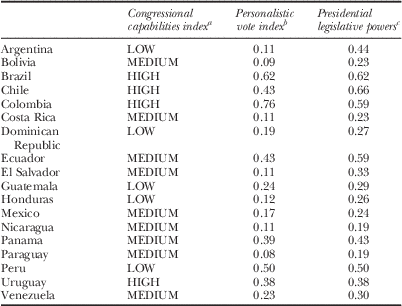
The ability of a Latin American legislature to serve as a counterweight will depend on three factors: the legislature’s technical capabilities, legislators’ career incentives and presidential legislative powers. Table 1 details where Latin American countries stand in terms of these variables.
Independent Variables Circa Mid-2000s

Notes: a Average of: (1) public confidence in congress; (2) business people’s assessments of legislative effectiveness; (3) average experience of legislators; (4) percentage of legislators with university education; (5) number of committee memberships per legislator, and qualitative assessments of (6) committee strength; (7) whether congress is a good place to build a career; and (8) technical expertise of legislators (IDB 2005: 267).
b Party leadership control over access to and rank on ballots, degree to which candidates are elected on individual votes independent of co-partisans, whether voters cast a single intraparty vote instead of multiple votes or a party-level vote, and average district magnitude (Carey and Shugart Reference Carey and Shugart1995; Hallerberg and Marier Reference Hallerberg and Marier2004: 577).
c Proactive (decree and budget power) and reactive powers (package veto, partial veto, exclusive initiation) (IDB 2005: 269; Shugart and Mainwaring Reference Shugart and Mainwaring1997; UNDP 2005: 92).
Legislature Capabilities
As Saiegh (Reference Saiegh2005: 21) notes, ‘the extent to which a legislature is able to influence the policy making process depends on its capacity to gather and process information independent of the executive’. The ability of legislators to effectively challenge the executive thus hinges on their level of preparation and expertise and their legislature’s capabilities and resources, particularly the strength of its committees. Gary Cox and Scott Morgenstern’s (Reference Cox and Morgenstern2001) blanket characterization of the region’s legislatures as ‘reactive’ obscures substantial cross-national variation in this regard. To measure this variation, the IDB (2005) compiled an index of legislative capabilities during the 2000s that consists of a simple average of individual assessments of a legislature’s performance from both regular citizens and business people, the average legislator’s experience, education and specialization, an assessment of relative committee strength, and legislators’ assessments of their own technical expertise and the extent to which congress is a good place to build a career.Footnote 3
This is not to say that legislatures with limited capabilities are completely powerless. With sufficient numbers, legislators should be able to obstruct a president’s policies, but lack of capabilities will prevent them from proposing alternative policies. Therefore, it can be expected that:
Hypothesis 1A: Legislatures with stronger capabilities will play a proactive policymaking role. They will be able to propose their own legislation challenging the executive’s policies.
Hypothesis 1B: Legislatures with weaker capabilities will play a reactive policymaking role. If they do challenge the executive, it will primarily be through obstruction.
Legislator Career Incentives
What motivates legislators to challenge the executive? Assuming legislators seek to extend their political careers, their desire to check the executive will, all else being equal, depend on their incentives for career advancement, which are, in turn, a function of the country’s electoral rules. Legislators should seek to please the people to whom they owe their current jobs and on whom their future jobs depend. There exists a crucial distinction between electoral rules that reward legislators for toeing the party line and those in which legislators have an incentive to cultivate a personal following (Carey and Shugart Reference Carey and Shugart1995; Hallerberg and Marier Reference Hallerberg and Marier2004). Pleasing the party is most important where parties control the order of candidates on the ballot, votes among candidates from the same party are pooled and voters choose between parties rather than candidates. Pleasing local constituents is most important in electoral systems with the opposite conditions.Footnote 4 Therefore, it can be expected that:
Hypothesis 2A: Legislators elected under personal-vote systems have an incentive to please their geographic constituents. If voters in the district have a strong stance on a policy, legislators will adopt that position, even if it means going against their party.
Hypothesis 2B: Legislators elected under party-vote systems have an incentive to please their parties. If a party has a strong stance on a policy, legislators will adopt that position, even if it means going against their constituents.
Presidential Powers
Executive–legislative relations constitute a strategic interaction. Whether a legislature will serve as an effective counterweight to the executive also depends on the president’s powers. Latin America’s presidents vary significantly in this regard, ranging from ‘potentially marginal’ with limited ability to counter an opposing legislature to ‘potentially dominant’ with substantial power to unilaterally alter the policy status quo (Shugart and Mainwaring Reference Shugart and Mainwaring1997). The IDB’s (2005) index of presidential power is an average of ‘proactive’ powers – which allow presidents to alter policy without consulting legislators – and ‘reactive’ powers, which allow them to block policy changes proposed by the legislature (see also UNDP 2005). Proactive powers include the power to enact decrees and control over the budget process. Reactive powers include veto power (both package and partial) and the exclusive right to legislate over specific policy areas. Thus:
Hypothesis 3: Strong presidents will, if they so choose, be able overcome a legislature’s efforts to act as a counterweight to the executive.
RESEARCH DESIGN
To analyse how congressional capabilities, legislators’ personal incentives and presidential powers interact to determine a legislature’s ability to act as a check on or even a counterweight to the executive, this article utilizes a most-similar systems design (Przeworski and Teune Reference Przeworksi and Teune1970). Specifically, it contrasts the legislative debates of comparable legislation – FTAs with the US – in three middle-income Latin American countries – Chile, Costa Rica and Peru – during the 2000s. The legislative debate of FTAs involves more than approving the agreement’s actual text. Countries must also reform various laws and ratify several treaties, the so-called implementing legislation.
This article makes the conscious methodological decision to conduct in-depth comparative case studies at a time when research on Latin American legislatures increasingly relies on roll-call votes (Alemán Reference Alemán2013). By reducing a bill’s trajectory to a binary yes/no, roll-call votes ignore what this article is most interested in – the dynamic give and take between legislators and executives. As the IDB (2005: 43) notes, ‘the task of appraising the legislature’s policymaking role in any given country is a very difficult task that requires detailed study of individual cases’. In comparing similar legislation across three countries, this article assesses the impact of cross-national institutional variation without sacrificing the richness and nuance of the legislative process.
Finding pieces of legislation that can be compared across several institutional settings constitutes a major challenge to conducting comparative case studies. FTAs with the US offer such an opportunity. Within the span of six years, the executive branches of 10 Latin American countries negotiated similar trade agreements with the US. The US–Chile FTA was explicitly used by US negotiators as a template for the negotiations that followed (Arbia Reference Arbia2013). The terms Latin America countries agreed to under the FTAs were quite similar: permanent, rules-based access to the US market in exchange for opening their domestic markets to US goods and enacting a wide range of legal reforms that went beyond their multilateral obligations (Shadlen Reference Shadlen2005). The controversial aspects of FTAs were also similar. Latin American governments agreed to gradually eliminate tariffs on agricultural staples, thus exposing domestic-oriented farmers to competition from subsidized US crops. Reforms to intellectual property rights (IPR), which were practically identical across FTAs (ITAC-15 2006), were highly controversial as well.Footnote 5
FTAs constitute a ‘hard case’ for assessing a Latin American legislature’s ability to serve as a counterweight to the executive in terms of both the complexity of their subject matter and the fact that legislators could not modify the actual agreements. Given that FTAs affect nearly every sector of a country’s economy, it was imperative for legislatures to act as counterweights to their executives. Yet their sheer length and the vast number of trade disciplines covered exacerbated the resource and expertise problems that plague even the strongest legislatures in the region. The inability to modify the negotiated text removed one of the most powerful tools in legislators’ arsenals. Thus, FTAs magnified the assumed reactiveness of Latin American legislatures (Cox and Morgenstern Reference Cox and Morgenstern2001). Regardless, legislators retained the ability to reject the agreements. And, as noted, entry into FTAs also required the approval of the implementing legislation. Legislators were allowed to modify said bills and could propose additional legislation to ameliorate the FTA’s perceived problems.
Case Selection
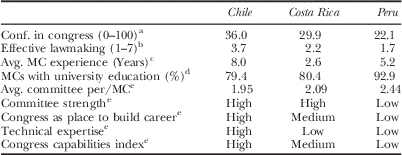
Following Gary King et al. (Reference King, Keohane and Verba1994), the cases vary with regard to the key explanatory variables (see Table 1). Legislatures in Chile, Costa Rica and Peru are catalogued as having high, medium and low capabilities, respectively (see Table 2). Surveys of citizens and business people found that Chile’s congress possessed higher public confidence and was deemed more effective than Costa Rica’s, which in turn was rated better than Peru’s. Profiles of the average legislator in each congress were less clear-cut. Peruvian lawmakers, 93 per cent of whom possessed college degrees, were more educated than both their counterparts, about 80 per cent of whom had degrees. But Chileans were significantly more experienced than Peruvians (8.0 versus 5.2 years), who in turn had twice the experience of Costa Ricans (2.6 years), who cannot run for immediate re-election. In addition to being more experienced, Chilean legislators can become more specialized in specific policy areas. They serve on 1.95 committees on average, compared with 2.44 among Peruvians. Costa Ricans serve on 2.09 committees (similar to Chile’s) but legislators have, on average, less than a third of the experience of Chileans. Legislators’ own perceptions provide further evidence that Chile’s legislature has strong capabilities. It was rated highly in terms of both technical expertise and as a place to build a career. This contrasts sharply with Peru’s, whose members gave it a low rating in both categories. Costa Rica’s legislators rated themselves as having low expertise but gave their congress a ‘medium’ rating as a place to build a career.
Legislative Capabilities for Chile, Costa Rica and Peru During Mid-2000s

Source: IDB (2005: 55).
Notes: a From Latinobarometer (1996–2004); b World Economic Forum; c PELA and Saiegh (Reference Saiegh2005); d PELA; e Saiegh (Reference Saiegh2005).
The cases also vary with regard to legislative career incentives. At one end of the spectrum, Costa Rica’s high-magnitude (M=8.1) closed-list proportional representation system provides limited incentives to seek personal votes. Chile and Peru’s open-list proportional representation systems provide incentives for personal votes above the regional average. Given Peru’s larger average district magnitude relative to Chile (5.1 versus 2), Peruvian legislators should, however, be expected to be more responsive to local constituents than their Chilean counterparts.Footnote 6
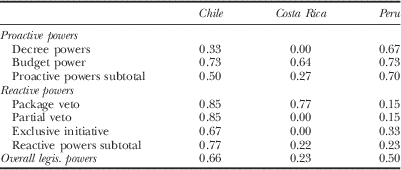
The cases also vary with regard to presidential powers (see Appendix, Table A1). Chile and Peru have two of the strongest presidencies in the region and Costa Rica had one of the weakest (Carey Reference Carey1996). Presidents of Peru and Chile, in contrast to their Costa Rican counterparts, possess substantial decree powers that enable them to circumvent the legislature (Carey and Shugart Reference Carey and Shugart1998), as well as urgency provisions that dictate the legislature’s agenda and impose voting deadlines. Peruvian presidents can even request that the legislature delegate to them the power to enact legislation via decree for a limited time (Schmidt Reference Schmidt1998). Chile and Peru’s presidents, however, differ in terms of ‘reactive’ powers or the ability to block the legislature. Most notably, Chile’s president can veto specific parts of legislation. Furthermore, Chile’s ‘exaggerated’ presidency retains exclusive power of legislature over several policy areas (Siavelis Reference Siavelis2000). Although their specific powers differ significantly, Costa Rica and Peru’s presidents possess similar levels of reactive powers.
CASE STUDIES
This section presents comparative case studies detailing how the three variables of interest shaped the congressional debates of FTAs with the US in Chile, Costa Rica and Peru.
Chile: Personal Vote/High Capability
In Chile, a highly capable legislature whose members had an incentive to cater to local constituents achieved a near balance between the two branches. The dominant political cleavage surrounding the FTA was geographic rather than partisan (Baeza Freer and López Varas Reference Baeza Freer and López Varas2015; Leight Reference Leight2008). Legislators representing southern agricultural regions that stood to be negatively affected by the FTA challenged the executive. These legislators, which included members of both the ruling and opposition coalitions, began advocating for their constituencies before negotiations concluded. Once the agreement reached the legislature, this same group worked proactively to enact compensatory policies. Thus, Chilean legislators went beyond acting as a check on the executive. By drafting legislation aimed at mitigating the FTA’s most controversial aspects they served as a counterweight.
Chile was the first Latin American country after Mexico to negotiate an FTA with the US. First proposed in 1994, negotiations began in earnest in November 2000 and concluded in December 2002. The agreement’s legislative discussion was brief, spanning three months towards the end of 2003. The FTA went into effect in January 2004. It should be noted that societal opposition to the FTA was more limited in Chile than in Peru, let alone Costa Rica. This national consensus on trade did not, however, prevent a vigorous debate on the FTA’s potential consequences.
As in the other countries studied, the opening of agricultural staples to competition from subsidized US producers was the main point of contention.Footnote 7 Import protection for staple crops, namely wheat and sugar beet, had survived successive rounds of liberalization. The centre-left Concertación coalition, in power since 1990, feared liberalization would hurt small producers and jeopardize efforts to win over historically conservative southern landowners (Leight Reference Leight2008: 231). Thus, prior to the negotiations, President Ricardo Lagos (2000–6) promised to defend these sectors (UPI 2002). Despite originally hoping to exclude them, Lagos ultimately accepted their gradual liberalization and the phase out of a price band mechanism that shielded farmers from price fluctuations.
Congress began acting as a check on the executive at the outset of the negotiations. The right-wing opposition coalition, Alianza por Chile, adopted a strong stance in defence of farmers. Following the first round of negotiations in December 2000, Senate President Hernán Larraín of Unión Demócrata Independiente (Independent Democratic Union) became the first legislator to express concern (El Mercurio 2001). This stance, which seemed out of place coming from someone with otherwise pristine free-market credentials, was explained by Larraín’s electoral incentives as a representative for the Maule region, home to a significant share of import-competing farmers (Leight Reference Leight2008: 234). Larraín became the unofficial leader of a geographically concentrated farm caucus.
The executive also faced pressure from within its own coalition. In April 2002, senators from Partido Demócrata Cristiano (Christian Democratic Party) conditioned their support for the FTA on policies protecting farmers (El Mercurio 2002a). Later that year, coalition member Partido por la Democracia (Party for Democracy) and former president and senator Eduardo Frei (1994–2000) expressed concerns (El Mercurio 2002b). Thus, Chilean legislators became informed and developed defined policy stances on the FTA’s most contentious issue two years before being required to vote on it.
The US Congress approved the FTA in July 2003, much sooner than anticipated, leaving Chilean legislators rushing to debate and vote the agreement in time for it to take effect in 2004. The agreement, submitted to Congress on 23 August, received overwhelming support from committees in both chambers. On 7 October, two months after being delivered to Congress, the FTA passed in the lower house with 87 votes in favour, eight against and eight abstentions.Footnote 8 Senators approved it two weeks later with an equally decisive 34 in favour, five against and five abstentions. Opponents and abstainers were primarily from import-competing regions – evidence of electoral incentives at work (Baeza Freer and López Varas Reference Baeza Freer and López Varas2015; Leight Reference Leight2008).
The legislature’s role diminished during the final steps of the approval process. Rushing to get the FTA approved, Lagos used his significant presidential powers (Shugart and Mainwaring Reference Shugart and Mainwaring1997; Siavelis Reference Siavelis2000) to limit to just three days the debate of the final implementation policies (El Mercurio 2003). Thus, even a motivated and capable legislature may find itself sidelined by a powerful executive.
Still, the legislature continued to push the executive on agriculture. Shortly after ratification, the government submitted a bill outlining the complete phase-out of the price band mechanism after 12 years. Legislators ultimately approved a version that called for their ‘re-evaluation’ after 12 years. Soon after, 90 legislators spearheaded by Larraín submitted to the executive a comprehensive proposal for agricultural adjustment and reconversion (Leight Reference Leight2008: 240). In 2008, legislators rejected a government bill that would have scrapped the price bands (Economía y Negocios 2008). The policy remains in place, in clear violation of the FTA (WTO 2015: 49).
In summary, Chilean legislators, including those from the ruling coalition, acted not only as a check on the executive’s actions but also as a counterweight. They generated their own proposals for addressing the FTA’s most controversial effects. In doing so, they challenged their own parties and defended the interests of those who voted them into office. This case also shows that congressional oversight can take place during every step of the FTA process. Lawmakers began worrying about protecting agriculture at the outset of negotiations and followed through after the FTA went into effect. The actual debate, however, was rushed and presidential powers were used to minimize the time spent debating the implementing legislation.
Costa Rica: Party Vote/Medium Capability
In Costa Rica, a legislature with medium capabilities composed of legislators whose careers depended on maintaining their party’s good graces obstructed the executive but ultimately did little to shape the policy agenda surrounding the FTA. As predicted, and in sharp contrast with Chile, the dominant cleavage surrounding the FTA was partisan. Opposition came primarily from the centre-left Partido Acción Ciudadana (PAC – Citizens’ Action Party), which proved adept at using obstruction to extend the legislative debate for several years. Unlike Peru and, to a lesser extent, Chile, where strong presidents used their considerable powers to speed up the legislative debate, Costa Rica’s weak presidents were forced to wait for opponents to exhaust all possible avenues for obstruction. However, despite having ample time to analyse the FTA, Costa Rican opponents did not influence the implementation legislation or generate their own policies compensating the FTA’s losers. In line with this article’s expectations, Costa Rica’s legislature was able to obstruct but did not propose. It acted as a check but was not a counterweight.
The Dominican Republic–Central America FTA (CAFTA-DR) polarized Costa Rican politics, sparking a stronger opposition movement than in the other countries studied. The most divisive aspect was the requirement that the country open its public-sector telecommunications monopoly to private competition. Earlier attempts at breaking the monopoly sparked widespread protests that forced the government to retreat. As in Chile and Peru, opponents also criticized the liberalization of agricultural staples and the strengthening of IPR.
CAFTA-DR was signed in May 2004. However, despite being supported by a two-thirds supermajority in two consecutive legislatures, the debate of the agreement and accompanying legislation continued until November 2008 (Borges Reference Borges2014). The length of the process is explained by the combination of an institutionally weak presidency (Carey Reference Carey1996; Shugart and Mainwaring Reference Shugart and Mainwaring1997) and legislative rules highly permissive of filibustering (Arias Ramírez Reference Arias Ramírez2008; Borges Reference Borges2014). Despite having the votes, filibustering rendered the debate inconclusive. As a result, the agreement’s fate was decided via a nationwide referendum in late 2007. Even then, it took more than a year for pro-FTA legislators to overcome opposition filibustering of the 13 implementing laws and treaties.
Party politics surrounding the agreement were highly disciplined. Whereas PAC opposed the agreement, the country’s two traditional centrist parties Partido Liberación Nacional (PLN – National Liberation Party) and Partido Unidad Social Cristiana (PUSC – Social Christian Union Party) and the upstart right-wing Movimiento Libertario (Libertarian Movement) supported the FTA. Unlike Chile, where the FTA divided parties along geographic lines, the main Costa Rican parties voted as blocs.
Seeking to force legislators to approve a proposed overhaul of the country’s tax system, President Abel Pacheco (2002–6) of PUSC delayed submitting CAFTA-DR to Congress for 13 months after its signing (Borges Reference Borges2014). Under pressure from supporters (La Nación 2005), Pacheco sent the FTA to the Congress’s foreign affairs committee in October 2005. By then, however, election season was underway, causing debate to grind to a halt.
The February 2006 elections should have marked a victory for CAFTA-DR. PLN’s Oscar Arias (2006–10), a strong proponent, won the presidency and exactly two-thirds of incoming legislators came from pro-FTA parties. However, this supermajority proved insufficient to overcome obstruction. CAFTA-DR finally made it to the floor in December 2006. Opponents filibustered in an attempt to force Costa Rica to miss the deadline for joining the agreement. Seeking a workaround, pro-FTA legislators enacted a fast-track rule to force a vote. But by the time the reform was finalized, the country’s electoral authority had approved a petition from opponents to decide the agreement’s fate via referendum. Debate once more ground to a halt. Originally opposed to the referendum (Weitzenkorn Reference Weitzenkorn2007), Arias came to see it as the only way forward. In October 2007, voters narrowly approved CAFTA-DR.
It would, however, take another 15 months for Costa Rica to meet all of CAFTA-DR’s requirements. Despite promising to refrain from obstruction, PAC filibustered. As an example, opponents issued more than 5,000 amendments, spanning 52,000 pages, to the first three implementation bills (La Nación 2008). Rather than propose a handful of major reforms to the executive’s bills, PAC legislators issued thousands of individual amendments, many of which were merely cosmetic, seeking to change the phrasing of particular sentences or replace specific words (Al Día 2007). This strategy is explained by the assembly’s rules, which allot minimum amounts of time for debating each amendment, regardless of its substance (Borges Reference Borges2014). Some amendments were even proposed to the same committee multiple times (Al Día 2007). Opponents also repeatedly broke quorum to delay debate of the very amendments they proposed (La Nación 2008). Ottón Solís (Reference Solís2016), PAC’s founder, has admitted that obstruction was the party’s objective: ‘PAC deputies had no qualms about presenting “wheelbarrows full of amendments” to impede the FTA’s implementation agenda bills from coming to vote.’
Pro-FTA legislators relied on the new fast-track to push the reforms through. Despite obstruction, the country was admitted into CAFTA-DR in November 2008. The debate consumed countless man-hours. However, when compared to the Chilean example, this process yielded few tangible benefits for negatively affected sectors. Opponents delayed votes rather than proposing compensatory and competitiveness-enhancing policies. Proponents equally failed to enact such policies. Their focus was on changing the rules of the game to circumvent the opposition and approve bills as quickly as possible. Meanwhile, Costa Rica’s weak presidents could do little more than wait the process out.
The years spent filibustering and enacting fast-track procedures could have been better spent proposing policies that addressed the issues that had motivated opposition to CAFTA-DR in the first place. It is unclear if such policies would have been approved had PAC proposed them. What is clear, though, is that the party’s main goal was to obstruct. Its legislators used all the tools at their disposal in an attempt to run out of time to join CAFTA-DR. Thus, legislators acted as a check on the executive but not as a true counterweight.
Peru: Personal Vote/Low Capability
Although Peru’s legislature had the lowest capabilities among those studied, its legislators seemingly had an incentive to appeal to local constituents. In line with predictions regarding capabilities, legislators largely failed to challenge the executive on the FTA or its implementing legislation. Pro-FTA legislators summarily approved the agreement and its subsequent amendments without much debate. Congress later delegated to the president the power to enact the implementing legislation via decree. When opponents did attempt to engage in oversight, they were easily sidelined by an institutionally powerful president. However, counter to this article’s predictions, the political cleavage surrounding the agreement was partisan, rather than geographic. This surprising finding can be attributed to the fact that few Peruvians take advantage of the opportunity to cast their vote for specific candidates rather than party lists (Schmidt Reference Schmidt2008: 166). Overall, Peru’s low-capability legislature failed to serve as a check, let alone a counterweight, to the executive.
The debate surrounding the FTA took place over two presidential administrations between mid-2006 and early 2009. Although neither Alejandro Toledo (2001–6) nor his successor Alan García (2006–11) controlled legislative majorities, the legislatures they inherited possessed multi-party pro-FTA majorities. As in Chile, the liberalization of agricultural staples was the main point of contention. Opponents also worried that the agreement’s IPR provisions would restrict access to medicines and facilitate the patenting of indigenous knowledge. Opposition was spearheaded by 2006 presidential candidate and later president Ollanta Humala (2011–16) and his nationalist Unión por Perú (Union for Peru).
Toledo worked to secure the FTA’s passage before leaving office, and García fully embraced it once elected. Toledo and US President George W. Bush signed the FTA in April 2006, one week after the first round of Peru’s presidential elections. Fearing that approval of the FTA could be obstructed by an incoming legislature in which Humala supporters made up the largest bloc, Toledo submitted the agreement to the lame-duck Congress despite polls showing that two-thirds of Peruvians wanted incoming legislators to handle the matter (El Comercio 2006).
The agreement sailed through committee and was recommended for ratification. The vote proved controversial. Opponents were granted limited opportunities to express their position. They unsuccessfully attempted to postpone the vote by demanding a review of the FTA’s constitutionality. Two hours into the debate, Unión por Perú legislators-elect stormed the floor to protest the vote, but were summarily expelled (Associated Press 2006). After a 15-hour debate, legislators approved the FTA with 79 votes in favour, 14 against and six abstentions. Parties supporting the agreement – Toledo’s Perú Posible (Possible Peru), its ally Frente Independiente Moralizador (Independent Moralizing Front), García’s Partido Aprista Peruano (Peruvian Aprista Party) and the right-wing Unión Nacional (National Union) – voted cohesively.
The election of a Democratic legislative majority in the US Congress following the 2006 mid-term elections stalled the FTA. Democrats conditioned their support on changes to the chapters on labour rights, environmental protection and IPR. Although the changes were drafted without Peru’s input (García Reference García2008: 14), García accepted them immediately after they were announced in May 2007. Congress subsequently approved them with 70 votes in favour, 38 against and one abstention two days later. Once more, debate was minimal.
The FTA’s approval by the US Congress in late 2007 put pressure on García to enact the implementation legislation. In mid-December, García requested and two days later was granted congressional authority to legislate via decree for six months in order to enact the implementation legislation. Decree authority was approved with a less-than-convincing 54 votes in favour, 38 against and 28 abstentions. Once more, the vote was split along party lines with the bulk of votes in favour coming from García’s Apristas and Alianza por el Futuro (Alliance for the Future), a vehicle for supporters of former President Alberto Fujimori (1990–2000).
Though delegated decree authority is not inherently objectionable (Carey and Shugart Reference Carey and Shugart1998; Schmidt Reference Schmidt1998), in this case there was minimal congressional oversight (Eguiguren Praeli Reference Eguiguren Praeli2008). García told legislators that 40 decrees would be necessary (El Comercio 2007), but ultimately enacted 102 decrees, about 20 of which were unrelated to the FTA (García Reference García2011). The most controversial unrelated decree, which simplified rules on the sale of communal indigenous lands, sparked protests in the Amazonian province of Bagua that claimed 33 lives (Arce Reference Arce2014: Ch. 6). The congressional committee created to oversee the decrees consisted of only three legislators and six aides (El Comercio 2008). It is unsurprising that a committee with such limited resources exerted weak oversight.
The legislature assigned insufficient resources to the committee. Regardless, the executive showed little willingness to be overseen by legislators. While not required to do so by law, the executive did commit to providing the committee with the decrees prior to their enactment (Eguiguren Praeli Reference Eguiguren Praeli2008: 95). However, according to the committee’s final report, legislators learned about half of the decrees after their publication and received summaries (not the full text) of the remaining decrees (Eguiguren Praeli Reference Eguiguren Praeli2008: 18). Thus, if the executive had honoured its end of the deal, the understaffed committee could have conducted more effective oversight.
The debate of the FTA and its accompanying legislation is emblematic of deeper problems in the Peruvian policymaking process, in which presidents dominate and the other branches fail to balance against it, let alone proactively shape the agenda (García 2011). Had it not been for violent protests, decrees on indigenous communal lands unrelated to the FTA might have gone unchallenged. Delegated decree authority rests on the principle that the legislature will oversee the executive. If the legislature lacks the capabilities and resources to do this, the executive governs with minimal checks and balances.
Assessing the Cases
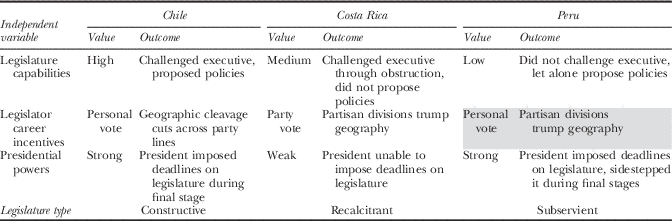
Table 3 summarizes the case study findings. Legislatures were constructive in Chile, obstructive in Costa Rica and subservient in Peru. Overall, the cases support most of this article’s hypotheses. There is strong evidence for Hypotheses 1A and 1B. Chile’s highly capable legislature played a proactive role, getting involved before the FTA was completed and even enacting its own compensatory policies. In contrast, while Costa Rica’s medium-capability legislature challenged the executive, it did so primarily through obstruction. Peru’s low-capability legislature acted as little more than a rubber stamp.
Case Study Findings

Source: Case studies.
Note: Grey signifies that observed outcome differs from the hypothesized one.
The evidence regarding Hypotheses 2A and 2B is less conclusive. As predicted, Costa Rica’s party-vote-seeking electoral system produced a legislative debate dominated by partisan cleavages. Legislators took their cues from party leadership, and parties voted as cohesive blocs. This contrasts with Chile, where an electoral system that rewards constituency service structured the debate along geographic lines and across party lines. Against predictions, the debate in Peru, whose electoral system prioritizes personal votes to a higher degree than Chile’s, was structured along partisan lines. Despite their much-discussed weakness, Peruvian parties voted cohesively.
In line with Hypothesis 3, variation in presidential power shaped the legislative process. Peru’s strong presidents utilized urgency provisions and delegated decree authority to dominate the process. This contrasts with Costa Rica, where institutionally weak presidents faced with obstruction proved powerless. Chile’s legislature, despite having acted as a counterweight during most of the process, had its autonomy curtailed by an extremely powerful president at the end of the process.
ALTERNATIVE EXPLANATIONS
Do other explanations do a better job of accounting for the observed variation in legislative behaviour? The most intuitive explanation attributes legislative responses to the level of opposition to the agreements within society and/or the legislature. Thus, Peru’s agreement, which sailed through the legislature multiple times, should have been the least controversial and Costa Rica’s, which became mired in legislative gridlock, should have been the most controversial.
Societal Polarization
Public support for the FTA in Chile was widespread, hovering between 75 and 80 per cent (Gobierno de Chile 2003: 16). At about 60 per cent, support was lower but still substantial in Peru (IOP-PUCP 2006; La República 2005). Peru also saw significant anti-FTA protests and roadblocks by farmers, something that did not take place in Chile. Despite this, the Chilean legislature exerted significantly more scrutiny of its FTA than its Peruvian counterpart.
Public opinion surrounding the FTA was significantly more polarized in Costa Rica, as exemplified by its narrow approval via referendum. However, public sentiment is malleable. The long legislative debate shaped public opinion – the more people learned about CAFTA-DR, the less they liked it. As a case in point, when negotiations concluded in February 2004, support was similar to that in Peru – 64 per cent (La Nación 2004). Perhaps if the FTA had sailed through the legislature, public opinion would not have become as polarized. Regardless, legislative supporters of CAFTA-DR had the required votes but were constrained by an obstructionist opposition.
Legislative Support
In all three countries there existed multi-party legislative majorities in support of the FTAs. In Chile, where more than three-quarters of legislators in both chambers voted in favour, debating took longer and was more thorough than in Peru, whose FTA was more controversial. Legislative support in the latter decreased significantly between the 2001–6 and 2006–11 legislatures. The former ratified the agreement with 80 per cent of votes. The latter ratified the amendments with 58 per cent of votes. Delegated decree authority slipped by with just 45 per cent (taking into account abstentions). In Costa Rica, exactly two-thirds of legislators supported CAFTA-DR during two legislatures. If the type of legislative debate was determined by legislative support, Costa Rica would have enacted the FTA quickly.
There exists a vast political economy literature that seeks to explain protectionism and legislative support for liberalization. Voting against the agreements and demanding protectionism are ways in which a legislature could challenge an executive-endorsed trade bill.
Ideology
There is disagreement on how legislator ideology affects support for liberalization. Traditionally, the left has favoured greater state involvement in the economy and, as such, would be expected to oppose FTAs. Counter-intuitively, more recent research finds that left-wing governments are more likely to join trade agreements (Mansfield and Milner Reference Mansfield and Milner2012) and implement pro-foreign investment policies (Pinto Reference Pinto2013). In line with the former, opposition to the FTA in Costa Rica and Peru was spearheaded by left-wing parties. In line with the latter, the left negotiated Chile’s FTA.Footnote 9
Institutions
A large body of work looks at how institutions affect support for trade bills. Daniel Yuichi Kono (Reference Kono2009) finds that countries with particularist electoral institutions – ones that encourage politicians to cater to small constituencies – are linked to higher levels of protection. In line with these predictions, Chile, a country with a fairly personalistic electoral system and small electoral districts, witnessed a protectionist backlash against the FTA. However, Costa Rica, which has a party-centred system and large districts, experienced much more significant opposition. Approval in Peru, which has large districts and a system that, in theory, promotes individual votes, faced few obstacles.
CONCLUSIONS
El Baguazo, the 2009 protests in the Peruvian Amazon that cost the lives of 33 indigenous protestors and police officers, offers an extreme example of what can happen when a legislature is unable or unwilling to challenge an executive. Seeking to approve a raft of legislation pertaining to the country’s FTA as quickly as possible, President García requested and was narrowly awarded by Congress delegated decree authority. The legislative committee created to oversee the executive’s decrees was woefully underequipped to fulfil this task. Largely free of oversight, García seized this opportunity to unilaterally enact a wide range of reforms, a fifth of which were unrelated to the FTA (García Reference García2011). Among these was the reform to communal land laws that sparked the deadly protests. In the absence of effective oversight of the executive, the likelihood that political conflicts will spill out onto the streets increases (Saiegh Reference Saiegh2011: Ch. 9).
Legislatures serve three functions: representation, lawmaking and oversight. Peru’s low-capability legislature performed poorly on all three. Representing the diverse interests in society is particularly important in Latin America’s multi-party democracies, where elected presidents often fail to win the majority of votes. García, in fact, even failed to win a plurality during the first round of the 2006 elections. Peruvian presidents used their significant legislative powers to curtail debate, thereby muting opponents’ concerns. Legislators later willingly ceded the power to legislate and failed to oversee what the executive did with that power (Eguiguren Praeli Reference Eguiguren Praeli2008).
Costa Rica’s medium-capability legislature fell on the other side of the spectrum. There, a recalcitrant minority did everything in its power to challenge the executive, but failed to propose its own alternative legislation or policies compensating the FTA’s presumed losers. The country’s presidents, among the weakest in the region, were forced to wait the process out for years. In the meantime, Costa Rican politics were paralysed. Although Costa Rica’s legislature oversaw the executive and opponents of the FTA were duly represented, this outcome was far from optimal. Both rubber-stamp and obstructionist legislatures threaten to destabilize Latin American democracies (Saiegh Reference Saiegh2011: Ch. 9).
Chile’s high-capability legislature came the closest to serving as a counterweight to the executive. Legislators became informed early in the process and consistently challenged the executive. Remarkably, these challenges came not only from the opposition but also from within the ruling coalition. That the FTA’s central cleavage was geographic rather than partisan (Baeza Freer and López Varas Reference Baeza Freer and López Varas2015; Leight Reference Leight2008) is evidence of an electoral system that rewards responsiveness to constituents. These incentives, when combined with the legislature’s capabilities, made it possible for lawmakers to not only thoroughly oversee the executive’s actions but also actively propose and enact their own policies aimed at addressing the FTA’s controversial aspects. However, the country’s powerful executive curtailed debate towards the end of the process. Thus, Chile’s otherwise exemplary legislature still faces the risk of being sidelined by an ‘exaggerated’ presidency (Siavelis Reference Siavelis2000).
By contrasting the legislative debates of FTAs with the US in three countries, this article has sought to demonstrate that three factors – a legislature’s capabilities, the rules used to elect legislators, and a president’s legislative powers – explain the ability of legislatures to challenge executives effectively. More broadly, from a methodological standpoint, it has made a case for conducting in-depth comparative case studies of legislatures at a time when scholars are increasingly focused on roll-call votes. While there is great value in this type of research, it is no substitute for the careful reconstruction of the legislative process (IDB 2005: 43). Roll-calls only cover bills that were put to vote and tell us nothing about what presidents and parties conceded to make those votes happen. Thus, this article has sought to heed Barry Ames et al.’s (Reference Ames, Carreras and Schwartz2012: 486) request for more ‘deep, qualitative, and inductively empirical’ research on Latin America’s legislatures. My hope is that this article will prompt others to consider the value in this approach.
APPENDIX
Presidential Powers for Chile, Costa Rica and Peru During Mid-2000s