Written paper has historically been the means used for all judicial actions in the Chilean system, which has no equivalent anywhere else in the modern world. If a case file goes missing then the whole procedure disappears. (Matus Reference Matus1999, 15–16)
Introduction
Chile's Criminal Procedure Reform (CPR), implemented between 2000 and 2005, was intended to professionalize judges and court officials and to bring Chile into compliance with international norms about the principle of a fair trial. Its supporters sought to end human rights abuses within an opaque and cumbersome criminal procedure, to reduce the discretionary power of court employees, and thereby to reduce coima (bribes). Indeed, prior to this reform, lower courts relied on what I call phantom officials who worked for free in the hope of one day being appointed to a permanent position. Despite having no legal training, they carried out much of the inquiry in the judge's stead. The CPR led to major changes in the way justice was delivered in parts of the Chilean justice system, but not all. Consequently, two seemingly incompatible criminal justice systems have in fact coexisted in Chile over the past fifteen years. On the one hand, there is an inquisitorial system based on the principle of guilt and the secrecy of proceedings. On the other, there is an adversarial system based on the presumption of innocence and safeguarding defendant rights, under which certain time limits apply to case investigations.
This article stresses the changes in the way criminal justice is administered: it analyzes the transition from one judicial system to another, emphasizing the important role the bureaucracy plays in judicial procedure and examining the social interactions arising from the application of the law. It also emphasizes that the outcome of a reform and the way it is concretely implemented greatly relies on frontline workers and the institution's micropolitics. This article thus contributes to “bridge the gap between public administration and socio-legal research” (Biland and Steimetz forthcoming).
The restructuring of the Chilean judicial bureaucracy has to be analyzed in the broader context of the so-called democratic transitionsFootnote 1 in 1990s Latin America, which was followed by the introduction of new criminal procedure codes in fourteen countries. These reforms were promoted by international development agencies and banks that “were looking for ways to strengthen Latin American legal systems to foster economic development and democracy” (Langer Reference Langer2007, 619). An activist expert network of Latin American legal entrepreneurs “persuaded them that the adoption of new codes would contribute to these goals” (Langer Reference Langer2007, 619). “Although the reforms have not been exactly the same among the different jurisdictions, [they] are, arguably, the deepest transformation that Latin American criminal procedure has undergone in nearly two centuries” (Langer Reference Langer2007, 618).
Yet, this restructuring of state administrations and judiciaries has been seldom studied (Geddes Reference Geddes1994; Rico Reference Rico1997; Baker Reference Baker2002; Bezès Reference Bezès2007). The street-level bureaucracy (SLB) theoretical frame provides a bottom-up approach to public policy. In the particular case of Chile, the SLB frame focuses attention on judges' administrative discretion: court administration as a traditional judge's preserve is a key issue in Chilean judicial micropolitics. Both the inquisitorial and the adversarial criminal justice systems in Chile are SLBs. They are agencies whose officials “interact with citizens directly and have discretion over significant aspects of citizens' lives” (Lipsky Reference Lipsky2010, 3, 4). In this article I distinguish judicial discretion—when actors “depart from a case-treatment perceived as impersonal” (Biland and Steimetz forthcoming)—from administrative discretion—when actors depart from legality or the established rules regarding the organization of work in the court. In the criminal lower courts, the CPR strengthened judicial independence and discretionFootnote 2 while limiting administrative discretion. In those Chilean courts that retain the inquisitorial system, judges combine both judicial and administrative authority.
The redistribution of administrative authority and discretion is at stake when one observes how macro-political dynamics translate at the micro-political level of interactions between actors in the lower courts. This article looks at what happens when lower criminal courts shift from a traditional to a legal-rational form of organization, according to the Weberian ideal-types of legitimate domination (Weber 1978). No doubt, “the reality of the work of street-level bureaucrat could hardly be farther from the bureaucratic ideal of impersonal detachment in decision making” (Lipsky Reference Lipsky2010, 9). Analyzing changing SLB roles in the Chilean administration of criminal justice helps measure to what extent the CPR succeeded in limiting discretionary practices in the judiciary.
This article shows how, in both systems, laypeople play an important role in the making of justice. The first part of the article looks at the judge/clerk setup under the inquisitorial system before and after the CPR, the common feature being that judges hardly interact with clients and delegate judicial prerogative to officials. The second part contextualizes the CPR by looking at the democratic transition process and at the emergence of a policy to modernize and professionalize judicial administration. I treat legal-rational authority both as a Weberian ideal-type—an unadulterated form not encountered in social reality—and, in its management version, as a model. The third part analyzes how the administrative reorganization of criminal lower courts altered both interrelationships and relationships of authority.
Case and Methods
These two parallel criminal justice systems currently in force are little known to the public and largely ignored by the social sciences. Recent work on the Chilean judiciary has tended to focus on two issues: corruption (Basabe-Serrano Reference Basabe‐Serrano2013) and the role the judiciary played under the dictatorship (Hilbink Reference Hilbink2007; Barros Reference Barros, Ginsburg and Moustafa2008; Pereira Reference Pereira, Ginsburg and Moustafa2008). This literature has tended to adopt a top-down approach, according pride of place to judges (mainly those in the courts of appeal and the supreme court)Footnote 3 and to rulings (Hilbink Reference Hilbink2007; Barros Reference Barros, Ginsburg and Moustafa2008; Pereira Reference Pereira, Ginsburg and Moustafa2008; Huneeus Reference Huneeus2010; Hilbink and Couso Reference Hilbink, Couso, Helmke and Ríos‐Figueroa2011). The way the lower courts actually function on a daily basis would appear a matter of secondary interest. With the exception of Hilbink and Couso (Reference Hilbink, Couso, Helmke and Ríos‐Figueroa2011), these works do not even refer to the CPR. This article focuses on lower courts targeted by the CPR, which introduced Juzgados de Garantía and Tribunales de Juicio Oral en lo Penal.
The Criminal Procedure Reform and the Changes in Criminal Courts
The reforms to criminal procedure in Chile and Latin America aimed at delivering more due process, efficiency, and transparency to the criminal justice system. They shared many characteristics: the introduction of oral and public trials, the decision to put the prosecutor instead of the judge in charge of pretrial investigation, the introduction of the principle of prosecutorial discretion, the fact that defendants are granted more rights at the police and pretrial phases, and the expansion of the victim's role and protection during the criminal process (Langer Reference Langer2007, 618–19). While the reform did not affect the penal code (dating from 1874), the criminal justice process was profoundly altered with the shift to an oral system and the creation of the Office of Public Prosecutor. Chile went from “the most inquisitorial model in Latin America to an adversarial system based more on argument and counterargument than any other in the entire region” (Alvear and Blanco Reference Alvear and Blanco2010, 27).
The CPR process was first rolled out in 2000 in the Araucania region (in southern Chile, with Temuco as its regional capital), finishing in 2005 in the Metropolitan region (in the center of Chile, capital Santiago). In the Valparaíso region, where the second part of this fieldwork was carried out, the reform began in 2003. All criminal affairs prior to the reform were automatically tried under the inquisitorial system; some cases are still ongoing. There are two inquisitorial criminal courts (Juzgado del Crimen) left in the Metropolitan region. Elsewhere, ongoing cases are heard by civil tribunals that still operate under the written and inquisitorial system. Similar reforms were applied to labor and family jurisdictions, and are currently being extended to the civil jurisdiction.
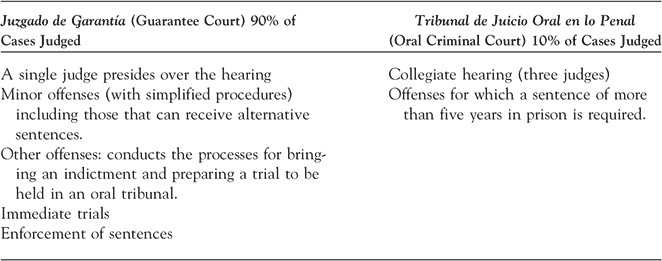
Before CPR, Juzgados del Crimen operated in the main urban centers such as Santiago, Valparaíso, Viña del Mar, and Concepción. Elsewhere, criminal cases were judged by Juzgados de Letras, whose judges had jurisdiction in cases relating to civil, criminal, and labor law (family law courts were set up shortly before the CPR). CPR created ninety-one new courts: Juzgados de Garantía and Tribunales de Juicio Oral en lo Penal (Table 1). In small municipalities, former mixed courts have been renamed Juzgados de Letras y Garantía, and have jurisdiction in criminal cases, though only for matters pertaining to the Juzgados de Garantía. All other cases have to be judged by the Tribunales de Juicio Oral en lo Penal in the nearest geographical division.
The New Criminal Justice Courts

| Juzgado de Garantía (Guarantee Court) 90% of Cases Judged | Tribunal de Juicio Oral en lo Penal (Oral Criminal Court) 10% of Cases Judged |
|---|---|
| A single judge presides over the hearing | Collegiate hearing (three judges) |
| Minor offenses (with simplified procedures) including those that can receive alternative sentences. | Offenses for which a sentence of more than five years in prison is required. |
| Other offenses: conducts the processes for bringing an indictment and preparing a trial to be held in an oral tribunal. | |
| Immediate trials | |
| Enforcement of sentences |
Many of the officials interviewed for this research had previously worked in courts operating under the inquisitorial system. I refer to them as actuarios (court clerks),Footnote 4 though according to court regulations (Código Orgánico de Tribunales), the only administrative category is that of officials (funcionarios), also commonly called judicial employees (empleados judiciales). Yet within the inquisitorial system, the term actuario/a was widely used to refer to “the role that any employee may hold independently of his or her official post or grade within the hierarchy” (interview with the head of the Asociación Nacional de Empleados Judiciales [ANEJUD], carried out on August 26, 2015).Footnote 5 “The actuarios do the routine court work, such as … interviewing witnesses, receiving lawyers' briefs, filing pieces of written evidence, and the like. … The function of the judge in judicial proceedings is therefore limited to ongoing supervision over the handling of cases by actuarios (and even this function may be partly delegated to the secretary of the court) and to deciding the case” (Ietswaart Reference Ietswaart1981−1982, 656). This system of delegating functions meant that actuarios had extensive discretionary powers. Officials' discretion is greater as there are no litigants, and sometimes no judges, witnessing their interactions with justice users. Despite being contrary to the ethics and legal framework incumbent upon judges, delegating functions in this manner was a well-established though dissimulated practice. The head of the ANEJUD was reprimanded for having alluded to it in public well before the reform process was launched (interview conducted on August 26, 2015).
The interviews and observations detailed here were first conducted between April and June 2012 in an inquisitorial court in the Metropolitan region. With the verbal agreement of the judge, obtained via an intermediary, I was able to observe activity in the court's plenario (resolution) room one day per week and to review the archives of cases that had already been judged. I was allocated a table and chair next to the judges' bench, slightly behind the other workplaces in the room. I was able to study the archives without attracting anyone's attention, and I had a privileged observation post of what was going on in the room. Some of the employees were intimidated by the interview process and saw my research as a means of assessing their work. I won their trust by naive questions about how they organized their cases and the tricks they used to identify and organize the enormous volumes of paper. I also took part in social moments at court.
The second phase ran from December 2012 to September 2015,Footnote 6 and comprised observations in two reformed courts in the Valparaíso region (in a Guarantee Court and an Oral Court), and interviews with judicial actors or people involved in the CPR in Santiago. I had then received funding that required the written authorization of the institutions where fieldwork would be conducted. The Valparaíso Court of Appeal initially rejected my request to observe the administrative work of the courts, instead only authorizing me to enter areas normally reserved for personnel (with the agreement of the court administrator), and to introduce myself to the staff and ask if they would let me interview them.
Over the course of these two phases of fieldwork, I carried out between one and five in-depth interviews (lasting between one hour and three hours) with twenty-nine people (fifteen men, fourteen women), for a total of forty-three interviews. Interview subjects include six judges,Footnote 7 fifteen officialsFootnote 8 of various status and with varying career paths, two administrators,Footnote 9 four heads of unit,Footnote 10 the head of the unit that had drawn up the plan for court administrative reform, and two lawyers.Footnote 11 Little place has been accorded to lawyers in this article as I have decided to focus on the role subaltern actors—clerks—play in the making of law within both systems.
The overrepresentation of female employees and male unit heads within the sample reflects the gender distribution of these ranks within the courts I visited. Nationally, 58 percent of those working for the judiciary are women (Poder Judicial 2014, 11). The administrative hierarchy of the judiciary is comprised of the grade of employee (54 percent, or 5,373 people), a secondary grade including unit heads and administrators (10 percent, or 1,046 people),Footnote 12 and a primary grade comprised of judges (19 percent, 1,851 people) (Poder Judicial 2014, 4).
In addition to the difficulty encountered in gaining access to the institution, there is very little information about how the criminal justice system actually functions.Footnote 13 Officials working in the inquisitorial criminal justice system have often been a disparaged category due to their low educational capital, their ignorance of the law, and the practice of coima. It was thus necessary to adapt my methodology to the specific situation I encountered in the field and to my objective. I did not seek to build up a statistically representative sample, but instead to obtain detailed biographical accounts, thereby enabling me to build up a picture of how individuals first joined the judicial institution and their subsequent career paths, as well as a description of working methods (which, other than in 2012, I was unable to observe directly). So in order to analyze these practices, it was first necessary to build up a relationship of trust in order to be able to carry out several interviews with the same people.
Patterns of Bureaucracy Under the Inquisitorial Justice System: Traditional Domination and Street-Level Bureaucracy
A feature of the Chilean legal system that proved to be a key institutional weakness was that judges have total control over criminal cases. The criminal court decides if it will investigate a case (sumario), decides if the collected evidence warrants a trial and indictment (plenario), holds a trial that is neither oral nor public, and thus renders both verdict and sentence. (von Mühlenbrock Reference von Mühlenbrock1997, 339)
The Lower Courts, the Poor Relation in the Chilean Justice System
“The Chilean judiciary, in its basic institutional structure, is the oldest in Latin America” (Hilbink Reference Hilbink2007, 41). But it has been built up as a centralized and extremely hierarchical entity, without the state bothering itself with the actual conditions in which judicial procedure took shape (Palma Reference Palma and Correa2014). Over the course of the twentieth century, “the judicial system continued to function with the structure that had been established in the early nineteenth century, in a clear state of neglect” (Matus Reference Matus1999, 256).Footnote 14 Between 1977 and 1989, the budget of the judiciary fluctuated between 0.39 percent and 0.79 percent of the national budget, with an average of 0.54 percent, “a pittance if compared to other allocations” (Yañez, quoted by von Mühlenbrock Reference von Mühlenbrock1997, 345).
This state of neglect affected the handling of ongoing cases, especially because the inquisitorial justice system was not subject to any procedural time limits. Until the 1990s, the position of lower court judge generally went to those, especially in the provinces, who were not sharp enough or sufficiently well recommended to find employment in the private sector. But in their own courts, they acted as landlords (dueños del fundo)—a reference to the virtually absolute authority exercised by the great landowners over their workers and servants in the past (Salazar Reference Salazar1990). It became common practice for judges not only to delegate functions, but also to call on people prepared to work for free “on merit” (a merito) so as to make up for understaffing in the courts. Gisela von Mühlenbrock (Reference von Mühlenbrock1997) states that work on merit and bribery appeared with the dictatorship, but there is no evidence of this, either in her article or in my own fieldwork.
Observations carried out in 2012 in the Metropolitan region show how, before the CPR, the need to find resources had an impact on judges' work; it also shows that delegating functions has continued to be an integral aspect of judicial work. Carlos,Footnote 15 the judge in the Juzgado del Crimen where I was conducting my observations, had started working as an actuario when still a law student in 1995. He had been struck by the lack of available means. It was not until 2001 that the courts were equipped with computers, “one per court, for the judge.” On graduating, Carlos completed his training at the Judicial Academy, and was then appointed judge in 2005. He then started setting up a system of donations to equip “his” court with computers. He says he was a bit ashamed, but that something had to be done. The private university where he had studied gave two computers, which though not new were still in good working order. As for printers, the officials had to buy them themselves, and it took several requests before the Corporación Administrativa del Poder Judicial (CAPJ)Footnote 16 at least agreed to provide ink cartridges (interview conducted on June 1, 2012).
Carlos first trained as a judge in an inquisitorial court, and the following year was appointed to a Guarantee Court. However, at the time of my fieldwork he had been seconded to the Juzgado del Crimen for the previous two years to work solely on closing pending cases, and he was to stay there until the court of appeal of his geographical division decided on its definitive closure: “when I took up my post in late 2009 there were 2,500 cases pending; now there are 985” (interview conducted on June 1, 2012).Footnote 17 Under these conditions he was unable to devote himself to anything other than drawing up rulings, and, as far as I was able to observe, neither he nor the court secretaryFootnote 18 —who acted as judge by subrogation—had any interaction with defendants or witnesses. An illustration of how the excess workload on judges led to a system based on delegating functions is that I only ever occasionally saw the court secretary on the bench throughout my three months of fieldwork in this court; and when she was there, it was to sign documents. She spent most of her time in the other room, where the investigation was conducted, or else in Carlos's office discussing various cases with him.
Patronage and Favoritism in the Careers of Actuarios
Until the 2000s,Footnote 19 an appointment as a judicial official required first being recommended by a third party (pituto) and then working unpaid; only the judge and court secretary were appointed on the strength of their law degrees. Court employees ran up against two initial difficulties on being co-opted: familiarizing themselves with tasks they were not necessarily qualified to perform and for which they had received no training and making sure they were appointed after their trial period. This situation matches what Lipsky calls a “difficult environment”: “All street-level bureaucrats potentially confront circumstances that lead them to coping mechanisms representing departures from the service ideal. [And they have to] cope with these issues all the time” (Lipsky Reference Lipsky2010, xviii). This section and those that follow stress that officials needed to develop routines to help them cope with this environment.
Recruitment on Recommendation and by Co-Optation
When conducting fieldwork, I started each interview with: “Tell me how you joined the Poder Judicial and how you to do learned your job.” The interviewees had all joined on the basis of a recommendation by a family member, friend, or neighbor, irrespective of their level of education. As of 1962, it was compulsory to have completed secondary schooling (interview with the head of the ANEJUD, August 26, 2015). It was thus not unusual to come across families in which all the siblings worked as officials. One of the people I interviewed had co-opted her three sisters and her brother into the judiciary.Footnote 20 Another, who had been co-opted by her mother, also had an elder sister working in the institution.Footnote 21 Training consisted of observing and seconding the person to whom they were appointed. They received no salary during this period. My interlocutors included a woman, Carla,Footnote 22 whose pituto had been so high ranking (an uncle by marriage who was a judge on the supreme court) that she had immediately obtained a permanent position as an official:
I was 24 and did not know anything. I arrived at the court at 8 am to start work, as this uncle had told me to. The person at the entrance gave me a pile of files and … she pointed me to a detainee who was waiting to be questioned. I was terrified. … The gendarme (prison guard) [escorting the detainee] saw that I was panicking and discreetly explained to me that he had been detained for a minor offence and what I needed to do to question him. (Interview conducted on March 18, 2012)
Rafael Retamal López, president of the supreme court from 1983 to 1988, placed no fewer than fifty of his relatives in the Chilean justice apparatus (Matus Reference Matus1999), in a literal instance of “belonging to the judiciary family.” This expression is used by old hands as a way of contrasting themselves with new entrants, who since the implementation of the CPR have been selected on the basis of external exams. These new recruits—both judges and officials—are referred to as having “come in off the street.” This binary distinction, family versus street, structures the patterns of belonging and can be seen as an attempt to invert the order of prestige and honorableness introduced by the reform. Competence and transparency, together with the allegedly scientific nature of the recruitment, are associated in a derogatory manner with the street, while co-optations and allegiances stretching back into the past acquire connotations of a nobility based on like-minded people, something to be preserved, a family. “It's a pain after all these years to still hear that you're not a member of the ‘judiciary family,’” observed Romina and Paloma, who both became judges after graduating from the Judicial Academy—set up in 1998 in order to professionalize the magistracy (interview carried out on May 29, 2014).
Favoritism, “Hand Kissing,” and an Inegalitarian System of Mutual Support
In addition to the strategies and routines specific to their duty of delivering public service, officials in the inquisitorial system had to develop skills and dispositions enabling them to retain their position, to please the judge, and to obtain his or her support if they were to be awarded a permanent position. We look at this in greater detail via two trajectories: those of Fabiola and Gabriela. The first requisite was to be hard working. Work on merit was considered as a trial period of indefinite duration, during which it was not possible to slacken. In addition to this, officials needed to know how to please the judge, where this involved knowing his or her habits and preferences for drawing up judicial documents and—in the proof of ultimate trust—rulings. Several times, when referring to her relationship with the judge in the labor court where she worked (which operated under a similar written procedure), Fabiola stated with pride:Footnote 23 “I never said no to him.” On some occasions, the judge would ask her to draw up a ruling. The way she told it did not suggest it was a matter of saving time in an overworked court. It was rather a form of initiation by which the judge showed his faith in an actuaria he viewed as promising: “he asked me how I would draw up the ruling and used to say ‘surprise me!’ But I knew his style, and never got it wrong” (interview conducted on August 11, 2014). Luisa and Carla also emphasized the importance of knowing how to work in a way that pleased the judge, that is, knowing his or her habits and personal preferences when presenting and drawing up official legal documents.
Gabriela's account,Footnote 24 in addition to showing the same zeal and deference as Fabiola's, illustrates a process for remaining in the judicial institution that had little to do with professional skills, strictly speaking (though this does not mean to say that they were in any way lacking). She joined the inquisitorial criminal court in the Valparaíso region in 1971 due to her mother's brother-in-law, who was its judge, and after six months was appointed to a permanent position when the post she had been informally filling without receiving any salary was officially declared vacant (interview conducted on June 20, 2013).
A few years later, under the dictatorship, in 1974, the body of the secretary to the Communist MP, Julieta Campusano, was found on a beach in the court's geographical jurisdiction.Footnote 25 A judge was sent from the Valparaíso Court of Appeal to devote himself exclusively to this inquiry. On leaving the court a few weeks later, he said to Gabriela: “What are you doing here in the middle of nowhere? Don't you want to leave?” She replied, “Of course I do. Can you help me?” A week later she received a telegram enjoining her to apply for a position in a mixed court in Viña del Mar as an oficial tercero (a rank above hers). I asked Gabriela how she had caught the visiting judge's attention, since the only person helping the judge on the politically sensitive case was the court secretary. “It was easy: I was the only woman in the court,” she answered. She would bring the judge his coffee and that sort of thing, “which men don't do.” She also talked about social moments at the court, such as birthday celebrations where she had danced folk dances with the judge. In fact, these were opportunities for Gabriela to stand out due to her humor and liveliness, while being affable. This is an example of “jobs in which ‘femininity’ is promoted to a professional quality” (Pinto Reference Pinto1990, 32).
This type of devotion, viewed as being typically feminine, was the key to the relationships between the judge and his subordinates, but it could also be demonstrated by drawing on allegedly masculine skills.Footnote 26 One judge from the region of Valparaíso and a supporter of the CPR nevertheless regretted the changes to the hierarchical chain brought about by the administrative parts of the reform, together with the disappearance of “the loyalty of office”: “officials used to have real working relationships with the judge, and they were also devoted.” He recounted the following incident: “one day, when I was a young lawyer [court secretary], the judge broke down near the court with a flat tire. I didn't hesitate for a moment and went out in my shirt sleeves to change her wheel. I was proud to do that for her” (interview with Osvaldo, December 8, 2012).
Once candidates had won a judge's trust and the judge's promise to support the candidate's application for a permanent position, they then faced the court of appeal and the ritual of hand kissing (besamano).Footnote 27 Courts of appeal are all-powerful at the regional level, and can draw up and unpick ternas as they wish (a short list of three people drawn up by the court's judge under the inquisitorial system, and on the recommendations of the administrator under the reformed system). Gabriela's account included many informative details about her first appointment. Along with the formal application procedure, she also had to go along with the ritual visit to the court of appeal in Valparaíso, sixty or so miles from the town where her court was. The person who was first on the list of three candidates drawn up by the judge physically had to go to the court and ask for an interview with some judge to show an interest in the job. While there was nothing obligatory about this formality, it was recommended.Footnote 28 According to Gabriela, failure to comply with the ritual of hand kissing meant you were likely to see the job being given to someone lower on the list, provided he or she had well-placed backers (interview conducted on July 9, 2013).
Thus, what may be observed is a hierarchical pyramid structure characterized by traditional forms of domination. The fact that there were frequently no formal contracts, and the predominance of relationships based on direct loyalty even when they did exist, implies obedience by the officials on the one hand, and, on the other, the judges' obligation to protect.
Traditional Domination and Coima
The delegation of functions, in conjunction with the lack of training and salary, contributed to the prevalence of coima, an illustration of the double-edged system of traditional domination in which judges were both boss and hostage to officials (interview with Romina, January 19, 2015), and “you never knew if they were going to put one over on you” (interview with Rafael, a judge at a guarantee court in the Metropolitan region, January 22, 2015). The most common form of bribery was to have lawyers pay to access a case file. Even if the judge rarely went to the public reception desk, where the lawyers made their requests, they were surely aware of this practice. They viewed it as a consequence of the fact that officials were working on merit for no salary: “they didn't do their job otherwise” (interview with Romina, January 19, 2015). The term coima refers, too, to the “old tactic” that “consists in paying a small sum of money to an official to ‘mislay’ a case file” (Matus Reference Matus1999, 15–16).
There were also smoke sellers (interview with Romina, January 19, 2015): officials who, on seeing the judge sign the release of a detainee (especially in the event of bail hearings), went to find the family in the waiting room, claimed it was thanks to them, and so received a commission. Confronted with this sort of situation, it was difficult for judges to intervene, either due to lack of proof or because they were afraid they would not have enough staff otherwise, and especially out of fear that the judicial hierarchy would deem them responsible for the disorder in their court. As a matter of fact, judges rather often had to turn a blind eye to illicit practices among officials. With the CPR process, bribing was eradicated in the criminal courts—according to several interlocutors it is still in use in civil courts—nevertheless, in the remaining inquisitorial courts, officials still have to deal with the delegation of functions.
The following section analyzes how new recruits assumed the role of the actuario. Officials had to develop routines to confront situations for which they had received no training other than observing their colleagues. They also had to develop routines to cope with the fact that the institution did not provide any logistical support and that the judge offloaded responsibility on them.
Learning to Be a Street-Level Bureaucrat: Dealing with the Delegation of Functions
According to accounts provided by the interviewees, previously, the reform judges tended to have little to no contact with plaintiffs and defendants. The routine was as follows: a brief interview with the accused to check his or her identity and the alleged facts, and so forth, then one of the actuarios conducted an in-depth interview with the parties and questioned the other people involved. After this process, the court secretary announced the sentence to the accused. This was the general rule, though in practice it was wholly possible for neither the judge nor the court secretary to have any direct contact with the accused. According to one actuario: “Theoretically, the judge had to be in the same room as the actuarios, or at least available to answer their questions or provide guidance, although this was not always the case. On occasions the judge even asked the actuario to draw up the sentence in his stead. In this case the judge would annotate the case file, though any notes were carefully erased afterwards, as the judge might otherwise have lost his job” (interview with Jorge,Footnote 29 March 12, 2012). This particular actuario refused to write rulings instead of the judge; this caused him no trouble.
All those I interviewed mentioned situations when questioning witnesses or defendants was difficult from both an administrative and an ethical point of view. First, because the justice system often deals with people of limited education, “you need to find simple words and to make sure they understand what you are saying, and that what you have written in their statement faithfully reflects what they mean” (interview with Jorge, March 12, 2012). This means spending several minutes repeating information again and again, sometimes in very different ways, in order to make sure the person fully understands (interview with Magdalena, April 5, 2013).
Second, officials without any training in attending to victims are dealing with particularly vulnerable people. On arriving as a court employee in 2000, XimenaFootnote 30 was shocked by the attitude of officials: “it's hard to believe the conditions in which people were questioned and their statements were taken” (interview conducted on May 15, 2012). Ximena developed routines based on her initial training as an early childhood educator: “I had courses on psychology at the University. I try to apply what I learned, especially in cases where I need to question minors who were victims of sexual abuse.” She described examples of unethical behavior, such as when a clerk who was taking down a statement from a woman who had been violently robbed asked: “Did he feel your tushy? Did you like that?” Ximena added that she had already seen clerks doubting the word of the plaintiff in this type of situation: “Are you sure you were robbed? Aren't you lying?” In one of these situations, she lost her temper with a colleague. She protested to the judge, which led her to fall out with some of her colleagues, but she was proud of having managed to obtain a separate room allocated for conducting sensitive interviews (interview conducted on May 15, 2012).
One of the most complex situations was when clerks had to announce the sentence, hiding behind the ritual phrase “The Court has sentenced you to …,” precisely because it was theoretically the duty of the judge or court secretary to do so. “We all develop our own ‘tricks of the trade’” (interview with Camila,Footnote 31 April 24, 2012). The routines developed by those working in the court can be based on a sense of detachment, reducing delicate situations to formalities or administrative routines, as shown by the following extract from my field notes dated April 24, 2012.
12.45 pm: [in the open-space courtroom] A detainee [handcuffed and shackled with chains] arrives flanked by two prison guards, who were joking together and whispering in one other's ear. As the interview progresses they become more serious. Luisa tells the man to sit down and quietly reads out the Court of Appeal's sentence: his sentence for sexual abuse of four years' imprisonment without remission has been upheld. The radio is blaring out above my head and the detainee therefore has to listen to the official over a pop song. The judge by subrogation is sitting at her desk and does not cast a single glance at what is going on. Without moving she suddenly calls out loudly to one of the officials whose desk is a little way away, covering (for me) the sound of Luisa's voice and what she is saying to the detainee. Then she stands up to greet someone going past in the corridor, calling out “Hello, how are you?” Once the convicted man has left with the prison guards, the judge turns towards Luisa and asks her: “who had that guy abused?”
The inquisitorial system, as one based exclusively on the written word and implemented in a fairly nonritualized manner, results in the ritual acts of the judicial process—identifying someone, informing him or her of his or her rights, and telling him or her what his or her sentence is—being reduced to the status of administrative procedures—calling out a number in a queue, taking down a statement, and signing papers. The solemn silence in which the sitting judge speaks is here replaced by a court clerk talking to an individual amid the hubbub of an office.
It is worth pointing out that the Metropolitan region (Santiago and its environs), home to 40 percent of the Chilean population (Ministerio del Interior y Seguridad Pública n.d.), has a particularly overburdened court system. Several interviewees in the Valparaíso region said that in their experience of the inquisitorial courts, at the very least the court secretary announced the sentence to the accused and the judge conducted some questioning. In what follows we see how the CPR and its administrative part redefined the distribution and definition of tasks within criminal courts.
The Shift from an Inquisitorial to an Adversarial Justice System in the 2000s
The domestic context within which the CPR was devised has been well documented, as has the way in which the requisite political consensus was built up for its deployment (Langer Reference Langer2007; Alvear and Blanco Reference Alvear and Blanco2010; Palacios Reference Palacios, Dezalay and Garth2011). Across Latin America, the CPR was viewed as a successful example of transitioning from an adversarial to an inquisitorial system, while in Chile it was an innovation in public policy due to the way it was devised. The reform was conducted on the basis of a public-private partnership between the Ministry of Justice and two nongovernmental organizations, the Corporación de Promoción Universitaria—funded by USAID—and the Fundación Paz Ciudadana, set up by Agustín Edwards, the owner of the El Mercurio newspaper, with links to right-wing circles and the business world in Chile (Alvear and Blanco Reference Alvear and Blanco2010; Palacios Reference Palacios, Dezalay and Garth2011). To understand why the inquisitorial system was maintained as part of the criminal justice system, the political context has to be taken into account, especially the debates about human rights violations cases.
The Political Context
The country had only recently emerged from seventeen years of military rule, and uncertainty about military support for democratic institutions continued to be a major factor in political life for several years (Fuentes Saavedra Reference Fuentes Saavedra2006; Joignant Reference Joignant2012). The memoirs of the justice minister and the lawyer who coordinated the reform process suggests that the army “was deeply suspicious of a democratically created body. … [It] did not want the public prosecutor to be able to carry out criminal investigations, and expressly requested that human rights cases [under the dictatorship] still be subject to the old [inquisitorial] system” (Alvear and Blanco Reference Alvear and Blanco2010, 78–79). On the other hand, human rights organizations representing victims of the dictatorship and certain sectors of the Concertación were unhappy that the CPR provided for the possibility of dismissing proceedings for human rights cases (Alvear and Blanco Reference Alvear and Blanco2010, 78–79). These were the circumstances under which constitutional reform no. 19.448 of 20 February 1996 was passed, stipulating that “[the organic constitutional law creating the Office of Public Prosecutor] shall be able to establish different dates for when its provisions come into effect, and decide on its gradual application in various matters and regions of the country” (Alvear and Blanco Reference Alvear and Blanco2010, 104).
Formally, Chilean citizens remain equal before the law since the criminal code itself was not altered. A sentencing law also makes it possible to incorporate elements from the new criminal procedure within the inquisitorial system whenever this benefits the litigants or the accused, but in practice, for the same offense, two Chilean citizens may face two distinct justice systems, depending on their place of residence and the date of the offense they are charged with or for which they are seeking redress.
The following subsection looks at the fundamental administrative reforms overseen by administration managers, before returning to the microsociological dynamics in the third section of this article.
The Involvement of Experts and Managers
The CPR bears the imprint of administration managers. To implement the reform, a “coordinating unit was set up,” including experts from outside the public sector, such as lawyers, economists, and managers, forming “a sort of parallel body to the Ministry of Justice” (Alvear and Blanco Reference Alvear and Blanco2010, 62). “I didn't even know where the Ministry of Justice was,” one of these experts reminisced (interview with Jaime, May 20, 2014). Agustín Edwards had Carlos Valdivieso, the executive director of the Fundación Paz Ciudadana, appointed to this group of experts advising the government on the CPR. “His management vision provided a way of opening up debate on themes which traditionally remained out of sight in legal transformations” (Alvear and Blanco Reference Alvear and Blanco2010, 57). “He was the one who battled to set up a technical sub-unit (of architects, journalists, and IT specialists) in charge of implementing the proposals put forward by the lawyers” (interview conducted on May 20, 2014 with Jaime, a civil engineer and economist by training, and coordinator of the technical unit from 1998 to 2000).
The judiciary historically evolved as an inward-looking institution (Correa Reference Correa, Drake and Jaksic1999, 289). The de facto autonomy it enjoyed under General Pinochet's dictatorship (Hilbink Reference Hilbink2007) probably explains why the “Chicago Boys”—who radically transformed the economy and the state under the dictatorship (Gárate Reference Gárate2012)—did not even question the way it functioned (Peña Reference Peña1992). When Jaime's technical subunit was set up in 1998, one of its first tasks was to gather information about how the lower courts functioned. “We didn't have any information about staff in the courts, and no idea of what we would find,” Jaime explained. Lower court judges were asked to indicate the number of officials they had, and this was when the committee members discovered the expression surnumerarios to designate people working without any contract on merit with no salary:Footnote 32 “The information that came back showed that there were two hundred and eighty of them to seven hundred and eighty permanent officials. …Footnote 33 Some judges did not see why we needed to account for this situation. … This discovery came on top of various cases of corruption and negligence in the courts [disappearing case files] that the press made public in 1993–95”Footnote 34 (interview with Jaime conducted on May 20, 2014).
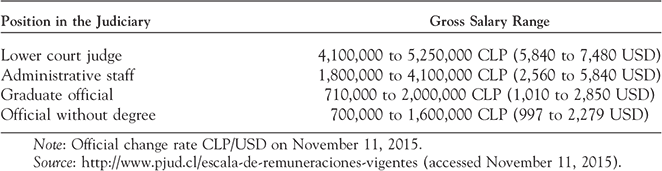
The judicial reform process launched by the CPR led to a marked increase in staff numbers. About 3,000 positions were created for officials, along with 1,000 for administrators and unit heads. The number of lower court judges rose from 376 in 1999 (Hilbink and Couso Reference Hilbink, Couso, Helmke and Ríos‐Figueroa2011) to 1,333 in 2014 (Poder Judicial 2014, 5). The reform process also resulted in the professionalization of judges and officials working in lower courts, together with an enhanced socioeconomic status. In 1996, President Frei decided to introduce a substantial graduated increase in salaries for people working for the judiciary as a preliminary to judicial reform and part of the policy for an “intelligent way out (of the crisis).”Footnote 35 Judges in higher courts (the supreme court and courts of appeal) saw their wages increase by 100 percent, judges in lower courts by 60 percent, and all officials and judicial employees by 30 percent. As a result of this, the lowest wage in the judiciary is about twice that elsewhere in the public administration (La Tercera Reference Tercera2013) (see Table 2).Footnote 36
The Remunerations in the Poder Judicial Depending on Grade (2015)
| Position in the Judiciary | Gross Salary Range |
|---|---|
| Lower court judge | 4,100,000 to 5,250,000 CLP (5,840 to 7,480 USD) |
| Administrative staff | 1,800,000 to 4,100,000 CLP (2,560 to 5,840 USD) |
| Graduate official | 710,000 to 2,000,000 CLP (1,010 to 2,850 USD) |
| Official without degree | 700,000 to 1,600,000 CLP (997 to 2,279 USD) |
Note: Official change rate CLP/USD on November 11, 2015.
Source: http://www.pjud.cl/escala-de-remuneraciones-vigentes (accessed November 11, 2015).
Changes to The Public Administration of Justice Introduced by the Reform
In the inquisitorial system, the lower court judges were in charge of not only judicial procedure, but also the administrative organization of “their” tribunals. Judges managed human resources, the assessment of personnel, and court procurement, down to matters as minor as ordering pencils, toilet tissue, and the thread to sew together the sheets of case files. A belief that such administrative issues should not be the concern of judges led reformers to hive off the judge's administrative functions from his or her jurisdictional functions. The reorganization of court administration was characterized by the desire to rationalize recruitment and other procedures.
Professionalizing Lower Court Administration
The overhaul of court administration, based on the CPR plan that had been drawn up by the lawyers, was entrusted to the administrators: “it was a matter of creating inputs,” Jaime explained (interview conducted on May 20, 2014). In particular, they created the position of administrator (“who cannot have a degree in the law”) and head of unit, most of whom were trained as civil engineers, managers, accountants, or public administrators. They are the administrative personnel in charge of administrative management, to be distinguished from employees (officials) who perform minor administrative tasks. They even have a separate professional association: the Asociación de Profesionales de la Administración Judicial.
The professionalization process has also affected how judges are recruited. Under the new system, they train at the Judicial Academy, entrance to which is based on a competitive exam for which candidates must first have qualified as a lawyer. When this academy was set up in 1998, it marked a break with how judges used to be recruited, closing the door to the judicial employees from the old system, or at least imposing drastic conditions on them. When the Judicial Academy opened, the supreme court allowed only four places for officials from the old system who had qualified as lawyers (the case for all court secretaries who had not reached the rank of judge prior to the reform) (interview with Romina, January 19, 2015).
In reformed courts, there are several judges, all of whom are of the same rank, and above the administrator; every two years they elect a judges' committee and presiding judge from among their numbers. The administrator is in a tricky position vis-à-vis the judges, being in charge of organizing court administration, and allocating hearings, and this despite being in a subaltern position. He also submits a short list to the judges' committee, which has the last word in recruitment. While drawing a parallel to “a family company,” Jaime implicitly acknowledged the weight of the traditional authority within inquisitorial courts: “it was the only possible figure. The administrator could be neither the judge's peer, nor his hierarchical superior, but had to control proceedings in a certain way and ensure that the court functioned properly” (interview conducted on May 20, 2014).
The technical unit coordinating the CPR also created software to manage judicial affairs (Sistema Informático de Apoyo a la Gestión Judicial), and together with its two architects oversaw the construction of over 300 buildings around the country (Alvear and Blanco Reference Alvear and Blanco2010, 53). All the lower courthouses built in the years following the reform were based on the same model of internal organization, with guarantee courts on the lower levels and oral courts on the upper levels, and the layout of courtrooms, judges' offices, and rooms where court officials worked was always the same: “the working procedures flowed from the organizational design” (interview with Jaime, May 20, 2014).
The new courts were all designed on the same model and do not have any refectories, meeting rooms, or rest areas. The officials took over storerooms originally intended for housing archives (which have now been computerized), and these were also sometimes used for interviews. Like Osvaldo, Romina complained about this layout: “I never get to see my colleagues. Sometimes I bump into people in the corridor or the lift and I have no idea who they are, if they are replacements, interns, or whatever. Sometimes they don't even answer when you say hello” (interview conducted on May 29, 2014). For Rafael, this situation is simply the corollary of a more tranquil environment: “it's true that nowadays the judge doesn't know the name of his clerks any more, he doesn't go and have lunch with them, but he can concentrate on his work as a judge.” He added: “you went from buildings that were falling into a state of ruin to this [pointing at his light, airy office and the courthouse as a whole], with air-conditioning, technology. … Who could say things were better before?” (interview conducted on January 22, 2015).
New Profiles and Tasks for Low-Level Judicial Officials
The dominant idea behind the reform of criminal procedure was to make it easier to replace those working in the old justice system with new staff (Alvear and Blanco Reference Alvear and Blanco2010, 50) because, according to an expression I often heard during interviews, judges and especially officials of inquisitorial courts were “contaminated” (by corruption, human rights abuses under the dictatorship, inefficiency, and nepotism). Although judges could not be removed, they had to pass an accreditation exam in order to work in the administration of the new adversarial system. At each stage of the implementation of the reform, judges were appointed to the new courts, then the administrative staff was recruited, and a selection process was conducted for recruiting officials for the Juzgados de Garantía and Tribunales de Juicio Oral en lo Penal (see Table 1).
The employees of inquisitorial courts were entitled to sit an accreditation exam to go and work in the reformed courts. The exam involved a reading comprehension test, a test of general and legal culture based on a manual distributed to candidates in advance,Footnote 37 a logic multiple-choice quiz due in limited time, and then psychology tests, an individual one being the final and decisive stage.
Gabriela and Renata,Footnote 38 who now work as officials in the same court in the Valparaíso region, sat the accreditation exam together. As Renata explained: “we were all summoned together at the same time to a reception room in a restaurant on Brazil Avenue one day at 5 pm. There were about fifteen officials from each court, so that made about seventy-five people in all. It was so hot in that room. … The exam conditions were devised to discourage those sitting it—we didn't get a day off either before or after, we had to go to the exam after a day at work, and all the tests were on the same day, including the collective psychology test. It was gone 10 pm by the time we finished” (interview conducted on April 4, 2013). Two-hundred- fifty people—about one-quarter (Ministerio de Justicia Reference de Justicia1999)—failed the exam (interview with the head of the ANEJUD, August 26, 2015).
The account given by Cristián, who sat the first external recruitment exams held in Valparaíso in 2003, highlights the sheer scale of the recruitment procedure for new officials, which made it necessary to contract the procedure out to a private company: “There were twenty thousand people applying for the three hundred or so positions created in the new courts in the region. I remember having read that in the local press, and the number struck me as enormous.Footnote 39 They had rented out your university [Playa Ancha, for the written exams]. There was a bit of everything—spelling, written comprehension, Machiavelli, the history of democracy, constitutional law” (interview conducted on July 29, 2014).
It was a long process, with applications starting in April and Cristián finally being appointed in November 2003. After the first exam, candidates selected for the next stage were summoned to a large hotel in Viña del Mar to sit the so-called psychology tests: “After each stage the successful candidates received an e-mail calling them to the following exam, sent out from an address such as no-reply@nameofconsultancy.cl. Those who failed did not receive any notification, and they did not know why they had been eliminated.” The psychology tests included a first group test in the form of role-playing: “I played the role of a shoe salesman and the client was played by another candidate, I was told ‘not to accept to exchange his shoes under any condition.’”
Just like the multiple-choice quiz, the group test “seeks measuring your abilities for working under pressure,” says Arturo, a head of unit in a court of the Valparaíso region who entered the judiciary with the implementation of the reform in the Metropolitan region in 2006 (interview conducted on March 7, 2016). Ricardo, another head of unit in Valparaíso, provided the details regarding the individual psychology interview: “there were standard Rorschach and Zulliger tests. Provided you know it, the principle is simple. You can see anything you want in the inkblots as long as it comes from real life and not something imaginary” (interview conducted on March 25, 2013).
These psychology tests have been generalized to the various stages in the career path of officials who, if they wish to be promoted, need to apply in an open process in which they are sometimes competing against people from the street.Footnote 40 According to the head of the ANEJUD, “there are now rather tests of peoples' potential, that's something new, it's to see if the candidate really has the skills that match the position they're applying for” (interview conducted on September 28, 2015). More prosaically, one judge observed that in comparison to work under the inquisitorial procedure, “the task of officials has been shorn of its intellectual content” (interview with Osvaldo, December 7, 2012). Indeed, in spite of being mostly graduates, officials today seem to have tasks unrelated to their degrees:Footnote 41 they are in charge of the audio recording of the hearings, and some others are ushers in the Tribunales de Juicio Oral en lo Penal. Alejandro, for instance, entered the judiciary as a fresh graduate in 2006 at the lowest grade of the hierarchy of officials in a guarantee court (Juzgado de Garantía) in Santiago. He was then a “hearing assistant” whose task was to “make photocopies, check the case files.” After a few months, he had the opportunity to apply to a post with a higher grade in the hierarchy. He has been since then in the highest but one grade in the hierarchy of officials. His tasks are to record the hearings and to transcribe a synthesis of them within twenty-four hours: “Basically, what I am doing is secretarial work,” he said (interview conducted on November 6, 2014).
Applying Management Rationales to Judicial Procedure
Whereas the inquisitorial system was based on thick paper volumes officials hand-stitched together with white thread, the oral procedure of claim and counterclaim is computerized. This has altered the timeframes according to which the judicial process operates, as well as the administrative ritual (written accounts) associated with it. In the two courts in the Valparaíso region where I carried out fieldwork, administrators have drawn up new work protocols, while in other places the initiative has come from judges in the early stages of their careers promoting new ways of organizing administrative work (interview with Rafael and Fernanda, respectively, presiding judge and former presiding judge at a guarantee court in the Metropolitan region, conducted on December 15, 2014).
An example may be afforded by a guarantee court in the Valparaíso region. “When I took up my position in August 2013 hearings were being planned for seven months later. Now the wait is one and a half months,” the administrator explained. First, in order to avoid hearings being suspended due to certain parties being absent, he fixes three hearings per time slot; that way if the people summoned were late or did not show up another hearing could start immediately. He has also taken steps (with the agreement of the judges' committee) to “improve yields in each courtroom.” “Some judges interrupt a hearing to go and have a coffee for example,” or “sometimes they spend five minutes asking questions to identify the accused—name, first name, identity number, and address is all well and good—but what does it matter to us what the profession of the accused might be?” According to the same administrator, other judges impose a ritual “which has no reason to be,” in which the official appointed to record the hearing “has to stand up for each new case and solemnly declare the date, place of hearing, and case number, before then announcing the judge.” “There is no place in a court like ours for this sort of ritual. It is completely out of place given the workload that builds up” (interview conducted on May 27, 2014).
Every day from midday onward, the prison guards bring people caught on flagrante delicto for bail hearings. Such hearings were previously shared out depending on the availability of rooms, “but now bail hearings are for the judge who has not yet worked through the hearings in his schedule” when the detainees arrive. This administrator stated that this step has encouraged the judges to cut down on the time of hearings, meaning they no longer spill over into the afternoon, thus freeing up officials for administrative tasks.
Certain younger judges consider it logical to fix the length of hearings and then delegate the management of the court's schedule to administrators, an approach they initiated within their own courts (interview with Rafael and Fernanda, December 15, 2014). However, frictions arose when judges were not prepared to relinquish their prerogatives over controlling hearings and overseeing the activity of officials. Without going into full details, Arturo stated that at his beginning in the judiciary—with the implementation of the reform in the Metropolitan region—the relationship was “more fluid with judges who were not coming from the inquisitorial system.” “Luckily,” he added, “the first presiding judge in that new court did always have a clear position regarding the separation of competences. ‘Don't bother me with administrative stuff,’ he used to say, ‘there is an administrator for that.’” But it was not like this in all courts, and Arturo evokes the “Acta 90” adopted by the supreme court (Corte Suprema Reference Corte2007) in order to reaffirm the strict separation between administrative and judicial competences (interview conducted on March 7, 2016). In some tribunals, administrators need to accommodate individual sensibilities when allocating hearings: “some of which are longer and more interesting than others, and it is that in particular which makes the administrators' task so complicated” (interview with Gonzalo, head of unit, January 8, 2013).
Administrators and unit heads promote a culture of efficiency and management issuing from the world of business. They tend to speak of clients rather than users and are fond of talking about inputs (insumo). “The way the court functions is not very different from the way a business does, with cases being the principal input,” explained Gonzalo, a head of unit, when I asked him to describe his work. However, “each judge has his or her idiosyncrasies, and it's very hard to establish standards. … They need to understand that in the court business they are only one input amongst others” (interview conducted on January 8, 2013). Both judges and officials commented that new entrants did not display any “feeling of belonging” to the institution or to the “culture of the judiciary.” For instance, Arturo, the head of unit, sees the permanence of personal ties between judges and officials coming from the inquisitorial system as a deviance from the rules. He recalls a female official who took any opportunity to go upstairs to one of the judge's office to chat. He then forbade her from bringing any document to judges' offices. He also remembers a judge “who could embrace warmly a female official he had known in the old system when he arrived in the morning and not even say ‘good morning’ to the others” (interview conducted on March 7, 2016).
Administrative Discretion and the Contested Sphere of Traditional Authority
The CPR has overturned the administrative hierarchy in lower courts, mainly because it has contained judicial discretion and redistributed administrative authority. Officials have lost judicial discretion, and judges are now in street-level bureaucrat positions: they interact with justice users and in this context they have administrative discretion related to their judicial remit/office. To understand the new court configuration better, we need to consider how judges use their administrative discretion to show authority within the court.
The judges, for instance, retain their privilege over officials due to a longstanding confusion between administrative and jurisdictional tasks. While the (at least partial) recording and transcription of proceedings at a hearing is the responsibility of the officials, it is up to the judge to redact the sentence as stated in the Code of Criminal Procedure (cf. Art. 342). Some judges used to ask officials to transcribe the factual elements of the hearings so that they would just have to redact the legal part, but they sometimes faced the officials' opposition to it. “[P]reviously an official would not have allowed a judge to contend with that type of situation on his own. Now when you ask them for a hand they answer it is not their job” (interview conducted on December 7, 2012). The head of the ANEJUD thus felt that delegation of functions still exists to a certain extent in reformed courts: “Some judges think that their work is over once they have announced a verdict at a hearing, and that transcribing the sentence is an administrative task” (interview carried out on August 26, 2015). In a guarantee court in Valparaíso where fieldwork was carried out, officials complained about the situation to the court of appeal in 2014. As a result, judges do not ask them to perform this task any more (interviews carried out with judges and officials, June 13, 20, and 23, 2016).
Furthermore, the attempt to establish a rational match between recruitment procedures and job profiles stands in contrast to the flexibility in the tasks officials are requested to perform. Work in guarantee courts is conducted with insufficient staff (especially as sentence enforcement was not addressed by the CPR) and management methods are based on results and objectives. Employee flexibility is therefore both a management necessity and a way to avoid officials becoming as empowered as they used to be in the inquisitorial system.
Another factor observed during fieldwork related to the status of the judge as a traditional authority figure: jobs were sometimes organized in a flexible manner so as not to inconvenience a judge. One evening, Fabiola, who has gone from one temporary replacement job to another in the courts in the Valparaíso region,Footnote 42 was talking to me in a courtroom where the person recording and transcribing the proceedings sat alongside the judges' bench. I asked Fabiola about the ornaments on the desk: “They belong to a female colleague of mine, who normally works at this desk. But the judge sitting in this courtroom this morning can't bear her, and so the administrator found her another spot for the day and got her to do something else” (interview conducted on July 25, 2014). In addition to this, a judge's committee might use its prerogative to bypass the administrator and veto some name in a short list (interview with Magdalena, November 21, 2014). Certain judges also demonstrate their symbolic status, for instance, asking the lowliest official in the court to go and buy them a snack or settle their domestic bills (interview with Magdalena, who works on the second-lowest rank at the court and had to carry out this sort of request, April 5, 2013). Under the old system, it was part of the job of the lowest-ranking official to clean the court, and he or she traditionally carried out this sort of errand too.
The reference to traditional authority also cropped up in interviews with administrators, with the figure of the protector or dutiful father. Both drew on this register to describe how they organized work. “You know what it's like,” one of them said (alluding to the fact that I have children and to his relationship with the judges in the court), “I have to give each of them the same sized slice of cake” (interview conducted on July 14, 2015). The other said, as he was showing me out at the end of the interview: “I have to protect my people (mi gente), I also need to correct them and teach them if they are to learn” (interview conducted on May 27, 2014). This protective stance and fatherly attitude—like the downplaying of the work done by judges by describing them as mere inputs to the judicial machinery—is indicative of a form of symbolic contest for the role of authority figure in the court.
The new court administrative setup created two competing types of legitimacy—one founded on experience or law—as a body of knowledge and as a prestigious degree that grants a strong social and symbolic capital—and solid interpersonal ties; and another founded on the competence (qualifications and expertise) of the new entrants. Law nevertheless seems to remain the measure of all things; several of the heads of unit and officials I interviewed were studying law at evening classes, with an eye to entering the Judicial Academy to become a judge.
Conclusion
This article has used a microsociological approach to analyze the on-the-ground process of judicial reform in a context of Chile's return to democracy. The reconfiguration of relationships within the lower criminal courts, based on an unequal form of mutual support such as described in the first section, has resulted in an upheaval to judicial work that is just as profound as that wrought by computerizing the procedure and introducing new forms of work organization.
To understand the making of criminal justice in Chile, it is important to consider administrative and judicial remit (and discretion) as shared resources between judges and lay actors (court clerks and administrative staff). The criminal justice system has gone through a reconfiguration in which discretionary power has been redistributed and handed to judges. Those not expert in law—new administrative management staff—continue to take part in the making of law via their interventions in the organization of judicial work and time. Like others judiciaries (Vigour Reference Vigour2015; Biland and Steinmetz forthcoming), the Chilean judiciary is attempting to implement a managerial logic to remedy chronic backlogs. This has occurred in tandem with the transition from an entirely written procedure to one that is primarily oral and computerized, in a country that had to convert from a continental European legal tradition to an Anglo-Saxon adversarial one (Rico Reference Rico1997, 34). Moreover, the CPR targeted the professional groups who formerly constituted the core of the lower criminal justice system: judges and actuarios. The Chilean CPR constituted a change that many of my interlocutors qualified as “brutal.” First, because of the huge transitioning in a short time from one of the most inquisitorial criminal systems in the world to a totally adversarial one. Second, for the reconfiguration of work environment and relationships described in this article.
Courts are a relatively new object of enquiry for the sociology and political science of Latin American institutions. On this ground, some authors recommend engaging in cross-national inquiries (Kapizsewski and Taylor Reference Kapizsewski and Taylor2008, 742). Unlike them, this article advocates studies enabling the realization of a case-oriented comparison (Della Porta Reference Della Porta, Porta and Keating2008) in order to account for the effects of intrinsically institutional patterns on both the reorganization and modernization of state administrations and the making of justice.