INTRODUCTION
The last decade witnessed increasing research interest in voice behaviour (Budd, Gollan, & Wilkinson, Reference Budd, Gollan and Wilkinson2010), which is a promotive citizenship behaviour and focuses on the expression and communication of constructive challenges aimed at improving a situation (Van Dyne & LePine, Reference Van Dyne and LePine1998). Researchers understand that organisations need to be conscious of employees’ voice behaviours because it is a reliable way of ensuring continuous improvement and competitive advantage (Botero & Van Dyne, Reference Botero and Van Dyne2009). In a fierce competitive marketplace, organisations need employee input of knowledge and ideas to adapt to the quick-changing world. Thus, employee voice increasingly becomes an important theme in practice and academia. Promoting voice is particularly critical in the Chinese setting where employees are likely to have high levels of power distance orientation, which represses employee motivation to speak out (Zhang, Zhou, Wang, & Cone, Reference Zhang, Zhou, Wang and Cone2011).
A key assumption that drives voice literature is that psychological safety is a core mediating mechanism that links work environments and voice behaviours. Psychological safety refers to the belief that exhibiting risky behaviours (e.g., voice) will not cause personal harm (Edmondson, Reference Edmondson1999). When individuals consider performing a risky behaviour, they are likely to provoke their conscious thought and scan their environment to determine potential personal outcomes via cognitive mechanisms (Tangirala & Ramanujam, Reference Tangirala and Ramanujam2008). This framework has guided much of the research on voice behaviour, and studies have demonstrated that individuals respond to perceptions of change-oriented (Detert & Burris, Reference Detert and Burris2007) and ethical leadership (Walumbwa & Schaubroeck, Reference Walumbwa and Schaubroeck2009) by speaking out via enhanced psychological safety.
Although this framework has proven generative, it is limited for two main reasons. First, the theoretical lens through which a concept is viewed drives research. Thus, by focusing solely on psychological safety as a mediating mechanism, this framework limits the understanding of work environments to voice behaviour. In this sense, a psychological safety framework limits potential antecedents and mediators to which voice may be theoretically linked. This problem bears directly on the second limitation, which suggests that while psychological safety provides a cogent explanation for psychological responses to work environments, it is less readily applicable to individual dispositional variables such as general self-efficacy.
In sum, although the psychological safety framework has proven useful, it may also inadvertently limit the scope of voice research and fail to provide an alternative explanation for other results. Hence, we believe that a broader framework is needed while still being true to the conceptual focus of voice concerning how individual and situational variables shape voice behaviour. In particular, based on social cognitive theory that regards self-efficacy as the central psychological mechanism for behaviours (Bandura, Reference Bandura1986), we propose a model that suggests general self-efficacy, perceived team servant leadership, and perceived organisational support facilitate voice efficacy or the belief in one's competence to voice effectively and to good effect (Kish-Gephart, Detert, Treviño, & Edmondson, Reference Kish-Gephart, Detert, Treviño and Edmondson2009).
Within this model, the concept of voice efficacy plays a key mediating role to link individual (i.e., general self-efficacy) and situational variables (i.e., perceptions of servant leadership and organisational support) to voice behaviour. General self-efficacy is a motivational trait and refers to ‘individuals’ perception of their ability to perform across a variety of situations’ (Judge, Erez, & Bono, Reference Judge, Erez and Bono1998: 170). Greenleaf (Reference Greenleaf1977) defined servant leadership as a form of leadership that includes a specific focus on fulfilling follower needs to grow, develop, and prosper. Perceived organisational support (POS) refers to global beliefs held by employees regarding the extent to which their organisations value their contributions and care about their well-being (Eisenberger, Huntington, Hutchison, & Sowa, Reference Eisenberger, Huntington, Hutchison and Sowa1986). Recent research has suggested that servant leadership particularly fits within Chinese contexts (Zhang, Kwan, Everett, & Jian, Reference Zhang, Kwan, Everett and Jian2012). In addition, scholars have issued a call to understand the effects of leadership styles on employees’ voice behaviours in Asia because of the important role of Asian leaders (Lam, Huang, & Lau, Reference Lam, Huang and Lau2012). Figure 1 illustrates our voice efficacy model.
Proposed theoretical model. NOTES. POS=perceived organisational support

To preview our arguments briefly, we suggest that individuals are more likely to have confidence to speak out when their general self-efficacy and perceptions of servant leadership and organisational support are high. Subsequently, individual voice behaviours are enhanced because, in facilitating voice efficacy, the effort to voice and the staying power achieved when their efforts fail are strengthened. Finally, POS moderates the relationship between voice efficacy and voice behaviour.
The current study contributes to the literature in a number of ways. First, by highlighting how voice efficacy can be characterised as a cognitive mechanism, our model provides a theoretical framework to better understand the effects of individual and situational variables on voice behaviour beyond the mediating mechanism of psychological safety. Although voice efficacy has been highlighted as a primary construct to understanding why employees keep silenced (Kish-Gephart et al., Reference Kish-Gephart, Detert, Treviño and Edmondson2009), to date few studies have actually examined this construct. Research is hindered perhaps by the lack of a measurement tool and theoretical framework that links appropriate antecedents to voice behaviours. Thus, we developed a suitable measurement based on social cognitive theory to argue that a voice efficacy model can provide a strong rationale for realising the relations between individual and situational variables and voice behaviours.
Second, in examining how situational differences moderate the effects of voice efficacy, we posit that voice efficacy is not likely to affect all individuals equally. Such prediction aligns with social cognitive theory in that supportive environments can provide incentives to strengthen the influences of self-efficacy (Bandura, Reference Bandura1986). As organisational support represents supportive work environments, we tested the moderating effect of POS on the relationship between voice efficacy and voice behaviour.
Finally, the third contribution of our model involves integrating both mediating and moderating mechanisms into a single model to provide an account for when and how individual and situational variables affect voice behaviour via the mediating mechanism of voice efficacy beyond psychological safety. In this manner, we outline for whom voice efficacy is most encouraging and develop practical implications by identifying advantage points to facilitate the effects of voice efficacy. To summarise, the present paper provides a novel efficacy model of voice that tests extant propositions in voice research and extends the literature by focusing on the mediating role of voice efficacy.
Below, we begin by reviewing relevant literature on voice and efficacy to illustrate how individuals strive to speak out in areas they have high competence. The following also discusses how voice efficacy itself is fostered by individual and situational variables. We subsequently discuss how situational differences in organisational support may influence the effects of voice efficacy on voice behaviour. Finally, we present the results of a multi-source survey study conducted to test our hypotheses.
THEORY DEVELOPMENT AND HYPOTHESES
A number of studies had found various predictors of voice behaviour. Specifically, research has found that factors such as personality (e.g., extraversion and conscientiousness; LePine & Van Dyne, Reference LePine and Van Dyne2001), psychological (e.g., psychological safety, organisation-based self-esteem, felt obligation for constructive change; Liang, Farh, & Farh, Reference Liang, Farh and Farh2012), leadership style (e.g., perceived ethical leadership; Walumbwa & Schaubroeck, Reference Walumbwa and Schaubroeck2009), and organisational factors (e.g., group voice climate; Morrison, Wheeler-Smith, & Kamdar, Reference Morrison, Wheeler-Smith and Kamdar2011) relate to employee voice. Kish-Gephart et al. (Reference Kish-Gephart, Detert, Treviño and Edmondson2009) introduced the construct of voice efficacy as a solution to inhibit employee silence, and noted that strengthening voice efficacy is a central solution to inhibit silence and activate employee voice behaviours.
The concept of voice efficacy was developed based on social cognitive theory (for a review, see Kish-Gephart et al., Reference Kish-Gephart, Detert, Treviño and Edmondson2009), which emphasises that self-efficacy influences what people choose to do, how much effort they put into it, and their staying power when their effort fails (Bandura, Reference Bandura1986). In addition, self-efficacy ‘reduces vulnerability to stress and depression in taxing situations and strengthens resiliency to adversity’ (Bandura, Reference Bandura2001: 10). Individuals with high levels of self-efficacy tend not only to develop the cognitive skills necessary to perform tasks, but also to use those skills effectively to control events (Bandura, Reference Bandura1986). Hence, researchers have concluded that self-efficacy is a powerful motivator of human actions towards particular outcomes (Bandura, Reference Bandura1986).
Gist (Reference Gist1987: 472) argued that efficacy measurements must be ‘tailored to the domain being studied’. Consequently, scholars from different domain have developed specific efficacy constructs such as drinking self-efficacy (Young, Oei, & Crook, Reference Young, Oei and Crook1991), creative self-efficacy (Tierney & Farmer, Reference Tierney and Farmer2002), etc. Combined with Van Dyne and LePine's (Reference Van Dyne and LePine1998) definition of voice behaviour, Kish-Gephart et al. (Reference Kish-Gephart, Detert, Treviño and Edmondson2009) conceptually defined voice efficacy and raised the call to operationalise this construct. Therefore, the present study echoed their call by empirically developing this construct and testing the influence of voice efficacy on voice behaviour.
Kish-Gephart et al. (Reference Kish-Gephart, Detert, Treviño and Edmondson2009) proposed two reasons why voice efficacy results in voice behaviours. First, employees with high levels of voice efficacy are likely to appraise an environment as controllable and perceive relatively low levels of threat. As such, research has indicated that personal control is positively associated with voice (Tangirala & Ramanujam, Reference Tangirala and Ramanujam2008). Second, these employees believe they can succeed despite the challenges inherent in speaking out. A barrier that hinders employee voice is the high personal cost when management rejects voice, which potentially causes those employees to suffer from the loss of trust, respect, promotion, or other career opportunities because their suggestions may harm the benefits of and offend to other people (Milliken, Morrison, & Hewlin, Reference Milliken, Morrison and Hewlin2003). However, when employees believe that management highly appreciates their voice, the fear of personal costs is less. Thus, individuals with high voice efficacy should be willing to speak out. Hence, we propose the following:
Hypothesis 1: Voice efficacy is positively related to employee voice behaviours.
This study considers that voice efficacy plays a central role forming employee voice behaviour. This idea is consistent with social cognitive theory, which suggests that self-efficacy plays a mediating role in the effects of motivational traits and environmental conditions on individual behaviours (Bandura, Reference Bandura1986). That is, traits and environmental assessments shape individual efficacy and influences how well individuals use their resources, the effort put into tasks, their persistence in the endeavour, their future goals, and their performance. Concerning voice, we suggest that general self-efficacy, perceived servant leadership, and POS enhances employee voice efficacy. In turn, voice efficacy strengthens employee voice behaviours. Research has provided rich evidence that efficacy is an important mediator to linking motivational traits and environmental conditions to employee outcomes. For example, Walumbwa, Hartnell, and Oke (Reference Walumbwa, Hartnell and Oke2010) found that self-efficacy mediates perceived servant leadership and organisational citizenship behaviours. Shin and Zhou (Reference Shin and Zhou2007) evidenced that team creative efficacy mediates the interaction effect of educational specialisation heterogeneity and perceived transformational leadership on team creativity. Next, we discuss how social cognitive theory guided us to select general self-efficacy, perceived servant leadership, and POS as antecedents of voice efficacy and voice behaviours.
Social cognitive theory asserts four sources of information on which people evolve their efficacy, mastery experience (e.g., past achievements), social persuasion (e.g., from others to confirm an individual's ability to finish a task), vicarious experience (e.g., past experiences that individuals acquire by observing and learning from role models), and physiological state (e.g., individuals’ emotional arousal) (Bandura, Reference Bandura1986). We argue that general self-efficacy, perceived servant leadership, and POS can represent these four sources and promote employee voice efficacy. As voice may be influenced by different levels of factors, the present study applies a multi-level approach by regarding general self-efficacy as an individual-level variable, perceptions of servant leadership as a group-level variable, and POS as an organisation-level variable. As such, we tested their impacts on voice efficacy and explored the mediating role of voice efficacy.
General self-efficacy can represent mastery experience (Chen, Gully, & Eden, Reference Chen, Gully and Eden2001). The most powerful antecedent of general self-efficacy is the aggregation of previous experiences such that general self-efficacy emerges over one's lifespan when one gathers past successes and failures across different tasks (Shelton, Reference Shelton1990). Bandura (Reference Bandura1997: 53) argued, ‘Powerful mastery experiences that provide striking testimony to one's capacity to effect personal changes can also produce a transformational restructuring of efficacy beliefs that is manifested across diverse realms of functioning’. Hence, employees may gradually accumulate a history of successful hands-on experiences including past voice successes. This accumulation of past successes may facilitate specific self-efficacy such as efficacy to speak out. Research has also indicated that general self-efficacy is related positively to specific self-efficacy, such as occupational self-efficacy (Chen, Gully, & Eden, Reference Chen, Gully and Eden2001) and direct sales self-efficacy (Mencl, Tay, Schwoerer, & Drasgow, Reference Mencl, Tay, Schwoerer and Drasgow2012). Combining the above discussion and Hypothesis 1 that voice efficacy is positively associated with voice behaviour, we propose the following:
Hypothesis 2: Voice efficacy mediates the relationship between general self-efficacy and voice behaviours.
Perceiving servant leadership is likely to encourage employees to speak out, which acts as effective social persuasion and vicarious experience to shape employees’ voice efficacy. Servant leadership, as the most people-centred leadership style, directly addresses the influence of leaders on employees’ needs and personal growth (van Dierendonck, Reference van Dierendonck2011). Servant leaders are truly concerned with serving their followers to help them grow, learn, and feel safe within the organisation and can persuade them to attain their career goals by facilitating followers’ skills, knowledge, and abilities (Greenleaf, Reference Greenleaf1977). Recent research has provided evidence for the claim that perceived servant leadership positively relates to self-efficacy via enhanced technical competence and social learning (Walumbwa, Hartnell, & Oke, Reference Walumbwa, Hartnell and Oke2010). We argue that a similar process occurs for voice efficacy. A servant leader may persuade his or her followers to believe that they have skills, knowledge, and abilities to improve work situations and meet personal and others’ needs and growth. Research supports this argument in that voice is an effective way to improve work situations through the expression and communication of constructive challenges (Kish-Gephart et al., Reference Kish-Gephart, Detert, Treviño and Edmondson2009). Hence, the belief of improving work situations shaped by a servant leader serves as social persuasion to increase employee voice efficacy.
From a social learning perspective, a servant leader prompts followers’ self-efficacy to emulate the leader's selfless and prosocial behaviours (Walumbwa, Hartnell, & Oke, Reference Walumbwa, Hartnell and Oke2010). Observing a role model shifts the mental schemas that direct the observer's beliefs (Bandura, Reference Bandura1986). Accordingly, perceiving servant leadership enables employees to believe that serving others is an organisational norm. Hence, employees can strengthen their confidence to act as good citizens by serving others. As voice is an effective vehicle to serve others by improving work situations (Kish-Gephart et al., Reference Kish-Gephart, Detert, Treviño and Edmondson2009), employees are likely to acquire high levels of voice efficacy. Hence, perceptions of servant leadership should positively relate to voice efficacy. Integrating the above discussion and Hypothesis 1, we proposed the following:
Hypothesis 3: Voice efficacy mediates the relationship between perceived servant leadership and voice behaviours.
Bandura (Reference Bandura1986) posited that aversive physiological arousal, such as fear and anxiety, depresses the development of self-efficacy. POS may accord employees a safe network and supportive resource because this construct is assumed to increase employees’ affective attachments to the organisation and their expectancy that greater effort towards meeting organisational goals will be rewarded (Eisenberger et al., Reference Eisenberger, Huntington, Hutchison and Sowa1986). In addition, POS may contribute to employees’ feelings of competence and worth and increase performance of standard job activities and actions that are favourable to the organisation and that go beyond assigned responsibilities (Rhoades & Eisenberger, Reference Rhoades and Eisenberger2002). It is also conceivable that POS decreases employees’ general stress levels (Rhoades & Eisenberger, Reference Rhoades and Eisenberger2002). Although voice may create potential problems, supportive resources can represent a solution. In a supportive organisational environment, employees can expect that their constructive opinions will receive positive feedback (Morrison, Wheeler-Smith, & Kamdar, Reference Morrison, Wheeler-Smith and Kamdar2011). Gradually, employees feel they have the power and ability to change work situations. In doing so, POS helps the employees reduce aversive states of physiological arousal and increase voice efficacy.
As proposed in Hypothesis 1, voice efficacy is related positively to voice behaviours. Our arguments represent an integrated framework in which employee voice efficacy mediates the positive relationship between POS and voice behaviours. Thus, we propose the following:
Hypothesis 4: Voice efficacy mediates the relationship between POS and voice behaviours.
Social cognitive theory suggests that self-efficacy does not necessarily result in behaviours because people need incentives (Bandura, Reference Bandura1986). Hence, we propose that POS may act as an incentive to strengthen the relationship between voice efficacy and voice behaviours. Because organisational support directs behaviours by signalling employees as to the organisation's values, desires, expects, and rewards (Eisenberger et al., Reference Eisenberger, Huntington, Hutchison and Sowa1986), POS that fosters a positive cooperative context by encouraging positive exchanges among organisational members is more likely to amplify the positive influence of employee attitudes on their positive behaviours. As a result, employees are likely to be influenced by voice efficacy and engage in voice to fulfil social normative expectations and acquire positive rewards. Hence, we argue that employees who are highly efficacious in speaking out are likely to be motivated to exhibit voice behaviours with a positive relationship that is enhanced by POS.
In contrast, perceptions of non-supportive organisations attenuate the extent to which employees speak out for their organisations because they do not have the incentive to do so, even though these employees may have voice efficacy. In other words, if these employees view voice as an ineffective currency in organisations with low levels of support, voice will not be reciprocated or induce positive social interactions. As such, voice efficacy has less impact on voice behaviours. Thus, we propose the following:
Hypothesis 5: POS moderates the relationship between voice efficacy and voice behaviours such that when POS is high, the relationship between voice efficacy and voice behaviours is stronger.
METHOD
Sample and procedures
We administered questionnaire surveys directly to 100 team leaders (supervisors) and 700 team members (subordinates) in 60 manufacturing firms in the eastern part of China. We selected teams that had at least seven members to obtain a sufficient sample size for each team. If the team had more than seven team members, we randomly selected only seven members. Questionnaires were coded before distribution to match supervisor–subordinate dyads. Respondents returned their completed questionnaires directly to us through the mail.
We received completed surveys from 94 team leaders (response rate = 94%) and 480 team members (response rate = 68.57%) in 55 organisations (response rate = 91.67%). After matching, we acquired valid data from 91 team leaders and 401 team members in 53 organisations. Team leaders’ mean age was 36.56 years, and mean organisational tenure was 8.62 years. In all, 78 (86.81%) team leaders were middle-level managers. For team members, 180 (44.89%) were male and 221 (55.11%) were female. Their mean age was 31.73 years, and mean tenure was 4.93 years. In all, 312 (77.81%) team members were frontline workers. On average, teams had 4.41 members (range of 3–7) and 7.57 employees in each organisation (range of 3–13).
Measures
We employed translation and back-translation procedures to translate the servant leadership scale into Chinese. We had well-established Chinese scales for general self-efficacy, POS, and voice behaviour, and we developed a scale of voice efficacy that was rated by team members. Team members also assessed general self-efficacy and servant leadership, whereas team leaders assessed employee voice behaviours. In addition, both team leaders and members rated POS. Team leaders were asked to rate POS for two reasons. First, team leaders could assess POS from a relatively high status. Ratings by organisational members from different job positions could provide relatively objective assessments. Second, because team members self-reported voice efficacy, POS ratings by team leaders could alleviate the correlation inflation possibly caused by common method variance.
General self-efficacy
Zhang and Schwarzer's (Reference Zhang and Schwarzer1995) 10-item Chinese general self-efficacy scale was used. This is a 4-point Likert-type scale that is rated by employees (1 = ‘completely incorrect’, 4 = ‘completely correct’). A sample item is ‘I can always manage to solve difficult problems if I try hard enough’. Cronbach's α was 0.87.
Servant leadership
Ehrhart's (Reference Ehrhart2004) 14-item servant leadership scale was used. Employees rated each item on a 5-point scale that ranged from 1 = ‘to a very small extent’ to 5 = ‘to a great extent’. A sample item is ‘My team leader works hard at finding ways to help others be the best they can be’. Cronbach's α was 0.93.
POS
Farh, Hackett, and Liang's (Reference Farh, Hackett and Liang2007) 7-item Chinese version scale was used, which was originally developed from Settoon, Bennett, and Liden (Reference Settoon, Bennett and Liden1996). A sample item is ‘Help is available from my organisation when I have a problem’. Cronbach's α was 0.88.
Voice behaviour
Liang, Farh, and Farh's (Reference Liang, Farh and Farh2012) 10-item voice behaviour scale was adopted. Team leaders rated their subordinates on a 5-point Likert-type scale (1 = ‘never’, 5 = ‘always’). A sample item is ‘Raise suggestions to improve the unit's working procedure’. Cronbach's α was 0.91.
Voice efficacy
Team members reported the extent to which they believed they were capable of voicing effectively. Respondents were asked the extent to which ‘You feel you are capable of effectively doing each of the following’ and a list of 10 voice behaviours from the Liang, Farh, and Farh's (Reference Liang, Farh and Farh2012) scale was presented. Behaviours included ‘Proactively develop and make suggestions for issues that may influence the unit’, ‘Proactively suggest new projects which are beneficial to the work unit’, and ‘Proactively voice out constructive suggestions that help the unit reach its goals’. Response options ranged from 1 = ‘definitely not capable’ to 5 = ‘definitely capable’. Cronbach's α was 0.87.
Control variables
We controlled for psychological safety. Edmondson's (Reference Edmondson1999) 5-item scale was used. A sample item is ‘In my work unit, I can freely express my thoughts’. Cronbach's α was 0.77. Because demographics may influence employees’ voice behaviours (e.g., Burris, Detert, & Chiaburu, Reference Burris, Detert and Chiaburu2008), we also controlled for the influence of subordinate and supervisor gender, tenure, education level, and position, and organisation sector and proprietary (i.e., state-owned, private, and joint ventures).
Analysis strategy
This study is multilevel and includes individual (i.e., general self-efficacy, voice efficacy, and voice behaviour), team (i.e., perceived servant leadership), and organisational levels (i.e., POS) variables as well as a cross-level interaction (i.e., POS × voice efficacy). However, there is a concern that within-group sample size at level three averaged about 1.72. Hence, it may be difficult to differentiate teams and organisations. We first estimated the null model of voice efficacy and voice behaviours (without any predictor variables) using hierarchical linear modelling (HLM) and tested the difference between teams and between organisations using χ2 analysis. The results showed that the variance between teams (χ2(90) = 186.35, p < .001, ICC(1) = 0.19) and between organisations (χ2(51) = 64.81, p < .001, ICC(1) = 0.05) for voice efficacy were both significant. The difference between teams (χ2(90) = 420.17, p < .001, ICC(1) = 0.47) and between organisations (χ2(51) = 68.94, p < .05, ICC(1) = 0.08) for voice was also significant. These results mean that the levels of voice efficacy and voice behaviours among teams and organisations were different. In addition, there is a relative distinction in variance explained by group and organisational factors. Hence, it is necessary to conduct multi-level analyses. According to Zhang, Zyphur, and Preacher (Reference Zhang, Zyphur and Preacher2009) and Bauer, Preacher, and Gil's (Reference Bauer, Preacher and Gil2006) suggestions, we used HLM (version 6.08, Raudenbush & Bryk, Reference Raudenbush and Bryk2002) with full maximum likelihood to test our hypotheses.
This analysis involved four hierarchical models in three levels, including individuals, cross-teams, and cross-organisations’ mediation models, and cross-organisations’ moderating model. More specifically, the three mediations are shown below: (1) 1→1→1 mediation, level-one antecedent through level-one mediator to predict level-one outcome; (2) 2→1→1 mediation, level-two antecedent through level-two mediator to predict level-one outcome; and (3) 3→1→1 mediation, level-three antecedent through level-one mediator to predict level-one outcome.
As for tests of the first two mediation models (1→1→1 and 2→1→1 mediation), we conducted a procedure recommended by Bauer, Preacher, and Gil (Reference Bauer, Preacher and Gil2006) who underlined the randomness of indirect effects in multi-level models. For a convenient calculation, we followed a concrete introduction supported by Preacher (a co-author in the aforementioned 2006 paper) who developed syntax to restructure raw data with SPSS. He also gave a manoeuvrable guidance to test the random indirect effect for a lower-level mediation model using HLM (http://www.quantpsy.org/supp.htm). To obtain random coefficients, we defined random components for level-one variable in our level-two equations. The program produced the estimation of fixed and random effects in HLM output and data files. With an Excel-based calculator provided on Preacher's website, we obtained an average random indirect effect and random total effect using 95% confidence intervals (CI) based on a normal sampling distribution. In addition, to create CIs for multi-level indirect effect, we adopted the Monte Carlo method, which does not assume that the indirect effect is normally distributed (Selig & Preacher, Reference Selig and Preacher2008). In addition, the Monte Carlo method provided a powerful and supplementary analysis for the first two mediation models.
For the examination of the 3→1→1 model, we took an analytical procedure, recommended by Pituch, Murphy, and Tate (Reference Pituch, Murphy and Tate2009), that allowed random effects at level two and level three and assumed different variances of indirect effects between groups or organisations. This method used two sets of cross-level equations to assess mediation. First, we made a cross-level regression function from the level-three predictor to the level-one mediator as the outcome variable. Then, we made the level-one outcome as another cross-level regression function of the level-one mediator and level-three predictor. We grand-mean centred the variables before entering predictors into both sets of regressions because this method can produce better assessments than doing so for an individual-level mediator (Pituch, Murphy, & Tate, Reference Pituch, Murphy and Tate2009). In both sets of multi-level modelling, we included random intercepts in the level-two and level-three equations, and set random intercept and random slope for the mediator as a predictor. However, we only considered the fixed effects of individual demographic variables as controls because we did not find significant variances at level two and level three in a preliminary analysis. Finally, we created a 95% CI for this indirect effect with the R-package of RMediation developed by Tofighi and MacKinnon (Reference Tofighi and MacKinnon2011). The program uses a distribution-of-the-product method to build CI of mediation.
For the sake of verifying our cross-level moderation model, two relevant stages were conducted to examine the moderating effect of POS in HLM. The first stage involves proving the effects of voice efficacy and POS on employee voice. The second stage involves testing the interaction between voice efficacy and POS in predicting employee voice behaviours. We grand-mean centred level-one and level-three predictors before entering the variables because grand-mean centring has an advantage of making the intercept more interpretable in a cross-level interaction model (Hox, Reference Hox2010). On the other hand, we had a relatively small within-group sample size at level three; therefore, we did not consider the different magnitudes of moderated effects between groups within the same organisation. Except for the individual demographic variables, all level-one predictors had random effects in the level-two and level-three models. When implementing both analyses of mediation and moderation, we included the level-one and level-three demographic variables. The leader-level demographic variables were excluded from analyses because they did not significantly influence our hypotheses in a preliminary analysis.
RESULTS
Discriminant validity
We conducted Harman's one-factor test, which included all variable measures in a single-factor analysis as recommended by Podsakoff and Organ (Reference Podsakoff and Organ1986). The results indicated that neither a single factor nor a general factor could account for the majority of covariance in the variables (the eigenvalue of the first factor = 7.30 and the percentage of variance explained by the first factor = 14.32%). This finding provides evidence that common method variance was not a problem in the current sample. To test the convergent and discriminant validity of voice efficacy, we conducted a confirmatory factor analysis using Amos 17.0, and included voice efficacy and psychological safety. The results showed that the two-factor model fit much better than the single-factor (for two-factor model, χ2/df = 2.28, GFI = 0.94, CFI = 0.96, RMSEA = 0.057; for single-factor model, χ2/df = 5.94, GFI = 0.84, CFI = 0.82, RMSEA = 0.112). These results support that voice efficacy and psychological safety are two different constructs.
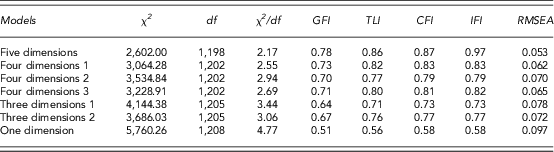
A confirmatory factor analysis was conducted to test the discriminant validity of all main variables. The results showed that the 5-factor model fit the data better than other alternative models (χ2/df = 2.17, GFI = 0.78, TLI = 0.86, CFI = 0.87, IFI = 0.97, RMSEA = 0.053; see also Table 1), which demonstrates good discriminant validity. In addition, all factor loadings were significant, which shows convergent validity.
Model fit indices
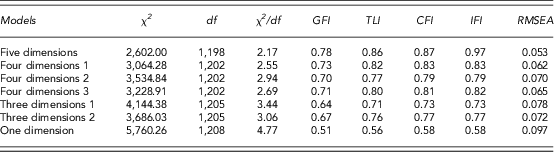
Notes: N = 401.
Five dimensions: GSE, VE, SL, POS, voice; four dimensions 1: (GSE + VE), SL, POS, Voice; four dimensions 2: GSE, SL, POS, (VE + voice); four dimensions 3: GSE, VE, (SL + POS), voice; three dimensions 1: GSE, (SL + POS), (VE + voice); three dimensions 2: (GSE + VE), (SL + POS), voice; one dimension: (GSE + VE + SL + POS + voice).
GSE = general self-efficacy; POS = perceived organisational support; SL = servant leadership; VE = voice efficacy.
Descriptive statistics
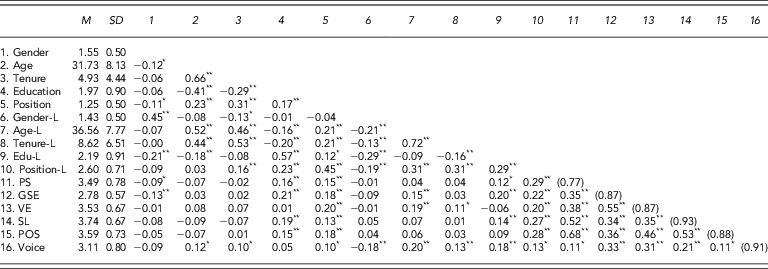
Table 2 is the descriptive statistics of our study variables.
Descriptive statistics
Note: N for employee = 401; for leader = 91.
Gender: 1 = male; 2 = female; age-years; tenure-years; education (Edu): 1 = high school and below; 2 = 3-year college; 3 = 4-year bachelor; 4 = master and above; L-leader; position: 1 = frontline worker; 2 = supervisor; 3 = middle manager; 4 = senior manager or above.
GSE = general self-efficacy; POS = perceived organisational support; PS = psychological safety; VE = voice efficacy; SL = servant leadership.
*p < .05, **p < .01 (two-tailed tests).
HLM
Researchers should calculate relative indicators before aggregating individual variables to branch- or organisation-level variables (e.g., RWG, ICC(1), and ICC(2)). To begin, we calculated the RWG median values of servant leadership (level two) and POS (level three); the results were 0.95 for servant leadership and 0.88 for POS. Both values were higher than the general criteria value 0.70, which indicates enough consistency of aggregation. We also calculated ICC(1) and ICC(2) values for these two variables. The two values of servant leadership were 0.30 and 0.65, respectively, and those of POS were 0.24 and 0.71, respectively. All the ICC(1) values were up to median (0.12) or standard in relative references; ICC(2) values were near or more than 0.70.
Hypothesis testing
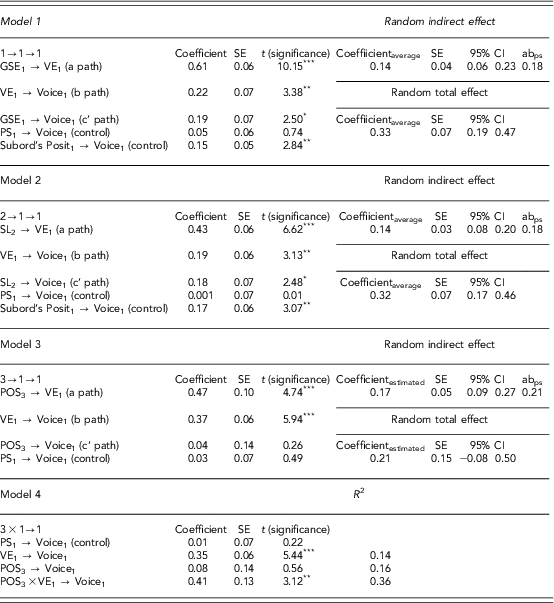
Hypothesis 1 proposed that voice efficacy is positively related to employee voice. Table 3 shows these results, which were supported by Model 1 (βb = 0.22; p < .01). Hypothesis 2 stated that voice efficacy mediates the relationship between general self-efficacy and employee voice. The following evidence supports this hypothesis. First, general self-efficacy, as an independent variable, is positively related to voice as an outcome variable (βtotal effect = 0.33; 95% CI: 0.19–0.47) after controlling for demographics and psychological safety. Second, general self-efficacy as an independent variable is positively related to voice efficacy as a mediating variable (βa = 0.61, p < .001). Third, when voice efficacy entered the model, the results indicated that voice efficacy was positively related to employee voice (βb = 0.22, p < .01). Meanwhile, the influence of general self-efficacy on voice was significantly lower (βc ' = 0.19, p < .05) compared with the original affect (βtotal effect = 0.33; 95% CI: 0.19–0.47). This result revealed a significant random indirect effect (βindirect effect = 0.14; 95% CI: 0.06–0.23). A CI calculated by the Monte Carlo method was given (95% CI: 0.05–0.22) with a more powerful test (Selig & Preacher, Reference Selig and Preacher2008), which yielded a similar CI using a normal distribution method. The effect size of the indirect effect was 0.18, which means that voice behaviour is expected to increase 0.18 standard deviations for each one-unit increase in general self-efficacy indirectly through voice efficacy. The analysis of this level supports the individual mediation model (Hypothesis 2); that is, voice efficacy partially mediates general self-efficacy and voice behaviours.
Multi-level analysis results (including control variables)
Notes: We removed some non-significant demographic control variables (subordinate's gender, tenure, education, sector, and corporation type) from the above table for the sake of parsimony.
R 2 was calculated from Snijders and Bosker (Reference Snijders and Bosker1999); abps was calculated from Preacher and Kelley (Reference Preacher and Kelley2011).
GSE = general self-efficacy; POS = perceived organisational support; SL = servant leadership; VE = voice efficacy.
*p < .05, **p < .01, ***p < .001.
Hypothesis 3 proposed that voice efficacy is a mediating variable between servant leadership and voice behaviours. This positive relationship (βa = 0.43, p < .001) between servant leadership and voice efficacy was supported in Model 2. We followed Bauer, Preacher, and Gil's (Reference Bauer, Preacher and Gil2006) procedure to calculate the random indirect effect. In Model 2, servant leadership had a significant total effect on voice (βtotal effect = 0.32; 95% CI: 0.17–0.46) when including the control variables. When voice efficacy was added, the results showed this variable was positively related to voice behaviours (βb = 0.19, p < .01). Meanwhile, the relationship between servant leadership and voice behaviours was significantly lower (βc ' = 0.18, p < .05). This result supports a random indirect effect (βindirect effect = 0.14; 95% CI: 0.08–0.20), and a Monte Carlo version of CI was given (95% CI: 0.03–0.14). The effect size of the indirect effect was 0.18, which implies that voice behaviours are expected to increase 0.18 standard deviations for each one-unit increase in servant leadership indirectly through voice efficacy. The analysis of this level supports the cross-team mediation model. That is, employee voice efficacy partially mediates the relationship between servant leadership and voice behaviours.
Hypothesis 4 proposed that voice efficacy mediates the relationship between POS and voice behaviours. We followed the procedure recommended by Pituch, Murphy, and Tate (Reference Pituch, Murphy and Tate2009) and constructed a level-three cross-organisation mediation model. Findings indicate that POS does not have a significant total effect on voice behaviours (βtotal effect = 0.21; 95% CI: −0.08 to 0.50), but does have a significant indirect effect via voice efficacy (βindirect effect = 0.17; 95% CI: 0.09–0.27), which was estimated with RMediation. These results also indicated that POS is positively related to voice efficacy (βa = 0.47, p < .001), and, when controlling for voice efficacy, the relationship between POS and voice is lower and not significant (βc ' = 0.04, p > .05). The analysis of this level supports the cross-organisation mediation model. That is, voice efficacy fully mediates the relationship between POS and voice behaviours. The effect size of 0.21 for the indirect effect implies that voice behaviours are expected to increase 0.21 standard deviations for each one-unit increase in POS indirectly through voice efficacy.
Hypothesis 5 proposed that the positive relationship between voice efficacy and voice behaviours would be enhanced in high POS conditions. This hypothesis was supported by Model 4 (βinteraction = 0.41, p < .01). Figure 2 shows these results. A simple slopes test indicates the relationship is stronger for those who perceive higher organisational support (βhigh POS = 0.50, p < .001; t = 7.42) compared with those who perceive lower organisational support (βlow POS = 0.25, p < .001; t = 3.73). Thus, Hypothesis 5 was supported.
Moderating effect of perceived organisational support (POS) on the relationship between voice efficacy and voice behaviour
DISCUSSION
As interest in the topic of voice has steadily increased, limitations of the original psychological safety framework for understanding voice have emerged. In the present study, we sought to advance a new model of voice based on social cognitive theory (Bandura, Reference Bandura1986). In particular, we proposed a model centred on voice efficacy to account for individual and environmental effects on voice behaviours. Within this model, voice efficacy serves as a mediator to link general self-efficacy, perceived servant leadership, and POS to voice behaviours, and the positive relationship between voice efficacy and voice behaviours is particularly the case for those who perceive strong organisational support. That is, POS plays an important role in incentives to strengthen the impact of voice efficacy on voice behaviours.
In focusing on the moderating and mediating effects together, our model helps explain how and why general self-efficacy, perceived servant leadership, and POS influence voice behaviours, as well as when voice efficacy will have the most influence on voice behaviours. Thus, our study provides evidence for the claim that voice efficacy can affect voice behaviours (Kish-Gephart et al., Reference Kish-Gephart, Detert, Treviño and Edmondson2009). This study also extends our understanding of when this relation works. It also addresses the call of Lam, Huang, and Lau (Reference Lam, Huang and Lau2012) to explore whether leadership styles facilitate employees’ voice behaviours in Asia.
One strength of our voice efficacy model is that it potentially accounts for a wider range of predictors than does a psychological safety framework. For example, within a psychological safety framework, the relation of general self-efficacy to voice behaviours is not readily apparent and requires the introduction of alternate theoretical mechanisms. However, within a voice efficacy model, the relation of general self-efficacy to voice behaviours is expected because of enhanced voice efficacy, given that self-efficacy is considered a critical mediating mechanism of behaviours (Bandura, Reference Bandura1986). Although past research has linked general self-efficacy with specific efficacy (e.g., Chen, Gully, & Eden, Reference Chen, Gully and Eden2001; Mencl et al., Reference Mencl, Tay, Schwoerer and Drasgow2012), voice efficacy has been ignored, which has undermined our understanding of the effects of general self-efficacy on voice behaviours. Using voice efficacy as a key mediator, this study extends our understanding of the effects of general self-efficacy on voice behaviours.
With respect to the present study, although past research has hinted that multi-level factors should influence voice behaviours (Tangirala & Ramanujam, Reference Tangirala and Ramanujam2008), it is not clear why and when individual and environmental factors effect voice behaviour together. However, a voice efficacy model, with enhanced general self-efficacy, perceived servant leadership, and POS facilitating voice behaviours, follows logically based on social cognitive theory.
Self-efficacy represents a broad paradigm with a number of insights into human behaviour that can be applied to future voice research. As mentioned, social cognitive theory suggests several ways to imbue self-efficacy (Bandura, Reference Bandura1986). For example, one way in which individuals increase self-efficacy is through past successes. On the one hand, these successes may not be highly related to voice, but can facilitate general self-efficacy, thereby enhance voice efficacy indirectly. On the other hand, specific voice successes may have direct affect on voice efficacy. Hence, a fine-grained approach can be applied in future research to realise the relationships among past successes, general self-efficacy, and voice efficacy.
Another example is role modelling, which provides opportunities for employees to learn how to speak out, and thus, facilitate their voice efficacy. It is possible that leaders’ or upper-level managements’ voice behaviours can result in employees’ voices. Studies have focused on understanding how leadership influences employees’ voice (e.g., Walumbwa & Schaubroeck, Reference Walumbwa and Schaubroeck2009); however, voice behaviours from the top may have greater influence on employee voice. Hence, the role modelling perspective may guide future research to understand how voice behaviours from high-level managers influence low-level employees. In sum, our study extends social cognitive theory to the voice literature, which may guide numerous future studies from various perspectives. Our model not only accounts for past findings, but also broadens the range of potential predictors that voice behaviours can be linked to.
Our findings also provide implications to guide future research regarding the influence of voice efficacy on different types of voice behaviours. Although Liang, Farh, and Farh (Reference Liang, Farh and Farh2012) model divided voice behaviour into two dimensions (i.e., promotive and prohibitive voice), it ignored the important role of voice efficacy. Social cognitive theory suggests that individuals with high levels of efficacy view their environments in a favourable light (Bandura, Reference Bandura1986). Therefore, it is possible that voice efficacy is related to these two voice dimensions in different ways. As this study adopted a general voice behaviour measure, we could not test this prediction. Thus, future research is needed to examine the effects of voice efficacy on both types of voice behaviour.
A main contribution of our work lies in the testing of POS as a moderator of the effects of voice efficacy. As noted, voice efficacy does not necessarily result in voice behaviours. Based on social cognitive theory, efficacious individuals need incentives to exhibit behaviours (Bandura, Reference Bandura1986). Organisational support is an interesting moderator because it represents a form of supportive work environment (Eisenberger et al., Reference Eisenberger, Huntington, Hutchison and Sowa1986) and should be expected to exacerbate the effects of voice efficacy. Our result of this moderating effect suggests that incentives are important moderators to realise when voice efficacy affects voice behaviours.
Limitations
Despite these contributions, our study has several limitations that are important to note. First, the present findings may be contaminated by common method variance as the data associated with general self-efficacy, perceived servant leadership, and voice efficacy came from the same source, although data of voice behaviour were collected from a secondary source. Hence, future studies may need to collect data from different sources. For example, peers or supervisors can observe and assess voice efficacy. Second, a constraint on the internal validity of the present findings was the use of cross-sectional data, which may affect the inference of causation. Future research should apply a longitudinal research design by collecting data of all variables at more than two time points. Finally, this study was conducted in China, which results in the concern that our findings may not be generalised to Western countries. Therefore, replication of this research using Western samples is recommended in future studies.
Managerial implications
Despite these limitations, our theoretical model and empirical findings have important implications for organisations in a Chinese setting. As employee voice behaviours can enhance organisational effectiveness and continuous improvement (Detert & Burris, Reference Detert and Burris2007), it is critical for organisations to bear in mind that general self-efficacy, perceptions of servant leadership, and POS can promote employee voice efficacy and voice behaviours beyond psychological safety.
Our work suggests that organisations can spur employee voice efficacy and voice behaviours by selecting employees with high levels of general self-efficacy and enhancing servant leadership and organisational support practices. First, our results underscore the positive role of general self-efficacy in generating voice efficacy and voice behaviours. Accordingly, organisations could consider general self-efficacy scores to evaluate the likelihood of employee voice when making recruitment decisions. When looking for new employees to work in dynamic environments, it would be useful to incorporate general self-efficacy as a criterion for evaluating potential job candidates.
Second, managers can exhibit the behaviours associated with servant leadership to facilitate their employees’ voice efficacy and voice behaviours, including putting employees’ benefits before managers’ own interests; helping employees grow, develop, and succeed; and encouraging the organisation and its members to contribute to society through community development programmes. Van Dierendonck's (Reference van Dierendonck2011) model suggests that individual and cultural factors can enhance servant leadership, which provides further implications for what the organisation can do.
Concerning individual factors, people are likely to have strong motivations to exhibit servant leadership when they have high levels of self-determination, moral cognitive development, and cognitive complexity. Therefore, organisations could offer training programmes for managers to strengthen the individual characteristics that lead managers to understand the importance of working from an integrated perspective where power is not sought for their own benefit and attention should be paid to moral issues concerning their subordinates.
As for cultural factors, a humane orientation and low power distance can motivate individuals to demonstrate servant leadership. This issue is particularly important for Chinese organisations because Chinese employees tend to have high levels of power distance (Farh, Hackett, & Liang, Reference Farh, Hackett and Liang2007). Hence, organisations should promote a humane orientation by acknowledging the want and need to take care of others. This can be accomplished by rewarding employees for being helpful and friendly and by offering social events for organisational members to establish and develop friendships. Organisations can also diminish the power distance by decentralising decision making and discouraging formal respect and absolute deference.
The current findings also indicate that organisations need to facilitate organisational support. On the one hand, organisational support directly enhances employees’ voice efficacy and voice behaviours. On the other, voice efficacy is more effective in enhancing voice behaviours when the organisation is supportive. Research has provided evidence that beneficial treatment received by employees can increase their POS (Rhoades & Eisenberger, Reference Rhoades and Eisenberger2002). This beneficial treatment includes fairness, supervisor support, organisational rewards, and favourable job conditions. Hence, organisations should promote a fair climate, encourage their supervisors to support their subordinates, positively evaluate employees’ contributions, and enhance job security and autonomy and reducing job stress among employees.
CONCLUSION
Voice behaviour is important for employee performance (Van Dyne & LePine, Reference Van Dyne and LePine1998) and organisational effectiveness (Detert & Burris, Reference Detert and Burris2007). The present study applied social cognitive theory and provided insights into important issues regarding general self-efficacy, perceived servant leadership, POS, voice efficacy, and voice behaviours. Findings revealed POS as a key moderator and voice efficacy as an important mediator of the relationship between individual and environmental factors and voice behaviours. This study has essential implications for organisations because it suggests several ways to encourage employees to speak out. As such, this research serves as a springboard for future study into additional predictors and underlying mechanisms that facilitate employee voice.
Acknowledgement
We would like to thank Jialin Xie for her helpful comments on the earlier draft of the paper. This research was supported by the National Natural Science Foundation of China (no. 70902056 and no. 71372180).