Introduction
Current evidence suggests that the risks associated with the use of antipsychotic medications in the treatment of behavioral and psychological symptoms of dementia (BPSD) may offset their clinical benefits (Schneider et al., Reference Schneider2006; Monette, Reference Monette, Monette, Champoux, Galbaud Du Fort and Wolfson2009). Adverse effects can include death (Schneider et al., Reference Schneider, Dagerman and Insel2005; Ballard et al., Reference Ballard2009), stroke (Schneider et al., Reference Schneider2006), cardiac arrhythmias (Ray et al., Reference Ray, Meredith, Thapa, Meador, Hall and Murray2001; Liperoti et al., Reference Liperoti2005), extrapyramidal signs (Lee et al., Reference Lee2005; Rochon et al., Reference Rochon2005; Weiden, Reference Weiden2007), falls and fractures (Trifiro et al., Reference Trifiro, Spina and Gambassi2009), pneumonia (Knol et al., Reference Knol, Van Marum, Jansen, Souverein, Schobben and Egberts2008), as well as metabolic (Trifiro et al., Reference Trifiro, Spina and Gambassi2009) and other disorders.
In 1986, the Institute of Medicine reported widespread “misuse of antipsychotics to sedate or discipline residents in long-term care” (Institute of Medicine, Committee on Nursing Home Regulation, 1986), which led to the establishment of standards for their use, legislatively embodied in the Omnibus Budget Reconciliation Act of 1987 (Burke, Reference Burke1991). These were subsequently updated in 2006 in the US interpretive long-term facility guidelines pertaining to APs in which a review for the continued necessity of the dose, and attempts at (or consideration of the possibility of) tapering these medications were both specifically mandated (Centers for Medicare and Medicaid Services, 2006).
About one-quarter to one-third of long-term care residents receive APs (Kamble et al., Reference Kamble, Chen, Sherer and Aparasu2008; Chen et al., Reference Chen, Briesacher, Field, Tjia, Lau and Gurwitz2010). In one Canadian study, 32.4% of nursing home residents received APs, but 44.3% of residents in nursing homes in the highest quartile of AP use received APs compared to 20.9% in the lowest quartile (Rochon et al., Reference Rochon2007). Residents of nursing homes in the highest quartile were three times more likely to be dispensed an AP both overall and within each clinical indication group demonstrating that variation in AP use across nursing homes is not adequately accounted for by measured differences in the characteristics of residents (Rochon et al., Reference Rochon2007).
Several AP reduction programs have been reported over the years, with varying degrees of success (Ray et al., Reference Ray, Blazer, Schaffner and Federspiel1987; Semla et al., Reference Semla, Palla, Poddig and Brauner1994, Thapa et al., Reference Thapa, Meador, Gideon, Fought and Ray1994; Roberts et al., Reference Roberts2001; Ruths et al., Reference Ruths, Straand, Nygaard, Bjorvatn and Pallesen2004; Reference Ruths, Straand, Nygaard and Aarsland2008; Ballard et al., Reference Ballard2008; Reference Ballard2009; Monette et al., Reference Monette2008; Westbury et al., Reference Westbury, Jackson, Gee and Peterson2010).
In 2004, a previous interdisciplinary education program for AP use was conducted in our long-term geriatric care center (Monette et al., Reference Monette2008). At that time, of 295 residents with a diagnosis of dementia, 90 (30.5%) were receiving regular APs. Of the 81 who were alive at six months, there were 61 (75.3%) attempts at discontinuation or dose reduction. These resulted in 40 (49.4%) discontinuations, 11 (13.6%) dose reductions, and 10 (12.3%) unsuccessful reductions. Twenty (24.7%) residents had no change in AP dose. There was no change in the use of restraints or other psychotropic medications, and mean behavior rating scale scores improved.
A limitation of the 2004 study, however, was the short period of follow-up, which raises the question as to whether or not such changes in prescribing policies and practices are transient or long lasting and whether there might be a benefit in periodically refreshing and updating physician and nurse knowledge. The aims of this present study were to (1) assess rates of AP use five years after the first intervention in order to determine the long-term impact of the 2004 program; and(2) implement an updated AP reduction educational intervention program at the same center five years later in order to determine whether AP use could be further reduced.
Methods
Setting and study population
Donald Berman Maimonides Geriatric Centre (DBM) is a 387-bed long-term care center in Montreal, affiliated to McGill University, with a majority of residents who have dementia. The present cohort were all long-term care residents with dementia at DBM who were receiving regular APs on 23 March 2009. Short-term care residents, such as those admitted for respite care, were excluded.
Design
This was a cohort study using a pre-post intervention design of five months duration, which compared rates of regularly administered AP use (i.e. not transient use of these drugs on an “as needed” basis) and resident BPSD status before implementing a program of interdisciplinary education about BPSD and again five months later.
Ethical review
The study was approved by the McGill University Faculty of Medicine Research Ethics Review Board. As it was conducted as a program evaluation assessing the effects of an interdisciplinary education program on clinical practice and not as a randomized trial, informed consent was obtained from attending physicians.
Outcomes
The primary outcomes were the proportions of discontinuations and dose reductions of APs in the follow-up cohort of residents with dementia at the end of the five-month study period. We also measured the proportion of residents regularly being prescribed APs at the beginning of this study period in order to compare them with the rates described in our 2004 study. The secondary outcome was the frequency of disruptive behaviors as measured by the Nursing Home Behavior Problems Scale (NHBPS), a validated instrument that measures 29 potential behaviors which could lead to pharmacological interventions (Ray et al., Reference Ray, Taylor, Lichtenstein and Meader1992). The NHBPS was completed at both the beginning of the present study and again between four and five months after our study intervention.
Education program and data collection
At study inception, electronic pharmacy records were collected and analyzed to identify the residents who were receiving regular APs. Among these, AP users with a diagnosis of dementia were identified through both automated records from the Health Information Department of DBM and chart review.
At baseline, treating physicians were interviewed regarding diagnosis and indications for the residents for which they had prescribed APs, and nursing staff completed the NHBPS for each participating resident.
After the pre-intervention assessment, education sessions on BPSD and APs were given to both physicians and nurses. The program update was adapted from the aforementioned 2004 interdisciplinary education program (Monette et al., Reference Monette2008). The education sessions consisted of two lectures, lasting approximately 60–90 minutes in duration, on pharmacological and non-pharmacological approaches to BPSD. The lecture on pharmacologic approaches included topics on common symptoms, causes, risk factors, precipitants, and assessment and differential diagnosis of BPSD, on issues specific to AP prescribing such as indications and pharmacologic alternatives, the evidence base for their effectiveness and for tolerability, government health warnings and individual profiles of APs available in Canada, and finally, guidelines for metabolic monitoring and reassessment.
The second lecture which focused on non-pharmacological approaches provided definitions and a theoretical model of disturbing behaviors, as well as a four-step approach to managing these behaviors which comprises: (1) ensuring the patient is not in imminent danger to him/herself or others; (2) assessing for delirium and comorbid medical illnesses and environmental factors; (3) looking for and treating specific psychiatric syndromes such as depression and delusions and hallucinations; and (4) formulating and implementing a behavior plan to identify the antecedents and modify the consequences to improve the behavioral disturbances. Each of these two lectures was given separately to groups of physicians and nurses with some content adjusted according to the learning needs of each group. Specifically, more information was given to physicians regarding contraindications and precautions with APs. Written reference materials were distributed to participants at the end of each education session which included a hard-copy of the slides being presented as well as consensus guidelines for clinical assessment, treatment and monitoring.
At four months post-inception, interviews with physicians were conducted in order to inquire about current indications for each resident for whom they were currently prescribing APs. Data were collected pertaining to changes in behaviors which were being specifically targeted. As part of the interview, physicians were asked if there had been a change in the target symptom and whether they felt that this change was causally related to the AP, whether the AP was still indicated, if an AP reduction or discontinuation had been attempted in the past four months, and if there was a plan to change the AP dose at this time. Interviews were conducted in a neutral manner without any attempt to encourage AP reduction or discontinuation.
Finally electronic pharmacy records were collected and analyzed at five months post-intervention in order to identify which residents were still receiving APs and at what dose, and NHBPS assessments were repeated between four and five months. Study results were then analyzed by AP dose after dichotomizing prescriptions into two categories based on whether or not they had been low dose at baseline. Specifically, prescriptions for haloperidol, olanzapine, quetiapine, and risperidone were categorized as being low dose if prescribed amounts were less than 1mg/day (Canadian Pharmacists Association, 2011), 10 mg/day (Jeste et al., Reference Jeste, Rockwell, Harris, Lohr and Lacro1999), 50 mg/day (Jeste et al., Reference Jeste, Rockwell, Harris, Lohr and Lacro1999), and 0.75 mg/day (Jeste et al., Reference Jeste, Rockwell, Harris, Lohr and Lacro1999), respectively.
Statistical analysis
The proportion of residents with dementia receiving APs at the beginning of the education program update was compared to the proportion at the beginning of the 2004 program. The proportion of the cohort for whom APs were discontinued or reduced was calculated. Pre- and post-intervention NHBPS scores were compared using the nonparametric Wilcoxon test. For this analysis, the mean NHBPS score over the three nursing shifts, day, evening and night, was used. In order to test whether our study result categories were equal across AP dose category, the Fisher's exact test was performed. Initial database construction and analyses for the comparison of NHBPS scores were performed using SPSS version 17.0. All other analyses were performed using SAS version 9.2.
Results
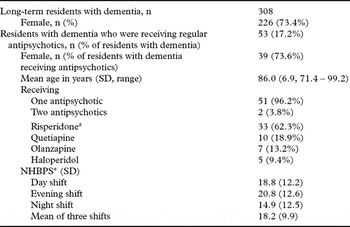
Of the 387 residents at DBM prior to the teaching intervention, eight were excluded for being short-term, primarily admitted for respite care. This left 379 long-term residents, of whom 309 (81.5%) had a diagnosis of dementia. Of these, one was excluded at the request of the family. In total, therefore, our study population consisted of 308 residents with dementia, of whom 53 (17.2%) were receiving one or two regular APs. Of these, 34 (69.4%) had received their AP at admission to the center. The mean three-shift NHBPS score was 18.2 (SD = 9.9) at the beginning of the study. Baseline characteristics of the cohort are described in Table 1.
Baseline characteristics of DBM long-term residents with dementia receiving antipsychotic medications

* NHBPS scores were available for 49 of the 53 residents because four were missing for logistic reasons such as not being completed by nursing staff.
a The sum of percentages by drug do not equal 100% because some residents received more than one AP.
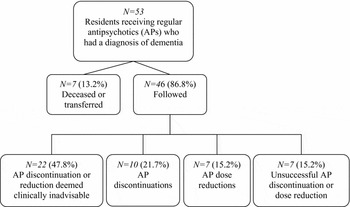
Over the five-month study period, six (11.3%) of the 53 subjects died and one (1.9%) was transferred to another hospital, leaving 46 analyzable subjects at five months. Among these 46 remaining residents, attending physicians deemed AP discontinuation or reduction clinically inadvisable for 22 (47.8%) residents. Discontinuation or reduction trials were made for the remaining 24 (52.2%). Of the 46 analyzable subjects, there were 10 (21.7%) AP discontinuations, 7 (15.2%) AP dose reductions and 7 (15.2%) unsuccessful discontinuations or dose reductions (see Figure 1 for flow diagram of AP intervention outcomes).
Flow diagram of antipsychotic intervention outcomes

The mean three-shift NHBPS score was 16.8 (SD = 10.1) at the end of the study representing a difference of 1.4 between the scores at baseline and after intervention, which was not statistically significant (Wilcoxon statistic = ˗1.166, p = 0.244).
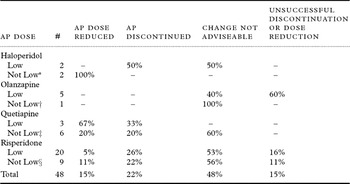
Finally, the effect of the intervention by specific drug and dose category was analyzed (Table 2). In total, 63% of the APs being prescribed at the beginning of our study period were classified as being low dose, and 70% of the discontinuations and 43% of dose reductions were attributable to APs that had been low dose at baseline. A Fisher's exact test was performed to test whether the intervention results were equal across AP dose category, which suggested that there is not a statistically significant relationship between AP dose and our outcomes (p = 0.6315).
Antipsychotic prescribing outcomes by medication and dose

* ≥1mg/day (Canadian Pharmacists Association, 2011)
† ≥10 mg/day (Jeste et al., Reference Jeste, Rockwell, Harris, Lohr and Lacro1999),
‡ ≥50 mg/day (Jeste et al., Reference Jeste, Rockwell, Harris, Lohr and Lacro1999)
§ ≥0.75 mg/day (Jeste et al., Reference Jeste, Rockwell, Harris, Lohr and Lacro1999)
Discussion
Our first aim was to determine rates of AP use five years after the first intervention in order to determine the long-term impact of the 2004 program. The prevalence of regular AP use at the beginning of the present study was 17.2%, substantially lower than the 30.5% at the beginning of the previous interdisciplinary education program five years prior, although this could not be statistically tested because it was not possible to determine the proportions of subjects with dementia receiving APs who were present at one or both time points. Even though it is difficult to attribute cause, this may be due to physicians and other professionals retaining the contents of the 2004 program and incorporating them into their clinical practice. This may particularly be the case at DBM, owing to the fact that due to high retention rates, our participating prescribing physicians were the same in both studies.
As our second aim, we set out to determine whether AP use could be further reduced and found that at the end of the study period, a substantial proportion of residents with dementia who had been taking APs had had their APs discontinued (21.7%) or reduced in dose (15.2%). After the 2004 program the proportion of discontinuations and dose reductions were 49.4% and 13.6% respectively. In both cases, more discontinuations were observed than dose reductions, although the proportions were attenuated in this program update. This attenuation is likely due to the lower prevalence of AP administration at the start of the 2009 study, which might indicate a long-term effect of the 2004 program.
It is not surprising that more AP discontinuations were achieved for low dose APs while we observed more success at dose reductions for APs which were not prescribed at low doses at baseline. It is reassuring, however, that the achievements in further reductions in AP prescribing were not met with any significant changes to NHBPS scores.
Our program update was adapted from the aforementioned 2004 interdisciplinary education program (Monette et al., Reference Monette2008) and could be readily adapted for use in other long-term care institutions. While the content within the educational sessions was similar to the 2004 intervention, the approach in which prescribing physicians were reminded to reassess antipsychotic indications was enhanced. Instead of sending memo reminders, face-to-face interviews were conducted by a member of the research team. While we did not specifically test the effectiveness associated with this facet of our intervention, current evidence suggests that educational outreach as well as audit and feedback are superior to manual reminders in interventions to improve prescribing (Ostini et al., Reference Ostini2009).
A limitation of our study was that it was not a randomized controlled trial. Unfortunately, in our jurisdiction, individuals who are not competent to consent to research may not participate unless consent is provided by a legally-appointed proxy such as a curator or homologated mandatory; consent from family members who are not legally appointed decision-makers is not sufficient. Because consent from family members is usually sufficient for medical decisions not involving research, many families do not go through the extra time and expense of proceedings to institute curatorship or homologate a mandate. Therefore, a randomized controlled trial would have been very difficult to implement in our jurisdiction. Moreover, it would be difficult to compare results across long-term care centers since their characteristics can be quite different. In addition, it would not have been feasible to have designed this study using a control group since this was a one-center study with a cohesive core of attending physicians in which it would have been difficult to avoid a contamination effect.
Conclusion
Despite starting with a relatively low proportion of residents who were prescribed an AP, an update of the education program was followed by further AP discontinuations and dose reductions. These results suggest the benefit of repeated education program administration and updates in reducing AP use.
Conflict of interest
None.
Acknowledgments
The authors thank the Donald Berman Maimonides Geriatric Centre Research Foundation for their financial support of the research program.