Healthcare-associated infection (HAI) constitute a significant health system burden globally. 1 , Reference Allegranzi, Bagheri Nejad and Combescure2 The World Health Organization estimates the prevalence of HAI to be 3.5-12% in developed countries, and 5.9-19.1% in low and middle-income countries. 1 In the Kingdom of Saudi Arabia (KSA), the emerging Middle-East Respiratory Syndrome (MERS) is a growing threat to health security. As of September 24, 2019, the Ministry of Health (MoH) has reported 2079 MERS cases, including 39% fatalities, since the disease was first reported in 2012. 3 Surges in MERS cases are frequently associated with healthcare-related outbreaks; from January to February 2019, at least 31 healthcare-acquired MERS cases involving both healthcare professionals (HCPs) and patients were reported in a hospital outbreak in KSA. 3 The healthcare-related transmission of MERS in KSA is mostly driven by inadequate infection prevention and control (IPC) measures in healthcare facilities. Reference Zumla and Hui4 , Reference Rabaan, Alhani and Bazzi5
As frontline HCPs, emergency medical service (EMS) providers constitute a major risk group for HAIs. Reference Thomas, O’Meara and Spelten6 Like other HCPs, EMS providers are required to apply standard precautions and other preventive measures to reduce the transmission of HAIs. 7 , 8 The current literature suggests that EMS providers have a low compliance level with recommended preventive measures. Reference Bledsoe, Sweeney and Berkeley9 - Reference Martel, Bui-Xuan and Carreau11 Misperceptions about the risks posed by infectious patients and self-justification of personal skills over adherence to IPC guidelines were reported in an Australian study. Reference Bouchoucha and Moore12 Such behavioral factors may differ across settings due to cultural diversity and differences in training and work-related norms and standards. Little is known about their experiences and practices of EMS providers in KSA, as well as the motivations that underpin perceptions toward recommended IPC guidelines. This study explores the experiences and attitude of EMS providers toward health risks and standard preventive measures to guide risks mitigation and prevention in emergency settings in KSA.
METHODS
The study used qualitative methods to explore EMS providers’ perceptions of risks and the factors that influence compliance with IPC guidelines. A qualitative design was considered appropriate to guide in-depth description of the organizational norms and personal values that inform behavior and enhance the full comprehension of reasons behind individual choices and IPC practices in EMS settings.
Study Setting
The study was conducted in Riyadh, Kingdom of Saudi Arabia. The study population consisted of EMS personnel from different sectors: Saudi Red-Crescents Authority (SRCA), King Fahad Medical City (KFMC, MoH), King Saud University Medical City (KSUMC), and King Abdulaziz Medical City at National Guards (KAMC). The SRCA is a government-funded national organization that provides emergency prehospital services, helping to stabilize and transfer patients to hospitals for care. KFMC, KSUMC, and KAMC are major governmental tertiary hospitals in Riyadh having established EMS units with specialized teams for inter-facility transfer (IFT) of patients.
Study Design
Participants were purposively selected based on years of experience, gender, age, and type of EMS team for the focus group discussions (FGDs) and in-depth interviews (IDIs). Only EMS providers who had spent at least 6 mo working in EMS were included. The data collection method consisted of 2 distinct FGDs for prehospital (SRCA) and IFT EMS teams (hospital teams), and 20 IDIs involving 11 prehospital and 9 IFT EMS providers. Overall, 32 participants were contacted through phone calls, based on personnel lists provided by the various heads of departments. However, 2 participants declined consent and were not enrolled for the study. Each FGD consisted of 6 participants, including 2 participants who also participated in the interviews. All participants from SRCA were males, and 5 of 14 IFT participants were females. The significant gender disparity was related to the low proportion of female EMS providers (1-4%) within the study population.
The sampling strategy was derived from the “saturation principle,” that is, sampling until no new idea is generated. Reference Ritchie and Lewis13 Distinct topic guides for the FGDs and IDIs derived from the study objectives were field tested on 4 SRCA personnel and revised throughout the data collection process to capture emerging ideas and concepts. All interviews and FGDs were conducted off-campus by the researcher at a confidential locations during May 2019. Informed consent was sought and obtained from all participants before data collection. The FGDs and IDIs were conducted in English, and each session was audio-recorded to ensure participants views and ideas were well-captured, and were transcribed verbatim by the researcher within 72 h after the interview. EMS-taught programs, including undergraduate studies, are delivered in English and EMS providers are expected to also communicate effectively with non-Arabic speakers, who make up a significant proportion of the population. The study followed all standards for ethical conduct, and the institutional review board approval was obtained from King Saud University Health Research Board as project No. E-r9-4o34.
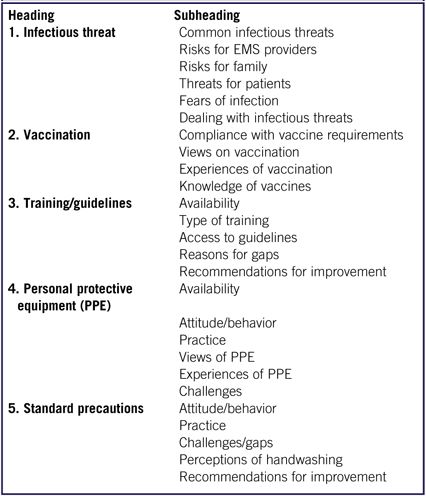
The data were thematically analyzed with NVivo 12 Plus, using Framework approach for qualitative data analysis. Reference Green and Thorogood14 , Reference Welsh15 Each transcript was read several times to identify key words or phrases across the data set. The highlighted data were subsequently used to create a coding framework, which was applied to the entire data set. Afterward, coded sections were sorted into themes and subthemes iteratively, based on a ranked relationship between data elements that include main concepts, views, and their corresponding subunits. Data were analyzed further by creating a chart of related items from the FGDs and IDIs to aid comparisons between participant’s views and thoughts and enable understanding of the full range of behaviors and experiences for summary and reporting of findings. The main chart headings and subheadings are shown in Table 1.
Headings and Subheadings of Charts Created During Data Analysis

RESULTS
Generally, 30 EMS providers participated in this study. The age-group category of participants were 24-34 years (36.67%), 35-44 years (43.33%), and 45-55 years (20%). Most participants (83.33%) were males, and the majority (56%) had an EMS working experience of 3-5 years. The result did not show any significant gender, age, or years of experience-related differences. Because these variables, especially gender, may impact on confidentiality, they are not characterized further in relation to quotes from participants. The following findings, including 3 main themes (perception of health risks, attitude, and practice of IPC and need for strengthening IPC measures) and their corresponding subthemes, were developed from the topic guides and the emerging concepts from the IDIs and FGDs. The themes and subthemes are summarized as follows:
Theme 1: Perceptions of Risks
Concerns About Respiratory Pathogens
Many participants considered respiratory pathogens the most significant health threat to EMS providers due to the perceived limited effectiveness of prevention, ease of transmission, and severity of few endemic diseases. They also described the emotional trauma they experienced when transporting or providing care for MERS patients, despite having applied requisite preventive measures.
“My last MERS patient was a week ago, I was afraid. I took all my protective equipment: gloves, masks, N95, gowns, and goggles. Yet, I was afraid of airborne disease, but other infections like those spread via blood are ok for me, because I can see it and can easily take precautions. For blood, I will be careful with needles.” (ID1 5, IFT)
“We got to know after maybe five days, his test result came out, and we got to know he has MERS. So, the hospital asked all staff involved (16 employees) to be swabbed, and one of us tested positive.” (FGD 2, IFT)
“Respiratory problems.. because you can avoid infections that come with the body fluid or blood. You can see the fluid, you can avoid it. But respiratory problems you cannot avoid, you cannot hold your breath for too long. Even, the mask is not effective.” (IDI 2, Pre-hospital)
Misinforming EMS Providers About Patients’ Health Status
Most participants hinted that frequent misinformation exposed them to risks during emergencies. In addition to incidents of dispatch operators being “occasionally negligent,” many believed that some patients deliberately conceal relevant medical history over suspicions that EMS providers would withhold care if certain information were shared with them. In some instances, caregivers were either oblivious of the importance of sharing relevant details with the dispatcher or uninformed about the case.
“Some hide information of having MERS, because of the fear of not being given the expected medical attention.” (FGD 1, Pre-hospital)
“Maybe due to false information given from the bystander to the dispatcher or false interpretation from the dispatcher.” (IDI 13, Pre-hospital)
“When we get a call from our dispatch, for example, and he tells us that the main problem of the patient is abdominal pain. Then you will not wear a mask or gloves, but the patient starts to cough, and we discover that he has fever also. Usually, I would stop and go back to my ambulance and wear a mask, but it’s late at that time…” (ID1 2, Pre-hospital)
Fears of Transmitting Nosocomial Infections to Family Members
The secondary transmission of nosocomial infections to family members was a significant concern to many participants. Even though they rationalized that an infected EMS provider could transmit disease pathogens to their colleagues and other patients, the fears of disease transmission to immediate family members was particularly heightened among participants who were married with children, and those having family members with impaired immunity.
“I’m always thinking about my kids and family. If I get an infection, I will transfer it to them. I have a child with low immunity; therefore, I try to be careful.” (IDI 1, IFT)
“I worry about my family. What I’m I carrying with me when I get home? That’s the question that I keep asking myself.” (IDI 8, IFT)
“I’m scared because I am a father of four children. I don’t want to transfer these kinds of viruses to my family, but I’m working as a paramedic, and I signed in knowing there is a risk in my job.” (IDI 17, Pre-hospital)
Theme 2: Attitudes and practice of IPC
Negative Attitude Toward Influenza Vaccination
Generally, participants viewed vaccination as an important IPC measure, but some vaccines were considered more useful than others. While most participants had willingly received the hepatitis B vaccine and would recommend it to others, the attitudes toward the influenza vaccine were rather unenthusiastic due to trust in natural immunity and low perception of risk, as well as perceived low effectiveness of the influenza vaccine and beliefs about harmful vaccine effects.
“It’s not effective because after I take the flu vaccine, I got ‘sicker’ two times. Even my friends and colleagues, they still get flu after the vaccination.” (IDI 1, IFT)
“I don’t believe it’s effective. I read about it, and maybe with time, it will decrease your immunity. I believe that.” (IDI 3, Pre-hospital)
“I depend on my immunity. My natural immunity is good. When I’m sick, I don’t take medications immediately; I give time for my immunity to work. No need for antibiotics or medications. For me, influenza is not a problem, I’m not afraid of influenza, but meningitis and hepatitis vaccines are very important.” (IDI 7, IFT)
Inappropriate Use of PPE
Many participants drawn from prehospital settings disclosed that the inappropriate use of PPE was largely driven by lack of prior information about the medical history of patients. They also expressed concerns over unavailability of fit test for N95 facemasks in prehospital settings. There were also reports of EMS providers not using recommended PPE due to perceived discomforts, communication challenges, and outright forgetfulness.
“We wear N95 masks if the dispatch team tells us they are suspecting MERS. If you have fewer calls, it’s easier to wear masks, but in cases where you have several patients, it’s difficult to wear it throughout.” (FGD 1, Pre-hospital)
“I don’t feel comfortable wearing masks with my glasses on; also when I wear the masks, the patients don’t hear me clearly. No fit test for N95 too, it’s only done in hospitals. I will wear gloves and N95, but sometimes I forget the gown.” (FGD 1, Pre-hospital)
“From the information I have, there are different sizes for N95. We need to take the test to take the exact size, and we don’t have that. We are given just one size, and I’m not sure that it will fit for the whole staff. I have a beard, and some don’t.” (IDI 13, Pre-hospital)
Motivations for Hand Hygiene
The majority of the participants described their perceptions and practice of hand hygiene. Low compliance of EMS providers with standard hand hygiene recommendations was partly informed by personal choices, which were driven by individual experiences and complacency about potential infectious threats.
“We should wash our hands before and after but many times we do it only after because we’re more concerned about ourselves.” (FGD 1, Pre-hospital)
“Well, it depends on personality. Sometimes we show off to be honest, that we don’t need to wash our hands. For example, someone says I’ve been working here for five years and haven’t gotten any infections. It happens a lot.” (IDI 16, IFT)
“Some wash immediately after contact with the patient. Some of them might forget. It is not like a protocol, its personal differences.” (IDI 18, IFT)
Theme 3: Need for Strengthening IPC Measures
Inaccessibility of IPC Guidelines
Many participants in the study expressed dissatisfaction over the inaccessibility of IPC guidelines in various EMS settings. IPC guidelines were mostly unavailable or not widely disseminated, and occasionally not tailored for EMS use. Thus, routine EMS service depended on intuitive approaches and individual knowledge formed from prior experiences, including academic training.
“Go and ask paramedics if they know about the protocol. Because the problem with us is that we have a lot of protocols inside the office. Nothing outside the station! This is the problem.” (IDI 15, IFT)
“I asked the infection control in my facility how to clean the ambulance because the infection control policy is only for in-hospital. The answer was we don’t have any for EMS.” (IDI 1, IFT)
“As we don’t have protocols, so we will take care of ourselves. It’s logic, some things that we learned back in school, somethings we gathered by experience.” (IDI 13, Pre-hospital)
Addressing the Knowledge Gaps
Existing knowledge gaps were highlighted in several participants’ accounts. Participants from settings that had experienced outbreaks of MERS reported the availability of regular IPC training for EMS providers. Whereas others reported the lack of IPC training courses in their organizations. The consensus was that regular trainings should be carried out to discuss health risks, including emerging diseases, and to improve IPC awareness among EMS providers.
“I don’t think most of people know exactly how to clean their hands. Usually, you clean this way (demonstrates). Most of them don’t do that, and I think some people don’t fully understand the proper way to clean their hands.” (IDI 19, IFT)
“In hospitals, when MERS came, they did more training for IPC, masks fit tests, and proper hand hygiene. But in our situation, I didn’t notice this, nobody was sent to teach or train people.” (IDI 2, Pre-hospital)
“Everything starts with education. Once they graduate, they deserve at least minor reminders. Also, if there is any new disease, there should be a new session talking about it.” (IDI 16, IFT)
DISCUSSION
Given the local endemicity and frequent outbreaks of MERS with its high fatality rates, the study participants’ concerns about respiratory pathogens are not misplaced. However, a variety of organisms, including blood borne viruses and drug-resistant bacteria, are potential causes of HAI. Several studies have described the high risk of healthcare-acquired respiratory infections among HCPs. Reference Staniforth16 - Reference Elkholy, Grant and Assiri18 Potentially, EMS providers, as frontline HCPs, have a greater risk of being infected with respiratory pathogens. Indeed, participants who were married with children considered themselves a potential health threat to their family because they often have nosocomial exposure to infectious patients. As a result, the protection of family members was a key individual motivation for the use of preventive measures among some participants. In other studies, the need to protect family and colleagues also informed the attitudes toward preventive measures. Reference Petek and Kamnik-Jug19 , Reference Khan and Al Johani20
Some participants believed that influenza vaccine was ineffective and associated with deleterious effects. These deeply rooted beliefs evolved from individual experiences of symptoms after vaccination and were reinforced by shared perceptions among known social networks. In addition, many were complacent about influenza risks and trusted in their own natural immunity. These findings are consistent with those of previous studies. Reference Gramegna, Dellafiore and Contarini21 - Reference Boey, Bral and Roelants23 Beyond the experiences of EMS providers, the consequences of nosocomial influenza transmission may be far greater for individuals at risks of severe diseases, such as pregnant women, immunocompromised individuals, and the elderly, with whom EMS providers have frequent contact. The culture of continuing work during illness, as documented in a previous study, exemplifies the potential risks to these “at risk” patients. Reference Boey, Bral and Roelants23 Because vaccination remains the best preventive measure against influenza, addressing EMS providers’ doubts and fears would contribute to increasing vaccine uptake. This would ultimately assist against nosocomial spread of influenza and contribute to protecting EMS providers, their families, and other vulnerable populations.
The study also contextualized the inappropriate practices and attitudes of EMS providers toward standard preventive measures. Participants described feeling discomfort and recalled overlooking hand hygiene and use of appropriate PPE during contacts with potentially infectious patients. An observational study involving EMS providers in the United States showed that the proportion of who wore gloves on arrival and practiced hand hygiene were 56.9% and 27.8%, respectively. Reference Bledsoe, Sweeney and Berkeley9 An emerging theme in this study was the report of patients concealing their medical history during emergency calls over fears that providers might withhold care. An additional concern was the disclosure that a fit test for N95 facemasks was unavailable in prehospital settings. Seemingly, the organizational reforms regarding improved IPC, especially facilities that had reported a MERS outbreak, contributed to improved IPC practices, including the provision of fit tests for N95 facemasks, in most IFT settings.
In this study, it was reported that specific IPC guidelines and training courses were lacking or inaccessible. This led to a dependency on intuitive approaches, knowledge from past academic training, and rarely personal development efforts, particularly in prehospital settings. Indeed, a proportion of participants attributed the shortcomings in the application of preventive measures to knowledge gaps among EMS providers. In a recent KSA study, 51.73% of HCPs identified lack of an IPC training program as a risk factor for disease outbreaks in healthcare facilities. Reference Rabaan, Alhani and Bazzi5 Hence, the development of regular IPC training courses for EMS providers in all settings would help to bridge the knowledge gap, influence attitude, and improve IPC practice.
Standard IPC guidelines ought to be adapted, simplified, and tailored to address specific needs of EMS providers, such as equipment and ambulances decontamination, and the basic IPC requirements for the patient transfer. The developed EMS IPC guidelines should be accessible to all EMS providers. This study provides the foremost naturalistic evidence of the experiences and perceptions of EMS providers toward IPC, building on existing knowledge to gain deeper insight into the beliefs and motivations that influence behavior. The findings are contextualized and do not necessarily mirror the needs and experiences of EMS providers in other settings or those of other HCPs. Yet, the findings would contribute to addressing the global burden of HAI by helping to meet the global goals of identifying local determinants of HAI burden and providing evidence for improved staff education and accountability. 24 Reflecting on the emerging theme in this study, the findings of this study could have been strengthened by triangulating the views of EMS providers with those of their patients and other care givers in the emergency setting.
CONCLUSIONS
This study highlighted the concerns of EMS providers toward nosocomial health risks, especially respiratory pathogens. While misperceptions contributed largely to inappropriate use of preventive measures, the reliance on intuitive approaches and individual experiences was attributed to inaccessibility of IPC guidelines and lack of formal IPC training programs. Therefore, there is a need to address EMS doubts and fears and promote their awareness of IPC by institutionalizing training programs and ensuring the design and accessibility of simplified and well-tailored IPC guidelines for EMS providers.
Acknowledgment
This work was supported by the College of Medicine Research Center, Deanship of Scientific Research, King Saud University, Riyadh, Saudi Arabia