Transgovernmental networks of domestic regulators and public officials have become a defining feature of contemporary global governance.Footnote 1 In diverse areas including financial markets, aviation, antitrust, data privacy, pharmaceuticals, and the environment, substate officials join their foreign counterparts to share information, develop harmonized guidelines and best practice, and reduce friction resulting from globalization.Footnote 2 According to Slaughter, these networks are “the optimal form of organization for the Information Age” and offer “the blueprint for the international architecture of the 21st century.”Footnote 3
The enthusiasm of network proponents is matched by the skepticism of doubters. Participation in transgovernmental networks is voluntary, engagement varies considerably across jurisdictions, and coordinating secretariats have neither formal enforcement powers nor mission-critical services that could induce compliance. A broad literature suggests that this type of decentralized, informal cooperation is unlikely to affect domestic policy.Footnote 4
This study offers the first systematic empirical evaluation of the relationship between transgovernmental networks and regulatory convergence. Does participation in a transgovernmental network have an independent, measurable association with domestic policy change? And, if so, what are the mechanisms at play? We explore these questions in new data on transgovernmental cooperation in the field of financial market regulation covering 116 jurisdictions between 1977 and 2006.
The empirical setting is particularly well-suited for our analysis. Proponents of transgovernmental cooperation have showcased the network linking the world's securities regulators as a success. Earlier studies have identified two distinct network components: agreements among pairs of regulators codified in memoranda of understanding (MoU); and the International Organization of Securities Commissions (IOSCO), a forum of regulators from more than one hundred jurisdictions that develops and disseminates best practices.Footnote 5
The evolution of the network coincides with the remarkable global diffusion of a policy at the heart of transgovernmental securities cooperation: rules against illegal insider trading. Banning insider trading is a costly policy change, affecting fundamental issues of corporate governance and the balance of power between corporate insiders and ordinary investors. Whereas only 15 percent of countries with stock exchanges prohibited insider trading in 1977, almost 83 percent had banned it by 2006. If transgovernmental cooperation indeed drives regulatory convergence, network participation should be positively associated with a jurisdiction's likelihood of banning insider trading, de jure and de facto. In the empirical analysis, we therefore evaluate the relationship between transgovernmental network participation for both the adoption of insider-trading policies and, separately, the likelihood of subsequent enforcement.
Our statistical analysis offers strong support for the claim that transgovernmental network participation is related to domestic policy outcomes. We find that participation in the transgovernmental securities network substantially increases a jurisdiction's likelihood of first adopting and subsequently enforcing insider-trading rules. However, the relationship between network-based cooperation and domestic regulatory practice is more complex than commonly assumed, as different network components are associated with each respective outcome. Having a direct tie through an MoU or similar agreement with the U.S. Securities and Exchange Commission (SEC), the world's leading securities regulator, makes a jurisdiction four times more likely to adopt insider-trading regulation, all else equal. Membership in IOSCO, in contrast, substantially boosts a jurisdiction's likelihood of enforcing newly adopted rules.
Our study makes four important contributions to research on international political economy. First, the results offer systematic empirical evidence corroborating earlier anecdotal accounts that transgovernmental networks have an independent and measurable association with participants' domestic policies. Second, the results offer a corrective to existing work on transgovernmental cooperation in a liberal tradition that focuses primarily on the coordination capacity of such networks and ignores the role that power asymmetries and politics might play. We develop an argument for why a lead regulator such as the SEC may shape adoption by using its transgovernmental ties to export its regulatory model and why more broad-based interactions through IOSCO help participants develop the regulatory capacity necessary for enforcement. Third, the results add to the growing body of research on international policy diffusion, which has so far focused on policy adoption. Our study expands on this work by showing (1) that the enforcement of newly adopted rules may also be shaped by international variables, and (2) that the variables associated with enforcement are different from the ones driving prior adoption. Finally, the findings bear directly on the future of global finance in the wake of the financial crises. As policymakers emphasize the need for global solutions, networked cooperation among the world's banking, securities, and insurance regulators takes center stage. The effectiveness of such alternative forms of global public authority is thus critical for public policy.
The Convergence of Insider-Trading Regulation
The global spread of U.S.-style securities regulation during the past two decades has received considerable attention.Footnote 6 While important national differences remain, in few areas is convergence of securities regulation more evident than in the case of insider trading.Footnote 7 The SEC defines illegal insider trading as the “buying or selling of a security, in breach of a fiduciary duty or other relationship of trust and confidence, while in possession of material, nonpublic information about the security.”Footnote 8 The price of stocks and other securities is not only affected by the long-term performance of the issuing firm but also by news that causes investors to update their price expectations. Certain individuals—executives, advisors, or other insiders—routinely obtain “material, nonpublic information” in the course of discharging their duties.
To protect ordinary investors from the harmful effects of corporate insiders' trading on such information, countries have enacted legislation that defines corporate insiders and regulates their market participation. The first such legislation originated in the United States in the aftermath of the 1929 stock market crash and the fight against illegal insider trading became a cornerstone of the newly created SEC's mission.
While the United States formally criminalized insider trading as securities fraud in the 1930s, insiders' use of material, nonpublic information remained perfectly legal in most countries well into the 1980s or even 1990s. Of the sixty countries with stock exchanges in 1980, only eleven had enacted legislation banning insider trading. Leading financial markets including the United Kingdom, Japan, Hong Kong, and Germany lacked such rules. In much of the world, there was an accepted view that trading on insider information was a prerogative of senior executives and that it constituted a legitimate form of executive compensation.Footnote 9
Since the mid-1980s, however, the number of countries banning insider trading has skyrocketed, reaching an astonishing 105 in 2006 (Figure 1). The 1990s in particular saw the widespread adoption of insider-trading rules around the world. As a percentage, insider trading was formally banned in 15 percent of countries with stock exchanges in 1977, compared with 83 percent in 2006.
Worldwide spread of insider-trading regulation, 1977–2006

Banning insider trading is a costly and far-reaching policy change. It effectively shifts the balance of power from privileged corporate insiders to ordinary investors. Comprehensive insider-trading rules not only prohibit the use of material, nonpublic information by corporate directors or bankers involved in a market-moving transaction, but also define as “passive insiders” those who receive and act on a tip from an insider. In the United States, TV celebrity Martha Stewart was sentenced to jail in 2004 because she had sold stocks in the pharmaceutical company ImClone after receiving a tip about the fate of one of the company's key drugs. Insider-trading rules thus bar the well-connected from profiting from superior information. In emerging markets characterized by considerable opacity and frequent favor-doing among the privileged, banning insider trading thus amounts to a small revolution.
Impressive as the spread of regulation during the past decades has been, the enforcement picture is more mixed.Footnote 10 In 1977, only three of the nine jurisdictions that had formally banned insider trading had prosecuted a case—the United States, Canada, and France. During the 1980s and 1990s, the percentage of jurisdictions that had enforced their insider-trading rules hovered between 25 and 35 percent. By 2006, 56 percent of jurisdictions with insider-trading rules had prosecuted a case (Figure 1).
While data on the enforcement of policies are often of interest, they are especially significant in the case of insider trading. Research in finance shows that the quality of financial market regulation sends important signals to investors.Footnote 11 Bhattacharya and Daouk compare the risk premium investors demand across jurisidctions where insider trading is unregulated, those where it has been banned but no prosecution has occurred, and those where individuals have been prosecuted on the basis of insider-trading rules.Footnote 12 The cost of capital is equally high in the first two but comes down considerably for the third. A prosecution makes the commitment credible whereas the market appears unmoved by the weaker signal sent by mere policy adotion.
Transgovernmental Cooperation in Financial Securities
Proponents of transgovernmental cooperation have argued forcefully that collaboration among regulators has a dual effect on domestic policy. Transgovernmental networks advance the nominal convergence of market rules and regulations.Footnote 13 These networks also foster the development of domestic regulatory capacity through training and technical assistance.Footnote 14 The same authors have held up collaboration among securities regulators on the issue of insider trading as a prime example of institutionalized transgovernmental collaboration.Footnote 15
Beginning in the mid-1980s, the SEC promoted transgovernmental cooperation among the world's securities regulators as a solution to growing arbitrage opportunities in global financial markets. A series of high-profile, cross-border cases of insider trading originating in jurisdictions lacking comprehensive regulation exposed the growing vulnerability of U.S. markets.Footnote 16 The SEC confronted the challenge by negotiating a series of MoUs with regulators from major markets. MoUs are informal, nonbinding agreements of only a few pages that establish procedures for information sharing and enforcement cooperation to combat suspected cases of cross-border securities fraud as well as procedures for technical assistance. MoUs enabled the SEC to gather evidence abroad and receive other legal assistance even if insider trading remained legal in a foreign jurisdiction. These voluntary agreements differ sharply from formal international treaties that are cumbersome to negotiate and require domestic ratification. The MoU model quickly spread beyond the SEC and by 2000 more than 250 MoUs had been signed between pairs of regulators from more than eighty jurisdictions (Figure 2).Footnote 17
Securities MoUs in force and share involving SEC

In parallel, the SEC with other peer regulators established broader cooperation by creating IOSCO in 1983.Footnote 18 IOSCO is a voluntary, nontreaty-based body where regulators from more than one hundred jurisdictions share information, develop best practices, and build expertise through organized training programs and peer advising.Footnote 19 The organization has led the development of several standards that have become global best practices. These include recommendations concerning financial conglomerates, derivatives trading, clearing and settlement, and alternative trading systems, as well as harmonized standards for non-financial disclosure by foreign issuers. In 1998, IOSCO adopted Objectives and Principles of Securities Regulation, a set of best practices and reference points for securities regulators.Footnote 20 The document explicitly calls on members to ensure regulation prohibits “market manipulation, misleading conduct, insider trading and other fraudulent or deceptive conduct which may distort the price discovery system, distort price and unfairly disadvantage investors.”Footnote 21 Not surprisingly, proponents of transgovernmental cooperation have stressed “the importance of IOSCO as a forum for promoting cooperation and the spread and strengthening of securities law to new areas of the globe.”Footnote 22
The two principal components of the transgovernmental securities network—MoUs and IOSCO—are both intricately linked to the global quest against illegal insider trading. If proponents of transgovernmental cooperation are correct, a jurisdiction's participation in the transgovernmental securities network should have a measurable and systematic association with the likelihood of it adopting and subsequently enforcing insider-trading rules domestically.
Data Set and Empirical Analysis
We test the transgovernmental hypothesis on new data from 116 jurisdictions between 1977 and 2006. We chose 1977 as the start date to begin the analysis five years prior to the onset of regulatory cooperation in securities, symbolized by the first MoU between the United States and Switzerland in 1982. The 116 countries comprise countries that had stock exchanges in 2006 and that had not yet banned insider trading in 1977. Most of the data on the status of insider-trading regulation come from Bhattacharya and Daouk.Footnote 23 They surveyed regulators in roughly one hundred jurisdictions to identify countries that had (1) adopted and (2) enforced insider-trading regulation up to 1998. We updated and expanded the data set, both with respect to time and the number of countries.
To analyze adoption, we consider all countries that have a stock exchange but have not yet passed legislation. A country receives a 0 every year prior to the adoption of insider-trading laws and then a 1 in the year of adoption at which time it exits the adoption data set.
In the year legislation is adopted, the country enters the data set for enforcement because it is now in a position to enforce its rules. For enforcement, the jurisdiction receives a 0 every year there is no prosecution and a 1 in the year it first prosecutes a case. With the first prosecution, the country exits the enforcement analysis. These criteria result in 1,122 country-year observations (for 116 countries) in the case of policy adoption and 941 country-year observations (for 100 countries) in the case of policy enforcement.Footnote 24
We use three indicators to measure our main predictor of interest—participation in the transgovernmental securities network. Our first variable, iosco membership, captures whether a jurisdiction's securities regulator is an official member of IOSCO in a given year. This measure is a dichotomous variable, where a value of 1 indicates a country is a member and a 0 that it is not. The second variable, called mou, identifies all countries whose regulators have signed at least one MoU or similar agreement with another regulator by assigning it a 1 from the year the first agreement was signed. Third, the variable u.s. mou gauges specifically whether a regulator has a direct tie to the SEC, the world's most important securities regulator.Footnote 25 Again, the dichotomous variable takes a value of 1 for regulators that have an MoU with the SEC starting in the year it was signed and 0 for those that do not. We obtained information on IOSCO membership and MoU ties primarily from the IOSCO library. We supplemented and checked our data against information from the respective regulators.
While our principle interest is the relationship between transgovernmental cooperation and domestic policy change, we also examine alternative explanations for the spread of insider-trading regulation. The recent literature on international policy diffusion has examined how international factors can affect domestic policy through coercion, competition, learning, and emulation.Footnote 26 In the case of insider-trading regulation, sources of coercive pressure are not readily apparent. Adopting insider-trading rules has not featured among explicit conditions attached to IMF loans, for example. Banning insider trading has been part of the European Union's acquis communautaire since the adoption of the Insider Dealing Directive in 1989, however, and we use a dummy variable to identify EU members and candidate countries. Moreover, non-U.S. companies that list on U.S. stock exchanges must follow U.S. securities law, including restrictions against insider trading. Following the “trading up”-logic espoused by Vogel,Footnote 27we use a dummy to identify countries that, in a given year, have at least one firm traded on the New York Stock Exchange (NYSE). For the potential effect of competition for capital we follow Simmons and ElkinsFootnote 28 and identify for each country and each year other countries with a similar investment profile based on a measure of foreign direct investment (FDI) potential. We compute the percentage among them that have adopted or enforced insider-trading regulation. We intuit that the greater the share of capital competitors who have adopted/enforced the policy, the greater the likelihood a given country will follow suit. To capture the potential effect of learning from policy success, we identify the countries in the top decile in terms of gross domestic product (GDP) growth in each year and then compute the percent of these countries that had either adopted or enforced insider-trading legislation. For peer emulation, we identify countries' neighbors as those with capitals within 2,000 kilometers of one another and then calculate the share that had adopted or enforced legislation in a given year.Footnote 29
Finally, we collected indicators to capture possible domestic factors. To measure the potential effect of stock market maturity and importance, we measure the stock market's age.Footnote 30 We control for GDP per capita and a country's international openness as measured by the ratio of exports and imports to GDP. The extent of individual rights is measured through the Freedom House Index on a scale from 1 (free) to 7 (not free). We rely on a political risk measure of corruption that evaluates national bureaucracies on a scale from 0 (corrupt) to 7 (not corrupt). Finally, we constructed dummies to measure a country's legal tradition (0, civil; and 1, common law), whether the country has undergone a postcommunist transition (0, no transition; and 1, a transition), and whether a country has a tradition of independent financial regulation (0 if the central bank is not independent and 1 if it is). Additional information regarding the variables and their sources are given in the annex.
For the empirical analysis we employ discrete-event-history analysis. This methodology, which is frequently used in studies of international diffusion, explores the probability that a unit will experience a particular event in a period of time, given that it has not already transpired. We run two separate sets of analyses for the two different dependent variables. First, we estimate the likelihood that a country will adopt insider-trading regulation in a given year. We then conduct a second analysis estimating the likelihood of the first prosecution of an insider-trading case. Following the work of True and MintromFootnote 31and Box-Steffensmeier and Jones,Footnote 32 we employ logit regressions. Logit models are used in cases of discrete data when time is measured in large increments such as years and is preferred over other hazard models. We begin each analysis with a stripped-down model isolating the possible effects of transgovernmental networks. We then compare this to a model of alternative explanations. Finally, we estimate coefficients for a full model that incorporates our transgovernmental indicators with those measuring diffusion and domestic covariates. As is common in diffusion studies, the transgovernmental and diffusion variables are lagged one time period. To correct for possible country effects, we cluster by country using the clustering procedure in Stata 10 and report robust standard errors. To account for duration and time dependencies, we include a polynomial cubic count variable.Footnote 33
Results
Adoption of Insider-Trading Laws
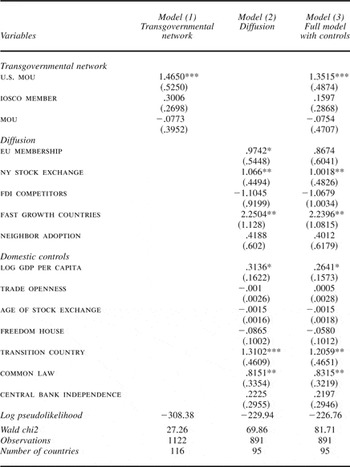
Table 1 reports the results of the logit regression estimate for the adoption of insider- trading rules. The findings strongly support the transgovernmental hypothesis as network participation has a positive and statistically significant association with a jurisdiction's likelihood of adopting insider-trading regulation. It is not membership in IOSCO or having any MoU that matters, however, but rather a direct network tie to the lead regulator (u.s. mou). This relationship holds in both a stripped-down model (Model 1 in Table 1) and one that includes domestic controls and diffusion variables (Model 3). The effect of u.s. mou is not only statistically significant and positive, but also substantively quite large. Holding all other variables constant, the odds of a country adopting insider-trading legislation increase nearly fourfold if its regulator has an MoU with the SEC as compared to countries whose regulators do not. This finding is surprising considering the extant literature has not differentiated among different types of transgovernmental network ties. The findings suggest that relationships within a network such as the transgovernmental securities network are asymmetrical and lead regulators, such as the SEC, seem to be in a privileged position to shape the domestic policy agenda of other jurisdictions. Surprisingly, IOSCO membership does not appear associated with the likelihood of adoption.
Event history analysis for adoption of insider-trading regulation

Notes : Robust standard errors are in parentheses.
* significant at .1;
** significant at .05;
*** significant at .01.
While we find strong support for the role of transgovernmental ties, other variables shape a country's decision to adopt insider-trading rules. Of the diffusion variables, we find the strongest evidence for learning. The variable capturing the policies of the top decile of countries in terms of economic growth (fast growth countries) has a statistically significant, positive effect in the complete model (Model 3) as well as a model that isolates the diffusion variables and domestic controls (Model 2). The odds that a country will adopt insider-trading legislation increase over nine times when all countries in the economic growth top decile have adopted such policies, compared to when none of the fastest growing countries have, holding all other variables constant.
We find only weak support for coercion effects. Listing on the NYSE is positively associated with the likelihood of adoption and is statistically significant in Models 2 and 3, but the finding is not consistent.Footnote 34 Similarly, the statistical significance of EU membership never reaches significance at the .05 level. Perhaps most surprisingly, we find no support for the hypothesis that competition for investment capital drives adoption.
The picture is mixed for possible domestic drivers. In Model 2, economic factors did not show statistically significant effects.Footnote 35 There is some indication that higher levels of GDP per capita boost the likelihood of adoption, but the relationship never achieves .05 significance.Footnote 36 This suggests that the adoption of insider trading rules is not simply a matter of relative economic development. By contrast, the domestic political variables show some significant results. The odds of adopting insider-trading legislation are three times greater for countries that have undergone a postcommunist transition than nontransition countries, holding all other variables constant. There is also some support for a relationship between a country's legal system and the likelihood of adoption.
Enforcement of Insider-Trading Laws
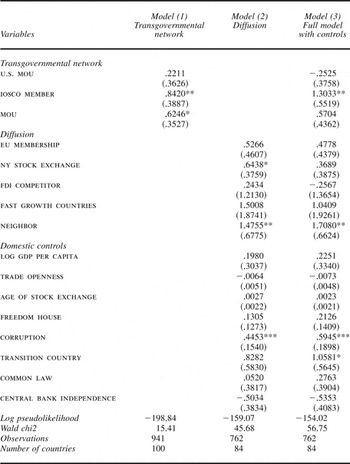
Transgovernmental cooperation is clearly associated with the likelihood of newly adopted insider-trading rules being enforced. However, the variable that is statistically significant and positively associated with enforcement across the models (Models 1 and 3 in Table 2) is IOSCO membership. The effect is substantively large with member countries three-and-a-half times more likely to enforce their insider-trading laws than nonmembers, holding all other variables constant. Having an MoU with the SEC does not increase the likelihood of enforcement. The coefficient is not significant and carries a negative sign in several models (Models 1 and 3). There is some evidence that having any MoU, as opposed to an MoU specifically with the SEC, promotes policy enforcement, though the variable's significance is unstable across the models. While the findings support in general terms the transgovernmental hypothesis, the relationship between transgovernmental networks and domestic policy convergence is more complex than commonly assumed. Membership in a forum such as IOSCO seems to promote the enforcement of newly adopted policies, though not the adoption of these policies in the first place.
Even history analysis for the enforcement of insider-trading regulation

Notes : Robust standard errors are in parentheses.
* significant at .1;
** significant at .05;
*** significant at .01.
As in the case of the adoption of insider-trading rules, other factors shape a jurisdiction's likelihood of enforcement. We find a positive, statistically significant relationship between the policies of neighboring jurisdiction (neighbors) and a jurisdiction's likelihood of enforcement. This finding supports earlier work that highlights the importance of physically proximate reference groups in driving compliance.Footnote 37 The odds that a country will enforce its insider-trading laws increase more than fivefold when all of its neighbors have enforced their laws compared to when none of them have, holding other variables constant. The variable capturing the policies of the fastest growing countries (fast growth countries), which was significant for the case of adoption, is not significant for enforcement in Model 2 or 3. This further underscores that different diffusion mechanisms appear to drive jurisdictions' policy adoption and enforcement behavior. We find no notable support for arguments based on coercion or competition.
With respect to domestic variables, we find limited support for explanations stressing economic development or market maturity.Footnote 38 On the internal political side, corruption has a substantively large, statistically significant relationship with enforcement. As one would expect, less corrupt countries are more likely to enforce their insider-trading laws. The dummy variable capturing postcommunist countries is statistically significant in one of our models, suggesting that countries having undergone a transition to a market system are more likely to enforce their policies than nontransition countries.
Robustness
To boost confidence in the findings, we ran a series of robustness checks for the two sets of models. Both adoption and enforcement are relatively rare events, raising the possibility that logit estimates produce biased results. Following King and Zeng, we reran our models using rare-events logit.Footnote 39 We found no significant differences from our findings, minimizing concerns that the frequency of the dependent variable might skew our results.Footnote 40 Additionally, we reran each model eliminating one independent variable at a time. We did this to guarantee that no one variable was significantly altering our findings. Across these checks, the transgovernmental variables (u.s. mou for adoption and iosco membership for enforcement) were always significant and carried similar coefficients to the reported results. We also changed the start date of the analysis from 1977 to 1983, the first year of transgovernmental cooperation, and found no significant differences. In 1998, the IMF began using IOSCO standards to evaluate the financial openness of securities markets. We therefore reran the analyses between 1977 and 1998 to demonstrate that the IOSCO result did not depend on IMF support and obtained similar results. In order to ensure that a few powerful countries were not skewing our results, we reran the analysis without major powers as identified in the Correlates of War data set.Footnote 41 Again, there was no substantive change to our findings.
It is possible that the relationship between our main variables of interest, u.s. mou and iosco membership, and insider-trading policy may be affected by endogenous processes. One plausible interpretation of the results is that underlying changes in economic or political conditions prompt governments to alter their domestic regulatory regime, including a ban of insider trading, and simultaneously engage transgovernmental networks. While further research is needed to fully resolve all endogeneity issues, we carefully account for timing to minimize concerns of simultaneity. Through the event-history methodology, we examine whether an MoU with the SEC in the periods prior to adoption is associated with domestic adoption. Similarly, we assess whether IOSCO membership prior to enforcement is associated with the likelihood of a prosecution. Because jurisdictions exit the analysis after they have experienced the event in question, a concern of reverse causality—adopting/enforcing first and then signing an MoU or joining IOSCO—is minimized.
Examining timing more closely, we find that in many cases the conclusion of an MoU with the SEC occurred several years prior to adoption (three years on average), and countries joined IOSCO several years before they began enforcing their insider-trading rules (seven years on average). As we show below for the case of Germany, signing an agreement is often the culmination of a lengthy process of dialogue and negotiation, during which the SEC can exert bilateral pressure.Footnote 42 The time between the bilateral relationship commencing and observable changes in domestic policy is thus even larger, reducing concerns of simultaneity. Moreover, our initial models included a one-year lag for the key independent variables measuring transgovernmental participation and diffusion factors, as is common practice. To further assess the findings' robustness, we also explored the effect of timing econometrically and reran all models with steadily increasing time lags. The association between u.s. mou and adoption remained substantively and statistically significant through a five-year lag. The association between iosco membership and enforcement remained substantively and statistically significant through a three-year lag.
A comprehensive econometric treatment of potential endogeneity would include the use of an instrument in a two-step estimation process. Unfortunately, little work identifies factors that might influence variation in transgovernmental network participation. This complicates the task of identifying a priori exclusion criteria for an instrument to assess potential endogeneity. More general work on participation in international organizations also has few insights on which jurisdictions might be more likely to participate in transgovernmental networks.Footnote 43 As transgovernmental cooperation gains traction, future research should lead to new insights about the sources of transgovernmental network participation, enabling a more thorough examination of potential endogeneity in domestic policy change.
Discussion: Regulatory Export Versus Regulatory Capacity
This study offers the first large-scale statistical analysis of claims that transgovernmental regulatory networks shape domestic policy convergence. Intriguingly, the findings suggest that different network components have distinct effects on countries' insider-trading policies. Having a direct tie to the SEC, the world's leading securities regulator, through an MoU or similar agreement, significantly increases a jurisdiction's likelihood of adopting insider-trading rules. Yet SEC–MoU partners are no more likely to enforce their insider-trading rules than the rest. In contrast, IOSCO members are significantly more likely to enforce newly adopted rules, even though IOSCO membership does not appear to affect the likelihood of adoption in the first place. What might account for this puzzling result?
An examination of both SEC behavior and political dynamics within IOSCO suggest that different transgovernmental network components may serve distinct purposes.Footnote 44 Lead regulators backed by significant market power, such as the SEC in securities, may use asymmetries within the network to promote the global export of their domestic policies. With the globalization of financial markets, lower regulatory standards abroad make U.S. investors vulnerable to foreign-born securities fraud such as insider trading.Footnote 45 Singer shows that lead regulators with significant market power will look to transgovernmental solutions to resolve such threats to their domestic markets.Footnote 46 This is precisely what the SEC did when it engaged foreign counterparts to negotiate MoUs. As early as 1983, one SEC commissioner formulated the agency's explicit goal: “The trick will be to encourage the securities regulators of the other major trading nations to develop systems that provide protections to investors substantially similar to those provided in this country.”Footnote 47 Similarly, in 1988, an SEC policy paper bluntly stated that international engagement was to “minimize differences between systems.”Footnote 48
The SEC thus had a clearly stated motive to reshape securities regulation abroad. MoUs were central to this strategy. As Lütz argues, “signing an MoU with the SEC imposes, more or less, direct pressures on the foreign counterpart to level its domestic system of sectoral supervision in line with U.S. standards.”Footnote 49 The SEC employed a combination of carrots and sticks to induce foreign regulatory change. It used MoUs to provide technical assistance and even went as far as drafting securities laws on behalf of foreign regulators to tilt local reform debates.Footnote 50 SEC pressure also affected pivotal interest groups abroad, thereby influencing the trajectory of policy evolution in foreign jurisdictions. In Germany, for example, regional governments overseeing the various stock exchanges and powerful banking interests had resisted efforts to make investor protection the focus of regulation. This coalition was so well entrenched that Germany became the only country to oppose the EU's adoption of the Insider Dealing Directive in 1989 and subsequently resisted domestic implementation. The situation changed as SEC pressure convinced German banks that continued reform refusal could shut them out of lucrative international markets. For example, when German banks tried to sell newly created options linked to the German stock index to U.S. investors, the SEC “prohibited trading of these products in the United States by arguing that they came from a market which operated under lower regulatory standards than that of the US.”Footnote 51 It was only after Germany adopted new securities market legislation in 1995 that the SEC finally allowed such products into the U.S. market.Footnote 52
While the SEC has a strong interest and the tools to pressure foreign jurisdictions into adopting U.S.-style regulations, it is less concerned with the quality of enforcement over domestic transactions abroad. A Thai insider defrauding Thai investors on the Bangkok stock exchange, for example, does not impose negative externalities on the United States.Footnote 53 Curtailing foreign insider trading without negative spillovers should thus not be a priority for lead regulators such as the SEC. Our statistical results are consistent with this reasoning, though further qualitative research is necessary to confirm the causal chain and exact mechanisms.
Turning to enforcement, a closer examination of the on-the-ground difficulties associated with prosecuting cases of insider trading explains why and how IOSCO membership might influence domestic implementation. Identifying a case of suspected insider trading, gathering sufficient evidence, and bringing charges is a highly complex technical task. As the SEC explains, “insider trading is an extraordinarily difficult crime to prove. The underlying act of buying or selling securities is, of course, a perfectly legal activity. It is only what is in the mind of the trader that can make this legal activity a prohibited act of insider trading.”Footnote 54 A jurisdiction's ability to prosecute a case of insider trading is thus closely linked to its regulator's competence and regulatory capacity.
Regulatory cooperation via IOSCO seeks to strengthen members' expertise, competence, and capacity through information sharing, the development and diffusion of best practices, mentoring, and training. IOSCO annual meetings feature forums to discuss current regulatory challenges and workshops stressing case-based learning. At the 2000 meeting, for example, South African and Australian regulators led a session on effective market regulation that was attended by regulators from several dozen developing countries. These annual meetings are complemented by standing committees, which intensify communication and interaction among regulators. The Technical Committee has a working group devoted to enforcement issues and the Emerging Markets Committee brings together more than eighty jurisdictions from developing countries for training. Finally, IOSCO coordinates day-to-day technical assistance and can put regulators from emerging markets in touch with more advanced regulators to advise on specific enforcement challenges.Footnote 55
Although IOSCO has been effective as a promoter of regulatory capacity, its ability to push specific policies among its diverse membership is limited. In several important areas, IOSCO has been unable to reach consensus on global standards.Footnote 56 Insider trading was long a case in point, as major markets such as Japan, Germany, and Switzerland resisted convergence pressure. It was only in 1998 that IOSCO formally advocated banning insider trading.Footnote 57 By then, over 86 percent of its then-members, including all major markets, had adopted insider-trading rules. It thus seems logical that IOSCO membership, by way of regulatory capacity building, would have an effect on the enforcement of insider-trading rules but not necessarily on their prior adoption.
While anecdotal evidence and a preliminary analysis of transgovernmental cooperation's evolution via MoUs and IOSCO underscore the plausibility of the regulatory export and regulatory capacity mechanisms, alternative explanations are possible. In many jurisdictions, increased exposure to the SEC through an MoU could have simply affected foreign regulators' standing in domestic policy debates. The kind of direct SEC pressure observable in the German case could have been the exception. Likewise, rather than strengthening domestic regulatory capacity, IOSCO's principal effect could have been to increase regulators' willingness to enforce domestic rules through socialization. Detailed qualitative research and process tracing is necessary to confirm whether the mechanisms sketched above hold across jurisdictions and issue areas.
Conclusion
We find that in the case of insider trading, transgovernmental networks are associated with the domestic adoption of internationally promoted policies as well as their subsequent enforcement. Importantly, different components of the network are at work during the two phases. Lead regulators seem able to use network relationships to promote policy export and shape foreign legislative agendas. This underscores the crucial, yet oft-neglected role that power politics might play within transgovernmental networks. This relationship dissipates during the enforcement phase, however, where broad-based cooperation focused on regulatory capacity building shapes enforcement outcomes. Our study of insider-trading legislation, then, supports the general propositions developed in the transgovernmental literature and refines our expectations about which types of transgovernmental relations affect which policy outcomes and why. More generally, it suggests that studies of policy diffusion should systematically include relevant transgovernmental variables. As our results are limited to the case of insider trading, further research will be necessary to examine the possible role of regulatory export and regulatory capacity-building in other areas.
The findings also highlight the importance of distinguishing theoretically and empirically between policy adoption and policy enforcement. Most prior work on diffusion has focused on nominal policy change.Footnote 58 Work on compliance, by contrast, focuses on the domestic political calculi that lead states to uphold formal international commitments.Footnote 59 This study suggests that the domestic enforcement of national laws is in part the product of internationally interdependent factors. Not only is enforcement behavior associated with diffusion dynamics, but these mechanisms might differ from those driving policy adoption. The enforcement question is not just of theoretical interest. Studies have shown that merely adopting insider-trading rules is not enough to send a credible signal to foreign investors.Footnote 60 Similar signaling effects could matter in areas such as intellectual property, competition policy, or environmental regulation.
Finally, the findings bear directly on academic and public policy discussions about financial market regulation following the global credit crisis. While major international summits such as the Group of 20 (G-20) gatherings capture the headlines, the reregulation of global financial markets will most likely occur in such network forms of public authority. As far as global governance is concerned, one of the most interesting developments in the run-up to the April 2009 London summit was the announcement to include major emerging markets in the Financial Stability Forum, an exclusive transgovernmental group that includes the securities regulators, central banks, and finance ministries of a handful of leading markets.Footnote 61 With a membership of regulators overseeing more than 85 percent of world GDP, the newly expanded forum could become a genuine “college of supervisors” for global finance. Our study sheds light on some of the political processes that can be expected within these settings. Capacity building will no doubt matter. But if the dynamics mirror at least to some extent the spread of U.S.-style securities regulation during a previous era, deliberate regulatory export by leading regulators might well play a critical role.
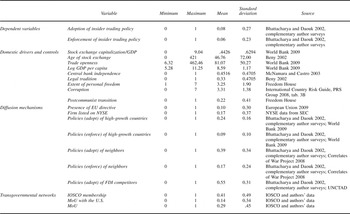
Descriptive statistics and data sources