Introduction
Can rockets be made of plastic? We show that the most mass- and volume-efficient (in terms of thrust and power) and high-performance “rockets” will be enabled by nanomaterials and nanofabrication and that such thrusters operate at room temperature utilizing electrically accelerated ions, in other words, yes, plastic rockets.
For the past few decades, electric propulsion (EP) has been explored and used in an increasing number of space missions because of the important benefits it provides with its high specific impulse (I sp), or amount of thrust force produced per unit weight of propellant used, and the corresponding savings in total mass of the propulsion system relative to chemical thrusters.Reference Jahn1 EP technologies work by creating and accelerating ion or plasma beams using a combination of electric and magnetic fields. The most successful of these technologies are ion engines and Hall effect thrusters, respectively. Ion engines are two-stage devices. The first stage is an ionization cavity where the ion-electron plasma is produced. The second stage is a pair of closely spaced grids biased at high voltage that accelerate ions in the plasma. A Hall thruster has no grids, but instead a magnetic structure that traps electrons, effectively producing the plasma and accelerating the ions in a single stage. Other promising technologies, such as the magnetoplasmadynamic (MPD) thruster, variable specific impulse magnetoplasma rocket (VASIMR), and pulse inductive thruster (PIT), also have the potential to serve the needs of high-power EP.
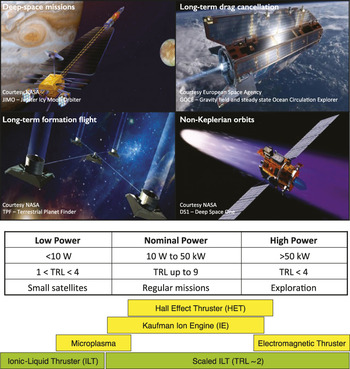
Different technologies are better suited for different applications (see Figure 1). Ion engines with I sp values in the 3000–5000 s range are optimized for deep-space exploration or very long missions, such as orbital maintenance of large communications satellites for which propellant savings are paramount. Hall thrusters, on the other hand, cover better the requirements at higher thrust to power (hence lower I sp at fixed efficiency) in missions such as orbital raising operations and corrections, where emphasis is given to savings in power supply mass. Most of these technologies have been optimized for operation at a range of power levels that serve the needs of specific space missions. For example, a relatively large number of Hall effect thrusters range from ∼200 W in power level to several tens of kilowatts. Despite significant progress, there is still a lack of high-performance (adequately high I sp and high-efficiency) EP devices operating outside this range, namely, at very low and very high power levels.
Existing electric propulsion technologies are optimized for power requirements where they are most efficient. Ionic-liquid thrusters at high array densities can provide power for a range of missions, including deep-space exploration. TRL – Technology Readiness Level scale from 0 to 9 (5–6 is demonstration in space). Upper images modified from originals courtesy of the US National Aeronautics and Space Administration (NASA) and the European Space Agency (ESA).

It has long been recognized that materials research would strongly pace advances in EP, in particular, thruster lifetime and performance of Hall effect thrusters.Reference Martinez-Sanchez and Pollard2,Reference Ahedo3 Resistance to erosion and environmental effects of cathode materials, even at the cost of using higher-work-function materials, has been of consistent interest.Reference Goebel, Watkins and Jameson4,Reference Warner, Branam and Hargus5 Materials research on low-work-function crystalline ceramics has been applied to increasing performance, lifetime, and startup characteristics without heating, through modification of the materials’ work functions using electrons clathrated in subnanometer-sized cages.Reference Farnell, Farnell, Farnell and Williams6,Reference Rand and Williams7
High-performance, but low-power EP would be beneficial in the field of micropropulsion, and main propulsion for small satellites. Very small forces are required by a very specific set of missions that call for extremely accurate positioning control. An example of this is the Laser Interferometer Space Antenna (LISA) and similar missions where forces on the order of 1 µN or lower are needed.Reference Ziemer and Merkowitz8 More relevant is perhaps the field of propulsion for nano- and picosatellites, defined here as vehicles with masses on the order of 10 kg or lower and volumes of a few liters or lower. CubeSats are an example of this relatively new family of small satellites (1 liter, 1 kg) that, given their low cost, fast development times and increased use in educational, scientific, and technology development activities, could easily become the most frequently launched satellites of all time.Reference Waydo, Henry and Campbell9 At the opposite end of the spectrum is very high-power EP propulsion, suitable for demanding missions, including those related to human exploration of the solar system. Powerful EPs, coupled with low mass-to-power electric generators, such as the new generation of multijunction solar arrays and perhaps nuclear reactors, would provide an important capability to expedite the way cargo and crews are moved in interplanetary space, thus minimizing trip times and, very importantly, radiation doses in human space exploration.
Ionic-liquid thrusters (ILTs) are unique EP technologies in that they exhibit direct scaling of thrust power with areal emitter density, whereas other technologies, even in the EP category, are challenging to scale beyond the medium power range where they currently operate. Even scaling to lower power has limits, for example, scaling plasma thrusters to very low power levels while keeping the same level of performance. Many plasma thrusters make use of electron collisions with neutral species to produce ions. These electrons are confined using a magnetic circuit to increase their lifetime in the ionization chamber. If the specific impulse is to remain invariant, then the size of the device should decrease with power as the magnetic field increases to improve confinement in the smaller thruster. More importantly, as the thruster becomes smaller, the mean free path for electron–neutral collisions needs to decrease to retain the same probability of ionization. This means that the number density of particles in the plasma has to increase.
Larger densities result in larger fluxes to the walls, decreasing both the efficiency and the lifetime as a result of increased heat-transfer and erosion rates. On the other side, scaling to high power removes some concerns about confinement and density, although it generally requires a larger thruster, with the associated mass and volume increase. Not surprisingly then, very high-power (100 kW and above) Hall and ion thrusters have significant mass and volume penalties. This is where high-density plasma accelerators such as MPD thrusters could find their niche application. These are relatively compact devices that are able to process power levels in the 100s of kilowatts to several megawatts. The efficiency of MPD thrusters is, in fact, tightly linked to power, and only when operating at the highest levels does the efficiency reach (predicted and inferred) values rarely exceeding 50%. Most of the power that is not used for thrust in MPD thrusters goes as Joule dissipation. What this means is that a very compact thruster such as an MPD thruster operating at high power cannot work continuously unless 100s of kilowatts of heat is removed, to prevent the <0.05 m3 device from reaching temperatures in excess of 1000 K in a matter of seconds.
In this article, we discuss the application of ILTs as an electrospray-based EP technology that should be able to cover the two ends of the power spectrum currently not efficiently covered by other technologies, particularly plasma thrusters. Electrosprays are sources of charged particles (tiny droplets, or ions) electrostatically extracted from an electrically conductive liquid. Nanomaterials and their integration will increase the performance of ILTs at both ends of the power spectrum, but most excitingly, favorable scaling at the high-power end could allow cold rockets that have power densities beyond plasma thrusters. In the United States, both the National Aeronautics and Space Administration (NASA) and the Air Force have identified broad-sweeping applications for nanomaterials,Reference Roco, Mirkin and Hersam10–12 including space. Here, we present the basic principles of operation of ILTs and discuss scaling and the obvious role of nanomaterials, before exploring and deriving possible limits to the operation of very dense arrays (needed for high power) of ionic-liquid thrusters.
Ionic-liquid thrusters
Thrusters (and rockets) such as the ILT are parameterized as a variable-mass system from which key quantities can be extracted (see text later). The performance of any type of EP thruster can be specified by thrust, specific impulse, and power efficiency.Reference Jahn13 The thrust (F) is given by
 $$F = \dot mc\,,$$
where  $\dot m$ is the mass flow (e.g., kilograms per second) of propellants ejected by the rocket at a relative velocity of c [m/s]. This propellant exhaust velocity can be linked to the specific impulse,
 $${I_{sp}} = c/g\,,$$
where g is Earth’s gravitational constant. Although the impulse of a payload is eventually what is needed for a given mission, the specific impulse is more useful for characterizing the performance of a rocket, as it represents the impulse divided by the propellant weight (hence the g in Equation 2). The units of I sp are in seconds, and the higher it is, the better is the “fuel efficiency” of the rocket. This is characterized by the rocket equation,
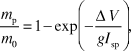 $${{{m_{\rm{p}}}} \over {{m_0}}} = 1 - exp\left( { - {{\Delta V} \over {g{I_{{\rm{sp}}}}}}} \right)$$,
where m p/m 0 is the ratio of the propellant mass to the initial vehicle mass, which depends on the ideal change in vehicle velocity, ΔV, required and the specific impulse, I sp. EP features an I sp, one order of magnitude higher than chemical rockets, leading to a reduced propellant mass ratio. On the other hand, electrical power generation is needed, and the less efficient the thruster is, the heavier the associated power supply will become. The efficiency is defined as
 $$\eta = {{Fc} \over {2{P_{\rm{e}}}}}$$,
where Fc/2 is the useful thrust power and P e is the input electric power. The mass of the power supply is proportional to P e. As a consequence, in electric rockets, there are propellant savings, but also the requirement to carry the electric power supply mass. Overall, there is an optimum I sp value to minimize vehicle mass that for many missions is found to be higher than the I sp value of chemical thrusters, making electric thrusters advantageous.
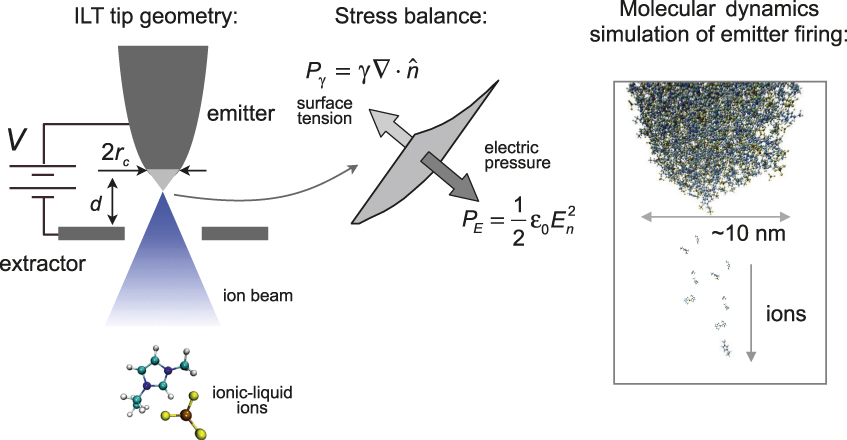
ILTs fall within the class of electric thrusters. Their basic element, a single emitter in an array, is shown in Figure 2. This basic element defines the unit cell of a square array with spacing p, referred to here as the array pitch, thus defining the lateral dimension of the unit-cell element. This parameter determines the scaling of the ionic-liquid thruster array when combined with individual emitter properties.
Schematic of a single emitter of an ionic-liquid thruster (ILT) operating as an ionic-liquid ion source, where the electric field is intensified by the stress balance between surface tension and electric pressure (MIT – Space Propulsion Laboratory).

The unit cell comprises an emitter with an aspect ratio such that the electric field would selectively be several times more intense at the emitter tip than in the troughs. This emitter is manufactured with electrically insulating solid or porous material and bonded to a substrate. A downstream metallic aperture serves as the ion accelerator and extractor. In the ILT, (see Figure 2) the propellant is an ionic liquid (IL),Reference Welton14 rather than a chemical propellant—room-temperature salts are formed exclusively by positive and negative ions with no intervening solvent. ILs have advantageous properties for use in space propulsion; for example, the extremely low vapor pressure of these substances allows them to be exposed to a vacuum with practically no evaporation. The electrically conductive liquid is normally held at the tip of a sharp structure (a single emitter tip or an array of emitter tips in a thruster) while being electrostatically stressed through the application of a voltage with respect to the extractor aperture. Ions of the attracted polarity accumulate at the liquid–vacuum interface, eventually deforming it into a conical meniscus as the electrostatic traction on the liquid surface is balanced by surface tension. This balanced liquid structure is known as a Taylor cone.Reference Taylor15
The electric field at the tip of the liquid cone is large enough to trigger the evaporation and subsequent acceleration of molecular ions.Reference Lozano and Martinez-Sanchez16 Ion-emission properties from ILT sources have been thoroughly characterized. Relevant to propulsion is the observation that, of the approximately 1 keV typically used in producing the ion beams, only about 5 eV is lost in the extraction process.Reference Lozano17 In contrast to plasma thrusters, ILT sources produce ion beams without ionization (in some sense, an ionic liquid could be regarded as “plasma in a bottle”). This means that they do not require an ionization volume and, as such, do not suffer from the scaling limitations described earlier. The overall benefits are too great to ignore compared to plasma sources: potential for very high-efficiency, cold operation and no need for a pressurized propellant, as the propellant itself is stored in the dense liquid phase.
However, ILTs have an intrinsic limitation, namely, the level of current (and therefore thrust) that can be extracted from a single electrified meniscus. Although it is true that the current per emitter is very small (about 1 µA or less), the emitters are so small that arrays of densely packed emitters can be manufactured to bring the total current to a competitive level with respect to plasma thrusters. Several attempts have been made to take advantage of recent advances in microelectromechanical systems (MEMS) technology to produce these arrays.Reference Velásquez-García, Akinwande and Martinez-Sanchez18 For instance, recent work makes use of photolithographic techniques to microfabricate structures in porous metalsReference Courtney, Li and Lozano19 or capillaries in silicon wafers.Reference Dandavino, Ataman, Ryan, Chakraborty, Courtney, Stark and Shea20 An ILT is designed to allow passive capillarity transport of the ionic liquid from an upstream reservoir to about 500 emitters distributed in a 1 cm2 area. Each one of these tips produce a current of about 1 µA for a total thrust density of 0.25–0.5 N/m2, which is not that different from those of most ion engines. With more sophisticated MEMS and nanoelectromechanical systems techniques, as well as an expanded nanomaterials palette with control of morphology and surfaces, it should be possible to pack a significantly higher number of emitters in the same area, thus increasing the thrust density to values competitive even with those of high-power plasma propulsion (and operating at room temperature instead of the limits imposed by refractory materials).
During operation, ILTs need to have two emitters or two arrays of emitters producing ions of opposite polarity to avoid satellite charging. Similarly, electrical neutrality in ion engines and Hall thrusters is achieved through the use of an electron-emitting cathode. Because ionic liquids are formed by both positive and negative ions, there is no need for cathodes in ILTs, as long as careful balance in the delivery of both polarities is provided.Reference Lozano and Martínez-Sánchez21
In addition to electrical neutrality, ILTs are required to operate under conditions that ensure chemical neutrality. As one polarity is extracted in the ion beam, ions of the opposite polarity that stay in the liquid accumulate, forming a double layer of charge at the electrode–liquid interface. When the potential across this charged layer reaches the electrochemical window limit (4–5 V for many ionic liquids), electron transfers (i.e., electrochemical reactions) occur. The consequences of these reactions vary from material loss to surface corrosion and should be avoided to achieve long operational lifetimes. This is achieved by alternating the polarity of the power supply at some frequency that prevents the double-layer potential from growing beyond the electrochemical window limit.Reference Lozano and Martínez-Sánchez21
The prospects for a new type of scalable, compact, flexible, and efficient EP technology based on ILTs depends on the capability to engineer devices at very small scales in a controllable way. These capabilities have been demonstrated in other engineering fields of notable microelectronics, primarily involving micro- and nanofabrication utilizing both bottom-up and top-down processing. The relevant step now is to transfer the outstanding advances in MEMS and nanomaterials to the field of space propulsion. Next, we analyze the physics of ILTs as the scale of the array is reduced. Such scaling provides increased thrust density and also necessitates the introduction of nanomaterials into the ILT devices.
Device and materials scale and limits
We consider direct scaling of the features required to achieve ultradensification of ion-emission sites down to scales at which physical processes could limit the performance of the device or prevent the ion sources from functioning altogether. Thus, we explore the limits of scaling in these devices and identify the most relevant limiting processes to quantify the limits of ionic-liquid thrusters.Reference Spearing22 The first step in that direction requires an understanding of the fundamental scale at which ion emission occurs, namely, the scale of the ion evaporation process.
Ion emission
Ion evaporation from an electrically charged surface can be described as an activated process. In ionic liquids, the energy barrier for ion evaporation, ΔG, sometimes called the energy of solvation, has been determined to be on the order of 1.5 eV.Reference Romero-Sanz, Bocanegra, de la Mora and Gamero-Castano23 A minimum electric field E* is therefore required to obtain macroscopic values of ionic current. This field scales as
 $${E^*} = {{4\pi {\varepsilon _0}} \over e}\Delta {G^2}$$,
with ΔG in electronvolt. Given the solvation energies in ionic liquids, we expect to have critical electric fields of about E* ≈ 1.6 V/nm. These are indeed very high for common engineering devices. However, the deformation of liquid menisci under electric stresses can generate such fields, as the corresponding electric pressure counteracts surface tension. This simple mechanical balance reads
 $${1 \over 2}{\varepsilon _0}{E^{*2}} - {1 \over 2}{\varepsilon _0}{E_{{\rm{in}}}}^2 \approx 2{\gamma \over {{r^*}}} \to {r^*} \approx {{4\gamma } \over {{\varepsilon _0}{E^{*2}}}}\left( {{\varepsilon \over {\varepsilon - 1}}} \right)$$,
and allows us to estimate the emission-area characteristic dimension r* (in m) and, assuming a half-sphere emission area, the total current, I ≈ 2jπr*2, as
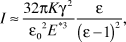 $$I \approx {{32\pi K{\gamma ^2}} \over {{\varepsilon _0}^2{E^{*3}}}}{\varepsilon \over {{{\left( {\varepsilon - 1} \right)}^2}}}$$,
where j = KE in is the current density (per unit area) and E in ≈ E*/ε is the field inside the liquid, assuming poor electric relaxation. Using values for typical ionic liquids of interestReference Lozano, Martínez-Sánchez and Lopez-Urdiales24 (electrical conductivity K ≈ 1 Si/m, ε ≈ 10, and surface tension γ ≈ 0.05 N/m), we obtain r* ≈ 10 nm and I ≈ 100 nA. The result for the total current is very similar to that obtained experimentally in single emitters.
There is a dramatic difference in the dimensional scales between the engineering device used to produce the ion beams and the active region from which ions actually come: from a few millimeters in single emitters or about a 100 μm in arrays of emitters to tens of nanometers for r*. That is up to five orders of magnitude difference in linear dimensions and ten orders for L –2 scaling. In addition, the current is limited to a mere 100 nA, which, translated into thrust for typical conditions, would yield between 5 nN and 10 nN. However, note that this small force corresponds to the approximate weight of a porous nickel conical emitter that is 100 µm on its base and 100 µm tall (i.e., thrust produced would be enough to lift the emitter tip on Earth).Reference Courtney, Li and Lozano25 In fact, such porous emitters are capable of holding up to 10 emitting menisci, producing currents of about 1 µA. One can use Equation 3 directly to find the thrust density achievable by packing together menisci sized by r* (∼10 nm) as
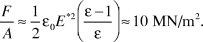 $${F \over A} \approx {1 \over 2}{\varepsilon _0}{E^{*2}}\left( {{{\varepsilon - 1} \over \varepsilon }} \right) \approx 10{\rm{\ MN/}}{{\rm{m}}^2}$$.
As a reference, nominal thrust densities of EP thrusters vary from 2.5 N/m2 for an ion engine and 10–30 N/m2 for most Hall thrusters to 100–1000 N/m2 for MPD thrusters. At the extreme end of the spectrum are high-power chemical engines, such as Saturn V’s F1 engine at 0.6 MN/m2. Although currently unachievable from a device standpoint, there is no fundamental limit apart from r* ≈ 10 nm such that the pitch, p, is at least this small. Recent advances in micro- and nanoengineering could enable the construction of structures with dimensions that, although larger than r*, would still be significantly smaller than the characteristic length scales of current electrospray MEMS devices, thus enabling compact thrusters that are able to work at high specific impulses and thrust densities.
Thus, any limitations on the scalability toward r* will likely come from other physical processes. In particular, space charge, viscous flow, and electrochemical reactions merit closer analysis given their relevance in ILT operation and their likelihood of becoming limiting factor. In any event, even if in foreseeable practical implementations the characteristic dimensions are two or even three orders of magnitude larger than r*, ILT performance would still be very favorable compared to other alternatives.
Space charge
It is well known that space charge imposes a limit on the amount of current that can be extracted from a plasma-based ion engine: Net positive charge between the ion accelerating grids modifies the potential distribution, effectively decreasing the electric field that extracts the charges from the plasma discharge chamber. When the field vanishes, no more charge can be extracted, and the device is said to be space-charge-limited. It would be expected that ILTs will also be limited in a similar way. However, the field is a function not only of space-charge density, but also of geometry. Larger charge densities would be allowed in geometries that promote higher potential gradients. In a regular ion engine, the geometry is fixed, whereas in an ILT, the most relevant geometric influence, namely, the meniscus sharpness, changes according to operating conditions to always give a field of value near E*; otherwise, emission would not occur, and there would be no space charge to begin with. As a consequence, space charge does not limit the emission process, although it could produce beam spreading or other post-acceleration effects, neither of which will prevent the ILT device from operating.
Small-pore flow
As the structures and pore size become smaller when scaling toward ultradense emitter arrays, there will be an increase in the viscous pressure drop, ΔP, due to the liquid flowing through the porous material. If this pressure drop becomes equivalent to the electric stress applied to the liquid–vacuum interface, then the mass flow rate, and consequently, the current that can be extracted from an emitter, will be limited. Thus, the driving pressure will be on the order of 1/2ε0E 2γ/r, with r = R p, the pore radius in the worst case, because, in principle, stronger pressures could be produced by highly curved liquid menisci far from mechanical equilibrium, for which r ≈ r*. According to Darcy’s Law (applicable to low-Reynolds-number flows), the total pressure drop will be
 $$\Delta P = Q\mu {L \over {\kappa A}}$$,
where Q is the volumetric flow rate, A is the cross-section of the flow area, μ is the liquid viscosity, L is the substrate thickness, and κ is the material permeability. Assuming that the substrate thickness and emitter area (the sharpness of the tips) scale as  $L \propto p$ and
 $A \propto {p^2}$, respectively, then the pressure drop will scale with the pitch p as
 $\Delta P \propto {p^{ - 1}}$, with all else constant (such as pore size, which affects permeability). It is clear then that as p is reduced, the pressure drop will increase, and once it becomes larger than γ/R p, emission will not be able to increase. Thus, although viscous flow would not prevent the operation of an ILT, there is no advantage in reaching too small pitch as the thruster output saturates.
Electrochemistry
To fully describe the scaling of ILTs, it is essential to consider the fate of counterions as they accumulate on the electrode in contact with the ionic liquid. Voltage alternation at a frequency f has been effectively introduced in single emitters to mitigate the effects of electrochemical degradation. However, as the emitters become smaller, the effective area in contact with the formed charge double layer does not diffuse as fast as the potential grows closer to the emission site. The diffusion of the double layer could also be slowed by the stronger liquid convection occurring at smaller dimensions. The solution to this problem resides in removing the electrical contact from the ion-emitting region.Reference Lozano and Martínez-Sánchez21 If emitters are fabricated in a conductive material, this is achieved by placing a porous insulating intermediate layer between the emitters and the upstream electrical porous contact. The porosity is used for liquid transport, but importantly, it is also used to increase the contact area for a given electrode volume. This technique is applied successfully in double-layer supercapacitors, where the whole electrode area becomes active during charge and discharge cycles.
Assuming homogenous charging, the double-layer formation can be modeled as a simple parallel-plate capacitor. The maximum charging time before reactions occur will be a function of the electrochemical window (V w) limit for the ionic liquid, the device current I, and the capacitance C,
 $${t_{\rm{w}}} = {C \over I}{V_{\rm{w}}}$$.
This time has to be longer than the alternation time, t w > 1/f; otherwise reactions will occur. The maximum alternation frequency is given by the electrified meniscus formation time, which is dominated by viscous flow. This effectively limits the frequency to values of f < 500 Hz. The capacitance depends on the overall dimensions of the material and, with all else constant, will scale as  $C \propto {p^2}$. Consequently, as p is reduced, there will be a point at which emission will not be possible because of the high alternation frequency required.
The key question here is how small p could be for the total ionic current of the device to continue increasing with the scaling  ${L^{ - 2}} \propto {p^{ - 2}}$. As explained earlier, the fundamental limit would be on the order of r*, but before reaching nanoscale dimensions, space charge, viscous flow, or electrochemistry will become the limiting factors. This assumes that manufacturing is not a limitation at all, which is already a very strong assumption, because it is well known that manufacturability is usually the main barrier to technology implementation. A definite answer to this question will need to come from experimental characterization of devices of increasingly smaller pitch.
From an analytical point of view, we could take each of the identified limitations and assume further geometrical, physical, and chemical characteristics to estimate the minimum pitch p that could be achieved. Detailed mapping of these effects against all degrees of freedom is a very laborious task that, without supporting experimentation, might prove to be unguided at best. Still, we could fix several parameters and estimate the minimum value of p under some particular conditions. For instance, if we take geometrical dimensions of the device (i.e., substrate thickness, radius of curvature of the tip, tip-to-extractor gap, and extractor thickness) to be linearly proportional to p while keeping the emitter aspect ratio and pore size constant, then a simple analysis using the properties of the ionic liquid 1-ethyl-3-methylimidazolium tetrafluoroborate (EMI BF4) indicates that the pitch would be limited to values larger than about 1 μm. Different results will be obtained if material (pore size, aspect ratio) and liquid properties (viscosity, conductivity, surface tension) are changed, so it is possible that, under some specific conditions, values even lower than this could be obtained. It is expected that manufacturing emitter arrays at a pitch of about 1 μm would currently be a formidable task. In all likelihood, it is an unnecessary task indeed, because as explained next, such densities would be vastly superior to what any EP system achieves today, with a margin so wide that relaxation in manufacturability to dimensions >1 μm might be in order.
Array packing density
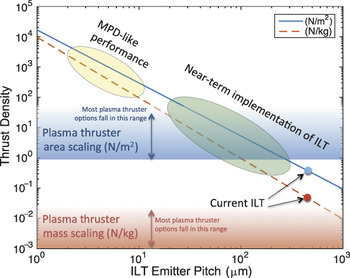
We can now estimate the potential performance of ILT arrays as the pitch is reduced considerably from current practice but not allowed to fall below 1 µm because of the limitations determined in the preceding section. The performance is specified in terms of specific (mass or volume) thrust densities and specific impulse. Figure 3 shows a plot of these thrust densities as a function of pitch from 1 µm to 1 mm, assuming 1 µA of emitted current and voltage scaling as p 1/2. The two circle symbols on the right at p = 450 µm represent the state of the art in laser microfabrication on porous borosilicate glass. When compared with the majority of plasma thrusters, such state of the art has a lower areal thrust density, but already a higher mass (and volume) thrust density. Between 1 µm and 10 µm, the areal thrust density would be similar to that of MPD or very high-power Hall thrusters. It is expected that this particular region might be accessible in the future with advanced manufacturing techniques and carefully engineered materials. However, the region between 20 µm and 200 µm (labeled “near-term implementation” in the plot), would result in ILTs that are competitive with all forms of existing low- and high-power propulsion, except MPD thrusters. What this effectively means is the possibility of implementing vanishingly small propulsion systems for all mission types at high specific impulse and efficiency. In fact, the expected efficiency (excluding power electronics) of ILTs will be about 80%, which is high compared to other forms of EP (60–70% for ion engines and 50–70% for Hall thrusters), but more interestingly, losses occur mostly because of polydispersity in the beam, that is, the fact that more than one ion type is emitted from the liquid surface and some of the heavier ions might break up in flight. These processes effectively “heat” the beam, but not the thruster, so these extraordinarily power-intense devices will literally run cold, except for the moderate ohmic drop incurred during ion emission (about 5–10 V drop out of 1000 V, or less than 1%). This contrasts with the high-temperature operating environment of plasma thrusters, especially on electrodes and other surfaces that could easily reach >1000 K.
Scaling of ionic-liquid thrusters (ILTs) to high power. At pitches p from <10 μm to 100 μm, the ILTs would outperform most plasma thrusters while operating at room temperature, rather than ∼1000 K (MIT – Space Propulsion Laboratory). (MPD- = magnetoplasmadynamic-like performance).

Recent materials advances toward ILT arrays
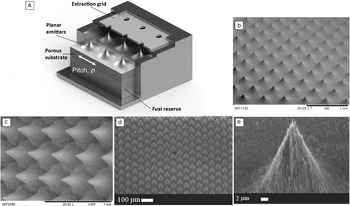
Porous metals have been investigated for ILT application, starting with the electrochemical microfabrication of porous tungsten and nickel. The main reason to choose metals was from previous experience with single emitters made on those materials. However, it was found that, when the electric contact was made directly on the metallic substrate, electrochemical reactions as described previously would occur preferentially at the tips of the emitters, even when voltage alternation was used. Because of this, a distal electrode configuration was introduced that effectively would electrically decouple the emitter substrate from the electric contact.Reference Brikner and Lozano26 The conductivity of the substrate material became irrelevant (except for some detailed physics) with this implementation, thus allowing for the use of dielectric materials, such as glass and ceramics. These materials are advantageous because of their possibility to be micro- and nanostructured through a variety of processes while completely eliminating electrochemical issues. Figure 4 shows a few examples of emitter arrays fabricated in metal, glass, and ceramics.Reference Canonica, Wardle and Lozano27 Except for the ceramic (alumina; Figure 4d–e), all such ILTs have been successfully fired in the laboratory at a pitch of 450 μm.Reference Krejci, Mier-Hicks, Fucetola, Hsu-Schouten, Martel and Lozano28
Fabrication of nanoporous materials into emitter tips with state-of-the-art pitch, p: (a) array schematic, (b–e) scanning electron microscope images of (b) porous nickel array with p = 450 μm,Reference Courtney, Li and Lozano19 (c) porous borosilicate glass with p = 450 μm, (d) nanoporous alumina array with p = 50 μm,Reference Canonica, Wardle and Lozano27 and (e) sharp tip with micron-scale tip radius in textured porous alumina.Reference Canonica, Wardle and Lozano27

Accessing the desired pitch approaching 1 μm, one will need to integrate nanoporous materials, perhaps textured nanoporous materials, into nanofabricated close-packed emitter tips. Techniques such as synthesis of aligned nanowires where porosity can occur within hollow tubes such as carbon nanotubes, or between aligned “solid” highly-packed nanofibers, are likely candidates. Recent work by the authors has explored such nanoporous arrays as supercapacitor elements, including tight packing and conformal polymer coatings.Reference Lachman, Xu, Zhou, Ghaffari, Lin, Bhattacharyya, Ugur, Gleason, Zhang and Wardle29,Reference Zhou, Ghaffari, Lin, Parsons, Liu, Wardle and Zhang30 Higher-fidelity conformal coatings using techniques such as atomic layer deposition are currently being explored.Reference Mackus, Bol and Kessels31,Reference Knez, Nielsch and Niinistö32
Burgeoning manufacturing technologies being developed for application in flexible hybrid electronics, such as self-assembly, additive-driven assembly, and roll-to-roll nanoimprint lithography, accompanied by mature metrology, inspection, and process control, could be harnessed to achieve large scale and low cost. Nanomaterials advances in other fields will likely feed into solutions to enable ILTs to high-power densities, providing cold rockets with thrust densities perhaps outstripping those of all other known technologies. Such performance, scale, and integration characteristics could provide enormous benefits to the size, weight, and power of spacecraft and enable new designs and configurations that will provide the next giant leaps in space science and exploration.
Conclusion
This article describes the fundamental principles of ILTs and their favorable scaling properties towards low- and high-power operation regions. They are different than chemical and other EP technologies, as they run cold and require a vanishingly small volume to ionize propellant. Because of these features, ILTs can be extraordinarily compact and deployable on spacecraft of any size. Since the relevant operational mechanisms of ILTs occur at the nanoscale, the thrust density obtainable from such devices could be larger than other forms of space propulsion. Such implementations are enabled by the use of a variety of materials without thermal concerns. The ILTs’ soft ion-emission process allows them to run at room temperatures, making the use of plastics possible. In the near term, “plastic rockets” could cover the propulsive requirements of small satellites, such as 1-liter, 1-kg CubeSats. These requirements might include orbital maintenance and modification, injection to interplanetary orbits, attitude control and, very importantly, forced reentry at the satellite’s end of life, to prevent the accumulation of space debris. In the future, ILTs could be applied to bigger satellites and other space vehicles. Given their large potential in efficient thrust density, they could substitute other forms of propulsion to bring exploration spacecraft to faraway places in the solar system, a “Giant Leap.”
Acknowledgments
B.L.W. acknowledges support from AFOSR under Grant FA9550-11-1-0192 and NSF under Grant CMMI-1130437. P.C.L. acknowledges support from NASA through contract No. NNL13AA12C and several DOD agencies.