Introduction
Hysterectomy is one of the most common surgical procedures worldwide (Hammer et al. Reference Hammer, Rositch, Kahlert, Gravitt, Blaakaer and Sogaard2015). In more economically developed countries, between 20 and 40% of women will have a hysterectomy by the time they are 60 years old (Redburn & Murphy, Reference Redburn and Murphy2001; Rositch et al. Reference Rositch, Nowak and Gravitt2014). Of the women who have a hysterectomy, between 10 and 55% will also have both ovaries removed (Hammer et al. Reference Hammer, Rositch, Kahlert, Gravitt, Blaakaer and Sogaard2015).
As far back as the 1940s, hysterectomies have been linked with psychiatric disorders and depression (Barker, Reference Barker1968); in 1974 Richards (Richards, Reference Richards1974) used the term ‘post-hysterectomy syndrome’ to describe the wide range of symptoms, including depression, that were experienced by women after having a hysterectomy. Many of these early studies however, had small sample sizes and inconsistent acknowledgement of pre-hysterectomy psychological morbidity. A 2014 review and meta-analysis of 22 studies that assessed women's mental health before and after hysterectomy (with and without oophorectomy) found that symptoms of depression were significantly reduced after hysterectomy, and the major contributing factor to post-hysterectomy depression was pre-surgery depression (Darwish et al. Reference Darwish, Atlantis and Mohamed-Taysir2014). However, nearly all of these studies had relatively short follow-up periods (<2 years follow-up in 20 of the 22 included studies) (Darwish et al. Reference Darwish, Atlantis and Mohamed-Taysir2014).
There is limited longitudinal research that has looked at the association between hysterectomy and the incidence of depressive symptoms in the longer term, allowing sufficient time to eliminate the influence of proximate pre- and post-surgery morbidity and the relief from menstrual symptoms and reproductive concerns. In contrast to studies with shorter follow-up, three studies (Dennerstein et al. Reference Dennerstein, Guthrie, Clark, Lehert and Henderson2004; Rocca et al. Reference Rocca, Grossardt, Geda, Gostout, Bower, Maraganore, de Andrade and Melton2008; Chou et al. Reference Chou, Lin, Cheng, Chang, Tsai, Tsai, Lan and Chan2015), with follow-up from 5 to 29 years, all found a significantly higher risk of depression/depressive symptoms in women who had gynaecological surgery. However, the use of different exposure and comparator groups across these studies limit the conclusions that can be made. One study compared women with a bilateral oophorectomy to women without a bilateral oophorectomy (who may or may not have had a hysterectomy) (Rocca et al. Reference Rocca, Grossardt, Geda, Gostout, Bower, Maraganore, de Andrade and Melton2008); the second compared women with a hysterectomy with ovarian conservation with a control group matched for age and physical comorbidity (Chou et al. Reference Chou, Lin, Cheng, Chang, Tsai, Tsai, Lan and Chan2015); and the third compared women who had a hysterectomy or endometrial ablation to women who had experienced natural menopause (Dennerstein et al. Reference Dennerstein, Guthrie, Clark, Lehert and Henderson2004).
Due to observed differences in a range of health outcomes for women with hysterectomy with or without ovarian conservation (Parker, Reference Parker2010), we were interested in examining the differences in depressive symptoms over the longer term in women with a hysterectomy stratified by their bilateral oophorectomy status, compared with women without a hysterectomy.
It is thought that oestrogen may play a role in mood and cognitive function through modulatory effects on serotonin and noradrenaline neurotransmission (Soares, Reference Soares2014). Both hysterectomy and bilateral oophorectomy have been associated with changes in blood supply to the ovaries and hormone levels as a result of the surgery (Nahas et al. Reference Nahas, Pontes, Traiman, NahasNeto, Dalben and De Luca2003; Xiangying et al. Reference Xiangying, Lili and Yifu2006; Parker et al. Reference Parker, Jacoby, Shoupe and Rocca2009) and as a consequence, a higher proportion of women who have had a hysterectomy/oophorectomy also use menopausal hormone therapy (MHT) than women without a hysterectomy (Blumel et al. Reference Blumel, Chedraui, Baron, Benitez, Flores, Espinoza, Gomez, Gonzalez, Hernandez, Lima, Martino, Montano, Monterrosa, Mostajo, Ojeda, Onatra, Robles, Saavedra, Sanchez, Tserotas, Vallejo and Vallejo2014; Worsley et al. Reference Worsley, Bell, Gartoulla and Davis2016). We therefore were also interested in exploring whether hormone use throughout midlife modifies the relationship between depressive symptoms and hysterectomy status.
In summary, the aim of this study was to investigate the association between hysterectomy status and incidence of depressive symptoms over a 12-year period in a mid-aged cohort of Australian women, and whether the relationships depended on their ovarian conservation status and were modified by the use of MHT.
Materials and methods
Study setting and population
The Australian Longitudinal Study on Women's Health (ALSWH) is a prospective population-based study with a focus on women's health and well-being across the life course. Details of recruitment methods and response rates have been described elsewhere (Lee et al. Reference Lee, Dobson, Brown, Bryson, Byles, Warner-Smith and Young2005; Dobson et al. Reference Dobson, Hockey, Brown, Byles, Loxton, McLaughlin, Tooth and Mishra2015). Briefly, the ALSWH study population consists of three cohorts of Australian women born in 1973–1978, 1946–1951 and 1921–1926, sampled from the Medicare Australia database, which covers all citizens and permanent residents of Australia, including refugees and immigrants. Sampling was random within each cohort, except that women from rural and remote areas were sampled at twice the rate of women in urban areas. Ethical approval was obtained from the Human Research Ethics Committees of the University of Newcastle and the University of Queensland and informed consent obtained from participants at each survey. The first survey for all cohorts was undertaken in 1996 and each cohort has been subsequently surveyed every 2–3 years (Lee et al. Reference Lee, Dobson, Brown, Bryson, Byles, Warner-Smith and Young2005).
Our analyses included data from the cohort of women born in 1946–1951 (mid-cohort). The baseline survey was conducted in 1996 (survey 1, n = 13 715) when the women were aged 45–50 years. Six follow-up surveys (surveys 2–7) took place in 1998 (47–52 years, n = 12 338), 2001 (50–55 years, n = 11 226), 2004 (53–58 years, n = 10 905), 2007 (56–61 years, n = 10 638), 2010 (59–64 years, n = 10 011) and 2013 (62–67 years, n = 9151). As depressive symptoms were only measured from survey 2 onwards, and as we excluded women who reported prior depression at survey 2, this analysis was based on symptoms reported from surveys 3 to 7.
Measures
Hysterectomy/MHT status
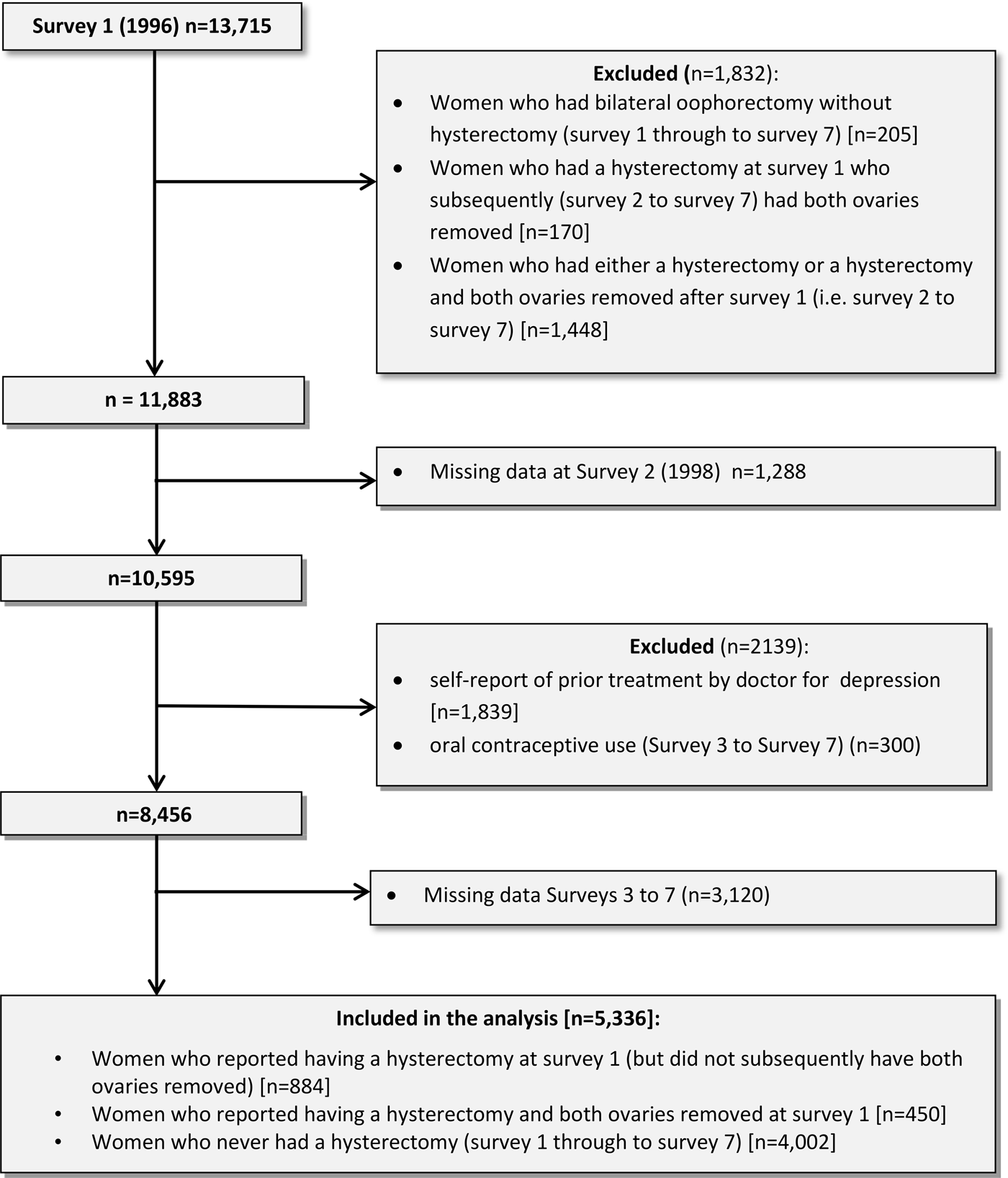
At each survey women were asked a series of questions about their hysterectomy and bilateral oophorectomy status, hormone use (oral contraceptive pills and MHT) and menstrual patterns. At survey 1, participants were asked whether they had ever had a hysterectomy and whether they had ever had both ovaries removed. At all subsequent surveys, participants were asked if they had either of these procedures in the intervening period. Women who reported having a hysterectomy at survey 1 and did not report having both ovaries removed (i.e., with at least one ovary retained) at any survey formed the hysterectomy with ovarian conservation group, henceforth referred to as the ‘hysterectomy only’ group. Women who reported having a hysterectomy and both ovaries removed at survey 1 formed the hysterectomy and bilateral oophorectomy group, henceforth referred to as the ‘hysterectomy–bilateral oophorectomy’ group. Women were included in the ‘no hysterectomy’ group if they still had an intact uterus and both ovaries by survey 7 in 2013. A priori, we excluded women who had both ovaries removed without a hysterectomy at survey 1 through to survey 7, a hysterectomy with or without both ovaries removed after survey 1, and used oral contraceptives at survey 3 to survey 7 (see Fig. 1 for exclusions).
Flow diagram of included and excluded women in study cohort.

While the hysterectomy status of these women did not change across surveys, we created a six-category time-varying variable that reflected their current MHT use: ‘No hysterectomy/No MHT’, ‘No hysterectomy/MHT’, ‘Hysterectomy only/No MHT’, ‘Hysterectomy only/MHT’, ‘Hysterectomy–bilateral oophorectomy/No MHT’, ‘Hysterectomy–bilateral oophorectomy/MHT’.
In a supplementary analysis, we further subdivided the ‘No hysterectomy/No MHT’ group according to their menopausal status (we could not stratify the No hysterectomy/MHT group as MHT use precluded the determination of menopausal status). Women were defined as pre-menopausal (had menstruated in the last 3 months and reported no change in menstrual frequency in the past year); peri-menopausal (reported changes in menstrual frequency in the past year or 3–11 months of amenorrhoea); and post-menopausal (had not menstruated for at least 12 months) (Guthrie et al. Reference Guthrie, Dennerstein and Dudley1999).
Depressive symptoms
From survey 2 onwards depressive symptoms were measured using the 10-item Centre for Epidemiologic Studies Depression Scale (CESD-10) (Andresen et al. Reference Andresen, Malmgren, Carter and Patrick1994), a standardised scale designed to screen for depressive symptoms experienced by women in the week prior to completing the survey. Scores can range from 0 to 30, with scores 10 or higher indicating individuals with significant levels of depressive symptoms (Andresen et al. Reference Andresen, Malmgren, Carter and Patrick1994). In this analysis, we dichotomised the CESD-10 score into women identified as having depressive symptoms (CESD-10 scores of 10 or above) and those that did not (scores below 10). At survey 2, women were also asked if they had ever been told by a doctor that they had depression either in the last 2 years and/or more than 2 years ago. To test associations with new incidence of depressive symptoms, we excluded women who answered yes to either of these response options from our analysis as a proxy for ever experiencing prior depressive symptoms.
Midlife symptoms
Hot flushes and night sweats were assessed at each survey and included in the analysis as a time-varying variable. Women were asked: ‘in the last 12 months, have you had any of the following – (a) hot flushes and (b) night sweats?’ Response options were ‘never’, ‘rarely’, ‘sometimes’ or ‘often’. We combined the hot flushes and night sweats variables into a vasomotor symptoms variable. Women responding as ‘often’ experiencing hot flushes and/or night sweats were categorised as ‘often’ reporting vasomotor symptoms at that survey. Otherwise they were categorised as ‘not often’ experiencing vasomotor symptoms.
Lifestyle factors
All of the lifestyle factors were measured at each survey and were included in the analysis as time-varying variables. Body mass index (BMI; kg/m2) was calculated from self-reported weight (kg) and height (cm) and categorised into ‘<25 kg/m2’ (under/healthy weight), ‘25–29.9 kg/m2’ (overweight) and ‘≥30 kg/m2’ (obese) (World Health Organisation Consultation on Obesity, 1999). Smoking status was categorised as ‘never smoker’, ‘ex-smoker’ and ‘current smoker’, and alcohol consumption as ‘never/rarely drinking’ (less than once a month), ‘low-level drinking’ (≤ 2 drinks/day) and ‘risky/high-risk drinking’ (≥3 drinks/day) (National Health and Medical Research Council, 2001). Physical activity levels were categorised according to minutes of moderate intensity activity: ‘none/low level’ (<150 min/week), ‘moderate level’ (between 150 and 300 min/week) and ‘high level’ (300 or more minutes/week) (Commonwealth Department of Health and Aged Care, 1999).
Socio-economic factors
Highest qualification was ascertained at survey 1 and categorised as ‘less than high school’, ‘high school/trade/diploma’ and ‘degree or higher’. Main occupation and marital status were measured at each survey (and included as time-varying variables) and dichotomised into ‘in paid work’ and ‘not paid in work’ and ‘living with a partner’ and ‘not living with a partner’, respectively.
Statistical analysis
Survey 3 formed our baseline as we used survey 2 data to exclude women who reported that they had previously been treated for depression. This baseline data point was therefore 5 years after the report of ever having a hysterectomy/oophorectomy at survey 1. Characteristics of participants were described according to the prevalence of depressive symptoms (CESD-10 score of ≥10 on any of surveys 3–7) (percentages weighted by area of residence to account for oversampling in rural areas). Differences between groups were assessed by the χ 2 test. The majority of missing data was due to missing information on hysterectomy/MHT status (n = 4158). To assess the impact of missing data we compared the characteristics of those included in the analysis, with those excluded due to missing information. Differences between groups were assessed by the χ2 test.
We estimated relative risks (RRs) with 95% confidence intervals (CIs) for the association between hysterectomy status and incidence of depressive symptoms at surveys 3–7 using generalised estimating equation (GEE) models for binary outcome data stipulating a Poisson distribution and a log-link function with robust error variance (Zou, Reference Zou2004; Yelland et al. Reference Yelland, Salter and Ryan2011). We tested the model using independent, unstructured and exchangeable correlation structures; an independent correlation structure was used in the final model as this gave the most conservative estimates (Twisk, Reference Twisk2013). A woman's depressive symptom status could change from survey to survey. We tested for an interaction between time and hysterectomy status and for interactions between hysterectomy status and all of the covariates considered. Initially, unadjusted RRs were calculated for each variable. We then adjusted for midlife factors, then added lifestyle factors and finally SES factors into the model to see the degree that each set of factors attenuated the association of interest (an interaction term for age at survey 3 and time was also included in all adjusted models to account for the trend with age). GEEs were repeated using the six-category time-varying variable that reflected current MHT use of the women in each hysterectomy group.
To assess the robustness of our results using alternative measures of depression/depressive symptoms and different exclusion/inclusion criteria we conducted the following sensitivity analyses:
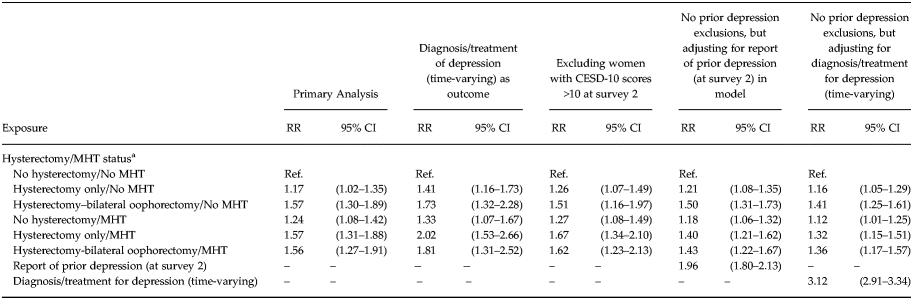
• We excluded women who had depressive symptoms (i.e., a CESD-10 score of ≥10) at survey 2 (n = 2354) instead of only excluding women who reported that they had ever previously been told by a doctor that they had depression.
• Instead of using depressive symptoms (determined by the CESD-10 score) as the outcome, we used self-report of diagnosis or treatment for depression in the preceding 3 years, which was asked at survey 3 to survey 7 with a yes/no response.
• We did not exclude women with prior depression from the analysis but instead adjusted for (i) prior depression (reported at survey 2); and (ii) diagnosis or treatment for depression (time-varying variable).
All statistical analysis was conducted using SAS version 9.4 of the SAS system for Windows, Copyright © 2002–2012 (SAS Institute, Cary, NC).
Results
The sampling strategy with exclusion criteria is summarised in Fig. 1. Of the 13 715 women recruited at survey 1 (1996), 3971 were excluded a priori and a further 4408 were excluded due to missing data (n = 4158 hysterectomy/hormone status; n = 11 depressive symptoms; n = 239 covariate information). In general, the women excluded due to missing data were more likely to have poorer lifestyle habits and lower socio-economic circumstances (online supplementary Table 1).
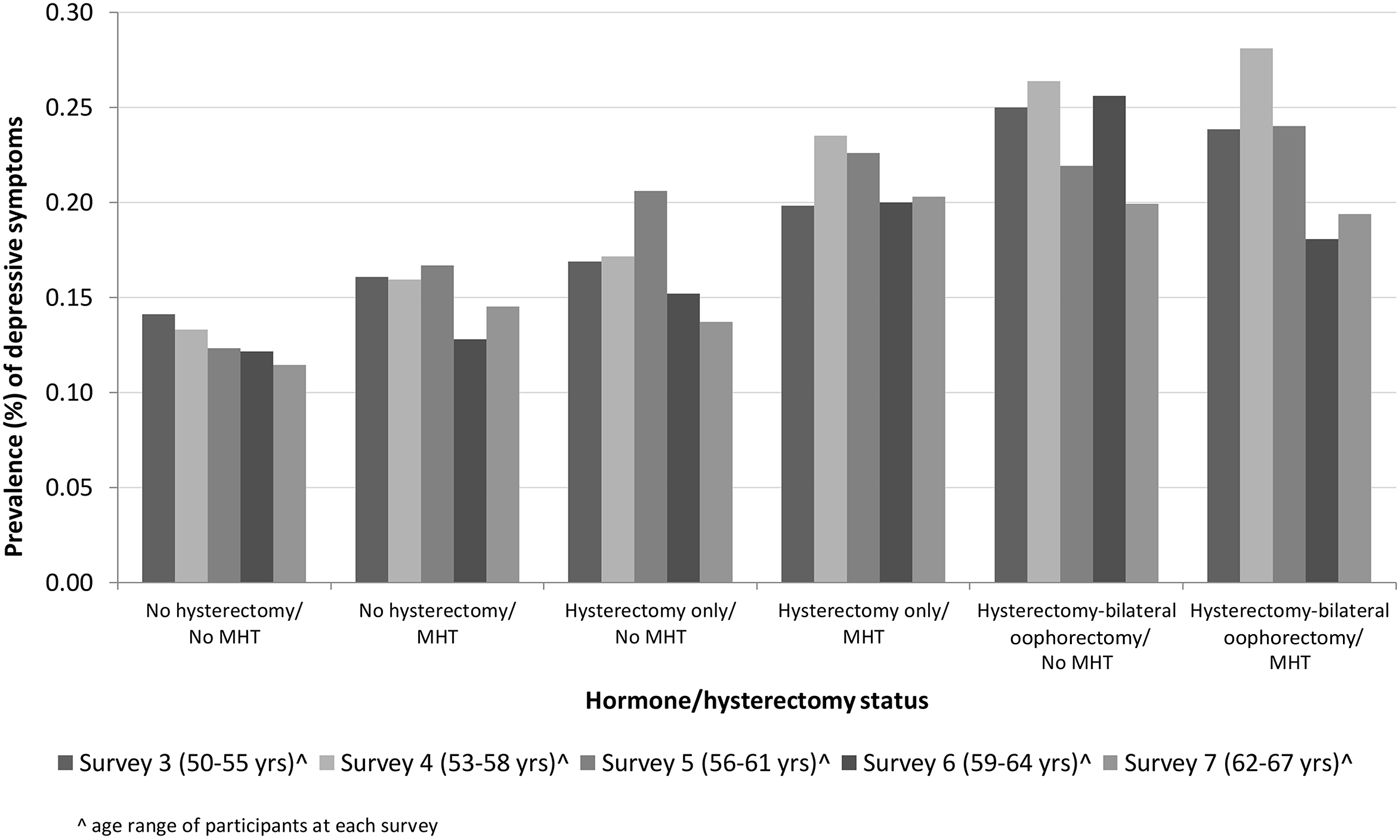
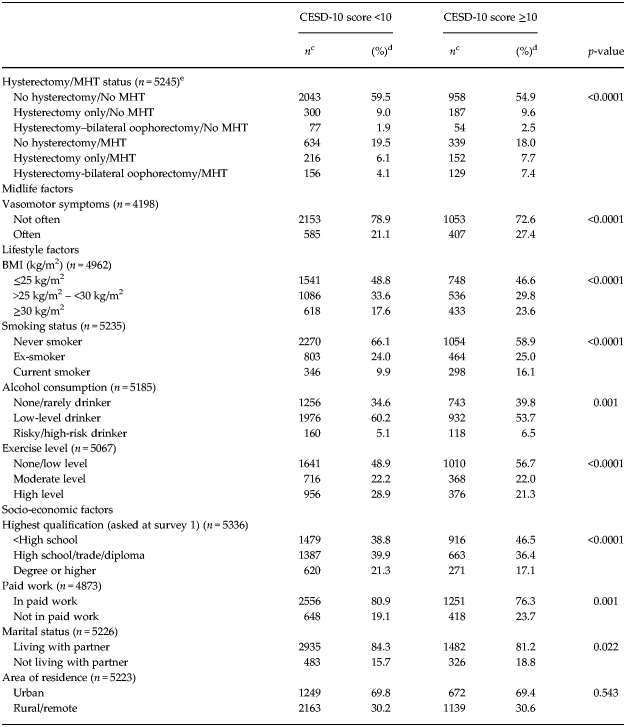
Descriptive characteristics of the women included in our analysis are summarised in Table 1. Women with depressive symptoms differed from women without depressive symptoms on all characteristics except for area of residence. They were more likely to have a hysterectomy (with and without bilateral oophorectomy), often experience vasomotor symptoms, be obese, current smokers, never/rarely drinkers, do no or low levels of physical activity, have a lower education level, not be in paid work or living with a partner (Table 1). The proportion of women experiencing depressive symptoms was higher in 2001 (survey 3) than in 2013 (survey 7) in all of the hysterectomy/MHT groups; however, the no hysterectomy/no MHT group was the only group that showed a clear linear decline in the prevalence of depressive symptoms over the study period (Fig. 2).
Prevalence of depressive symptoms (CESD ≧ 10) by hysterectomy/menopausal hormone therapy (MHT) status at surveys 3–7.

Characteristics of women at survey 3 (50–55 years)a and incidence of depressive symptomsb between surveys 3 and 7

Notes: CESD-10 score, 10-item Centre for Epidemiologic Studies Depression (CESD) scale; n, number; MHT, menopausal hormone therapy.
a Women who had not reported a prior diagnosis of depression at survey 2.
b Defined as a CESD-10 score ≥10.
c Numbers for each characteristic will differ due to missing values.
d Weighted for participants’ area of residence at baseline (1996).
e Hysterectomy only = women reported having a hysterectomy only at survey 1 and did not subsequently have both ovaries removed (surveys 2–7); Hysterectomy–bilateral oophorectomy = women who reported having a hysterectomy and both ovaries removed at survey 1; No hysterectomy = women who had an intact uterus and both ovaries from survey 1 through to survey 7; MHT – women in the three hysterectomy groups who reported current use of MHT (time-varying).
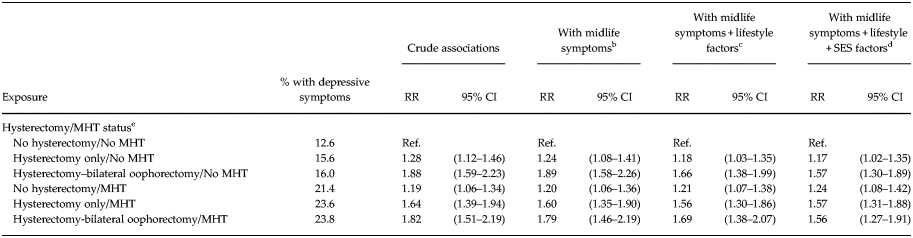
In the GEE analysis, the association between hysterectomy status and incidence of depressive symptoms did not change over time. In a model comparing women with and without hysterectomy/oophorectomy, adjusted for current MHT use, midlife symptoms, lifestyle and socio-economic factors, women with a hysterectomy only and women with a hysterectomy–bilateral oophorectomy had a higher risk of depressive symptoms compared with women who never had a hysterectomy (RR 1.20; 95% CI 1.06–1.36 hysterectomy only and RR 1.44; 95% CI 1.22–1.68 hysterectomy–bilateral oophorectomy). There were differences in the strength of the risk for women with a hysterectomy only when the groups were stratified by current MHT use (Table 2). Compared with women in the no hysterectomy/no MHT group, women in the hysterectomy only/MHT group had a higher risk of depressive symptoms (RR 1.57; 95% CI 1.31–1.88) than the hysterectomy only/no MHT group (RR 1.17; 95% CI 1.02–1.35). Women in the no hysterectomy/MHT group also had a higher risk but of a lesser strength (Table 2). Among women with a hysterectomy–bilateral oophorectomy, the risk was not attenuated by MHT use (RR 1.57; 95% CI 1.30–1.89 non-MHT users; RR 1.56; 95% CI 1.27–1.91 MHT users) (Table 2). When we tested for interactions between hysterectomy status and other covariates included in the model, none reached statistical significance.
Relative risks (95% CI) for the associations between hysterectomy/MHT status and incidence of depressive symptomsa with midlife, lifestyle and SES factors included in the model

Notes: CESD-10 score, 10-item Centre for Epidemiologic Studies Depression (CESD) scale; RR, relative risk; CI, confidence interval; MHT, menopausal hormone therapy.
a defined as a CESD-10 score ≥10.
b Adjusted for vasomotor symptoms and an interaction term between age at survey 3 and time.
c Adjusted for vasomotor symptoms, body mass index, smoking status, alcohol consumption, level of physical activity and an interaction term between age at survey 3 and time.
d Adjusted for vasomotor symptoms, body mass index, smoking status, alcohol consumption, level of physical activity, highest qualification level, in paid work, marital status and an interaction term between age at survey 3 and time.
e Hysterectomy only = women reported having a hysterectomy only at survey 1 and did not subsequently have both ovaries removed (surveys 2–7); Hysterectomy–bilateral oophorectomy = women who reported having a hysterectomy and both ovaries removed at survey 1; No hysterectomy = women who had an intact uterus and both ovaries from survey 1 through to survey 7; MHT – women in the three hysterectomy groups who reported current use of MHT (time-varying).
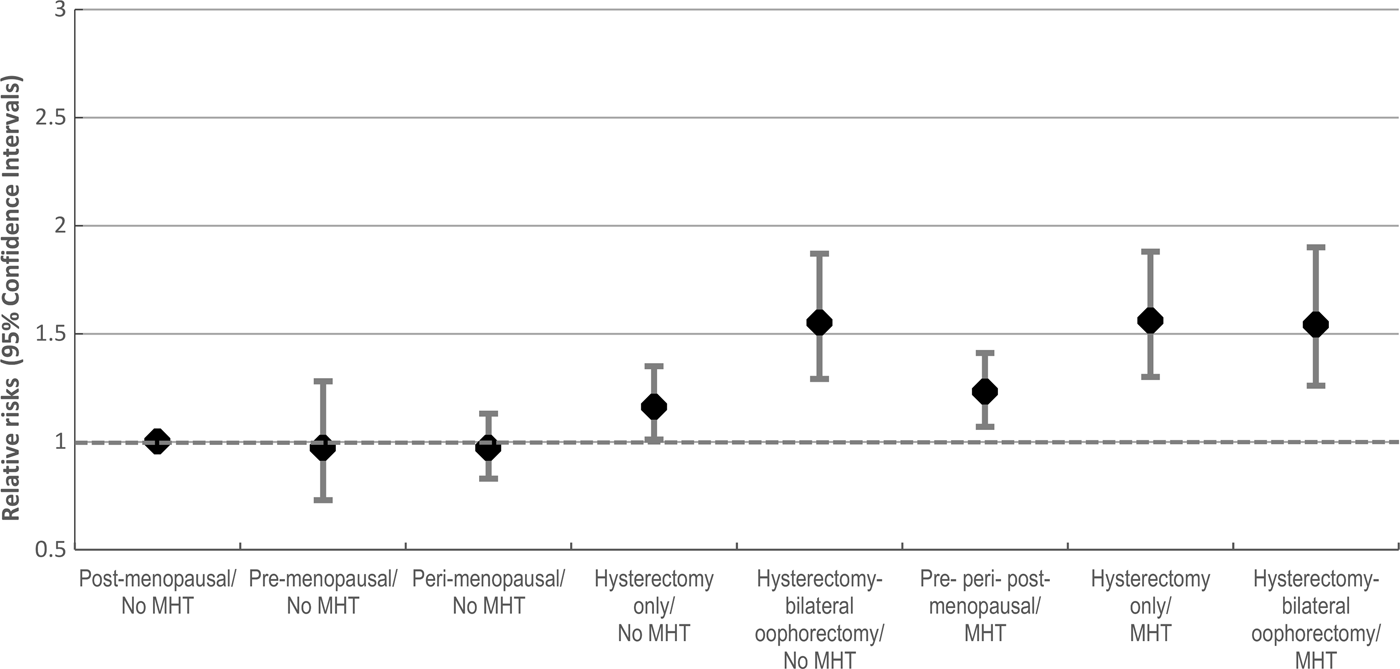
In the supplementary analysis where we further subdivided the ‘No hysterectomy/No MHT’ group according to menopausal status, there was no difference in risk of depressive symptoms between pre-menopausal, peri-menopausal and post-menopausal women that were not using MHT (Fig. 3).
Forest plot showing associations between hysterectomy/menopause/menopausal hormone therapy (MHT) use and depressive symptoms.

Associations between hysterectomy status (stratified by MHT use) and depressive symptoms were robust in all of our sensitivity analyses (Table 3).
Summary of sensitivity analysis (RRs and 95% CIs) – hysterectomy/MHT status and depressive symptoms

Notes: CESD-10 score, 10-item Centre for Epidemiologic Studies Depression (CESD) scale; RR, relative risk; CI, confidence interval; MHT, menopausal hormone therapy.
All Models are adjusted for: vasomotor symptoms, body mass index, smoking status, alcohol consumption, level of physical activity, highest qualification level, whether in paid work, marital status and an interaction term between age at survey 3 and time.
a Hysterectomy only = women reported having a hysterectomy only at survey 1 and did not subsequently have both ovaries removed (surveys 2–7); Hysterectomy–bilateral oophorectomy = women who reported having a hysterectomy and both ovaries removed at survey 1; No hysterectomy = women who had an intact uterus and both ovaries from survey 1 through to survey 7; MHT – women in the three hysterectomy groups who reported current use of MHT (time-varying.).
Discussion
To our knowledge this is the first longitudinal study that has examined the relationship between depressive symptoms in women with a hysterectomy (with and without a bilateral oophorectomy) compared with women without a hysterectomy over a long-time period. In our study, the incidence of depressive symptoms was measured over a 12-year period, with the first measurement occurring at least 5 years post-surgery to minimise the influence of pre- and post- surgical morbidity. We found that women with a hysterectomy (with and without a bilateral oophorectomy) were at higher risk of depressive symptoms than women without a hysterectomy. Of note is our finding that while MHT use did not attenuate the association between hysterectomy and depressive symptoms in women with a hysterectomy and bilateral oophorectomy; there was an increased risk of depressive symptoms in MHT users who never had a hysterectomy or had a hysterectomy with ovarian conservation than their non-MHT using counterparts.
Our study, although not directly comparable, is consistent with findings from previous longitudinal studies. In the Mayo Clinic study (Rocca et al. Reference Rocca, Grossardt, Geda, Gostout, Bower, Maraganore, de Andrade and Melton2008), depressive symptoms were assessed approximately 24 years post-surgery and women who had a bilateral oophorectomy before menopause had an increased risk of depressive symptoms diagnosed by a physician (HR = 1.54, 95% CI 1.02–2.26) compared with women, age-matched from the same population, who had not had a bilateral oophorectomy (although they could have had a hysterectomy with both ovaries retained). A Taiwanese retrospective matched cohort study (Chou et al. Reference Chou, Lin, Cheng, Chang, Tsai, Tsai, Lan and Chan2015), with a least 5 years of follow-up, found that women with a hysterectomy (with both ovaries conserved) had a higher risk of depression (HR = 1.78; 95% CI 1.46–2.18) compared with the control group (matched for age and physical co-morbidities). An Australian study (Dennerstein et al. Reference Dennerstein, Guthrie, Clark, Lehert and Henderson2004) that followed 314 women aged 45–55 years at baseline for 11 years found that while all women showed a decrease in depressive mood scores over the follow-up period, women who experienced surgical menopause (defined by women who experienced a hysterectomy or endometrial ablation) had significantly higher scores of depressed mood than women who were naturally post-menopausal.
There may be a range of reasons for the higher risk of depressive symptoms seen in women with a hysterectomy (with and without bilateral oophorectomy) in our study. Qualitative studies have shown, that even some distance post-surgery a number of women who have had a hysterectomy may feel a sense of loss or regret if they were unable to have the number of children they hoped for (Cabness, Reference Cabness2010); in addition, women who have had both ovaries removed may no longer believe that they are ‘completely female’ impacting upon their levels of self-belief and self-worth (Elson, Reference Elson2003). These factors may be affecting these data, with the women in our study all having a hysterectomy before age 50, but would be expected to attenuate when the women are in their 60s.
Biologic mechanisms may relate to oestrogen exposure which is thought to play a role in mood and cognitive regulation (Soares, Reference Soares2014). Pre- and peri-menopausal women who have a hysterectomy with bilateral oophorectomy experience an abrupt reduction in oestrogen levels resulting in immediate menopause (Whiteman et al. Reference Whiteman, Staropoli, Benedict, Borgeest and Flaws2003; Sarrel et al. Reference Sarrel, Sullivan and Nelson2016). Studies have also shown that women with a hysterectomy with conservation of one or both ovaries can also experience changes in hormone levels and blood supply to the ovary post-surgery (Nahas et al. Reference Nahas, Pontes, Traiman, NahasNeto, Dalben and De Luca2003; Hehenkamp et al. Reference Hehenkamp, Volkers, Broekmans, de Jong, Themmen, Birnie, Reekers and Ankum2007; Moorman et al. Reference Moorman, Myers, Schildkraut, Iversen, Wang and Warren2011), which may precipitate early ovarian failure and menopause (Farquhar et al. Reference Farquhar, Sadler and Stewart2008).
As oestrogen levels are related to mood, we anticipated that MHT users would be less likely to experience depressive symptoms. However, we found that hormone use was not protective against depressive symptoms, and indeed seemed to be associated with a higher risk of depressive symptoms in women without a hysterectomy and women with a hysterectomy with ovarian conservation.
The reasons behind these results are not clear. While MHT has been promoted to treat depressive symptoms, there appears to be a ‘critical window’ for use, with studies showing that MHT is an effective treatment for depression in the peri-menopause, but not the post-menopause period (Payne et al. Reference Payne, Palmer and Joffe2009; Soares, Reference Soares2014). All of the women with a hysterectomy in our study were at least 5 years post-surgery, and about 70% of women without a hysterectomy reported being post-menopausal at survey 4, so potentially beyond the window of effective treatment. Conversely, it is possible that the women without a hysterectomy and the women with a hysterectomy with ovarian conservation who were MHT users were being prescribed MHT to treat a range of peri-menopausal symptoms, including depressive symptoms; however, their depressive symptoms persisted even with this treatment, resulting in confounding by indication.
We also wondered whether there may be a ‘push’ factor with hormone use, i.e. that women who have gynaecological surgery may visit their health practitioners more often (due to poorer overall health), and as a consequence be more likely to be prescribed MHT. When we investigated this, while women with a hysterectomy in our cohort were more inclined to rate their health poorly and more likely to visit their GP more often over a 12-month period, this did not explain the differences that we found (results not shown). We also explored the potential impact of physical health problems and stressful life events; however, the mental health of women with a hysterectomy remained compromised after consideration of these factors (results not shown).
Our study had a number of strengths and limitations. Key strengths of the study include the large community-based sample of ALSWH, the longitudinal nature of the analysis and the breadth of information collected. Depressive symptoms were measured by the same validated instrument at each survey, and we were able to exclude women who reported that they had previously been treated for depression. Follow-up was for more than a decade and our analysis commenced with data that was measured at least 5 years after women had their surgery, so our results were unlikely to be contaminated by psychological reactions directly related to the surgery.
Although we had missing data on hormone/hysterectomy status, we had a large study sample of 5336 women of which 25% (n = 1334) had a hysterectomy. In addition, the observed characteristics of the women with missing data (poorer lifestyle habits, lower socio-economic status) suggests that the association is true and if any bias is present it is more likely to be an underestimate.
Limitations of the study are that hysterectomy and bilateral oophorectomy status was collected by self-report. While the validity of self-report of hysterectomy is consistently high, the validity of self-reported status of bilateral oophorectomy may be less reliable (Colditz et al. Reference Colditz, Stampfer, Willett, Stason, Rosner, Hennekens and Speizer1987; Phipps & Buist, Reference Phipps and Buist2009); however, this bias is only likely to affect the distribution between the two hysterectomy groups. We also could not ascertain whether the women in our hysterectomy only group had a unilateral oophorectomy or retained both ovaries and we did not have information on the type of hysterectomy performed (e.g., total, sub-total), so we could not investigate whether there may have been differences according to unilateral oophorectomy status or hysterectomy type. Our capacity to explore any potential physiological mechanisms was limited as we did not have any information on the diagnostic indications for hysterectomy. As a result, we were unable to exclude women who had a hysterectomy for malignant conditions; although in a sensitivity analysis when we excluded women who reported that they had ever been told by a doctor that they had breast, cervical, bowel or other cancer (women who reported skin cancer were not excluded), the results did not change (data not shown). Furthermore, we were able to stratify our analysis by current hormone use; however, we did not have information on the type, dose or route of MHT used or age at initiation, so we could not ascertain their impact on the relationships. Finally, approximately 90% of study participants were from English-speaking backgrounds, so our results may not be applicable to women from other cultures.
Conclusions and future research
We have identified that even 5 years or more post-surgery, women with a hysterectomy (with and without bilateral oophorectomy) have a higher risk of new incidence of depressive symptoms. Use of MHT did not confer a protective effect. Further research investigating the type, duration and age at initiation of MHT use by hysterectomy status is needed to shed further light on the role exogenous hormones can play in the incidence of depressive symptoms in midlife. Future research should also explore whether the indications for hysterectomy (such as endometriosis, fibroids and dysfunctional uterine bleeding) play a differential role in depressive symptoms.
Supplementary material
The supplementary material for this article can be found at https://doi.org/10.1017/S2045796016001220.
Acknowledgements
The research on which this paper is based was conducted as part of the Australian Longitudinal Study on Women's Health by the University of Queensland and the University of Newcastle. We are grateful to the Australian Government Department of Health for funding and to the women who provided the survey data.
Financial support
The Australian Longitudinal Study on Women's Health is funded by the Australian Government Department of Health. G.M. was supported by an Australian Research Council Future Fellowship (FT120100812). The funders had no role in study design, data collection and analysis, decision to publish or preparation of the manuscript.
Conflicts of Interest
None.
Ethical standards
Ethical approval for the Australian Longitudinal Study on Women's Health was obtained from the Human Research Ethics Committees of the University of Newcastle and the University of Queensland.
Availability of data and materials
The data underlying this study are owned by the Australian Government Department of Health. The process for data access is documented on the Australian Longitudinal Study on Women's Health (ALSWH) website [http://www.alswh.org.au] which includes all the survey questionnaires, data books of frequency tables for all surveys, metadata, conditions of data access and request form.