Introduction
Most universities offering health professional programs have two primary components in both undergraduate and post-graduate programs. These two components combine the factual or academic component, that provide the scientific and theoretical basis of the profession, and the professional or clinical component of each profession.
The experiences and issues students face when undertaking each of these components can vary significantly. Many tertiary institutions have formative and summative feedback mechanisms in place that provide information on the student experience in the academic component of their programs. Providing feedback on the experiences of students during their professional placement can be more difficult as the experience may vary significantly from program to program, from one clinical site to another and from student to student.
There is a vast range of literature that discusses those issues and experiences that have been known to affect health professional students during their professional placement. Issues that confront students on placement include developing and managing patient interaction and empathy attitudes and skills, managing on the job learning and the development of practical skills, developing professional knowledge and awareness, as well as concepts linked to making the theory–practise connection. Most of the research related to these outcomes has come from the study of students in the professions of nursing, physiotherapy, medicine and dentistry.Reference Patton, Woods, Agarenzo, Brubaker, Metcalf and Sherrer1–Reference Williams, Wessel, Gemus and Foster-Seargeant7 There is a lack of published literature that focuses specifically on the professional placement experiences of radiation therapy (RT) students.
The environment in which radiation therapists routinely work varies greatly from that associated with other allied health professions. The large technical role and its state of rapid and ongoing change is coupled with a highly challenging humanitarian care givers role, which combined creates a unique environment for radiation therapists to work and learn in. Radiation therapists work in an intimate and unique team environment, relying on colleagues for not only professional competence but also for professional and emotional support. Hence, it is extremely problematic to generalise the findings of studies in health professions that work in a different way with the experience of RT students while on professional placements.
At the University of Newcastle, Australia, within the Bachelor of Medical Radiation Science (RT) (BMRS-RT) program, students are required to complete 25 weeks of professional placement in a clinical facility over five placement periods. During each of these placement students are required to complete a range of written reports, one of which is a Personal Reflective Journal. This journal is an unguided freeform journal and is assessed formatively to provide information sharing between the university staff and the student about their insights and reflections during professional placement. Part of the information that is provided to students about this task includes the following instructions:
Write a report assessing your achievements and progress in this block. Include new or different techniques you took part in or observed, your progress in communication skills and team work, any problems you experienced and how you feel these could be addressed. Do not make this a critique on the centre but address it to your own personal performance8 [p. 16].
These Personal Reflective Journals are a great source of feedback and insight into the experiences of RT students while undertaking professional placement. The journals, however, have only ever been read for the feedback they may contain to inform the academic staff who monitor the students during and after placement. This information is used to further support students during debriefing sessions held after professional placement where professional placement issues are discussed globally with the entire cohort. The journals have not been, until this research, subject to a research-led review and analysis.
The research reported in this paper aims to
1. Complete a qualitative analysis of the personal reflective journals of RT students completed during professional placement to uncover the issues that affect students on placement.
2. Investigate how the issues identified within the journals may vary as students progress through the program.
Method
Participants and setting
This study included the reflective journals (text-based unstructured freeform journal entries) from a cohort of RT students at the University of Newcastle, Australia. The reflective journals were completed during all five professional placements over the 3 years of the program, and they were collected with the written informed consent of each. The journals were de-identified for the purposes of all reading and analysis within this research, and they were not traceable in relation to students or the clinical centres attended by the students. The study was approved by the University of Newcastle, Australia, Human Research Ethics Committee.
Methodological framework
A qualitative descriptive analysis (QDA) is the methodological framework of choice for the qualitative analysis of the written journal entries. QDA is derived from naturalistic inquiry research methods, with the analysis attempting to remain as close to the data as possible, with very little interpretation applied to the data to be analysed. Because of the predetermined, de-identified and non-traceable nature of the data, a phenomenological or narrative inquiry approach was not suitable.Reference Findlay, Dempsey and Warren-Forward9 Following the principles of a QDA, a descriptive content analysis was undertaken on the sample of journals used within this study.
Sampling techniques
Purposeful sampling was utilised to define an appropriate sized sample for analysis of the student journals. Purposeful sampling was achieved by the researchers reading all the journals and highlighting the useful reflective information provided in each of the journals, as well as reflecting on the journal entry in its entirety. For ease of journal and data management, a comment both qualifying and quantifying the level of descriptive content in the journal, from low to moderate to good, was recorded on the top cover of the journal. If the entry provided little to no insight into the clinical experience of the student on placement, then the journal was removed from the sample and discarded from the QDA section of the project.
Sourcebook development
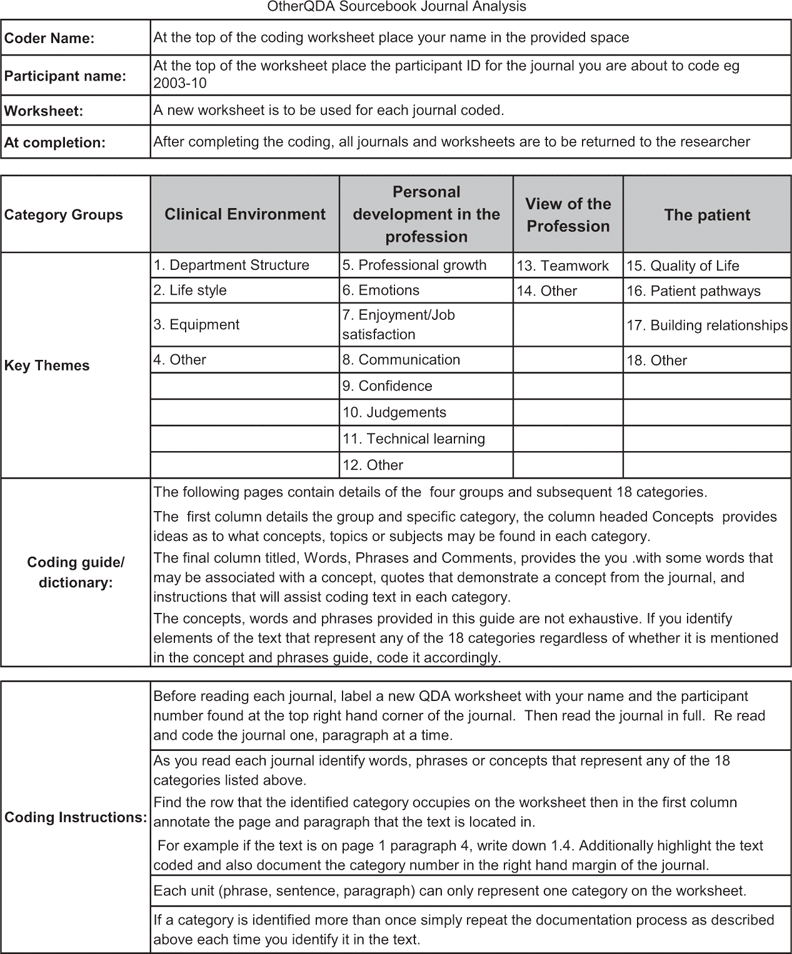
Essential to descriptive content analysis is a well-written sourcebook and worksheet that facilitate the coding of categories of description of student reflections that are uncovered from the reading of the individual journals. The categories of description of professional placement were derived by the authors from their qualitative review of the journals. A sourcebook was developed, which included the framework of major categories of description and subcategories of each category to be coded (Table 1), a coding guide, and coding instructions. The hard copy worksheet consisted of a simple table that allowed coders to document each subcategory when it was identified within the text. Full details of the sourcebook development are available in a previous publication.Reference Findlay, Dempsey and Warren-Forward9
Rules governing the QDA coding process (exert from Sourcebook)Reference Findlay, Dempsey and Warren-Forward9

Coder training
Two coders were recruited to independently code the journals. Coder one was a 22-year-old female radiation therapist, and coder two was a 23-year-old male radiation therapist. Both coders were currently working in Radiation Oncology Centres within Australia, and both had completed degrees in RT in 2006. Both had used reflecting journaling when students within their degree.
Training consisted of orientation to the sourcebook and worksheets, discussion concerning the importance of the bracketing of their own preconceptions to the research and research outcomes, and discussion concerning confidentially and the requirement to maintain independence from each other when coding the journals. The training ensured that the coders were fully aware and understood the variables of the study and the measures to be used, however, they were intentionally kept unaware of the aim or purpose of the research so as to reduce the risk of coding bias.
Initial coder training involved five student journals being randomly selected and both coders coding the journals. The level of agreement of the initial coder training was assessed using κ co-efficient and absolute agreement. κ coefficients were calculated using STATA 11 by StataCorp. Coder training also involved open discussion about the coding system being used and discussions about changes to be made to the coding system.
No revision of the sourcebook was required as a result of the initial coder training. A second round of pilot coding was repeated on another randomly generated sample of 12 journals, excluding the initial five journals used. Again inter-coder reliability was again assessed using κ and absolute agreement, providing pilot inter-coder reliability results.
Journal analysis
The unit of data to be evaluated were the text response of students structured into sentences and paragraphs within the journals. The journals could contain a single or multiple units (words and sentences) that represented one of the major categories or subcategories of description within the framework.
The two independent coders completed the descriptive content analysis of the journals. The coding was governed by a set of rules outlined in the QDA sourcebook (Table 1).
The results of the analysis were entered into an excel spreadsheet and descriptively analysed across the four developed major categories of description determined by the authors, these being reflections about
• the Clinical Environment;
• Personal Development within the Profession;
• the View of the Profession; and
• the Patient.
as well as the 18 subcategories of description. Results were entered into a contingency table and χ 2 analysis was undertaken to identify the
a. Statistically significant differences in the evidence of each category and subcategory as the students progressed across the 3 years of the program.
b. Statistically significant linear trend in the evidence of each category and subcategory as the students progressed across the 3 years of the program.
Following the completion of the coding inter-coder reliability, statistical analysis was completed over the entire sample for each category and for all categories combined, providing final validity results for the QDA. Absolute agreement was also calculated for all categories and subcategories between the coders.
Results
Sample size
The original sample size of 97 Personal Reflective Journals was subject to the purposeful sampling process described earlier in the ‘Methods’ section. The total number of journals included in the final analysis was reduced to 46 following the purposeful sampling, with 14 year 1 journal, and 16 years 2 and 3 journals (Figure 1).
Distribution of the number of journal entries over the years before and after the purposeful sampling.
Coder training
This initial coder training provided an absolute agreement across the four major categories of description and 18 subcategories of 80% with both sets of analysis being statistically significant (where p < 0·05). A κ co-efficient of 0·69 (p < 0·001) for the four major categories of description, and 0·53 (p < 0·001) for the 18 subcategories, was achieved during initial coder training.
Pilot coder training on the 12 randomly selected journals had an absolute agreement of 60·3% and a κ co-efficient of 0·49 (p = < 0·001) across all four categories. For the 18 subcategories, absolute agreement of 73·1% and a κ co-efficient of 0·48 (p = < 0·001) were achieved.
Coding results
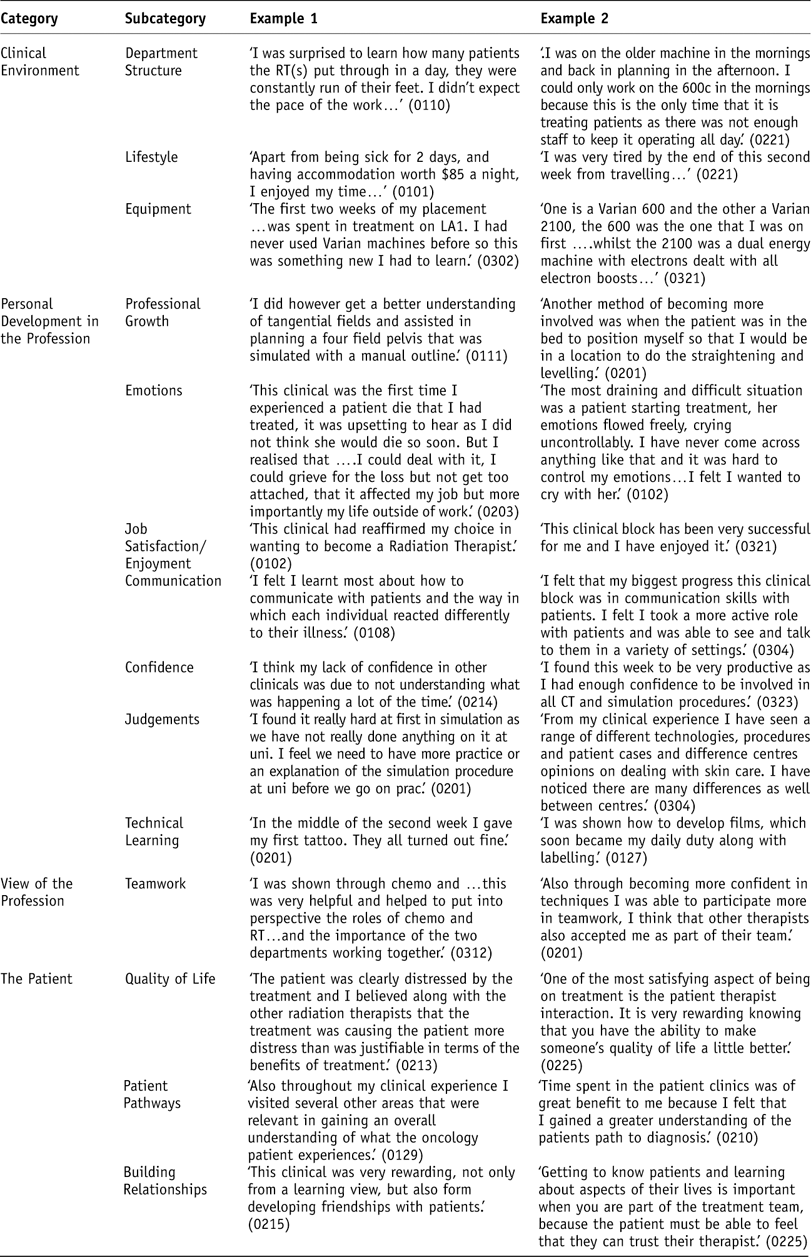
A rich description of each of the categories and subcategories was identified within the journal text analysis. Table 2 shows examples of the journal entries completed when students discussed each of the categories and subcategories within the coding sourcebook from across varying years of the program. The QDA identified the percentages of students that discussed each of the categories as they progressed from year 1 to year 3 of the program (Figure 2).
Example of student's descriptors for both the categories and subcategories
Code 0110 means year 1 student 10, 0221 year 2 student 21 and 0302 year 3 student 2.
Box and Whisker plot showing the percentage of students that wrote about each of the four categories, broken down by years of the program (data combined for both coders).
There was a significant increasing tendency for students to discuss the Clinical Environment more as they progressed through the five professional placements, 35·7–81·3% (coder 1, first to third year) and 42·9–1·3% (coder 2, first to third year). Both coders results demonstrated a statistically significant linear trend in the increasing incidence of this category as the student moves from year 1 to year 3 of the degree (coder 1, p = 0·01, coder 2, p = 0·03).
There was also a significant decreased tendency to discuss the Patient, 92·9–12·5% (coder 1) and 85·7–18·8% (coder 2), as they progressed through the program. A statistically significant difference (coder 1, p < 0·001; coder 2, p = 0·001) and linear trend (coder 1, p < 0·001; coder 2, p = 0·001) was identified in the number of students discussing this category within their clinical journals.
All students discussed at high levels their Personal Development in the profession through every year of the program, and the discussion about the View of the Profession varied across the 3 years of the degree.
The analysis of the 18 subcategories and the percentage of students that discussed these in their journals over the 3 years of the program was calculated. Both coders indicated students increasingly commented on the clinical centre's department structure as they progress through the program, 14·3–81·3% (coder 1) and 28·6–75·0% (coder 2). There was a decreased trend to comment on the lifestyle impacts of professional placement from 1st to 3rd year 21·4–6·3% (coder 1 and 2).
In the category of personal development within the profession, both coders identified an increasing occurrence of comments on professional growth, 85·7–93·8% (coder 1) and 64·3–93·8% (coder 2), and making judgements, 14·3–68·8% (coder 1 and 2, first to third year). Within the same category, a decreasing trend in discussing job satisfaction and enjoyment, 100–87·5% (coder 1) and 100–37·5% (coder 2) were evident. The journals revealed that students discussed the concepts surrounding teamwork more in year 2, than in other years of the program (coder 1, 42·9% year 1, 68·8% year 2 and 31·3% year 3 and coder 2, 57·5% year 1, 68·8% year 2 and 31·3% year 3).
In the Patient category, the subcategories of patient pathway and building relationship decreased in frequency within the journals as students moved through the program; patient pathways, 64·3–12·5% (coder 1) and 42·9–6·3% (coder 2); building relationships, 78·6–0% (coder 1) and 64·3–6·3% (coder 2).
Of these changes the subcategories of ‘Department Structure’, ‘Confidence’ and ‘Judgements’ showed a statistically significant change in their incidence within the journals and also a statistically significant linear trend increasing as the students progressed through the program. While the subcategories of ‘Enjoyment/Job Satisfaction’, ‘Patient Pathways’ and ‘Building Relationships’ also showed a statistically significant decrease in incidence as students progressed through the program.
Coder agreement
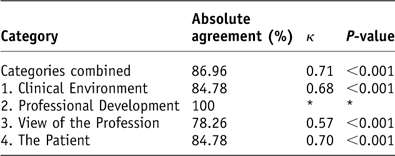
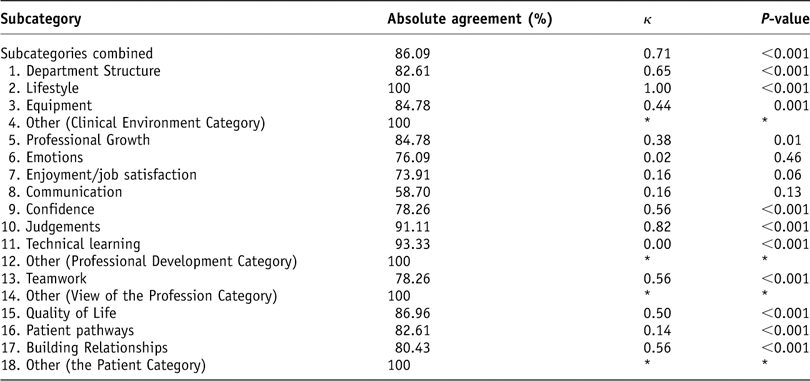
Absolute agreement between the coders was good to excellent (73·9–100%; Tables 3 and 4) for both the four categories and 18 subcategories, excluding the subcategory of ‘Communication’ (58·7%). The κ co-efficient illustrated good to very good agreement across the four categories 0·57–0·71 (Table 3). Despite the good absolute agreement within the 18 subcategories, the κ co-efficient displayed a range of values from 0·00 to 1·00 (Table 4).
Inter-coder reliability between coder 1 and coder 2, broken down into absolute agreement and κ co-efficient for the four categories
*Too few categories to calculate.
Inter-coder reliability between coder 1 and coder 2, broken down into absolute agreement and κ co-efficient for the 18 subcategories
*Too few categories to calculate.
Discussion and conclusion
Reflective journal analysis
This study showed that as RT students progressed through the program, the issues that they found important and document in the professional practice reflective journals varied the most in relation to the clinical environment they are working within and issues to do with patients. As they progressed through their program students discussed their clinical environment more, and they discussed patients less. In relation to their personal development within the profession and their view of the profession, their discussion of this remained mostly unchanged across their degree.
This variation is not unexpected; often during the 1st year of professional placement, students are confronted for the first time with the hospital environment and the concepts of illness, quality of life and dying. The decrease in this content during the program may be due to a shift of focus for the students towards more technically orientated concepts, or it may be a sign of developing professional resilience with the increased exposure to the health-care setting. Although this trend is not unexpected, it does require further investigation.
This finding should prompt universities to align the ‘actual curriculum’ being delivered with the students’ needs, to support the ‘workplace learning’ that occurs on professional placement. It is therefore important that early in the degree program, students are provided with information and activities that support the patient focused learning that occurs in these initial professional placements. This will assist in preparing students emotionally, ethically and morally for ‘workplace learning’ that occurs at this stage. A lack of alignment in the ‘actual curriculum’ and the ‘workplace learning’ that occurs could have a significant impact on student skill development. For example, a program that is solely technology focused in the early stages and hence poorly aligned with the heavy patient focus of the workplace learning component, may risk underdeveloping the patient-focused skills of students. At the same time, it is important for universities to review the teaching and assessment mechanisms within degree programs to ensure that both are aligned with a patient-centred focus for the entire duration of the program. This will assist students in developing technical competence while maintaining continual patient focus.
The increased incidence of discussion surrounding the ‘Clinical Environment’ may be as a result of increased technical knowledge and ability to critique the clinical centres they attend.
No conclusion can be drawn as to whether the decrease in incidence of ‘job satisfaction’ as a category is an actual decrease in job satisfaction or simply a lack of incidence within the journals. Early in the program, students discussed ‘job satisfaction’ and satisfaction with the choice of program they were undertaking. As students progress, should we expect to see this change or is continuing in the program a sign of satisfaction with the chosen career path? During professional placements, students are subject to continual clinical supervision and academic constraints, should we more expect to see an increased incidence of job satisfaction and level of satisfaction once students graduate and the full scope of practice is realised? Individual and anecdotal feedback from final year students support this idea as they report frustration with the level of autonomy students can be afforded on professional placement and the eagerness to be working in a qualified capacity. This requires further investigation with the current RT cohort and recent graduates as it has obvious implications for career longevity and staff numbers.
Although studies in other health professions have not tracked the changes in issues facing students, similarities can be drawn between the emergent themes and the categories used within this study. Previous studies involving, dentistry, physiotherapy and medicine students have all identified content similar to that included in ‘Personal Development in the Profession’ category.Reference Boyd2–Reference Williams and Wessel4, Reference Pitkala and Mantyranta6 Only the work of BoydReference Boyd2 and Pitkala and MantyrantaReference Pitkala and Mantyranta6 clearly identify ‘The Patient’ as an emergent category in their research of medical students. With Williams and Wilkins,Reference Williams and Wilkins3 physiotherapy students showed strong similarities with the category ‘View of the Profession.’
Although the results of this study show similarities between the RT cohort and other allied health disciplines, the breadth of issues documented by RT students range from highly technical and environment focused to issues of empathy and grieving, illustrating the truly diverse and unique nature of the profession.
Coder agreement
The good to excellent absolute agreement between the coders for the categories and subcategories supports the well developed and validated sourcebook. Although the κ coefficients for the four categories showed good to very good agreement (0·57–0·71), there was a large variation in the values obtained for the 18 subcategories. This phenomenon can be explained by the fact that it is not always accurate to conclude that a poor κ indicates poor inter-coder agreement.Reference Thomsen, Olsen and Nielsen10 Prevalence of a category within a data set can effect the resultant κ coefficient.Reference Thomsen, Olsen and Nielsen10–Reference Thompson and Walter12 This can be illustrated when you consider the κ value for the subcategory of ‘Emotions’ (κ = 0·02) and ‘Technical Learning’ (κ = 0·00) where the absolute agreements for ‘Emotions’ was good (76·09%) and ‘Technical Learning’ was excellent (93·3%).
This study has demonstrated the diverse and unique range of experiences and issues that RT students are exposed to during professional placement. The study has highlighted the need for further investigation into graduating students’ levels of job satisfaction and the level of students’ actual patient-centred practice during the degree program. It has confirmed that when analysed, Personal Reflective Journals can be a rich source of feedback for universities and clinical centres on the experiences that affect students.