Introduction
In a 2011 study on copyright law and digital sampling, Kembrew McLeod and Peter DiCola calculated how much it would cost to release the Beastie Boys’ Paul's Boutique (1989) and Public Enemy's Fear of a Black Planet (1990) had all the dozens of samples been licensed.Footnote 1 They estimated that Fear of a Black Planet would cost over six million dollars and Paul's Boutique nearly twenty million dollars.Footnote 2 It is not surprising that McLeod and DiCola chose to compare these two albums. Released within a year of each other, they each contain over one hundred identified samples and are both are critically recognized as masterpieces.Footnote 3 Neither album was a debut effort; rather, both groups had solidified elements of their musical styles and approaches to sampling in previous releases.Footnote 4
Yet for all their similarities, these two hip hop albums use sampling in markedly different ways. Although many scholars and critics have made significant and insightful contributions in the study and analysis of sample-based hip hop, no systematic or consistent terminology exists for analyzing the musical language of this repertory. That is not to say that scholars have ignored the differences among the various uses of digitally sampled sound. Justin Williams refers to Serge Lacasse's notions of “autosonic quotation” and “allosonic quotation” when distinguishing digital samples from re-performed material.Footnote 5 McLeod and DiCola have used terms such as “fragmentary samples,” “small sonic chunks,” and “individually sampled and sliced beats” to describe samples; they moreover differentiate between looping (continuously repeating) a single phrase from a preexisting song and fusing multiple fragments from different songs.Footnote 6 David Metzer suggests that samples come in two basic types: “isolated performance sounds” that are “edited and combined together” and “longer, more involved section[s]” that are more readily identifiable.Footnote 7 In his ethnographic study of sample-based hip hop, Making Beats, Joseph Schloss takes a different approach, citing the language that his consultants use when describing the sounds of their samples, such as “off the wall,” “upbeat and danceable,” and “funky as hell.”Footnote 8” Although the work of these and other scholars is valuable, and indeed provides a foundation for the present study, I propose that a more systematic, comprehensive terminology would better help us describe and understand musical form and style in sample-based hip hop. To that end, I offer a typology of digital sampling practices in hip-hop, using the landmark albums Paul's Boutique and Fear of a Black Planet as particularly rich case studies.
Methodology
The typology I offer arose from a study of the relationships between source tracks and samples in hundreds of hip hop tracks released between approximately 1985 and 2011. It was developed through a process of identifying sampled sources, discerning which elements (instruments, lyrics, or other sounds) of the source track were sampled, and then analyzing how the producer—the person who creates the instrumental or non-lyric parts of a hip hop track—incorporated those sampled sounds.Footnote 9 Producers tend to rely on several specific formulas when creating sample-based hip hop; I identified the various types by observing patterns in sample-based hip hop production, and then verified these types and approaches in interviews with a number of producers. The typology names extant musical practices rather than creating artificial categories or imposing theoretical distinctions when there are no corresponding sonic differences.
With the typology, we can separate and identify—and thus hear and understand—samples in new and precise ways. We no longer have to reinvent the wheel every time we describe the role of samples in the construction of a sample-based track. Instead, we can start from a common terminology. As Theodore Gracyk, writing about the ontological distinction between the terms “rock ‘n’ roll” and “rock,” notes:
As with most other concepts through which we organize experience, classification of a specific case depends upon the range of contrasting concepts available. Consider the task of classifying the color of a patch of paint. If I have only the most basic color terms in my vocabulary (e.g., “red,” “blue”), I may have no problem in saying that the paint is red. But offer me more categories, such as light red versus red versus dark red, and I may well reclassify the same [patch of paint]. Offer me a color wheel of the sort used by professionals for mixing paint, and I may well tell you that the color falls between “holly red” and “antique ruby.”Footnote 10
The typology, like Gracyk's color wheel, helps us differentiate between sampling's “holly reds” and “antique rubies” rather than just its light and dark reds. Now, instead of simply describing samples as “fragments” or “collages,” we can speak of surface sample types, aggregate component sample types, and recurring lyric sample types, to name a few of the types from the typology. This level of specificity draws our attention both to the individual samples as well as to how various samples and sample types interact in a track. Furthermore, differentiating individual sample types and their interaction can help us define and differentiate the musical styles of hip hop artists who sample.
My own listening and analysis form the basis of the typology and the differentiation of sample types. I used online resources such as Who Sampled, The Breaks, Crate Kings, and Wikipedia, as well as CD liner notes and artists’ websites, to identify the source tracks of the samples.Footnote 11 All other aspects of the analyses, including the sample type classification and the specific location of the sampled material in the sample-based track, are entirely my own, and I take full responsibility for any misidentifications. When I could not locate an existing identification for a sample, I did not include it in my analyses. In sample-based hip hop, copyright-infringement lawsuits lurk around every corner, and I have no intention of drawing attention to any sampled material that might provoke in a lawsuit. I have not been able to identify every sample, but I took advantage of all available resources to identify as many samples as possible.
I by no means intend to focus exclusively on the sound object without historical perspective or context. Schloss observed this particular problem in analyses that “focus on the results of sampling rather than the process.”Footnote 12 As Schloss noted, formalist analyses tend to avoid music's expression, role, and meaning. My typological approach is intended to analyze the music's form while simultaneously linking that form to the music's cultural and historical context. The typological analysis opens the door for discussion and analysis of style, history, and culture.
To avoid creating an analysis in a formalist vacuum, I interviewed hip hop producers and asked them how they understand and create sample-based music. I should note here that I conducted the majority of the interviews after I created the basic framework of the typology, so the examples and practices I discussed with producers did not inform the development of the typology. I provided an overview of the typology to each producer I interviewed, and each one agreed that my organizational system made sense but was not necessarily the way the conceived of his or her own music. We discussed specific examples as well as more general tendencies in the production of sample-based hip hop. Speaking with the producers gave me a sense of the many facets of hip hop production, and allowed me to frame my analyses with a more generalized sense of sampling aesthetics.
Comparing Paul's Boutique and Fear of a Black Planet
The Beastie Boys consist of rappers Mike D (Michael Diamond), Ad-Rock (Adam Horovitz), and MCA (Adam Yauch). Paul's Boutique is their second studio album, a follow-up to their smash hit Licensed to Ill, released in 1986. Paul's Boutique was produced by the Dust Brothers, Mike Simpson, and John King. The album contains a total of fifteen tracks, but the fifteenth track, “B-Boy Bouillabaisse,” is divided into several sections, each with its own title. As a result, I treat Paul's Boutique as if it contains twenty-four total tracks, because each section of “B-Boy Bouillabaisse” can function independently.
Fear of a Black Planet is Public Enemy's third studio album, following Yo! Bum Rush the Show (1987) and It Takes a Nation of Millions to Hold Us Back (1989). Members of Public Enemy include frontman Chuck D, supporting rapper Flavor Flav, sideman Professor Griff, and DJ Terminator X. The Bomb Squad, Public Enemy's production team, consists of Chuck D, Eric “Vietnam” Sadler, and brothers Hank and Keith Shocklee. The Bomb Squad is nearly as well-known as Public Enemy itself, having also produced tracks and albums for artists such as Ice Cube, 3rd Bass, and Run-DMC. Fear of a Black Planet has a total of twenty tracks.
Throughout this article I refer interchangeably to “Public Enemy,” “Public Enemy and the Bomb Squad,” and “Public Enemy and their production team,” as well as to “the Beastie Boys,” “the Beastie Boys and the Dust Brothers,” and “the Beastie Boys and their production team.” I do not mean to diminish the role the production teams play in the creation of each group's sound, given that the members of both the Beastie Boys and Public Enemy were directly involved in the production of the albums. Each album was a collaborative effort between the group and its production team.
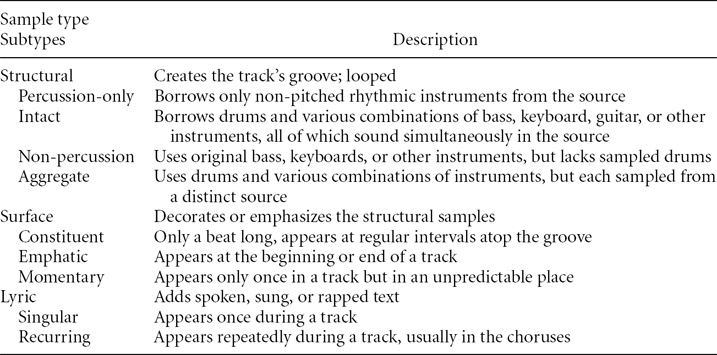
In the typology, I have identified three main types of samples: structural (a measure or two of sound that is looped or repeated throughout a new track); surface (a short fragment of sound that appears intermittently or unpredictably); and lyric (samples of sung, spoken, or rapped lyrics). In interviews, the producers of both albums have suggested approximate numbers of samples, but there are no official tallies. I have identified 105 samples in Paul's Boutique and 132 samples in Fear of a Black Planet, but I am certain that each album contains many more samples than those I have identified.Footnote 13Table 1 provides an outline of the typology of sampling that I have developed. The following sections will address each of the three main sample types in turn, which will then allow me to make generalizations about how the use of samples contributes to each group's musical style and sound.
A Typology of Sampling in Hip Hop

Structural sample types
I identify four subtypes of structural samples: percussion-only (borrowing only drums from the source track); intact (borrowing drums and various combinations of bass, keyboard, or guitar, all of which sounded simultaneously in the source); non-percussion (borrowing original bass, keyboards, or other harmonic or melodic instruments, but lacking any sampled drums); and aggregate (borrowing drums and various instrument combinations, but each part is sampled from a distinct source; each individual sample in an aggregate groove is called an “aggregate component sample”). Structural samples create the track's groove, which is looped almost continually throughout the new track.Footnote 14
Both Public Enemy and the Beastie Boys prefer the aggregate structural type over the other three, but the two groups assemble their aggregate tracks very differently. In Public Enemy's aggregate grooves, most or all of the individual component samples sound simultaneously. In the Beastie Boys’ grooves, the individual component samples alternate rather than sound simultaneously. These approaches to structural samples help define each group's musical style.
The graph in Figure 1 includes the total number of tracks on each album, broken down by the type of sample-based structure of each track. The Beastie Boys prefer percussion-only and aggregate structures equally (25% each), and nearly half (45%) of Public Enemy's tracks contain aggregate grooves. In other words, both groups most commonly use aggregate structural types, but Public Enemy and the Bomb Squad prefer primarily aggregate structures while the Beastie Boys and the Dust Brothers employ aggregate structures equally as often as percussion-only structures.
Structural types by percentage of tracks per album
If both groups favor aggregate structural types, why do Public Enemy's tracks sound so much complex than those of the Beastie Boys? The answer lies in how the groups construct those aggregate structures and how the individual aggregate component samples interact in the sample-based track. Although the Beastie Boys’ aggregate grooves have just as many component samples as Public Enemy's do, the Beastie Boys and the Dust Brothers alternate aggregate component samples rather than layering them. Public Enemy's aggregate structures typically contain two to six component samples heard simultaneously, and the Beastie Boys’ aggregate tracks rarely contain more than two component samples heard concurrently.
Comparing aggregate tracks reveals how each group's use of aggregate samples result in very different sounds. The Beastie Boys’ “Johnny Ryall” and Public Enemy's “911 is a Joke” each contain aggregate sample-based structures with equal numbers of the same sample types: each track contains four aggregate component samples in its aggregate groove, and each track contains nine total samples.
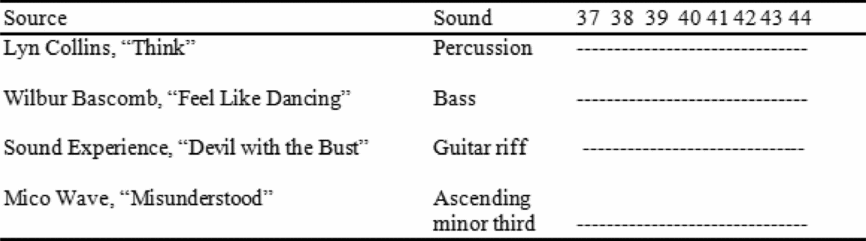
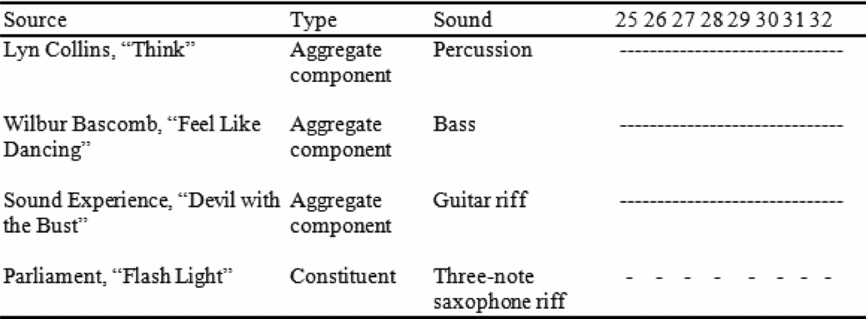
As shown in the layering graph in Figure 2, during the verses of “911 is a Joke,” all four aggregate component samples in the aggregate groove sound simultaneously. In the choruses of “911 is a Joke,” the sample from Mico Wave's “Misunderstood” drops out, but the remaining three samples continue to be looped throughout each measure (see Figure 3). A three-note saxophone figure, a constituent surface sample from Parliament's “Flash Light,” now appears in every measure of the choruses.Footnote 15 Because the saxophone sample is just a snippet rather than a continuous figure, it functions as a constituent surface sample rather than an aggregate component sample; regardless, the saxophone sample contributes to the activity of the chorus.Footnote 16 Further, a layer of continuous chatter overlays the entire track—these sounds are not samples but are in fact the sounds of rapper Flavor Flav's friends, who, according to Chuck D, were invited “to do background vocals to give [“911 is a Joke”] that real back in the projects feel.”Footnote 17 Although not samples, the layer of chatter also heightens the track's sense of aural activity.
Public Enemy, “911 is a Joke,” part of verse 2, mm. 37–44 (1:24–1:42); structural samples only.
Public Enemy, “911 is a Joke,” first chorus, mm. 25–32 (0:56–1:15)
The aggregate groove of “911 is a Joke” always includes at least three layered component samples. During the verses, all four component samples sound simultaneously, and during the choruses, the producers combine three of the four component samples with the constituent sample from “Flash Light.”
The density of Public Enemy's grooves is not the only reason they sound noisy. If, for example, each of the four aggregate component samples in “911 is a Joke” outlined the pitches of a tonic triad, then those component samples would combine to create a pleasantly homogeneous aggregate groove.Footnote 18 The four component samples, however, have completely different pitch collections, rhythmic characters, timbres, and ranges. The combination is aurally abrasive, and intentionally so. As Robert Walser noted in his study of “Fight the Power,” “Noisiness is always relative to whatever articulates order in a discourse or culture, and the noisiness of hip hop contributes to its ability to express dissent and critique.”Footnote 19 In fact, Public Enemy and the Bomb Squad would often begin producing a track by searching for particularly grating sounds to sample. According to DJ Bobcat (Bobby Ervin), who observed (but did not participate in) the production of several Public Enemy tracks, “They were looping [a sample of] something that you would hate. Bill Stephney [of the Bomb Squad] said, ‘Your brain has to process it and eventually love it after hearing it so many times, or you'll go crazy.’ I don't know if that has any real scientific significance, but that's what he told me.”Footnote 20 As Bobcat's anecdote reveals, the producers often predicated their sample choices on their potential for aural distress; in fact, Bill Stephney seems to hope for an auditory Stockholm syndrome in which the listener has to love the sound to cope with it. The lack of harmonic, rhythmic, or timbral similarity among these individual sampled parts in “911 is a Joke” creates an aggregate groove that is dissonant on many levels.
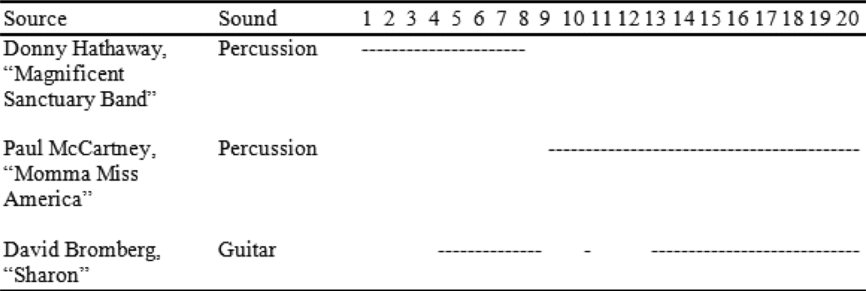
The Beastie Boys’ “Johnny Ryall” also contains an aggregate groove that comprises four aggregate component samples, but the track sounds very different from “911 is a Joke.” As shown in the layering graph of the first twenty measures of “Johnny Ryall” in Figure 4, the producers never deploy more than two aggregate component samples simultaneously. In fact, in measures 8–9 and measure 12, only one of the four component samples is audible.
The Beastie Boys, “Johnny Ryall,” intro and part of first verse, mm. 1–20 (0:00–0:48)
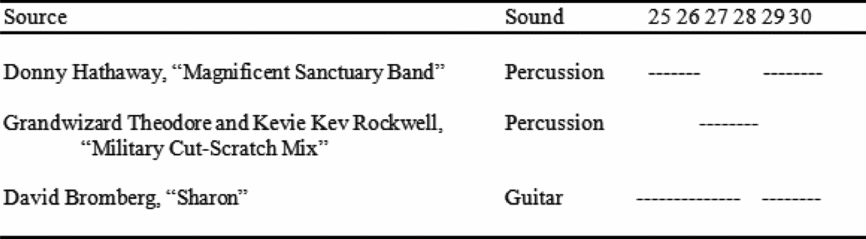
“Johnny Ryall” is typical of many aggregate Beastie Boys tracks because multiple drum samples alternate. Although a Beastie Boys and a Public Enemy aggregate structure may contain similar numbers of aggregate component samples, the Beastie Boys rarely layer more than two of those samples simultaneously. For example, the aggregate structure of “Johnny Ryall” contains four component samples, three of which are drums; the producers alternate these three drum samples throughout the track. As shown in Figure 5, the chorus also includes percussion exchange because the producers introduce a third drum sample and alternate it with the drum sample from “Magnificent Sanctuary Band.”
The Beastie Boys, “Johnny Ryall,” first chorus, mm. 25–30 (1:00–1:15)
In measure 28 (1:07), the guitar sample drops out, leaving only the drum sample. Eliminating all melodic or harmonic samples for a measure or two and leaving just the drums is also a stylistic characteristic of the Beastie Boys’ aggregate structures.
Even though Public Enemy and the Beastie Boys and their production teams frequently create aggregate structures, both the number of component samples and the ways the producers layer those component samples affect the sonic character of each group's aggregate grooves. The Beastie Boys’ aggregate structures tend to sound sparer than those of Public Enemy because the former alternate component samples while the latter layer them. Further, Public Enemy and the Bomb Squad choose structural samples based both on their individual sonic abrasiveness as well as how chaotic those samples sound when combined with each other.
Surface sample types
Surface samples decorate or punctuate a track's groove without necessarily participating in the track's primary loop, as seen in the above example from “911 is a Joke” in which a three-note saxophone sample from Parliament's “Flash Light” augments the groove. Surface samples do not contribute to the rhythmic or harmonic propulsion of the track, but they are valuable samples for rhetorical emphasis, historical context, and formal articulation. Figure 6 compares the percentages of each subtype of surface sample on both albums. Surface sample subtypes can be categorized as momentary (appearing a single time during a track), emphatic (beginning or ending a track or a section within a track), or constituent (occurring at regular intervals but without the same sense of continuity as a structural sample, as in the saxophone sample just described).
Surface sample distribution in the Beastie Boys’ Paul's Boutique and Public Enemy's Fear of a Black Planet
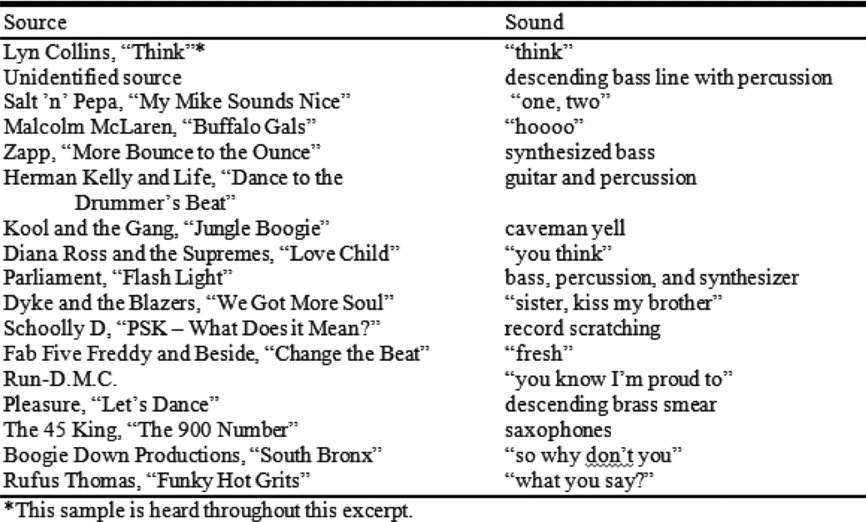
The majority of Public Enemy's surface samples are the momentary subtype, whereas the Beastie Boys’ music includes very few momentary surface samples. Public Enemy and the Bomb Squad overwhelmingly favor momentary to all other subtypes of surface samples: just over 60% of the surface samples on Fear of a Black Planet are the momentary subtype. In fact, of the total number of samples on the album, over one-fifth of those samples are momentary surface samples. Paul's Boutique contains only two momentary surface samples. Momentary surface sample types prevail on Fear of a Black Planet for two reasons: Public Enemy's penchant for collages and quodlibets, and Public Enemy's use of samples to frame historical references in Chuck D's rapped lyrics. Consider two tracks on Fear of a Black Planet, “Contract on the World Love Jam” and “Anti-Nigger Machine,” which include either a collage or a quodlibet of momentary surface samples. These two tracks contain nineteen identified momentary surface samples, that is, two-thirds of the total number of momentary surface samples on the entire album.Footnote 21 The first twenty-one seconds of “Anti-Nigger Machine” include at least fourteen different momentary surface samples from African American popular music, as shown in Figure 7. A quodlibet consists of many borrowed elements, each of which share a particular characteristic yet remain distinct from each other; the main difference between a collage and a quodlibet is that a collage is created atop the piece's “basic musical structure” or “underlying structure” while a quodlibet stands alone without supporting or accompanying music.Footnote 22 There is no sample-based groove in the beginning of this track, thus making “Anti-Nigger Machine” a quodlibet of momentary surface samples rather than a collage because it contains no underlying groove at this point in the track.
Momentary surface sample quodlibet in Public Enemy, “Anti-Nigger Machine,” intro (0:00–0:21)
This quodlibet juxtaposes samples from a number of genres of African American music: the record scratching of hip hop DJing, a funky synthesized Parliament groove, and the voice of Motown singer Diana Ross. Even without recognizing the specific source of a sample, a listener can identify the styles heard in the quodlibet.
Of “Fight the Power,” the final track on Fear of a Black Planet, Chuck D has said, “That song contains a great deal of black music history from a twenty-five year period. You listen to it, and it's like, ‘This twenty-five-year period of black music is brought to you by Public Enemy.’”Footnote 23 The same sentiment certainly applies to this quodlibet in “Anti-Nigger Machine,” which contains samples of recordings spanning twenty years: the earliest sample is of Diana Ross and the Supremes from 1968, and the latest sample is of the 45 King from 1990.Footnote 24 Public Enemy and the Bomb Squad encapsulated two decades of black music in this twenty-second quodlibet.
This quodlibet introduces a track about discrimination and racial profiling by the police, who, in Chuck D's estimation, “treat us [blacks] like niggers and they're an anti-nigger machine.”Footnote 25 Racial profiling uses race as a determining factor for law enforcement, or, according to political scientist William Rose, “the use of race—particularly blackness—as a proxy for criminal dangerousness.”Footnote 26 Over 42% of African Americans believe that they have been stopped by the police simply because of their race, and over half of all Americans believe that the practice is widespread.Footnote 27 As Chuck D raps, the black community perceives that the police would rather take away human rights than keep peace. “Anti-Nigger Machine” thus juxtaposes objects of African American pride (music) and anger (unfair treatment by the police).
Momentary surface samples also dominate the soundscape of Fear of a Black Planet. Although they may initially seem random, the brief guitar chords, cymbal crashes, or James Brown shouts enhance the meaning of a particular track and contextualize the rapped lyrics within a political and chronological framework. Poet and filmmaker Saul Williams offered an example in “Welcome to the Terrordome”:
There's this part, my favorite part of the song, where Chuck [D] goes, “The shooting of Huey Newton / from the hand of a nigga pulled the trigger.” The thing is, hearing that guitar, you know that that guitar is a sample. You know it's not coming from someone in the studio with them now doing that. And you get the feeling that that guitar is related to the era when Huey Newton was shot.Footnote 28
The guitar sample to which Williams refers is a momentary surface sample from James Brown's “Get Up, Get into It, Get Involved” from 1970.Footnote 29 Williams's instinct about the chronology is correct: Black Panther Party leader Huey Newton was shot in 1967, convicted of manslaughter in 1968, and released from prison in 1970, after the case was overturned. Public Enemy's use of momentary surface samples for collages and for brief flashes of historical or rhetorical context, particularly those related to crucial figures and moments in black American history and identity, explains why this category of samples is more important to Public Enemy's music than to the music of the Beastie Boys.
Lyric sample types
Following their approach to structural samples, the Beastie Boys and the Dust Brothers interchange rapped lyrics and lyric samples, and Public Enemy and the Bomb Squad add lyric samples to the track's existing sonic texture. The Beastie Boys alternate lyric samples with their rapped texts in the form of substitutions, in which a sampled word or phrase replaces a rapped lyric and complements the existing meaning and rhyme scheme. Public Enemy typically treats lyric samples as an additional layer, scratching them in over the track's sample-based groove, placing them against the rapped lyrics in an adjunct function, or rapping or speaking along with the sampled words as opposed to using them as a lyric substitution.
Each group's treatment of lyric samples creates audible differences in the albums. Nearly half of the lyric samples on Paul's Boutique are lyric substitutions, and for Fear of a Black Planet, the figures are less than 10%. For example, in the first verse of the Beastie Boys’ “Shake Your Rump” (0:16–0:25), the italicized lyric is a sample from Foxy's “Get Off Your Aahh and Dance”:
Got arrested at the Mardi Gras for jumping on a float
My man MCA's got a beard like a billy goat.
Hoo-hoo is the disco call
MCA, hu-huh, I'm getting rope, y'all.
In this example, as in most lyric substitutions, the rapper could easily have delivered the sampled lyric's text himself, but the sample essentially italicizes the text; it is grammatically and semantically part of the rapped lyric, but is distinguished by its timbre and voice type.
In several instances, the Beastie Boys’ lyric samples contain both the voice and the instruments from the source. These elements signal the genre and context of the sample. “Hello Brooklyn” is the fifth section of “B-Boy Bouillabaisse,” and its final lines (7:53–8:02) contain a prominent lyric sample from Johnny Cash's “Folsom Prison Blues”Footnote 30:
I ride around town ‘cause my car is fly,
I shot a man in Brooklyn just to watch him die
The five sampled words in Cash's voice, plus the rockabilly guitar, walking bass, and shuffle-rhythm percussion, signal and preserve the sample's original context rather than disguise it or extract only the lyrics. In the Cash sample, not only do the sampled lyrics replace the rapped lyrics, but the instrumentation of the sampled lyric also stands in for the groove. In this way, the Beastie Boys and the Dust Brothers maintain the same number of sonic layers in the track. The lyric sample in this case is substitutive rather than additive, and is typical of the Beastie Boys’ approach to sampling.
Although Public Enemy and the Bomb Squad do not avoid lyric substitutions, the vast majority of their lyric samples are recurring (heard in the choruses), framing (scratched in during introductions or interludes), or adjunct (placed against rapped lyrics). These kinds of lyric samples contribute a layer of sound to the existing groove or lyrics and thus, in contrast to the Beastie Boys’ approach, are additive rather than substitutive, The groups’ approaches to lyric samples echoes their broader approach to sampling in general: the Beastie Boys substitutive approach reveals an interest in lean textures, whereas Public Enemy uses lyric samples as much for their timbral, musical qualities as for their semantic content, combining them with instrumental samples to create a thick, complex texture.
Public Enemy and the Beastie Boys approach each of the three types of samples—structural, surface, and lyric—in distinct ways. First, in structural types, both groups prefer aggregate structures, yet the way they arrange the component samples results in contrasting sounds. Public Enemy's music contains multiple layers of looped aggregate component samples; the Beastie Boys’ music uses aggregate component samples in alternation with each other. Second, Public Enemy uses surface samples more frequently and with a greater sense of historical awareness compared to the Beastie Boys. Third, in lyric sample types, the Beastie Boys overwhelmingly prefer lyric substitutions, whereas Public Enemy typically takes an additive approach. The typology thus allows us to articulate how and why these two groups sound so different from each other, but more importantly, it helps us define and describe their sample-based musical styles, which are inextricably linked to the meaning and message of their music.
Genre, Race, and the Sample Canon
We can further describe and define the musical styles of the two groups by linking the typology to the musical genres they sample. As Figure 8 reveals, Public Enemy and the Beastie Boys, in collaboration with their production teams, show striking similarities and differences in the genres of music they choose to sample.
Sources of all samples in the Beastie Boys’ Paul's Boutique and Public Enemy's Fear of a Black Planet, according to genre
Both groups rely heavily on funk and soul recordings for their sample sources in all categories of the typology; both groups sample funk and soul recordings more than any other genre. Both groups also sample roughly the same percentage of hip hop recordings (just under 20% for the Beastie Boys and just over 20% for Public Enemy).
In the context of this particular analysis, “funk and soul” refers to artists such as James Brown, Chic, Sly and the Family Stone, Trouble Funk, and Marvin Gaye. “Rock” includes Led Zeppelin, Uriah Heep, and the Beatles. Jazz artists include Idris Muhammad, Grover Washington, and T. S. Monk (son of Thelonious). “Hip hop” means Afrika Bambaataa, Spoonie Gee, Schoolly D, and Run-DMC. “Reggae” means Bob Marley and Musical Youth. “Comedy and spoken word” includes Eddie Murphy, Richard Pryor, and Robin Harris. Although some readers may resist collapsing funk and soul into the same category, nearly every producer I interviewed referred to the two genres both collectively and interchangeably. To many hip hop producers, the Temptations, Parliament-Funkadelic (in any of its incarnations), the Soul Searchers, Rose Royce, Kool and the Gang, the Winstons, and Dyke and the Blazers all belong to the same broad genre. Separating “funk” and “soul” creates a distinction that many hip hop producers do not make themselves.
Both the Beastie Boys and Public Enemy prefer to sample soul, funk, and hip hop, but that is their only similarity in their choices of source materials. They obtain the rest of their samples from very different sources. After funk and soul, the Beastie Boys sample rock most frequently, whereas Public Enemy's rock samples are scant. Combined, funk, soul, and hip hop samples account for nearly 83% of the total samples on Fear of a Black Planet, while funk, soul, hip hop, and rock account for about 82% of the total samples on Paul's Boutique. In other words, the Beastie Boys sample funk, soul, hip hop, and rock in approximately the same concentration as Public Enemy samples only funk, soul, and hip hop.
Samples of music by white artists make up just over 25% of the samples on Paul's Boutique, but samples of white artists on Fear of a Black Planet comprise only 6.8% of the album's samples. This is not surprising, given the prevalence of rock samples on Paul's Boutique and the tendency of rock artists to be white.Footnote 31 By and large, to sample rock is to sample white artists, and the rock samples on these albums are no exception.
Although all rock groups sampled on these albums are white, not all white artists sampled on these albums are rock groups. Each group sampled music by white artists working in genres other than rock, including jazz, country, film music, and hip hop. In the structural sample types, both Public Enemy and the Beastie Boys typically include samples of white artists’ music as either an aggregate component sample—one layer of a groove that contains many different looped samples—or as a percussion-only structural sample—the only sampled part of a groove. As noted, both groups prefer aggregate sample-based grooves and percussion-only sample-based grooves over the other two types. By including samples of white artists’ music in these types, the producers reveal that the music of white artists is as valued and respected as the music of black artists for creating a track's sample-based groove.
When sampling the music of white artists for lyric sample types, however, the contrast between the two groups is striking. Fear of a Black Planet contains only a single lyric sample of a white artist or group: Double Dee and Steinski's “Lesson 2 (James Brown Mix)” is sampled in Public Enemy's “Revolutionary Generation.”Footnote 32 Although the hip hop DJs Double Dee and Steinski are both white, “Lesson 2” is itself a DJ track that contains samples from several different James Brown recordings. “Revolutionary Generation” includes a sample of the word “Brown” panned back and forth between audio channels. Although it is technically a sample of the Double Dee and Steinski track because their audio manipulations are left intact, the sampled material is just as easily heard as a sample of James Brown rather than of Double Dee and Steinski. In other words, the only lyric sample of a white artist's music on Fear of a Black Planet is a sample of two white DJs who were themselves sampling a black artist's voice. There are no voices of white musicians, sampled or otherwise, on Fear of a Black Planet. As Mark Katz has observed of “Fight the Power,” the final track on Fear of a Black Planet, “Even when not readily identifiable, the samples clearly draw from African American culture.”Footnote 33
On the other hand, lyric samples of white artists’ voices on Paul's Boutique are plentiful and prominent, including Johnny Cash, Kenny Loggins and Jim Messina, Sweet, the Ramones, and the Beastie Boys themselves. These lyric samples are often heard alongside lyric samples of black artists; in “Hey Ladies,” for example, the white group Sweet appears in the company of black musicians including Afrika Bambaataa, Kurtis Blow, James Brown, Fab Five Freddy, and Kool and the Gang.
With the exception of their self-sampling and the sample of Johnny Cash already mentioned, the structural, surface, and lyric sample types of white artists included on Paul's Boutique are drawn either from music of British or American rock groups—including Pink Floyd, Led Zeppelin, and Alice Cooper—or from film music, among them recognizable portions of film soundtracks by John Williams and Bernard Hermann. The white artists sampled on Fear of a Black Planet, however, perform in traditionally African American musical genres, such as jazz, funk, and hip hop: Average White Band (sampled in “Pollywanacraka”) is a Scottish funk band, Double Dee and Steinski are white DJs who frequently sample the voices of black artists such as James Brown and Syl Johnson, and Bob James (sampled in “Anti-Nigger Machine”) is a white jazz keyboardist.
It would be too simple to say, however, that Public Enemy samples black artists’ recordings because they are black and the Beastie Boys sample white artists’ recordings because they are white. Public Enemy, the Beastie Boys, and their production teams sample tremendous numbers of funk and soul recordings, which are predominantly and traditionally black genres of music. By sampling funk and soul recordings, these groups engage with the established tradition of sample-based hip hop. According to Schloss, most of the earliest producers—most of whom were African American—found their sample sources in their parents’ record collections. As Schloss notes, this practice
led to a certain core of well-known records, generally those that were popular with urban African American listeners in the 1970s . . .. This is one material way in which African American culture has influenced the hip hop aesthetic. The first and second generation of deejays were afforded access to and familiarity with the recordings of such artists as Bob James, Grover Washington, New Birth, and others whose original listenership was largely confined to urban African American communities.Footnote 34
After the first generation of sampling artists, all aspiring hip hop producers not already familiar with the classic funk and soul recordings had to steep themselves in the music. Most of the producers I interviewed had this experience, either because they were too young or because their parents did not listen to those genres of music. As Apple Juice Kid (Stephen Levitin) explains, “I did not grow up on seventies funk, which is ninety percent of hip hop. If you wanted to be a hip hop producer, you needed to . . . find the coolest loops off seventies funk records.”Footnote 35 Other producers told me that they likewise had to “catch up” when they were starting out; 9th Wonder's (Patrick Douthit) parents listened exclusively to gospel music and did not allow secular music in their household, and Vinroc (Vincent Punsalan) does not recall his parents listening to music during his childhood.Footnote 36 To this day, it is extremely unusual for a hip hop producer, regardless of race, not to know this body of recordings, one that is now regarded as the canon of source materials for sample-based hip hop.
Sampling artists also draw on music learned from their own performance experiences. In the case of Public Enemy and the Bomb Squad, the members with instrumental music experience had played music from the same genres that were in the sample canon, namely, funk, jazz, and soul. Flavor Flav is a drummer, and in Public Enemy's live shows, he occasionally still plays. Producer Bill Stephney played guitar. Producer Eric “Vietnam” Sadler played keyboards in funk and jazz bands.Footnote 37 Their experiences, not just as listeners, but also as musicians, further confirms the likelihood that they would draw on funk, soul, and jazz recordings—predominantly black genres—for their samples. In contrast, the Beastie Boys were a hardcore punk rock band in the early 1980s. The lineup in 1981 and 1982 included Mike D on drums and MCA on bass, along with John Berry and Kate Schellenbach. This version of the group released the EP Polly Wog Stew in 1982, and the Beastie Boys continued to play the album's single “Egg Raid on the Mojo” in their live shows until MCA's untimely death in 2012. Although the group transitioned to hip hop after Berry and Schellenbach left the group and were replaced by guitarist Ad-Rock, clearly the Beastie Boys knew rock recordings from their early careers as performers.
Public Enemy's and the Beastie Boys’ choices of source materials were influenced both the recordings in hip hop's sample canon and by their own performance and listening experiences. Both Public Enemy and the Beastie Boys sample funk and soul recordings because those recordings are a standard requirement for any sampling hip hop artist. They generously incorporate samples of these music genres into every sample type. However, there is a clear difference when looking at the role samples of white artists’ music plays in the sample choices of these two artists. Public Enemy draws its samples almost exclusively from black music genres, and the few white artists they sample recorded in traditionally black genres. They treat samples of white artists working in black genres the same as black artists, using their samples primarily as aggregate structural sample types and percussion-only structural sample-types. Public Enemy views white artists’ music as appropriate for these structural sample types, but they completely avoid white artists’ music when looking for lyric sample types. In fact, the only lyric sample on Fear of a Black Planet is actually another artist's sample of a black voice. The Beastie Boys sample both the canonic genres of funk and soul as well as rock and other predominantly white genres, and they treat black and white artists’ music relatively equally when choosing genres for each sample type. Each group's source materials reflect its listening and performance experiences as well as its familiarity with hip hop's sample canon.
Conclusions
We can draw two main lessons from the deploying a sampling typology in comparing Paul's Boutique and Fear of a Black Planet. First, the two albums reveal the rich generative possibilities of the canon of funk and soul recordings as source materials for sample-based hip hop. As most of the producers I interviewed were eager to explain, it is possible to create tracks that are completely new, unexpected, and radically different from one another even if they derive from a common source. They emphasized that certain sounds will stand out to one producer that another missed entirely; even successive hearings by the same producer will sound different from one another. 9th Wonder explains:
Myself and Kanye West and Just Blaze can have the same sample, the same record, and you might hear it three different ways. It all depends on the ear of the sampler, which part of the song we want to take. And I may hear a part that Kanye and Just are like, man, I missed that part. Kanye may hear a part that I'm like, “Man, I missed that!” It's weird. You hear different things on different days. I have a record that I'm listening to, and I'm like, “There's nothing on this record,” and I'll go back and listen to it again like, “How the hell did I miss this?”Footnote 38
Thus, even if a producer is sampling the same genre, artist, or track as another producer, he or she should look for a unique passage within that canonic material, and use it in a distinctive manner. This shared body of source materials yields inexhaustible musical possibilities, and the manner in which producers use samples plays a crucial role in defining their musical style. The typology I have developed helps us understand differences in musical style by characterizing the distinctive ways in which a producer deploys a collection of samples.
Second, this study makes clear that close listening is a fundamental activity of hip hop production. The dozens of surface samples in the music of Public Enemy or the Beastie Boys were not strewn haphazardly across the sonic landscape; they were carefully selected and extracted, and their particular placement in the new track is always significant. The painstaking process of selecting samples demands a deep familiarity with a repertoire and repeated close listening. Apple Juice Kid, for example, told me that the reason he chose to sample Van Halen in his early years as a producer was because he knew their music so well: “I could totally do that because I've listened to ‘Jump’ like a thousand times.”Footnote 39 Producers scour recordings for what they consider the best parts; as DJ Jazzy Joyce says, “Why wouldn't I know how to cut out the fluff and get to the best of the best to present to you?”Footnote 40 For a producer to find the “best of the best,” he or she must know a record in an extraordinary level of detail.
Paul's Boutique and Fear of a Black Planet both sample funk, soul, and hip hop, but the albums are unique, different from one another and distinct from the sample-based music of other hip hop artists. The typology offers a way to describe how the construction of these two albums differs. Public Enemy's music was built with multiple component samples in aggregate structural grooves, copious surface samples, and up to twenty different samples in a single track. The Beastie Boys, by contrast, used a spare, sample-based texture, alternating structural sample types and using lyric samples in a substitutive manner; moreover, they sampled liberally from outside the funk and soul canon. These two albums opened the door for myriad production approaches, and demonstrated innovative approaches to the treatment of sampled materials while also embracing hip hop's history. By combining my own typological analyses with perspectives from producers I offer new ways to hear these albums—and sample-based hip hop in general—as well as a precise vocabulary for discussing it. The typology represents a form of close listening that occurs in the same spirit as the intense aural focus hip hop producers bring to their work.