Healthcare-associated infection (HAI) reports for public display, performance compensation, and prevention progress claims require credible validation of surveillance and reporting.Reference Talbot, Bratzler and Carrico 1 In other industries, quality sciences experts define validation as ensuring that processes reliably produce outcomes fitting their intended purpose.Reference Fortuna, Brenneman, Birnbaum and Brown 2 For HAI reporting, this means ensuring that hospital infection surveillance programs continually produce accurate HAI data. However, maintaining surveillance validation activities beyond basic data quality checks can be resource intensive. 3 Within the quality sciences, statistically powerful yet efficient acceptance sampling plans exist that can be used for surveillance validation. The Washington State Department of Health implemented an international quality sciences based protocol to central line-associated bloodstream infection (CLABSI) reporting validation in 2009.Reference Fortuna, Brenneman, Birnbaum and Brown 2 This protocol uses acceptance sampling to ensure hospital HAI surveillance accuracy; it also estimates disease burden and distribution. Here, we report findings and resource needs from the initial years of applying this validation methodology.
METHODS
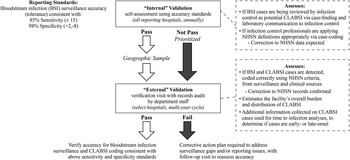
Our validation protocol sets required sensitivity and specificity standards with detailed instructions for 2 components: annual hospital self-assessments (ie, internal) and periodic health-department site visits to review primary records and practices (ie, external) (Figure 1). Full theory and practice details are available in the department’s technical reference manual (see Online Supplementary Material). 4
Washington State validation protocol for hospital central line-associated bloodstream infection (CLABSI) reporting. NOTE. BSI, bloodstream infection; NHSN, National Healthcare Safety Network.

Since 2008, Washington State law (RCW) has required state-licensed, acute-care hospitals to report intensive care unit (ICU) CLABSIs using the Centers for Disease Control and Prevention (CDC) National Healthcare Safety Network (NHSN) and has also required the department to validate the quality and accuracy of HAI reporting (RCW 43.70.056). Although public reporting requirements expanded to all inpatient areas in 2014, the validation protocol has included samples from all inpatient areas since its inception (ie, ensuring correct ICU attribution after patient transfer). We set standards and tolerance limits at 85% (±15%) for sensitivity and 98% (+2%, –8%) for specificity. Sample sizes and passing levels for sampling by attribute were set under the double-sampling method, consistent with International Organization for Standardization (ISO) standard 2859. Hospitals with failing or borderline “internal” results are prioritized for “external” visits. Passing hospitals are visited randomly at least once in a multiyear cycle. Failure on “external” visits requires process improvement corrections by the hospital and a departmental follow-up visit.
In “external” visits, records spanning 1–2 years from a sample of positive blood cultures, and all ICD-9 CM cases coded 999.31 or 999.32 (as proxy for clinical judgment) are reviewed. Bloodstream infection records are reviewed for NHSN CLABSI criteria, attributable location, and agreement with infection control and NHSN records. Total CLABSI burden is estimated as a range (minimum: NHSN criteria met; maximum: ICD-9 coded cases) using the Lincoln-Petersen capture–recapture formulae, which compensates for underreporting.Reference Stephen 5 Burden distribution estimates are calculated from location proportions among sampled records weighted by hospital rates.
Visits were conducted by the state’s certified-in-infection-control (CIC) expert HAI nursing consultant. Workload was determined by reviewing the department’s activity logs and expense records and the feedback from hospital infection control professionals (ie, infection preventionists) from 2009 to 2014. A full-time equivalent (FTE) is 1,740 productive hours per year. To estimate staffing costs, we used the 2014 Washington State employee salary ranges. 6
Year-appropriate NHSN definitions were used. Device days were calculated for a subset of records that contained line-insertion or -confirmation and infection-onset dates. Infection “present on admission” (POA) is onset earlier than day 3 after admission. Proportions were compared using Fisher’s exact test. Descriptive statistics were analyzed using SPSS version 21 software (IBM, Armonk, NY).
RESULTS
From 2009 to 2013, all 65 hospitals required to report CLABSIs participated in annual “internal” validation: 17 teaching hospitals (26%); 32 non-teaching hospitals (49%); 14 critical-access hospitals (22%), and 2 long-term acute-care hospitals (3%). Furthermore, 3 hospitals (5%) had >500 beds, 18 hospitals (27%) had 201–500 beds, 23 hospitals (35%) had 51–200 beds, and 21 hospitals (32%) had ≤50 beds. Validation results are confidential under quality-assurance protections in state law. As in our pilot study, each year, some hospitals find cases that were missed or misclassified. The estimated time required for hospital staff to complete the review is <7 hours per year; total departmental time required to review returned results is <3 hours per year.Reference Zarate, Cummings and Birnbaum 7
All hospitals received at least 1 “external” visit by December 2013, during which sampled records ranging from January 2009 through October 2013 were reviewed. In most hospitals, a pass/fail decision was reached at the first stage of sampling (see double-sampling and power curves in the administrator instructions 4 ). In total, 2,108 records were reviewed (hospital minimum: 20; maximum: 128) from blood culture (n=1,340) and ICD-9 codes (n=768); 171 positive blood culture cases (12.8%) and 415 ICD-9 code cases (54.0%) met NHSN CLABSI criteria. Overall, 628 unique CLABSI events were identified among records reviewed and NHSN cases reported. Of 155 NHSN-reported ICU CLABSI cases, 24 (15.5%) had corresponding ICD-9 codes. The validation procedure found 15 unreported ICU CLABSI (12 by blood culture, 3 by ICD-9 definition) and corrected 2 misclassified cases (erroneously reported to the NHSN as CLABSIs). After discussion and agreement, hospitals corrected their NHSN reports. Hospitals typically exceeded our standard, achieving ≥90% sensitivity and 98% specificity.
Most “external” validation visits (89%) required ≤1 day; only the most complex hospitals required more. This work represents 0.19 FTE (0.13 FTE, excluding travel) and $10,519–$16,826 per year. Mean and median travel distance to hospitals were 103.4 and 62.8 miles, respectively. Travel expenses were approximately $3,400 per year. Data cleaning requires ~0.21 FTE by an Epidemiologist I and costs between $11,161 and $14,649 per year.
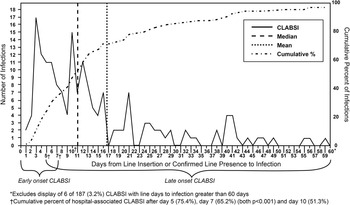
We estimate that Washington State has 2,250–3,650 CLABSI cases per year, with 10.9%–11.9% attributable to ICUs, 20.9%–21.3% attributable to lower-acuity wards, and 67.2%–67.9% POA. To assess onset time (Figure 2), 347 of 628 CLABSIs (55.3%) were excluded as POA, and 94 (15.0%) were excluded for missing device-days data. Of the remaining 187 cases, 89 (47.6%) were attributed to the ICU and 98 (52.4%) were attributed to lower-acuity wards. Time to infection was bimodal; most were late onset (P<.001; median, 11 days).
Hospital-associated central line-associated bloodstream infection (CLABSI) onset distribution, Washington State validation data, 2009–2013.

DISCUSSION
Validation enables HAI public reporting to remain credible among certified quality professionals and the public, and it assures hospitals that all maintain comparable quality of infection surveillance. Validation “internal” self-reporting and “external” visits cause hospitals to correct their NHSN records, and they improve surveillance processes to address infrastructure problems. The finding that unreported CLABSIs comprised ~9% of the 155 CLABSIs reported from ICUs (and state annual average 3 ) is consistent with the overall objective of achieving at least 85% sensitivity. Corrective actions addressed inadequate retention of surveillance records, poor communication between microbiology and infection control staff, misinterpretation of NHSN definitions, missing CLABSI after recent discharge (from same or other facility), and incorrect automated screening algorithms. In our experience, no hospital received a nonpassing result twice for the same reason. Washington State hospitals met and exceeded our standards for sensitivity and specificity; they may report more completely than typical hospitals in other states.Reference Oh, Cunningham and Beldavs 8 – Reference Rich, Reese and Bol 10 Washington State’s higher reporting accuracy may be due to the fact that it is one of very few states that conduct validation as a mandatory annual activity and enforce prespecified standards. Higher hospital reporting accuracy may also be effected by the state’s emphasis on surveillance of bloodstream infections hospitalwide, state routine data cleaning and annual outlier case reviews prior to public reporting and statewide efforts to improve infection control competency in quality reporting and surveillance criteria by the department and other partners in healthcare quality.
Despite concerns that states performing validation report higher infection rates, 11 Washington State’s commitment to trustworthy HAI reporting shows that Washington is consistently among the states with low CLABSI rates. 3 Our validation process ensures that hospitals reporting zero or near-zero rates are not artifacts of poor surveillance or underreporting.
Our validation of >60 hospitals supports ISO 2859 acceptance sampling efficacy to produce manageable workloads for chart reviews to achieve reliable accuracy estimates. Annually, ~0.40 FTE are needed for validation, data cleaning, and data quality activities with direct personnel, and travel costs are estimated to be $25,000–$35,000. Our annual validation protocol has proven credible to quality science professionals,Reference Fortuna, Brenneman, Birnbaum and Brown 2 practical, resource-efficient, scalable, and sustainable, providing valued advice to participating surveillance programs.
To our knowledge, ours is the first statewide review of hospitalwide CLABSI. We have confirmed, as have other single-institution studies, that more CLABSIs occur outside ICUs.Reference Kallen, Patel and O’Grady 12 – Reference Weber, Sickbert-Bennett, Brown and Rutala 14 These findings supported a change in state law to expand the scope of required reporting to all inpatient areas. We have confirmed a low correlation between administrative ICD-9 coding and surveillance (NHSN) reporting of CLABSIs. This finding supports the NHSN as the preferred data source. We also found that among hospital-associated CLABSIs, more are late-onset infections (likely attributable to line maintenance)Reference Davis 15 and that POA accounts for most of the disease burden. The findings of this study can guide future prevention efforts. Future reporting of healthcare-associated, community-onset CLABSIs from outpatient or home care settings may complete the CLABSI distribution spectrum to further prevention efforts and more effectively reduce the CLABSI burden.
ACKNOWLEDGMENTS
David Birnbaum was the Washington State HAI Program Manager from 2008 to 2014, and Jason Lempp was the Washington State HAI Program Epidemiologist from 2013 to 2016. The current Washington State Department of Health, Healthcare Associated Infection Program validation reference manual and toolkit are available upon request.
Financial support: The Washington State Healthcare Associated Infection (HAI) Program, during validation development and implementation, was supported by Washington State Legislative Proviso; Washington State General Funds; and US Centers for Disease Control and Prevention, Epidemiology and Laboratory Capacity for Infectious Diseases (ELC) Cooperative Agreement for Healthcare Associated Infection activities, through the Division of Healthcare Quality Promotion (DHQP).
Potential conflicts of interest: All authors report no conflicts of interest relevant to this article.
SUPPLEMENTARY MATERIAL
To view supplementary material for this article, please visit http://dx.doi.org/10.1017/ice.2016.303