Introduction
In the golden age of the welfare state, the dominant discourse was one of redistribution, solidarity and the social protection of citizens. However, over the past decades questions have arisen about the future of the welfare state, the rising costs of social protection and the principle of social insurance in a changing societal context (Esping-Andersen et al., Reference Esping-Andersen, Gallie, Hemerijck and Myles2002; Scharpf and Schmidt, Reference Scharpf and Schmidt2001; Rosanvallon, Reference Rosanvallon1995). Parallel with a changing discourse on social welfare, profound changes in social policy took place (Hemerijck, Reference Hemerijck2011a; Bonoli, Reference Bonoli2005). Nowadays we speak of the ‘active welfare state’, the ‘enabling state’ or the ‘social investment state’ in which people are to be activated and empowered instead of ‘passively’ protected (Morel et al., Reference Morel, Palier and Palme2012; Lister, Reference Lister2003; Esping-Andersen et al., Reference Esping-Andersen, Gallie, Hemerijck and Myles2002; Gilbert, Reference Gilbert2002). As such, the ethical justification of redistribution as fairness (e.g. Rawls, Reference Rawls1971; Van Parijs, Reference Van Parijs1995) and the ideal of social protection as a universal and citizen-based entitlement (Marshall, Reference Marshall and Shafir1998; Titmuss, Reference Titmuss1968) have lost ground against a more stringent interpretation of social protection in which individual responsibility and quid pro quo have become key.
In this article, we discuss some of the new tensions that are emerging between the foundations of the welfare state as a result of these developments. We will argue that a shift in social policy from redistribution to equal opportunities, which has been accompanied by a normative shift towards greater individual responsibility, may have detrimental consequences for society's weakest: they will not always be able to meet the newly emerged standard of reciprocity. In doing so, we will focus on the case of truancy, which is related to the instrument of social investment par excellence: equal opportunities in education. In Belgium, the Flemish government introduced the possibility to recuperate (fully or partially) the school allowance (schooltoelage) from parents of persistent truants as a disciplinary measure.Footnote 1 This has been fully implemented since 2008. Some policy-makers are willing to go even further and propose legislative initiatives to link entitlement to child benefits with school attendance or to impose administrative fines on parents of truants,Footnote 2 a policy measure already in place in several other welfare states as we shall see below. We argue that this specific case is symptomatic of the aforementioned paradigm shift in social policy in which the pendulum of responsibility could arguably swing too far.
In a sense, we build on Peter Taylor-Gooby's recent article (Reference Taylor-Gooby2011) in this journal. In that important piece, he explored the shifting relationship between opportunity and solidarity by focusing on individual-level views about opportunity-driven policies in three countries. In this article, we focus on macro-level changes in policy and explore its consequences using a real-life example of a relatively recent policy measure which is fully embedded in the new social policy paradigm. As this policy shift is not confined to the Belgian case alone, our contribution bears broader relevance.
The reconfiguration of European welfare states
Social justice, equality, redistribution and solidarity were recurrent themes in the normative legitimation of the post-War welfare settlement (Mann, Reference Mann2009). Despite the fact that the actual policy implementation of these ideals materialised in different ways across welfare states, as demonstrated by Esping-Andersen's (Reference Esping-Andersen1990) threefold welfare typology, social policy focussed on the realisation of social rights and the universal idea of social protection (Marshall, Reference Marshall and Shafir1998; Titmuss, Reference Titmuss1968; Cox, Reference Cox1998). In this perspective, reciprocity was understood in a rather generic sense: it stood for a system of social insurance in which there is equivalence between contributions and benefits, albeit characterised by a considerable degree of solidarity, because high-income and low-risk groups pay more than is required from a strict insurance-perspective (Barr, Reference Barr2001). Ensuring social welfare for all was thus regarded as a collective responsibility and was founded on a degree of well-considered self-interest as well as on an element of benevolence, the human capacity for compassion and altruism. Moreover, it also admitted a high degree of freedom and autonomy. Although in many countries child benefits, for example, are paid to the mother (the underlying reason being that she will spend the money appropriately), the benefit can be spent freely.
In the 1970s, industrialised welfare states sailed into choppy waters. At this time, they began to reach a considerable level of maturity, coinciding with a period of social and economic upheaval. Growth was slowing down, unemployment was rising and the post-war institutions of the welfare state seemed unable to cope with the consequences of several evolutions following the economic crisis, such as economic globalisation and international competition, demographic changes, the tertiarisation of employment, changing family relations, the massive entry of women into the labour market and new migratory flows (Bonoli, Reference Bonoli2005; Taylor-Gooby, Reference Taylor-Gooby2004; Morel et al., Reference Morel, Palier and Palme2012; Hemerijck, Reference Hemerijck2011b). Designed to cope with traditional social risks such as sickness, injury, unemployment, old-age and the burden of raising children, the welfare state had to set out in search for an adequate response to a set of unfamiliar new challenges and newly emerging social risks, such as being low-skilled (often resulting in a high unemployment risk), single parenthood, the problem of combining care duties with paid work, the necessity to care for frail relatives and insufficient social security coverage (Taylor-Gooby, Reference Taylor-Gooby2011; Vandenbroucke and Vleminckx, Reference Vandenbroucke and Vleminckx2011; Bonoli, Reference Bonoli2005). Although it seems prima facie that welfare states have proven to be remarkably robust in the past four decades (Pierson, Reference Pierson2011), in qualitative terms there has been an important shift away from the traditional welfare settlement, both at the level of policies and at the level of ideas (Dwyer, Reference Dwyer2004). Incrementally at first, restricted by the laws of path dependency, but more explicitly since the mid-90s, a common focus on employment, social investment and cost containment has been developed which was underpinned by European discourse and policy (Hemerijck, Reference Hemerijck2011a; Cox, Reference Cox1998). This inevitably required a new balance between solidarity and reciprocity, between universality and selectivity and between autonomy and responsibility.
Indeed, the scope and simultaneity of the economic, social and demographic evolutions presented the welfare states with a tough balancing act. The emergence of new social risks, combined with a tight budgetary framework, rapidly increasing dependency rates and a surge in take-up of social benefits compelled policy-makers to search for a new settlement which was found in an ‘opportunity-driven logic’, to use Taylor-Gooby's phrasing (Reference Taylor-Gooby2011). While social policy traditionally aimed to protect people from the market, the idea is now to ‘empower’ people in order to integrate them into the market (Jenson and Saint-Martin, Reference Jenson and Saint-Martin2003). Social policy, then, ought to invest in people in order to make them resilient and enhance their capacity to grab the available opportunities in a level playing field (i.e. equality of opportunities), before they become dependent on benefits. Labour market integration, social investment and equality of opportunities are thus closely related. Consequently, norms on social welfare as a citizenship-based entitlement were progressively watered down in favour of a more strict form of reciprocity and conditionality (Dean, Reference Dean2004). This equates, in Giddens's words, to a ‘no rights without responsibilities’ approach (Reference Giddens1998: 65). Hence, individual instead of collective responsibility came to play a determining role in both discourse and policy practice (Pintelon et al., forthcoming). Supported by the Social Policy Agenda adopted by the European Union in 2000, which identified as its guiding principle to strengthen the role of social policy as a ‘productive factor’ and explicitly referred to social investment (Cantillon, Reference Cantillon2011), the emphasis on individual responsibility and reciprocity is now omnipresent in all European welfare states.
In what follows, we elaborate on some of the aforementioned social and economic developments which have played a major role in the shift away from the traditional welfare state to the social investment state, both in social policy and in its normative framework. This will allow us to better understand the context in which policy thinking and popular discourse on responsibility and reciprocity has changed, before we turn to the consequences of this shift in terms of one particular policy in the subsequent sections. Bear in mind that this is a non-exhaustive overview and inevitably we provide a bird's-eye view only. Developments and changes in different welfare states have taken place at a different pace and did not always materialise along exactly the same lines. Hence, presenting the discussion in greater detail would render our overview utterly complex. Nevertheless, our considerations hold – to a greater or lesser extent – for all European welfare states.
Exploring the foundations of the paradigm shift: four decades of societal change
The so-called post-industrial transition has resulted in often painful shifts in the labour market, from industry to services and from low-skilled to high-skilled jobs (Iversen and Wren, Reference Iversen and Wren1998; Pierson, Reference Pierson and Pierson2001). This has been a momentous change. Since the early 1970s, a process of de-industrialisation has taken place and the share of industrial production in the creation of national wealth has declined. Conversely, the importance of services has grown throughout the post-war period. According to figures from the OECD STAN Indicators Database, employment shares of manufacturing industries in the total economy of OECD countries have declined substantially since the 1970s (from about between 25 and 30 per cent to between 10 and 15 per cent in the mid-2000s) while employment in services has increased rapidly (Wölfl, Reference Wölfl and OECD2005). At the same time, job content has changed dramatically: the share of routinising and ‘alienating’ labour stemming from the industrial era (the traditional working-class jobs) has declined and generally made way for more knowledge-intensive jobs (be they low-end service jobs or high-end creative jobs) (Goos et al., Reference Goos, Manning and Salomons2009; Oesch and Menés, Reference Oesch and Menés2011). This implies a move towards a highly skilled workforce and is likely to exacerbate the gap between those who can and those who cannot or are not able to acquire the skills needed in a ‘knowledge economy’.
Consequently, a substantial group of people, who are often the low-skilled and/or the socially vulnerable, have become economically redundant, resulting in greater reliance on social benefits and thus higher dependency rates (and costs) in social security. Pierre Rosanvallon (Reference Rosanvallon1995) termed this la nouvelle question sociale – the new social question. To the extent that the low-skilled become detached from the dominant culture in society (as it finds expression in the middle classes), their economic exclusion coincides with a far-reaching exclusion in social, political and cultural spheres. This at once sheds light on the paradigm shift that has taken place in the social agenda, away from protecting people from the perils of the labour market (by means of, say, the prohibition on certain types of (night) work for women, the introduction of shorter working hours, unemployment benefits, etc.) towards the notion of ‘social inclusion through work’, ‘welfare-to-work’ and ‘investment in human capital’ which is now prevalent in European discourse on social protection (Lewis, Reference Lewis2009; Dean, Reference Dean2007; Gilbert, Reference Gilbert2002).
Intertwined with this labour market transition are the emancipation of women and the changing patterns of family formation. The post-war welfare settlement was grounded on gendered assumptions: men were primarily responsible for the household income while women were considered responsible for the children and the family, a ‘silent agreement’ resulting in regular and full-time male employment and stable families (Orloff, Reference Orloff and Levy2006; Lewis, Reference Lewis2001). This model eroded, however, from the second half of the 1960s onwards with the massive influx of women in to the labour market, accompanied by changing patterns of family formation and an increase in divorce rates (Lewis, Reference Lewis2009; Crompton and Lyonette, Reference Crompton and Lyonette2006; Blossfeld, Reference Blossfeld1995; Cantillon, Reference Cantillon1989). Described by Ann Orloff as a ‘farewell to maternalism’ (Reference Orloff and Levy2006), the policy logic changed from supporting women as mothers and full-time carers to encouraging employment for all, reflecting the ideal of a gender-neutral and individualised model wherein men and women are regarded as both workers and carers. Moreover, in the context of changing demographics (see below), not only increasing employment but also increasing fertility became a policy focus. Hence allowing women to be both workers and mothers was also regarded as of uttermost importance from this point of view (Esping-Andersen et al., Reference Esping-Andersen, Gallie, Hemerijck and Myles2002). In sum, both increasing employment and the reconciliation of family and work have become key in contemporary family policy (Mätzke and Ostner, Reference Mätzke and Ostner2010), firmly underpinned by European discourse (e.g. Van Lancker and Ghysels, Reference Van Lancker and Ghysels2012) and promoted by international organisations such as the OECD (Mahon, Reference Mahon and Lewis2006; OECD, 2007). The consequences for the functioning of the welfare state were far-reaching. First and foremost, the emancipation of women meant that the working population grew quite strongly, which inevitably translated into great imbalances in a labour market already in full transition. As a result, the socio-economically weak (be they men or women) saw their position further deteriorate and the impact of the service economy on low-skilled individuals further aggravated. Second, the outsourcing of care work, previously performed unpaid by women, suddenly came at a cost. Moreover, as women are still largely responsible for families’ care work, despite the formal ideal of the individualised worker, this resulted in a double – and sometimes excessively burdensome – day's work for both single parents and mothers in dual income families. Third, marital instability led to the rise of one-person households and lone parent families often going hand in hand with an intensified poverty risk for these vulnerable households (Esping-Andersen et al., Reference Esping-Andersen, Gallie, Hemerijck and Myles2002). In sum, men and women alike are now expected to engage in paid employment, and family policy is reoriented to fully support this new settlement.
Moreover, changing demographics pose a real threat to the sustainability of the welfare state (e.g. Blome et al., Reference Blome, Keck and Alber2009). In the past forty years we have witnessed a large baby-boom generation move slowly through the active-age span. Its substantial inflow into the labour market from the 1970s onwards aggravated the disequilibria between supply and demand occasioned by the previously mentioned economic and social changes.
Finally, there has been the increase in and changing nature of migratory movements. Distinct from the case of organised labour migration in the 1960s and despite a freeze on immigration proclaimed in the early 1970s, the affluent West has since then attracted a rapidly growing flow of unsolicited economic immigrants and asylum seekers and witnessed various forms of family reunification (Hooghe et al., Reference Hooghe, Trappers, Meuleman and Reeskens2008; OECD, 2006a). These processes have unfolded quickly and concurrently with the problematic integration in education and the job market of the migratory flows of the 1960s. This has resulted in a high prevalence of poverty among immigrants, especially in the large urban centres and the emergence of a subclass of illegal immigrants in search of a better future (Lelkes and Zólyomi, Reference Lelkes and Zólyomi2011; Corluy and Verbist, Reference Corluy and Verbist2010). Consequently, governments saw themselves compelled to attribute certain social rights to this group (Corluy et al., Reference Corluy, Marx and Verbist2011), which in turn led to a fundamental change in the role of social security in general and social assistance safety nets in particular. Whereas in most countries a minimum income guarantee was originally intended as an ultimate safety net for those slipping through the social security system, it is now increasingly serving as a ‘stepping stone’, so to speak, for the inclusion of immigrants in society. For many of them, this is the first entry into the social system. However, the inclusion of groups ‘which do not belong’ (e.g. Mau and Burkhardt Reference Mau and Burkhardt2009) in the social protection system impacts public attitudes on deservingness (van Oorschot, Reference van Oorschot2000; Finseraas, Reference Finseraas, Kvist, Fritzell, Hvinden and Kangas2012). Indeed, previous research has shown that individual views on welfare state solidarity are negatively associated with migratory influx (Mau and Burkhardt Reference Mau and Burkhardt2009), although there is no evidence yet that European welfare states are ‘going American’ in this respect (Taylor-Gooby, Reference Taylor-Gooby2005). It is nevertheless true for European welfare states that non-EU immigrants are overrepresented in the social assistance dependent population (van Oorschot, Reference van Oorschot2008) which beyond doubt feeds into a (perceived) ‘no free lunch’ rhetoric among both policy-makers and the general public (Miller, Reference Miller2008). As Will Kymlicka argues (Kymlicka and Banting, Reference Kymlicka and Banting2006), fears of this kind have helped to impose restrictions on solidarity and welfare entitlements.
Consequences of the policy shift: ‘incentivising’ social policy
It is against the background of these social, economic and demographic transitions that we should understand the changed interface of European welfare states. In general terms, policy changes in OECD countries have included the following ingredients, although actual implementation differs greatly between welfare states: (1) an all-encompassing focus on work, e.g. by making work attractive by acting against unemployment traps, imposing restrictions on early retirement schemes, activating benefit recipients, providing in-work benefits, subsidising low-productive labour and – more generally – by making the labour market more flexible (Eichhorst et al., Reference Eichhorst, Kaufmann and Konle-Seidl2008; Clegg, Reference Clegg2007; Serrano-Pascual, Reference Serrano-Pascual and Serrano-Pascual2004; Grover and Stewart, Reference Grover and Stewart1999); (2) cost containment, e.g. by making minimum benefits in social security and social assistance schemes less generous and strengthening their link with work histories, imposing greater selectivity such as an increased dependence on activation programmes, stricter eligibility requirements such as the acceptance of ‘suitable jobs’, and by shifting responsibilities to other actors such as private bodies and local governments (Cantillon, Reference Cantillon2011; Weishaupt, Reference Weishaupt2011; Van Mechelen et al., Reference Van Mechelen, Marx, Marchal, Goedemé and Cantillon2010; Kazepov, Reference Kazepov2010; Van der Veen, Reference Van der Veen and Schinkel2009); (3) family policy as a productive factor, e.g. by implementing career break schemes, the expansion of parental leave schemes and pre-school services such as child care (Ghysels and Van Lancker, Reference Ghysels and Van Lancker2011; Esping-Andersen et al., Reference Esping-Andersen, Gallie, Hemerijck and Myles2002); and (4) investment in human capital, e.g. a move towards early childhood services, equal opportunities in education, encouraging life-long learning and vocational training (Esping-Andersen, Reference Esping-Andersen2008; OECD, 2006b). It is quite clear that the underlying rationale of these reforms is the belief in welfare through work, exemplified by investment in human capital and the enhancement of individual opportunities (Van der Veen, Reference Van der Veen and Schinkel2009). Briefly stated, in the era of the social investment state, emphasis is put on ‘the ability of everybody to accumulate skills and to find one's way on the labour market’ (Gazier, Reference Gazier, Morel, Palier and Palme2009: 153). Not all of these policy elements are necessary or even desirable conditions for a ‘social investment strategy’, as its proponents fiercely argue (see for instance Vandenbroucke and Vleminckx, Reference Vandenbroucke and Vleminckx2011), but it is undeniable that the direction of change in social policy under the umbrella of social investment has been rather one-sided: employment as a fast-track to social inclusion whereby reciprocity, individual responsibility and desert are focal points. This is, almost by default, accompanied by a ‘creeping conditionality’ of benefits and services (Dwyer, Reference Dwyer2004) as has been manifest in the well-documented areas of labour market policy and social assistance in almost all European welfare states (Weishaupt, Reference Weishaupt2011; Bonoli, Reference Bonoli2010; Palier, Reference Palier2010; Eichhorst et al., Reference Eichhorst, Kaufmann and Konle-Seidl2008): minimum benefits in social security and social assistance schemes have become less generous and increasingly dependent on activation programmes, the acceptance of ‘suitable jobs’ and in some cases even the obligatory acceptance of community services. Governments increasingly deploy policy tools which are shaped by the very notion of responsibility: behavioural incentives (carrots, e.g. in-work benefits to ‘make work pay’, and sticks, e.g. the curtailing of benefit entitlements to compel benefit claimants to take up work) to steer individuals into the direction of appropriate behaviour (Gilbert and Van Voorhis, Reference Gilbert and Van Voorhis2001). Instead of dependent pawns, using Julian Le Grand's (Reference Le Grand1997) appealing metaphor, individuals are increasingly seen as rational and incentive-sensitive knaves furthering self-reliance through paid employment.
Proponents of the role of conditionality in benefit entitlement often argue that these improve outcomes for the targeted population (often the poor and welfare dependents; in short, the vulnerable). For instance, by requiring beneficiaries to send their children to school, conditionality is assumed to enhance human capital and further labour market outcomes (Bastagli, Reference Bastagli2008). A stringent standard of quid pro quo, involving conditional benefits and behavioural incentives, thus finds itself at the core of an investment strategy. Several examples of such policies, enabling the suspension or cancellation of income support payment or issuing administrative fines to parents whose child is not enrolled in school or is a persistent truant, are found in contemporary welfare states such as Belgium (infra), The Netherlands, France and United Kingdom among others. In the latter, parents of truants even risk being imprisoned (Donoghue, Reference Donoghue2011). Moreover, the CSB MIPI dataset (Van Mechelen et al., Reference Van Mechelen, Marchal, Goedemé, Marx and Cantillon2011) shows that the conditionality of child benefits on school enrolment is today a common practice in several Central and Eastern European EU member states. There are of course numerous other examples of conditional and disciplinary policies (‘behavioural management contracts’), such as jobseekers agreements, youth offender contracts, parenting contracts et cetera (Vincent-Jones, Reference Vincent-Jones2009). As Jens Alber (Reference Alber2010) sharply observes, in this sense European welfare states became ‘American’. It should be noted that the concept of social investment not only inspired European welfare change, but also steered policy directions in developing countries, and in Latin America in particular (Jenson, Reference Jenson2009). For instance, almost all cash transfers in Latin America are conditional, as exemplified by the well-known examples of Bolsa Familia in Brazil and Oportunidades (formerly known as Progresa) in Mexico (Bastagli, Reference Bastagli2008).
But can conditional policies of this kind be expected to contribute to better outcomes? In the following section, we will focus on our case study of Flemish policy on truancy and school allowances, which is fully embedded in the social investment idea and is thus an ideal case to illustrate the problems and pitfalls arising from the prevailing social policy paradigm.
Equal opportunities amidst new tensions in social policy: Flemish truancy policy
It is well-known that education is an important determinant for individual fulfilment and opportunities in the labour market and in later life, yet education is also beneficial for society as a whole in the form of enhanced human capital (Esping-Andersen et al., Reference Esping-Andersen, Gallie, Hemerijck and Myles2002). In this sense, education is regarded as one of the cornerstones of the social investment state. And indeed, since the 1990s, Flemish educational policy is strongly characterised by the ideal of equal opportunities. The government aspires for everyone alike (rich and poor, vulnerable and strong, more and less talented) to reap the fruits of high-quality education. To achieve this, (in principle) free elementary and secondary education is provided, and families who cannot afford the additional costs of schooling (such as after-school care, transportation and extracurricular activities) are entitled to a means-tested school allowance. The allowance is available for children enrolled in kindergarten and for students enrolled in elementary and (part-time or full-time) secondary education. There is also a system of study allowances (studietoelagen) for higher education. In this article, we focus on secondary education.
The Flemish school allowance is a textbook example of selective and conditional social policy: it is a form of vertical solidarity but subject to a means-test. If all conditions are met, the allowance (capped by a ceiling) varies with household income. The allowance is thus by definition targeted at financially vulnerable families. However, the provision of school allowances is not only an instrument of targeted solidarity, but also one of discipline. Parents of students who are either unauthorised absent from school for more than 30 half days in two consecutive years or not officially registered for more than 15 consecutive days have to repay their allowance. Between its implementation in 2008 and 2010, 351 allowances were recovered (Van Steenberge, Reference Van Steenberge2011).
Against the background of the aforementioned tensions between the foundations of social policy, we will discuss this disciplinary measure from a consequentialist and an ethical point of view. We believe that it ultimately boils down to a matter of social justice.
The consequences of a disciplinary policy measure
Evaluating the social efficiency of a disciplinary measure from a consequentialist point of view cannot but start with a straightforward question: does it work? Looking at the figures, this does not seem to be the case so far. The annual monitoring reports issued by the Flemish Ministry of Education suggest that ‘problematic absenteeism’ in secondary education is on the rise, both with respect to the total school population as compared to the previous years (Departement Onderwijs en Vorming, 2010). This is in line with recent research on truancy conducted in the UK, which found that punitive financial measures aimed at parents are ineffective in improving pupils’ attendance (Zhang, Reference Zhang2007). However, as it may be too premature to empirically assess the genuine effect of the Flemish measure, there are three additional reasons to question its outcomes.
A first issue concerns the time period. The complete package of measures issued by the Flemish government to combat truancy (‘Spijbelactieplan’) encompasses a range of integrative measures (in cooperation with schools, community workers and pupil support centres) to intervene rapidly in the case of problematic absenteeism. The financial disincentive, however, follows with a delay of about two years. The link between cause (truancy) and effect (repaying the school allowance) has dissolved after such a long period and therefore has little effect as an instrument to raise awareness among parents: if there is a real problem of truancy, one can safely assume it will be already too late. A second issue concerns the financial consequences of the measure. These households are financially deprived by definition, which means that repaying such substantial amounts (ranging from €100 to €2,854 for a secondary school student) may very well worsen their financially precarious situation. Disciplinary policies of this kind at least corroborate the unequal distribution of income. A final issue is that the principle of non-discrimination is violated because only families receiving an allowance are subject to the disciplinary measure. One could at least assume that disciplinary rules apply to everyone: the late ethicist Koen Raes rightly described this as a moral benchmark for a public sense of justice (Raes, Reference Raes2003: 3). As we will see below, there is a substantial yet incomplete overlap between families entitled to a school allowance and families with truant children. Not everyone is equal when it comes to truancy which can hardly be regarded as fair. Thus arises a somewhat schizophrenic situation in which only the least affluent are punished by revoking an allowance designed to help them in preventing exactly what is being disciplined.
The unbearable complexity of individual responsibility
The more fundamental, ethical, issue at stake is the concept of deservingness. If one fails to attend school, is it not simply a matter of fairness that one loses the entitlement to a school allowance? That society, echoing Cicero's suum cuique tribuere, only has a duty to give to whom it deserves? The crux of this argument boils down to the association of merit with responsibility: who is responsible for the socially aberrant behaviour, and to what extent?
To fully understand the significance of this issue, one has to go back to the beginning: the coincidence of being born in a disadvantaged or privileged family. Many of the inequalities, disadvantages and wrongdoings we observe in contemporary society find their origins in the accident (or lottery) of birth. Obviously no-one can be held responsible for being born. Furthermore, several crucial elements are more or less fixed at birth: not only genetic endowments, cognitive abilities and talents but also parental educational attainment, socio-economic background of the family, the quality of the house in which one lives, the neighbourhood in which one grows up. More than a century of historical, sociological, economic and psychological research has made very clear how determining those contextual factors are in becoming an ‘autonomous individual’. Children growing up in precarious neighbourhoods where social problems (unemployment, crime, poverty . . . and truancy) are cumulated, which is by the way a largely urban phenomenon, begin their adult lives with a disadvantage they are often not able to overcome.
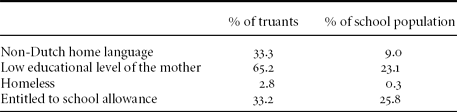
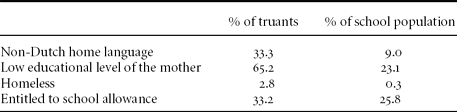
Now let us turn to the profile of persistent truants in Flanders. Table 1 shows that students of non-native descent, students with poorly educated parents and students from families entitled to a school allowance are overrepresented (Departement Onderwijs en Vorming, 2010). Moreover, the problems are relatively concentrated in urban areas (the Brussels Capital Region, the cities of Antwerp and Ghent and smaller Flemish cities). Obviously, it is not a coincidence that we recognise the same characteristics of vulnerability as outlined above in the profile of truants, and that families entitled to school allowances are overrepresented.
Socio-economic characteristics of truants in Flanders in secondary education
Source: Departement Onderwijs en Vorming, 2010.
Given all this, to what extent is individual responsibility a useful concept to support disciplinary policy? In this case, the measure is aimed at parents in order to raise their awareness about the importance of education. The parents are thus held responsible for the behaviour of their children. Net of the de jure responsibility parents have for their children, we are here concerned with the de facto responsibility. Holding parents accountable for the absenteeism of their children does not take into account the unbearable complexity of the concept of responsibility: seldom clear-cut, almost always equivocal and ambiguous. It is beyond our aspiration to make a contribution to the philosophical debate on the question of moral responsibility (see Strawson, Reference Strawson1962, for a good starting point). We do aim to demonstrate that in practice the notion of individual responsibility is not a good guidance for the constitution of fair social policy, let alone for the deployment of punitive measures.
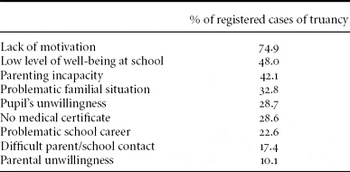
Consider the following examples. Can we hold the single mother responsible for the regular absenteeism of one of her children when she is time-constrained combining paid employment with the care for all of her children and doing the household chores? Should we punish the migrant mother who is unable to untangle Flemish laws on compulsory schooling? And what about the short-term perspective of a sixteen-year-old preferring quick money in the informal circuit above the longer-term perspective of graduating, who has never seen among her peers and kin that education effectively leads to a decent job? These examples illustrate how hard the task is to exactly demarcate responsibility. Do we blame the parent(s) or the child? Is it a matter of insufficient social protection for vulnerable households, which makes it a collective responsibility? And what about the responsibility of the school and the school system? Research shows that truancy occurs least in schools with a strong commitment to provide support for pupils, including a clear focus on their well-being (Claes et al., Reference Claes, Hooghe and Reeskens2009). Vice versa, truancy frequently occurs in school where negative features (such as inadequate infrastructure, shortage of teachers and lack of funding) are cumulated. More generally, school systems reproduce existing socio-economic inequalities (Dronkers, Reference Dronkers2010). This is especially so in the Flemish school system (van Aerden and Cantillon, Reference van Aerden and Cantillon2010), which is characterised by early tracking and a segregated structure of differentiated educational careers. Lesser performing students from weaker socio-economic backgrounds are ‘reoriented’ downwards towards vocational tracks, while the better ones remain in the higher track, preparing for higher education (Phalet et al., Reference Phalet, Deboosere and Bastiaenssen2007). Again we are confronted with the same dilemma: is it an individual or collective responsibility, or both? The multitude of causes in explaining truant behaviour is also apparent in Flemish administrative data on truancy. Table 2 shows a list of the most common causes related to truancy in Flanders, as registered by the schools. On top of the list one finds motivational problems, followed by school-related (low level of well-being at school), family-related (parenting incapacity, problematic familial situation), individual (pupil's unwillingness) and combined (difficult parent/school contact, problematic school career) causes. Importantly, only in 10 per cent of the cases is truant behaviour directly related to the unwillingness of parents to cooperate.
Causes of truancy as registered by Flemish schools

Note: multiple answers are possible.
Source: Departement Onderwijs en Vorming, 2010.
We can safely assume that most human beings, including parents of truants, want to ensure their children a good life, but the resources to do so (not only financial resources but also ‘knowledge’, ‘information’ and ‘time’) are not equally distributed. As John Rawls discusses in his Theory of Justice, the outcome of equality of opportunities is ‘affected by all kinds of social conditions and class attitudes. Even the willingness to make an effort . . . is itself dependent upon happy family and social circumstances’ (Rawls, Reference Rawls1971: 14). Popular discourse would say that people are responsible for their own (mis)fortune when it is a consequence of their own actions or choice. Hence, if people ‘choose’ not to comply with the entitlement conditions (in casu coercing their children to attend school), they have no one but themselves to blame (e.g. Goodin, Reference Goodin, Schmidtz and Goodin1988). Such a narrow view of responsibility however denies the context-specific nature of human agency and the unequal distribution of opportunities, which in itself shapes the range of choices open to people. Moreover, it also overstates the ability of parents to control their children's behaviour, especially when they grow older (Donoghue, Reference Donoghue2011). In such a context, conditional policy measures built on a narrow conception of individual responsibility are deemed to promote new, or reinforce existing, inequalities, thereby shifting the blame to the individual (‘flawed parents’). In contrast, policy measures aimed at behavioural change should be built upon a broad conception of responsibility that acknowledges the multitude of causes and the difficulties involved in establishing liability whilst taking into account the social dynamics and inequalities underlying this phenomenon. The integrative measures (‘spijbelactieplan’, supra) taken by the Flemish government more or less adhere to this broad conception of responsibility (a range of preventive and supportive measures involving several relevant actors), while the financial punitive measure added on top of that only assigns blame where blame is almost never due.
In this sense, we do not state that parents or their children bear absolutely no responsibility in the case of truancy. We however believe that the common sense notion of ‘who is responsible for what’ is too ill-informed and weak to support disciplinary measures against financially vulnerable families, certainly in cases where real opportunities are not equally distributed.
Some final considerations
Truancy is a social phenomenon that deserves proper attention: it is related to undesirable social consequences such as alcohol and drug abuse, early school dropout, nuisance and delinquency, but also to other problems in adulthood such as lower status occupations, unemployment and economic deprivation (Hibbett et al., Reference Hibbett, Fogelman and Manor1990; Hallfors et al., Reference Hallfors, Vevea, Iritani, Cho, Khatapoush and Saxe2002; Attwooda and Crollb, Reference Attwooda and Crollb2006; Zhang et al., Reference Zhang, Katsiyannis, Barrett and Wilson2007; Kearney, Reference Kearney2008). In short, truancy is associated with damaging outcomes detrimental for future opportunities in life.
Social intervention aimed at behavioural change to remedy that risk is entirely reasonable from a social investment point of view. But choosing the right policy response is a matter of social justice: truancy is a complex phenomenon affected by a myriad of factors, related to an unequal distribution of resources and opportunities. It is particularly a problem among vulnerable families with a precarious socio-economic profile whose children are generally enrolled in educational levels with less favourable labour market perspectives, the same families that are entitled to school allowances in the first place. The use of financial disincentives as a disciplinary measure – aimed at exactly those vulnerable families – will only add up to their problems and is neither socially efficient nor ethically justified. The main point to take home here is that complex issues such as truancy cannot be reduced to a single cause such as ‘flawed parents’. Such an approach only serves to scapegoat parents of truanting children whilst overlooking the real issue at stake: how to ensure an equal start for all children alike?
More generally, the case of school allowances is symptomatic for the current discourse on reciprocity and individual responsibility as foundations of the new welfare settlement. It seems like our society has freed itself from social class and traditional bonds and has transformed into a place where everyone has the opportunity to be, in William Henley's words, the master of his own fate.Footnote 3 This is what we could call, following Ulrich Beck (Reference Beck1992), the individualisation thesis. However, this thesis does not follow from the facts. Time and again research shows that people are just as determined by their background and origin as they were half a century ago (Erikson and Goldthorpe, Reference Erikson and Goldthorpe1992), and – although to a lesser extent – that also holds for new social risks (in which individual choice presumably plays a greater role) (Pintelon et al.,forthcoming). In other words, we observe a discrepancy between the moral and the factual notion of merit and responsibility (Raes, Reference Raes2007). Crucial in this respect is what psychologists call the fundamental attribution error: people tend to overestimate individual explanations and underestimate contextual and situational explanations for the observed behaviour and decisions of others (Ross, Reference Ross and Berkowitz1977). In such a frame of mind, adverse social behaviour such as truancy is more often ascribed to one's own responsibility and failure. The same reasoning holds for the views people have on redistribution and the welfare state (Taylor-Gooby, Reference Taylor-Gooby2011; van Oorschot, Reference van Oorschot2000). Yet in our view, the notion of individual responsibility is not strong enough to constitute a fair basis for social policy. Young truants, often with a low socio-economic status, personal problems, an unhappy home, attending an inappropriate school and with few prospects in the labour market, will not be compelled to ‘behave properly’ by reclaiming allowances from their parent(s). Any such course of action can and will only lead to resentment and personal frustration and will, consequently, contribute to social unrest. Disciplinary policy instruments should only be deployed if they stand a good chance of achieving success, in accordance with human dignity, in the service of self-fulfilment and social justice (e.g. Nussbaum, 2001). That is why great modesty is called for in policy design and implementation.
A social policy paradigm built on the moral notion of individual responsibility whilst overlooking the factual one inevitably leads to tougher policy measures and a more stringent form of reciprocity, which the most vulnerable will not always be able to meet. Given the unequal distribution of opportunities, a policy paradigm in which punitive measures are deployed on the basis of individual responsibility risks encouraging new forms of exclusion.
Acknowledgments
We would like to thank Olivier Pintelon, Vincent Corluy, Josefine Vanhille, Frank Vandenbroucke, Ninke Mussche and two anonymous referees for their valuable comments and suggestions. All remaining errors are of course our own.