“I’m conscious of the fact that they may never go on to take a political science class. I mean this [could be] it, and then we dump them into the world and let them vote.”
– US High School Social Studies Teacher (explaining why she teaches lessons on economic inequality)
If we could agree on one common assumption that competing theories of democracy share, it might be this: governments that are of the people, by the people, and for the people require the people to have some knowledge and familiarity not only with democratic institutions but also contemporary issues and debates. Yet studies of what people know about current political affairs reveal significant gaps. Although many Americans are familiar with debates surrounding health care or immigration, far fewer are aware of the contested positions concerning minimum wage, supreme court appointees, or a variety of international treaties (Pew 2015). One topic that is both central to current political discourse and especially misunderstood is economic inequality.
While citizens require accurate information about economic inequality, empirical evidence suggests that this knowledge is not widely held. In their 2011 study, researchers Michael Norton and Daniel Ariely asked a representative sample of more than 5,000 Americans to estimate the distribution of wealth (including savings, stock holdings, and property) in the United States. In other words, if the total wealth of the US were represented by a pizza, how big a slice would be owned by the top fifth, the second wealthiest fifth, and so on, down to the poorest fifth? The average American believes that the richest fifth of the population owns about 59% of the wealth and that the bottom 40% (lowest two quintiles combined) own about 9%—a distribution much like Sweden’s actual distribution. The reality for the United States differs widely from the estimates: the wealthiest quintile of Americans actually owns 84% of the nation’s wealth while the bottom 40% of the population owns only 0.3% (Wolff Reference Wolff2012).
Underestimating inequality does not tell us much about whether Americans think anything should necessarily change. But Norton and Ariely also asked participants to convey their ideal distribution. How should wealth in the United States be distributed across the quintiles? The results show that most Americans (92%) would prefer to live in a society that is far more equitable. In fact, 92% of respondents would like to see a distribution in which the richest fifth of the population owns 32% of the wealth and the bottom 40% owns 25%. Of particular note, Republicans and Democrats alike chose this type of distribution. Americans, it seems, believe they live in Scandinavia but actually live in a country that, in terms of economic inequality, more closely resembles Russia or Mozambique. Moreover, they would prefer to live in a society with lower levels of economic inequality than exists in Canada, Denmark, Finland, or Norway.
TEACHING ABOUT ECONOMIC INEQUALITY
Public schools are arguably the institution best situated to educate a large number of citizens and potential civic actors about important matters of contemporary social concern, such as economic inequality. If students grapple with information and policy debates related to inequality, they will be better equipped to participate as effective democratic citizens. Given the broad misinformation and misunderstandings about economic inequality described earlier, what might schools teach students about economic inequality?
In what follows, we draw on data from the first large-scale empirical study of what American high school teachers currently do to prepare youth to understand economic inequality, its causes, effects, and possible remedies. Footnote 1 We report results from a teacher survey and follow-up interviews we conducted in late spring and summer 2015 that examined how often US high school social studies teachers address issues of economic inequality, what they teach about this topic, and why. The survey included items on teachers’ political ideology and civic and political engagement as well as classroom practice. The 685 teachers who participated in the survey teach in 293 schools that are representative of US public schools generally in terms of student demographics and geographic location. Footnote 2 We draw particular attention to the relationship between teachers’ political ideology and civic and political engagement and what, how often, and why they teach about economic inequality.
Some readers might make the plausible assumption, given the controversial nature of the topic, that high school teachers teach very little about economic inequality. We wondered about that as well. Indeed, in the first phase of our larger study, our research team analyzed social studies content standards in every state, and we found that even though all 50 states in the US include economics lessons (Council for Economic Education 2012), most states do not include issues of economic inequality, and those that do often merely acknowledge economic inequality without addressing causes or possible remedies (Rogers and Westheimer Reference Rogers and Westheimer2015). Although illuminating, this analysis of the content standards only refers to topics explicitly included in the official curriculum. The results of our surveys and interviews paint a different picture.
As we detail below, many US social studies teachers report that they address issues of economic inequality at least once a week and talk with students specifically about the distribution of income or wealth. But what exactly are teachers talking about with their students and what factors predict how often teachers discuss economic inequality, what topics they cover, why they teach about it, and in what ways? We wanted to find out.
We begin our analysis with vignettes of two teachers. They both engage students in lessons about economic inequality in rich ways, but they emphasize different topics, teach them in different ways, and do so with different motivations.
… many US social studies teachers report that they address issues of economic inequality at least once a week and talk with students specifically about the distribution of income or wealth. But what exactly are teachers talking about with their students and what factors predict how often teachers discuss economic inequality, what topics they cover, why they teach about it, and in what ways?
Fred Franklin Footnote 3
Fred Franklin teaches AP (Advanced Placement) European History and US Government in a mid-size southern town. He frequently talks with his students about economic inequality, and these issues are brought into particular focus in lessons about the industrial revolution and late nineteenth century labor unrest in his AP European History class. Mr. Franklin assigns Pope Leo XIII’s 1893 encyclical, Rerum Novarum which discusses the relationship between capital and labor as well as the right to private property and the role of government in connection to markets. In the context of discussing this text, Mr. Franklin addresses broader themes about the “battles between socialism, communism and capitalism within Europe” and “the idea of the just wage.” He also draws connections between late nineteenth century European debates about wages and working conditions and contemporary issues facing the community where his school is located. Mr. Franklin discusses the “ripple effect” of industrial dislocation—how the closure of the local auto plant meant that workers could no longer “buy things and [support] other businesses.”
Mr. Franklin seeks to “stimulate thought and discussion and debate” through a mix of close textual analyses and big provocative questions. Before the class discussion on Rerum Novarum, students fill out a “primary document analysis” worksheet that includes questions about rhetoric (author point of view, pattern of argument, audience) and substantive argument. Mr. Franklin then asks every student to share with the entire class at least one idea from this analysis. These initial points lead to questions about the meaning and purpose of a “just wage.” Mr. Franklin sees his role as a “devil’s advocate,” prompting students to take on and then clarify their positions. The last time he taught this lesson, a student with a very “blue background” engaged in a “back and forth” with a student who was “a little more red.” He notes: “I love it when that happens; so I referee, rather than have to take the other side totally.”
Mr. Franklin hopes that these lessons allow students to develop analytic skills and to “chew on” big and important ideas. He does not try to promote “this cause or that cause.” Rather, he aims to “plant a seed where they’ll be more open to ideas as they mature.”
Hanna Sanders
One thousand miles northeast, Hanna Sanders teaches US Government and Economics in a socio-economically diverse school located in a deindustrializing city. When teaching a unit on poverty and economic inequality, she is aware that “I’m not just teaching students about some other people. I’m teaching them about people in their community. I have had students in the past who were homeless, who had had layoffs and were really dealing with these issues at home. And the challenge is to help everyone in the classroom be respectful when learning about it.”
During the unit on poverty and inequality, students read Barbara Ehrenreich’s Nickle and Dimed about the challenges faced by low-wage workers and watch Morgan Spurloch’s documentary on hunger, Thirty Days. Students also examine data from the US Census, the US Department of Labor, and other sources about poverty and the distribution of income and wealth in the United States. Ms. Sanders engages her students in a set of inquiry activities in which they first develop an ideal budget for themselves as young adults and then juxtapose this budget to the official poverty line. Finally, students examine government policies to redress poverty and, in groups, develop proposals for how to do so in their own community. Recently, one group “submitted a proposal to the school board, talking about how they needed to improve resources for children who faced domestic violence, either in the form of child abuse or witnessing domestic violence at home, where families didn’t have the resources to get the counseling that they needed.”
Ms. Sanders views her unit on poverty and inequality as an opportunity to develop students’ knowledge about poverty and income distribution, their understanding of big ideas in economics, and their capacity to integrate data from multiple sources in order to construct a well-organized and persuasive policy solution. She also aims to develop more informed and engaged citizens. “I look at where our community, where our country is headed in terms of separation of wealth and people struggling economically and issues in school around those things. I think that path to change involves an educated citizenry.” Ms. Sanders wants her “students to see that we can do something about the millions and millions of children living in poverty in this country and we can do it in our own backyard, and these individuals have the power to create that change, and to make our society a better place.”
HOW OFTEN DO SOCIAL STUDIES TEACHERS TEACH ABOUT INEQUALITY?
Mr. Franklin describes himself as a political conservative and Ms. Sanders characterizes herself as a liberal. But both follow politics closely. Although their vignettes differ from one another, they are representative of many of the teachers in our study who were highly engaged in teaching about economic inequality. Of course, not all teachers offer lessons with the same depth or frequency. Our survey asked teachers: “How often have you addressed issues related to economic inequality, for example, the distribution or disparities of income or wealth?” We found that 2.9% of the sample said that they “never” addressed this topic, 14.2% said they only had taught about economic inequality “once or twice a semester,” 29.7% said that they addressed it “monthly,” 29.2% “weekly,” and 24% “a few times a week” or “daily.” Footnote 4 That is, almost all teachers reported that they taught about economic inequality, with a little more than half saying that they did so at least weekly.
While these responses indicate that many teachers clearly engage students in lessons about economic inequality, our own experiences in classrooms researching civic education lead us to explore two possible explanations for these surprisingly high numbers. First, it is possible that these figures are inflated by social desirability bias—that is, teachers may have believed that others would deem it important to be teaching about economic inequality. The responses to other questions on the survey, however, lead us to believe this is not the case. Large majorities of teachers were willing to acknowledge elsewhere in the survey that they did not teach about other topics such as climate change or sexual assault on college or high school campuses, topics that would also be subject to social desirability bias.
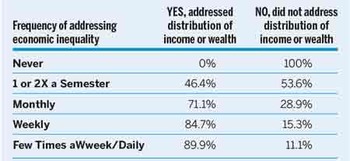
Another explanation is that social studies teachers draw connections between economic inequality and a wide variety of historical and contemporary social issues. Responses to an open-ended question about what teachers covered when talking about economic inequality yielded an extraordinarily broad range of topics, including: “robber barons,” “imperialism,” “globalization,” “access to education, health care, housing,” “the military industrial complex,” “exploitation of immigrants” “human trafficking,” the “importance of resilience,” and “unwed motherhood.” It is quite likely that some teachers believe that they are teaching about economic inequality whenever they address topics of poverty, stratification, or exploitation. Footnote 5 Indeed, a number of respondents who said that they occasionally talked about issues related to economic inequality, also noted later in the survey that, when teaching about this topic, they did not address the distribution of income or wealth Footnote 6 (see table 1).
It is quite likely that some teachers believe that they are teaching about economic inequality whenever they address topics of poverty, stratification, or exploitation.
Did Teachers Who Report Addressing Economic Inequality Talk about Distributional Issues?

Note: 73.7% of the entire sample reported addressing the distribution of income or wealth.
DOES A TEACHER’S POLITICAL IDENTITY PREDICT TEACHING ABOUT INEQUALITY?
Almost half (45.9%) of our sample report addressing issues of economic inequality at least once a week and talking with students about the distribution of income or wealth. We wondered whether this group of social studies teachers differs in their ideological beliefs or levels of civic engagement from teachers who only occasionally address economic inequality or from those who occasionally address the topic but never engage distributional questions with their students. That is, does a teacher’s political identity predict teaching about economic inequality?
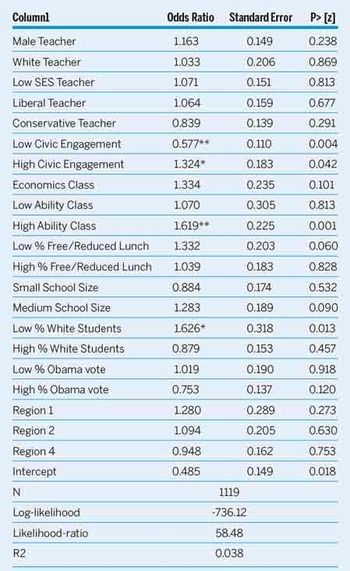
Table 2 presents a logistic regression model designed to predict factors associated with teaching about economic inequality at least once a week. The model includes teachers’ self-reported political ideology (liberal, moderate, conservative) as well as a composite variable of civic and political engagement based on teachers’ responses to questions about how frequently they follow the news, talk about politics with friends and family, and participate in organizations that seek to make a difference in their community or broader society. It also includes control variables associated with teacher background (race, gender, SES); the class teachers reported on (subject matter and ability level); school demographics (school size, race, student SES); and community characteristics (region and the political leaning of the local congressional district). Footnote 7
Logit Model—Regularly Teaching about Economic Inequality

Note: For two-tailed t-test: *p < .05; **p < .01.
Our analysis finds that teachers’ levels of civic and political engagement, but not their political ideology, predict whether they teach about economic inequality regularly. Liberal and conservative teachers are no more or less likely than moderates to teach about this topic regularly. However, teachers with low-levels of civic and political engagement are only 57.7% as likely as moderately engaged teachers to address inequality at least once a week; highly engaged teachers are 32.4% more likely than moderately engaged teachers to do so. Social studies teachers teaching economics or high ability classes or whose schools enroll relatively few white students were also more likely to teach regularly about economic inequality.
IS TEACHER POLITICAL IDENTITY RELATED TO WHAT THEY TEACH ABOUT ECONOMIC INEQUALITY?
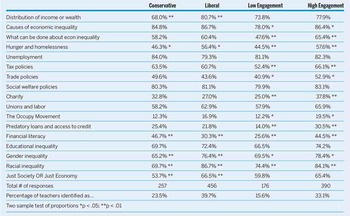
We next considered whether teachers’ political identities are related to the topics they address when they teach about economic inequality. Table 3 shows that across a number of policy domains, ranging from taxes to trade to social welfare, the responses of liberal teachers are very similar to those of conservative teachers. The one exception is that liberals are more likely than conservatives (56.4% to 46.3%) to report that they address “hunger and homelessness”—a difference that is statistically significant. By contrast, larger proportions of high engagement teachers than low-engagement teachers report addressing each policy domain, and most of these differences are also statistically significant.
What Topics Teachers Address When They Report Teaching about Economic Inequality

Differences between liberal and conservative teachers arise around themes that are tied to intersectional understandings of inequality, normative conceptions of justice, or ideologically inflected approaches to social change. When talking about economic inequality, liberal teachers are more likely than conservative teachers to address racial or gender inequality. Liberal teachers also are more likely than conservatives to introduce normative discussions about the meaning of a just or fair society and a just or fair economy. Yet conservatives are far more likely than liberals to frame economic inequality in relation to individual behavior by emphasizing financial literacy, which focuses on individual spending habits, use of credit, and skills in budgeting and keeping track of personal finances.
High-engagement teachers are more likely than low-engagement teachers to address all of these themes, with almost all the differences statistically significant. In addition, high-engagement teachers are more likely to talk about both the causes and possible strategies for addressing economic inequality, items that showed no difference between liberal and conservative teachers.
IS TEACHER POLITICAL IDENTITY RELATED TO HOW TEACHERS TEACH ABOUT INEQUALITY?
Much as we would expect of the general public, social studies teachers’ political beliefs and practices likely influence the news sources they attend to and hence the ways they understand an array of social issues such as economic inequality (Bartels Reference Bartels2009). But even if teachers ascribe to somewhat different assumptions and “facts,” do their political identities shape their approach to empiricism in the classroom? That is, do liberals and conservatives or high- and low- civic engagement teachers differ in the way they call for students to use data and interpret evidence?
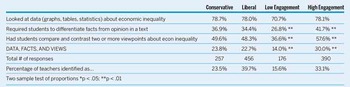
Our analysis in table 4 shows that, when addressing issues of economic inequality, liberal and conservative social studies teachers are equally likely to require their students to look at data, differentiate facts from opinion, and compare and contrast different viewpoints. Conversely, teachers’ engagement level is strongly associated with these practices. High-engagement teachers are more than twice as likely (30% to 14%) as low-engagement teachers to respond “yes” to all three of these items.
What Instructional Strategies Do Teachers Use to Teach about Economic Inequality?

Note: Analysis compares a) responses of Conservatives to Liberal teachers; and b) responses of Low Engagement to High Engagement teachers. Politically Moderate and Moderately Engaged teachers are excluded from this analysis.
IS TEACHER POLITICAL IDENTITY RELATED TO WHY TEACHERS ADDRESS ECONOMIC INEQUALITY?
Whereas there are clear expectations (tied to state standards or official textbooks) that social studies teachers will address core topics such as the three branches of government or the concept of supply and demand, teaching about economic inequality emerges more organically from the choices of individual teachers. Are these decisions related to teachers’ political identities?
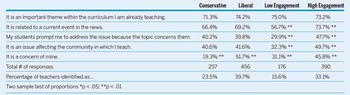
In table 5, we show how ideology and level of civic engagement relate to teachers’ responses to the question “When you have talked about economic inequality with this class, why did this topic arise?” It is noteworthy that an equal number of liberal and conservative teachers and high- and low-engagement teachers reported that they introduced inequality because “it is an important theme” in their existing curriculum. In these instances, professional understanding of the subject matter seems to have shaped teachers’ decisions. In other domains, experiences following, talking about, and participating in civic and political life weigh more heavily on teacher decisions. High engagement teachers thus are much more likely to report that the topic of economic inequality arises because it is a salient current event or because it is tied to the interests of their students, their local community, or themselves. Conversely, liberal teachers distinguish themselves from conservatives only in relation to their individual beliefs; they were far more likely than conservatives to report that they addressed inequality because “it is a concern of mine.”
Our most striking finding with regard to teaching and learning about economic inequality is that a teacher’s political ideology does not predict the frequency with which he or she teaches lessons about inequality.
Why Do Teachers Teach about Economic Inequality?

Note: Analysis compares a) responses of Conservatives to Liberal teachers; and b) responses of Low Engagement to High Engagement teachers. Politically Moderate and Moderately Engaged teachers are excluded from this analysis.
ECONOMIC INEQUALITY AND THE IMPORTANCE OF POLITICAL ENGAGEMENT
Many readers of PS have no doubt given thought to the preparation of effective citizens in a variety of areas important to democratic life. High school teachers have similar concerns. We studied public high school social studies teachers’ engagement with the increasingly important issue of economic inequality with an eye towards, first, assessing the prevalence of teaching and learning about this issue, and second, whether there are certain factors or teacher characteristics associated with the frequency, content, or approaches to the task.
Our most striking finding with regard to teaching and learning about economic inequality is that a teacher’s political ideology does not predict the frequency with which he or she teaches lessons about inequality. While liberal teachers are more likely than conservative teachers to report that economic inequality is a topic of particular concern to them personally, both liberal and conservative teachers more or less equally believe it should be part of the curriculum and classroom discussion. The degree to which a teacher is politically engaged outside of the classroom, however, is a strong predictor of how often he engages his students with issues related to economic inequality. It is likely that the contextual knowledge teachers gain from their own political engagement makes them more comfortable with the idea of engaging their students with these issues.
There is limited scholarship on the political backgrounds, ideology, or engagement of social studies teachers. Some research suggests a slight Democratic or liberal lean among US social studies teachers as a whole (Leming et al. Reference Leming, Lucien, Schug and Dieterle2009; Farkas and Duffett Reference Farkas and Duffett2010), but there is little evidence of a significant ideological divide. There is also some evidence that some social studies teachers have a thinner view of the demands of democracy and limit their role to purveyors of information rather than facilitators of methods for assessing evidence and of deliberation (e.g., McAvoy and Hess Reference McAvoy and Hess2013). We might extrapolate that more civically engaged teachers have a more robust view of the demands of democracy. Our study suggests that politically and civically engaged teachers are more likely to engage students more frequently and in more sophisticated ways with the economic, political, and social implications of increasing inequality in both American society and the world.
The implications of these findings are threefold. First, when education policy makers think about both pre-service teacher education and professional development, it would be worthwhile to consider teachers’ levels of interest in civic and political life. Teacher education programs and school districts might consider ways to encourage new and experienced teachers to follow the news, engage in civil discourse with one another about topics of public concern, and participate in civic life. Moreover educators could work towards teaching the knowledge, skills, and dispositions associated with political and civic engagement.
Second, it is likely that exposure to notions of civic and political engagement in university political science courses influence attitudes and skills of civic and political engagement. Political science professors can seed students’ initial understandings of a set of issues surrounding social, political, and economic equality.
Finally, K-12 educators, education policy makers, and professors of political science could work together to create the time and space for teachers to engage civically and politically without fear. The idea that schools should be “above politics” has historically served to curb political discussions in classrooms. Politics, in this view, is something to be avoided. But a more noble conception of politics is possible. Politics is the way in which people with different values from a variety of backgrounds and interests can come together to negotiate their differences and clarify places where values conflict. Politics is, as Bernard Crick observed in his classic work In Defence of Politics, “a great and civilizing activity” (1962, 9). To accept the importance of politics is to strive for a plurality of views rather than a unified perspective. In this reclaimed vision, being political means embracing the kind of controversy and ideological sparring that is the engine of progress in a democracy and that gives education social meaning.
Economic inequality (or equality) will always be among the issues most central to democratic dialogue and debate. For a robust democracy to flourish, the social, political, and economic principles through which we define our common bonds must be subject to ongoing assessment. Citizens need to be able to interrogate these principles and to consider them in relationship to questions about taxation and a host of other public policy issues. Our research suggests that educators have an important role to play in this regard. When it comes to economic inequality, schools and universities alike have both the capacity and the responsibility to pursue the kinds of teaching and learning that enables informed deliberation and makes possible the collective pursuit of a more just society.
ACKNOWLEDGMENTS
The authors would like to thank the graduate student researchers in The Inequality Project including Anthony Berryman, Anton Birioukov, Matt Brillinger, Claudia Diera, Mary Candace-Raygoza, Michael Ishimoto, Agata Soroko, and Jung-eun Ellie Yun as well as the teacher participants who took the time to share their thoughts about their teaching practices.