Background
The increasing incidence and prevalence of dementia is a challenge for healthcare systems worldwide. There have been efforts to establish guidelines for evidence-based diagnosis and treatment of dementia (e.g. DEGAM, 2008; DGPPN and DGN, 2009; NICE, 2012). A common theme among these guidelines is the complexity of the disease that affects a variety of physical, medical, psychological, social, and legal issues. In caring for people with dementia (PWD), these issues are ideally addressed comprehensively with multi-professional and multimodal interventions. These interventions need to be tailored to the individual needs and resources of the individual PWD, his or her caregiver and the local and regional framework of the healthcare system. Although these guidelines offer practicing physicians an orientation for caring for PWDs, the diagnosis and treatment of dementia are complex tasks. Studies show that physicians sometimes feel challenged to adapt these guidelines to specific local and individual situations (Riepe and Fellgiebel, Reference Riepe and Fellgiebel2012; Vollmar et al., Reference Vollmar2010). Case management has been suggested as a method to optimize treatment and care for community-dwelling PWDs, and intensive collaborative care management programs that ensure a high level of integration between health and social service organizations have been proofed to be clinically effective in the United States (Somme et al., Reference Somme, Trouve, Drame, Gagnon, Couturier and Saint-Jean2012). With DelpHi-MV (Dementia: life- and person-centered help in Mecklenburg-Western Pomerania), we developed and implemented a collaborative dementia care management program to provide “optimum care” to community-dwelling PWDs and their caregivers in Germany (for a detailed description of the dementia care management in DelpHi-MV, see (Eichler et al., Reference Eichler2014)). The comprehensive, individualized intervention is initiated and coordinated by a dementia care manager (DCM) and delivered in close cooperation with the treating general practitioner (GP). The intervention is based on a systematic and standardized baseline assessment that covers up to 3,500 different variables with the aim of identifying the individual needs and resources of the PWDs and his or her caregiver. These needs are then addressed in a tailored intervention/treatment plan. Considering the vast amount of data needed to assess for the provision of optimum care, there is a considerable risk that unmet needs remain overlooked and therefore unaddressed. Clinical decision support systems (DSS) have been suggested to assist GPs in the diagnosis and management of dementia (Lindgren et al., Reference Lindgren, Eklund and Eriksson2002; Downs et al., Reference Downs2006; Lindgren and Eriksson, Reference Lindgren and Eriksson2010). In Delphi-MV, a computerized Intervention-Management-System (IMS) was developed and implemented to facilitate the planning as well as the conduction and documentation of the Delphi-Intervention. IMS is a rule-based expert DSS that matches individual patient characteristics to a computerized knowledge base. One of the most important functionalities of IMS is to support the compilation of the individual intervention plan by systematically identifying unmet needs and suggesting the corresponding specific interventions for recommendation to the GP.
The objective of the present analyses was to examine whether the implementation of the IMS improved the identification of unmet needs as well as the recommendation of adequate specific interventions to the treating GP. In addition, the feasibility and acceptability of the system to the users (i.e. the DCMs) were evaluated.
Methods
Study design
Present analyses are based on data derived from the on-going GP-based randomized, controlled intervention trial DelpHi-MV (Dementia: life- and person-centered help in Mecklenburg-Western Pomerania). The details of the study are described in the study protocol (Thyrian et al., Reference Thyrian2012). The eligible patients (older than 70 years, living at home) are screened for dementia in participating GP practices using DemTect (Calabrese and Kessler, Reference Calabrese and Kessler2000). DemTect is a widely used dementia screening tests in GP practices in Germany (Thyrian and Hoffmann, Reference Thyrian and Hoffmann2012). Patients who meet the inclusion criteria (DemTect < 9) are informed by their GP about the study, are invited to participate, and are asked to provide written informed consent. If the patient names a caregiver, he or she is asked to participate in the study. When the patient is unable to provide written informed consent, his or her legal representative is asked to sign the consent form on the patients behalf (as approved by the Ethical Committee of the Chamber of Physicians of Mecklenburg-Western Pomerania, registry number BB 20/11).
Participants and their caregivers are assigned to an intervention or a control group, depending on whether the treating GP practice was randomized into either the control or intervention group. The enrollment into the main study started on January 1, 2012. Baseline and annual follow-up assessments are conducted identically in both groups. Whereas the control group receives “care as usual,” the intervention group receives the “DelpHi-Intervention.” The intervention is initiated and coordinated by a DCM – a nurse with dementia-specific qualifications (Dreier et al., Reference Dreier, Thyrian and Hoffmann2011; Dreier and Hoffmann, Reference Dreier and Hoffmann2013).
Study participants are contacted by their designated DCM to arrange two to four personal visits at their homes to carry out the comprehensive standardized baseline assessment regarding each patient's specific social, medical, psychological, pharmaceutical, and nursing care situation. The DCM conducts further in-depth assessments at the first visit after baseline (e.g. mobility tests, pain assessment, and neuropsychiatric assessment). Based on the information collected, the unmet needs of the PWD are identified and an adequate individualized intervention plan according to the “DelpHi-Standard” is established and forwarded to the treating GP by a semi-standardized GP-information letter. The letter includes the recommendations for specific interventions. The GP decides whether he rates a recommended intervention as “necessary” and, if so, whether he conducts the respective intervention himself or delegates it to the DCM. The GP-information letter is the main instrument for communication and coordination between the DCM and GP and ensures that the GP assumes a key role in the DelpHi-Intervention.
The “DelpHi-Standard” of optimum care is composed of a comprehensive set of 95 intervention modules that are assigned to eight different action fields representing the complexity of dementia care (e.g. medical diagnosis and treatment; nursing care; pharmaceutical treatment and care). Each intervention module consists of: (a) predefined trigger condition(s) derived from the comprehensive standardized assessment; (b) a subsequent intervention task; and (c) at least one criterion to define the successful completion of the respective task. Intervention tasks include in-depth assessments, counseling of the PWD or the caregiver on specific dementia-related topics, emergency measures, structured provision of information to the treating GP about specific health problems and recommending specific interventions to the treating GP (for a detailed description of the “Delphi-Standard,” see (Eichler et al., Reference Eichler2014)).
Intervention-Management-System
IMS is a rule-based expert DSS, which is composed of the programmed algorithms of the 95 predefined intervention modules of the “DelpHi-Standard.” For data collection, tablet-PCs that comply with the legal requirements for technical products in medical settings (Bundesministerium der Justiz, 1994) are used. All data are entered directly into the DelpHi-information system and are immediately processed (Meyer et al., Reference Meyer, Fredrich, Piegsa, Habes, van den and Hoffmann2012). Whenever a predefined trigger condition is activated, the corresponding intervention task is automatically selected by the IMS.
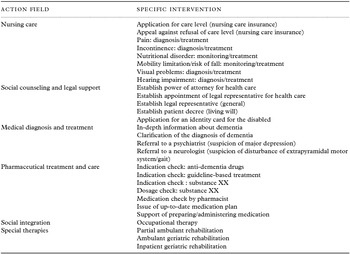
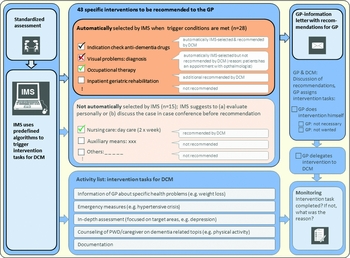
A total of 43 specific interventions can be recommended in the GP-information letter. Of these, 28 are automatically selected by IMS whenever the respective trigger conditions are met (see Table 1).
Specific interventions that are automatically recommended by IMS for the GP-information letter whenever the respective trigger conditions are met (grouped by action fields)

Trigger conditions were defined broadly to ensure that unmet needs do not remain undetected. Thus, not all triggered and selected interventions must be recommended to the GP (the reason for not recommending an IMS-selected intervention has to be documented). Because life circumstances are too complex and individual to cover them entirely with a fixed set of predefined algorithms, the DCM can also recommend further interventions manually, even if they had not been previously selected by IMS.
The present analyses focus solely on these 28 specific interventions that IMS automatically selects for recommendation in the GP-information letter when the trigger conditions are met.
There are another 15 specific interventions that can be recommended to the GP, but are not automatically selected by IMS. Instead, IMS suggests either (a) a special evaluation of complex circumstances to decide whether a specific intervention should be recommended or (b) a case conference to discuss the case before recommending a specific intervention. Because recommending these interventions requires active human interactions that could disturb the evaluation of the impact of implementing IMS, they were excluded from the analysis. Figure 1 illustrates the outline of IMS.
Outline of IMS (present analyses are focused on thick-rimmed areas).

IMS was developed and tested over the course of the DelpHi-trial and implemented into the study routine 12 months after the first enrollment of study participants into the main study (January 2012). Before the implementation of IMS, a written version of the “DelpHi-Standard” was used by the DCM to identify unmet needs and to establish the intervention plan. A total of 96 patients were included in this period (the “pre-IMS-group”). After the implementation of IMS, the system was tested with 33 patients (the “IMS-group”). For each of these 33 PWDs, the IMS generated a list of recommended interventions. The DCM decided, if the respective intervention should be recommended to the GP in the GP-information letter. If not, the reason for not recommending was documented. In addition, the DCM can recommend interventions that have not been automatically selected by IMS.
To determine the benefits of implementing IMS, the system was also retroactively applied to the 96 PWDs of the “pre-IMS-group.” Because the data to run and trigger IMS were available in this group, we determined which specific interventions IMS would have selected for these respective patients. After comparing the actual recommendations given in the GP-information letters for each PWD in the “pre-IMS-group” with the recommendations triggered retrospectively by IMS, the DCMs were asked to document the reason for each difference based on their individual case documentation.
The feasibility and acceptability of IMS to the users (n = 6 DCMs) were assessed by a self-designed questionnaire, which contained the following three questions: How helpful is IMS for your work? How user-friendly is IMS? Would you like to apply the system in your further work? The DCMs were asked to answer these questions on a scale ranging from 1 (lowest possible satisfaction) to 10 (highest possible satisfaction).
Sample
The present analyses are based on a total sample of 129 patients of the intervention group (n = 96 PWDs in the “pre-IMS-group” and n = 33 PWDs in the “IMS-group”).
Data analyses
For the sample description, we analyzed age, sex, living situation (alone/not alone), and cognitive status (assessed using the German version of the Mini Mental Status Examination (Kessler et al., Reference Kessler, Markowitsch and Denzler1990)). To test for significant group differences, we used Fisher's exact test for categorical variables and the two sample t-test for continuous variables. Statistical analyses were performed with STATA version 11.0 (StataCorp, 2009).
The frequency of IMS-selected and subsequently DCM-recommended interventions, reasons for not recommending IMS-selected interventions as well as additionally DCM-recommended interventions are described for both groups (number of recommended interventions: total/per PWD). We report the total number of recommended interventions in the GP-information letters and the number of recommended interventions grouped by the action fields (“nursing care,” “social counseling and legal support,” “medical diagnosis and treatment,” “pharmaceutical treatment and care,” “social integration,” and “special therapies”).
Regarding the feasibility and acceptability of the IMS to the users, we report mean sum scores and ranges.
Results
Characteristics of the study sample
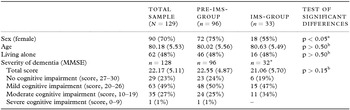
Table 2 presents the sociodemographic and clinical characteristics of the study sample. With the exception of sex, there are no significant differences between the “pre-IMS-group” and the “IMS-group.”
Sociodemographic and clinical characteristics of the study sample

Standard deviations or percentages are in brackets.
MMSE = Mini Mental State Examination; range: 0–30; higher score indicates better cognitive functioning.
*n = 1 observation missing; aFisher's exact test; btwo sample t-test.
Identification of unmet needs
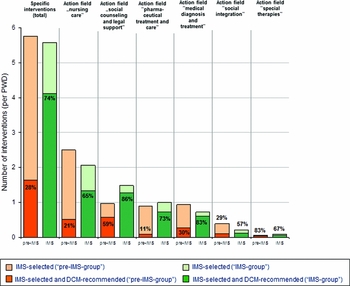
The retroactive application of IMS to determine, which specific interventions IMS would have selected for the PWDs of the “pre-IMS-group,” yielded the following results: in total IMS selected n = 552 specific interventions (n = 5.75 per PWD; R = 1–12). Of these, the DCMs had actually recommended 28% to the GP (n = 157 interventions; n = 1.64 per PWD; R = 1–5). Across the individual action fields, the concordance between IMS-selected and actually DCM-recommended interventions varied widely between 11% (“pharmaceutical treatment and care”) and 83% (“special therapies”). The results are illustrated in Figure 2.
Number of specific interventions (per PWD) that were suggested by IMS and the percentage of subsequently recommended interventions in the GP-information letter before (“pre-IMS-group”; n = 96) and after (“IMS-group”; n = 33) the implementation of IMS into the study routine (total/grouped by action fields).

In the “pre-IMS-group,” as many as 72% of the IMS-selected interventions were actually not recommended to the GP (n = 395 interventions; n = 4.13 per PWD). The DCMs were asked to provide reasons why they did not recommend these interventions (retrospective statements). The majority of the interventions (n = 311 (78.8%)) were not recommended, because the respective unmet need had not been identified by the DCMs. Another 19.7% of these interventions (n = 78) were already addressed, thus the intervention was not deemed necessary by the DCM (e.g. IMS triggered the recommendation for diagnosis/treatment of visual problems, but the DCM knows that the PWD has an appointment with an ophthalmologist already). Furthermore, 1.5% of the interventions (n = 6) were not agreed to by the PWD or their caregivers.
After the implementation of IMS into the study routine, IMS selected a total of n = 184 interventions (n = 5.58 per PWD; R = 1–11) for the n = 33 PWD of the “IMS-group.” Of these, the DCMs subsequently recommended 74% to the GP (n = 136; n = 4.12 per PWD; R = 1–11). Regarding the individual action fields, the variation of concordance between IMS-selected and actually recommended interventions was considerably lower than in the “pre-IMS-group” and ranged between 65% (“nursing care”) and 86% (“social counseling and legal support”). The results are illustrated in Figure 2.
In the “IMS-group,” only 26% of IMS-selected interventions were not recommended by the DCMs (n = 48; n = 1.45 per PWD). Of these, 90% (n = 43 interventions) were not recommended because these needs were addressed already. The remaining 10% (n = 5 interventions) were not wanted by either the PWD or his or her caregiver.
Recommendations of specific interventions to the treating GP
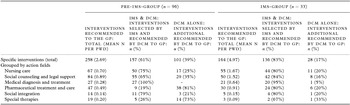
For n = 96 PWD of the “pre-IMS-group,” the DCMs recommended a total of n = 258 specific interventions (n = 2.69 per PWD; R = 1–8) to the GP. The results are shown in Table 3.
Specific interventions recommended to the GP before (pre-IMS-group) and after (IMS-group) the implementation of IMS into the study routine: total number of recommended interventions; interventions selected by IMS and subsequently recommended by DCM (IMS & DCM); and additional recommended interventions by DCM (DCM alone)

We found that 61% of these recommended interventions (n = 157) were retroactively selected by IMS as well. Across individual action fields, these figures varied considerably between 19% and 100%.
The DCMs recommended additional n = 101 specific interventions (n = 1.05 per PWD) that were not selected by IMS (39% of the finally recommended interventions).
After the implementation of IMS into the study routine, the DCMs recommended n = 164 specific interventions for n = 33 PWD of the “IMS-group” to the GP (n = 4.97 interventions per PWD; R = 1–13) (see Table 3).
Of these recommended interventions, 83% were previously selected by IMS. Variance across action fields (67%–95%) was considerably lower than in the “pre-IMS-group.”
The proportion of additional recommended interventions that were previously not selected by IMS was clearly lower than in the “pre-IMS-group” (17% vs. 39% of finally recommended interventions).
Feasibility and acceptability of IMS
On a scale from 1 to 10, the six current users of IMS evaluated the system as followed: They regarded IMS as helpful for their work with an average score of 9.5 (R = 8–10). The user-friendliness was judged with an average score of 6.8 (R = 5–8). In terms of willingness to implement IMS in their future work, the average score was 9.0 (R = 7–10).
Discussion
Present results demonstrate a substantial benefit of implementing the computerized IMS on the identification of unmet needs in dementia care management. Before the implementation of IMS, 72% of the interventions that the IMS would have automatically suggested for recommendation to the GP according to the “DelpHi-Standard” have actually not been recommended by the DCM – most often because the DCMs did not recognize the respective unmet need without the support of IMS. These results clearly point out the difficulty of detecting unmet needs within the complexity of home caring situations for PWDs. The capacity of human conscious thinking is limited; only 5 ± 2 chunks of information can be processed at the same time (Doerner and Schaub, Reference Doerner and Schaub1994; Miller, Reference Miller1994). This fundamental psychological principle supports the need for utilizing the assistance of a computerized system to improve the systematic identification of unmet needs.
Furthermore, the implementation of IMS resulted in an improved adherence to the “Delphi-Standard” of dementia care and increased the comprehensiveness of the established intervention/treatment plans. The results show that due to the implementation of IMS, the concordance between automatically IMS-selected and actually DCM-recommended interventions increased from 28% to 74%. Consequently, the number of recommendations for specific interventions given to the treating GP increased by 85% (from n = 2.69 to n = 4.97 recommended interventions per PWD). The high concordance between automatically IMS-selected and actually recommended interventions indicates that IMS produces adequate suggestions for the intervention with a high degree of clinical relevance.
However, our findings clearly reflect that IMS can only support, but not serve as a substitute for a qualified person. After the implementation of IMS, the DCMs did not rely solely on the suggestions that are generated automatically by IMS. Instead, they critically reconsidered whether an IMS-selected intervention was actually necessary and acceptable by the PWD and/or the caregiver. On the other hand, they also gave additional recommendations when they thought that an intervention was required, even when IMS had not selected it previously.
Regarding the feasibility and acceptability of IMS, the current six users of the system evaluated it as very helpful and they would like to use it for their future work. However, the usability was not so highly rated and could be further improved. Because the number of users is still low, these results cannot be generalized.
To summarize, our findings provide evidence that IMS improves the systematic identification of unmet needs and the subsequent recommendation of interventions to adequately address these needs. Therefore, our data suggest that utilizing IMS increases the comprehensiveness of dementia care management. Whether this will actually lead to optimized care and to improved patient outcomes needs to be evaluated over the course of the DelpHi-trial. Three reviews of clinical DSS for various diseases and purposes have shown inconsistent results (Garg et al., Reference Garg2005; Roshanov et al., Reference Roshanov2011; Sahota et al., Reference Sahota2011). These reviews report an effect of implementing a clinical DSS on the improvement of the care process in more than half of the studies under consideration (52%, 63%, and 64%). However, they differ considerably in their estimate on the positive results of a clinical DSS regarding patient outcomes (range of 15% to 65% of the studies under consideration). Bryan and Boren (Reference Bryan and Boren2008) report positive or variable outcomes in 76% of the included studies.
Only one of the studies included in these reviews implemented a dementia-specific DSS (Downs et al., Reference Downs2006). Their DSS operated within patient electronic records and was used to prompt and assist clinical reasoning and care planning. Results showed a significant improvement in detection rates of dementia, but there was no evidence for an impact on the management of dementia. However, for the DelpHi-trial, we expect a positive effect of the dementia care management on patient outcomes because of the setup of the intervention that differs to the one of Downs et al. (Reference Downs2006). IMS has been developed and implemented to facilitate the planning as well as the conduction, monitoring, and documentation of the dementia care management. The system does not only support the establishment of an individualized intervention plan that is forwarded to the GP. In addition, IMS suggests specific interventions directly to the DCMs, e.g. the counseling and support of the caregiver. Most important is that the DCMs are responsible for the implementation of all IMS-selected and additional self-selected interventions, including all the interventions that the GP delegated back to them (except for the ones that were rated as “not necessary” or “not wanted” by the DCM, the PWD, the caregiver or the GP). The completion of each specific intervention has to be documented by the DCMs in the IMS. In the case that an intervention cannot be completed, the reason has to be documented as well. This way IMS ensures that unmet needs are not only identified, but will be really addressed in the course of the DelpHi-Intervention.
Limitations
The size of the “IMS-group” was not sufficient to allow meaningful comparisons regarding the action fields “social integration” and “special therapies.”
The reasons for not recommending an IMS-selected intervention were given retrospectively by the DCMs and may not be fully reliable. However, because the DCMs kept detailed documentation of each case, the potential for systematically compromised validity is most likely limited.
Conflict of interest
None.
Description of authors’ roles
TE drafted the manuscript and was a main contributor to the development of IMS. JRT, the study coordinator, contributed substantially to the overall design of the Delphi-trial and the development of the DelpHi-Intervention. DF (computer science), LK (data management), AD (nursing care), DW (pharmacy), and BM (health economy) contributed to the DelpHi-trial and to the manuscript in accordance with their areas of expertise. WH, the principal investigator of the study, contributed substantially to the concept of the DelpHi-trial and to the final version of the manuscript. All authors have read and approved the final manuscript.
Acknowledgments
The authors would especially like to thank Kerstin Albuerne for the programming of the IMS-algorithms. The DelpHi-trial and IMS were developed and established as a result of input from the following experts in their respective fields, with support provided by an experienced field study team: Ines Abraham, Aniela Angelow, Grit Aßmann, Vaska Böhmann, Georgia Böwing, Kathleen Dittmer, Thomas Fiß, Sarah Gardzella, Jana Hubert, Ulrike Kempe, Ingo Kilimann, Saskia Moll, Andrea Pooch, Sabine Schmidt, Christiane Schnick, Christine Winckler, and Paula Winter. We thank all of the participating patients and their general practitioners for their collaboration.