INTRODUCTION
Red foxes (Vulpes vulpes) and raccoon dogs (Nyctereutes procyonoides) are widely distributed in Europe and are hosts for a broad range of parasites including important zoonotic helminths such as Trichinella spp., Toxocara canis and Echinococcus multilocularis. In contrast to the red fox, which is a native species, raccoon dogs were introduced from the Far East and are currently among the most common wild carnivores in Baltic countries (Kowalczyk, Reference Kowalczyk2006). Recent experimental studies have shown that raccoon dogs are highly susceptible to intestinal E. multilocularis infections (Kapel et al. Reference Kapel, Torgerson, Thompson and Deplazes2006; Thompson et al. Reference Thompson, Kapel, Hobbs and Deplazes2006). Natural helminth infections have also been documented in several studies in Europe (Machnicka-Rowinska et al. Reference Machnicka-Rowinska, Rocki, Dziemian and Kolodziej-Sobocinska2002; Shimalov and Shimalov, Reference Shimalov and Shimalov2002; Kirjušina, M. unpublished data in Bagrade et al. Reference Bagrade, Šnabel, Romig, Ozolinš, Hüttner, Miterpakova, Ševcova and Dubinsky2008; Hurnikova et al. Reference Hurnikova, Miterpakova and Chovancova2009; Schwarz et al. Reference Schwarz, Sutor, Staubach, Mattis, Tackmann and Conraths2011). However, the relevance of the raccoon dog as a definitive host and its contribution to parasite transmission remains controversial (Yimam et al. Reference Yimam, Nonaka, Oku and Kamiya2002; Kapel et al. Reference Kapel, Torgerson, Thompson and Deplazes2006; Romig et al. Reference Romig, Dinkel and Mackenstedt2006).
Several studies on the helminths of red foxes have been undertaken in Europe but only a few originate from Eastern Europe. Reports from Belarus (Shimalov and Shimalov, Reference Shimalov and Shimalov2003), Hungary (Sréter et al. Reference Sréter, Széll, Marucci, Pozio and Varga2003) Estonia (Moks et al. Reference Moks, Saarma and Valdmann2005), and Latvia (Bagrade et al. Reference Bagrade, Šnabel, Romig, Ozolinš, Hüttner, Miterpakova, Ševcova and Dubinsky2008) have demonstrated high helminth prevalence and a varied helminth fauna in red foxes.
In Lithuania, a recent study has revealed that wild carnivores are highly infected with helminths including E. multilocularis, and human alveolar echinococcosis is of increasing concern (Bružinskaite et al. Reference Bružinskaitė, Marcinkutė, Strupas, Sokolovas, Deplazes, Mathis, Eddi and Šarkūnas2007). Therefore, we undertook a comparative study of red foxes and raccoon dogs to investigate their helminth fauna and the abundances of helminth infection.
MATERIALS AND METHODS
Sampling and examination of red foxes and raccoon dogs
Between 2001 and 2006, 310 carcasses of hunted red foxes and 99 raccoon dogs were collected from 22 districts in various parts of Lithuania. Carcasses were collected every week during the hunting season (October–March). Animals were labelled and sex, age, locality and date of death were recorded. The age was determined according to dental development as described by Giraudoux et al. (Reference Giraudoux, Romig, Eckert, Eckert, Gemmell, Meslin and Pawlowski2001). According to these criteria, animals were allocated into 2 groups: juveniles (⩽1 year; foxes n=22; raccoon dogs n=27) and adults (>1 year; foxes n=283; raccoon dogs n=72). Due to scull damage, the age could not be estimated in 5 animals. During dissection all internal organs (trachea, lungs, urinary bladder, esophagus, kidneys, heart, and stomach) were separated from the gastrointestinal tract. Necropsy and investigation of intestines were carried out following strict safety precautions (Hofer et al. Reference Hofer, Gloor, Müller, Mathis, Hegglin and Deplazes2000).
The samples from 41 red foxes and 14 raccoon dogs were examined by the washing and sieving technique to detect the presence of systemic helminths in the trachea, lungs, heart, renal pelvis, urinary bladder, liver, gall bladder and stomach. Briefly, organs were opened and washed with tap water through 212 μm and 53 μm mesh sieves (Endecotts Ltd, London, UK) and examined under a stereomicroscope. Liver lobes were cut into slices of 1 cm size, and flukes were carefully squeezed out from bile ducts into a Petri dish. Furthermore, liver slices and opened gall bladders were washed with tap water through the sieves (212 μm and 53 μm mesh size). Stomach contents were collected and washed through 500 μm and 212 μm mesh sieves and examined with the stereomicroscope.
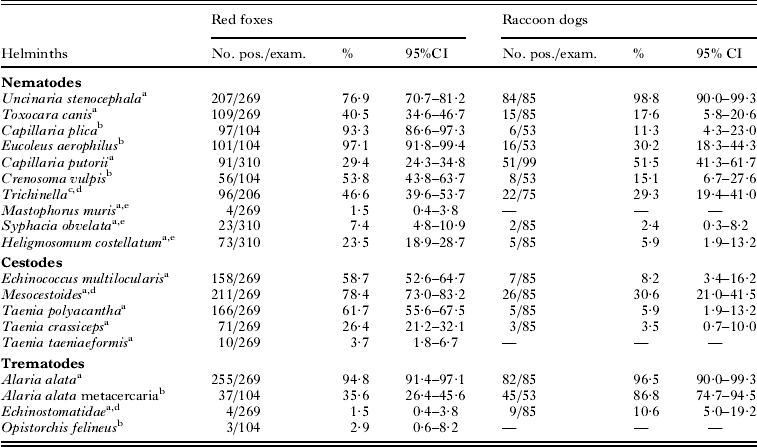
To detect the presence of intestinal helminths (Table 1), the small and large intestines from 269 red fox and 85 raccoon dogs were opened and visually examined. The abundance of intestinal helminth infection was enumerated in each animal by the sedimentation and counting technique (SCT) according to Hofer et al. (Reference Hofer, Gloor, Müller, Mathis, Hegglin and Deplazes2000).
Prevalence of helminth species isolated from red foxes and raccoon dogs in Lithuania
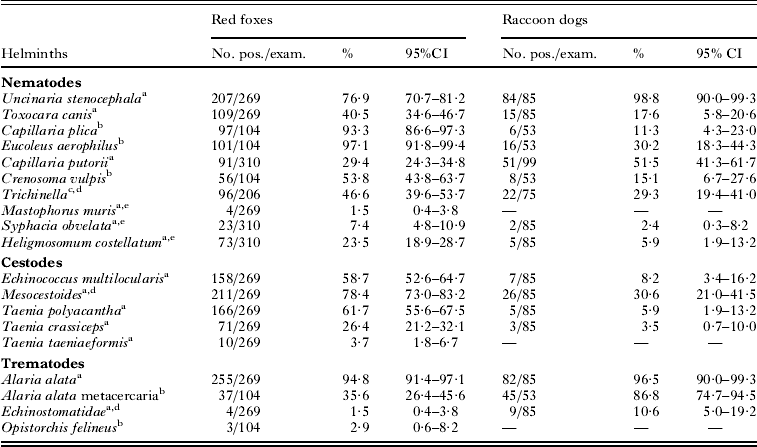
a SCT (Hofer et al. Reference Hofer, Gloor, Müller, Mathis, Hegglin and Deplazes2000).
b Helminthological examination.
c Artificial pepsin–HCl digestion of m. triceps brachii (Malakauskas et al. Reference Malakauskas, Paulauskas, Järvis, Keidans, Eddi and Kapel2007).
d Species not determined.
e Rodent-specific nematode species.
Larvae of Trichinella spp. were detected by the artificial pepsin–HCl digestion technique using 20 g of forelimb muscle (m. tricepsbrachii, m. biceps brachii) (Malakauskas et al. Reference Malakauskas, Paulauskas, Järvis, Keidans, Eddi and Kapel2007).
Helminth species identification
The helminth species were identified according to morphological features and, in some cases, confirmed by PCR. E. multilocularis was identified according to the general size of the worm and the shape of the uterus of the last gravid segment (Eckert and Deplazes, Reference Eckert and Deplazes2004). Other helminth species were identified according to Skrjabin (Reference Skrjabin1947, Reference Skrjabin1948), Skrjabin et al. (Reference Skrjabin, Shichovaliova and Lagodovskaja1960), Abuladze (Reference Abuladze1964), Soulsby (Reference Soulsby1982) and Bowman (Reference Bowman1999), while Trichinella spp. larvae were not identified to species level.
Morphological identification of Taenia spp. was performed according to hook measurements, shape, and general appearance of the cestode. Due to similarities in hook size of some Taenia spp., special attention was paid to the shape of the hooks (Verster, Reference Verster1969). According to these criteria, Taenia spp. were grouped into T. polyacantha-like, T. crassiceps-like and T. taeniaeformis-like species. To confirm the morphological identification, a multiplex PCR (Trachsel et al. Reference Trachsel, Deplazes and Mathis2007) followed by sequence analysis was performed with cestodes from each group (T. polyacantha-like, n=6; T. crassiceps-like, n=2, T. taeniaeformis-like, n=1). Due to deep freezing of samples some cestodes had lost their hooks. Therefore, the number of hooks was not recorded.
Statistical analysis
A mixed modelling approach was used to analyse the abundance of parasite infection in both species of hosts. Data were imported into R (www.r-project.org) for analysis. Initially, for each parasite, the mathematical distribution that produced the best description of the abundance data was determined. All data were highly aggregated and hence zero inflated Poisson, negative binomial and zero inflated negative binomial modes were examined. This was achieved by comparing the AIC for each null model (i.e. with just an intercept). Once the appropriate distribution was chosen, confidence intervals of the mean abundance of parasites were calculated using a likelihood profile. The constant of aggregation was also calculated. There were 5 sampling seasons (5 autumn-winters seasons) and animals were also sampled in a number of different districts. Therefore, sampling season and district were assumed to be a mixed effect. The data for each host were divided into those animals sampled in the autumn (October–December) and those animals that were sampled in the winter (January–March). Using such an approach, hypotheses regarding variations in infection pressure due to availability of prey or differences in activity of the hosts could be explored. The final analyses examined the factors of age, gender and sampling season (autumn/winter) as fixed effects and sampling year and district as random effects, utilizing the appropriate general linear mixed model or zero inflated mixed model.
The parasite abundance and prevalence were also analysed with respect to the stomach contents found at post-mortem. As these were generally different sample sizes (because the stomach contents were only available for a subpopulation of these animals), a separate analysis to examine these factors was undertaken.
The significance of parasite abundance between the different host species can be estimated from the likelihood profile. Thus, if the mean abundance in one host is greater or less than the 95% CIs of the mean abundance in the other host, then there is a significant difference. Due to the highly aggregated nature of parasite abundances, the confidence intervals of parasite abundances are highly asymmetric. Thus, the parasite abundance in one species may be outside the confidence limits of the abundance in the second species, but nevertheless the mean abundance of the second species may lie within the confidence limits of the first species. Where this occurred, evidence of significance was estimated by calculating the AIC of the null model when the abundance data were pooled and comparing it to the AIC of the model when it was in 2 populations. If the AIC was lower when the data were in 2 populations it indicates that there was a significant difference in the means.
Prevalence of E. multilocularis (positive/negative) in animals of different age and sex were cross-tabulated and analysed using two–tailed Fisher's Exact Test. For the prevalence 95% exact binominal confidence intervals (95% CI) were calculated.
RESULTS
Red foxes and raccoon dogs were infected with the same variety of helminth genera and species in the intestines, lungs, liver, gall bladder and urinary bladder (Table 1). Occasionally, cestodes, nematodes, or trematodes were detected in the stomach of investigated animals and were added to those found in the intestines.
Eucoleus aerophilus (Capillaria aerophila) (97·1%), A. alata (94·8%) and Capillaria plica (93·3%) were the most prevalent species in red foxes. Respectively, 98·8% of raccoon dogs were infected with Uncinaria stenocephala and 96·5% with A. alata. E. multilocularis (58·7%), T. canis (40·5%) and Trichinella spp. (46·6%) were highly prevalent among foxes while raccoon dogs had lower prevalences (Table 1). The morphological identification of the Taenia spp. was confirmed genetically in 9 cases (6×T. polyacantha, 2×T. crassiceps and 1×T. taeniaeformis) examined by sequence identities of >99·4% with corresponding sequences deposited in the GenBank. All 3 Taenia spp. identified are rodent-transmitted species, and prevalences were higher in foxes than those in raccoon dogs (Table 1).
In suburban areas of Kaunas, the second largest city of Lithuania, 45 fox samples were collected. Of those, 53% (24/45, 95% CI 37·9–68·3) were infected with E. multilocularis, 47% (21/45; 95% CI 31·7–62·1) with T. canis and 9 of 45 (20%; 95% CI 9·6–34·6) foxes had co-infections with T. canis and E. multilocularis.
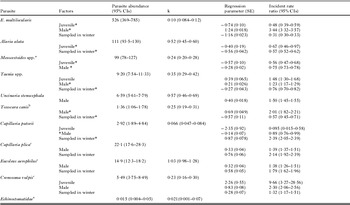
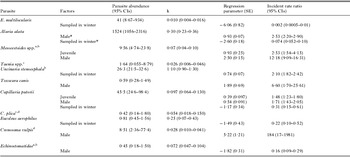
Statistical analysis is summarized in Tables 2 and 3. With all parasites, the best mathematical probability distribution was the negative binomial, and the mean abundance and 95% confidence intervals are given. Likewise, the aggregation constant for each parasite is detailed in the table. Significant regressors that are associated with the mean abundance of each parasite are presented. The regression parameter and its standard error are reported. This is also converted into the incident rate ratio and its 95% confidence intervals. The incident rate ratio gives the relative abundance in animals in the presence or absence of that factor when all other regressors are held constant. Thus, a juvenile male fox sampled in winter would have a mean abundance of 0·31 (CIs 0·30–0·33) E. multilocularis compared to that of a juvenile male fox sampled in the autumn. The mixed model suggested that the age of the fox was significant in determining the mean abundance with E. multilocularis, A. alata, Mesocestoides spp., Taenia spp., C. putorii and Crenosoma vulpis. The sex of the animal was a significant regressor with E. multilocularis, Mesocestoides spp., Taenia spp., U. stenocephala, T. canis, Capillaria spp., E. aerophilus and C. vulpis. Winter sampling was significant for E. multilocularis, A. alata, Taenia spp., T. canis, Capillaria spp., E. aerophilus and C. vulpis. Likewise, in raccoon dogs age was significant with Mesocestoides spp. and C. putorii. The sex of the animal was significant with A. alata, Mesocestoides spp., T. canis, C. putorii, C. vulpis and Echinostomatidae. Winter sampling was significant with E. multilocularis, A. alata, U. stenocephala, C. putorii and. E. aerophilus.
Parasite abundance in red foxes and significant risk factors for infection

* There were also significant interactions between factors (data not shown).
a The species was not determined.
b The district was not significant as a random effect.
c Samples were only taken from one season, hence only district was a random effect.
Parasite abundance in raccoon dogs and significant risk factors for infection

* There were also significant interactions between factors (data not shown).
a The species was not determined.
b The season was not significant as a random effect.
c There were no significant associations.
d Samples were only taken from one season; hence only district was a random effect.
Abundances of the different parasites were analysed concerning several risk factors including age, sex and season and compared between foxes and raccoon dogs. Thus, in Tables 2 and 3 it can easily be seen that the abundance of Mesocestoides spp., Taenia spp., C. plica, and E. aerophilus were higher in foxes than in raccoon dogs. A. alata, U. stenocephala, C. putorii and Echinostomatidae had higher abundances in raccoon dogs. E. multilocularis also had a higher mean abundance in foxes compared to raccoon dogs despite the mean lying within the upper 95% CI of the estimate of the mean of raccoon dogs. In this case, the AIC of the negative binomial model with 2 populations of parasites from the 2 hosts was lower than the AIC of the negative binomial model fit using the pooled data.
DISCUSSION
The present study showed that red foxes and raccoon dogs share a similar range of helminth species. However, the variability and abundance was different when compared to observations reported in previous studies from Lithuania (Kazlauskas and Prūsaite, Reference Kazlauskas and Prūsaitė1976) and Belarus (Shimalov and Shimalov, Reference Shimalov and Shimalov2002, Reference Shimalov and Shimalov2003).
Differences in parasite abundance might be explained by the different biology and ecology of these 2 canine species. In Lithuania, the diet of raccoon dogs mainly involves amphibians whilst red foxes prefer rodents (Baltrūnaitė, Reference Baltrūnaitė2002). In the present study, undertaken in winter, most of the raccoon dogs' stomachs investigated were empty or filled with vegetables only (data not shown). In contrast, rodents were found in 79·9% of the fox stomachs. Therefore, it is not surprising that more than half of the red foxes were infected with the rodent-transmitted cestodes E. multilocularis and T. polyacantha compared to a significantly lower proportion (E. multilocularis-8·2%; T. polyacantha- 5·9%) of raccoon dogs. The abundance of E. multilocularis was also significantly higher in foxes. The same phenomenon of higher prevalences in foxes than in raccon dogs from the same area was observed in studies from Belarus (7·5%; 7/94 in foxes and 0%; 0/78 in raccoon dogs; Shimalov and Shimalov, Reference Shimalov and Shimalov2002, Reference Shimalov and Shimalov2003), Latvia (36%; 16/45 in foxes and 21%; 12/57 in raccoon dogs; Bagrade et al. Reference Bagrade, Šnabel, Romig, Ozolinš, Hüttner, Miterpakova, Ševcova and Dubinsky2008) and in Japan (56·7%; 38/67 in foxes and 23·1%; 3/13 in raccoon dogs; Yimam et al. Reference Yimam, Nonaka, Oku and Kamiya2002). Therefore, we can hypothesize that although raccoon dogs are highly susceptible for patent infections with E. multilocularis (Kapel et al. Reference Kapel, Torgerson, Thompson and Deplazes2006; Thompson et al. Reference Thompson, Kapel, Hobbs and Deplazes2006) they may not play an important role in parasite transmission. This hypothesis is supported by the fact that raccoon dogs hibernate during winter in the Nordic countries (Ward and Wurster-Hill, Reference Ward and Wurster-Hill1990; Sheldon, Reference Sheldon1992). During hibernation, food consumption, migration and defecation are reduced. Additionally, the special habit of raccoon dogs to defecate at few definite sites (latrines) (Prūsaitė et al. Reference Prūsaitė, Mažeikytė, Pauža, Paužienė, Baleišis, Juškaitis, Mickus, Grušas, Skeiveris, Bluzma, Bielova, Baranauskas, Mačionis, Balčiauskas and Janulaitis1988) may limit the contamination of vole habitats with helminth eggs.
Significantly lower abundances of E. multilocularis, Alaria sp. and C. putorii were recorded in animals of both species sampled in the winter as compared to those sampled in the autumn. This could be associated with lesser availability of food, particularly prey species in the winter months. This association presumably may have had an impact on seasonal reduction in the abundance of E. multilocularis being much more marked in raccoon dogs. Thus foxes sampled in the winter had 31% of the mean abundance recorded in the autumn (incidence rate ratio 0·31) whereas in winter-sampled raccoon dogs the mean abundance was reduced to 0·2% when compared to those sampled in the autumn (incidence rate ratio 0·002). This greater reduction in raccoon dogs is consistent with raccoon dogs being much less active than foxes in the winter, possibly due to hibernation in the area investigated. A similar pattern was seen in A. alata and C. putorii infection with a greater reduction in abundance seen in raccoon dogs. Taenia spp. was only reduced in the winter-sampled foxes, but very few raccoon dogs were infected with Taenia spp. so a valid comparison is difficult for these species. Likewise with T. canis, only the foxes had a reduced abundance in the winter. Mesocestoides spp. had no reduction between autumn and winter sampling times in either host species. This may be because the parasite is longer lived in the host and animals were actually infected earlier in the season. E. multilocularis in contrast, has a life expectancy of between 60 and 90 days (Kapel et al. Reference Kapel, Torgerson, Thompson and Deplazes2006) in both host species and therefore infections detected in the winter are likely to be the recent ones. U. stenocephala and particularly C. vulpis, had a marked increase in abundance in winter-sampled raccoon dogs compared to autumn-sampled animals. In foxes, all Capillaria spp. increased in the winter-sampled animals as did C. vulpis.
In this study, consisting largely of rural foxes, there was no decrease in abundance in E. multilocularis in relation to age. On the contrary, there was evidence of adult foxes having significantly more E. multilocularis than juveniles. In earlier studies, a lower abundance (Hofer et al. Reference Hofer, Gloor, Müller, Mathis, Hegglin and Deplazes2000; Raoul et al. Reference Raoul, Deplazes, Nonaka, Piarroux, Vuitton and Giraudoux2001; Yimam et al. Reference Yimam, Nonaka, Oku and Kamiya2002) has been reported in older foxes. This result has been hypothesized as a possible effect of immunity in response to infection but ecological factors influencing age-dependent parasite transmission were not excluded. Indeed, in the present study rodents constituted a high proportion of stomach content in young and adult foxes documenting that foxes are heavily dependent on this food resource in the area investigated during the winter. In contrast, adult urban foxes in Switzerland were significantly more dependent on anthropogenic food as compared with juvenile foxes (Hegglin et al. Reference Hegglin, Bontadina, Contesse, Gloor and Deplazes2007). Therefore, it can be hypothesized that the dependence on rodents as the major food source could strongly influence the helminth abundance in red foxes. However, in this case, intestinal immunity seems to play a minor epidemiological role in E. multilocularis infections in foxes.
A recent study from Switzerland has shown an increase of human AE cases following an increase in the fox population (Schweiger et al. Reference Schweiger, Ammann, Candinas, Clavien, Eckert, Gottstein, Halkic, Muellhaupt, Prinz, Reichen, Tarr, Torgerson and Deplazes2007) and on-going invasion of urban areas by foxes (Gloor et al. Reference Gloor, Bontadina, Hegglin, Deplazes and Breitenmoser2001; Deplazes et al. Reference Deplazes, Hegglin, Gloor and Romig2004). Unfortunately, there are no available data on the development of the fox population over the last 25 years in Lithuania. However, the high prevalence of E. multilocularis in red foxes is comparable to reports from high endemic areas of Central Europe (Romig et al. Reference Romig, Dinkel and Mackenstedt2006). In this study, E. multilocularis was detected in almost all districts (13 of 16) examined. Furthermore, a high prevalence was detected in suburban areas of Kaunas, the second largest city in Lithuania with a population of 358 107 inhabitants, which is comparable to other European cities (Deplazes et al. Reference Deplazes, Hegglin, Gloor and Romig2004; Hegglin et al. Reference Hegglin, Bontadina, Contesse, Gloor and Deplazes2007). Recent studies have suggested that human AE is an emerging disease in Lithuania (Bružinskaitė et al. Reference Bružinskaitė, Marcinkutė, Strupas, Sokolovas, Deplazes, Mathis, Eddi and Šarkūnas2007). This shows that the parasite must have been widely distributed in the fox population some 10–15 years earlier than when the cases were diagnosed in humans due to the long incubation period of the disease. However, it remains unclear if Lithuania was free of E. multilocularis in the past. In 2003, E. multilocularis was described for the first time in 1 of the 5 muskrats in Lithuania (Mažeika et al. Reference Mažeika, Paulauskas and Balčiauskas2003). E. multilocularis has not been reported by previous authors who examined necropsied red foxes and raccoon dogs (Danilevičius, Reference Danilevičius1964; Kazlauskas and Prūsaitė, Reference Kazlauskas and Prūsaitė1976). Danilevčius (Reference Danilevičius1964), however, detected E. granulosus in 8 of 102 domestic dogs. While E. multilocularis was not documented at this time, the absence of the parasite in Lithuania before 2001, when the first infected fox was found (Bružinskaitė et al. Reference Bružinskaitė, Marcinkutė, Strupas, Sokolovas, Deplazes, Mathis, Eddi and Šarkūnas2007), is questionable. Possibly the prevalence of this parasite was very low.
Prevalences of more than 90% for A. alata, U. stenocephala, C. aerophila and C. plica in one or both of the investigated host species are amongst the highest reported in Europe (Shimalov and Shimalov, Reference Shimalov and Shimalov2002, Reference Shimalov and Shimalov2003; Davidson et al. Reference Davidson, Gjerde, Vikøren, Lillehaug and Handeland2006; Saeed and Kapel, Reference Saeed and Kapel2006; Reperant et al. Reference Reperant, Hegglin, Fischer, Kohler, Weber and Deplazes2007). They are also higher than in the previous Lithuanian study where A. alata, U. stenocephala, E. aerophilus and C. plica were prevalent in 76·0%, 48·7%, 29·3% and 57·7% of red foxes, respectively (Kazlauskas and Prūsaitė, Reference Kazlauskas and Prūsaitė1976). Such a difference may be related to variation of intermediate hosts and different feeding habits of definitive hosts.
Interestingly, some non-typical helminths–Syphacia obvelata, Heligmosomum costellatum and Mastophorus muris that have previously been detected in rodents in Lithuania (Arnastauskienė et al. Reference Arnastauskienė, Kazlauskas and Maldžiūnaitė1981; Mažeika et al. Reference Mažeika, Paulauskas and Balčiauskas2003; Grikienienė, Reference Grikienienė2005) were found in the gastrointestinal tracts of investigated animals. Most of these helminths did not have a clear shape and were damaged, probably due to digestion. Therefore, it cannot be excluded that these vole parasites were intestinal passages.
Deep freezing at −80°C, storing worms in 70% alcohol and overlapping sizes of taeniid hooks made some difficulties in identifying Taenia species morphologically. Therefore, we confirmed the identity of Taenia spp. by PCR. Additionally, we checked for the presence of eggs in the uterus of T. taeniaeformis, since this cestode normally infects cats. None of the T. taeniaeformis had eggs in the uterus suggesting that foxes were an accidental host, but more studies are required to prove this hypothesis.
The present study shows that both red foxes and raccoon dogs were highly infected with helminths including zoonotic species like E. multilocularis. However, red foxes were more frequently (P<0·0001) infected when compared to raccoon dogs and, therefore, they probably play the most important role in transmission of this cestode in Lithuania.
FINANCIAL SUPPORT
The study was supported by the Food and Agricultural Organization of the United Nations (FAO, project TCP/LIT/3001 (T)); and the Swiss Baltic Net (GebertRüfStiftung).