Introduction
People with a personality characterized by difficulty processing or regulating emotions using cognitive strategies (alexithymia) are thought to be at risk of developing mental disorders such as major depression (Taylor & Bagby, Reference Taylor and Bagby2004), panic disorder (Marchesi et al. Reference Marchesi, Fontò, Balista, Cimmino and Maggini2005), eating disorders (Bydlowski et al. Reference Bydlowski, Corcos, Jeammet, Paterniti, Berthoz, Laurier, Chambry and Consoli2005) and substance abuse (Speranza et al. Reference Speranza, Corcos, Stephan, Loas, Perez-Diaz, Lang, Venisse, Bizouard, Flament, Halfon and Jeammet2004).
Concerning major depression (Honkalampi et al. Reference Honkalampi, Hintikka, Saarinen, Lehtonen and Viinämaki2000, Reference Honkalampi, Hintikka, Antikainen, Lehtonen and Viinämaki2001a, Reference Honkalampi, Hintikka, Laukkanen, Lehtonen and Viinämakib, Reference Honkalampi, Koivumaa-Honkanen, Antikainen, Haatainen, Hintikka and Viinamaki2004; Luminet et al. Reference Luminet, Bagby and Taylor2001; Saarijärvi et al. Reference Saarijärvi, Salminen and Toikka2001, Reference Saarijärvi, Salminen and Toikka2006), this hypothesis is supported by data from studies that have assessed alexithymia, using the Toronto Alexithymia Scale (TAS; Bagby et al. Reference Bagby, Parker and Taylor1994), during the acute phase of illness and after treatment. These studies observed a decrease in TAS scores when depressive symptoms improved. This finding raises the question of whether alexithymia is a state-dependent phenomenon, as suggested by some authors (Honkalampi et al. Reference Honkalampi, Hintikka, Saarinen, Lehtonen and Viinämaki2000, Reference Honkalampi, Hintikka, Antikainen, Lehtonen and Viinämaki2001a, Reference Honkalampi, Hintikka, Laukkanen, Lehtonen and Viinämakib, Reference Honkalampi, Koivumaa-Honkanen, Antikainen, Haatainen, Hintikka and Viinamaki2004; Saarijärvi et al. Reference Saarijärvi, Salminen and Toikka2001), or a stable personality trait, as proposed by others (Luminet et al. Reference Luminet, Bagby and Taylor2001; Taylor & Bagby, Reference Taylor and Bagby2004; Saarijärvi et al. Reference Saarijärvi, Salminen and Toikka2006; Le et al. Reference Le, Ramos and Muñoz2007). The authors who suggested the trait hypothesis claimed that, even though the TAS scores decreased with an improvement in symptom severity, the relative differences in alexithymic scores remained the same among depressed patients (relative stability) (Luminet et al. Reference Luminet, Bagby and Taylor2001; Taylor & Bagby, Reference Taylor and Bagby2004; Saarijärvi et al. Reference Saarijärvi, Salminen and Toikka2006). Therefore, the relative stability is thought to be a characteristic of alexithymia as a personality trait (Taylor & Bagby, Reference Taylor and Bagby2004). Nevertheless, the relative stability does not provide any information regarding the pre-morbid alexithymic levels in depressed patients and hence it cannot represent a conclusive finding supporting the hypothesis of alexithymia as a personality trait. This conclusion was also stated by Mikolajczak & Luminet (Reference Mikolajczak and Luminet2006), who support the trait hypothesis and claimed that ‘the stability of alexithymia scores at follow-up would not constitute evidence that alexithymia preceded mental disorder’.
Therefore, we have determined alexithymic levels before, during and after a depressive episode, and evaluated the episode of MD, in a sample of women attending the Centers for Prenatal Care, at approximately monthly intervals throughout the pregnancy.
Method
Sample
The study population was recruited among women who consecutively sought assistance at the Centers for Prenatal Care of the Public Health Service of District of Mantova (Italy), from September 2005. Women participated in the study after the procedure had been fully explained and written informed consent was obtained, if they were older than 18 years and had completed all the evaluations from the beginning of their pregnancy.
The study protocol was approved by the local ethical committee.
Assessment
At each visit (approximately every month), all women were asked to complete the following evaluations: (1) the Italian translation of the Primary Care Evaluation of Mental Disorders (PRIME-MD; Spitzer et al. Reference Spitzer, Williams, Kroenke, Linzer, deGruy, Hahn, Brody and Johnson1994), for the screening of depressive disorders; (2) the Italian translation of the Hospital Anxiety and Depression Scale (HADS; Zigmond & Snaith, Reference Zigmond and Snaith1983), for the evaluation of severity of anxious and depressive symptoms; and (3) the Italian version of the TAS (Bressi et al. Reference Bressi, Taylor, Parker, Bressi, Brambilla, Aguglia, Allegranti, Buongiorno, Giberti, Bucca, Todarello, Callegari, Vender, Gala and Invernizzi1996), for the assessment of alexithymic levels. Moreover, all women completed a brief questionnaire, performed ad hoc, to collect sociodemographic and anamnesis information.
The PRIME-D is a structured interview for the diagnosis of mental disorders according to DSM-IV criteria (APA, 1994), and was administered at each visit by gynecologists who were trained by a senior psychiatrist. The HADS is a self-administered instrument for the evaluation of anxiety and depression in a non-psychiatric population. The seven items of the depression subscale were largely based on the anhedonic state, since five items are related to the loss of pleasure. The seven items of the anxiety subscale were chosen from the psychic manifestations of anxiety. Therefore, the HADS generates two subscale scores: an anxiety score and a depression score.
A woman was defined as depressed if, at any evaluation during her pregnancy: (1) she fulfilled the criteria for an MD episode, or (2) she complained of at least two symptoms in the diagnosis of MD, of which one could be depressed mood or loss of pleasure (subthreshold depression) (md). A woman was defined as non-depressed if she did not satisfy the criteria for MD or md at any evaluation during pregnancy.
Statistical analysis
Comparisons between depressed and non-depressed women were performed using the two-tailed Student's t test for continuous variables and the χ2 test for categorical variables.
One-way analysis of variance (ANOVA) for repeated measures was used to evaluate whether TAS and HADS subscale scores changed during pregnancy in non-depressed, MD and md women.
ANOVA with Bonferroni correction was used to compare TAS and HADS subscale scores in the three groups of women. Three comparisons of TAS and HADS subscale scores were performed between MD, md and non-depressed women. The evaluations before, during and after the MD or md episode were used for depressed women. When more than one evaluation was available before or after the depressive episode, we used the evaluation corresponding to the lowest severity of depressive symptoms, whereas if more than one evaluation was available during depression, we used the one corresponding to the highest severity of depressive symptoms. For non-depressed women we used the evaluations corresponding to the same time as those of the depressed women because they did not show any significant change in TAS and HADS subscale scores during pregnancy (see Results section).
To test the relative stability of alexithymia in depressed women, a step-wise regression analysis was used. In this analysis, TAS scores after depression were used as dependent variables and TAS scores before and during depression and HADS subscale scores after depression were used as independent variables.
An analysis of covariance (ANCOVA) was used to evaluate whether the difference in TAS scores (dependent variable) between depressed women during the depressive phase and non-depressed women (independent variable) was still present after controlling for the HADS subscale scores (covariates).
Finally, logistic regression was used to test whether the TAS scores at the beginning of pregnancy (used as independent variable) predicted the development of depression (both MD and md) during pregnancy (presence or absence of depression was used as dependent variable).
Results
Sample
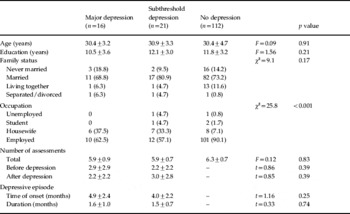
The study included 156 women with a mean age of 30.4±4.6 years (range 18–44 years). Seven depressed women were excluded from the study because they fulfilled the diagnosis of MD or md at their first (n=3) or last (n=4) visit and therefore in these subjects no assessment of alexithymia before or after depression was available. Therefore, the study population included 149 women: 16 were diagnosed as affected by MD, 21 by md and the remaining 112 controls (C) were non-depressed during pregnancy. MD, md and C women showed the same age, years of education and family status, whereas a higher rate of housewives was found in MD and md women than in controls (Table 1). Moreover, MD and md women showed the same time of onset of depression during pregnancy and the same duration of depressive phase (Table 1).
Sociodemographic and clinical features in women who developed major depression or subthreshold depression during pregnancy and in healthy pregnant women

Values are given as mean±s.d. or n (%).
Assessments
The number of assessments were similar in women affected by MD or md and in non-depressed women (Table 1). The time of HADS and TAS assessments used in the data analysis as evaluation before or after depression were similar in MD and md women (Table 1).
Alexithymia and symptom severity
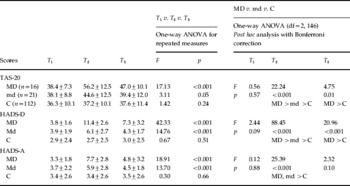
The TAS and the HADS subscale scores in depressed women (before, during and after the depression) and in controls are presented in Table 2. Non-depressed women did not show any change in the TAS (F=1, 42, df=5, p=0.28) and HADS subscale (HADS-D: F=0.67, df=5, p=0.51; HADS-A: F=0.33, df=5, p=0.66) scores across all evaluations. By contrast, in women who developed depression (both MD and md), the pre-morbid TAS and HADS scores were similar to those observed in non-depressed women, they increased significantly during depression and decreased after remission. However, the TAS and HADS scores were higher in MD than in md women both during depression and after remission. After remission, only md women had the TAS and HADS scores normalized.
TAS-20 and HADS scores in women who developed major depression (MD) or subthreshold depression (md) during pregnancy and in healthy pregnant women (C)

HADS-D, Depression subscale score on the Hospital Anxiety and Depression Scale; HADS-A, anxiety subscale score; T 1, before the onset of depression in MD and md women; T 2, during depression in MD and md women; T 3, after depression in MD and md women.
In non-depressed women, T 1, T 2 and T 3 represent the evaluations assessed at the same time of those of depressed women.
Logistic regression analysis showed that TAS scores at the beginning of pregnancy did not predict the development of depression during pregnancy [Wald=1.1, p=0.29, odds ratio (OR) 1.00, 95% confidence interval (CI) 0.98–1.05]. In depressed women, regression analysis showed that the TAS scores after remission were positively related to the alexithymic levels observed during depression (b=0.42, t=3.0, p=0.004), but not to pre-morbid levels (b=0.20, t=1.6, p=0.11), controlling the effect of symptom severity after remission (HADS-D: b=0.42, t=3.0, p=0.004). The differences in TAS score observed in depressed women, both during the illness phase and remission, and in non-depressed women disappeared after controlling for the severity of anxious and depressive symptoms (ANCOVA: F=0.35, df=2,149, p=0.70; F=0.22, df=2,149, p=0.80 respectively).
Discussion
To our knowledge, this is the first prospective study investigating alexithymic levels in women, before, during and after a depressive episode (MD or subthreshold depression). In non-depressed women, alexithymic levels did not change throughout the pregnancy. By contrast, before the onset of a depressive episode in depressed women, the alexithymic levels were similar to those of women who maintained a non-depressive condition and, at the beginning of pregnancy, the TAS scores did not predict the development of depression. Moreover, in depressed women alexithymic levels increased significantly during the depressive phase (the increase was greater in MD than in subthreshold depression) and decreased significantly after a mean period of 2 months of remission, with a normalization only in subthreshold depression (higher levels were still present in MD). Finally, in depressed women after remission, alexithymic levels were related positively to the TAS scores during depression (but not to pre-morbid scores) and to the residual depressive symptoms.
Taken together, our data suggest that in pregnant women alexithymia does not represent a personality trait that increases the risk of developing a depressive episode, and they support the hypothesis that alexithymia is a state-dependent phenomenon. According to the state hypothesis, in our study alexithymia levels were in the normal range before the onset of depression (regardless of the type of depression), increased as depression became clinically relevant (with an increase proportional to the severity of depressive symptoms) and decreased when remission of symptoms occurred.
Some authors (Luminet et al. Reference Luminet, Bagby and Taylor2001; Taylor & Bagby, Reference Taylor and Bagby2004; Saarijärvi et al. Reference Saarijärvi, Salminen and Toikka2006; Le et al. Reference Le, Ramos and Muñoz2007) have suggested that, in depression, alexithymia, as a personality trait, is characterized by relative stability: even though the alexithymic levels can decrease from the acute to the remission phase, the relative differences among individuals remain stable over time. This hypothesis implies that the basic personality conditions, which constitutes a predispositional factor to a depressive disorder, are accentuated by the state of illness and return to the pre-existing conditions after remission, as suggested by Hoffart (Reference Hoffart1994) in his predisposition-state model. However, to our knowledge no previous study has demonstrated that the alexithymic levels observed in the remitted state corresponded to those of the pre-morbid phase.
In our study, alexithymia showed relative stability. However, our data demonstrated that TAS scores assessed after a mean period of 2 months of remission from an MD episode did not represent a return to the pre-morbid condition because, at this time, residual depressive symptoms can maintain an elevation of alexithymic levels, as suggested by the positive relationship between HADS-D and TAS scores after remission. Therefore, our study suggests that, in patients affected by MD, the alexithymic reaction might resolve only after many months of remission, when residual symptoms have also disappeared and symptom severity has returned to the pre-morbid level. Otherwise, the presence of residual depressive symptoms seems to be a sufficient condition to prevent the normalization of the alexithymic reaction.
Therefore, our data do not confirm that relative stability is a finding supporting the hypothesis of alexithymia as a personality trait, and they suggest that the relative stability of alexithymia in depressed patients is the result of a parallel change between symptom severity and TAS score, which increase and decrease together. The hypothesis that alexithymic levels are modulated by the severity of symptoms is also supported by the lower increase in alexithymic levels in patients who developed subthreshold depression as compared to patients who developed MD and by the disappearance of the differences in TAS scores observed between depressed women during the illness phase (and also in the remission phase in MD women) and non-depressed women after controlling for symptom severity. Therefore, our data confirm the suggestions of both Hoffart (Reference Hoffart1994), who claimed that to support the hypothesis that a personality feature constitutes a predispositional factor to one disorder, the personality differences observed between diagnostic groups should persist after symptom severity has been controlled for, and Lumley (Reference Lumley2000), who stated that the uniqueness of the TAS in the relationship with depression could be tested by statistically controlling the other construct and examining the residual relationship of the TAS with the criterion.
There are at least two explanations for the relationship between alexithymia and depression observed in our study. Alexithymia may be a temporary response to stress represented by a depressive episode; in this view, ‘secondary alexithymia’ can represent a defense or a strategy to cope with distress (emotional pain, aversive memories and physiological arousal) associated with depression (Lumley, Reference Lumley2000). In the second view, the relationship between alexithymia and depression may represent an artifact of the method and measures used (Lumley, Reference Lumley2000). In particular, the TAS dimensions ‘difficulty identifying feelings’ and ‘difficulty describing and communicating feelings’ correlate with different measures of negative affects (Lumley, Reference Lumley2000; Marchesi et al. Reference Marchesi, Brusamonti and Maggini2000; Hintikka et al. Reference Hintikka, Honkalampi, Lehtonen and Viinamäki2001; Honkalampi et al. Reference Honkalampi, Koivumaa-Honkanen, Tanskanen, Hintikka, Lehtonen and Viinämaki2001c). Therefore, people with negative emotional states (i.e. anxiety and depression) may score high on these TAS dimensions.
The present study does not allow any conclusion to be drawn regarding which view represents a better explanation of our results because our data can support both of these hypotheses.
Some methodological aspects limit the generalization of our results. First, given the small sample size of our depressed women, firm conclusions should be drawn from our results with caution, and the present data need to be verified by using larger samples and longer follow-up periods. Nevertheless, the presence of MD symptoms, their severity and alexithymic features were frequently and carefully monitored in our sample.
Second, we studied alexithymia and depression in a particular setting, represented by pregnant women; therefore, our data can probably be only poorly generalized to other depressed patients. However, no study has demonstrated that MD or subthreshold depressive symptomatology occurring in pregnancy is different to that occurring in other conditions.
Third, MD or subthreshold depression was not diagnosed by a psychiatrist and therefore the reliability of our data might be questioned. However, the depressive episode was diagnosed using the PRIME-MD, an interview designed to evaluate mental disorders in primary care that has shown good reliability between diagnoses obtained by trained physicians and those obtained by psychiatrists (Spitzer et al. Reference Spitzer, Williams, Kroenke, Linzer, deGruy, Hahn, Brody and Johnson1994). Moreover, the PRIME-MD is reported to show good specificity (98%) and sensitivity (73%) in detecting MD in primary care (Spitzer et al. Reference Spitzer, Williams, Kroenke, Linzer, deGruy, Hahn, Brody and Johnson1994).
Declaration of Interest
None.