INTRODUCTION
Approximately 20% of patients diagnosed with a life-threatening illness will experience a comorbid psychological problem (Griffin & Fentiman, Reference Griffin and Fentiman2002). Therefore, it is important that we identify the warning signs and symptoms to prevent a negative progression to comorbid psychological problems in those diagnosed with a life-threatening illness. One way to identify negative progression in comorbid mental illness is to identify how much the illness influences a patient's daily life. Life-threatening illness not only causes physical symptoms but also psychosocial burdens (Devins et al., Reference Devins, Binik and Hollomby1981; Blagg, Reference Blagg and Friedman1978; Czaczkes & De-Nour, Reference Czaczkes and De-Nour1978). In some instances, symptoms like fatigue and decreased energy levels prevent patients from being involved with work or other activities (Devins et al., Reference Devins, Binik and Hollomby1981). These psychosocial factors (e.g., stigma of illness, lack of support, and perceived illness intrusiveness) can influence a patient's quality of life in a number of ways, including but not limited to mood, strained relationships, decreased well-being, and increased emotional distress (Binik & Devins, Reference Binik, Devins, Garovoy and Guttmann1986; Devins et al., Reference Devins, Mandin and Hons1990; Reference Devins, Binik and Hutchinson1983; Binik et al., Reference Binik, Chowanec and Devins1990; Devins, Reference Devins and Kutner1989; Reference Devins and Hardy1991). If these factors are not identified early, life-threatening illnesses cause suffering, distress, anxiety, and depression (Weis & Boehncke, Reference Weis and Boehncke2011).
These outcomes can largely be attributed to the fear and uncertainty that these patients have to face, in many instances for the first time (Adejumo, Reference Adejumo2009; Henderson, Reference Henderson1997). The initial trauma of being diagnosed with a life-threatening illness sets off a chain reaction that results in transformation of their lives (Adejumo, Reference Adejumo2009). To make matters worse, the effects of these uncertainties are intensified by changes in quality of life, strain on relationships, and a perceived loss of control.
Despite the fact that there have been substantial advances in the treatment of life-threatening illnesses, such treatments often are unable to help patients deal with psychological and social problems (Adejumo, Reference Adejumo2009; Fann et al., Reference Fann, Ell and Sharpe2012). While many of the effects of life-threatening illnesses appear to be negative, some subjective changes in response to illness can lead to personal growth (Brennan, Reference Brennan2001). Observation of subjective changes in patients by palliative care providers have identified that individuals are able to make positive adjustments to life-threatening illness despite all of the psychosocial and physical issues they face (Skeath et al., Reference Skeath, Norris and Katheria2013). Identification of the underlying factors that promote psychosocial growth in patients with life-threatening illness is essential for the formation and implementation of more directed and effective therapies, interventions, and treatments.
One of the most prevalent life-threatening illnesses is heart disease, which affects close to 100,000,000 Americans (Go et al., Reference Go, Mozaffarian and Roger2013). According to the American Heart Association, these individuals are likely to be diagnosed with one or more type of cardiovascular disease (CVD) every year, including myocardial infarction, heart failure, stroke, and angina pectoris (Go et al., Reference Go, Mozaffarian and Roger2013). Moreover, heart disease is the leading cause of death and disability for both women and men (Grace et al., Reference Grace, Abbey and Shnek2002). Recovery from heart disease and cardiac events is an intricate process that involves not only the physical but also the psychological and social realms of health. Therefore, rehabilitation programs that influence patients across multiple domains (psychological, social, occupational, and physical) may best meet their needs (Burgess et al., Reference Burgess, Lerner and D'Agostino1987). Therefore, care/healthcare management that involves each of these domains and is given in the days, months, and even years following the experience of a cardiac event is paramount.
While the majority of the studies investigating the psychosocial experiences of cardiac rehabilitation patients employ interviews as the main measurement tool, there is no questionnaire or survey that investigates positive outcomes in the healing process for cardiac patients during or after cardiac rehabilitation (Nadarajah et al., Reference Nadarajah, Berger and Thomas2013).
The goal of our study was to investigate the lived experiences of psychosocial healing in cardiac rehabilitation patients using a qualitative written interview packet.
METHOD
Measures and Exclusion Criteria
No one individual is able to fully represent all aspects of the experience of healing in the context of cardiac events (Wertz, Reference Wertz2005). Therefore, a series of purposefully selected subjects were needed to gain an accurate representation of all categories of experience of cardiac rehabilitation. We utilized a qualitative analysis and model-revision approach (see Charmaz, Reference Charmaz2006). After examining the transcript of each interview, we used a methodology (Charmaz, Reference Charmaz2006) to best interpret and investigate the contextualized human meanings and experiences of cardiac participants by coding, categorizing, and validating themes from their responses. Wojnar and Swanson (Reference Wojnar and Swanson2007) have shown that interpretive phenomenology is a useful measure for interpreting the blend of meaning and understanding of influences and structures expressed by participants. All written interview packets were collected and transcribed into an electronic document.
The principal investigator initially explained participant selection criteria and convenience sampling to the cardiac rehabilitation services (CRS) director and staff. The director and staff then employed the participant selection criteria to choose potential participants. After individuals were informed of their options, the National Institutes of Health (NIH) research team staff and/or CRS staff offered potential participants the written interview packet.
The written interview packet is a 22-page stapled document with an instruction sheet on the top, an informed consent to be signed, and a participant contact information sheet. Then, the participants completed the written interview packet (estimated to take one hour). In the interview packet, participants first had to pass screenings to be eligible for the study. These screenings included being 18 years of age or older and having a physician-diagnosed cardiac disease and/or events. Further screenings included a measure of current levels of distress, using an unvalidated instrument similar to the Distress Thermometer (DT) (Holland et al., Reference Holland, Andersen and Breitbart2007; Holland & Bultz, Reference Holland and Bultz2007; Jacobsen et al., Reference Jacobsen, Donovan and Trask2005). If potential participants scored at or above 4.0 (on a scale of 0–10) on the modified DT, their data would be disregarded to ensure that a heightened level of distress was not a confounding factor for our results. If a potential participant indicated a current level of distress at or above 4.0, a member of the NIH research team staff and/or CRS staff would refer them to a social worker or spiritual counselor. If individuals scored between 3.0 and 4.0, they were excluded from the study as a precaution against any potential confounding caused by that distress.
Interview Packet and Procedure
Participants who passed the screening were deemed eligible to participate in the study and were deidentified to protect their identities. Eligible interviewees completed a self-administered interview that asked questions related to screening (part 1) and demographics (part 2). Qualitative questions were then answered by participants in writing on their experiences during their cardiac event (part 3) and on how they may have experienced a question or statement (part 4). Participants were informed that there was no right or wrong answer. The instructions also suggested that participants should express their thoughts about the questions in an uninhibited manner, because their data were the only valid data (as opposed to the interpretations of the research team). An experimenter was not present during the written interview, which promoted a sense of privacy and comfort for the participant.
RESULTS
Once all written interview packets were electronically transcribed, we used an “open-coding” system to create new codes to be added without use of any preexisting codes to minimize confirmation bias (Charmaz, Reference Charmaz2006). This method of minimizing bias was performed in a two-step process. First, codes were reconciled among multiple independent coders to further extract significant statements and phrases, and to interpret the meaning of cardiac participants' experiences. After identifying the codes, we then used categorization to identify a comprehensive phenomenological model with codes. Once the codes were organized and meanings were arranged into themes, theme clusters, and categories, validation during the categorization process was carried out using independent categorizers from the research team to ensure that all categories were meaningful and distinct and did not overlap.
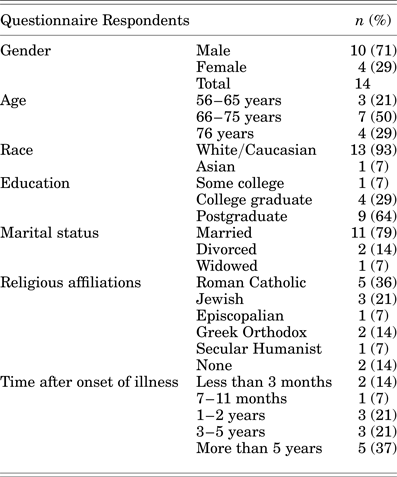
Cardiac rehabilitation patients (n = 14) were recruited. Each participant completed the qualitative written interview packet on their cardiac rehabilitation experience. Each passed the screening criteria and had completed or enrolled in a formal cardiac rehabilitation program. Our sample population consisted of 10 males and 4 females (13 Caucasians and 1 Asian). Half the participants (n = 7) were within the age range of 66–75 years. Only 1 participant had not completed college, while the other 13 had either completed college or postgraduate education. Most of the 14 participants (n = 11) were married, 2 were divorced, and 1 was in a partnership. Our sample also included various religious faiths, including eight who reported an affiliation with a Christian faith (Roman Catholic being the most prevalent), three Jewish affiliates, one secular humanist, and two who did not respond.
Participants reported experiencing either one or a combination of the following cardiac events: stent placement(s) and/or coronary bypass surgery. Participants completed the questionnaire at various times after the onset of their cardiac events: more than 5 years for five participants, 3–5 years for three participants, 1–2 years for three participants, 7–11 months for another, and less than 3 months for two others. Additional demographic data can be garnered from Table 1.
Demographics of respondents

Overall, our participants described several psychosocial benefits of a heightened awareness of their own mortality, including enhanced relationships with friends and family, a more positive outlook on life, and healthy lifestyle changes. The benefits of an enhanced awareness of their own mortality prompted individuals to make changes during their recovery. These benefits manifested themselves in various ways. One participant described heightened awareness of mortality after a cardiac event as traumatizing: “My heart attack and bypass surgery were wake-up calls.” After experiencing these “wake-up calls,” participants were forced to deal with the anxiety and fear that came with being more aware of their own mortality. Ultimately, participants handled these adverse circumstances by accepting their own mortality. One participant expressed this by saying, “I realized that I am not immortal, and at some point in time I will go.”
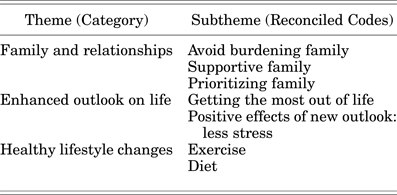
Participants found that a heightened awareness of mortality led to the following factors (as can be seen in Table 2) that positively influenced their recovery from the cardiac events: relationships and family, enhanced outlook on life, and healthy lifestyle changes. They typically indicated that relationships and an enhanced outlook on life were necessary in bringing about healthy lifestyle changes.
Psychosocial themes in recovery from a cardiac event

This table summarizes the results obtained from the qualitative written interviews.
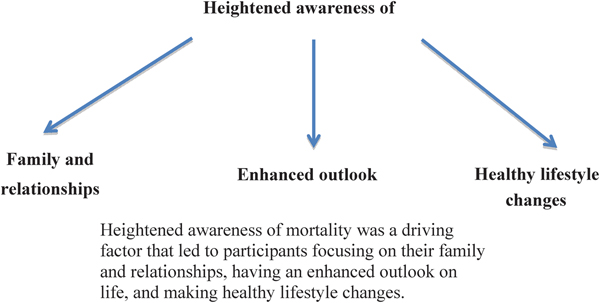
This lived experience of cardiac rehabilitation patients is further depicted in Figure 1, which shows the relationship between a heightened sense of mortality and the three factors involved in the recovery process for patients who experienced a cardiac event.
Lived experiences of cardiac rehabilitation patients.

Relationships and Family
After their cardiac events, most participants expressed emphatically how vital relationships and family support were during the recovery phase. However, this support was often confronted with resistance during the initial stages of recovery, as many participants did not want to burden their loved ones. One participant demonstrated this concern for family by not wanting to burden his wife with grief or responsibility thus: “I love her. We have a great life together, and I don't want to devastate her or handicap her by needing to take care of me or grieve.”
Although several participants expressed the desire not to burden loved ones, they understood the benefit of their support. This support and strength arising from relationships with family was demonstrated by the following comment: “My life with my wife, children, and grandchildren had taken priority—they are very important to me, because I would be totally lost without them.” Similarly, another participant indicated the importance of the role of family in his life as follows:
I have a wife that loves and care. It make[s] life worthwhile. I always believed that she cared, but now I know [after my cardiac event]. [All] she had to do was nothing when I had the heart attack, and I wouldn't be here. My four daughters care. We were in Colorado Springs, and they all got there in less than 18 hours. I realize that they do care about their dad.
Other participants valued their families so highly that they made living for their family their highest priority, as shown by the goals of another participant:
I would like to stay around a little longer since I have much to accomplish. I would like to pass on my life's story to my children and grandchildren. I would like to see my two granddaughters marry (one is four years old and one is six years old). [I want] to write down my memories. I would like to see continuity in the family. It gives me an objective that is important for me to achieve. I never experienced this motivation.
Overall, participants showed more consideration for their loved ones after experiencing a cardiac event. This consideration manifested itself in the following ways: being less of a burden to family members, appreciating family support, and prioritizing family-related goals.
Enhanced Outlook on Life
Another factor that positively influenced their recovery effort was a more positive outlook on life. This positive, or enhanced, outlook was expressed by participants who decided to take part in the activities that were most important to them while also experiencing the benefit of less stress. One tried to get the most out of life by focusing on the most important things:
My outlook on life in general is much more positive. I came out of the heart attack alive. I now believe that I should do what I want to do now. There is no point in waiting. If I put it off, I might not be here to do it.
Another participant more specifically demonstrated this by identifying which activities they wanted to engage in during their remaining time:
I feel an urgency to do the things I really want to do. I am an artist, and I feel like I can't afford to waste my time. I need to do things [paint] that are most important to me. I feel that I tend to waste time.
As a result of this drive and motivation to make the most out of their lives, several participants reported a number of benefits related to these changes, for example: “I am more relaxed and less stressed than before. My changes have been gradual, not sudden. My life is better but not transformed.”
Collectively, our participants typically expressed an enhanced outlook on life. This improved outlook led to a desire to enjoy their lives to the fullest, which in turn resulted in a number of benefits, including feeling more relaxed and less stressed.
Healthy Lifestyle Changes
The combination of family, relationships, and a more positive outlook on life allowed participants to make healthier decisions. These decisions were reflected in exercise and dietary choices. One participant indicated a desire to lose weight in order to more fully enjoy life: “The decision to lose weight from 210 pounds to 165 pounds and improve my overall health. I want to live longer and enjoy what life has left for me.”
The decision to lose weight caused a heightened awareness of the importance of exercise. Heightened awareness of mortality allowed participants to realize the health benefits of exercise. This realization was clearly depicted by one participant:
I have always felt that exercise was important. Now, after my heart attack, I feel greater urgency to get exercise. I felt that it is as important as taking medicine.
Participants also noticed additional benefits of exercise:
I have a range of options to turn to, but I don't take my eyes off the ball. Diversions such as exercise help clear my head to better think through and cope with any problems.
While participants did increase their focus on exercise, they also engaged in healthier decision making. One applied these healthier decisions to dietary choices:
[I] dramatically changed what I eat, increased aerobic exercise. [I] am now about 80% vegan.
After experiencing a cardiac event, participants were able to utilize support from their family to gain a more positive outlook. This enhanced perspective and support allowed participants to make healthier lifestyle changes. These changes included being more aware of their weight, exercising more, and making better dietary decisions.
DISCUSSION
A majority of our participants reported that heightened awareness of their own mortality prompted individuals to experience positive, life-transforming changes during their recovery from cardiac events. From the outset, these changes were most notable in participants' relationships with family and friends, as well as an enhanced outlook on life. Ultimately, these changes led to healthier lifestyle changes.
Our findings are consistent with several studies which indicate that family and social support play a major role in the reported positive, life-transforming change. Staniute ent colleagues (Reference Staniute, Brozaitiene and Bunevicius2013) found that perceived social support allowed individuals to have a more positive quality of life and cope better with stressful life events. Similarly, family support was found to be the primary source of support (Ell, Reference Ell1996). It therefore follows that poor social and family support is associated with recurrent cardiac events as well as comorbid psychological disorders (Molloy et al., Reference Molloy, Perkins-Porras and Bhattacharyya2008b ; Mehnert et al., Reference Mehnert, Lehmann and Graefen2010). These positive results for cardiac rehabilitation might also be explained by the literature which indicates that those who were married were more likely to attend cardiac rehabilitation sessions (Molloy et al., Reference Molloy, Hamer and Randall2008a ; Yates et al., Reference Yates, Kosloski and Kercher2010). Yates and colleagues (Reference Yates, Kosloski and Kercher2010) theorized that these findings may be due to the enhanced emotional support provided by their spouses.
While some study findings support our results, others indicate that there are different factors that might be responsible for the positive health outcomes concomitant with cardiac rehabilitation. Sheikh (Reference Sheikh2004) found that extraversion was the most significant predictor of posttraumatic personal growth, while the role of social support was questionable. Molloy and colleagues (Reference Molloy, Hamer and Randall2008a ) believed that practical support may be more important in encouraging recovery behaviors, including medication adherence, help with filling prescriptions, and CR attendance. Practical support was more effective than social support regardless of the level of connection or affection from the source of support.
Still others indicated that social support plays a limited role in recovery from a cardiac event, like Hamalainen and colleagues (Reference Hamalainen, Smith and Puukka2000), who demonstrated that patients' functional and psychological status and mental outlook were the main determinants of recovery at one year. On the other hand, Kahane (Reference Kahane1993) indicated that support improves self-esteem and mental outlook, which can result in a greater ability to deal with the psychosocial factors surrounding a life-threatening illness.
Across the literature, other authors agree with our finding indicating that psychological status and mental perspective/outlook are important determinants in recovery from a cardiac event. Chang and colleagues found that patients achieved enhanced quality of life after their cardiac events, as they improved on measures examining depression, anxiety, and hostility (Chang et al., Reference Chang, Casey and Dusek2010), and these positive changes likely promoted healthier lifestyle changes.
Similar positive changes reported by participants in cardiac rehabilitation studies included decreased pain and anxiety, improved general health, and enhanced vitality and mental health scores (Seki et al., Reference Seki, Watanabe and Sunayama2003). Another possible explanation for the link between positive outlook and healthy lifestyle changes was found by Hanssen and colleagues (Reference Hanssen, Peters and Vlaeyen2013). These findings indicate that optimism, or at least a more positive outlook, is important in lowering levels of pain and is consequently negatively correlated with psychosocial distress (Hanssen et al., Reference Hanssen, Peters and Vlaeyen2013; Stanton & Snider, Reference Stanton and Snider1993). In addition, an optimistic outlook has been found to be associated with increased psychosocial adjustment, decreased psychosocial stress, and renewed vigor among those with a life-threatening illness (Miller et al., Reference Miller, Manne and Taylor1996; Mishel et al., Reference Mishel, Hostetter and King1984; Stanton & Snider, Reference Stanton and Snider1993).
Positive psychological factors are even able to slow progression, increase survival time, and reduce mortality in life-threatening illnesses by lowering levels of stress and improving regulation of a patient's immune system (Coyne & Tennen, Reference Coyne and Tennen2010). Moreover, initial self-reports of well-being, personality, outlook, and levels of optimism in another study demonstrated substantial continuity when compared to measures taken 5–13 years later (Carver et al., Reference Carver, Scheier and Weintraub1989; Reference Carver, Pozo and Harris1993).
The literature suggests that cardiac rehabilitation offers not only a more positive effect on mental outlook and psychological activities but also provides benefits related to physical activities and exercise. These benefits of exercise contribute to secondary prevention of recurring cardiac events (Yoshida et al., Reference Yoshida, Kohzuki and Yoshida1999). Stauber and coworkers found it likely that patients were able to feel less pain during exercise and increase their maximum walking distance due to the effects of a positive outlook, support from family and friends, and cardiac rehabilitation, and were thus able to increase the distance they were able to walk and reduce body mass index (BMI) (Stauber et al., Reference Stauber, Guera and Barth2013).
Other investigators have found additional positive effects of CR that address the psychosocial domain. Some studies determined that CR improved depression symptoms and quality of life (McGrady et al., Reference McGrady, McGinnis and Badenhop2009; Yohannes et al., Reference Yohannes, Doherty and Bundy2010), increased the confidence of patients in their own abilities (Clark et al., Reference Clark, Hartling and Vandermeer2005), improved patients' knowledge of better diet options (Nadarajah et al., Reference Nadarajah, Berger and Thomas2013), and lowered levels of perceived stress (Kreikebaum et al., Reference Kreikebaum, Guarneri and Talavera2011). More important, these effects are influential over the long term, as they affect a patient's physical condition, life habits, and health knowledge (Lidell & Fridlund, Reference Lidell and Fridlund1996).
CLINICAL IMPLICATIONS
Cardiac rehabilitation programs are vital when it comes to the well-being of individuals who have experienced a cardiac event. The lived experience of cardiac rehabilitation patients and patients with a life-threatening illness result in powerful experiences that can lead to an enhanced quality of life. Understanding the nature of this progression from cardiac event to successful recovery is imperative for the medical community. If a measure were employed to examine the process of adaptive coping to a life-threatening illness, it would provide healthcare providers with a reliable means of identifying and diagnosing disorders and other medical conditions earlier in their course. With this understanding of the lived experience of cardiac patients, healthcare professionals may have an opportunity to enhance the clinician–patient relationship. This dynamic relationship between healthcare provider and patient is most important when dealing with such sensitive issues as addressing mortality after a life-threatening event. Moreover, this enhanced relationship has the potential to emphasize and provide healthy adaptive coping mechanisms for patients. It could also ultimately prove to be beneficial for integration of various complementary treatment options into cardiac rehabilitation programs—such as yoga, meditation, music therapy, pet therapy, prayer, and referral to spiritual and at times religious counselors.