INTRODUCTIONFootnote 1
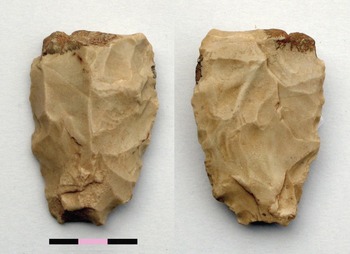
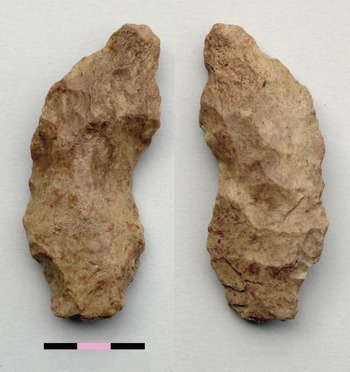
Six bifacially flaked leaf-points have been found in the course of the Petrota survey,Footnote 2 five of them in the body of the chert scatter around Vrahos Hill, and a sixth on a hillslope c.400 m to the south (Figs 1, 2 and 3). The last piece, no. 6, is much worn through rolling, and so too is no. 3 in Fig. 1, which was collected from the foot of Vrahos Hill. All six artefacts are made on thick supports (thickness 1.1 to 2.0 cm) and their preserved lengths range from 5.4 to 8.4 cm. Missing tips and/or butts (kolovosis) from most pieces indicate that they had not been idle. Repairs and/or reuse marks are, however, difficult to identify.Footnote 3
Petrota, leaf-points 1, 2, 3 and 4. Drawings: D. Papayanni.

Petrota, leaf-point 5. Scale is 3 cm. Photo: the author.

Petrota, leaf-point 6. Scale is 3 cm. Photo: the author.

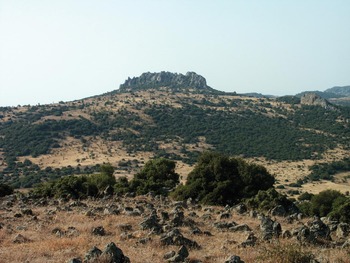
The chert scatter on and around Vrahos Hill consists of thousands of products of prehistoric reduction sequences geared to tool production, and of a vastly larger number of natural and natural-like fragments. The source of the raw material is Vrahos, a craggy, tower-like mass of volcanic rock (silicified dacitoid andesite of Oligocene ageFootnote 4 ) that crowns the hill (Fig. 4). This feature, visible from points up to 50 km away, rises to 221 m above sea level and 130 m above the floor of the valley immediately to the east of Vrahos Hill. The scatter extends from the foot of Vrahos down to the valley floor; it covers approximately one square kilometre. Besides Vrahos chert, the scatter contains very few other stones. The latter are demonstrably manuports (such as naturally rounded small cobbles of dacitoid andesite and tuff, which were used as hammer stones). The southwest-facing slope of the hill was used by humans in the first millennium bce, as is shown by foundations of sizeable buildings, potsherds and a fragment of a hopper-rubber quern. Our survey concentrated mainly on the east, south-east and north slopes, which are virtually free from artefacts relating to those uses. In recent times, but probably for several centuries, the hill has served as a grazing and resting ground for goat- and sheep-herds. In the mid-twentieth century the Greek military used Vrahos Hill as a mortar-testing ground (unexploded missiles are still to be found along the slopes). This, no doubt, contributed to the population of chert fragments (which resemble natural formations) in some sectors of the scatter, but it does not appear to have damaged the boulders forming the hill's crown. In the mid-twentieth century too, a Greek from Cappadocia (Turkey), resettled in a village in the Petrota area, collected chert from Vrahos, carried it home and turned it into teeth for threshing sledges.Footnote 5
Vrahos Hill from the north. Photo (2006): the author.

The chert of Vrahos was extensively exploited from the Neolithic to the beginning of the Early Bronze Age. About 85% of the period-diagnostic pieces in the scatter are securely datable to that period (e.g. prismatic cores in various stages of preparation and exploitation, tablets from such cores, slender blades, and end-scrapers on blade fragments). The remainder is of Middle Palaeolithic date and includes discoid and Levallois cores, Levallois flakes, points and blades, and the six leaf-points already mentioned.Footnote 6 Our collection, formed both by controlled sampling (total collection in select areas) and by free-ranging reconnaissance, contains no fewer than 60 such pieces. Many more, mainly raw flakes but also blades and retouched pieces, would be at home in a Middle Palaeolithic site. But doubts remain about them. The flakes, in particular, could have derived from the initial stages of turning natural chunks of chert into cores, Palaeolithic or Neolithic. Such ambiguous pieces have, therefore, been excluded from the figure cited above. The effect of this conservative principle is probably an underestimation of the intensity of use of the Vrahos chert in the Palaeolithic.
We suggested long ago (Fotiadis, Papayanni and Efstratiou Reference Fotiadis, Papayanni and Efstratiou2001, 12) that the Middle Palaeolithic of Petrota ought to date to a late stage of that long period (spanning 200,000 years or more).Footnote 7 That suggestion was prompted by the presence of leaf-points in the scatter. But we treated the matter superficially, drawing on received wisdom rather than secure empirical evidence: in Greece and Bulgaria, leaf-points have repeatedly been thought to date to an era well after the Eemian (c.128–118 ka BP), perhaps to a time between 80 and 40 ka BP,Footnote 8 yet without support from stratigraphic sequences or radiometric dates. In short, our claim for a late date was poorly documented and in some respects misleading. In the present paper I revisit the issue of the Petrota leaf-points and their significance for the site's Palaeolithic chronology, and I do so more systematically. The conclusion is somewhat different from our 2001 suggestion, but above all is better documented. In 2001 such documentation was unimaginable: most of the research upon which I rely and cite below has been published after 2001.
Already in our first survey season we became concerned with slope processes and their effects on the distribution of surface artefacts. In 2002, for example, we were able to demonstrate to our satisfaction that the dense concentrations of chert pieces on the floor of the valley immediately to the east of Vrahos Hill were exclusively the result of the erosion of the hill's slopes. What, however, of the subsurface of the valley floor? Were we to excavate or drill into it, we could perhaps encounter older deposits of similar origin and thus be able to reconstruct the erosional history of Vrahos Hill. Coring into the valley floor became possible in 2008, and the results, supported by five radiocarbon (AMS) dates, are instructive (Pavlopoulos Reference Pavlopoulos2010; summary in Fotiadis, Efstratiou and Pavlopoulos Reference Fotiadis, Efstratiou and Pavlopoulosin press): the present fill of the valley dates to the period from c.1500 to c.1900 ce, especially to the sixteenth, seventeenth and eighteenth centuries. Its accumulation coincides, that is, with the ‘Little Ice Age’, and is thus probably a climate-induced development. The older valley fills and the chert artefacts they contained were completely removed from the valley, transported to, and redeposited in, the Komotini Plain to the north before the ‘Little Ice Age’. Such removals, moreover, are likely to have occurred time and time again, in climate-induced episodes extending back to the Pleistocene. I will draw upon this last point in the conclusion of the paper.
LEAF-POINTS IN EUROPE AND THEIR DISTRIBUTION, TEMPORAL AND GEOGRAPHICAL
Bifacially flaked stone tools (hand-axes, picks, cleavers) appeared in east Africa 1.75 Ma BP (Lepre et al. Reference Lepre, Roche, Kent, Harmand, Quinn, Brugal, Texier, Lenoble and Feibel2011). By 0.85 Ma BP, highly symmetrical ovate hand-axes were manufactured in the same area (Beyene et al. Reference Beyene, Katoh, WoldeGabriel, Hart, Uto, Sudo, Kondo, Hyodo, Renne, Suwa and Asfaw2013, especially fig. 52 in their online Supporting Information). The hand-cum-brain aptitudes essential for bifacial flaking (Gibbons Reference Gibbons2013) have not yet been entirely lost (Brumm and Moore Reference Brumm and Moore2012, figs 3 and 5). In evolutionary terms, the Petrota leaf-points descend from those same aptitudes, emergent in Homo ergaster/erectus already 1.75 Ma BP, even though traditions of bifacial flaking have been anything but continuous, global or invariant.
Bifacially flaked points in the form of an elliptic or ovoid leaf made on flakes and on tabular natural fragments have a wide geographical distribution, extending from Bavaria (e.g. Weinberghölen: Richter Reference Richter2008–9, 99–105) to the northern Caucasus (e.g. Mezmaiskaya Cave: Doronichev and Golovanova Reference Doronichev, Golovanova, Soressi and Dibble2003, 91 and fig. 4.7:1).Footnote 9 Apparently absent from the Middle East and sites further east in Asia, leaf-points still are by no means an exclusively European phenomenon. Examples are known from north Africa (e.g. from the Levalloiso-Mousterian of Haua Fteah, dated c.75–73 ka BP; McBurney Reference McBurney1967, 112 fig. V.5; Douka et al. Reference Douka, Jacobs, Lane, Grün, Farr, Hunt, Inglis, Reynolds, Albert, Aubert, Cullen, Hill, Kinsley, Roberts, Tomlinson, Wulf and Barker2014, 58), and exquisitely worked leaf-points come from the Still Bay levels of Blombos Cave, South Africa, dated c.75–72 ka BP (Henshilwood Reference Henshilwood2012, fig. 3; Villa et al. Reference Villa, Soressi, Henshilwood and Mourre2009). In Europe, scores of leaf-points have been found in sites in Moravia and western Slovakia (Neruda and Nerudová Reference Neruda, Nerudová, Neruda and Nerudová2009, 202–7; Kaminská, Kozlowski and Škrdla Reference Kaminská, Kozlowski and Škrdla2011), in the Bükk Mountains and vicinity (north-east Hungary: Allsworth-Jones Reference Allsworth-Jones1986; Kozlowski et al. Reference Kozlowski, Mester, Zandler, Budek, Kalicki, Moskal and Ringer2009), in Moldavia and along the Lower Danube valley on its Bulgarian side (for locations of European sites see Fig. 5). In the last area, Muselievo, an open-air site a few kilometres away from the Danube talweg, has yielded more than 500 leaf-points made from local, good-quality flint; it has thereby been designated a ‘workshop’ for the manufacture of leaf-points (Ivanova and Sirakova Reference Ivanova, Sirakova, Bailey, Panayotov and Alexandrov1995, 28 and 31–5). Still in Bulgaria but closer to Greek Thrace and Petrota, Shiroka Polyana, also an open-air site at c.1500 m above sea level in the Rhodope Mountains, has been surface-surveyed and has yielded c.30 leaf-points (Ivanova and Sirakova Reference Ivanova, Sirakova, Bailey, Panayotov and Alexandrov1995, 38, 41–4). Further south, in Greece, such artefacts are known from surveys in several areas, but quantities are small; the largest group (eight pieces) comes from Kokkinopilos in western Greece (Runnels Reference Runnels1988, 282–5).
Central and east European sites discussed in the text: 1 Weimar-Ehringsdorf; 2 Bisnik Cave; 3 Kulna Cave; 4 Brno-Bohunice; 5 Moravský-Krumlov IV; 6 Vedrovice V; 7 Milovice; 8 Istállóskö Cave; 9 Szeleta Cave; 10 Korolevo 1; 11 Ripiceni-Izvor; 12 Vindija Cave; 13 Kozarnika Cave; 14 Muselievo; 15 Buran-Kaya; 16 Kokkinopilos; 17 Shiroka Polyana; 18 Petrota. Base map after National Geophysical Data Center, USA, Europe Physical Map.

Questions surrounding the chronostratigraphical position of leaf-points in Europe are legion, not least because that chronostratigraphy is thought to bear on the matter of the succession of Neanderthals by Modern Humans in the subcontinent. Like the Petrota material, moreover, the majority of known leaf-points are surface finds, while scores come from old, insufficiently documented excavations. Leaving aside the issue of the Neanderthal – Modern Human succession in Europe, to which the Petrota material cannot contribute anything new, I concentrate below on the chronostratigraphy of leaf-points as it can be traced from excavated, more or less securely dated, sequences in a few central and east European sites.
Leaf-points occur in contexts of Middle and Initial Upper Palaeolithic (IUP, or ‘transitional’) industries. In the latter case, they have since the 1950s routinely been dubbed ‘Szeletian’, after Szeleta Cave in the Bükk Mountains, where more than 150 of them were excavated about one hundred years ago.Footnote 10 Among the earliest occurrences are those from ‘complexes’ Va and V of Korolevo 1 (Transcarpathian Ukraine), which are dated to the later part of MIS 7 (c.240–180 ka BP; Nikolaevitch Gladilin, Slitlvyj and Tkachenko Reference Nikolaevitch Gladilin, Slitlvyj and Tkachenko1995; Richter Reference Richter, Conard and Richter2011, 10 and fig. 2.3). The ‘Lower Travertine’ at Weimar-Ehringsdorf, Thuringia, assigned to MIS 7 on the basis of uranium-series dates and biostratigraphy, has also yielded a number of leaf-points (Feustel Reference Feustel1983, 18 and figs 5:3, 6:2 and 7:1; Mallick and Frank Reference Mallick and Frank2002, especially 4271; Mania and Mania Reference Mania and Mania2008, especially 25–8 and 39). Some of them were abandoned before they were fully shaped; many more bear marks of repeated edge resharpening (Kot Reference Kot2013, 182–6).
Korolevo and Ehringsdorf are open-air sites. Biśnik Cave (Upper Silesia, Poland), a meticulously excavated site in recent times, has also produced examples of leaf-points from layers 12 and 11, dated by several methods to MIS 5d and 5c (c.118–95 ka BP; Cyrek et al. Reference Cyrek, Sudot, Czyźewski and Osipowicz2014). The context of the Korolevo leaf-points is said to be ‘Mousterian,’ that of Bisník Cave ‘Mousterian-Micoquian’ (Cyrek et al. Reference Cyrek, Sudot, Czyźewski and Osipowicz2014, especially 61 table 12).
Assemblages with leaf-points are noticeably more common in deposits dating to MIS 4 (c.71–57 ka BP) and the early part of MIS 3 (c.57–24 ka BP). At Kulna Cave, Moravia, leaf-points are associated with a Micoquian industry dated by ESR between c.70 and c.50 ka BP (Rink et al. Reference Rink, Schwarcz, Valoch, Seitl and Stringer1996; Valoch Reference Valoch1995). Optical luminescence (OSL) measurements for the relevant layers are in agreement with the ESR date for the beginning of the Micoquian sequence but not with that for its end (Nejman et al. Reference Nejman, Rhodes, Škrdla, Tostevin, Neruda, Nerudová, Valoch, Oliva, Kaminská, Svoboda and Grün2011, 1058 and table 7).
To move onto IUP industries in Moravia that contain leaf-points: Brno-Bohunice, the type-site for the Bohunician industry, was also a place where bifacial leaf-points were manufactured (Richter, Tostevin and Škrdla Reference Richter, Tostevin and Škrdla2008, 877; Škrdla and Tostevin Reference Škrdla and Tostevin2005, 59). The relevant horizon has been dated by 14C (AMS), OSL and TL. The last method, applied to 11 heated flints, gave a weighted mean of 48.2 ± 1.9 ka BP (Richter, Tostevin and Škrdla Reference Richter, Tostevin and Škrdla2008). The eight AMS dates from the Oxford Archaeometry Laboratory, on samples obtained from recent (2002) excavations, place the Bohunician at the type-site between 44,647 and 38,974 Cal BP (Nejman et al. Reference Nejman, Rhodes, Škrdla, Tostevin, Neruda, Nerudová, Valoch, Oliva, Kaminská, Svoboda and Grün2011, 1053 table 4). But note that none of those samples could sustain ABOx treatment (Richter et al. Reference Richter, Tostevin, Škrdla and Davies2009, 715), and this is probably the reason why the resulting dates are significantly younger than the TL date. The OSL dates from Bohunice (Richter et al. Reference Richter, Tostevin, Škrdla and Davies2009, 717–18; Nejman et al. Reference Nejman, Rhodes, Škrdla, Tostevin, Neruda, Nerudová, Valoch, Oliva, Kaminská, Svoboda and Grün2011, table 7), on the other hand, are difficult to interpret.
At Vedrovice V, Moravia, the leaf-point horizon (‘Szeletian’; see Valoch Reference Valoch1993) has been dated by 14C to between 46,166 and 38,791 Cal BP (Nejman et al. Reference Nejman, Rhodes, Škrdla, Tostevin, Neruda, Nerudová, Valoch, Oliva, Kaminská, Svoboda and Grün2011, table 6; Haesaerts et al. Reference Haesaerts, Damblon, Nigst and Hublin2013, 644Footnote 11 ). Optical luminescence dates from the site are, however, irreconcilably at variance with the 14C dates, suggesting a far higher chronology (c.60–100 ka BP; Nejman et al. Reference Nejman, Rhodes, Škrdla, Tostevin, Neruda, Nerudová, Valoch, Oliva, Kaminská, Svoboda and Grün2011, 1062–3). Still, the 14C dates from Vedrovice V are in reasonably good agreement with AMS dates from Moravský Krumlov IV, also in Moravia, excavated in 2000–4. At the latter site, the four AMS dates from the Szeletian layer, a confirmed workshop for manufacturing leaf-points, place the human presence in the period between 43,258 and 41,311 Cal BP (Nerudová Reference Nerudová2008–9; Nejman et al. Reference Nejman, Rhodes, Škrdla, Tostevin, Neruda, Nerudová, Valoch, Oliva, Kaminská, Svoboda and Grün2011, 1054). The OSL date from the upper part of the Szeletian layer correlates perfectly with the AMS dates, but the one from the lower part gives 64.6 ± 7.0 ka, possibly, the authors suggest, as a result of contamination (Nejman et al. Reference Nejman, Rhodes, Škrdla, Tostevin, Neruda, Nerudová, Valoch, Oliva, Kaminská, Svoboda and Grün2011, 1061).
The chronostratigraphical record of the type-site for the Szeletian, Szeleta Cave, is notoriously difficult to interpret and will not be discussed here (for the problems see e.g. Davies and Nerudová Reference Davies, Nerudová, Neruda and Nerudová2009, 84–7; Neruda and Nerudová Reference Neruda, Nerudová, Neruda and Nerudová2009, 259–61; Davies and Hedges Reference Davies and Hedges2008–9; Jöris et al. Reference Jöris, Street, Terberger, Weninger, Condemi and Weniger2011, 258–61).Footnote 12 Problematical too are claims about the presence of leaf-points in Aurignacian, even Gravettian, contexts in Romanian sites, e.g. in Ripiceni-Izvor, an open-air site on the right bank of the Prut (for a critical assessment of the claims see Anghelinu et al. Reference Anghelinu, Niță, Sitlivy, Uthmeier and Băltean2012, especially 145–6; Anghelinu and Niță Reference Anghelinu and Niță2014, especially 181). In this case too, I will refrain from further discussion. Even if the claims for an Aurignacian/Gravettian chronology for the leaf-points at Ripiceni-Izvor and at Szeleta Cave (e.g. Lengyel, Mester and Szolyák Reference Lengyel, Mester and Szolyákin press) are one day vindicated, they would still have no bearing on my present task: there is no chance that the Petrota material could date to those periods (see above, n. 6).
Further south, in Bulgaria, leaf-points are associated with the local Mousterian industries, e.g. in Shiroka Polyana and Samouilitsa Cave (Ivanova Reference Ivanova1992, 153–60). Direct dates are lacking in all cases. At Muselievo, pedological evidence correlated with the climatic sequence of the Weichselian suggests a date c.50–45 ka BP for the leaf-point workshop (Ivanova and Sirakova Reference Ivanova, Sirakova, Bailey, Panayotov and Alexandrov1995, 28 and 31).Footnote 13 Support for such a chronology may be drawn from Kozarnika Cave, in north-west Bulgaria. Here, the few leaf-points encountered in level VII, itself of early Upper Palaeolithic character and dated to c.39.3–36.2 ka 14C BP, are suspected to derive from the underlying Mousterian levels (lithostratigraphic unit 9), dated to a time before c.43.6–42.7 ka 14C BP (Tsanova Reference Tsanova2008, 166, 167, 172). Whichever is the case, such dates are sufficiently close to the estimated age of the Muselievo leaf-point workshop. It should be added that the main preliminary report of the Kozarnika Cave excavations (Guadelli et al. Reference Guadelli, Sirakov, Ivanova, Sirakova, Anastassova, Courtaud, Dimitrova, Djabarska, Fernandez, Ferrier, Fontugne, Gambier, Guadelli, Iordanova, Iordanova, Kovatcheva, Krumov, Leblanc, Mallye, Marinska, Miteva, Popov, Spassov, Taneva, Tisterat-Laborde, Tsanova, Molines, Moncel and Monnier2005) suggests a very long temporal span, beginning at MIS 5e or earlier, for the presence of leaf-points in the cave. But detailed documentation is essential before that suggestion can be taken at face value (see also Popov and Marinska Reference Popov and Marinska2007, especially 84 and 88–9, and fig. 11).
One could look for chronological guidance from sites further afield, e.g. to the Buran-Kaya III rock shelter, Crimea (Marks and Monigal Reference Marks, Monigal, Brantingham, Kuhn and Kerry2004, 71 and fig. 5.3). Recently obtained AMS dates from the latter site show that the Szeletian leaf-points horizon (layer C) is definitely older than 40 ka Cal BP, if not older than 44 ka Cal BP (Péan et al. Reference Péan, Puaud, Crépin, Prat, Quiles, Plicht, Valladas, Stuart, Drucker, Patou-Mathis, Lanoë and Yanevich2013, 1464–5). This would corroborate the chronology already derived from the Moravian sites with Szeletian-type leaf-points as presented above. In brief, reliably dated contexts of leaf-points indicate that such artefacts were crucial to Palaeolithic folks during MIS 4 and 3 until c.45 ka, and ceased to be crucial in the course of the next few millennia. Claims for the presence of leaf-points in Gravettian contexts in western Slovakia have been shown, upon re-examination of those contexts, to be ill founded (see Kaminská et al. Reference Kaminská, Kozlowski, Sobczyk, Svoboda and Michalík2008, especially 236; also Kaminská, Kozlowski and Škrdla Reference Kaminská, Kozlowski and Škrdla2011, 35). Isolated leaf-points have in some cases been found in association with Gravettian and Aurignacian artefacts, e.g. in Moravia and north Hungary. Best known is the case of Istállóskö Cave (Bükk Mountains), where two leaf-points were found in deposits containing many split-base bone points (see e.g. Kozlowski et al. Reference Kozlowski, Mester, Zandler, Budek, Kalicki, Moskal and Ringer2009, 402–3). Does this stratigraphic ‘cohabitation’ of Aurignacian and Szeletian artefacts demonstrate their contemporaneity? I doubt it: occasional leaf-points in Aurignacian contexts might just as well be manuports, pieces encountered in the landscape and brought onto Aurignacian sites thousands of years after such points had gone out of use. In fact, this suggestion has been made for Milovice, Moravia, where a leaf-point was found amid the remains of the late Gravettian occupation (Oliva Reference Oliva2010, 66). A single leaf-point has also been found in Vindija Cave (Croatia) in unit G1, in association with Aurignacian bone and stone tools; but unit G1 at Vindija has been shown to be a post-depositionally disturbed palimpsest (Zilhão Reference Zilhão, Camps and Chauhan2009).
CONCLUSION
What does this overview of the chronological spread of leaf-points indicate about the chronology of the Petrota quarry in the Palaeolithic? It is clear that such a chronology is poorly constrained: the leaf-points of Petrota (a) could be contemporary with those of Korolevo and Ehringsdorf (MIS 7), (b) could be contemporary with those of Muselievo and the IUP Moravian sites (late MIS 4 to early MIS 3, c.65–45 ka BP), or, last (c), could date from a time between those two termini. The first alternative is not probable: supposing that hominins were present around Vrahos Hill during MIS 7, their lithics are likely to have since been removed to the Komotini Plain in one or more of the climate-induced episodes of such removal I postulated earlier, e.g. during the rapid climatic fluctuations of MIS 6 (c.185–135 ka BP; see Roucoux et al. Reference Roucoux, Tzedakis, Lawson and Margari2011, especially 621 and 624). This leaves us with alternatives (b) and (c), deciding between which is difficult at this time. If leaf-points were present in the Balkans since MIS 5 (or earlier), as the evidence from Kozarnika Cave seems to indicate (see above), we have to regard a date roughly about 100 ka BP as a likely terminus post quem for the Petrota leaf-points and the area's Middle Palaeolithic. The continuing study of the Kozarnika Cave excavation materials may resolve some of the ambiguities noticeable in the project's preliminary reports, and thus offer a firmer ground for estimating the date of the earliest hominin presence around Vrahos Hill.
Deciding on the terminus ante quem for the Petrota leaf-points and Middle Palaeolithic, on the other hand, presents fewer difficulties. The combined evidence from Muselievo, Kozarnika Cave and several other central and east European sites indicates that leaf-points went out of use some time between 45 and 40 ka BP.
On the basis of the above, the minimum age for the Petrota leaf-points and, accordingly, for the Petrota Middle Palaeolithic is 45–40 ka BP, and the maximum age c.80–120 ka BP.
ACKNOWLEDGEMENTS
I thank two anonymous reviewers for useful comments on the manuscript originally submitted to the Co-Editors of the Annual. I also thank Vangelis Tourloukis for calling my attention to, and providing me with a digital copy of, Małgorzata Anna Kot's PhD thesis. The Archaeological Ephoreia of Komotini continuously provided essential facilities to the Petrota survey. My collaborator in the field Nikos Efstratiou and I are much indebted to Diamantis Triantafyllos and Dimitris Matsas, successive directors of the Ephorate, who embraced our idea for the Petrota survey and offered moral support to us throughout the fieldwork. Our research expenses were covered by annual grants from the Universities of Thessaloniki (1998–2000) and Ioannina (2001–10).