Albert Camus’ novella The Stranger (Reference Camus and Gilbert1946) is one of the literary centrepieces of the existentialist movement. Except for the novella's final pages, in which his impending execution sparks anxiety and examination of his life, the protagonist Meursault is an existentialist anti-hero, a picture of alienation from wider society. He lives emotionally detached from others, with no apparent investment in them or their fates. He willingly cooperates in his friend Raymond's plan to exact cruel vengeance on the latter's girlfriend and can give no accounting of his motivations for shooting an Arab man on the beach. Indeed, aside from the transient pleasures of sex, movies, and café au lait, Meursault hardly seems motivated by anything at all.
Curiously, Camus uses grief, including grief's absence, to illustrate Meursault's alienated condition. The novella opens with Meursault attending the funeral of maman. He gives no evidence of the psychological turmoil associated with grief though. At most, Meursault goes through the motions of mourning, passively participating in its rituals but without the death of maman occupying his attention in the slightest. Later, at his murder trial, his prosecutors introduce no material evidence concerning his crime. Instead, their strategy, which of course proved successful, focuses on how Meursault not only failed to grieve but quickly resumed his hedonistic lifestyle after maman’s death. As the novella concludes, a condemned Meursault notices parallels between his own predicament and maman's. He sits alone in his cell with death creeping ever nearer, much as maman might have as she slowly declined in the retirement home. For Meursault, this insight does not seem to provoke grief for maman exactly; but he finds comfort all the same in this newly discovered solidarity with her. At the very least, he undergoes some of the tender feelings that a less alienated person would likely have undergone in response to their mother's death.
Camus clearly intended The Stranger as an interrogation of the morality of grief. He later wrote that the novella could be summarized with the observation that ‘In our society any man who does not weep at his mother's funeral runs the risk of being sentenced to death’. Merusault is convicted, Camus said, because he ‘does not play the game’ of grieving in accordance with societal expectations (Carroll, Reference Carroll1955, p. 27). But The Stranger also represents an ethical arc connecting grief and meaningfulness in life. At the novella's outset, Meursault does not grieve maman, and experiences his life in terms that (I expect most would agree) are meaningless; he is not connected to anything greater or larger than himself, has no enduring concerns or commitments, and takes satisfaction only in transient pursuits. Ironically, his condemnation awakens in Meursault an awareness of the finitude of mortal human lives and, in turn, a recognition of the central role that our relationships with other finite creatures plays in making our lives meaningful. We see in his reflections on the parallels between his fate and that of his maman an inkling of how isolation from others corrodes meaningfulness in our lives, and in observing that although he will die in front of a hostile crowd, his death will at least not be a lonely one, Meursault glimpses how meaningfulness is out of reach in a life impoverished of any significant emotional entanglement with others.
Fortunately, few of us are as alienated from others, and from the world as a whole, as Meursault was. Nevertheless, I wish to highlight how Camus’ tale gestures at a philosophically significant relationship between the grief we undergo in response to the deaths of particular others and the meaningfulness of our lives. Meursault's initial inability to grieve is evidence of the meaninglessness of his life, whereas the sorrows and worry he faces as his life concludes (though they do not quite rise to the level of grief) suggest his growing susceptibility to grief and a correlative growth in both the meaningfulness of his life and his recognition of the centrality that our relations with others play in rendering our lives meaningful. The case of Meursault thus illustrates how grief serves as a barometer of the possibility of meaningfulness in life (or at least of one important contributor to it). Grief reflects a susceptibility to losses in meaningfulness in life since it tracks events that represent a threat to life's meaningfulness. Simultaneously though, grieving can enable us to recover or even amplify the overall meaningfulness of our lives. Hence, for those of us not handicapped by Meursault-like alienation, grief can be recommended on the grounds that it can both diagnose threats to life's meaningfulness, but thanks to certain distinctive affective features it has, grief also has the potential to resolve these threats.
Vindicating these claims will require exploration of the nature of grief as well as of life's meaningfulness. In section 1, I defend positions regarding the scope, object, and the temporal structure of grief.Footnote 1 Section 2 situates these positions vis-à-vis a prominent contemporary account of meaningfulness in life (that of Cheshire Calhoun) that explains how grief enables the recognition that the deaths of others can threaten the meaningfulness of our lives. I turn in section 3 to an elaboration of how grief nevertheless contains the seeds of a solution to this threat.
1. The nature of grief
Others’ deaths prompt many emotional responses in us. But not all of those responses are grief responses. We may feel distress or anger when we learn of large numbers of individuals killed by severe weather events, transport accidents, or war and terrorism. Likewise, in reading obituaries of strangers, we may have a pang of sadness for them or for their families and loved ones. But such responses, while genuine, are not instances of grief. Grief is selective and particularized, a response specifically to the deaths of those with whom we stood in an antecedent personal relationship. But what kind of relationship is requisite to prompt grief? Our paradigmatic cases of grief are those in which the relationships in question involve love, intimacy, or attachment – grief resulting from the deaths of spouses, family members, or close friends. But not all cases of grief involve these attributes. We also grieve the deaths of those that we admire but do not love, such as professional role models, inspiring political leaders, or innovative artists. Nor are we intimate with or emotionally attached to these individuals. We sometimes grieve individuals with whom we had a relationship that was cut short in its very earliest stages, such as parents who grieve the death of a miscarried child or the lover who grieves the death of the beloved whom she had only met days before. In these cases, grief occurs despite the relationships lacking the rich histories found in the paradigmatic cases of grief.
The scope of grief – who we do and can grieve for – is thus more puzzling than it appears at first consideration. We grieve not only for close relationships, but also for more distant but nevertheless significant relationships, as well as for relationships whose basis was grounded almost exclusively in future hopes concerning the relationship rather than being deeply rooted in the past. What unites the relationships for which we grieve, I suggest, is that we grieve in response to the deaths of those in whom we have invested our practical identities. As articulated by Christine Korsgaard, a practical identity is not a ‘theoretical’ fact about oneself or an ‘inescapable scientific fact’ about who one is. Rather, a practical identity ‘is better understood as a description under which you value yourself, a description under which you find your life to be worth living and your actions to be worth undertaking’. Korsgaard observes that practical identities will typically have many levels or elements.
Practical identity is a complex matter and for the average person there will be a jumble of such conceptions. You are a human being, a woman or a man, an adherent of a certain religion, a member of an ethnic group, a member of a certain profession, someone's lover or friend, and so on. (Korsgaard, Reference Korsgaard1996, p. 101)
Each of these elements of a person's practical identity is a source of practical reasons, according to Korsgaard. That you are Muslim may give you a reason to undertake pilgrimages; that you are a psychiatrist a reason to adhere to norms of patient confidentiality; that you are Ella's friend reasons to celebrate her achievements; and so on.
Crucially, the vast majority of the elements of our practical identities assume, both ethically and metaphysically, other individuals. The goals, concerns, and commitments that comprise a practical identity provide us reasons that make certain actions ‘worth undertaking’. But the justifiability of many such actions – indeed, the very possibility or intelligibility of performing them – requires the existence of others. A marriage, a friendship, parenthood, participation in a profession or a religious faith, belonging to a fan club, contributing to a political movement; none of these are enterprises one can undertake alone. Hence, to the extent that these relationships are sources of one's practical identity, one's practical identity normatively implicates others. And when that is the case, our practical identities are invested in those others.
Grief occurs, on my view, when a person in whom we have invested our practical identity dies. The wide range of individuals whose deaths we grieve reflect the wide range of ways in which our practical identities are invested in others. We are invested in our spouses or close family members by virtue of love or affection; in mentors, by virtue of emulation; in public figures, by virtue of admiration; in our future children or lovers, by virtue of hope. In each of these cases, we had come to count on the other as critical to certain of our goals, concerns, and commitments. This will not be the case with respect to the deaths of others that do not or should not prompt grief. Those deaths may rightfully result in impartial moral reactions such as indignation or generic instances of emotions such as sympathy. But those deaths do not have the practical and agent-relative gravity of the deaths we grieve. At heart then, grief is an ego-centred reaction, a response to the deaths of persons that are incorporated into our self-conceptions or self-understanding in non-trivial ways.
Grief is thus a response to a particular kind of threat to our interests. This self-interested role does not entail, though, that grief is objectionably selfish. Grieving seems likely to be among those activities in which we permissibly pursue our interests. Nor does it entail that grieving itself is unduly self-centred. One might infer from my claim that we grieve those in whom we have invested our practical identities that the psychological focus of grieving falls largely or exclusively on oneself – that the various emotions, memories, and so on that constitute a grief episode are directed at, or focused upon, oneself. If so, then grief may seem like an act of emotional vanity, in which others’ deaths lead us to linger Narcissus-like over our own emotional condition. But this inference is incorrect. From the fact that we grieve those who matter to us insofar as we have invested our practical identities in them it does not follow that grief must be solely self-concerned. There is an aspect of grief that is self-concerning, I shall argue later. But what instead dictates the content of our grief experience are the particularities of the relationship in question. Many of the relationships in which we have invested our practical identities (and hence, we have reason to grieve when the other member of the relationship dies) are ones in which the investment involves love of one kind or another. And part of loving another is that their fate or their well-being matters to us in a distinctive and disproportionate way. We revel in the happiness of those we love, as we despair in their sufferings. For loving them entails that what matters to them comes to matter to us. Thus, when we grieve in connection with loving relationships, a proportion of our grieving will be directed at what has happened to the other, such as what they may have gained or lost by dying, the quality of their dying process, etc. But our own investment in them as a constituent in our practical identities frames this attention to their well-being or their fate. We do not reflect in the same way or with the same intensity on the fates of those who have died in whom our practical identities have not been invested or in whom our investment does not take the form of love (grieving a revered political activist, say). Our practical identities thus serve to bring into relief the practical identities (the well-being, concerns, commitments, etc.) of those in whom our identities are invested. Therefore, there is no contradiction between the claim that we grieve those who matter to us because we have invested our practical identities in them and the observation that grief itself, particularly in connection with loving relationships, often focuses emotionally on the deceased rather than on the bereaved. Indeed, the former claim explains both why grief focuses on the deceased when it does and why it does not focus on the deceased when it is not focused on them.
That we grieve those in whom we have invested our practical identities sheds little light, however, on grief's emotional texture. The central emotion within grief tends to be sadness or sorrow, but other emotions are not uncommon: anxiety, guilt, anger, disorientation, puzzlement, a sense of alienation from oneself and one's environment. The diversity and complexity of the emotions raises questions about how we should understand the loss to which grief is a response. Here again certain tempting answers prove implausible. For instance, we might suppose that grief responds to the loss suffered by the deceased by dying. But this is clearly inadequate. For one, as we just observed, not all grief relationships involve practical identity investment of the kinds that result in a focus on the losses suffered by the deceased. In grieving (say) a political leader such as Nelson Mandela, most people are not grieving whatever he (Mandela) personally lost by dying. Furthermore, some deaths are arguably not bad for the deceased. The voluntary death (by euthanasia, say) of a person who had lived a long and complete life but faces a painful or undignified process of dying prompts grief in those whose practical identities are invested in that person, and justifiably so. But the deceased did not seem to lose much by dying. Indeed, dying at that time may have been beneficial to the deceased. Similarly, believers in the possibility of salvation in the afterlife may sometimes believe that their deceased loved ones are now enjoying heavenly bliss. And yet grief seems intelligible in such cases despite the loved one's death being the greatest conceivable benefit they could attain.
Another possibility is that grief responds to the loss suffered by the bereaved due to the others’ death. This seems more promising since it more readily explains why grief hurts. But this too proves vulnerable to counterexamples. We may grieve those who, despite our practical identity investment in them, did not augment our well-being and were, on balance, harmful to us. Individuals may grieve the deaths of abusive spouses or neglectful parents. A caregiver may grieve a person's death even though their death relives them of caregiving burdens that made their lives miserable. Furthermore, that grief responds to the loss suffered by the bereaved is difficult to square with the intuition that grief is highly particular, grounded in the irreplaceability of the deceased. Seneca once argued that just as a person who loses his cloak should immediately find a replacement, so too should someone grieving a dead friend immediately strike up new friendship with others. Seneca's reasoning seems wrongheaded if intended to imply that we can replace those for whom we grieve. Indeed, the particularity of a friend is among the factors that distinguishes friends from cloaks. While we can replace a cloak by acquiring another cloak that provides the goods cloaks provide, efforts to replace a dead friend with a new friend leave a crucial remainder, even if the new friend is as good as the old in all the relevant ways. We thus seem to grieve persons, not the goods we derive from them.
This last observation seems to suggest another candidate for the loss behind grief: that we grieve the loss of the relationship with the deceased. This proposition has several advantages: It does not require either that the deceased or the bereaved are harmed by the former's death, and the loss of a relationship could well cause not only sadness, but other emotions common in the course of grief (again, anxiety, guilt, disorientation, etc.) that could vary depending on the specific relationship in question. However, this proposition needs refinement. For it incorrectly implies that the deaths of those in whom our practical identities are invested results in the end of said relationship. In reality, many individuals continue their relationships with the dead, albeit on very modified terms.Footnote 2 They continue to acknowledge the influence of the deceased on their lives, they commemorate their deaths, and engage in imagined conversation with the deceased. (This is especially likely if the bereaved believe in the afterlife, since they presumably relate to the dead as if they literally continue to exist.) Our bonds with the deceased often continue, but their deaths necessitate a transition in those bonds. The terms of those bonds can no longer include, for example, reciprocity, thus precluding planning, negotiation, or mutual promises. Morally significant interactions such as apologies, forgiveness, or gratitude become elusive or impossible. And whatever our obligations to the deceased, they diverge from our obligations to the living in key ways.
Matthew Ratcliffe has observed that because the death of others can topple a ‘system of possibilities’ in which we are practically immersed, grief can feel like a loss not only of the other but a forced divorce from the world in which one has lived (Ratcliffe, Reference Ratcliffe, Stangheillni, Broome, Raballo, Fernandez, Fusar-Poli and Rosfort2019). A world previously suffused with meaning may appear as a world of normatively disenchanted things. This aspect of grief thereby underscores how grief discloses to us shifts in the possibilities for our practical identities. As mentioned earlier, the deaths of those in whom our practical identities are invested foreclose some possibilities for our relationships. But their deaths also open new possibilities for how we relate to them. Their deaths may shift our attention from promoting their happiness to securing their legacies. In the case of the death of a spouse, the question of remarriage emerges, a question which implicates us in our relationship with the deceased.
Hence, the loss for which we grieve is not the loss (i.e., the cessation) of the relationship but the loss of the relationship as it was. In many cases, the relationship will continue in a new guise, adapted to the strange new circumstance that one of its members is dead.
Curiously though, even though the relationship is not destroyed, our response to that loss – grief itself – is nevertheless emotionally taxing because the relationship at issue has been disrupted. Recall that we grieve those in whom our practical identities are invested. The disruptions in our relationships with them wrought by their deaths thus represent a disruption to our practical identities as well. Some of the practical reasons we formerly operated under are no longer applicable to our choices. Their deaths thus spark an emotional condition, grief, that is often disorienting to one's self-conception. Many grieving people find themselves interrogating a world in which they previously felt more at home, and some find themselves not entirely at home in their own bodies. As I see it, these emotions represent how the other's death threatens or undermine our practical identities. Whatever clarity or confidence one's practical identity previously had — to whatever degree one affirmed a description under which one was valuable, one's life was worth was worth living, and one's actions were justifiable in light of that description – is shaken by the death of someone who formed part of the foundation of that identity. It is thus understandable that the losses encountered in grief are often described not simply as losses to the self but as losses of self. For the grieving person is in the midst of an identity crisis rooted in the concurrent crisis in their suddenly evolving relationship with the deceased.
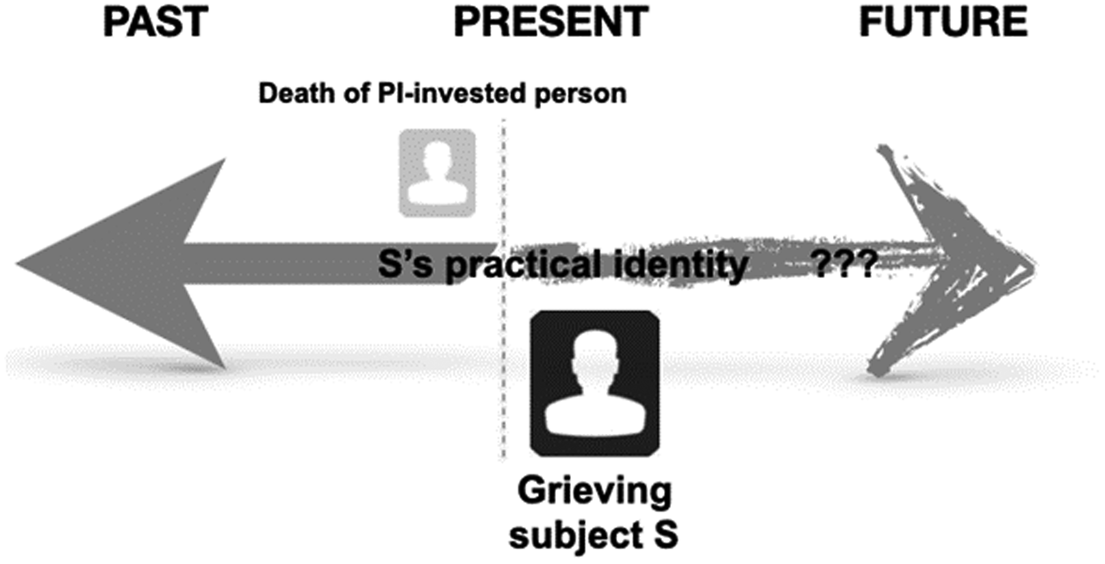
This practical identity crisis has a cross-temporal autobiographical character. On the one hand, the death of the person for whom one grieves is the death of someone whose normative significance originates in the past. For the bereaved have already invested their practical identity in that person. But on the other hand, this prior investment was also an investment in one's future, a future in which that person's continued existence was assumed. Grief is thus often a complex interplay of attempting to make sense of one's past with an eye to crafting the future. The bereaved individual is attempting to navigate a transition from a past practical identity to one more reflective both of the fact of the death of the other and of the goals, commitments, and concerns it would be rational to her to adopt in light of that fact. As represented in Figure 1, the grieving subject has been unmoored from the practical identity under which she operated prior to the other's death, but has yet to develop and settle upon a new practical identity, and so her future practical orientation may well feel hazy or ‘up in the air’. This ethical reality, in my estimation, accounts for why the emotions felt in grief episodes are not only backward-looking (sadness, most notably) but also forward-looking (such as anxiety or disorientation).
How Grief Responds to Threats to Practical Identity Posed by Others' Deaths

2. Calhoun on meaningfulness in life: Grief and disruptions to frames in agency
Grief, then, tracks a disruption in our relationships with others and in our practical identities. But some of the emotional resonances of grief are isomorphic with how it feels for our lives to suffer diminished meaningfulness. The ingredients of a meaningful life are of course a matter of philosophical dispute, but many partisans in those disputes will recognize in grief – or more accurately, in the loss of our practical identity-constituting relationships as they were to which grief is a response – signs of a threat to meaningfulness in one's life. The grieving individual is likely to sense that the other's death has diminished the scope or significance of their own life, or that their connection to concerns larger than themselves has weakened. Similarly, the person in grief may intuit that the other's death has knocked their own life narrative off-kilter or that they have somehow lost their direction in the world.
Such thoughts are naturally at home in those subjectivist conceptions of life's meaningfulness according to which a person's life is meaningful because and to the extent that one has a certain evaluative pro-attitude toward one's life, such as caring about one's projects, endorsing one's values, or viewing one's life as embodying a coherent whole. One such conception, Cheshire Calhoun's, is particularly illuminating in explaining how grief corresponds to a threat to our lives’ meaningfulness (Calhoun, Reference Calhoun2018).
Calhoun's account of meaningfulness is distinctive in foregrounding how our relation to time is integral to meaningfulness. Calhoun does not speak in terms of practical identity, but her account can be restated in such terms without much residue or distortion. The past and the present shape our practical identities, but as Calhoun observes, our agency is oriented toward the future because it is the future where the goals, commitments, and concerns that constitute our practical identities will be pursued and realized. Fortunately, for most of us most of the time, we look forward to our futures, and in particular, we look forward to our futures as the timeframe in which to implement or act upon our practical identities. Typically, the future ‘stretches out ahead’ as a valued resource ‘in which to do things’ (Calhoun, Reference Calhoun2018, p. 49). And it is this orientation toward the future that lends our lives their meaningfulness. For Calhoun, a person's life is meaningful to the extent that she has ends that she understands as justifying her expenditure of her future time. Transposed into the language of practical identity, a person's life is meaningful to the extent that her practical identity is one whose future pursuit or implementation she welcomes to a sufficient degree that expending her future on its pursuit or implementation is justifiable to her.
But Calhoun enumerates a number of ways in which our interest in expending our own futures, and hence our desire to choose and act in anticipation of those futures, can be weakened. We may come to doubt that our ends are attainable, and so find ourselves helpless in the face of the fast-arriving future. Or we may suffer such grotesque pain that our ability to attend to our ends (deliberating about them or about how to attain them, or even enjoying them once attained) is severely hampered. Such developments upend what Calhoun calls ‘background frames’ of agency, those beliefs and attitudes concerning our agency that are typically taken for granted as we exercise our agency and whose presence makes the exercise of agency in deliberating, choosing, and acting coherent to us. The erosion of such frames induces meaninglessness to the extent that it removes our grounds for wishing to continue into the future. At its worse, such erosion could make suicide rational.Footnote 3
Our relationships to others, and in particular the relationships in which our practical identities are invested, are another central background frame of agency. The existence of such relationships, established in the past, nevertheless projects our agency into the future since many of our goals, commitments, and concerns implicate the continued existence of those relationships and, thereby, of the other participants in those relationships. Absent such relationships, or if such relationships come to lack the properties that make them normatively relevant to the pursuit of our goals, commitments, and concerns, then our agency will not have the same traction it would have otherwise. Our practical identities cannot serve so effectively as anchors for deliberation and choice. The deaths of those in whom we have invested our practical identities compels a reconfiguration of those relationships and so act to upend ‘the future as we imagine, anticipate, predict, assume, or sense it will be’ (Calhoun, Reference Calhoun2018, p. 8). In terms of Calhoun's account of life's meaningfulness, their deaths pose a threat to our being intelligibly drawn into our own futures and so pose a threat to meaningfulness.
Because grief is a response to the disruption in our practical identities that results from the deaths of others, grief alerts us to this threat to meaningfulness in our lives. Grief thus resembles an emotion such as fear in signalling threats to ourselves or what matters to us. Grief is a sign of a potential or emerging threat to a background frame of agency and so invites our attention to the possibility of a crisis in the meaningfulness of our lives.
Crucially, grief itself will not generally be the source of meaninglessness. For grief gives evidence of the threat but will rarely constitute a threat to life's meaningfulness. It is not impossible for grief itself to threaten meaningfulness as it is understood in Calhoun's theory. A person whose grief persists at an intense level for years on end may be unable during that time to attend to any other concern besides the alleviation of her suffering, in which case the grief itself has wrecked a background frame of agency. But usually, grief's relation to meaningfulness is to track it, not embody it.
3. Grieving to recover meaningfulness
As I have presented it so far, grief's role is epistemic and negative: It alerts us to threats to the meaningfulness of our lives by giving evidence that the relationships in which we have invested our practical identities cannot continue just as they were. Of course, a person such as Camus’ Meursault seems not to have invested his practical identity in relationships with others, and hence the death of his mother (a relationship in which many people invest their practical identity) does not elicit grief in him. Her death poses no threat to his practical identity and so grief has no epistemic part to play in notifying him of such a threat. To the degree that a profoundly alienated figure such as Meursault has background frames for his agency at all, his relationships with others are not among them.
The good news, however, is that grief also has a positive epistemic role to play vis-à-vis meaningfulness. It alerts us to threats to the meaningfulness of our lives but also makes available a robust trove of evidence concerning our own good, evidence we can draw upon to deflect the threat to meaningfulness that others’ deaths can represent.
To the extent that the average person knows much about how psychologists and others have theorized about grief, they are aware of Elisabeth Kübler-Ross’ five-stage account of grief, according to which individuals grieve by undergoing denial, anger, bargaining, depression, and acceptance (Kübler-Ross, Reference Kübler-Ross1969). Subsequent empirical research has shown that this account rarely holds true at the level of detail. Many bereaved people do not undergo one or more of those stages; or undergo other emotions in the course of grief; or do not undergo the stages in that order.Footnote 4 But Kübler-Ross’ account captures something important about grief episodes, namely, that they are complex emotional processes involving many types of affect. As discussed earlier, grief nearly always includes sadness, but will often include disorientation as well as emotions such as guilt or anxiety. That grief is a complex emotional process is not at all surprising if (as I have argued here) grief's object is the loss of a practical identity-constituting relationship as it was in its pre-mortem incarnation. For human relationships are themselves emotionally complex, particularly our relationships with those in whom we invest our practical identities. Take a fairly standard case of grief, that felt by an adult in response to the death of a close sibling. We expect sadness in such a case, but it would not be surprising for such a grief episode to include other emotions rooted in the relationship between the siblings. The bereaved sibling who served as the deceased sibling's medical surrogate might feel anxiety or guilt about medical decisions she made on the deceased's behalf. Or the bereaved sibling might feel anger because the deceased sibling's lifestyle (for example, smoking tobacco) led to a premature death that deprived the bereaved sibling of further time with them. If grief marks not the cessation of a relationship with another but a necessary transition within it, then grief itself is an event within that relationship and so will bear the emotional marks of other attempts to understand, process, or reconfigure that relationship.Footnote 5 In coming to terms with the loss of the deceased and in attempting to craft a revised practical identity that fully reflects the significance that such a loss has on one's practical identity, a bereaved individual will be drawn to attend to the relationship in question in its totality. The emotional complexity of grief will therefore tend to mirror the normative complexity of the relationships whose disruptions are grief's object.
Bereaved individuals are engaged, I propose, in an effort to deflect the threat to their lives’ meaningfulness caused by another's death (or if that meaningfulness has already been diminished, to recover lost meaningfulness). They are seeking, however unwittingly, to establish a revised practical identity in which the other's existence or availability is no longer assumed. And this undertaking has a significant epistemic dimension. For establishing this revised practical identity requires a metaphysical-cum-normative engagement with one's relationship with the deceased, and more indirectly, with oneself and one's practical identity in relation to the deceased. This is why grief often involves puzzlement or questioning. For a grieving person is in effect asking, ‘who am I – or who can I be – without you?’
Fortunately though, the emotional richness of grief positions us well to answer this question. For grief is not simply a ‘dumb’ distress signal, merely alerting us to the threat without disclosing its nature to us or pointing us toward its neutralization. Grief is a kind of emotional ‘data dump’, revealing to us a wide array of information about the depth of our commitments, the nature of our goals, and the place of specific (now deceased) individuals in both of these (Reference CholbiCholbi, Reference Cholbi2017, p. 102). This information, so salient to revealing our practical identities and enabling their revision, allows us to find our normative bearings again and puts us on track to ‘recovery’ from grief. Grieving well, on my account, consists in attaining a form of practical self-knowledge in which one's new practical identity is both recognized and recognized as worthy of endorsement.
For these reasons, talk of grief as a ‘wound’ or ‘injury’ is misleading. To do so is to confuse grief, which I have argued alerts us to the ‘wound’ or ‘injury’ that the death of others can imprint on the meaningfulness of our lives, with the wound or injury itself. Grief may hurt, but it enables our recognition of the wound or injury without being by its very nature a wound or injury in its own right.
We should therefore be grateful that grief, despite its emotional burdensomeness, affords us the chance to know ourselves better and be more firmly anchored in our practical identities. Yet grief, by being distressing, also has value to us by motivating us to know ourselves and to reconstruct our practical identities in the wake of a death that disrupts them. I have reservations about the claim that grief must be arduous labour, as suggested by the phrase ‘grief work’. But grief is a happy phenomenon to the extent that it not only alerts us to a threat to our lives’ meaningfulness, but is also a vital resource for undertaking the ‘work’ needed to defuse this threat.
So depicted, grief is not a passive emotional ‘sensation’ of hurt or loss. It is instead a robust species of activity and attentionFootnote 6 in which we make evidence-responsive moves in an effort to normatively adapt to deaths that implicate our practical identities. This does not mean we necessarily make the right moves; some episodes of grief may conclude with individuals continue to adhere to practical identities that are essentially out of date. These individuals are, in a fairly literal way, living in the past. As such, they have missed a critical opportunity to render their lives more meaningful. But when successful, grieving rejuvenates a vital frame of agency. In Calhoun's terms, we rebuild our practical identity-constituting relationships so that they can return to playing the reason-giving role they had prior to the death of a person in whom we had invested that practical identity. Our normative relation to our own future alters as a consequence: after their death but prior to grief (or in its midst or prior to its successful resolution), our futures are hazy, as we do not entirely know what goals, commitments, or concerns it makes sense for us to invest that future in. With the successful resolution of grief, this haze lifts. Grief helps make our futures meaningful to us once again.
4. Conclusion
Grief often feels bad. Yet I have argued elsewhere that it is often in fact beneficial to us insofar as it helps us to augment our well-being (Cholbi, Reference Cholbi2021, chs. 2 and 3). So too in the case of grief and meaningfulness in life: Though grief includes sadness and other affective states we otherwise have reason to avoid, it enables us to sustain or augment the meaningfulness of our lives. Only at the end of Meursault's life did he seem to have invested himself in the fate of others in such a way that he became susceptible to grief. But for those of us less alienated from others, grief is a powerful tool for navigating threats to life's meaningfulness stemming from the precarity of the relationships in which we invest our practical identities.
In defending grief as a tool for enabling meaningfulness in life, I drew upon Calhoun's subjectivist account of meaningfulness in life. Does this imply, then, that objectivist accounts of meaningfulness in life, according to which meaningfulness in life depends not on our attitudes toward our life (such as that our futures are worth expending, as in Calhoun's account) but on facts independent of our attitudes, should be rejected? Not exactly. It seems possible to affirm that grief enables meaningfulness in the way that I have described while maintaining that objective facts contribute to life's meaningfulness. For instance, suppose that a particular friendship has been particularly useful in enabling someone to realize some good that putatively confers objective meaningfulness on one's life. The friendship could, for example, involve working with a friend at a charity that improves quality of life for poor or marginalized peoples. If that friend were to die, the bereaved individual might therefore find herself deprived of a relationship that enabled her to confer greater objective meaningfulness on her life. Grief might be seen as evidence of this deprivation and a motivational catalyst to finding new avenues for acquiring objective meaningfulness of this kind.
This is not an incoherent story. Nevertheless, the phenomena relating grief and life's meaningfulness I have outlined in this article exert pressure on purely objective accounts of life's meaningfulness. For this story seems not to explain certain aspects of grief experience. The surviving friend could understandably experience the other's death as a loss of meaningfulness, but it would be hard to see with the surviving friend should feel disoriented or puzzled in the way bereaved individuals often do. To return to Seneca's remarks about replacing a lost cloak: What the surviving friend has lost is not only the source of objective meaningfulness afforded by the friendship. She has lost the friendship itself (or is forced to adopt new terms of friendship), a friendship that is part of her own self-conception or practical identity. ‘Replacing’ that which the friend fostered by finding a new way to improve others’ quality of life is possible, but it would not substitute for the relationship in which she had invested her practical identity. Nor ought the surviving friend feel a sense of puzzlement or bewilderment at the friend's death. For no difficult questions about the shape of one's future practical identity need arise if the relationship's significance was purely a conduit to objective meaningfulness. Grief registers a personal loss because it registers losses of what matters, as well as registering how those losses matter to us.
Hence, a purely objective account of meaningfulness in life, in my estimation, underestimates or misdescribes the losses to which grief responds. My arguments suggest that meaningfulness in life is at least a hybrid fact, one resting both on ‘subjective attraction’ to what one cares about and the ‘objective attractiveness’ of what one cares about (Wolf, Reference Wolf2015, p. 112).