Introduction: Language of incitement to hostility and violence in society
Terrorist incitement, an important aspect of threatening terrorist communication (Tsesis Reference Tsesis2013, Reference Tsesis2017), is a critical problem facing the global community, particularly given the current rise in far-right extremism. Incitement is language designed to persuade, compel, or encourage those addressed to commit violent actions, and is thus a language crime (Jaconelli Reference Jaconelli2017; Gordon Reference Gordon, Bayefsky and Blank2018). In the laws of many countries of common law jurisdictions (e.g. United Kingdom and Australia) and continental law jurisdictions (e.g. Germany and the Netherlands), terrorist communication is considered part of a terrorist's behaviour and is punishable by law. For example, the Ministry of Justice and Security of the Government of the Netherlands considers terrorist texts to be one of the grave aspects of the terrorist threats, such as inciting violence and being sources of negative ideological inspiration (Etaywe Reference Etaywe2022a). Unlike other types of one-to-one incriminating texts, terrorist incitement texts are public. They often target multiple audiences and are motivated by an extremist ideology. Despite the violent tendencies of far-right extremists to capitalise on shared values for recruitment (FBI Counterterrorism Division 2008), the language of incitement to value-based action networks is an under-explored area that law enforcement generally ignores (Atran Reference Atran2015). Far-right terrorist discourse is also ‘more likely to be overlooked or tolerated by western polities’ than the jihadist terrorism (Corbin Reference Corbin2017:483). Nevertheless, understanding the language of incitement by terrorists remains a critical concern that is directly relevant to countering violent extremism through legal and security measures (e.g. Shuy Reference Shuy, Coulthard, May and Sousa-Silva2021).
This article examines the evaluative language of far-right incitement, adopting social semiotic methods to illuminate how values and alignments are construed in terrorist incitement of violence. It explores how this language attempts to forge particular kinds of community membership and to foster social bonds as shared values that are morally underpinned and should be defended. The article contributes to current linguistic tools and methods used in forensic contexts to better understand inciting texts, and to the scarce tools available for examining the moral motivations behind racially and religiously aggravated hate crimes (see e.g. Culpeper, Iganski, & Sweiry Reference Culpeper, Iganski and Sweiry2017). This research article involves a case study exploring linguistic incitement strategies in a manifesto published by Brenton Tarrant, the far-right violent extremist who perpetrated the 2019 terrorist attacks on two mosques in Christchurch, New Zealand. The study forms part of a broader project examining both incitement and communicated threats by jihadists and far-right extremists, two of the most lethal transnational terrorist ideologies (Global Terrorism Index 2020).
Linguistic studies of discourses of violence and hate speech have been concerned, inter alia, with identifying text types, authorship attribution, and linguistic evidence of meaning for forensic purposes. Many studies use tools and principles from discourse analysis and pragmatics to help understand how hate-fed incitement is enacted. Critical discourse analysis approaches focussing on grammar, lexicon, and argumentation strategies have shown how inciters use language to encourage harmful actions against outgroups (e.g. Prideaux Reference Prideaux, Hwang and Lommel1999/2009; Al-Saaidi Reference Al-Saaidi2017; Ascone Reference Ascone, Kang, Rivé-Lasan, Kim and Hall2020). This work has suggested that inciters use language to generate attitudinal alignments, enact intergroup power relations, and legitimate power abuse and inequality. This work also suggests that legitimating ‘Us’ (including ‘Our’ membership and actions) within the context of social conflicts implies delegitimating outgroups via discursive acts that challenge the identity of the outgroups—including delegitimating the outgroups’ actions, goals, norms and values, social position, and access to social resources (van Dijk Reference van Dijk1998:258–59). A number of key dimensions have emerged from this research as critical to forensic linguistic studies: (i) the functional context of meaning-making (May, Sousa-Silva, & Coulthard Reference May, Sousa-Silva, Coulthard, Coulthard and Sousa-Silva2021), (ii) the discursive positioning and legitimation of particular groups, and (iii) the role of ideologies and relations of power on addressees’ beliefs and social relations (Coulthard, Johnson, & Wright Reference Coulthard, Johnson and Wright2017). All of these dimensions are considered in this article.
Crucial insights into the characteristics of incitement texts have also emerged from pragmatic analysis approaches focussing on speech acts. This work positions incitement as a form of coercive ‘impoliteness’, for instance, in terms of religiously aggravated hate speech expressed against particular groups such as Muslim groups (e.g. Culpeper et al. Reference Culpeper, Iganski and Sweiry2017:19). According to this perspective, inciters use explicit resources such as imperative and hortative constructions as rhetorical strategies for inciting illegal behaviour (e.g. utterances such as ‘KILL SADIQ KHAN’ and ‘Let's overthrow the government’ (Kurzon Reference Kurzon1998:591–92). Speech act analyses have also noted that utterances can have a degree of ‘ambiguity’ even in aggravated hate speech and terrorist contexts (Jaconelli Reference Jaconelli2017:248). For example, the decontextualised utterance ‘When you discover a nest of vipers in your yard, do you spare the adolescents?’ is ambiguous in terms of the extent to which it is an incitement to physical violence against people constructed as a nest of vipers or merely an expression of negative opinion about vipers. This accords with the position that the ‘speech act status of utterances quite often cannot be determined entirely by examining the sentence internal properties’ (Hasan Reference Hasan and Webster2016:66–67) and that indirect/‘opaque’ incitement can play a role in ‘the commission, preparation or instigation of acts of terrorism’ (see Jaconelli Reference Jaconelli2017:246). For instance, in the present example, without accounting for the rhetorical function of the evaluation used in dehumanising the incited-against and constructing them as ‘vipers’ in the rhetorical question, the kinds of interpersonal positioning that are functioning in the service of incitement in a text may be missed (e.g. Jaconelli Reference Jaconelli2017). Similarly, failure to account for the iconicity (which is an evaluative aspect) of the Koran in an utterance such as ‘Let's fuck up the Koran’ in a hate crime context (Culpeper et al. Reference Culpeper, Iganski and Sweiry2017:20) can lead to missing the interpersonal positioning of the incitees that is functioning in such contexts on religious grounds. This article seeks to establish a link between patterns of interpersonal meaning, specifically evaluative language, to account for their rhetorical function in the service of inciting for violence. Given that evaluation is the very foundation for persuasion and manipulation (Partington & Taylor Reference Partington and Taylor2017), we illuminate the nuances in ‘the linguistic mechanisms for positioning [and] (dis)aligning/(dis)affiliation’ (Etaywe Reference Etaywe2022a:8; Etaywe & Zappavigna Reference Etaywe and Zappavigna2021).
The range of ways that language can be used for incitement necessitates a close study of how incitement functions as a discursive practice targeted at influencing a particular audience. In addition, with the disdain that a society may feel for terrorists (Khosrokhavar Reference Khosrokhavar2014), a terrorist's reliance on imperative and hortative constructions alone is likely to fail unless a connection is established between the urged actions and the incitees’ beliefs and values. The close study of how incitement functions, thus, involves attending to the ‘goals and beliefs’ (Poggi Reference Poggi2005:297) that are expressed by the terrorist as they attempt to influence, motivate, and ‘bond’ with putative incitees (the potential audience of the terrorist's text). It is this affiliative connection with the putative incitee, and how it is constructed through choices in evaluative meaning, that is the focus of this article. We begin with a discussion of the role of affiliation in incitement and provides details of the dataset. We then introduce the Affiliation framework used for undertaking the data analysis. The results section explores in detail the specific affiliation strategies and tactics identified and how they act in the service of incitement. The focus is on several tactics used for what we term communion and alienation—which are, respectively, ingrouping and outgrouping strategies.
The role of affiliation in incitement
Sociological research has suggested that social alignments around particular values, theorised as joint cause and action networks, play a pivotal role in terrorists’ incitement to violence (see e.g. Atran Reference Atran2011; Ginges & Atran Reference Ginges, Atran, Gelfand, Chiu and Hong2014). Many studies in discursive psychology (e.g. Potter Reference Potter and Cooper2012; Humă, Stokoe, & Sikveland Reference Humă, Stokoe and Ove Sikveland2019) also highlight how attitudes and beliefs are a central factor in intergroup relations and in enacting practices of persuasion and solidarity. For instance, when individuals make social comparisons, they tend to shift their attitudes to align with the communal values of a particular group and away from the beliefs of devalued groups (Wood Reference Wood2000). In incitement, this kind of communal alignment is mobilised via moralising discourses that encourage people to commit collective hate acts against threatening outgroups for the good of the ‘virtuous’ ingroup (Reicher, Haslam, & Rath Reference Reicher, Haslam and Rath2008:1326). Linguistic studies of incitement have been influenced by these ideas, as well the concept of membership categorisation for understanding how ‘us’ versus ‘them’ groupings are formed (see Sacks Reference Sacks1992; Higgins Reference Higgins2007). Membership categorisation establishes ‘category-bound features’ for analysing these groupings (Antaki & Widdicombe Reference Antaki, Widdicombe, Antaki and Widdicombe1998:4).
This article focuses on the key role that evaluative language plays in the discursive incitement strategies used by terrorists to align with and alienate particular social groups. Our approach is aligned with previous social semiotic work on how general ideations—attitudinal targets, that is, the targets of evaluation (Etaywe & Zappavigna Reference Etaywe and Zappavigna2021)—‘facilitate positioning by acting as loci of moral valuations’, in turn, offering insight into membership categorisations (Tann Reference Tann, Bednarek and Martin2010:175). We refer to the process by which social alignments are forged or contested via these evaluations as ‘affiliation’ (with ‘disaffiliation’ used to refer to disalignments with outgroups). This concept is grounded in the Appraisal framework for analysing linguistic evaluation and dialogistic positioning (Martin & White Reference Martin and White2005). Affiliation has been used in a range of linguistic studies to understand how attitudinal alignments are enacted and negotiated (Zappavigna Reference Zappavigna2011; Zhao Reference Zhao2020). The key unit of analysis in these studies is the ‘coupling’ of ideational and attitudinal meaning (Knight, Reference Knight, Bednarek and Martin2010a:49, Reference Knight2010b, Reference Knight2013), where a coupling is the linguistic realisation of a social bond (examples and further explanation are provided in the Analytical method section, second paragraph). According to this perspective, bonds are mobilised in discourse (e.g. by being shared, rejected, or deferred), aligning language users into communities of shared values. In this way the act of ‘bonding’ is concerned with ‘ways of building togetherness, inclusiveness and affiliation’ (Stenglin Reference Stenglin2004:402), or in other words with the construction of ‘overlapping communities of attitudinal rapport’ (Martin Reference Martin, Putz, Aertselaer and van Dijk2004:323). Systematic examination of couplings has been shown to reveal the ‘evaluative disposition’ of the authors of terrorist texts (Etaywe & Zappavigna Reference Etaywe and Zappavigna2021). It has also been used to determine potential ‘bond clusters’, that is, groupings (of good ‘We’ versus bad ‘They’) made on the basis of repeated evaluative couplings that realise key social bonds (Etaywe Reference Etaywe2022a:188, Reference Etaywe2021).
Dataset: Tarrant's far-right terrorist manifesto
The dataset explored in this study are the passages of incitement in ‘The Great Replacement’, a manifesto published online in 2019 by the far-right extremist, Brenton Tarrant. The manifesto is a homage to the ‘Great Replacement’, a White nationalist conspiracy theory that posits that White Europeans are at risk of extinction and of replacement in their countries by non-Whites (Heim & McAuley Reference Heim and McAuley2019). After publishing the manifesto online, Tarrant live-streamed on social media his terrorist attack on two Christchurch Mosques in which he killed fifty-one people, making a linguistic investigation into Tarrant's deployment of affiliation strategies in his manifesto a relevant study of a social concern that is directly linked to mass violence.
Tarrant's manifesto is a long document which contains both passages that can be interpreted as threat messages targeted at particular social groups, as well as passages of incitement that encourage hatred and violence. This article focuses on the incitement phases which occur throughout the manifesto, across the following sections:
-
Introduction
-
Section I: Addresses to various groups, namely To conservatives and To Christians
-
Section II: General thoughts and potential strategies, such as ‘Kill high profile enemies’, etc.
-
Section III: In conclusion
Collecting these incitement phases resulted in a dataset of 9,683 words (348 paragraphs; 487 sentences), which were analysed using the linguistic methods described in the next section.
Analytical method: Affiliation analysis
The approach adopted in this case study for understanding how Tarrant attempted to build solidarity and enact alignment with his audience through incitement is an Affiliation analysis. The Affiliation framework was developed within systemic functional linguistics (SFL), arising out of work on how social bonds are negotiated in conversational interactions (Knight Reference Knight, Bednarek and Martin2010a,Reference Knightb). SFL is a model of language that considers how meanings are made in their functional contexts (Halliday & Matthiessen Reference Halliday and Matthiessen2014) and is a model that it is oriented towards using linguistics to address social issues and inequalities (Halliday Reference Halliday2008). The main analytical unit used in an Affiliation analysis to investigate how values are negotiated in texts are couplings of ideational and attitudinal meaning through which interactants or audiences discursively co-identify (Knight Reference Knight2010b).
To elaborate, attitudinal meaning here: (i) refers to the evaluative meanings that are realised explicitly in lexis (e.g. ‘strong’—hence inscribed attitude), or implicitly in lexicogrammatical expressions (e.g. ‘run over the weak and the elderly’—hence invoked attitude) and in ideations invoking attitudinal response (e.g. ‘rape’); and (ii) is used for enacting social relations and building interpersonal relations and hence relate to social positioning, affinity, power, and solidarity. Ideational meaning here refers to categories of attitudinal targets (i.e. who or what is evaluated by the evaluative expression in discourse), including social actors, terms (e.g. ‘multiculturalism’), ideas (e.g. to become a minority, freedom), and social processes (e.g. ‘radicalisation’, killing)—hence essential for construing our experience and knowledge of the world. The co-instantiation of an attitudinal expression with an attitudinal target is termed coupling. In the example below, an attitude-ideation coupling in the dataset is a negative attitude (shown in bold) targeted at immigrants (shown underlined).
what few know is that Rotherham is just one of an ongoing trend of rape and molestation perpetrated by these non-white
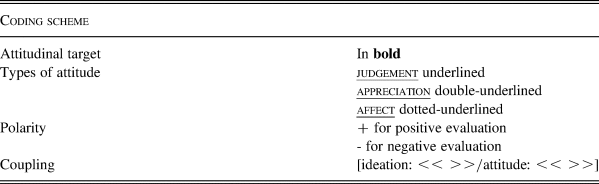
According to Affiliation this ideation-attitude coupling can be said to table (i.e. make available) a bond, which we might gloss as ‘immigrants are bad: rapists and molesters’, to serve as a moral basis for inciting the killing of immigrants following incidents such as Rotherham scandal of organised child sexual abuse that occurred in the town of Rotherham, South Yorkshire, England (similar to Etaywe Reference Etaywe2021). The dataset was annotated for ideation-attitude couplings, according to the coding scheme summarised in Table 1. The bonds tabled (i.e. made available in discourse), realised by these couplings, were then grouped into localised patterns or broader networks of values. The ideational targets that were repeatedly appraised, such as people (e.g. Muslims, immigrants) or ideas and abstractions (e.g. democracy), were then aggregated into ingroup-centred versus outgroup-centred bond clusters. This provides a synoptic perspective on the opposing value systems of the ingroup and outgroups, making explicit the networks of shared bonds into which incitement texts invite incitees.
Coding scheme for text analysis.

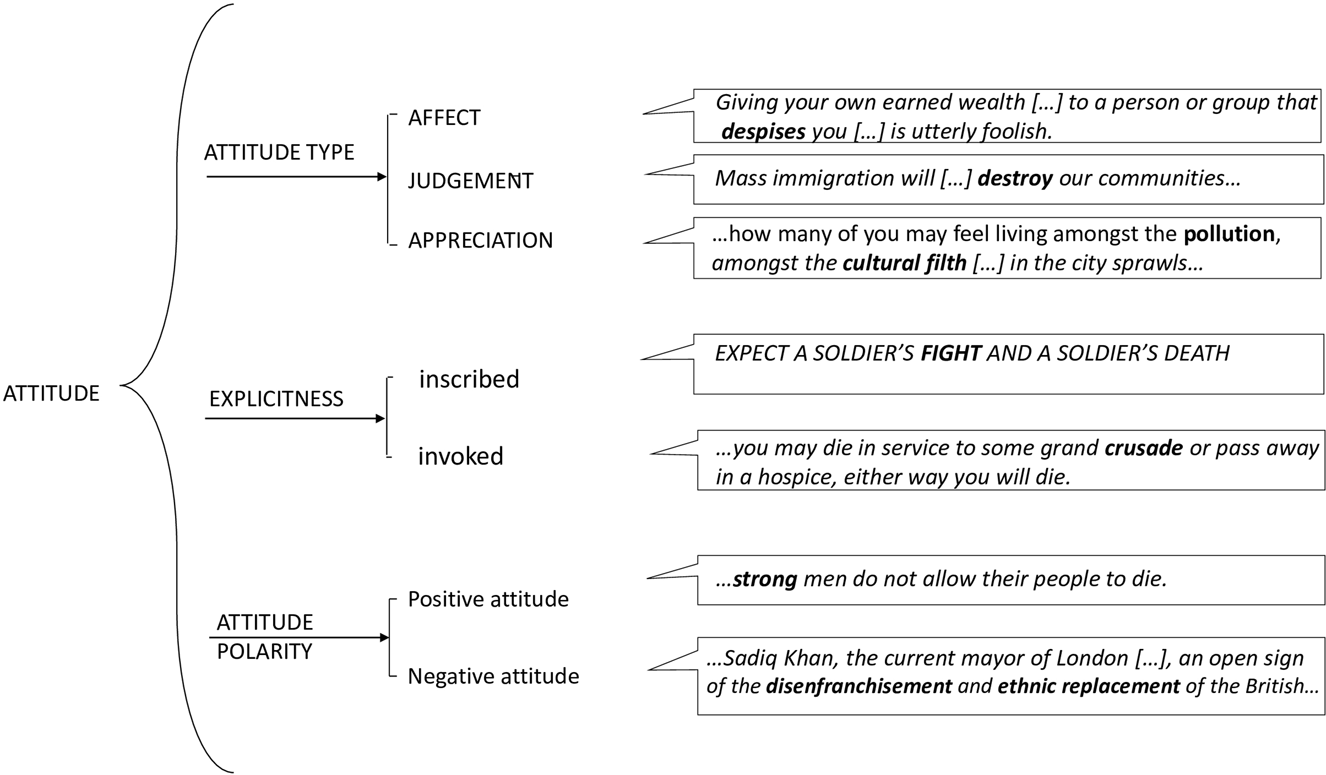
In order to systematically account for evaluative meanings, the Appraisal framework (Martin & White Reference Martin and White2005) was used to analyse the evaluation in the annotated couplings. Appraisal defines three main regions of attitudinal meaning at the level of discourse semantics.
• affect: expressing emotional reactions and states
• judgement: construing assessments of behaviour in terms of social rules or regulations
• appreciation: estimating the value of entities or processes
These three subsystems of attitude are shown in the system network in Figure 1. In this network the brace represents simultaneous features (an ‘and’ relation) and the square brackets indicate a choice between features (an ‘or’ relation). Using this network in relation to the coupled ideations enables observing of the ‘path through the network of systems of [the] language’ (Nini & Grant Reference Nini and Grant2013:180) that Tarrant tended to select in discourse.
Attitude system used for attitudinal meaning analysis (based on Martin & White Reference Martin and White2005).

In order to sensitise us as to the moral motivations as well as assumptions and considerations underpinning the mobilized couplings, five moral metavalues were considered, drawing on recent research into the morality of social actions and evaluation suggesting that evaluation in conflict contexts is sustained by universal, yet culturally and contextually sensitive, moral foundations (see e.g. Kádár, Parvaresh, & Ning Reference Kádár, Parvaresh and Ning2019; Etaywe & Zappavigna Reference Etaywe and Zappavigna2021; Etaywe Reference Etaywe2022a,Reference Etayweb, Reference Etaywe2023a,Reference Etayweb).
(i) ingroup/loyalty
(ii) authority/respect
(iii) purity/degradation
(iv) harm/care
(iv) fairness/reciprocity
For each of the identified couplings, the affiliation tactics used in incitement were then identified and classified in terms of whether they enacted an ingrouping strategy, referred to as ‘communing’, or outgrouping strategy, referred to as ‘alienation’. Communing is concerned with tabling bonds aimed at forging solidarity, sympathy, consensus, and shared membership. The use of the term communion for this strategy was inspired by Firth's (Reference Firth1964:112) view that ‘communion of feeling’ is one of the major interpersonal functions of language. The term alienation references Martin's (Reference Martin and Candlin2002:196) contention that when attitudes are not shared but rejected ‘a sense of alienation sets in’ because bonds are positioned as unshareable.
This categorisation of tactics into communing or alienating tactics was made based on the following principles and complementary forms of linguistic analysis aimed at unpacking the interpersonal meaning and identifying the bases of the tactics used in bond enacted.
• Expansion and projection as general semantic relations that Zhao (Reference Zhao2020) has identified as contributing to how axiological affiliation is built in texts
• The SFL principle of iconisation, whereby icons such as celebrated persons, things, or rituals provoke attitude (Martin & Zappavigna Reference Martin and Zappavigna2013)
• The principle of ‘relationality’, whereby inclusive and/or exclusive pronouns or names of social actors afford attitude (Martin & White Reference Martin and White2005), and so does the use of two ideations where one ideation acquires social meaning in relation to another in discourse based on ‘similarity/difference’ relations (Bucholtz & Hall Reference Bucholtz and Hall2005:598)
• The principle of indexicality, whereby identity is constructed by indexes such as names or labels as interpersonally charged ideations that provoke attitude (Bucholtz & Hall Reference Bucholtz and Hall2005)
Results: Affiliation strategies and tactics
The analysis revealed the values negotiated in the affiliation strategies used by Tarrant in the service of incitement, as well as distinct clusters of opposing ‘us versus them’ bonds. This section reports on these findings, beginning with an overview of bond clusters, and then exploring the communion and alienation strategies used to encourage incitees to commit violent acts.
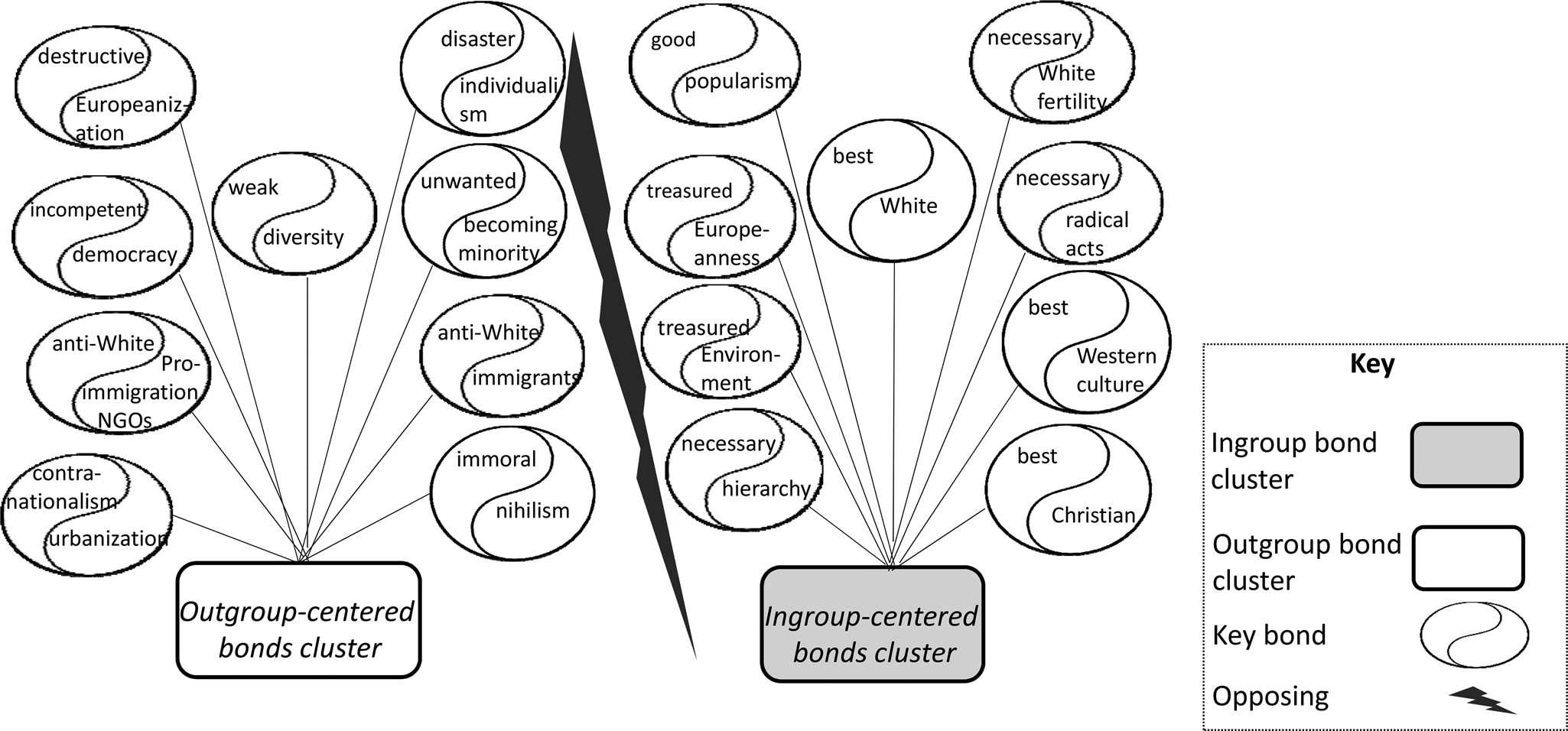
At the most general level, Tarrant sets up an ‘us versus them’ dichotomy, underpinned by repeated couplings associating the ingroup with positive attitude and the outgroup with negative attitude. At a synoptic level this can be interpreted as two opposing bond clusters as summarised in Figure 2 which gives an overview of some of the main ideation-attitude couplings represented using the yin yang symbol to suggest the fusion of interpersonal and attitudinal meaning in a single bond (for similar bond cluster diagrams see Etaywe Reference Etaywe2021).
An overview of opposing bond clusters realized in Tarrant's texts.

As the couplings on the left of this figure suggest, negative attitudes are associated with the following to disalign with: outgroups (e.g. Muslim immigrants, Marxists), and pro-immigration NGOs, politicians, and leftists who are accused of being ‘greedy’ and propagating ‘anti-White’ ideas such as consumerism, individualism, globalism, urbanisation, multiculturalism, and diversity, which all impose a threat of making ‘people of our race’ lose majority and power. On the right, positive attitudes were coupled with being White, Christian, and European, and with popularism, hierarchy, and radical actions, to align with. Tarrant blames European men and women failing to act against ‘the reality’ that immigrants’ cultures are flourishing. According to his perspective, the West experiences ‘decay’ due to abandoning traditions, failing to reproduce, killing the notion of God, embracing nihilism, and increased drug use, suicide, and divorce rates, and so on. The putative reader of the text is invited into ingroup memberships and affiliating with a bundle of ingroup ideations and ‘positive’ values.
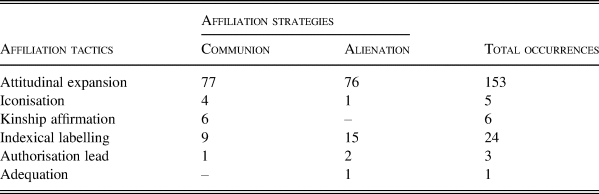
Table 2 summarises the affiliative strategies used in the dataset alongside counts of each time a bond was realised by a single coupling in a clause or by a series of co-textual couplings that realise the same bond. Tarrant's communion and alienation strategies are similar but differ on the basis of group-orientation (membership categorisation, that is, the targets of evaluation are categorical)—except for the ‘kinship affirmation’ tactic which was employed only in communion (i.e. an ingroup-oriented tactic), and the ‘adequation’ tactic which was utilised only for alienation (i.e. an outgroup-oriented).
Social affiliation strategies deployed.

Communion and alienation tactics and their functions
This section explains the linguistic resources used in the affiliation strategies of communion and alienation deployed by Tarrant. It demonstrates how attitudinal resources are tabled to forge inciter-incitee alignment around shared bonds. It also shows how these resources are used to forge disalignment with outgroups by positioning their bonds as unshareable in order to exclude them, construct them as a threat, and licence hostility against them.
Attitudinal expansion tactic
Attitudinal expansion functions in the manifesto to forge alignment with potential incitees via deploying sequences of ideation-attitude couplings that emphasise the same overall bond. Drawing on the concept of expansion as a general semantic relation (see Zhao Reference Zhao2020), these couplings operated by:
• Enhancing: supporting a positive attitude through providing another instance of the same attitude type and polarity targeted at the same ideation such as ‘killing’
• Elaborating: specifying or clarifying an ideation or attitude
• Extending: supplying a new attitude type with consistent polarity
Consider example (1) where Tarrant uses attitudinal expansion (enhancement) to promote solidarity with views aimed at radicalising young Western men and women against multiculturalism.
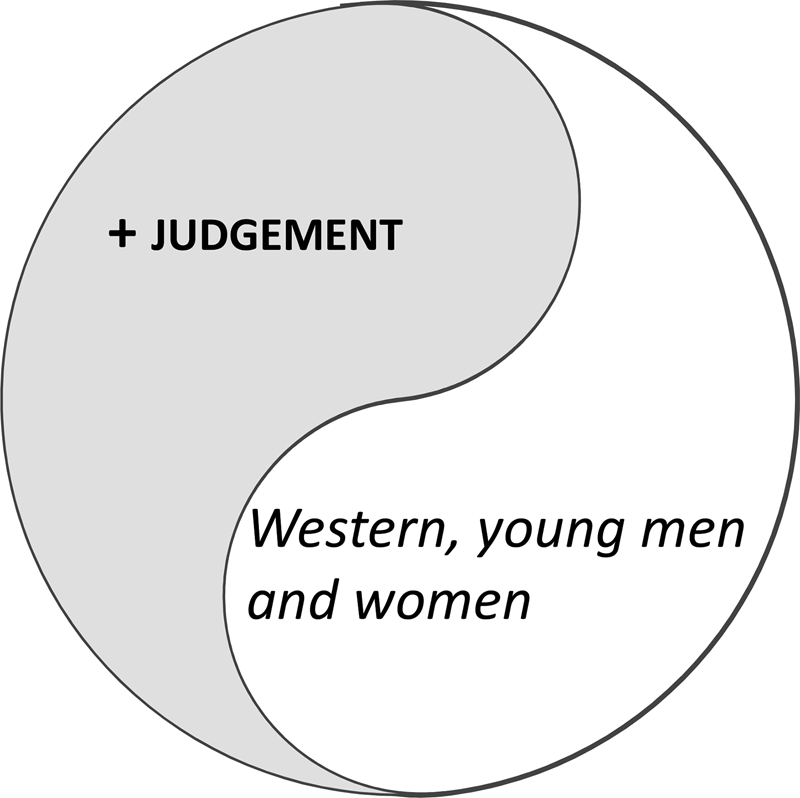
(1) 1So these young men and women see this suicidal nihilism 2and isolate themselves from this mainstream, ‘multicultural’, egalitarian, individualistic insanity 3and look for allies anywhere they can find them, in the flesh or online […] 4They decry weakness, 5mock fecklessness 6and worship strength, 7and in this worship of strength they radicalize and find the solution.
1 [nihilism / - appreciation]
2 [themselves (these young men and women) / + judgement]
[mainstream, ‘multicultural’, egalitarian, individualistic / - appreciation]
3 [they (these young men and women) / + judgement]
4 [they / + judgement (decry weakness)] invoking - appreciation of ‘weakness’
5 [(they) / + judgement (mock fecklessness)] invoking - appreciation of ‘fecklessness’
6 [(they) / + judgement (worship strength)] invoking + appreciation of ‘strength’
7 [(this) / + appreciation]
affiliation: communion: attitudinal expansion → multiculturalism, egalitarianism and individualism are bad; racial strength is good/the solution
In this example, Tarrant uses a series of predominately positive judgement-based couplings (see notes 2–7 in (1) above; Figure 3), realising the ‘racial strength is the solution’ bond aimed at aligning Tarrant and young Western incitees. At the same time Tarrant devalorises multicultural, egalitarian, and individualistic ideas by using negative appreciation-based couplings (see notes 1 and 2 above) which instantiate the ‘multiculturalism, egalitarianism, and individualism are bad’ bond.
A predominant coupling that intensifies a call for radical actions.

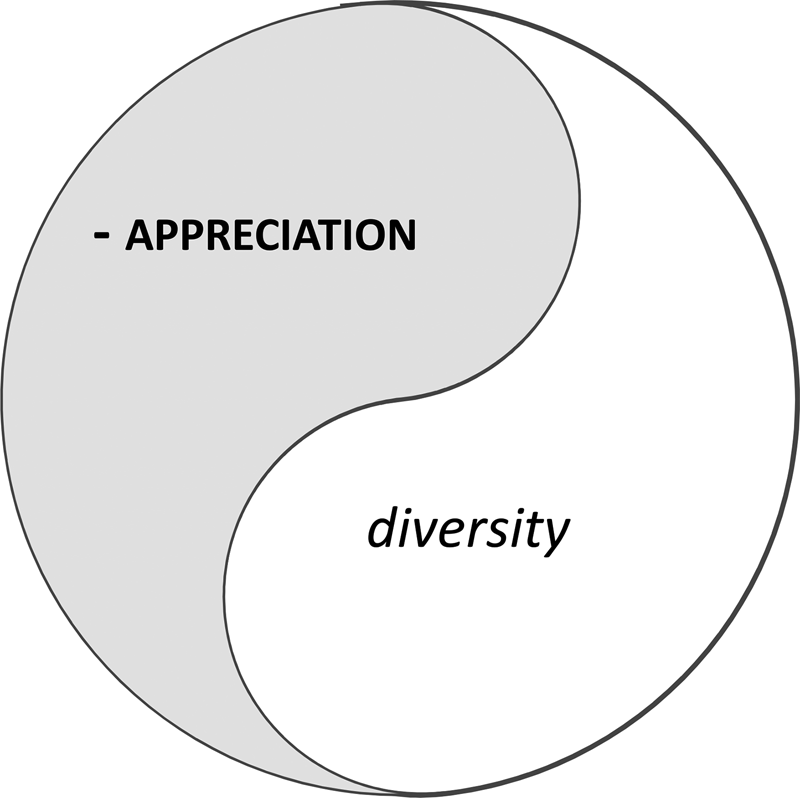
Attitudinal expansion was used in the manifesto, as in example (1), to saturate radical actions (and ingroup values justifying pursuing these actions) with a positive prosody. It was also used to promote a basic value of inequality through, for example, condemning egalitarianism as being ‘insanity’ (i.e. a negatively appreciated value [-appreciation]). The positive appreciation of inequality in terms of ethnic and racial identity, besides the invoked condemning of ‘equality’ accompanying ‘diversity’ via attitudinal enhancement ([-appreciation]) (example (2), visually displayed in Figure 4), has thus been consistently construed to serve to disalign the ingroup from those who are racially different.
(2) The more diverse a group becomes, the less equal it becomes. Diversity is anathema to equality.
A coupling that promotes inequality and the negative appreciation of diversity.

To alienate outgroups, attitudinal expansion was also employed. Consider example (3) where Tarrant deploys a series of six negative judgement-based couplings of the immigrants (attitudinal enhancement) to support the ‘mass immigration is destructive’ bond. These couplings serve to manage awareness about the imagined future impact of immigrants (as emphasised by the anaphora ‘destroy our’). Couplings such as these promote violence as rational protection from a destructive force.
(3) 1Mass immigration will disenfranchise us, 2subvert our nations, 3destroy our communities, 4destroy our ethnic binds, 5destroy our cultures, 6destroy our peoples.
[mass immigration / - judgement]
affiliation: alienation: attitudinal expansion → immigrants are a destructive force
In terms of the moral metavalues introduced earlier, evaluative couplings such as those in examples (1) and (3) attest to the presence of assumptions about ‘loyalty’ to the ingroup's race, cultural bonds, control, and power, remaining vigilant against destructive outgroups, and, as in example (2), ‘accepted unfairness’ as ‘natural’ treatment towards outgroups. The evaluative couplings provide clues of a situation where the inciter—in Bandura's (Reference Bandura2016) terms—morally engages with the ingroup coalition and disengages from outgroups. The evaluations thus appear to be triggered by the need (i) to maintain White superiority over those whom Tarrant considers in the manifesto: ‘race[s] of low intellect, low agency, muddled, muddied masses’, and (ii) to lay the ground for hostile treatment against those responsible for alleged ‘racial replacement’, and ‘WHITE GENOCIDE’.
Iconisation tactic
Iconisation was employed to forge alignment using ‘bonding icons’ (Stenglin Reference Stenglin2004:402), that is, ideations which crystallise, symbolise, and provoke shared values and attitudes. These icons operated as rallying devices towards shared values and, using Martin & Zappavigna's (Reference Martin and Zappavigna2013) terms, included:
• hero icons in the form of important cultural or religious figures, e.g. Pope Urban II
• creed icons, that is, highly valued scripture, parables, or rituals such as church prayers which are constructed as missing in today's Western life and contrasted to the full mosques as in: ‘empty churches and full mosques, entropy in blitzspeed’.
• symbolic cities and objects, for example, Londinium, Hagia Sophia (a Byzantine structure in Istanbul with minarets and inscriptions of Islam as well as lavish mosaics of Christianity, which reflects the religious changes that have played out in the region over the centuries).
These icons distil interpersonal meanings with which the incitee can co-identify. These icons also activate bond networks associated with religions (i.e. particular master identities). For instance, in example (4), Tarrant references the words of Pope Urban II during the First Crusade in the eleventh century.
(4) To Christians ‘The people worthy of glory, the people blessed by God Our Lord, moan and fall under the weight of these outrages and most shameful humiliations… The race of the elect suffers outrageous persecutions… Let…the love of our brethren lead us into combat. Let our lives be stronger than death to fight against the enemies of the Christian people’ ASK YOURSELF, WHAT WOULD POPE URBAN II DO?
[Christians and Whites/ + appreciation]
[(the White Christian fight against their enemies)/ invoked + appreciation]
affiliation: communion: iconisation → Christian violent actions are good: Pope's path
Here Pope Urban acts as a hero who symbolises the Christian values of holy war, the White defending ‘the elect, blessed, and those worthy of glory’, and thus a model to follow. The voice of the pope has a potential to align the incited Christians with the anti-Muslim views of the pope on the premise of ‘love of our brethren’. Ideations such as these facilitate affiliation through their interpersonal ‘charge’ that provokes positive attitude, in this case violent axiology regarding religious war. Deploying iconic ancestors to table a ‘good violence’ bond also underlines the religious and racial ideology of Tarrant who draws on revered early White Christian iconography as symbols of racial and religious unity.
To forge disalignment with outgroup, iconisation was also employed by using de-bonding (i.e. anti) icons that constructed adversarial identities and symbolised unshared values. Building on example (4) above, Tarrant mobilised the hero's (the pope's) words to present a historical violence against the ‘anti-world’, particularly Muslim, Turk immigrants who are negatively appreciated (‘the impious race’), dehumanised (‘barbarians’), and negatively judged (as underlined) (see example (5)). These referenced, negative couplings serve—in Bandura's (Reference Bandura2016:328) terms—to lay the moral ground for construing violence as ‘sacred’ action that is worthy of emulation and aligned with ‘Our’ religious ancestors, and to morally disengage from outgroups through obliterating any sense of shared humanity. This violence is further justified by framing it via a formulation that enacts intergroup treatment bonds and urged ‘war’ against Muslims (‘the enemies of the Christian people’) as ‘true’, warrantable and ‘holy’, which—in Bandura's terms—serves to moralise division and conflict as sanctified violence in which ‘We’ are doing ‘God's bidding’. Evaluative couplings as such appear as reactions to religious-enmity attributes.
(5) the impious race of the Saracens respects neither the virgins of the Lord nor the colleges of priests […] … run over the weak and the elderly, they seize the children from their mothers so that they might forget, among the barbarians, the name of God… Let the fire of our repentance raise up the Holy War.
[the Saracens / - appreciation]
[they (the Saracens) / - judgement]
affiliation: communion: iconisation → Muslim immigrants are unhuman, sinful enemies
To forge alienation, Tarrant also used icons such as mosque and minaret to construct the anti-Muslim immigrants’ identity, and referenced Erdogan and Merkel as iconic anti-White figures to incite for killing them (e.g. ‘Merkel, the mother of all things anti-white and anti-Germanic; Erdogan, the leader of one of the oldest enemies of our people, and the leader of the largest Islamic group within Europe… KILL ANGELA MERKEL, KILL ERDOGAN’). Tarrant also used proverbs (e.g. ‘A[n] ounce of prevention is worth a pound of cure’) to provoke negative attitude towards the danger of immigrants and to morally disengage from any inhumane treatment against them, considering this disalignment an act of prevention and wisdom. As such, evaluative couplings enact the ingroup/loyalty metavalue and are underpinned by assumptions about obligations towards racial and religious memberships.
Authorisation lead tactic
Authorisation lead tactic was employed to forge alignment with putative incitees and disalignment from the outgroups, by strategically quoting a text of an authoritative figure and entering it into the opening of an inciting text to serve the discursive purpose of constructing and radiating to the text divisive, opposing identities as consistent themes. This tactic is based on the principle of iconisation (Martin Reference Martin, Bednarek and Martin2010) where the quote is—in Haddington's (Reference Haddington2005:119) terms—categorising and ‘doing positioning’ simultaneously, and it serves to establish a background for alignment. For example, Tarrant used lines of Sir Oswald Mosley, a military and political figure, and Rudyard Kipling, a pro-White poet, to serve to legitimise what Tarrant perceives as rooted ethnic, political, and violent ideology and to condemn current democrats and politicians who favour multiculturalism and egalitarianism over White supremacy and thus hinder an ‘ethnocentric European future’, and against whom Tarrant incites for taking over their positions (e.g. ‘BLITZ TO DOMINANT POSITIONS’).
Consider example (6) where the affect-based coupling construes the ‘hate is populist and voluntary’ bond. This populism-based meaning of hate is extended (i.e. attitudinally expanded by supplying a new attitude type) by a positive appreciation-based bond that expands the initial meaning—hate towards ‘others’ is not taught by the state. These couplings enact the loyalty metavalue and are underpinned by expectations about the need to maintain a strong racial coalition against outgroups (on the premise of love and hate) and not to wait for a sign from the state or democrats to fight for ‘our’ race—thus enacting authority/respect for populists and condemning democrats’ disrespect for White supremacy. Rudyard Kipling's lines—as in the rest of his pro-White poetry (see van der Dussen Reference van der Dussen and van der Dussen2016)—serve to divide the world into civilised White Western people versus non-White people worthy of colonisation, hence alluding to the ‘West’ and ‘the Rest’ binary opposition. The deployment of these lines serves to align the inciter and incitees with Whites identity based on the racial authority of the sayer and his words, which is ‘a power capable of maintaining or subverting the social order’ (Bourdieu Reference Bourdieu1991:170). That is, the quoted lines were strategically employed in a ‘dialogical struggle’ (Hardy & Phillips Reference Hardy and Phillips1999:3) over racial values to align the inciter-incitee personae categorically.
(6) There was neither sign nor show When the Saxon began to hate. It was not preached to the crowd, It was not taught by the state.
[the Saxon / - affect]
[it (to hate others) / + appreciation]
affiliation: communion: authorisation → ‘our’ hate to others is populist and voluntary
A strategic selection of an authorisation lead that includes categorical terms, as such, feeds outgroup exclusion and enables the inciter to claim to have a particular identity and to establish his moral status. It also enables him to construe a call (i) for the positively appreciated popularist movement (example (7)) as a sign of loyalty to ingroup, which is unlike the negatively appreciated democratic solutions (example (8)) and (ii) for radical actions as necessary (example (9)) and urgent (as stressed in capitalised evaluations, example (10)).
(7) All true movements are populist movements.
[populist movements / + appreciation]
(8) This solution of a Democratic salvation is nothing but a pipe dream.
[democratic salvation / - appreciation]
(9) we need to radicalize society as much as possible.
[(our radicalisation of society) / + judgement]
(10) we are losing even our smallest towns to ethnic replacement. […] THE BEST TIME FOR ATTACK WAS YESTERDAY, THE SECOND BEST TIME IS NOW.
[time for attack / + appreciation] → Radical acts are urgent
Indexical labelling tactic
Indexical labelling was employed in the manifesto to forge alignments with the putative incitee by referencing particular social value or identities through use of a word, name, description or structure that provokes attitude about groups of people and their shared attributes. Consider example (11) where the label ‘green nationalism’ alludes to the impact of overpopulation and mass immigration on the environment.
(11) Green nationalism is the only true nationalism.
[green nationalism / invoked + appreciation]
affiliation: communion: indexical labelling → environmentalism/eco-fascism is good
This notion has a long racial and ethnonational lineage and is usually deployed to rationalise alignment to protect ‘our’ environment as ‘the only true’ marker of nationalist identity and action. A similar rationalisation is explicit in example (12) where ‘nationalism’ and ‘environmentalism’ are constructed in a causation structure where the absence of the latter leads to the threat of absence of the former and is thus negatively appreciated.
(12) there is no nationalism without environmentalism […]. The protection and preservation of these lands is of the same importance as the protection and preservation of our own ideals and beliefs.
[environmentalism / invoked + appreciation]
[The protection and preservation of these lands / invoked + appreciation]
affiliation: communion: indexical labelling → environmentalism/eco-fascism is good
The positive appreciation-based bonds here rhetorically contribute to constructing a positive image of the inciter as a caring nationalist. The inciter enacts the metavalue of ‘care’ for harm posed by immigrants against the ingroup lands and environment. The evaluative structure thus serves Tarrant's generation of xenophobic fear that co-opts environmental concerns to licence hostility and violence against those responsible for the harm. This rhetorical manoeuvre has been termed a form of racist ‘greenwashing hate’ (Savoulian Reference Savoulian2019) and ‘eco-fascism’ (Wilson Reference Wilson2019; Szenes Reference Szenes2021). It draws on the ‘membershipping devices’ (Chang Reference Chang2004:1) of xenophobic nationalism that call for White solidarity against immigrants.
Indexical labelling was also used to forge alienation by referencing particular social value or identities through using overt naming or descriptions indexing a condemned category of membership related to adversary groups. For example, in (13) Tarrant used labels such as ‘pedophile’ to mark off a rejected, ‘degenerate’ contemporary Western culture and the immoral depravity of role-model ‘politicians’, ‘priests’, and ‘pop stars’. Similar marking off is evidenced in example (14) where immigrants are coupled with negative appreciation (‘non-White scum’) in addition to negative judgement of their acts of ‘rape’ and ‘molestation’. Lexical labelling was thus found to be facilitating moral disengagement from ‘bad’ social actors and groups to licence violence against them. Labelling, as condemnation lexis, allowed for identity relations to emerge and for negotiating ‘differential values’ (Knight Reference Knight2010b:183) that serve to create a fandom and reorienting social meanings to intersubjective bonds. That is, labelling—in Bucholtz & Hall's (Reference Bucholtz and Hall2005) terms—enables establishing semiotic links between linguistic structure and social meanings rooted in shared cultural beliefs and values. Labelling (e.g. of rapists of British women in Rotherham as anti-White scum) also attests to the presence of ingroup expectations about virtues of chastity and discretion of body of Western women, and serves to enact the ‘purity/degradation’ metavalue, encouraging violence against ‘immoral’ outgroups as ‘reactions to an allegedly immoral/inappropriate action’ (Kádár Reference Kádár2017:33).
(13) Pedophile politicians, pedophile priests and pedophile pop stars, demonstrating to all the true depravity of our age.
affiliation: alienation: indexical labelling → priests, politicians and pop stars are moral depravity models
(14) But what few know is that Rotherham is just one of an ongoing trend of rape and molestation perpetrated by these non-white scum.
affiliation: alienation: indexical labelling → immigrants are rapists and molesters
Kinship affirmation tactic
Kinship affirmation was employed only in communion, that is, to forge alignment with the putative incitees using involvement resources. This tactic, which is based on the principle of relationality (Bucholtz & Hall Reference Bucholtz and Hall2005), involved the use of inclusive pronouns and terms of kinship which afford attitude and constructs identities through constructing an equation between two positively charged ideations, and identity thus acquires inclusive or exclusive social meaning in relation to other social actors and their identities available in discourse, achieving—in Martin & White's (Reference Martin and White2005:211) terms—‘communing sympathies of kinship [and] friendship’. For example, communion was achieved by Tarrant via imposing shared value through the manipulative mechanism of the use of first-person singular pronouns (e.g. my people, my race), first person plural consensual and inclusive ‘we’ pronouns (e.g. us, we, our nations) and second person pronouns (e.g. your brother, your nation and people). Consider example (15) where first-person singular pronouns (double underlined) are used to manipulate the perception of violence perpetrated and incited by Tarrant as being for the sake of ‘Our’ kin group (in bold), and to avoid defeat and gain victory against non-kin ‘others’ (underlined).
(15) All I can guarantee is that inaction is sure defeat, power structures will be tested and likely will fall… You may fall. But the only way to get to the final destination, total victory, is to get up and keep marching forward. Final victory is yours… As for me, my time has come… All I know is the certainty of my will and the necessity of my cause. Live or die, know I did it all for you; my friends, my family, my people, my culture, my RACE.
Via kinship opposition, Tarrant set the stage to introduce himself as part of a ‘collectivised’ (Van Leeuwen Reference Van Leeuwen, Caldas-Coulthard and Coulthard1996:50) transnational community (in Europe and America). This penetration of the world of the incitees aligns them with kinship networks where involvement ultimately serves to manipulate the incitees’ perception of violence as an act of maintaining solidarity. For instance, Tarrant (example (16)) encourages Western men and women to come in one coalition and to support politically, economically, and by force Whites across Europe and America so that they regain power. By forging alignment via collectivisation kinship terms (e.g. ‘your brothers’), Tarrant lays a moral foundation for endangering peace for the good of ‘our’ passivated people, thus enacting ingroup/loyalty and care/harm metavalues. These findings support Malešević's (Reference Malešević, Chenoweth, English, Gofas and Kalyvas2019:190) argument that terrorists tend to use language that ‘invoke[s] friendship and kinship metaphors to mobilise wider support’ against vulnerability to foreign [unarmed] invasion.
(16) why should you have peace when your other brothers in Europe face certain war?
[(Europeans) / invoked + appreciation]
affiliation: communion: kinship affirmation → Europeans are one/brothers
Adequation tactic
Adequation was utilised only in alienation, forging disalignment with the incited against by stressing the similarity between two negatively viewed ideations while implying distinction from the ingroup. This tactic is based on Bucholtz & Hall's (Reference Bucholtz and Hall2005) principle of relationality. Consider example (17) where Tarrant communicates the inciting message using ‘metaphor’ (see also Jaconelli Reference Jaconelli2017:248) which serves to alienate immigrants by equating their threat with the threat of a ‘nest of vipers’ (in bold) found in someone's yard—constructing the need for having ‘enemies of our children’ burnt. Adequation here serves—in Bandura's (Reference Bandura2016:321) terms—to dehumanise outgroups, where dehumanisation is a rhetorical function that serves to lay the foundation for genocidal mission. Evaluative couplings also appear to be triggered by fear of potential suffering, and attest to the presence of expectations about the need to ‘care’ for imagined future vulnerability.
(17) When you discover a nest of vipers in your yard, do you spare the adolescents? Do you allow them to grow freely, openly, to one day bite you child as they play in their own yard? No. You burn the nest and kill the vipers, no matter their age. The enemies of our children are being born in our lands right now, even as you read this. […] LEAVE NO VIPERS NEST UNBURNT.
[(immigrants) / - appreciation]
affiliation: alienation: adequation → immigrants are as dangerous as a nest of vipers
Conclusion and future implications
Incitement is an axiological and ideological practice: axiologically speaking, incitement texts—in Martin & White's (Reference Martin and White2005:211) terms—unfold rhetorically as ‘an invitation to community’ and joint action; ideologically, they unfold as rationality, that is in ‘a quest for “truth”’. This study has explored the affiliation strategies used in terrorist incitement through analysis of evaluation in the discourse of a far-right extremist. This analytical strategy has the potential to aid in threat assessment by sensitising assessors to the kind of linguistic tactics used in incitement and accords with other studies that have noted the value of discourse analysis to forensic investigation (Coulthard et al. Reference Coulthard, Johnson and Wright2017). Our argument on the role of evaluation accords with previous research (e.g. Reicher et al. Reference Reicher, Haslam and Rath2008; Cap Reference Cap2017) showing that collective hostility-fed actions include enacting (i) identification with the good ‘We’ and (ii) exclusion of the bad ‘They’ whose presence and acts constitute an ideological and physical threat to ‘Us’. The present study has, nevertheless, added, from a functional perspective, a detailed account of the evaluative resources and techniques used for incitement purposes. These linguistic techniques have a rhetorical effect, that is, forging values-(dis)alignment and making the incited-against appear more threatening, less human, or immoral, and thus provide a warrant for violence. The communing and alienating affiliation strategies identified appear to function to both:
• establish a connection between the violent actions being promoted and putative incitees’ pre-existing beliefs and values
• manage the putative incitees’ perceptions of both ingroup and outgroups by promoting alignment/disalignment with these values
Our approach has provided clues relating to ‘moral considerations’ as to why the incitees should employ radical acts (Jaconelli Reference Jaconelli2017:246) and clues of how ‘the morality of terrorism’ (Seto Reference Seto2002:1227) is constructed through language. These linguistic clues can serve as a primary indicator of an author's extreme values and behaviours. Determining these textual features of incitement can aid investigators’ awareness of the language elements that may indicate dangerous messages intended to promote, encourage, and justify harmful actions. The approach also reveals how terrorists construe what they view as ‘reasonable hostility’ (Tracy Reference Tracy2008:169) in terms of an imagined moral struggle faced by an ingroup, where moral disengagement acts (e.g. dehumanisation and demonisation) serve to license violence (see also Gordon Reference Gordon, Bayefsky and Blank2018:12–14). The findings accord with previous work on moral metavalues (e.g. Kádár et al. Reference Kádár, Parvaresh and Ning2019; Etaywe Reference Etaywe2022b) and the construction of social networks via evaluation (Millar & Hunston Reference Millar and Hunston2015; Etaywe Reference Etaywe2022a) by framing incited violence as a response to a disruption in the moral order and a means of social change by moral agents. The present study has identified a pattern of assumptions and moral considerations underpinning and encoded in the evaluative couplings. Evaluation appears to be regulated by assumptions about relational links (e.g. ingroup/loyalty metavalue) and intergroup treatment (e.g. harm/care, and fairness metavalues). In Etaywe's (Reference Etaywe2022a:39–40) terms, the inciting texts have been found to be operating within ‘the context of inciter-incitee interpersonal values, relations and worldviews, [which are] encoded in evaluative language’. That said, we suggest a future study be carried out to research these moral foundations in incitement context more extensively. Additionally, the findings provide support to previous research (e.g. Malešević Reference Malešević2010) that modernity and related values and ideas such as democracy, globalisation, and citizenship (e.g. Europeanisation) tend to challenge and impede the formation and maintenance of traditional identities, providing a justification for violence as one form of response to these challenges.
The findings support Canning's (Reference Canning and Burke2014) contention that examining metafunctional linguistic patterning can offer a robust analytical basis for forensic analyses, in terms of enabling us to describe the interaction between ideations and attitude (i.e. ideational and interpersonal meanings). This interaction presents incitement texts in terrorist context as an evaluative construct with a characteristic functional fingerprint. That is, the overall tendency of ‘coupling disposition’ (Etaywe & Zappavigna Reference Etaywe and Zappavigna2021:333) and prosodic structure resulting from the unfolding of positive ‘We’ versus negative ‘They’ in discourse presents incitement texts as being predominantly judgemental and (non)appreciative and constantly promoting a divisive worldview through strategically coordinated choices from the attitude-system network. In Etaywe's (Reference Etaywe2022a:1, 9) terms, what has been identified is an extremist's ‘appraisal signature (i.e. evaluative style)’ in terms of ‘patterns of attitudinal meaning, the polarity of which is inflicted by categories or networks of membership of the ideational targets’, which position the extremist to enact particular configurations of polarising bonds for ideological purposes. This morally underpinned, polarising evaluative radiation of discourse has a persuasive power: it constructs a version of social reality and serves to promote certain sociologic, feelings, decisions, and actions. The findings have suggested links between moral foundations, membership categorisation, and evaluative stances construed in the language choices made in Tarrant's manifesto.
The article has offered insights into understanding how the terrorist incitement texts operate via positioning bonds as either shared or condemned. The affiliation strategies of communion and alienation identified help interpret the evaluative resources whereby community members are invited not only to co-identify but also to exclude others in an ‘Our’ versus ‘Their’ good/bad paradigm. This has enabled us to view the language of incitement texts as ‘a network of bonds and obligations’ (Firth Reference Firth1964:113) construed via the linguistic patterning realising coercion. Tarrant's manifesto presents violence as a collective goal and inciter and incitees as cultural members who ‘share beliefs about what are good and bad actions, as well as who are responsible’ (Tracy Reference Tracy2008:176). This presentation of cultural members ultimately constructs the inciter and incitees as being ‘active participators’ in creating and maintaining cultural values (Firth Reference Firth1957:186), and ‘deontic’ (i.e. value-serving) agents (Searle Reference Searle2010:9). The identified affiliation strategies and tactics as such augment existing linguistic accounts of identity in discourse by suggesting the role of axiological forms of communion and alienation in (re)producing and performing identities in discourse.
This study has offered evidence of how the function of (dis)affiliation is cultivated in far-right extremists’ incitement discourse to generate conflicts and influence inter-group relationships. The ‘nurturing of the (dis)affiliative function’ (Etaywe Reference Etaywe2022a:279) gives rise to and presents the extremist discourse as being a discourse of (dis)affiliation par excellence. Future research might expand the examination of affiliation undertaken in this study to consider the kind of incitement produced by terrorists from different ideological backgrounds in order to better understand moral positioning of terrorism across different radical groups. Although we do not claim that our description of the affiliation tactics identified is exhaustive, we, nevertheless, hope that our approach will provide a useful complementary method to the investigative approaches of intelligence and security organisations. More than ever, understanding the inherent appeal of terrorist organisations to potential followers is crucial for maintaining global peace and stability.