Implications
In extensive conditions buffaloes spend most of their time in two main behavioural categories: feeding (including grazing and ruminating) and resting. Wallowing and bathing, particularly in the hot season, represent specific buffalo behaviours expressed for thermoregulation and ecto-parasite protection. Confinement, as currently conducted in intensive conditions, prevents some of these natural behaviours, such as grazing and wallowing, and increases the expression of undesired behaviours, such as excessive aggressive interactions and inter-sucking, thus representing a potential risk factor for buffalo welfare.
Introduction
The domestic water buffaloes are broadly classified into two major categories based upon their phenotype and karyotype: river buffalo (2n = 50), currently found in the Indian subcontinent, Middle East, Eastern Europe and Italy and swamp buffalo (2n = 48) distributed in China, Bangladesh and the Southeast Asian countries. Domestication of these animals has been controversial until Kumar et al. (Reference Kumar, Nagarajan, Sandhu, Kumar, Behl and Nishanth2007) provided strong evidence for the independent origin of domestic river and swamp buffaloes. Within the river type, the Mediterranean and Indian domestic buffaloes were likely derived from the same population. The same authors observed that the time of expansion (i.e. domestication) was estimated to be 6300 years before present, while the place of domestication corresponds to the South-western region of the Indian subcontinent, as also suggested by archaeological studies. Around 2600 BP, Arab traders brought water buffaloes from Mesopotamia towards the Near East, corresponding to modern day Syria, Israel and Turkey. During the Middle Ages (XIII century), the domestic animal was brought to Europe by returning pilgrims and crusaders. Within this continent, dairy buffaloes are mainly concentrated in Italy (Campania and Lazio regions, in particular) where they account for about 350 000 head. From Europe, dairy buffalo farming is currently spreading to other western countries.
In the last three decades, because of the economic interest, buffalo farming has moved from traditional techniques based on the extensive use of marshland environments to intensive systems that were developed for dairy cattle with no access to grazing areas and water for wallowing. Such changes have negatively affected several aspects of buffalo behaviour and welfare (De Rosa et al., Reference De Rosa, Grasso, Braghieri, Bilancione, Di Francia and Napolitano2009a).
This review deals with the major behavioural categories of river buffaloes as expressed in confinement and in extensive conditions. This is followed by a discussion of the effects of different housing and rearing conditions on the welfare of buffaloes in relation with the increasing intensification of the farming system. Finally, methods to monitor the buffalo welfare at farm level are also described.
Behaviour
Maintenance behaviour in extensive conditions
From the literature, there are extensive data on the maintenance behaviour of cattle, sheep and goats in extensive temperate and tropical zones. These animal species may devote about 60% of the daylight time to feeding, 20% to 26% to walking and 12% to 20% to resting (Schlecht et al., Reference Schlecht, Hiernaux, Kadaourè, Hulsebusch and Mahler2006). Much less is known about the maintenance behaviour and grazing time of the buffalo.
In Southwest Italy, the behavioural schedule expressed by buffalo heifers (Napolitano et al., Reference Napolitano, Grasso, Saltamacchia, Martiniello, Bilancione, Pacelli and De Rosa2007) was similar to those displayed by other ruminants in extensive conditions (Schlecht et al., Reference Schlecht, Hiernaux, Kadaourè, Hulsebusch and Mahler2006). The authors found no significant effect of the season on the distance covered by the animals in 6-h periods, although during spring (2.83 km) they covered a longer distance.
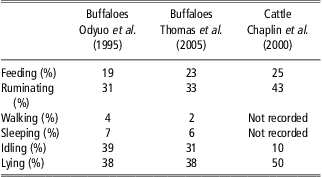
Table 1 compares data from different studies on buffaloes with data on cattle, both kept in extensive conditions, and confirms a similar time allocation in different ruminant species. According to Schultz et al. (Reference Schultz, Schultz, Garmendia and Chico1977), on average buffaloes spend 27% of the time feeding, 39% ruminating and 34% of the time resting (while lying or standing). Bud et al. (Reference Bud, Velea, Marcu, Muresan, Vomir and David1985) and Napolitano et al. (Reference Napolitano, Grasso, Saltamacchia, Martiniello, Bilancione, Pacelli and De Rosa2007) observed that buffaloes spent a larger proportion of time feeding and a lower proportion ruminating with the remaining time devoted to resting and walking. Similar results were shown for cattle in similar geographical and climatic conditions (Braghieri et al., Reference Braghieri, Pacelli, Girolami and Napolitano2011). In buffaloes much of the time spent resting was spent wallowing. This is a specific behaviour of buffaloes; however, there are limited data on the expression of this activity. When the buffaloes have free access to water, which is often the case in extensive conditions, in the form of ponds, potholes or pools, they spend a high proportion of time lying in there for thermoregulatory purposes and for protection and possibly control against ecto-parasites and flies (BOSTID, 1981) as also observed in other animal species (Bracke, Reference Bracke2011).
Maintenance behaviour of buffaloes and Podolian cattle (Italian local breed) in extensive conditions as reported by different authors

Through natural selection, buffaloes have acquired several morphological features, which allow their adaptation to hot-humid areas. For instance, melanin pigmented skin is useful for protection against ultraviolet rays and low hair density facilitates heat dissipation by convection and radiation. In hot–dry climates, low humidity induces intense evaporative heat loss, which, in buffaloes, is limited by the low number of sweat glands. In addition, respiratory evaporation is less effective than in cattle as it can induce alkalosis as a consequence of a rapid increase of blood pH (Koga, Reference Koga1991). By contrast, in hot-humid climates, high humidity is paired with small diurnal changes in air temperature and evaporative heat loss is not as effective in body heat dissipation. Therefore, buffaloes rely on wallowing for an efficient thermoregulation, as indicated by the high secretion of sebum, which protects the skin while the animals are in the mud (Hafez et al., Reference Hafez, Badreldin and Shafie1955). In particular, buffaloes in hot conditions increase blood volume and flow to the skin surface in order to maintain a high skin temperature and facilitate heat dissipation while in the mud or in the water (Koga, Reference Koga1999). In summer, in fact, the proportion of time spent in the mud by heifers is twice that in other seasons (Napolitano et al., Reference Napolitano, Grasso, Saltamacchia, Martiniello, Bilancione, Pacelli and De Rosa2007), with almost 50% of adult lactating buffaloes being observed to lie in the mud when given the opportunity (De Rosa et al., Reference De Rosa, Grasso, Braghieri, Bilancione, Di Francia and Napolitano2009a). When access to water for wallowing is restricted during the hot seasons, heat can only insufficiently be dissipated and milk production is reduced (De Rosa et al., Reference De Rosa, Grasso, Braghieri, Bilancione, Di Francia and Napolitano2009a) and fertility is adversely affected (Di Palo et al., Reference Di Palo, Midea, Campanile, Rossi and Zicarelli2001), as indicated by the higher number of days open and percentage of non-pregnant cows.
Natural pasture conditions may facilitate the expression of self-grooming (De Rosa et al., Reference De Rosa, Grasso, Braghieri, Bilancione, Di Francia and Napolitano2009a). In addition, bathing and wallowing in the pool can induce a higher proportion of buffaloes in performing integumentary care, as self-grooming is often associated with body muddiness (Sato et al., Reference Sato, Sako and Maeda1991).
Maintenance behaviour in confinement
Under confinement, animals have less space for movement, and environmental stimuli facilitating the expression of proper species-specific behaviours are often lacking. In a study on Murrah buffalo in loose-housing conditions (Odyuo et al., Reference Odyuo, Jana and Das1995), animals spent more time eating, idling and walking during daytime than during the night, and more time ruminating and resting at night than at daytime. Ruminating behaviour was lowest during the hours around noon and highest during early morning and late evening. The highest peaks of resting behaviour were observed around 0300 and 2300 h. Idling was most prevalent at noon.
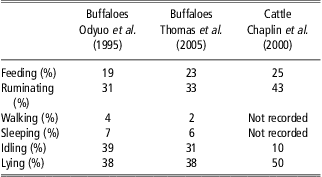
In Table 2, the behaviour expressed in confinement by adult dairy buffaloes is compared with that of cattle. The two species display similar behavioural patterns. However, in comparison with animals kept in extensive conditions the time spent feeding is lower, whereas idling may be prevailing. The lower level of activity is also indicated by the higher percentage of time spent lying or in the various lying postures.
Maintenance behaviour of buffaloes and cattle in confinement (loose-housing conditions) as reported by different authors
Buffalo cows kept in intensive conditions and having no access to pasture and water for wallowing extend their periods of idling (Tripaldi et al., Reference Tripaldi, De Rosa, Grasso, Terzano and Napolitano2004) and are less often involved in investigative activities (De Rosa et al., Reference De Rosa, Grasso, Braghieri, Bilancione, Di Francia and Napolitano2009a). Buffaloes are strongly motivated to explore and investigate the environment (Napolitano et al., Reference Napolitano, De Rosa, Grasso and Bordi2004). They often revisit familiar areas presumably to check for changes. Therefore, low levels of exploration, as observed in confinement, may be seen as a sign of poor adaptation to the environment associated with lack of stimulation. However, reduced activity may also be because of other factors (e.g. diet quality) and not necessarily interpreted as a negative aspect. Confinement and intensification of dairy buffalo farming techniques has also been linked with a reduction of space allowance to that specified by the dairy cattle standards (e.g. Royal Society for the Prevention of Cruelty to Animals, 2011), but there have been no specific studies carried out to determine what the actual space requirements are for this species. Space restriction can adversely affect various aspects of animal welfare, such as health (increased levels of lesions and injuries), social behaviour (increased number of agonistic interactions) and reduced possibilities for heat dissipation (Macfarlane, Reference Macfarlane1981). Lack of space resulted in evidence of stress in different buffalo categories (unweaned calves, weaned calves, heifers and cows), as indicated by alterations in a number of behavioural indicators (Grasso et al. Reference Grasso, De Rosa, Marsico, Napolitano, Migliori and Bordi2003; Napolitano et al., Reference Napolitano, De Rosa, Grasso and Bordi2004; Tripaldi et al., Reference Tripaldi, De Rosa, Grasso, Terzano and Napolitano2004).
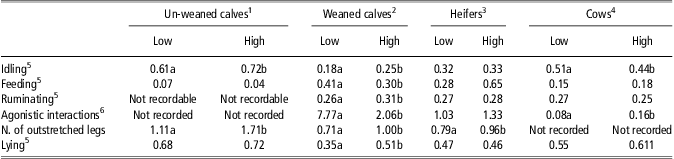
The behaviour expressed by buffaloes from different age categories according to different space allowances is reported in Table 3. In particular, the number of outstretched legs is significantly affected by the space allowance: animals increase the number of bent limbs and tend to lie sternally recumbent presumably in order to reduce the risk of being stepped on by their companions. Unweaned and weaned calves are more often observed idling (defined as animals with open or closed eyes but showing no other overt activity) at higher space allowances; most of this behavioural expression, however, is observed while the animals are lying, and lying idle may be considered the most important form of resting (Napolitano et al., Reference Napolitano, De Rosa, Grasso and Bordi2004). It has been hypothesised that in a restricted space buffaloes may be more often disturbed by other animals’ activities, which impairs the time they spent lying idle (Grasso et al., Reference Grasso, Napolitano, De Rosa, Quarantelli, Serpe and Bordi1999). Opposite results were observed in adults possibly because in these cases the higher space allowance was combined with free access to an ample yard and water for wallowing (Tripaldi et al., Reference Tripaldi, De Rosa, Grasso, Terzano and Napolitano2004; De Rosa et al., Reference De Rosa, Grasso, Braghieri, Bilancione, Di Francia and Napolitano2009a), which represent important factors stimulating buffalo activity.
Behaviour expressed by buffaloes from different age categories in different space allowance conditions
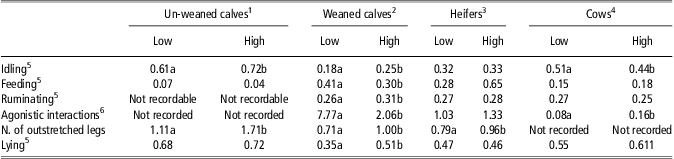
2Napolitano et al. (Reference Napolitano, De Rosa, Grasso and Bordi2004).
4De Rosa et al. (2009).
5Data are expressed as proportion of animals.
6Data are expressed as number of interactions per animal.
a,b Indicates significant differences within each buffalo category (P < 0.05–0.001).
As for feeding, in unweaned calves a lower space allowance paired with a higher age can induce higher levels of eating (Grasso et al., Reference Grasso, Napolitano, De Rosa, Quarantelli, Serpe and Bordi1999). In other experiments on weaned calves, where space allowance was adjusted to the increasing dimensions of the animals (Napolitano et al., Reference Napolitano, De Rosa, Grasso and Bordi2004), the group kept in a restricted space consistently showed higher levels of feeding. In addition, in all age categories weight gains did not differ between groups. Although feed conversion rates were not recorded, a lower feeding conversion efficiency in the restricted groups may be hypothesised. Similarly, in buffalo cows a restricted space allowance may have induced a lower milk production as a consequence of a poorer feed conversion (De Rosa et al., Reference De Rosa, Grasso, Braghieri, Bilancione, Di Francia and Napolitano2009a).
Foraging and feeding behaviour
According to Napolitano et al. (Reference Napolitano, Grasso, Saltamacchia, Martiniello, Bilancione, Pacelli and De Rosa2007), in an experiment where approximately 10% of the study site was occupied by woodland (e.g. Quercus sp, Fraxinus spp.) and shrub (e.g. Calycotome villosa, Cistus spp., Myrtus communis), while the rest of the fenced area was dominated by grassy habitat (e.g. Lolium spp., Dactylis glomerata, Trifolium spp., Hedysarum coronarium, Inula spp., Plantago spp.), the ingestion of woody or shrub vegetation was rarely observed, thus indicating that Italian Mediterranean buffaloes may be considered grazers rather than browsers. In the same experiment, bite rate of Mediterranean heifers on grassy vegetation was on average 40.1 (bite/min).
Weight gain and age at puberty were compared with those displayed by a control group kept in a confined loose-housed setting (Terzano et al., Reference Terzano, Mazzi, d'Elisi, Cuscunà, Borghese, Martiniello and Pacelli2007). Results showed that grazing heifers reached puberty at lower weights than confined animals as a consequence of lower weight gains. However, the age at puberty did not differ between groups. Therefore, the reproductive performance of grazing heifers was potentially comparable to those of loose-housed animals, while reducing the input of feeds that may also be used for humans (e.g. cereals), the concentration of manure and the use of external inputs, such as fossil fuel, water for irrigation, chemical fertilisers and pesticides. The management of unproductive categories of animals, such as heifers, on pasture may render buffalo farming more environmentally sustainable without impairing production efficiency.
As dairy buffaloes originate from tropical areas, they are well adapted to an environment characterised by large variations in food availability and quality (Bartocci et al., Reference Bartocci, Terramoccia and Puppo2005). Therefore, they usually graze a wider range of plants as compared with cattle. In addition, the digestibility of CP and fibre fractions of the diet is usually greater than in sheep and cattle. This may be because of the lower energy content of the rations generally offered to these animals as well as to certain features of buffalo rumen, which are different from that of other ruminants: a larger volume, slower movements, a smaller rate of outflow and a higher bacterial activity. However, these characteristics tend to disappear when buffaloes are fed with high-energy diets (Kennedy, Reference Kennedy1995).
In the same climatic conditions, the dry matter (DM) intake of lactating buffaloes is about 30% less than dairy cattle with a mean of 16 kg DM/animal per day as compared with 22 kg DM/animal per day (Terramoccia et al., Reference Terramoccia, Bartocci and Borghese2005). However, the use of a shower to cool the animals before milking and during the hottest parts of the day can increase buffalo daily ingestion (Thomas et al., Reference Thomas, Nordstrom, Svennersten-Sjaunja and Wiktorsson2005).
Maternal behaviour
In mammals, a fundamental role of mothers is nursing and promoting the development of social behaviour in their offspring. In buffaloes, a lasting and mutual cow–calf bond is established soon after parturition. The onset of this strong relationship is promoted by two main mechanisms: the maternal response of the mother and the learning ability of the calf. The maternal response is under hormonal control, which induces a sensitive period during which mothers selectively remember the features of their own calves, which allows them to distinguish their own from alien calves. The ability of the newborn mammals to identify the mother is likely to be related with rewards provided by parental care, as the association of maternal cues with rewards deriving from the dam provides the basis for an early bond. This specific type of learning where both the mother and the offspring quickly learn to identify each other is a form of imprinting. In cattle and sheep this relationship soon becomes selective with alien offspring actively rejected by head butting (e.g. Napolitano et al., Reference Napolitano, De Rosa and Sevi2008). However, in buffaloes it is common to see the calves, sometimes in a group, suckling cows other than their own mother (Murphey et al., Reference Murphey, Paranhos da Costa, Silva and Souz1995). This behaviour, described in terms of communal nursing, consists of one adult female nursing groups of calves of other females. Allo-nursing is unrelated to kinship or reciprocal relationships among the cows and is associated with a lack of maternal experience in young cows and apparent milk theft by hungry calves whose mothers are not providing them with sufficient milk (Murphey et al., Reference Murphey, Paranhos da Costa, Silva and Souz1995).
Once formed, the mother–young relationship induces the pair to stay in close contact until the age of natural weaning. The whole weaning process is gradual and depends on a number of factors (e.g. availability of solid food, milk production, physiological stage of the mother), thus a precise time for natural weaning cannot be specified. In intensive dairy enterprises, while male buffalo calves are sold soon after birth because of their low commercial value, female calves are prematurely separated from the dam to increase the amount of milk available for transformation into mozzarella cheese and fed reconstituted milk. These artificial rearing programmes represent a combination of emotional (early disruption of mother–young relationship) and nutritional stress (transition from maternal milk to commercial milk substitute) with obvious detrimental effects on animal welfare. Young calves can exhibit reduced immune responsiveness as a consequence of stress (Grasso et al., Reference Grasso, Napolitano, De Rosa, Quarantelli, Serpe and Bordi1999) and high mortality rates. In most buffalo farms, the incidence of calf loss from birth to weaning is usually between 10% and 20% (Masucci et al., Reference Masucci, De Rosa, Grasso, Napolitano, Esposito and Di Francia2011), and this percentage can increase to more than double this value if animals are reared under sub-optimal conditions. Neonatal diarrhoea is one of the main causes of calf death with higher mortality rates in the first weeks of life, thus affecting the welfare and production efficiency of buffalo farms (Masucci et al., Reference Masucci, De Rosa, Grasso, Napolitano, Esposito and Di Francia2011).
Social behaviour
Social relationships are an integral part of the behaviour of most mammalian species. Individual aggregation represents a trade-off between a tendency to concentrate as behavioural mechanism against predation and a tendency to disperse to minimize foraging competition. Buffaloes in free-range conditions move in groups where individuals maintain close proximity to one another (empirical observation).
As other farm animal species, buffaloes are kept in herds (i.e. social groups), where agonistic interactions occur as a means to establish and maintain a social structure. However, once dominance relationships are established, threats performed by dominant animals generally induce retreat by subordinate subjects without any physical contacts. In a study conducted on buffalo heifers aged 19 months (unpublished data) the number of agonistic interactions observed over 6-h periods decreased from 0.41 to 0.15 and 0.03 (n/animal per hour) with increased time (10-day intervals) from group formation. Various factors, such as group size, space allowance, housing system and management strategies can affect the frequency and quality of social interactions, and a certain level of agonistic interactions may be considered as normal. Nevertheless, an increased level of agonistic behaviour may be indicative of reduced welfare. In addition, buffaloes are mostly left with horns and, in horned cattle, the frequency of agonistic encounters is positively correlated with skin injuries (Menke et al., Reference Menke, Waiblinger, Fölsch and Wiepkema1999).
A higher number of positive social interactions (sniffing and nuzzling conspecifics) and social licking have been observed in a group at higher space allowance and provided with a pool than in a corresponding control group kept in a restricted space without a pool (De Rosa et al., Reference De Rosa, Grasso, Braghieri, Bilancione, Di Francia and Napolitano2009a). Although social licking may merely alleviate social tension or else indicate boredom and oral under-stimulation (Knierim and Winckler, Reference Knierim and Winckler2009), it can also play a role in reinforcing and stabilising social relationships, thus functioning as a socially cohesive interaction in the development of affiliative bonds (Sato et al., Reference Sato, Sako and Maeda1991). The presence of a pool along with a higher space allowance may have promoted non-agonistic social interactions, thus encouraging the development of affiliative relationships among buffaloes, with beneficial effects on the cohesion of the group. Surprisingly, in the same group agonistic interactions were also more often observed. In another study conducted on weaned buffalo calves, a shortage of free space was associated with increased agonistic interactions (1.30/animal per hour) in comparison with the control group (0.34/animal per hour) over 6 h of observations (Napolitano et al., Reference Napolitano, De Rosa, Grasso and Bordi2004). However, in the buffalo cow study the level of aggression was much lower (0.03 v. 0.01/animal per hour for groups with and without pool, respectively) than in the weaned calves’ study. These different results may be attributed to the different space allowances used in the two studies: too low in the weaned calves’ study (it never exceeded 3.4m2/animal), approximately sufficient in the buffalo cow study (it was always over 10m2/animal). The values observed in the buffalo cow study were, in fact, much closer to those reported by Napolitano et al. (Reference Napolitano, Grasso, Saltamacchia, Martiniello, Bilancione, Pacelli and De Rosa2007) in heifers free ranging in a 40 ha pasture, where agonistic interactions ranged from 0.13 to 0.33 and non-agonistic interactions ranged from 0.42 to 0.53 (n/animal per hour) observed on the focal animals in 6-h observation.
These studies taken together suggest that in herds provided with sufficient space and facilities, the level of negative social interactions does not represent a threat to buffalo welfare. In small groups, linear relationships are soon established either after group formation or inclusion of new pen-mates. Bulls, which are often an integral part of the herd because of the low efficiency of artificial insemination, are dominant. Once dominance relationships have been established, threats generally induce retreat or withdrawal by subordinate buffaloes, which assume a submissive posture (head lowered away from the opponent). However, empirical observations indicate that in intensive conditions problems may arise when bulls exhibit agonistic behaviour towards heifers, younger bulls or cows and also aggressiveness towards humans.
Temperament and style of interaction with the environment
Buffaloes have been reported to be more curious than cattle (Napolitano et al., Reference Napolitano, Grasso, Bordi, Tripaldi, Saltalamacchia, Pacelli and De Rosa2005). When exposed to environmental challenges, such as isolation and novel environment, they exhibit increased vocalisation, exploration and locomotion. Napolitano et al. (Reference Napolitano, De Rosa, Grasso and Bordi2004) observed that buffaloes housed in a less spacious environment show a lowered threshold for release of locomotory behaviours. This rebound response may reflect the build-up of internal motivation to perform locomotion and galloping behaviour while the animals were kept in a more restricted environment. In addition, novelty may induce increased levels of exploration (e.g. sniffing) and locomotion aimed at providing the animals with information about the unknown environment. De Rosa et al. (Reference De Rosa, Napolitano, Saltalamacchia, Bilancione, Sabia, Grasso and Bordi2007a) observed that in a novel object test (i.e. a traffic cone placed in the middle of a novel pen) heifers housed in confinement devoted more time to the exploration of the cone in comparison with animals kept on pasture. The authors attributed this different behaviour to the lack of stimuli in the home environment of intensively reared buffalo heifers, which, therefore, were more motivated in exploring a novel object. Increased levels of vocalisation have been interpreted in terms of fear, although they primarily represent a means to keep in contact with other members of the group (Watts and Stookey, Reference Watts and Stookey2000). Heifers kept in intensive conditions showed a higher vocal response to isolation possibly more dependent on the group, whereas animals kept in extensive conditions may be more accustomed to sporadic isolation because of dispersion through the pasture while grazing (De Rosa et al., Reference De Rosa, Napolitano, Saltalamacchia, Bilancione, Sabia, Grasso and Bordi2007a).
Similar results were obtained using a new methodology recently applied to buffalo heifers (Napolitano et al., Reference Napolitano, De Rosa, Grasso and Wemelsfelder2012): the qualitative behaviour assessment, which is a description of the quality of the behaviour expressed by the animals. Animals when exposed to a novel outdoor pen were described as more restless and explorative, whereas in the home indoor pen they were more relaxed and calm.
Human–animal relationship
One of the key factors affecting animal welfare in modern farms is the quality of the relationship between animals and stock-people. A number of studies have shown a reciprocal relation between attitude and behaviour of stock-people towards the animals and the behavioural response of the animals (reviewed by Hemsworth and Coleman, Reference Hemsworth and Coleman2011). According to this relation, fear induced responses from the animals can induce a reduction in productivity and welfare on one hand, a higher difficulty in handling on the other and, as a consequence, a more negative attitude and a more forceful behaviour of the stock-people. However, the reaction of animals to humans is not only related to unpleasantness (e.g. fear), as a positive dimension has been also identified in case of good human–animal interactions.
In dairy cattle, the presence of aversive handlers during milking induces increased heart rate, cortisol level and residual milk (Rushen et al., Reference Rushen, Munksgaard, Marnet and DePassillé2001), which are all expressions of fear and stress. Data on buffaloes (Saltalamacchia et al., Reference Saltalamacchia, Tripaldi, Castellano, Napolitano, Musto and De Rosa2007) indicate that exogenous oxytocin injections are often performed to facilitate complete milk ejection. In contrast to dairy cattle milking where oxytocin is only used occasionally, in 17 farms the prevalence of lactating buffaloes treated with oxytocin while being milked was 9.5% and, within treated animals, 24% was primiparous. Saltalamacchia et al. (Reference Saltalamacchia, Tripaldi, Castellano, Napolitano, Musto and De Rosa2007) also observed that the behaviour of the animals in the milking parlour expressed in terms of stepping and kicking, was positively correlated with the frequency of oxytocin injections, whereas positive stockperson interactions with the animals, expressed in terms of talking quietly, petting and gentle touching, were negatively correlated with the number of kicks during milking. In the same study, negative and neutral interactions were not related with animal behaviour. These results are consistent with the hypothesis that in buffaloes also, the behaviour of the stockperson may have a great influence on animal behaviour during milking. Previous studies in cattle have shown that stepping may be considered an indicator of agitation, whereas kicking is more related to aggressiveness (Munksgaard et al., Reference Munksgaard, de Passillé, Rushen, Herskin and Kristensen2001). Animal restlessness at milking is a possible source of injury and may be caused by many different factors such as pushing by adjacent cows, lameness, low mineral intakes, presence of hematophage insects, poor maintenance of milking machine, etc. Nevertheless, in dairy cattle a correlation between human behaviour and cow restlessness during milking was found (Waiblinger et al., Reference Waiblinger, Menke and Coleman2002), suggesting that at least a proportion of this reaction by the animal to milking may be interpreted as a response to the stockperson. According to Hemsworth and Coleman (Reference Hemsworth and Coleman2011), practical opportunities exist in the form of training program targeting stockperson attitude and behaviour, to modify human–animal relationship to improve dairy cow productivity. A similar programme could also be envisaged for buffalo farming.
Owing to the relevance of human–animal interactions in terms of animal welfare, different tests have been suggested to assess the quality of the human–animal relationship, ranging from approach and avoidance tests to the assessment of animals’ reactions during handling procedures, whereas only some of them have been included in animal welfare monitoring schemes. According to Waiblinger et al. (Reference Waiblinger, Menke and Coleman2002), avoidance distance more appropriately reflects the human–animal relationship from the animal's perspective than other tests. In buffaloes, this variable measured in the pen proved to be able to detect differences in the quality of human–animal relationship among farms as well as to be reliable in terms of short-term consistency (Napolitano et al., 2005). Data from farms where both dairy cattle and buffaloes were present (Napolitano et al., 2005) showed that avoidance distance measured in the pen is lower in buffaloes than in cattle (64 v. 242 cm). Buffaloes also show avoidance distances in the pen similar to goats (68 cm) (Mattiello et al., Reference Mattiello, Battini, Andreoli, Minero, Barbieri and Canali2010) and lower than sheep (238 cm) (Napolitano et al., Reference Napolitano, De Rosa, Girolami, Scavone and Braghieri2011). This may be attributed to the fact that buffaloes are generally recognised to be curious animals. However, buffaloes also are gregarious animals, with small inter-individual distances, particularly when they move. When approached in an enclosed area, they may run and, if they do not have an escape route, they may run towards the observer. In addition, bulls are often included in buffalo herds. Therefore, the measurement of avoidance distances may be not feasible in the pen for safety reasons, whereas it can be performed at the manger with no danger for the observer.
Buffalo avoidance distance measured at the manger (mean = 37 cm; De Rosa et al., Reference De Rosa, Grasso, Bilancione, Migliori, Napolitano, Winckler and Van Reenen2009b) is lower than in sheep (mean = 68 cm; Napolitano et al., Reference Napolitano, De Rosa, Girolami, Scavone and Braghieri2011) but higher than that measured in fattening bulls (mean = 12 to 15 cm; Windschnurer et al., Reference Windschnurer, Boivin and Waiblinger2009). The percentage of buffaloes that accepted being touched at the manger (median = 20%; De Rosa et al., Reference De Rosa, Grasso, Bilancione, Migliori, Napolitano, Winckler and Van Reenen2009b) is similar to that observed in cattle in the barn (median = 19%; Waiblinger et al., Reference Waiblinger, Menke and Coleman2002), and in sheep at the manger (mean = 14%; Napolitano et al., Reference Napolitano, De Rosa, Girolami, Scavone and Braghieri2011). Both avoidance distance at the manger and the percentage of animals accepting being touched showed a high inter-observer reliability (De Rosa et al., Reference De Rosa, Grasso, Bilancione, Migliori, Napolitano, Winckler and Van Reenen2009b).
Welfare issues and welfare assessment
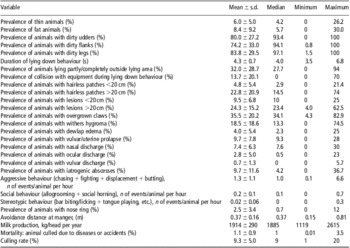
In this section are briefly described the animal based (health and behavioural) and resource indicators of buffalo welfare included in the monitoring system developed for buffalo within the Welfare Quality® project (www.welfarequality.net). They are mainly based on what has been used for dairy cattle with modifications to accommodate the characteristics of this animal species. These indicators were recorded in 42 buffalo farms (De Rosa et al., Reference De Rosa, Grasso, Bilancione, Migliori, Napolitano, Winckler and Van Reenen2009b) and the main results are reported in Table 4.
Animal-based measures recorded in 42 buffalo farms (adapted from De Rosa et al., Reference De Rosa, Grasso, Bilancione, Migliori, Napolitano, Winckler and Van Reenen2009b)

Body condition scoring (BCS)
In buffalo, as well as in cattle, BCS is used as a means to estimate the body energy reserves by assessing the subcutaneous fat layers in place of live weight change. Although in the river buffalo milk production is remarkable, from a morphological and metabolic point of view the buffalo is more similar to dual purpose cattle than to dairy animals (Campanile et al., Reference Campanile, De Filippo, Di Palo, Taccone and Zicarelli1998). Therefore, a BCS system derived from that developed by Lowman et al. (Reference Lowman, Scott and Sommerville1976) for beef cattle may be used. This method consists of assigning each buffalo cow three different scores corresponding to the categories ‘very lean’, ‘regular’ and ‘very fat’. This parameter should be used to assess long-term undernutrition, with a high prevalence of thin buffaloes being associated with reduced levels of animal welfare. In contrast to cattle, over-condition in buffaloes is usually not associated with ketosis (Gillund et al., Reference Gillund, Reksen, Gröhn and Karlberg2001). However, after calving, fat buffaloes may show decreased fertility (Campanile et al., Reference Campanile, De Filippo, Di Palo, Taccone and Zicarelli1998).
Body cleanliness
The evaluation of body cleanliness may give some information on animal comfort as well as attitudes and the quality of care for the animals. In dairy cattle, the soiling of skin and hair may reduce thermoregulatory and anti-germal properties of the skin, and cause inflammations of the skin (Winckler et al., Reference Winckler, Capdeville, Gebresenbet, Hörning, Roiha, Tosi and Waiblinger2003). A relationship between udder and hind limb cleanliness, and subclinical and clinical mastitis has been established (Munoz et al., Reference Munoz, Bennett, Ahiström, Griffiths, Schukken and Zadoks2008), since if these areas are dirty, they are more likely to be contaminated with micro-organisms which may invade the udder. In buffaloes, swimming and wallowing behaviours are essential during the hot season to dissipate body heat. Therefore, the presence of mud on the buffalo skin may be considered a positive aspect, whereas a thick and compact layer of dung on the body of the animals may represent a health risk factor for dairy buffaloes.
Lameness
Lameness is a major welfare problem in dairy cattle, which is often associated with pain and discomfort of long duration. In these animals, lameness can be assessed using different ‘locomotion scoring’ or ‘gait scoring’ systems (Winckler and Willen, Reference Winckler and Willen2001). However, in a study conducted in 42 buffalo farms (De Rosa et al., Reference De Rosa, Grasso, Bilancione, Migliori, Napolitano, Winckler and Van Reenen2009b), lameness was virtually absent, which may be attributed to either low concentrate feeding regimen or differences in metabolism compared with cattle (Campanile et al., Reference Campanile, De Filippo, Di Palo, Taccone and Zicarelli1998). Although pathological conditions affecting the feet of buffaloes are rare, claw overgrowth and corkscrew claws can be frequently observed in buffalo farms. The latter claw abnormality may have a genetic basis and bulls carrying this defect are usually excluded from reproduction. Therefore, in a monitoring system for assessing buffalo welfare at farm level, the proportion of animals with poor claw conformation (corkscrew claws, abnormal angle of pastern, etc.) and claw overgrowth (long toes, excessive heel depth, etc.) could be considered; lameness, because of its low incidence, may be less important.
Integument alterations
Freedom from injury is an important part of farm animal welfare in any housing systems. Skin lesion and swellings reflect the impact of the surrounding environment on the animal's body. Alterations can be caused by contact with hard floors, pressure and knocks against feed rack and cubicle partitions, etc. In addition to any callosity, swelling and lesions (wounds and scabs) on the body area as registered in dairy cattle, withers hygromas, dewlap oedemas and iatrogenic abscesses (mainly located in the hind quarters) should be noted. The first two measures are indicative of an inappropriate design of feeding rack and the last one reflects the use of oxytocin injection to facilitate milk ejection.
Disease and mortality
Disease and mortality among dairy buffaloes are a problem both in terms of welfare and economic loss. Welfare assessment protocols designed for the assessment of individual farms may take into account parameters which directly or indirectly reflect their health. Data regarding health are sometimes recorded on a routine basis, yet may not be readily available, or may be recorded in variable formats. Respiratory and enteric problems, mastitis, mortality and culling rate due to disease and accidents should be noted along with specific buffalo reproductive diseases, such as vaginal and uterine prolapses, which have been associated with unbalanced rations in terms of minerals (unbalanced calcium phosphorous ratio) fed to dry cows (De Rosa et al., Reference De Rosa, Napolitano, Grasso, Bilancione, Spadetta, Pacelli and Van Reenen2007b).
Resting behaviour
Only a few studies on resting behaviour of buffaloes are available so far. Grasso et al. (Reference Grasso, Napolitano, De Rosa, Migliori and Bordi2001) observed that buffalo calves kept in a restricted space (1.2 m2/head) lie and rest for a shorter time and, when lying, have a higher number of bent legs compared with animals kept in larger space (2.1 m2/head). In addition, lying patterns may be restricted by other buffaloes, which could cause disturbances in the resting of pen mate if they are stepped on (Napolitano et al., Reference Napolitano, De Rosa, Grasso and Bordi2004). Animals also show decreased levels of lying idle, which is likely to represent an important form of resting. However, the feasibility of these measurements is low and, within the Welfare Quality® project, other indicators have been suggested, such as prevalence of animals lying outside the lying area, duration of lying down behaviour and prevalence of collisions with equipment during lying down behaviour (Table 4).
Agonistic interactions
Agonistic interactions and subsequent injuries are an emerging problem in buffalo farming. In recent years, space allowance has been dramatically reduced as a consequence of farming intensification: presently animals are usually kept indoors (5 to 10 m2/head) with access to an outdoor paddock (8 to 14 m2/head), whereas in the past they were free to roam in marshland. Animals are not dehorned and free to perform and to avoid any agonistic behaviour. However, in a restricted space social contacts are forced and flight opportunities markedly reduced for subordinate animals. In addition, the bulls (one or more are usually left in the herd) may become more aggressive towards females and younger males and may cause injuries to subordinate animals through head butting or horning them. These agonistic behavioural expressions along with aggression towards humans are the main culling reasons for bulls. A further factor contributing to social disturbance is that primiparous buffalo cows are often not separated from multiparous animals. They occupy the lowest social ranks and obviously incur higher incidences of skin lesions and injuries to the udder (empirical observation).
Abnormal behaviours
Heifers and adult dairy cattle have been shown to develop or increase the time spent performing oral stereotypies as a response to tethering, restrictive allotments and decrease in eating duration (Redbo and Nordblad, Reference Redbo and Nordblad1997). In buffaloes, cross-sucking is often observed in calves resulting in inflammation or injuries at the prepuce, teats or navel, but it is also displayed by lactating animals resulting in milk loss. Therefore, the presence of weaning rings, indicating animals attempting to suck milk from the udder of conspecifics, should be recorded. However, buffalo oral abnormal behaviours should be studied more extensively.
Human–animal relationship
As reported above, avoidance distance is considered as an indicator of the quality of the relationship between farm animals and stock-people. For buffaloes, because of the presence of the bulls in the herd, the test should be performed at feeding rack for safety reasons.
Wallowing and grazing
The welfare of farm animals is not simply limited to the animal's functioning and performance. They should also be able to develop normally and to express species-specific behaviours in order to adapt to the environment in relation to their innate nature. The provision of barren housing systems irrespective of the animals’ natural behaviour and needs may reduce the welfare of livestock such as buffaloes, which have been only recently subjected to farming intensification. In particular, in recent years, in order to improve milk hygiene and to reduce the time required for cleaning the udder at milking as well as potentially reducing disease transmission, potholes and pools, typical of the traditional system, have been abolished or in some cases replaced by spray systems. It has been observed that the provision of a housing system enriched with potholes and spontaneous vegetation, thus closer to natural conditions, was able to improve the welfare of buffalo cows. These animals were able to express their species-specific natural behaviours, such as wallowing and grazing (Tripaldi et al., Reference Tripaldi, De Rosa, Grasso, Terzano and Napolitano2004; De Rosa et al., Reference De Rosa, Grasso, Braghieri, Bilancione, Di Francia and Napolitano2009a) and a reduced adrenal response to exogenous adreno-corticotropic hormon challenge (Tripaldi et al., Reference Tripaldi, De Rosa, Grasso, Terzano and Napolitano2004). Accordingly, a reduced calving interval and higher conception rate was observed in animals provided with a pool (Di Palo et al., Reference Di Palo, Midea, Campanile, Rossi and Zicarelli2001). Higher space allowance was also associated with higher milk production in buffaloes (De Rosa et al., Reference De Rosa, Grasso, Braghieri, Bilancione, Di Francia and Napolitano2009a). Therefore, for on-farm buffalo welfare monitoring the provision of systems aiming at alleviating heat stress, particularly those allowing the expression of natural thermoregulatory behaviour, should be positively considered.
Conclusion
This review has shown that there is a lack of knowledge both in basic topics, such as social behaviour, and applied aspects, such as bull aggressiveness and inter-sucking behaviour. Hierarchy formation and stability, and synchrony of behaviour have not been studied in any detail, although they can have important implications for buffalo welfare. Both bull aggressiveness and inter-sucking behaviour markedly affect production efficiency (injured females, bull culling and loss of milk, respectively) and are also related to animal welfare. Causes and possible remedies should be investigated.
As also observed in other domestic ruminants, in extensive conditions buffaloes spend most of their time in two main behavioural categories: feeding (including grazing and ruminating) and resting. Wallowing and bathing, particularly in the hot season, represent a more specific buffalo behaviour expressed for thermoregulation and ecto-parasite protection. Confinement, currently associated with intensive husbandry conditions, prevents some of these natural behaviours from occurring, such as grazing and wallowing, and increase the expression of undesirable behaviours, such as bull aggressiveness and inter-sucking, thus representing a potential risk factor for buffalo welfare per se. Therefore, a predominantly animal-based welfare monitoring scheme such as proposed in Welfare Quality® (De Rosa et al., Reference De Rosa, Napolitano, Grasso, Bilancione, Spadetta, Pacelli and Van Reenen2007b) should be further developed to allow the reliable assessment of buffalo welfare in the current intensive farming conditions. Its application may help to improve both the consumer perception of the food chain quality and the farm management and housing conditions.
Acknowledgements
The present study is a part of the Welfare Quality® research project which has been cofinanced by the European Commission, within the 6th Framework Programme, contract n. FOOD- CT-2004-506508. Thanks to Amelia Maria Riviezzi and Giovanni Migliori for expert technical assistance. Special thanks to the two anonymous referees for improving the quality of the manuscript.