One of the most difficult problems developmental psychopathologists face is to identify the environmental conditions that may contribute to the development of behavior problems originating in early childhood. Behavior problems are common in young children (Sahker, McCabe, & Arndt, Reference Sahker, McCabe and Arndt2015), developing during the preschool period (Calkins, Blandon, Williford, & Kean, Reference Calkins, Blandon, Williford and Keane2007; Combs-Ronto, Olson, Lunkenheimer, & Sameroff, Reference Combs-Ronto, Olson, Lunkenheimer and Sameroff2009; Loe, Feldman, & Huffman, Reference Loe, Feldman and Huffman2014), and for some children persisting into middle childhood, (Choe, Olson, & Sameroff, Reference Choe, Olson and Sameroff2013; Sulik et al., Reference Sulik, Blair, Mills-Koonce, Berry and Greenberg2015), preadolescence (Romer et al., Reference Romer, Betancourt, Giannetta, Broadsky, Farah and Hurt2009), and adolescence (Martel et al., Reference Martel, Nigg, Wong, Fitzgerald, Jester and Puttler2007). Further, behavior problems that emerge early in life can lead to mental health problems in childhood and adolescence (Fanti & Henrich, Reference Fanti and Henrich2010) and psychopathology during adulthood (Conduct Problems Prevention Research Group, 1992). It is unclear at this point how these processes may unfold, though longitudinal, transactional models of change may help to uncover pathways leading to the emergence of psychopathology in early adolescence.
In this study we take a developmental psychopathology approach to understanding how internalizing and externalizing behavior in early adolescence evolved from experiences in early and middle childhood. This approach helps us to answer the questions related to how particular disorders develop from earlier manifestations. Of course, not all children will follow the same pathway to disorder; an earlier risk factor can lead to multiple outcomes, or the same outcome may be due to multiple earlier pathways. Consistent with the developmental psychopathology approach is a targeted analysis of how multiple outcomes can arise from similar earlier risk factors, also known as multifinality.
We hypothesize that one way in which trajectories may be altered is through resilience factors. Even less is known about resilience processes that may alter developmental pathways leading to psychopathology. Resilience is thought of as the development of competency in the face of environmental risk or adversity (Luthar, Cicchetti, & Becker, Reference Luthar, Cicchetti and Becker2000; Masten, Reference Masten2001). The study of how resilience processes may alter developmental trajectories, particularly those stemming from early risk factors, is a core tenet of the developmental psychopathology perspective, and one that has been minimally applied to this study of children with prenatal substance exposure (though, for an exception, see Sheinkopf et al., Reference Sheinkopf, LaGasse, Lester, Liu, Seifer and Bauer2007). The sample in this study comes from the Maternal Lifestyle Study (MLS) of high-risk families with significant prenatal and postnatal maternal substance use including cocaine and opiates, and stressors impacting caregivers include poverty, depression, psychopathology, and domestic violence (LaGasse et al., Reference LaGasse, Seifer, Wright, Lester, Tronick and Bauer1999).
Caregiving Stress and Behavior Problems
One of the most important contextual factors that exacerbate behavior problems is caregiving stress (Calkins et al., Reference Calkins, Blandon, Williford and Keane2007; Choe et al., Reference Choe, Olson and Sameroff2013). According to Patterson's coercion theory (Dishion, Patterson, & Kavanagh, Reference Dishion, Patterson, Kavanagh, McCord and Tremblay1992; Granic & Patterson, Reference Granic and Patterson2006), children with externalizing behaviors can evoke negativity, anger, frustration, more physical discipline, and excessive parental control in highly stressed caregivers, which in turn provokes increased behavior problems (Combs-Ronto et al., Reference Combs-Ronto, Olson, Lunkenheimer and Sameroff2009). The cycle continues whereby increased disciplinary action by the caretaker serves to maintain and enhance the negative behavioral cycle. Further, although internalizing behavior may seem less demanding of a caregiver, a similar parental pattern emerges in part because children with internalizing behaviors may be highly susceptible to the caregiving environment due to a low threshold for anxiety, depression, and emotional reactivity, and a tendency to withdraw (Wagner, Propper, Gueron-Sela, & Mills-Koonce, Reference Wagner, Propper, Gueron-Sela and Mills-Koonce2015).
Thus, the dyadic process between parent and child is a series of transactions whereby each partner reacts to the other. Negativity in the parent is the currency for development of disruptive behaviors in the child, while disruptive behaviors in the child evoke stress and increased negativity in the parent. In children transitioning from preschool (ages 3.5 to 5.3 years), disruptive behavior showed bidirectional patterns with negative parenting (Combs-Ronto et al., Reference Combs-Ronto, Olson, Lunkenheimer and Sameroff2009).
Further exacerbating caregiving stress, many children live in poverty with a single parent, whereby parental stress is high, but positive support for the child is limited (Bagner et al., Reference Bagner, Sheinkopf, Miller-Loncar, LaGasse, Lester and Liu2009). In the MLS study, caretaker depression, impoverished home environment, violence, and tobacco use all predicted behavior problems in the child at age 7 years through 13 years. While it is known that caregiving stress and psychopathology are bidirectional, very little research compares these factors across multiple sensitive developmental periods. This study adds to the existing research by determining the intra- and interrelations of behavior problems and caregiving stress across multiple developmental periods.
Role of Executive Functioning
Within-child factors, such as executive functioning, are also relevant to the transactional relationships between caregiving stress and behavior problems. Executive functioning encompasses domains such as attention, inhibitory control, working memory, and set shifting (Miyake et al., Reference Miyake, Friedman, Emerson, Witzki, Howerter and Wager2000) and is of particular interest in relation to developmental psychopathology because executive functioning abilities support self-regulation of behavior and emotion (Derryberry, Reference Derryberry2002; Ochsner & Gross, Reference Ochsner and Gross2005; Ochsner, Silvers, & Buhle, Reference Ochsner, Silvers and Buhle2012; Rothbart, Sheese, Rueda, & Posner, Reference Rothbart, Sheese, Rueda and Posner2011). Executive functioning also shows protracted development throughout infancy, childhood, and adolescence (Anderson, Anderson, Northam, Jacobs, & Catroppa, Reference Anderson, Anderson, Northam, Jacobs and Catroppa2001; Williams, Ponese, Schachar, Logan, & Tannock, Reference Willams, Ponesse, Schachar, Logan and Tannock1999; Zelazo, Reference Zelazo2004; Zelazo, Muller, Frye, & Marcovitch, Reference Zelazo, Muller, Frye and Marcovitch2003), suggesting it sets the stage for child's regulatory capacity, but it may also be influenced by intervening environmental events that either facilitate or interfere with cognitive development.
The substantial change in executive functioning that occurs throughout childhood and adolescence complicates its measurement across a broad development range; however, models in both child and adult populations suggest that executive functioning abilities reflect a combination of domain-general and domain-specific abilities (Lehto, Juujärvi, Kooistra, & Pulkkinen Reference Lehto, Juujärvi, Kooistra and Pulkkinen2003; Miyake et al., Reference Miyake, Friedman, Emerson, Witzki, Howerter and Wager2000), with increasing contributions of domain-specific effects as children age (Lee, Bull, & Ho, Reference Lee, Bull and Ho2013; Miyake et al., Reference Miyake, Friedman, Emerson, Witzki, Howerter and Wager2000; Shing, Lindenberger, Diamond, Li, & Davidson, Reference Shing, Lindenberger, Diamond, Li and Davidson2010).
Within the infancy and early childhood period, directed attention abilities (i.e., the ability to control the focus of attention) are most relevant and set the stage for later maturing executive functioning skills (Garon, Bryson, & Smith, Reference Garon, Bryson and Smith2008; Petersen & Posner, Reference Petersen and Posner2012; Rothbart et al., Reference Rothbart, Sheese, Rueda and Posner2011; Rueda, Posner, & Rothbart, Reference Rueda, Posner and Rothbart2005). In early childhood, inhibitory control plays an increasing role (Carlson, Reference Carlson2005; Carlson & Moses, Reference Carlson and Moses2001; Kochanska, Murray, & Harlan, Reference Kochanska, Murray and Harlan2000; Kochanska, Murray, Jacques, Koenig, & Vandegeest, Reference Kochanska, Murray, Jacques, Koenig and Vandegeest1996; Rhoades, Greenberg, & Domitrovich, Reference Rhoades, Greenberg and Domitrovich2009), allowing children to inhibit preferred or prepotent responses in order to enact responses that facilitate longer term goals. During middle childhood and adolescence, directed attention and inhibitory control remain critical, while further development in working memory and set shifting (Cragg & Nation, Reference Cragg and Nation2009; Crone, Wendelken, Donohue, van Leijenhorst, & Bunge, Reference Crone, Wendelken, Donohue, van Leijenhorst and Bunge2006; Kalkut, Han, Lansing, Holdnack, & Delis, Reference Kalkut, Han, Lansing, Holdnack and Delis2009; Luciana, Conklin, Hooper, & Yarger, Reference Luciana, Conklin, Hooper and Yarger2005) allow children to solve increasingly complex problems and improve the regulation of behavior and emotions. (Note that the NIH Toolbox provides measures of many of these constructs across a wide development range. See http://www.nihtookbox,org/WhatAndWhy/Cognition/Pages/defaulty.as0x. However, these tools were not available when data were being collected for the MLS study.)
It was not surprising that, because the development of executive functioning is closely related to self-regulation, executive functioning deficits are associated with clinical impairment in a variety of internalizing and externalizing pathologies (Eigsti et al., Reference Eigsti, Zayas, Mischel, Shoda, Ayduk and Dadlani2006; Hughes & Ensor, Reference Hughes and Ensor2011; Schoemaker, Mulder, Dekovic, & Matthys, Reference Schoemaker, Mulder, Dekovic and Matthys2013; Sulik et al., Reference Sulik, Blair, Mills-Koonce, Berry and Greenberg2015). Further, executive functioning impairment may mediate trait negative affect in early childhood (Bridgett, Odi, Laake, Murdock, & Bachmann, Reference Bridgett, Oddi, Laake, Murdock and Bachmann2013), as well as irritability and depression symptoms in later adulthood (Joormann & Gotlib, Reference Joormann and Gotlib2008; Williams, Suchy, & Kraybill, Reference Williams, Suchy and Kraybill2010). It is also predictive of functional outcomes, such as social competence, academic achievement, and job attainment (Biederman et al., Reference Biederman, Monuteaux, Doyble, Seidman, Wilens and Ferrero2004; Miller & Hinshaw, Reference Miller and Hinshaw2010; Thorell, Reference Thorell2007). Together, results highlight the potential for development of executive functioning to either mitigate or exacerbate emerging psychopathology during childhood and adolescence.
Although research within developmental psychopathology has often emphasized executive functioning abilities as traitlike markers of risk for psychopathology, the development of executive functioning is also affected by the child's environment. In a study from this sample, we found that early adversity was associated with executive functioning difficulties at ages 8–9 years (Fisher et al., Reference Fisher, Lester, DeGarmo, Lagasse, Lin and Shankaran2011). Parenting practices also effect development of executive functioning, and studies in early childhood have found that these effects are bidirectional such that a child's executive functioning abilities both influence and are influenced by parenting practices. However, whether these relationships extend into later developmental periods has not been examined. Here we build on prior studies to examine the relationships between child executive functioning, caregiving stress (which may both directly and indirectly influence parenting practice), and child outcomes. Consistent with prior research in earlier developmental periods, we hypothesize that caregiving stress will predict concurrent and prospective child executive functioning, but that child executive functioning will also predict concurrent and prospective caregiving stress. Both caregiving stress and child executive functioning will prospectively predict child internalizing and externalizing symptoms.
Caregiving Stress, Executive Functioning, and Behavior Problems
The purpose of this study is to determine the transactional or bidirectional relationships among caregiving stress, executive functioning, and behavior problems across early childhood (age 5), middle childhood (age 9), and early adolescence (age 13). To our knowledge, related studies focus on two of the three components, and few studies include changes across more than two developmental periods. We conduct a structural equation model analysis of internalizing and externalizing behaviors in the context of caregiving stress and executive functioning to specify the unique patterns of each within and across ages 5, 9, and 13 years. We hypothesize that the relationship between caregiving stress and behavior problems will have a bidirectional association. Consistent with coercion theory, children's behavior problems may increase caregiving stress and reciprocally caregiving stress may be predictive of increased behavior problems. These transactions are expected to occur within and across developmental periods. The inclusion of executive functioning is unique and important because it may uncover different resilience pathways leading from caregiving stress to psychopathology across developmental periods. For instance, in a low-income sample similar to our own, Blair et al. (Reference Blair, Granger, Willoughby, Mills-Koonce, Cox and Greenberg2011) have found consistent, strong associations between the quality of early parenting and executive functioning in early childhood. As reviewed above, executive functioning is also a strong predictor of problem behavior. We hypothesize that executive functioning mediates the relation between early caregiving stress (or early problem behavior) and problem behavior in adolescence. In other words, executive functioning may be a mechanism by which caregiving stress or problem behavior, experienced in early childhood, is related to problem behavior in adolescence.
Method
Participants
This study is based on data from the MLS. Subjects were recruited postpartum at four participating hospital sites from 1993 to 1995. The study was approved by the institutional review board at each site. Complete study details and eligibility requirements are reported elsewhere (Bauer et al., Reference Bauer, Shankaran, Bada, Lester, Wright and Krause-Steinrauf2002, Reference Bauer, Langer, Shankaran, Bada, Lester and Wright2005; Lester et al., Reference Lester, Bada, Bauer, Shankaran, Whitaker and LaGasse2014). Briefly, the study was conducted in two phases, an acute phase at birth and a longitudinal phase that began at the 1-month visit. Maternal exclusion criteria included age of <18 years, identified psychosis or history of institutionalization for retardation or emotional problems, or language barriers that prevented giving informed consent or understanding the study. Infant exclusion criteria included not born at one of the participating hospitals, multiple gestation, birth weight of <501 g, gestational age of >42 weeks, or if the attending physician concluded that the infant was unlikely to survive.
There were 1,388 mother–infant dyads enrolled in the longitudinal study at the 1-month visit. The 1-month visit included neurobehavioral, medical, and physical status measures of the infant; social and demographic questionnaires; and the Maternal Interview of Substance Use. The Maternal Interview of Substance Use provides information about the frequency and quantity of substance use for each trimester during this pregnancy and was administered only to the biological mothers who brought their infant to the 1-month visit (n = 1,255). At subsequent visits, behavioral and executive functioning measures were collected on children and psychosocial risk factors including socioeconomic status (SES), psychiatric status, parenting stress, abuse potential, and ongoing drug use were collected on caregivers. This study includes data from follow-up visits at 4, 8, 10, 12, 18, 24, 30, and 36 months and 4, 4.5, 5, 5.5, 6, 7, 8, 9, 10, 11, 12, and 13 years.
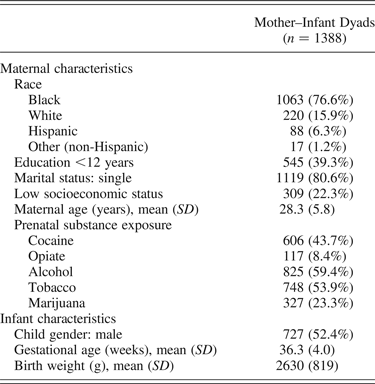
The racial/ethnic distribution of the sample was as follows: African American (76.6%), Caucasian (15.9%), Hispanic (6.3%), and children whose parents identified other racial and ethnic backgrounds (1.2%). Of the children, 52.4% were male. Average maternal age was 28.3 years. Most of the mothers were single (80.6%), 39.3% did not complete high school, and 22.3% had low SES. Prenatal substance exposures included cocaine (43.7%), opiates (8.4%), alcohol (59.4%), tobacco (53.9%), and marijuana (23.6%; Table 1). The retention rates based on the number of subjects with complete Child Behavior Checklist (CBCL) data for the three developmental periods are as follows: early childhood (59.2%), middle childhood (73.0%), and early adolescence (71.1%). Little's missing completely at random test was performed (Little, Reference Little1998); as expected, the test showed that missing values were missing completely at random (χ2 = 14.5, df = 18, p = .696).
Maternal and infant characteristics at birth
Measures
Behavior problems
CBCL
Internalizing and externalizing behavior were measured using the CBCL (Achenbach, Reference Achenbach1991; αinternalizing = 0.90, αexternalizing = 0.94). The CBCL was administered to the child's parent or caretaker every 2 years from ages 3 to 15 years. For this study, CBCL assessments at 5, 9, and 13 years old were included to represent three developmental periods: early childhood (age 5 internalizing and externalizing), middle childhood (age 9 internalizing and externalizing), and early adolescence (age 13 internalizing and externalizing). A trained and certified interviewer administered the CBCL verbally during the annual clinic visit to assure uniform administration across all four sites. The CBCL T scores for externalizing and internalizing behavior were used to provide a profile of the child's social and behavioral functioning relative to children of the same age and gender.
Caregiving stress
Brief Symptom Inventory (BSI)
Caregiver psychological distress was assessed using the BSI (Derogatis, Reference Derogatis1993; α = 0.96). The BSI is a 53-item questionnaire administered by interview to the caregiver designed to reflect the psychological symptom patterns over the previous 7 days of psychiatric and medical patients as well as community nonpatient respondents. The caregiver rated each item on a 5-point scale of distress ranging from not at all to extremely/a whole lot. There are two global scores: global severity index and positive symptom total.
Beck Depression Inventory (BDI)
Caregiver symptoms of depression were assessed using the BDI (Beck, Steer, & Brown, Reference Beck, Steer and Brown1996; α = 0.88). The BDI is a 21-item instrument designed to assess the severity of depression in adolescents and adults. For each item, the caregiver selects one of four statements that best describes how he/she has felt over the past week. A BDI total score provided an estimate of overall severity of depression.
Parenting Stress Index (PSI)
Caregiver stress was assessed using the PSI (Abidin, Reference Abidin1983; α = 0.91). The PSI is a 36-item questionnaire, scored on a 5-point scale, administered to the caregiver that measured stress arising from parenting. The instrument provided a summary index of total stress.
Caretaker Inventory of Substance Use (CISU)
Caregiver history of abuse was assessed using the CISU (Shankaran et al., Reference Shankaran, Bauer, Bada, Lester, Wright and Katsikiotis1996). The CISU is a caregiver-report questionnaire of current substance use, including tobacco, marijuana, alcohol, cocaine/crack/heroin, and methadone, and domestic violence sustained by the caregiver. The caregiver indicated whether or not he/she had experienced emotional, physical, or sexual abuse (0 = no, 1 = yes).
Caregiving Stress Summary score
Caregiving stress was calculated at each developmental period: early childhood, middle childhood, and early adolescence. For early childhood caregiving stress, the BSI global severity index was averaged from the 4- and 30-month visits; the BDI total score was averaged from the 4- and 30-month and 4-year visits; the PSI total stress index was averaged from the 4- and 30-month visits; and a sum of caregiver indicated abuse was calculated from the CISU reported at the 4-, 8-, 12-, 24-, and 36-month and 4- and 5-year visits. An early childhood caregiving stress summary score (age 5 caregiving stress) was calculated from the four individual measures.
For middle childhood caregiving stress, the BSI global severity index was averaged from the 5.5- and 9-year visits; the BDI total score was averaged from the 5.5-, 7-, and 9-year visits; the PSI total stress index was averaged from the 5.5- and 8-year visits; and a sum of caregiver indicated abuse was calculated from the CISU reported at the 6-, 7-, 8-, and 9-year visits. A middle childhood caregiving stress summary score (age 9 caregiving stress) was calculated from the four individual measures.
For early adolescence caregiving stress, the BSI global severity index was measured at the 11-year visit; the BDI total score was averaged from the 11- and 13-year visits; the PSI total stress index was measured at the 10-year visit; and a sum of caregiver indicated abuse was calculated from the CISU reported at the 10-, 11-, 12-, and 13-year visits. An early adolescence childhood caregiving stress summary score (age 13 caregiving stress) was calculated from the four individual measures.
Correlations between caregiving stress summary scores were significant and ranged from 0.44 to 0.67.
Executive functioning
Age 5 years: Delay of gratification task
In the delay of gratification task (Kochanska, Reference Kochanska1997), a wrapped “present” was given to the child with an instruction not to touch the present until the examiner returned. A maximum of 3 min was allowed to see if the child violated the prohibition. The latency to contact the gift was the primary outcome variable. Maximum action taken was scored as follows: 0 = no action taken by the child to get or look at toy; 1 = child peeked in the bag only; 2 = child touched the bag but did not touch tissue; 3 = child moved the tissue but did not get the toy; and 4 = child obtained the toy.
Age 5 years: Prohibition task
In the prohibition task (Kochanska, Reference Kochanska1997), the child was presented with an inviting display of toys by a “stranger” with instruction not to play with them until the “stranger” returned. The examiner stayed in the room but was reading and not paying attention to the child. If the child started to play with one of the toys, the examiner reminded the child 1–2 times not to play with the toys. If the child did not touch the toys for 1–2 min the examiner tempted the child 1–2 times to play with the toys. Total touches are the total number of times the child purposefully touched the prohibited toys. One additional touch was counted for each 5 s of continuous play, if the child played with the toys.
Age 5 years: Test of Variables of Attention (TOVA)
The TOVA (Leark, Dupuy, Greenberg, Corman, & Kindschi, Reference Leark, Dupuy, Greenberg, Corman and Kindschi1996) is a computerized visual continuous performance test. It is a vigilance test that challenges the child's ability to sustain attention. The test we used has been modified for children and contained geometric shapes as targets. The test consisted of four blocks of 325 trials in which a child pressed a key when the correct target appeared. The summary scores included errors of omission (%; failure to press key when the correct target appeared) and errors of commission (%; pressed the key for the incorrect target).
Ages 9 and 13 years: Cambridge Neuropsychological Test Automated Battery (CANTAB)
The CANTAB is an automated computerized, normed test battery (De Luca et al., Reference De Luca, Wood, Blair, Buchanan, Proffitt and Mahony2003; Fray, Robbins, & Sahakian, Reference Fray, Robbins and Sahakian1996; Ornstein et al., Reference Ornstein, Iddon, Baldacchino, Sahakian, London and Everitt2000) that captures executive functioning factors present in middle childhood (Lehto et al., Reference Lehto, Juujärvi, Kooistra and Pulkkinen2003) through adulthood (Miyake et al., Reference Miyake, Friedman, Emerson, Witzki, Howerter and Wager2000). The tests are nonverbal, visually presented using a touch screen for subjects' responses. The CANTAB has been used with adult substance abusers and with high-risk children.
Executive functioning summary scores
One concern in studies of executive functioning in childhood is the modest reliabilities of cognitive tasks, which reduces statistical power to detect associations between cognitive processes and other variables of interest (Green et al., Reference Green, Nuechterlein, Gold, Barch, Cohen and Essock2004; Kendler & Neale, Reference Kendler and Neale2010; Kuntsi, Neale, Chen, Faraone, & Asherson, Reference Kuntsi, Neale, Chen, Faraone and Asherson2006). Composite scores are one method for improving measurement reliability. Further, some evidence suggests that composite measures that capture the complex coordination of executive functioning may be most associated with clinically relevant outcomes (Miller, Loya, & Hinshaw, Reference Miller, Loya and Hinshaw2013). Thus, we also used a single composite score to capture executive functioning in early and middle childhood and early adolescence to maximize measurement reliability and clinical prediction. Executive functioning was calculated at each developmental period: early childhood, middle childhood, and early adolescence. The executive functioning summary score in early childhood (age 5 executive functioning) was constructed using the delay of gratification task (maximum action taken), the prohibition task (total touches), and the TOVA (errors of omission and errors of commission).
At ages 9 and 13 (age 9 and age 13 executive functioning) measures from the CANTAB were used. The summary score at each age point included four individual subtests: spatial span task (the longest sequence successfully recalled by the subject), spatial working-memory task (number of times a subject revisits a box already found to be empty), intradimensional/extradimensional set-shifting task (measure of subject's efficiency in adapting to changing criteria), and stockings of Cambridge (number of occasions upon which the subject had successfully completed a test problem in the minimum possible number of moves). Correlations between executive functioning summary scores were significant and ranged from to 0.14 to 0.48.
Prenatal substance exposure
Prenatal substance exposure was measured as a summative index ranging from 0 to 5 for use of cocaine or opiates by self-report or by meconium toxicology using gas chromatography–mass spectrometry confirmation of presumptive positive meconium screens for cocaine or opiate metabolites and self-reported use of marijuana, alcohol, and tobacco during pregnancy (Fisher et al., Reference Fisher, Lester, DeGarmo, Lagasse, Lin and Shankaran2011; Messinger & Lester, Reference Messinger, Lester, Fogel and Shanker2005). One point was assigned for each substance used.
SES
SES was derived using the Hollingshead Index of Social Position (ISP; Hollingshead, Reference Hollingshead1975). The ISP was calculated at each follow-up visit and was based on the average of the weighted sum of education and occupation of the primary caregiver and another adult who was contributing to the household in which the child lived. For early childhood (age 5 SES), the ISP was averaged from the 1-, 12-, 24-, and 36-month and 4- and 5-year visits. For middle childhood (age 9 SES), the ISP was averaged from the 6-, 7-, 8-, and 9-year visits. For early adolescence (age 13 SES), the ISP was averaged from the 10-, 11-, 12-, and 13-year visits. Lower ISP summary scores indicate low SES.
Statistical analyses
We used structural equation modeling to examine associations between caregiving stress, executive functioning, and internalizing and externalizing behavior at ages 5, 9, and 13 years. Percentage of missing data varied across indicators and ranged from 8.3% to 40.8% with a mean of 26.6%. Full-information maximum likelihood was used to handle missing data, which uses all available information and provides more statistically reliable standard errors than mean-imputation, pairwise, or listwise models (Brown et al., Reference Brown, Wang, Kellam, Methen, Petras and Toyinbo2008). Model fit was determined using the standardized root mean square residual and comparative fit index. Fit was considered acceptable if the standardized root mean square residual was less than 0.08 and comparative fit index was greater than 0.90 (McDonald & Ho, Reference McDonald and Ho2002). Mplus version 7.0 (Muthen & Muthen, Reference Muthen and Muthen2012) was used to conduct these analyses.
Results
Descriptive statistics
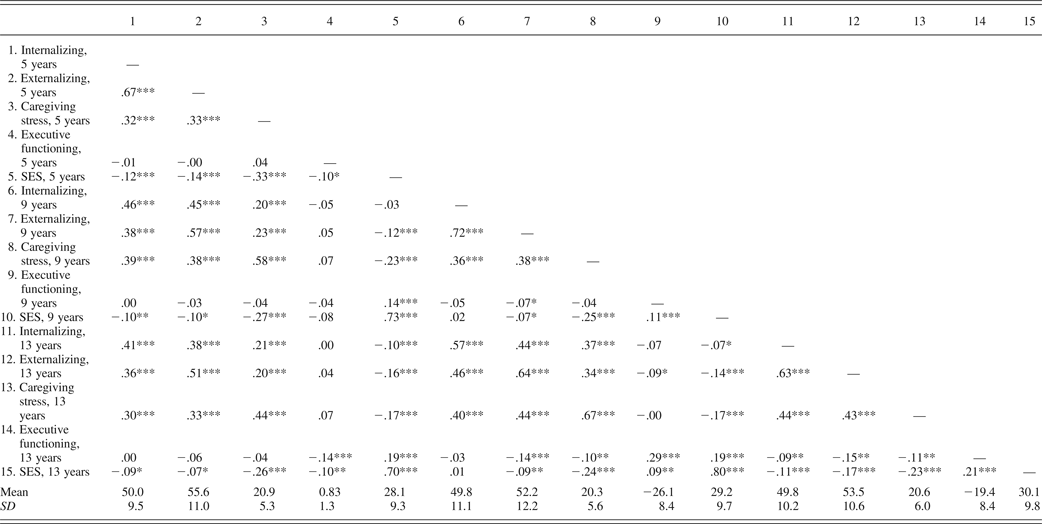
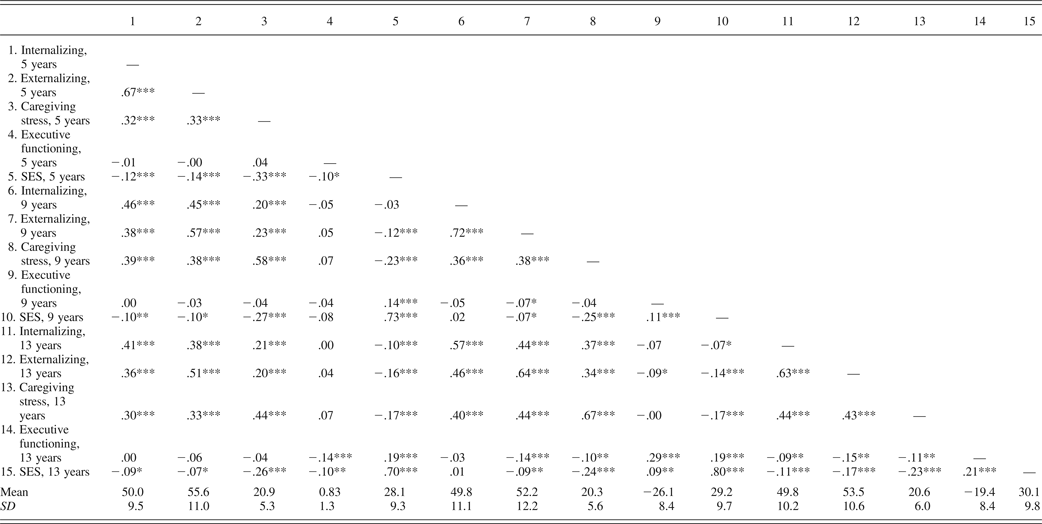
Table 2 includes the correlations, means, and standard deviations between our core predictor and outcome variables. Correlations between the three caregiving stress and SES summary scores were all significant and positive, within each time point and across time. Correlations between the executive functioning summary scores were also moderate within time, and there was one significant association across time. Greater internalizing and externalizing behavior at age 5 was associated with greater caregiving stress and lower SES at ages 5, 9, and 13. Internalizing behavior at age 5 was not associated with the executive functioning variables at ages 9 and 13. Greater externalizing behavior at age 5 was associated with poorer executive functioning at age 13. Greater internalizing and externalizing behavior at age 9 was associated with greater caregiving stress at ages 5, 9, and 13. Greater externalizing was associated with lower SES at ages 5, 9, and 13. Greater externalizing behavior at age 9 was associated with poorer executive functioning at ages 9 and 13. Greater internalizing and externalizing behavior at age 13 was associated with greater caregiving stress and lower SES at ages 5, 9, and 13. Greater externalizing behavior at age 13 was associated with poorer executive functioning at ages 9 and 13.
Bivariate correlations and descriptive statistics for problem behavior, caregiving stress, executive functioning, and SES at ages 5 to 13
Note: SES, Socioeconomic status.
*p < .05. **p < .01. ***p < .001.
Covariates
We tested whether sex and race or ethnicity varied by caregiving stress, executive functioning, and internalizing and externalizing behavior. Sex was associated with internalizing behavior at ages 5 and 9, with girls exhibiting higher internalizing behavior than boys (ps < .02). Race was related to caregiving stress at age 5 (p < .001), with non–African American mothers exhibiting the lowest levels of caregiving stress and African American mothers the highest levels. There were also main effects of ethnicity on externalizing (p < .001) and internalizing behavior at age 9 (p = .04). Hispanic children had significantly lower externalizing behavior compared to Caucasian and African American children, who did not differ from each other. Caucasian children had higher internalizing behavior than African American children, who had higher internalizing behavior than Hispanic children. Differences between ethnic groups also emerged on externalizing (p = .05) and internalizing (p = .01) behavior at age 13. Caucasian adolescents had significantly higher externalizing behavior compared to Hispanic adolescents, and significantly higher internalizing behavior compared to African American adolescents.
Finally, ethnic/race differences were found with respect to executive functioning (summary score) at age 13 (p < .001). African Americans performed significantly worse on executive functioning tasks compared to Caucasians and Hispanics, who did not differ from each other. Some of these associations became nonsignificant when entered into our full structural equation model, and therefore are not included in our final models (Figure 1).
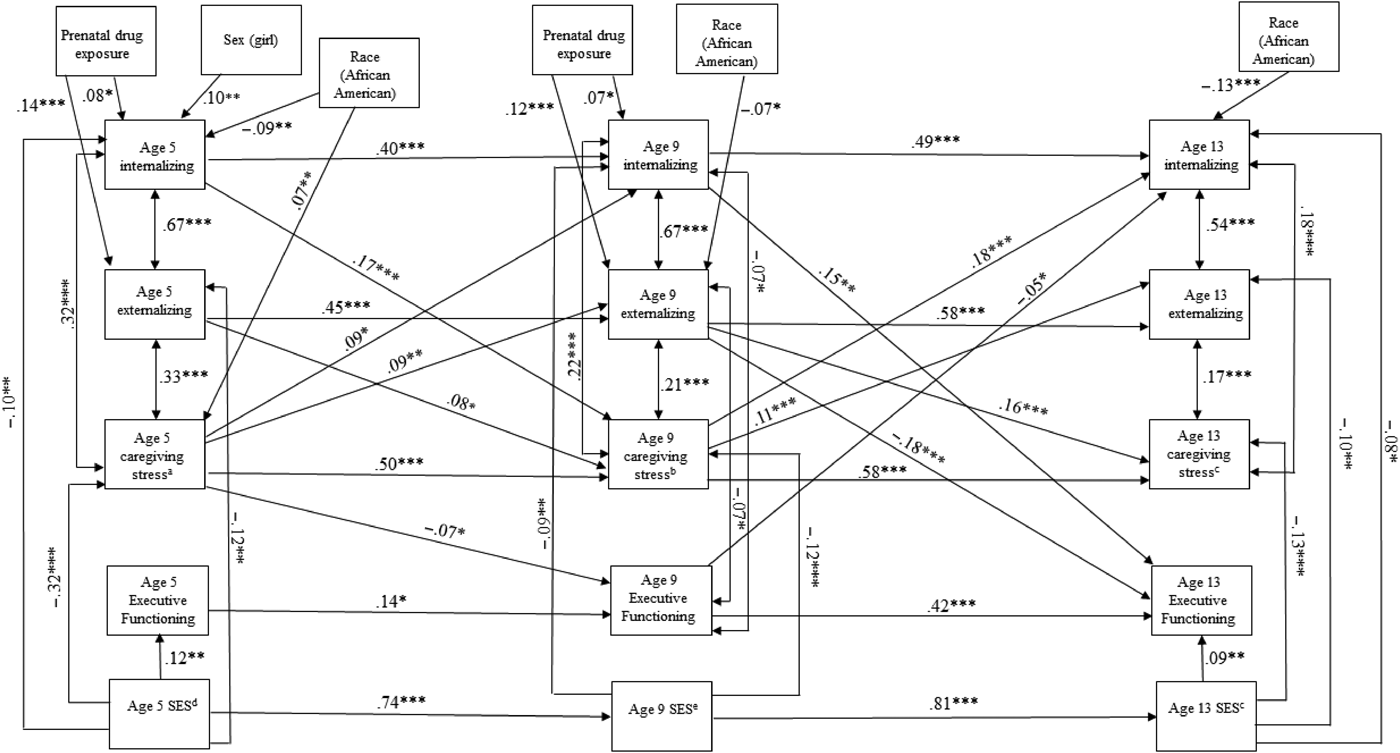
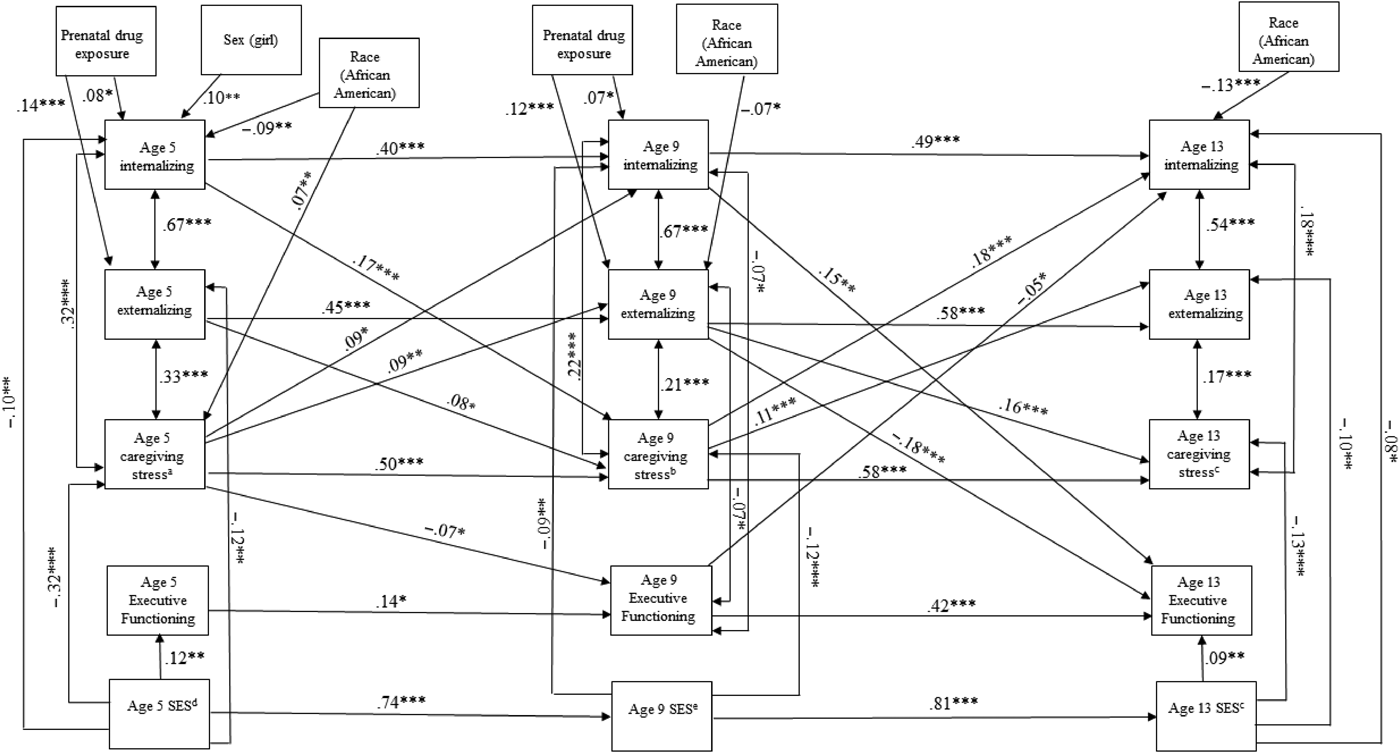
Transactional model predicting internalizing and externalizing behavior, caregiving stress, and executive functioning from ages 5 to 13 years. Paths are standardized beta coefficients. χ2 (67) = 353.51, comparative fit index = 0.95, standardized root mean square residual = 0.06. Only significant paths are modeled due to ease of presentation. *p < .05. **p < .01. ***p < .001. aAge 5 caregiving stress was calculated from data collected at ages 4 months to 5 years. bAge 9 caregiving stress was calculated from data collected at ages 5.5–9 years. cAge 13 caregiving stress and socioeconomic status (SES) was calculated from data collected at ages 10–13 years. dAge 5 SES was calculated from data collected at ages 1 months to 5 years. eAge 9 SES was calculated from data collected at ages 6–9 years.
Structural equation modeling
Figure 1 shows a structural equation model that includes internalizing and externalizing behaviors at 5, 9, and 13 years in order to account for the significant co-occurrence of these symptoms in childhood and adolescence. There were significant, strong, positive associations between internalizing and externalizing behavior within each age (ranging from .54 to .67). There was also significant stability in internalizing and externalizing behavior across time, ranging from .40 to .49 for internalizing behavior and .45 to .58 for externalizing behavior. The model below includes the specific contribution of caregiving stress and executive functioning to each type of behavior problem in the context of SES, prenatal drug exposure, race/ethnicity, and sex. Predictors and mediators of internalizing and externalizing behavior are presented separately below.
Internalizing behavior
Higher levels of prenatal drug exposure were related to greater internalizing behavior at ages 5 and 9, but not at age 13. Females had higher internalizing behavior at age 5, but there were no significant sex effects at ages 9 or 13. African American children experienced greater caregiving stress and lower internalizing behavior at age 5 compared to non–African American children. Greater caregiving stress and lower SES at age 5 was associated with higher internalizing behavior at age 5. Lower SES was also related to higher caregiving stress and lower levels of executive functioning at age 5. Executive functioning at age 5 was not related to internalizing behavior at age 5.
Greater caregiving stress at ages 5 and 9, and lower SES at age 9, was predictive of greater internalizing behavior at age 9, controlling for internalizing behavior at age 5. Greater caregiving stress and lower executive functioning at age 5 was predictive of lower executive functioning at age 9. Lower executive functioning at age 9 in turn was related to higher levels of internalizing behavior at age 9. Greater internalizing behavior at age 5 was predictive of greater caregiving stress at age 9, and lower SES at age 9 was related to higher caregiving stress at age 9. It was not surprising that greater caregiving stress at age 5 was associated with greater caregiving stress at age 9, and higher SES at age 5 was predictive of higher SES at age 9.
We next turn to our age 13 outcomes. African Americans, compared to non–African Americans, experienced greater internalizing behavior at age 13. Greater caregiving stress and lower levels of executive functioning at age 9 were related to greater internalizing behavior at age 13. Greater caregiving stress at age 9 was related to greater caregiving stress at age 13. Unexpectedly, greater internalizing behavior at age 9 was associated with greater executive functioning at age 13 years. Greater internalizing behavior at age 13 was related to higher caregiving stress at age 13 and lower SES at age 13. Lower SES at age 13 was related to greater caregiving stress and lower executive functioning at age 13. High SES at age 9 was predictive of high SES at age 13, and high executive functioning at age 9 was predictive of high executive functioning at age 13.
Given our interest in how resilience processes may alter pathways leading to problem behavior, we tested whether executive functioning may mediate effects of caregiving stress and/or internalizing behavior on the expression of internalizing behavior at 13. Because higher caregiving stress at age 5 was related to lower executive functioning at age 9, and lower executive functioning at age 9 was predictive of greater internalizing behavior at age 13, we tested whether executive functioning at age 9 mediated the relation between caregiving stress at age 5 on internalizing behavior at age 13 using the Sobel test in Mplus. The indirect effect was not significant (p = .10).
Externalizing behavior
As with internalizing behavior, higher levels of prenatal drug exposure were related to greater externalizing behavior at ages 5 and 9, but not at age 13. Higher caregiving stress and lower SES at age 5 was related to greater externalizing behavior at age 5.
African Americans experienced significantly greater externalizing behavior at age 9 compared to non–African Americans. Greater externalizing behavior at age 5 was predictive of greater caregiving stress at age 9. Consistent with our hypotheses, greater caregiving stress at ages 5 and 9 were related to greater externalizing behavior at age 9. Greater executive functioning at age 9 was associated with lower externalizing behavior at age 9.
Higher caregiving stress at age 9 was predictive of greater externalizing behavior at age 13. Higher externalizing behavior at age 9 was also predictive of higher caregiving stress and lower executive functioning at age 13. Lower SES and higher caregiving stress at age 13 was associated with greater externalizing behavior at age 13. None of the models tested with executive functioning at age 9 as a mediator were significant.
Discussion
Our goal was to evaluate transactions between caregiving stress and executive functioning across three developmental periods to highlight pathways leading to internalizing and externalizing behavior in early adolescence. We capitalized on a rich data set of 1,388 children with prenatal substance exposure to model our constructs across three sensitive developmental periods: early childhood (birth to age 5), middle childhood (age 6 to age 9), and early adolescence (age 10 to age 13). Our findings are strengthened by our inclusion of internalizing and externalizing behavior at earlier developmental periods so that we can better understand what contributes to psychopathology in early adolescence, above and beyond the expression of symptoms in early childhood. Our study is unique in its inclusion of executive functioning, which is gaining traction as a possible resilience factor for the emergence of psychopathology, but which is rarely included in longitudinal, transactional models of development. We highlight these results in the context of a development and psychopathology theoretical framework and suggest directions for future research below.
Exposure to substances prenatally was predictive of internalizing and externalizing behavior at ages 5 and 9, but not at age 13. It may be that by age 13, children can compensate for the effects of prenatal substance exposure, which tend to target neurobiological systems of reactivity and self-regulation, (Conradt et al., Reference Conradt, Sheinkopf, Lester, Tronick, LaGasse and Shankaran2013) through behavioral self-regulation, and/or improved cognitive control, given that prenatal drug exposure was not predictive of executive functioning at age 5, 9, or 13. It could also be that individual differences in pubertal timing, which may be influenced by prenatal drug exposure, is a stronger predictor of problem behavior in adolescence than is prenatal drug exposure (Fried, James, & Watkinson, Reference Fried, James and Watkinson2001). In other words, the effects of prenatal drug exposure on internalizing and externalizing behavior could depend on pubertal development, a hypothesis to be explored in future studies.
Transactional relations differed between caregiving stress and internalizing, versus externalizing, behavior. Consistent with hypotheses and with Patterson's coercion theory, within each age, greater caregiving stress was associated with greater internalizing and externalizing behavior. These associations were also consistent longitudinally, as age 5 externalizing behavior and caregiving stress predicted age 9 caregiving stress and externalizing behavior, which both predicted age 13 externalizing behavior and caregiving stress. In short, it is impossible, in the absence of intervention studies, to disentangle the directional effects of caregiving stress and externalizing behavior; they appear bidirectional with each one impacting the other across time. These results are not surprising, given that both child internalizing and externalizing behavior may elicit negative parenting responses and increase parenting stress, (Reitz, Dekovic, & Meijer, Reference Reitz, Dekovic and Meijer2006) and that psychopathology and parenting stress can lead to increases in internalizing and externalizing behavior (Eisenberg et al., Reference Eisenberg, Fabes, Shepard, Guthrie, Murphy and Reiser1999; Stormshak, Bierman, McMahon, & Lengua, Reference Stormshak, Bierman, McMahon and Lengua2000). This finding suggests it is important to target parental stress and psychopathology as well as child externalizing behavior, with the ultimate goal of reducing internalizing behavior in children.
Different associations emerged over time for internalizing behavior and caregiving stress. While higher internalizing behavior was related to higher caregiving stress within each age, internalizing behavior at age 9 was not predictive of caregiving stress at age 13, though caregiving stress at age 9 was predictive of greater internalizing behavior at age 13. This finding was unexpected and suggests that caregiver psychopathology in middle childhood may have a stronger association with the expression of internalizing behavior in adolescence than internalizing behavior in middle childhood has on the expression of caregiver psychopathology. Children with higher levels of internalizing behavior in middle childhood may present as more withdrawn and less likely to elicit stressful caregiving interactions, which in turn may make it less likely that caregivers experience stress in the form of elevated psychopathology in the future. The strongest evidence for coercive child–parent interactions is the presence of an externalizing or oppositional behavior (Stoolmiller, Reference Stoolmiller2001), though more research is needed to tease apart whether coercive processes differ for children who present with primarily internalizing, as opposed to externalizing, behavior.
Unique to this study was our longitudinal examination of transactions between caregiving stress, executive functioning, and internalizing and externalizing behavior. We first turn to associations between caregiving stress and executive functioning. Within each age, caregiving stress and executive functioning were not associated with each other. However, caregiving stress at age 5 prospectively predicted executive functioning at age 9, whereas child executive functioning did not prospectively predict caregiving stress. In contrast to the hypothesized bidirectional effects, these findings suggest there may be a direction of effect from caregiving stress to executive functioning. These results support earlier work indicating that the quality of the parenting environment may shape neural networks involved in executive functioning (Blair, Raver, Berry, & Family Life Project Investigators, Reference Blair, Raver and Berry2014). However, in the absence of an intervention study, we cannot claim causality.
Regarding the effects of executive functioning on problem behavior outcomes, at age 9 there was an association between executive functioning and concurrent internalizing and externalizing behavior. However, these associations were only found at age 9 and not at age 5 or 13. It is unclear why executive functioning would be more strongly associated with problem behavior in middle childhood, as opposed to early childhood or adolescence. A recent review indicates that there is a critical period for the development of cognitive flexibility, goal setting, and information processing between the ages of 7 and 9 years, with maturation in these areas by age 12 (Anderson, Reference Anderson2002). Perhaps during this putative sensitive period, cognitive systems are more susceptible to the extreme emotional experiences that accompany the presentation of internalizing and externalizing behavior.
Higher internalizing, but lower externalizing, symptoms at age 9 predicted higher executive functioning skills at age 13. This finding with internalizing symptoms was unexpected given that executive functioning impairments are implicated in anxiety and depression and related to rumination and difficulties with cognitive reappraisal (Chambers, Lo, & Allen, Reference Chambers, Lo and Allen2008; Hofmann, Friese, Schmeichel, & Baddeley, Reference Hofmann, Friese, Schmeichel, Baddeley, Vohs and Baumeister2011; Whitmer & Banich, Reference Whitmer and Banich2007); however, concurrent internalizing symptoms at age 9 remained negatively related to executive functioning as expected. Some prior longitudinal research suggests that improvement in internalizing symptoms with age is associated with improvement in executive functioning (Eisenberg et al., Reference Eisenberg, Valiente, Spinrad, Liew, Zhou and Losoya2009), and the current results may be explained by a group of children showing this pattern of co-occurring improvement in cognition and symptoms over time. Future studies could apply parallel process or cross-lag models, which can be applied to infer causality, to test this hypothesis.
Alternatively, internalizing symptoms (particularly when differentiated from any co-occurring externalizing symptoms) may be associated with higher levels of self-restraint and compliance (Friedman, Miyake, Robinson, & Hewitt, Reference Friedman, Miyake, Robinson and Hewitt2011; Murray & Kochanska, Reference Murray and Kochanska2002), and attentional control theory predicts improved cognitive performance for individuals with anxiety under some conditions due to greater effort and utilization of processing resources (Eysenck, Derakshan, Santos, & Calvo, Reference Eysenck, Derakshan, Santos and Calvo2007), which may also account for the observed relationships. Additional longitudinal studies examining these complex transactional relationships will be required to confirm and extend our findings.
The remaining relationships between executive functioning and internalizing behavior at age 9 were as expected. At age 9, lower executive functioning was associated with higher concurrent internalizing symptoms and higher internalizing symptoms at age 13. Internalizing disorders have been associated with low effortful control (Bridgett, Oddi, et al., Reference Bridgett, Oddi, Laake, Murdock and Bachmann2013; Joormann & Gotlib, Reference Joormann and Gotlib2008; Nigg, Reference Nigg2006; Williams et al., Reference Willams, Ponesse, Schachar, Logan and Tannock1999), an aspect of temperament strongly associated with executive functioning (Zhou, Chen, & Main, Reference Zhou, Chen and Main2012). It is hypothesized that poor executive functioning may make it difficult for children prone to internalizing problems to inhibit stimuli that may make them anxious or fearful (Nigg, Reference Nigg2006), thus exacerbating their internalizing symptoms. Support for this hypothesis comes from our findings linking caregiving stress, executive functioning, and internalizing behavior. High caregiving stress at age 5 was predictive of both greater internalizing behavior and poorer executive functioning at age 9, though the indirect effect of executive functioning was not significant.
A growing literature suggests that the quality of the caregiving environment is related to executive functioning, particularly in early childhood (Blair et al., Reference Blair, Raver and Berry2014). The quality of the caregiver–child relationship may be compromised when caregivers experience stress and psychopathology (Goodman & Gotlib, Reference Goodman and Gotlib1999). Children whose mothers have major depressive disorder exhibit poorer executive functioning as adolescents (Klimes-Dougan, Lee, Ronsaville, & Martinez, Reference Klimes-Dougan, Lee, Ronsaville and Martinez2008). It may be that caregivers' own stress related to parenting or psychopathology may make it difficult to act as an external source of regulation for their young children. As a result, these children may find it more difficult to control impulses or exhibit cognitive flexibility, or even inhibit attention to threatening or fearful stimuli, an attention bias they may be more prone to by virtue of having a caregiver with psychopathology (Bridgett, Burt, Laake, & Oddi, Reference Bridgett, Burt, Laake and Oddi2013; Nigg, Reference Nigg2006).
Our interests were in caregiving stress as a primary predictor of executive functioning, internalizing, and externalizing behavior, controlling for SES, as SES is not directly causal. Rather, it is a proxy for unmeasured variables that exert direct effects such as parental mental health, postnatal drug exposure, and neighborhood violence and criminality (Brooks-Gunn & Duncan, Reference Brooks-Gunn and Duncan1997). Given the nature of our sample, we controlled for SES in our models. It was not surprising that low SES was related to poorer executive functioning at ages 5 and 13 (Kishiyama, Boyce, Jiminez, Perry, & Knight, Reference Kishiyama, Boyce, Jimenez, Perry and Knight2009). Research designed to model the impact of SES on executive functioning across development is needed to understand why such an association did not emerge at age 9, particularly as both internalizing and externalizing behavior were related to executive functioning, but only at age 9.
Limitations and implications for the development of evidence-based interventions
We recognize that we discuss some of these processes in causal language given that we predict internalizing and externalizing behavior, over and above previous symptom levels. However, we cannot infer direction of effect with these data in the absence of intervention studies, which could help disentangle cause and effect. Due to the developmental nature of this study, we were also not able to employ the same executive functioning tasks at each age; our age 5 tasks differed from our ages 9 and 13 tasks (which were the same). However, all tasks are well validated and chosen based on theory and available evidence indicating they should be prognostic of later internalizing and externalizing behavior. There is also a substantial body of evidence suggesting that some children may be more susceptible to the effects of caregiving stress than other children due to their psychophysiological makeup. It will be important to include physiological indicators as possible moderators of links between caregiving stress, executive functioning, and psychopathology.
We also examined the effects of multiple drugs on internalizing and externalizing behavior rather than a single drug in isolation. Polydrug use during pregnancy is more common than the use of one specific substance, and the cumulative effects of multiple drugs could have a more substantial effect than that of a single substance (Lester et al., Reference Lester, Bagner, Liu, LaGasse, Seifer and Bauer2009). At the same time, we recognize that some substances are more harmful than others, and the mechanism of action of these drugs differ. This is a very complex issue involving many factors, such as when during pregnancy substances were used, how frequent was the use, and how large of a dose was taken, to name a few.
Finally, all children in this sample are high risk because of prenatal substance exposure and poverty. Pathways from caregiving stress to executive functioning and psychopathology may differ from children with less stress exposure in their neighborhood or schools. It will also be important in future work to include additional measures of executive functioning that may have more external validity, such as parent-report measures of everyday behavior that is associated with problems in executive functioning. Given that effect sizes for executive functioning associations were low in the internalizing model and there were few associations with executive functioning in the externalizing model, it will be important to incorporate more externally valid markers of executive functioning, because these measures may reveal additional pathways to psychopathology.
More research investigating the utility of targeting executive functioning in evidence-based interventions for children with prenatal substance exposure is needed. This process may be particularly important for children presenting with internalizing behavior in early childhood, as executive functioning at age 5 was predictive of executive functioning at age 9, which in turn predicted internalizing behavior in early adolescence. Further research investigating the efficacy of treating caregiving psychopathology, depression, and parenting stress in early childhood (before age 5) may also prove fruitful, as this variable predicted both executive functioning at age 9 and later internalizing behavior at age 13. Given that current interventions for children presenting with internalizing behavior focus less on caregiving stress, tailoring interventions with drug-exposed children and youth to focus on the family, rather than the individual, may be warranted.