1. Introduction
This paper analyses the role of co-production for personalisation in the context of two recent Scottish policies, Reshaping Care for Older People (RCOP) and Self-Directed Support (SDS). The paper begins with an exploration of Osborne et al.’s (Reference Osborne, Radnor and Strokosch2016) co-production matrix and then introduces the concept of personalisation and the specific Scottish context of the empirical study. To address our research objective, the paper presents two exploratory case studies that consider the role co-production plays for social policy outcomes and classifies their use of co-production according to Osborne et al.’s (Reference Osborne, Radnor and Strokosch2016) model. In discussing our findings, we pay particular attention to the implications of our evidence for both effective social policy and co-production theory, and we conclude with three propositions for public service reform.
2. Conceptual framework
Following Osborne et al. (Reference Osborne, Radnor and Strokosch2016), we define co-production as ‘the voluntary or involuntary involvement of public service users in any of the design, management, delivery and/or evaluation of public services’ (2016: 639). The co-production concept first evolved in the US (Ostrom, Reference Ostrom1971; Ostrom et al., Reference Ostrom, Parks, Whitaker and Percy1978) and has developed subsequently around the world (e.g. Brudney and England, Reference Brudney and England1983; Bovaird, Reference Bovaird2007; Needham, Reference Needham2008; Alford, Reference Alford2009; Osborne and Strokosch, Reference Osborne and Strokosch2013; Brandsen and Honingh, Reference Brandsen and Honingh2016). However, there are ongoing debates about its definition and about the contingencies of its enactment and impact (Voorberg et al., Reference Voorberg, Bekkers and Tummers2015).
Irrespectively, co-production is seen globally as a core element of both civil society and public service reform (Alford, Reference Alford2015). Inter alia, it is argued to improve the quality and performance of public service delivery (Boyle and Harris, Reference Boyle and Harris2009), to encourage active citizenship and communities, to support civil society (Bovaird et al., Reference Bovaird, Van Ryzin, Loeffler and Parrado2015), and to lever resources into service delivery – though not necessarily all at the same time. In Scotland, it is a significant element of the social and health-care reform agenda initiated by the Scottish Government (‘Christie Commission’) (2011).
Recent work (Alford, Reference Alford2015) has advanced the conceptualisation debate, providing a more cohesive model of co-production. This approach integrates two perspectives: the traditional public administration view of co-production as a voluntary process extrinsic to statutory service encounters (Pestoff, Reference Pestoff2006); and the service management theory view, which conceptualises co-production as an intrinsic and often involuntary element of any service delivery encounter (Osborne et al., Reference Osborne, Radnor and Strokosch2016). Alford (Reference Alford2015) explores co-production both in terms of the extent to which it is a voluntary/involuntary or conscious/unconscious process and in terms of its location within both the individual service experience and the broader service delivery system. He also locates it within a context of the co-creation of value for citizens through its enactment (Osborne et al., Reference Osborne, Radnor and Strokosch2016).
This paper follows Osborne et al. (Reference Osborne, Radnor and Strokosch2016), who conceptualise four processes of co-production: (1) ‘pure’ co-production of the individual service and its outcomes which are intrinsic to any service relationship; (2) the co-construction of the ‘lived experience’ of service users, as well as their families and communities, as a result of using a public service; (3) the co-design and management of individual service packages; and (4) the co-innovation of new forms of service delivery. While pure co-production (1) and co-construction (2) are often unconscious and involuntary, co-design and co-innovation are conscious and voluntary actions that strive for equal partnership between service provider and service user as an ideal. Crucially, this model also articulates that co-production is not a normative good. It is as likely to have adverse effects (sometimes termed ‘co-destruction’, Echeverri and Skålén, Reference Echeverri and Skålén2011) as positive ones, depending upon how it is managed (Figure 1).
Conceptualising co-production (Osborne et al., Reference Osborne, Radnor and Strokosch2016)

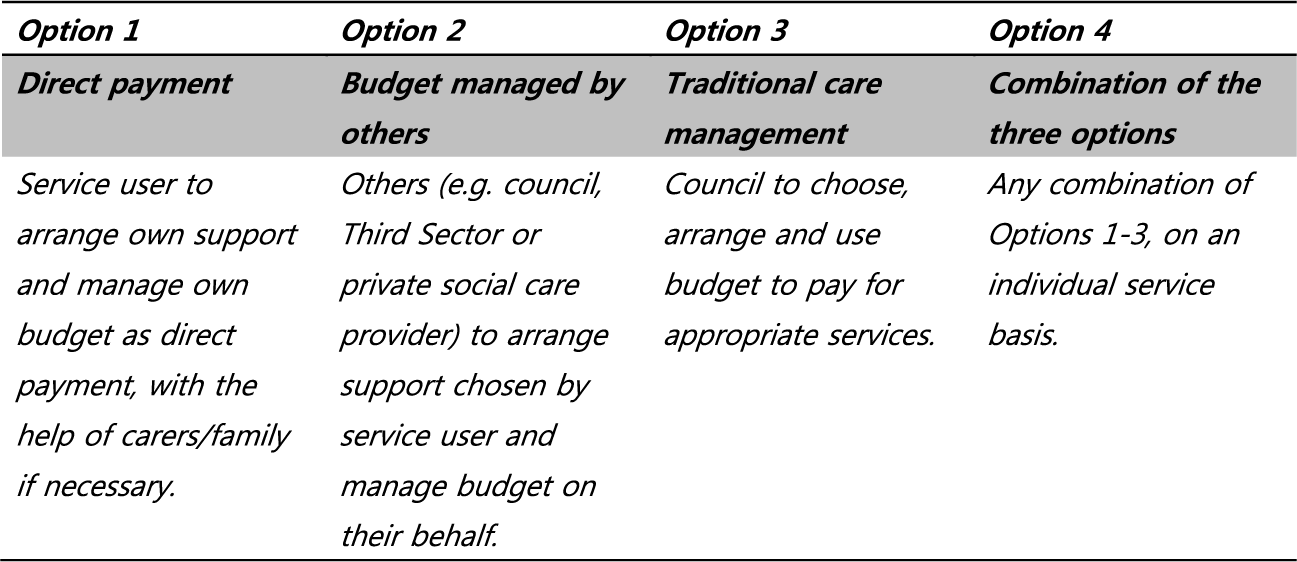
Self-Directed Support and its four options (Source: Audit Scotland, 2017)

We adopt Osborne et al.’s (Reference Osborne, Radnor and Strokosch2016) model as it captures not only the individual and collective dimensions of co-production (Bovaird et al., Reference Bovaird, Van Ryzin, Loeffler and Parrado2015) but also the intrinsic and deliberate aspects of co-production in any service context. This means that co-production can be managed well to create value or, conversely, managed badly, resulting in an overall co-destruction of value (Echeverri and Skålén, Reference Echeverri and Skålén2011).
3. Policy background
3.1 Personalisation in social care policy: Scotland and beyond
Social and health-care services are in a time of radical change around the world (King’s Fund, 2014), in particular due to demographic changes resulting in greater service demands (Office of National Statistics, 2015). Models of social care service delivery are also evolving, with the integration of social and healthcare (Scottish Government, 2018; Social Care Institute for Excellence, 2017), a focus on prevention (Government Office for Science, 2015), and partnership approaches to support that are based on the concept of co-production (Scottish Government (‘Christie Commission’), 2011).
One such approach is personalisation (Needham, Reference Needham2011; Needham and Glasby, Reference Needham and Glasby2014; Needham, Reference Needham and Bevir2016; Leadbeater, Reference Leadbeater2004). While Needham characterises personalisation as a ‘way of thinking about services and those who use them, rather than being a worked out set of policy prescriptions’ (Reference Needham2011: 55), the common thread of personalisation policies is that individual needs and preferences are placed at the heart of services. This opens up a wide choice of policy options, the most widely known being personal budgets (Needham, Reference Needham2011).
Personalisation is undisputedly part of the marketisation of social care (Holloway, Reference Holloway2007; Pearson and Ridley, Reference Pearson and Ridley2017), but it nonetheless provides the opportunity for the co-productive involvement of service users in the design, commissioning and delivery of the social care services they receive (e.g. Bracci and Llewellyn, Reference Bracci and Llewellyn2012). This includes greater choice around the content and provision of services, which is often addressed through the allocation of personal budgets to individuals who meet specific eligibility criteria (Duffy, Reference Duffy2007; Le Grand, Reference Le Grand2007). It can, however, also extend beyond the allocation of budgets, including an individualised and flexible schedule of social care (Duffy, Reference Duffy2007).
Personalisation can be a double-edged sword (Ferguson, Reference Ferguson2007; Needham, Reference Needham and Bevir2016) that can empower service users (Needham and Glasby, Reference Needham and Glasby2014) but also increase user risks (Ferguson, Reference Ferguson2007; Needham and Glasby, Reference Needham and Glasby2014; Ismail et al., Reference Ismail, Hussein, Stevens, Woolham, Manthorpe, Aspinal, Baxter and Samsi2017; Pearson and Ridley, Reference Pearson and Ridley2017). This is the result of competing motivations for introducing personalisation policies, one based on the ideals of the independent living movement in disability activism (Oliver and Sapey, Reference Oliver and Sapey2006), and the other propelled by austerity-driven savings (Power, Reference Power2014; Pearson and Ridley, Reference Pearson and Ridley2017). To add further complexity to personalisation as a policy, individual implementation factors, such as the role of service delivery staff (Mason et al., Reference Mason, Spinks, Hajkowicz and Hobman2014), have been found to influence overall outcomes and create variation in the service-user experience.
In the Scottish context, there are two notable policies that follow this personalisation approach: Self-Directed Support (SDS), which aims to enhance the autonomy of service users regarding their care (Audit Scotland, 2017: 11; Social Care (Self-Directed Support) (Scotland Act, 2013), and the Reshaping Care for Older People (RCOP) initiative (Scottish Government, 2012), which seeks to empower older people and their carers and actively involve them in decisions about their own care provision. RCOP was supported by the £230 million Change Fund for Older People (Scottish Government, 2012), whereas SDS benefited from additional central government funding for local councils (Audit Scotland, 2014).
While Scotland was slow to incorporate market elements into social care (Pearson and Ridley, Reference Pearson and Ridley2017), SDS in particular was one of the Scottish government’s flagship policies that heralded a new approach to social care.
Similar to personalised care options in England and Wales, SDS provides service users with four options to fund and commission their own care package, ranging from full local authority provision of services to direct payments (Social Care (Self-Directed Support) (Scotland Act, 2013) (see Figure 2).
Audit Scotland highlights in its latest audit of SDS that it is ‘based on the human rights principles of fairness, respect, equality, dignity and autonomy for all. This means that people should be equal partners with relevant professionals in determining their social care needs and controlling how their needs are met’ (Audit Scotland, 2014: 5).
Of particular interest for a co-production analysis is Section 1(3) of the Social Care (Self-Directed Support) (Scotland) Act 2013, which states that service users should be enabled ‘(a) to express any views the person may have about the options for self-directed support, and (b) to make an informed choice when choosing an option for self-directed support’. The Act thus seems to promote user-driven decision-making that should entail co-design and co-innovation (see Figure 1).
Yet, there is great variation in how successful RCOP and SDS have proved in practice (Audit Scotland, 2016, 2017). Pearson et al. (Reference Pearson, Watson and Manji2017) point out the strategic role of co-production in the context of SDS and argue that it partly accounts for variations in service-user experience. However, their study does not differentiate between different forms of co-production and thus does not focus on the underlying challenges for different co-production categories. This is one of the current research gaps that our paper seeks to address theoretically and empirically.
We thus investigate the role of co-production and its management in personalisation policies, using the examples of RCOP and SDS, and identify related contingencies. Beyond being relevant for social policy design and implementation, our data are of particular interest for two reasons. First, Scotland’s approach to personalisation follows similar patterns to earlier approaches in England and Wales, meaning that findings from Scotland will be relevant across the UK and beyond. Second, the service experience of older people that we capture not only represents the core adult service-user experience but also allows us to capture the experiences of vulnerable service users, in our case people with dementia, whose capacity may make it difficult for them to actively participate in standard service interactions or who require support through carers (Brown, Reference Brown2010; Lymbery and Postle, Reference Lymbery and Postle2010; Jepson et al., Reference Jepson, Laybourne, Williams, Cyhlarova, Williamson and Robotham2016). Incapacity is here defined by the Adults with Incapacity (Scotland) Act 2000 as the inability to make, communicate, understand or retain memory of decisions without additional assistance.
Our theoretical contribution is twofold: first, we test Osborne et al.’s (Reference Osborne, Radnor and Strokosch2016) model empirically and add to the evidence base on co-production outcomes, which a recent systematic review has identified as an area for further research (Voorberg et al., Reference Voorberg, Bekkers and Tummers2015). Second, we identify three dimensions of co-production and link them to the co-production matrix, creating a framework to guide policy-makers in matching policy focus with co-production type.
4. Analysis
4.1 Research objective and questions
This paper explores the role of co-production in personalisation policies in adult social care, addressing a research gap of relevance for co-production theory and our understanding of the implementation of personalisation in social policy reform. This leads us to the following four research questions:
RQ1: What forms of co-production, following Osborne et al. (Reference Osborne, Radnor and Strokosch2016), have been practised in the context of RCOP and SDS?
RQ2: What are the drivers and barriers to co-production in personalisation?
RQ3: How does the type of co-production relate to outcomes?
RQ4: How can current co-production theory inform social policy and legislative reform on personalisation?
4.2 Methodology
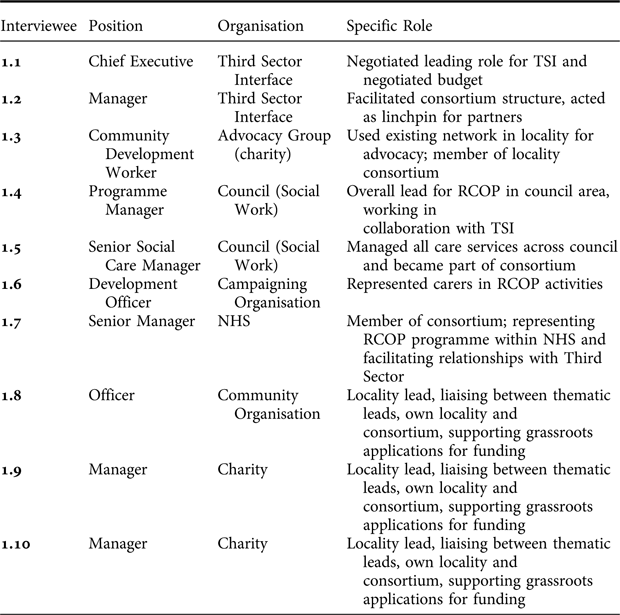
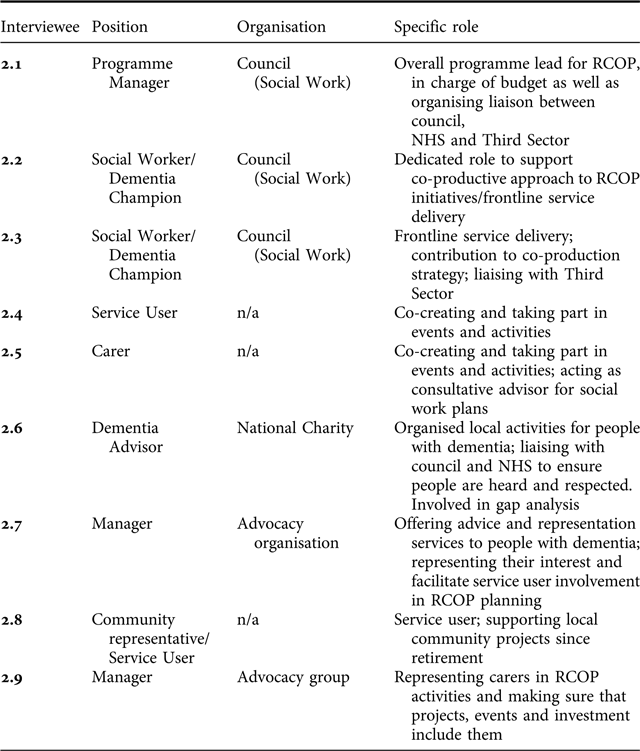
The research was conducted as part of a European research programmeFootnote 1 that focused on co-production and social innovation. It adopted a mixed-method qualitative approach involving two in-depth case studies in Scotland. We identified the cases through expert interviews and desk-based document analysis. Ten interviews were conducted for case study 1 and nine for case study 2, amounting to 19 semi-structured face-to-face interviews with key informants – including service users, public sector staff, Third Sector staff and a carer (see Appendix).
To address the research objective, interview protocols focused on individual roles in, and perceptions of, co-production, as well as the organisational and legislative coordination mechanisms employed. This enabled us to identify relevant drivers and barriers of co-production and match them to reported outcomes. Interviews lasted up to 80 minutes. Data analysis was conducted according to Gioia et al. (Reference Gioia, Corley and Hamilton2012), following first an inductive, then an abductive approach of interviewee-led first-order concepts, an analysis resulting in second-order themes and, finally, aggregate dimensions. Coding was undertaken in NVivo with verification through two coders.
4.3 Two case studies
The cases were located across two Scottish local authorities, spanning rural and suburban areas, capturing representative experiences applicable across Scotland and the wider UK. Case 1 focused on co-production as part of the Scottish Government’s 2011 initiative, Reshaping Care for Older People (RCOP). It benefitted from the Change Fund for the purpose of creating more community-based opportunities for older people, including vulnerable service users suffering from learning disabilities and dementia (Convention of Scottish Local Authorities, National Health Service and Scottish Government, 2013). The project was coordinated by the local Third Sector Interface (TSI) and had a remit to ensure that service users were involved throughout.
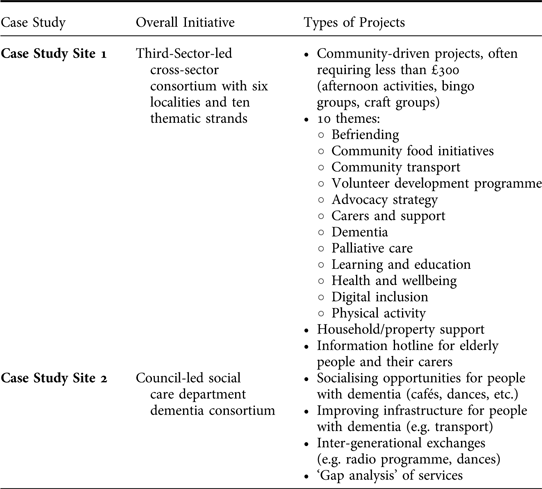
Case 2 was led by a local authority social care dementia unit, which was seeking closer collaboration with other social and healthcare actors across the public and third sectors to focus more on outcomes and service-user voices. Whilst it already had an expressed orientation towards co-production, the unit required significant further investment to embed these connections and a service-user focus, which was again supplied through the Change Fund. Further information on the two case studies is presented in Table 1.
Case Study Co-Production Projects and Types, Following Osborne et al. (Reference Osborne, Radnor and Strokosch2016)

A limitation to both case studies was the limited direct involvement of service users; this resulted from difficulties in standardising interviews across vulnerable service users and restrictions on their involvement on ethics grounds. We have hence included carers in our data collection; while certainly not identical with service-user views, carers proved important putting the service provider emphasis of our data into context.
4.4 Data analysis
The interview data are visually displayed in Figure 3, following Gioia et al.’s (Reference Gioia, Corley and Hamilton2012) data structure model, and are discussed in the following sub-sections.
Gioia methodology coding process according to Corley and Gioia (Reference Corley and Gioia2004) and Gioia et al. (Reference Gioia, Corley and Hamilton2012)

Interviews: first-order concepts
Transcripts were coded in NVivo, yielding 52 first-order concepts, with the highest number of references focused on impact and outcomes (77 individual mentions/18 sources), relations with statutory providers (46 individual mentions/14 sources), the origins of the co-production approach (45 individual mentions/15 sources), the understanding of co-production (43 individual mentions/13 sources), resources such as funding and staff (42 individual mentions/16 sources), and the commitment from service users required to co-produce (39 individual mentions/16 sources).
Analysis: second-order themes and aggregate dimensions
Using insights from the literature, first-order concepts were grouped into second-order themes, with a total of nine themes verified by two coders. Particular consideration was given to how first-order concepts related to the research questions and the Osborne et al. (Reference Osborne, Radnor and Strokosch2016) co-production framework. Special attention was paid to potential outlier data that did not fit the theoretical framework but, due to the individual and systemic level of Osborne et al.’s (Reference Osborne, Radnor and Strokosch2016) model, it allowed for a full coding of our data set. The second-order themes were aggregated into three dimensions: co-production implementation, context and potential.
Co-production implementation denotes practical themes of managing co-production, including the different actors involved (individual and organisational). It also relates to prior motivations that affect the overall introduction of co-production as the approach of choice for RCOP and SDS. The co-production context represents internal and external factors that establish the operating environment for managing co-production within the RCOP/SDS case study sites, e.g. austerity (environment), individual leadership (organisation), and eligibility for services (legislation). Co-production potential, finally, represents the third dimension, with data relating to outcomes and the service-user experience, including attitudes and perceptions of co-production practice.
5. Findings
This section discusses the specific findings arising from the interview data in relation to the first two research questions, while the remaining two questions are addressed in the discussion section.
5.1 RQ1: What forms of co-production, following Osborne et al. (Reference Osborne, Radnor and Strokosch2016), have been practised in the context of RCOP and SDS?
The interview data, supported by internal documentation, indicate a discrepancy between the intended co-production approach and its implementation. This is apparent throughout all three dimensions, but particularly the co-production potential dimension (see Table 2). Most actors felt that they ‘were already doing co-production before we knew it was co-production’ since ‘it just made sense to us’ (manager, advocacy group). Among frontline social work staff, however, there was some enduring scepticism. Some considered co-production to be ‘a flavour of the day’ (social worker in dementia care) – popular with the Scottish government, but not fundamentally different from what they had been doing before (corroborating the Osborne et al. (Reference Osborne, Radnor and Strokosch2016) conceptualisation of pure co-production as an integral part of the service experience):
I hadn’t heard the term before; it was a new term for me. But I’ve been in social work for nearly thirty years and I’m used to terms coming up and my field is being ‘reinvented’ every few years and, you know, different words can be used for different things.
(Social worker and Dementia Champion).Significantly, though, many social workers found it hard to differentiate co-production from consultation and often conflated the two. They argued that any service would have to take into account user input and feedback and that this had been part of their practice for many years. This would suggest that there was an awareness of ‘involuntary’ co-production as per the Osborne et al. (Reference Osborne, Radnor and Strokosch2016) model. Some failed to differentiate between ‘asking’ service users for their opinions (consultation) and users having direct control over the design and delivery of their services, in partnership with professional staff (co-design).
Those leading the co-production initiatives were aware of this particular tension and highlighted training and communication efforts to resolve the conflation between voluntary co-design and consultation/participation. In this case, however, there was little cognisance of unconscious co-production. A Third Sector Interface manager (case study 1) recalled:
(…) we started to put it in a more concrete fashion what we were doing in terms of co-production [sic]. I think that was really important, because prior to that, people thought that the words co-production and [consultation] could be interchanged. I feel very strongly that it is obviously not the case, it cannot be.
Gaining views from service users on their understanding of co-production proved difficult and our data is insufficient to provide firm conclusions. An emerging theme, however, was a perception that co-production meant providing input rather than involvement in their services. Asked whether they felt they could shape their own services, a service user commented that ‘I don’t think that kind of service is available’. Future research would benefit from a specific focus on the understanding of co-production among service users and how it interacts with professional perceptions.
The majority of what was described as collective co-production entailed substantial elements of advocacy through the Third Sector on behalf of service users. Thus, Third Sector organisations collected user views and argued for the introduction of specific services, such as tea dances or singing groups. This seems to confirm findings from Bovaird et al. (Reference Bovaird, Van Ryzin, Loeffler and Parrado2015) regarding the challenges of citizen-led collective co-production. Lindsay et al. (Reference Lindsay, Osborne and Bond2013) suggest that metrics may have a role to play here, as measurement tends to capture structural interactions between organisations more easily than individual or collective outcomes.
Co-production and co-construction figured in both case studies by virtue of being intrinsically linked to the use of any service (Osborne et al., Reference Osborne, Radnor and Strokosch2016). They entailed, for instance, the attendance at dementia cafes, tea dances or movie viewings, which were initiated and organised by either statutory or Third Sector organisations. Service users were co-producing through their service experience (i.e. attending these events) but also their interactions with public service organisations (e.g. responding to questionnaires, attending co-production workshops). Case study 1 showed evidence of co-design, particularly through the locality structure that was part of its governance approach; service users were supported to actively contribute to council meetings and more local committees in order to shape their services. We did not find evidence of co-design in the context of case study 2. Co-innovation in both case study sites was guided by Third Sector and social work advocacy that structured collective involvement in service systems, e.g. by relaying service users’ views in Community Planning Partnerships or using their insights into the service-user experience to create new services.
Types of Co-Production, Following Osborne et al. (Reference Osborne, Radnor and Strokosch2016)

5.2 RQ2: What are the drivers and barriers to co-production in personalisation?
The qualitative data under each first-order concept were revisited to identify drivers and barriers of co-production, with some concepts fulfilling both roles depending on the context (e.g. resources), while others were not discussed as either (e.g. replication of co-production). We also matched the types of co-production described or implicitly inferred through the interview data to the corresponding aggregate dimensions. This allowed us to present drivers and barriers not just in relation to our three dimensions of co-production but also in relation to the co-production typology. Results are summarised in Table 3.
Drivers and Barriers to Co-Production, Following Osborne et al. (Reference Osborne, Radnor and Strokosch2016). Drivers and Barriers Discussed in more Detail Below are Highlighted in Bold

The results of the analysis support the previous finding that the Third Sector acted as a key driver of co-production, in particular using its advocacy role to co-innovate service redesign or new services (e.g. better local transport systems). The co-production potential dimension was associated most closely with co-design and co-innovation, involving voluntary acts of co-production beyond the service users’ experience (e.g. offering a new service based on one of their interests, such as co-hosting a dementia radio show). However, this is also the dimension in which most barriers were identified, such as a lack of time to get involved or a lack of support to make one’s voice heard.
Interviewees associated the majority of drivers with the dimensions of co-production implementation and environment, which related mostly to collective forms of co-production. For instance, additional funding drove new services created through Third Sector advocacy (co-innovation) and improved the collective service-user experience across the service system (co-construction).
We present a more detailed discussion of those drivers and barriers that are of particular interest due to one or more of three indicators: the number of sources mentioning the concept as a driver and/or barrier, the number of individual references across both case study sites, and new insights from the academic literature.
Contextual drivers
‘Leap of faith’
Respondents identified the need for what a Third Sector Interface Chief Executive called a ‘leap of faith’, to open up the decision-making processes beyond the existing organisational actors. This required professional actors to allow more time and resources to facilitate open decision-making processes, so that users and carers could become fully engaged in voluntary forms of co-production beyond the service-user experience. Moreover, it also required a commitment to surrendering decision-making and budgetary power by statutory managers – not always something that they did easily. Thus, one senior manager referred to a key moment where, at a particular meeting, he secured the Health Board’s buy-in that service users, rather than experts, were best placed to decide on their services. This paved the way for voluntary co-production and improvements in the service experience. While this leap of faith related to culture change, interviewees described it as a separate variable that presented a necessary condition for culture change in the first place. Without the ‘leap of faith’, no further culture change could take place, and its absence would thus become a barrier to co-production. We hence suggest that future research adopt a closer focus on the initial leap of faith and its contingencies, independent of wider cultural change.
Measuring outcomes
Almost all respondents, but especially those involved at a strategic level, commented on the crucial importance of monitoring the processes of co-production in order to evidence its success:
Metrics are everywhere, everything is measured… It is a fairly formal system of reporting and performance management that ties us to the investment and the outcomes of the investment that is associated with the reshaping agenda. (…) We are at the initial stage of reporting outcomes, but we are reporting activity, we are reporting process, we are reporting the building of infrastructure.
(Local government senior manager)However, interviewees also pointed out that measurement did not always capture the actual co-production impact, while putting a burden on staff and participants:
Sometimes you’ve seen a person smile at you but, I don’t know, that person can’t tell me if they’re feeling less lonely. Is she smiling because she enjoys the activity? Or is she smiling because she is recognising my face? (…) So that’s where I would say it’s very difficult and sometimes we’re actually missing a lot of good work that’s happening through co-productive processes. (…) And how would we evidence it?
(Advocacy group manager)Further refinement on linking activities with outcomes through innovative measurement and evidencing techniques is thus a crucial step in using co-productive approaches to enhance personalisation.
Role of statutory providers
Statutory providers were seen as a key group of stakeholders as they were often in charge of the most substantial and regular sources of funding. Beyond the ‘leap of faith’ discussed above, interviewees commented on the change in attitudes that was necessary to foster overall culture change.
Initially there was a strong reluctance from the partners to consider the devolved budget situation. (…) There was a lack of confidence that resources could be managed appropriately, that accountability could be assumed and demonstrated. And that, essentially, partners felt that they were simply throwing money to the third sector to prop up organisations that were suffering financial cuts elsewhere. So we had to take a very strong position in demonstrating the intent.
(Third Sector Interface CEO)Thus, statutory partners were a necessary condition for successful co-production. Moving beyond traditional frameworks of measurement and governance was described as crucial in achieving buy-in, which links statutory partners as a variable directly to the aforementioned measurement of outcomes. Further empirical work on the outcomes of co-production is thus necessary to support further culture change across all organisations involved in the delivery of personalisation policies.
Contextual barriers
Conditional resources
Dedicated funding was identified, unsurprisingly, as one of the most crucial factors that could allow organisations to grow capacity in order to adopt co-productive approaches in practice. The Change Fund in particular was mentioned as a key driver. However, our research identified resources as a barrier to co-production in three ways: first, it was unclear how the co-productive projects would be funded once dedicated funding (e.g. the Change Fund) ended. A recent study by Audit Scotland suggests that the Change Fund/RCOP achieved only limited impact, mostly due to a lack of sustainable funding (Audit Scotland, 2016). In a similar vein, one social worker feared a lack of ongoing commitment to co-production and argued that ‘[y]ou cannot throw a bit of money at something and then walk away. And I’m just worried, maybe we’ve thrown a wee bit of money at this and we may walk away’. Another social worker identified a lack of commitment by the Scottish government: ‘If government were serious about local authorities looking at different ways of working (…) [w]e need the resources to do that’.
Second, service managers articulated a conflict between funding innovative co-production projects and hiring more staff for existing services. They found it hard to resolve this conflict because little comparable success data was available for the co-production projects. Health bodies, with a more clinical mind-set, were especially prone to such concerns, and this could be a source of tension between them, local government and third-sector partners.
Finally, resources were not just discussed as a barrier in a financial sense but also in terms of time and engagement. A service user involved in several boards described this as follows:
I don’t think there was necessarily a lack of financial resources. I think, the biggest resource was time and different appointment times to get together and to really talk at some length and some depth about what they were doing and how they could benefit from what the other groups were doing. Many professionals didn’t have enough time.
This provides some background to Bovaird et al.’s (Reference Bovaird, Van Ryzin, Loeffler and Parrado2015) finding that co-production activities tend to correlate with age, with older people more likely to co-produce, possibly because they have more time to devote to co-productive work.
Overstretched carers
Against expectations, the carer and carer representatives we interviewed were somewhat pessimistic about their influence through voluntary forms of co-production, particularly because of the additional pressures these put on their own time:
[…] I find myself going to these meetings, I get a wee bit bogged down with the whole process – sometimes it just doesn’t quite get through to me, what they’re looking for, or what they’re trying to do. And I think sometimes when you’re looking after someone with dementia and you go to these meetings, your brain isn’t just as alert as it should be because I find myself thinking about what’s going to happen tomorrow.
(Carer)Most fundamentally, though, the carer seemed to question the basic premise of involving dementia patients in the co-design of their own services, at least given current structures and forms of engagement:
It’s quite difficult sometimes. I mean one of the co-production [events] we went to, we broke into groups, my husband, he went with one group and I went with another. But I felt that I was kept busy wondering how he was coping because he wouldn’t have a clue what they were talking about or anything.
(Carer)Of course, there is the caveat that our sample included only one carer, although these sentiments were echoed by Third Sector respondents and social workers, and corroborate the aforementioned findings on resources. Still, this presents a potential tension between the views of project managers and those of carers, which remains unresolved. We hence suggest that further research on the resource implications and constraints for carers is needed, in particular in their role of facilitating co-production with vulnerable adults.
Motivating service-user contributions/lack of service-user representation
Third Sector respondents remarked that it was crucial to achieve buy-in from service users in order to motivate them to get involved and break down barriers to their participation. A council manager was more specific, arguing that successful co-production required ‘not just [users] but [users] who can articulate what they need eloquently’.
In addition to the confusion between consultation and co-production, some social workers saw voluntary co-production as a poorly implemented top-down imposition, particularly for vulnerable service users. Corroborating the carer’s experience, one social worker thought that ‘[t]he whole process has been too fast… to clearly listen to people with dementia. (…) we need to find better ways of… slowing things down’. She feared that voluntary, ‘add-on’ forms of co-production were simply a ‘fashionable fad’ amongst policy-makers and involved little genuine engagement from service users.
Staff on the same project disagreed, arguing that ‘[y]ou have to get past the idea that people with dementia cannot make decisions for themselves or don’t know what they want’ (Third sector manager). A service-user advocacy campaigner agreed, explaining that
[I]t is a challenge, because people with dementia find these kinds of things scary … a lot of people… fear for the unknown for suffering dementia… It is often also the fear of speaking in front of people. So they do not volunteer for these kind of things, because they don’t want to be singled out – ‘I have dementia’.
The service users interviewed expressed doubts that their key services were truly open to their input or that they could ask for new services. Project staff were aware of this scepticism from service users and did try to overcome it – either by encouraging carers to be advocates on a vulnerable adult’s behalf or by employing approaches that are best described as ‘informal’ and ‘accidental’ to engage with service users – such as, for instance, asking questions at social events in order to gather information. Yet, in light of the previous findings on the role of carers, more attention on ensuring service-user buy-in is required.
6. Implications for theory and practice
These case studies provide a rich and revealing snapshot of the challenges of developing co-productive services in the context of personalisation. We now use these exploratory data to discuss the implications for theory and practice.
In terms of theoretical contributions, this study is an important empirical test of the Osborne et al. (Reference Osborne, Radnor and Strokosch2016) typology of co-production. We find evidence of all forms of co-production across the two case studies; however, the majority entail collective forms of co-production. At first sight, this looks to be at odds with previous findings in the literature (Loeffler et al., Reference Loeffler, Parrado, Bovaird and Van Ryzin2008; Parrado et al., Reference Parrado, van Ryzin, Bovaird and Loeffler2013). However, we find a potential explanation: the preference for co-innovation and co-construction may relate to specific service-user characteristics, such as the high proportion of vulnerable service users with various amounts of capacity (Jepson et al., Reference Jepson, Laybourne, Williams, Cyhlarova, Williamson and Robotham2016). One service user expressed a desire for mutual support in co-constructive/co-innovative settings rather than co-design, expressing a belief that one could advocate better for the desired services as part of a collective rather than as an isolated individual. The Third Sector forum he joined was thus a place
…where all these people like us can get together and exchange views about what they are going through… It has taken an awful lot of worries from me because I live on my own and living on my own means that you have to think about what is coming next to me.
(Service user)We suggest, therefore, that this sense of belonging found in a group setting can facilitate participation and may hence be a fruitful approach for engaging vulnerable service users. However, we also acknowledge that the views of such advocacy groups and individual service users may not always coincide; they could even be in conflict. This is a risk deserving further attention in future research, particularly because our data suggests that local authorities mainly worked through the Third Sector in order to co-produce with service users. Interestingly, there was more awareness of the involuntary individual and collective dimensions of co-production and co-construction (as well as the importance of managing them well) at a frontline level, than there was at leadership level. Senior staff’s narrative of co-production focused on voluntary forms of co-production, i.e. co-design and co-innovation, even though this was not borne out in practice. We thus find an interesting divide between the perceptions and awareness of co-production at different levels of public service organisations, including the Third Sector.
RQ3: How does the type of co-production relate to outcomes?
Findings on Outcomes and Co-Production Types for each Case Study, Building on Outcome Classifications from Bovaird and Loeffler (Reference Bovaird, Loeffler, Brandsen and Holzer2010). Outcomes were Evaluated and Reported by Case Study Sites and have not been Verified Independently.

The main issue in linking co-production types to outcomes was the actual measurement and reporting of outcomes (see Table 4). Interpreting outcomes proves difficult for two reasons: In case study site 1, contacts/referrals were used as a main indicator, with qualitative data presenting a positive but also highly localised view that makes it hard to evaluate the overall legacy of the co-production initiatives. Case study site 2 used measurements at a service level that indicated reductions in acute service expenditure, but these cannot be traced to any individual policy or project and may have other underlying drivers. Moreover, they say little about actual personal outcomes.
This evaluation is echoed by Audit Scotland, who found little systemic change in their overall audit of Reshaping Care for Older People (Audit Scotland, 2016) and highly variable outcomes in their report on Self-Directed Support (Audit Scotland, 2017). A key factor was the lack of a unified impact-reporting framework (Audit Scotland, 2016). While individual qualitative data supports anecdotal evidence that meaningful positive outcomes have been achieved, there is not enough robust data to confirm this conclusion.
Finally, our study followed an abductive approach to data analysis, with three dimensions of co-production emerging from the data: co-production implementation, co-production context and co-production potential. In analysing the first-order concept and second-order themes, we found voluntary types of co-production (co-design and co-innovation) to be associated above all with the co-production potential dimension. Thus, co-design and co-innovation emerged from statements relating to the service-user experience and to outcomes, which seems an obvious connection. However, they were also associated with key barriers to co-production. Conversely, co-production implementation and context were predominantly associated with co-construction and the drivers identified through the research. We suggest that this differentiation is emblematic of the divide between the policy intentions and potential of co-productive approaches to personalisation and the implementation-driven reality. This ties in with observations about the variable outcomes across Scotland (Audit Scotland, 2016, 2017) and previous observations about the role of co-production (Pearson et al., Reference Pearson, Watson and Manji2017).
In terms of implications for practice, we now introduce three propositions, based on the preceding discussion and our research findings, to address research question 4.
RQ4: How can current co-production theory and practice inform social policy and legislative reform on personalisation?
Proposition 1: Policy-makers and those involved in implementation need to differentiate between co-production dimensions to maximise value creation.
This matters because forms of engagement will differ across types and loci. For instance, we found that pure co-production was embedded in the service ethos of frontline staff, which could be reinforced if senior management focused more on involuntary co-production as part of the service experience rather than just voluntary ‘add-ons’. Conversely, the creation of facilitative forums, such as experience and advocacy groups including users (and carers) and guided by the Third Sector, may facilitate co-innovation at the service system level, even though it comes with its own risks. Specific interventions are needed for different forms of co-production; thus, it is important that there is conceptual clarity as to what form of co-production is to be encouraged, and alignment among the views of service users, frontline staff, management and policy.
Proposition 2: Metrics and evaluation need to capture more than just co-production structures.
We echo Lindsay et al. (Reference Lindsay, Osborne and Bond2013) and the Audit Scotland (2016) conclusions on RCOP, which show that data itself does not automatically lead to evidence-based decision-making. A meaningful system of comparable metrics needs to support organisations in their frontline activities rather than act as an additional administrative burden. Our data suggest that part of this evaluation strategy needs to be a more realistic timeframe that allows for outcomes to be tracked over time. The current focus on quantitative, population-level data does not seem fit for this purpose, neither does it prove insightful in understanding potential differences between service-user outcomes and service-provider priorities. While qualitative forms of impact recording offer more powerful insight into actual outcomes, they are also difficult to evaluate at policy level. This paper sadly cannot offer a panacea for this problem; however, it indicates that efforts have to be system-wide rather than only driven by individual organisations on a local level.
Proposition 3: Effecting successful cultural change in social and health-care services, based around co-production, will require engagement with the wider community.
Current co-production theory highlights that co-production is far from dyadic: it requires an approach that includes a wider variety of stakeholders. This is particularly relevant in negotiating self-directed decision-making on services by vulnerable users, potentially involving risks to themselves, service staff and the wider community. Instead of risk management that seeks to minimise all such risks irrespective of the expected benefit, co-production theory strongly supports a negotiated risk discourse that includes service users, professionals, carers and the wider public. This may also help to prevent the ‘blame game’ effect (Hood, Reference Hood2002; Flemig et al., Reference Flemig, Osborne and Kinder2016) that a media predominantly focused on failed social policy innovation can trigger. This governance structure needs to be taken into account in policy design, not just at the point of implementation.
7. Conclusions
Co-production as a set of approaches to working in partnership with service users offers a natural fit with user-focused ideals of personalisation. However, we have found co-production to be a potential stumbling block in using personalisation to truly set individual needs at the heart of service provision. This is partially because personalisation implemented through a New Public Management lens very much remains the proverbial ‘old wine in new bottles’. We identify that paying close attention to the specific type of co-production and its locus has important implications for outcomes, particularly if we want to move towards voluntary forms of co-production, such as co-design and co-innovation. Our study highlights that there remain crucial gaps in leveraging voluntary and involuntary co-production for service-user empowerment, particularly when it comes to vulnerable user groups, especially because of gaps in understanding between policy-makers, managers, frontline staff, and service users and their carers.
The evidence and propositions presented here offer a first foray into an integrated policy and service delivery framework that will both enhance the role of co-production in personalisation settings and bridge the gap between current variations in implementation and the policy ideals in personalisation. Without addressing the challenges identified in this paper, services based upon the principles of the autonomy and human rights of service users, including vulnerable groups with limited capacity, will continue to fall far short of their espoused intentions.
Appendix I
Case Study Site 1 Interviewees

Case Study Site 2 Interviewees