


Introduction
A high degree of comorbidity between substance misuse and sleep deficits and disorders is reported in the literature (Weissman, Greenwald, Nino-Murcia and Dement, Reference Weissman, Greenwald, Nino-Murcia and Dement1997; Teplin, Raz, Daiter, Varenbut and Tyrrell, Reference Teplin, Raz, Daiter, Varenbut and Tyrrell2006). Sleep disorders have are also been shown to be a risk factor for later development of substance misuse problems (Crum, Storr, Chan and Ford, Reference Crum, Storr, Chan and Ford2004). Cognitive-behavioural therapy treatments for insomnia in this population have been trialled, but improving sleep variables relapse rates have not been affected (Currie, Clark, Hodgins and el-Guebaly, Reference Currie, Clark, Hodgins and el-Guebaly2004; Arnedt, Conroy, Armitage and Brower, Reference Arnedt, Conroy, Armitage and Brower2011).
Heavy alcohol consumption induces fatigue, reducing sleep onset latency, reducing time spent in Rapid Eye Movement (REM) sleep and increasing time spent in “deeper” Slow Wave Sleep (SWS). As it metabolizes and levels fall, it disrupts sleep in the later part of the night resulting in greater periods of wakefulness (Vitiello, Reference Vitiello1997; Landolt and Gillin, Reference Landolt and Gillin2001). In the longer-term there is longer sleep latency, increased time in REM sleep, and reduced SWS. It is has been found that the duration of these sleep disturbances have been as high as 27 months following abstinence (Drummond, Gillin, Smith and DeModena, Reference Drummond, Gillin, Smith and DeModena1998).
Sleep disturbance following withdrawal from alcohol has been cited as a cause of treatment failure and relapse to abuse and dependence (Teplin et al., Reference Teplin, Raz, Daiter, Varenbut and Tyrrell2006). Significant REM and SWS disruption has been linked to drinking in laboratory settings and in follow-up studies (Allen and Wagman, Reference Allen and Wagman1975; Allen Wagman and Funderburk, Reference Allen, Wagman and Funderburk1977). Objectively measured sleep difficulties have also been shown to predict relapse on completion of alcohol treatment programmes (Gillin et al., Reference Gillin, Smith, Irwin, Buttos, Demodena and Schuckit1994; Drumond et al., Reference Drummond, Gillin, Smith and DeModena1998).
Subjective complaints of disordered sleep have also been related to relapse. In a study of 74 individuals with alcohol dependence, questionnaire rated sleep complaints and difficulty falling asleep at baseline predicted relapse, with self-rated insomnia the only significant predictor of relapse at follow-up (Brower, Aldrich and Hall, Reference Brower, Aldrich and Hall1998; Brower, Aldrich, Robinson, Zucker and Greden, Reference Brower, Aldrich, Robinson, Zucker and Greden2001). Foster, Marshall and Peters (Reference Foster, Marshall and Peters1998) found that lower social class, number of cigarettes smoked, and reported disturbed sleep were predictors of relapse at 12 weeks after discharge from a detoxification unit. In a treatment trial Currie and colleagues found that higher baseline sleep onset latency and a shorter period of predicted relapse at a 3-month follow-up period (Currie et al., Reference Currie, Clark, Hodgins and el-Guebaly2004). Subjective sleep measures have been reported as being better predictors of drinking outcomes than objective polysomnographic techniques (Conroy et al., Reference Conroy, Arnedt, Brower, Strobbe, Consens and Hoffmann2006)
There is a strong body of evidence linking cognitions and sleep. Sleep related cognitions are seen as contributing to maintaining poor sleep patterns (Harvey, Reference Harvey2002). Explanatory models in the literature have included elements of cognitive arousal, beliefs, attitudes and dysfunctional responses to perceived sleep deficits (Harvey, Reference Harvey2002; Espie, Reference Espie2002).
Cognitive arousal has been shown to be more important than physiological arousal in disrupting sleep (Lichstein and Rosenthal, Reference Lichstein and Rosenthal1980). Most people with insomnia claim that they have trouble sleeping as they cannot switch off their “racing” mind (Espie, Brooks and Lindsay, Reference Espie, Brooks and Lindsay1989). Differences in beliefs between insomniacs and non-insomniacs have been well described. Individuals often respond to insomnia, either overtly or covertly, by attempting to address and reduce their sleep deficit in some fashion. Dysfunctional beliefs can lead to individuals attempting to change sleep related behaviour, with negative results on sleep quality (Morin and Gramling, Reference Morin and Gramling1989; Morin, Stone, Trinkle, Mercer and Remsberg, Reference Morin, Stone, Trinkle, Mercer and Remsberg1993; Morin, Reference Morin1993). These behaviours can be explained as “safety behaviours”, which are attempts at coping that works, paradoxically, to increase the likelihood of the feared outcome (Salkovskis, Reference Salkovskis1989). Insomnia related safety behaviours, both overt and subtle, have been shown to interfere with sleep at night (Ree and Harvey, Reference Ree, Harvey and Bennett-Levy2004a, b).
Cognitive-behavioural therapy (CBT) techniques have shown great promise in the treatment of primary insomnia conditions (Hauri, Reference Hauri1997; Espie, Inglis, Harvey and Tessier, Reference Espie2000; Edinger, Wohlgemuth, Radtke, Marsh and Quillian, Reference Edinger, Wohlgemuth, Radtke, Marsh and Quillian2001). The treatment of insomnia with CBT secondary to other conditions has also shown promising results (Currie, Wilson, Pontefract and deLaplante, Reference Currie, Wilson, Pontefract and deLaplante2000; Krakow et al., Reference Krakow, Johnston, Melendrez, Hollifield, Warner and Chavez-Kennedy2001; Dreher, Reference Dreher2003; Simeit, Deck and Conta-Marx, Reference Simeit, Deck and Conta-Marx2004).
There have been several published trials of CBT interventions for insomnia in alcohol dependent individuals. An open trial of CBT for insomnia with abstinent alcohol users found improvements on sleep measures and no lapses during the trial (Arnedt et al., Reference Arnedt, Conroy, Rutt, Aloia, Brower and Armitage2007). The earliest RCT of CBT for insomnia in alcohol dependent individuals again showed improvements in subjective ratings of sleep when compared with a control group (Currie et al., Reference Currie, Clark, Hodgins and el-Guebaly2004). A later trial found sleep diary and sleep cognition scale improvements when compared with a control intervention (Arnedt et al., Reference Arnedt, Conroy, Armitage and Brower2011). However, both studies collected posttreatment rates of relapse and found no differences in rates of relapse to alcohol in those who received the CBT for insomnia treatment. This is in spite of the later trial using a CBT for insomnia programme modified for alcohol dependence populations (Arnedt et al., Reference Arnedt, Conroy, Armitage and Brower2011)
As this runs counter to what might be predicted from the literature there is a need to investigate this further to explain the relationship between cognitions, sleep and relapse to alcohol use. This study is designed to add to the body of evidence on the role of sleep related cognitions in this specific population with the hope of informing psychological treatment of this problem. The hypothesis is that a range of poor sleep-related cognitions would have a predictive effect on relapse rates; understanding the specific cognitions involved in this process would help in the design of specific CBT programmes for this population.
Method
Sample
The sample included ICD-10 (World Health Organization, 1992) alcohol dependent inpatients in a NHS inpatient alcohol unit. Those suffering from the symptoms or who had a recent history of delirium, Korsakoff's syndrome or cognitive difficulties of sufficient severity to make comprehension and completion of the study problematic were excluded from the study.
Approval for the study was obtained from the local research Ethics Committee and Research and Development Committee. Participants were recruited by the researcher and permission was gained to access patient records for demographic data. Participants were provided with an actigraph, sleep diary and information sheet. They were asked to wear the actigraph at night-time for 7 days, pressing a button on the front of the actigraph when they got into bed, which served as an event marker. They were also asked to press the button again when they got out of bed for the last time in the morning. The participant was also asked to complete the sleep diary daily for 7 days. One week later the actigraphs and sleep diaries were collected and participants were asked to complete the study questionnaires.
In total 89 individuals were approached and invited to participate; 87 (97.8%) consented, attended the first interview and were supplied with the actigraph recording equipment and sleep diaries. The study was designed to avoid recruiting in the first 10 days due to the prescription of anxiolytic medication as part of the detoxification treatment in the first 7 to 9 days. The average interview time for participants was 13.7 days from admission. From this group 71 complete datasets of cognition and sleep measures were collected, a response rate of 80% of those initially approached.
Approximately one month after discharge follow-up telephone interviews were conducted. All consented to the follow-up and 62 (87.3%) were contactable. There were no differences between responders and non-responders on any variables. The mean time to follow-up was 36 days (SD = 7.2).
Measures
Sleep diary
Sleep monitoring was carried out by means of a sleep diary, as described in Morin (Reference Morin1993). The diary was to be completed over a 7-day period and provided information on nightly estimates of sleep onset latency (SOL), wake time after sleep onset (WASO), and total sleep time (TST). Responses were averaged over the 7-day period to provide an aggregate score for each category.
Actigraph
Participants were asked to wear an actigraph motion monitor on their non-dominant wrist for a continuous period of 7 nights (Actiwatch; Cambridge Neurotechnology Ltd). Individuals were instructed to put the actigraph on just before getting into bed, regardless of time. Communal areas were closed at a set time but there existed no “lights-out” policy in bedrooms. The Actiwatch provides activity readings over a specified time period. Activity data are analysed by dedicated software provided by the manufacturer (Sleep Analysis 98; Cambridge Neurotechnology Ltd). Data were recorded in epoch lengths of 0.25 minutes. As with the actigraph, SOL, WASO and TST data were extracted for analysis.
Glasgow Content of Thoughts Index (GCTI; Harvey and Espie, Reference Harvey and Espie2004)
The GCTI is a 25-item questionnaire developed to assess the nature and frequency of presleep cognitive activity in primary insomniacs. Items are scored on a 4-point scale (1 = never, 2 = sometimes, 3 = often, 4 = always).
Dysfunctional Beliefs About Sleep Scale-10-item version (DBAS-10; Espie et al., Reference Espie, Inglis, Harvey and Tessier2000)
The DBAS-10 is a short form of the longer 30-item DBAS scale 20. This scale was designed to tap into various beliefs, attitudes, expectations and attributions about sleep and insomnia. For each statement the person rates his or her level of agreement or disagreement on a 100mm visual analogue scale ranging from 0 (strongly disagree) to 100 (strongly agree).
Sleep-related Behaviours Questionnaire (SRBQ; Ree and Harvey, Reference Ree and Harvey2004b)
The SRBQ comprises 32 items designed to assess the use of safety behaviours employed to promote sleep and cope with tiredness. It is scored on a 5-point scale (0 = almost never, 1 = rarely, 2 = sometimes, 3 = often, 4 = almost always).
Relapse
Individuals were asked whether they had had an alcoholic drink in the past month and, if so, on how many days and how many drinks they had consumed on an average day. Data on the location of the individual (i.e. home or residential rehabilitation unit) were also recorded. Relapse was recorded if the individual had taken any alcoholic drink since discharge.
Hospital Anxiety and Depression Scale (HADS; Zigmond and Snaith, Reference Zigmond and Snaith1983)
The HADS contains 14 items and consists of two subscales: anxiety and depression. Each item is rated on a 4-point scale, giving maximum scores of 21 for anxiety and depression.
Clinical Institute Withdrawal Assessment for Alcohol-Revised (CIWA-Ar; Sullivan, Sykora, Schneiderman, Naranjo and Sellers, Reference Sullivan, Sykora, Schneiderman, Naranjo and Sellers1989)
The CIWA-Ar is an assessment tool for alcohol withdrawal symptoms across 10 symptoms. Scores of less than 10 indicate mild to minimal withdrawal symptoms that do not require medicinal intervention.
Regression
Sleep onset latency (SOL) and waking time after sleep onset (WASO) data from both sleep diary and actigraph measures appeared positively skewed, with significant outliers, violating assumptions for normality (Field, Reference Field2005). Untransformed data were used for describing the data and initial analysis employed non-parametric statistical tests; these data were transformed for the multivariate analysis. Bivariate analysis of the data was conducted using the log data and parametric statistical tests. Step-up Hochberg procedures were applied to correct for a Type 1 error.
Analysis of the relationship between sleep, cognitions and relapse utilised backwards stepwise logistic regression. The criterion for removal of variables in the backward stepwise process was a p value of greater than .10. The confounding predictors measured in this study, derived from the literature relating to relapse to alcohol, are limited to the number of previous treatments and the number of days of sobriety prior to treatment. In this study the variable “number of days from admission to interview” was used as an indicator of length of sobriety. Anxiety, depression, withdrawal symptoms and presence of a co-morbid diagnosis were added to these variables as they were considered to be variables that could influence relapse.
There were two high correlations in this data set, between the GCTI and HADS anxiety measure (r = .730) and between the GCTI and SRBQ (r = .714). However, the variance inflation factor and condition index revealed no effects of co-linearity.
Results
Demographic information and description of the sample
Of the 71 participants 46 (64.8%) were male and 25 (35.2%) female. The mean age was 42.8 years (SD = 9.37). Primary diagnosis for all individuals was Alcohol Dependence Syndrome. The mean age of onset of problem drinking was 29.4 years (SD = 9.8) with the mean length of time since onset 13.4 years (SD = 9.5). Previous treatment, defined as medically assisted withdrawal from alcohol, was reported by 42 (59.2%) individuals, mean number 1.72 episodes (SD = 2.8).
Secondary diagnosis, established by psychiatric admission interview using ICD-10, revealed 11 individuals (15.5%) to have a co-morbid diagnosis, probably an underestimate. A lifetime history of poly-substance abuse was reported by 44 (62%) participants, with current poly-substance abuse reported by 29 (40.8%) participants. The number of participants who were being prescribed medication for a psychiatric condition was 34 (47.9%).
Measures
HADS and CIWA
The mean score for the HADS anxiety scale was 8.2 (SD = 4.9); on the HADS depression scale it was 4.94 (SD = 3.8). The mean score for the CIWA measure was 4.19 (SD = 3.7) with 6 participants (8.5%) scoring at or above the cut-off score of 10 (withdrawal symptoms requiring medical intervention). The CIWA was significantly correlated with both the HADS anxiety (r = .476, p<.001) and depression measures (r = .461, p<.001).
Sleep diary and actigraph measures
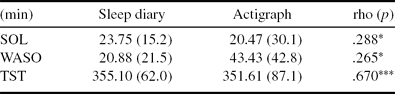
The three main measures taken from the sleep diary and actigraph were sleep onset latency (SOL), wake after sleep onset (WASO), total sleep time (TST) – all expressed in minutes. Descriptive data and bivariate analysis are displayed in Table 1. TST values between the two measures were highly correlated but the WASO and SOL measures showed lower agreement ratings, although all were significant. In general the actigraph measure provided a wider spread of scores. After correcting for a Type 1 error the significant associations with the actigraph measures were depression with WASO, and with the sleep diary measures WASO with anxiety and length of time since onset of alcohol abuse (all p values <.05). Medication use during the study was not associated with any of the sleep measures.
Mean scores in minutes on objective and subjective sleep measures and correlation between measures

* p<.05 **p<.01 ***p<.001
Cognition measures
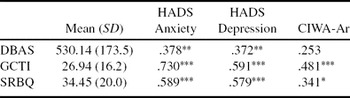
Descriptive data for the Dysfunctional Beliefs and Attitudes about Sleep scale (DBAS), Glasgow Content of Thoughts Inventory (GCTI) and Sleep Related Behaviours Questionnaire (SRBQ) are displayed in Table 2. After correcting for a type 1 error the HADS measures remained significantly associated with the DBAS (p<.01), GCTI and SRBQ (p’s<.001). The CIWA remained significantly associated with the GCTI (p<.001) and the SRBQ (p<.05).
Descriptive statistics for cognition questionnaires and relationships with mood and withdrawal measures

* p<.05 **p<.01 ***p<.001
Follow-up interview
Of the 62 individuals who were contactable at the follow-up period 45 (72.6%) were living at home and 17 (27.4%) were living in a residential rehabilitation setting. The number of individuals who had relapsed at the follow-up interview was 19 (30.6% of the contactable sample). All of these were living at home; the relapse figure represents 42.2% of those people who went home following detoxification. After correction for Type 1 error there were no significant associations in baseline characteristics between those who attended a rehabilitation unit and those who went home.
Sleep and cognitions
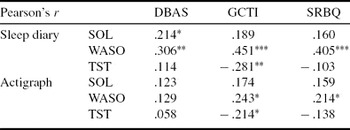
Table 3. displays bivariate analysis data on the relationships between the three cognition measures and the data collected from the sleep diaries and actigraphs.
Correlations between cognitions questionnaires and actigraph and sleep diary measures

* p<.05; **p<.01; ***p<.001
Relapse
Baseline characteristics
Of the 62 participants contactable at the follow-up period 43 (69.4%) had relapsed. All relapsers had gone back into the community following detoxification. Using chi-square analysis there were no associations between relapse status and use of medication (p = .250), having a secondary diagnosis (p = .549), or lifetime or current poly-substance misuse (p’s = .536 and .317). There were also no differences found on the mood, anxiety, withdrawal measures or on any of the severity of dependence indices between relapsers and non-relapsers.
Sleep-related cognition questionnaires
Analysis of differences on the cognition questionnaires between those who relapsed and did not relapse showed only one significant association; DBAS scores were higher in those who did not relapse (relapse = 458.1, SD = 194.6 - non-relapse = 556.2, SD = 166.6: t = 2.03, p<.05). Comparison of the sleep measures also revealed only one significant association; sleep onset latency as measured by the actigraph on the ward was longer in those who relapsed (Relapse = 25.9, SD = 36.9; Non-relapse = 16.3, SD = 28.6; t = −2.07, p<.05).
Multivariate analysis
Due to the high number of hypothetical predictors the multivariate analysis on relapse was conducted in three phases:
Relapse status as outcome with the predictors:
-
i) Cognition questionnaires and sleep measures;
-
ii) Potential confounding predictors;
-
iii) Significant predictors taken from steps i) and ii) placed into combined model.
The potential confound predictors in this model were the CIWA withdrawal measure and HADS anxiety and depression measures from the interview on the ward, the number of previous treatments, co-morbid diagnosis and the number of days from admission to interview.
Table 4. shows the outcome of the regression model investigating the predictive role of cognitive questionnaires and the actigraph and sleep diary measures on the risk of relapse. The regression model including just the confound predictors was not significant, with all variables being excluded from the backwards stepwise method. The HADS depression measure, previous treatments and days from admission to interview all had negligible Wald values (<.015) and so were excluded from later analysis.
Multivariate analysis outcome data for cognition questionnaires and sleep measures

1 Pseudo R-square – Nagelkerke's method; * p<.01
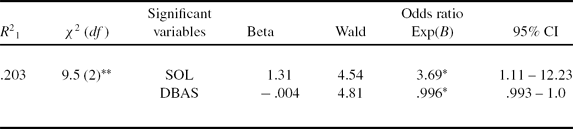
The effect of the DBAS on relapse was a 3–4% decrease in the risk of relapse for every 10 points scored on the DBAS (95% CI: 1- 7%). The SOL measure was log transformed so for every 1% increase on this variable there was a three and three quarter times increased risk of relapsing at one-month follow-up. The combined regression model incorporated the DBAS, actigraph SOL, HADS anxiety, co-morbid diagnosis and CIWA withdrawal symptoms measure. The results of this analysis are displayed in Table 5. Anxiety, withdrawal symptoms and co-morbid diagnosis did not have a substantial effect on the model and did not serve to reduce the amplitude of the effects of the SOL and DBAS measures found in the earlier regression models.
Multivariate analysis outcome data for DBAS, SOL and confound predictor variables

1 Pseudo R-square – Nagelkerke's method; *p<.05; **p <.01
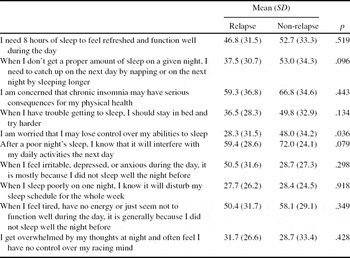
Analysis of the individual DBAS items by t-test revealed that eight of the ten DBAS items were higher in those who did not relapse, but with only one item significantly different between relapsers and non-relapsers: “I am worried that I may lose control over my abilities to sleep” as displayed in Table 6.
Item analysis of the DBAS-10 measure by relapse status at follow-up

Discussion
Objectively measured difficulties in getting to sleep on the ward were found to predict relapse at a one-month follow-up interview. Negative cognitions were not found to predict relapse but dysfunctional beliefs about sleep were found to be a protective factor. This is an important outcome as it is contrary to findings in the literature with primary insomniacs that would suggest the utility of reducing dysfunctional beliefs.
The finding that sleep onset latency is predictive of relapse to alcohol use is in line with previous studies research into the link between sleep and relapse (Drummond et al., Reference Drummond, Gillin, Smith and DeModena1998; Brower et al., Reference Brower, Aldrich and Hall1998; Foster and Peters, Reference Foster, Marshall and Peters1998). The effect of sleep latency in this study is stronger; this study also includes more potential confounding variables so it can be viewed as a more robust test of this effect. In terms of cognitions the finding that higher dysfunctional beliefs about sleep are protective of the risk of relapse was in the opposite direction to that hypothesized. The DBAS-10 involves items relating to the need for a certain amount of sleep, and attribution based worries about sleep. Scoring higher on the former items may lead to individuals paying more attention to sleep and this may be protective in the early stages of recovery form relapse. A focus on sleep length and effort, although at other times seen as dysfunctional, may in the early stages of recovery be adaptive for the individual. The CBT for insomnia trial with recovering alcohol users used a format taken from the primary insomnia literature including a focus on the reduction of dysfunctional beliefs (Currie et al., Reference Currie, Clark, Hodgins and el-Guebaly2004). If the findings here are correct then this might have had a small negative effect on recovery.
The items of worry about sleep may indicate the individual's sense of hope about their sleep and also the importance of sleep to functioning. It is notable that when individual items from the DBAS-10 were analysed, the only significant item involved a catastrophic thought about a loss of control due to sleep. This indicates a sense of sleep being crucial to personal integrity. Again this seems paradoxical with regard to the literature but may indicate the degree of importance the individual places on sleep which, in this population, may be beneficial to recovery.
Although the interpretation of this finding in this study is speculative, the finding itself was quite robust. The DBAS measure showed a reasonable degree of independence from other cognitive and mood measures. The effect of DBAS was consistent on both objective and subjective sleep measures and it remained the strongest predictor when allowed to compete with both sleep and confounds gleaned from the literature as predictors of relapse. The low cut-off for relapse – i.e. a single drink – also makes this study robust in its findings of effects of sleep on lapse patterns.
This study includes a mixed group of individuals both with and without sleep problems, some of which may be primary insomnia and some secondary to alcohol withdrawal. As such it is difficult to compare this sample with the samples from the primary insomnia literature. The results of this study are limited to individuals undergoing detoxification from alcohol on an inpatient unit. These findings cannot be generalized to a population of individuals with alcohol dependence as the sample included a proportion of individuals with poly-substance use.
In conclusion, associations were found between cognitions and sleep, both objectively and subjectively measured. In this alcohol dependent sample those who slept poorly whilst in the inpatient unit and with a specific set of cognitions were more likely to relapse upon discharge. This finding lends support to the identification of sleep problems early in treatment and the potential use of a specifically designed psychological treatment for sleep to reduce relapse rates following detoxification. The finding of dysfunctional beliefs being associated with lower rates of relapse suggests the need for further research into the relationship between cognitions about sleep and relapse. It also suggests the need for specific CBT models for treatment of sleep disorders in this population. It is clear that poor sleep remains a factor with this population and not attending to it as part of a treatment package is likely to adversely affect success rates.




Comments
No Comments have been published for this article.