Introduction
Out-of-pocket payments (OOPs) play an important role in the financing of pharmaceutical care. Across Organization for Economic Co-operation and Development (OECD) countries the share of OOPs to the total drug costs varies from less than 10% in the Netherlands up to 60% in Poland (OECD, 2016). Given that pharmaceuticals constitute on average more than 40% of a household’s budget spent on health, some experts claim that the greater reliance on OOPs may negatively influence the ability to consume other goods (Eurostat. European Commission, 2009). In addition to that, they believe that the burden of OOPs may adversely impact the utilization of other health care services, as well as health outcomes. This is because extensive OOPs may hinder those in need from searching for medical help. There are other experts however who argue that the lack of OOPs may lead to overconsumption of health care services. They introduce the notion of moral hazard which refers to the situation where medical services are used to a greater extent than would otherwise be optimal from a medical standpoint (Einav et al., Reference Einav, Finkelstein, Ryan, Schrimpf and Cullen2013). This is because the elimination of barriers may encourage the utilization of expensive medical technologies by those who do not need them. It is highly challenging therefore for health policy makers to establish a structure of OOPs that mitigate the risks of both incidences.
Given the growing significance of the role of direct patient contributions toward the financing of pharmaceutical care, it can be asked whether a structure of OOPs can be achieved such that both the accessibility to medical help needed and the efficiency of health care system are ensured.
The objective of the study was to estimate the association between drug cost sharing and health care service consumption, as well as health outcomes. In particular, it was to verify whether an increase (decrease) in household expenditure on pharmaceuticals leads to higher (lower) consumption of health care services and/or a worsening (improvement) of health status.
Methodology
The review protocol was prepared in advance. The Cochrane Library, PubMed and Embase databases were searched for the following key phrases: ‘cost sharing,’ ‘out of pocket’ and ‘co-payments.’ Each of these was paired with the terms ‘impact,’ ‘health outcomes’ and ‘utilization.’ The scope of the review was limited to drug technologies. Consequently, the terms ‘drug’ and ‘pharmaceutical’ were added to the search criteria.
The following inclusion criteria were used: (1) empirical studies examining the impact of change in drug cost sharing on health care costs, utilization patterns, as well as health outcomes, (2) manuscripts written in English and (3) articles published between September 2003 and February 2016.
The publications included were reviewed in three stages. First, the set of key characteristics for each study was summarized in table format. The cost-sharing mechanism was categorized in one of three types: copayment, coinsurance, deductibles.
Second, classification was performed so that three groups were defined in order to separate publications that measured the OOPs’ impact on health care utilization patterns, health care costs and health outcomes. For each study it was determined whether a change in a given drug cost-sharing policy had a significant (non-zero) or non-significant effect on health care consumption and/or health outcomes. Lack of significance was assumed if no confidence intervals or p-values were provided.
Finally, the quality of included studies was assessed based on the checklist prepared by Gardner et al. for the statistical review of general papers. It covered the design, conduct, analysis and presentation of each piece of research (Gardner et al., Reference Gardner, Machin and Campbell1986). In cases where more than three out of nine quality criteria were not met, the given study was considered as of poor quality.
The assessment of each study was conducted by both authors separately. Any disagreements were solved by consensus. Data were extracted and reviewed following the PRISMA guidelines (Liberati et al., Reference Liberati, Altman, Tetzlaff, Mulrow, Gøtzsche, Ioannidis, Clarke, Devereaux, Kleijnen and Moher2009). The PRISMA checklist is presented in the Supplementary Table 1.
Results
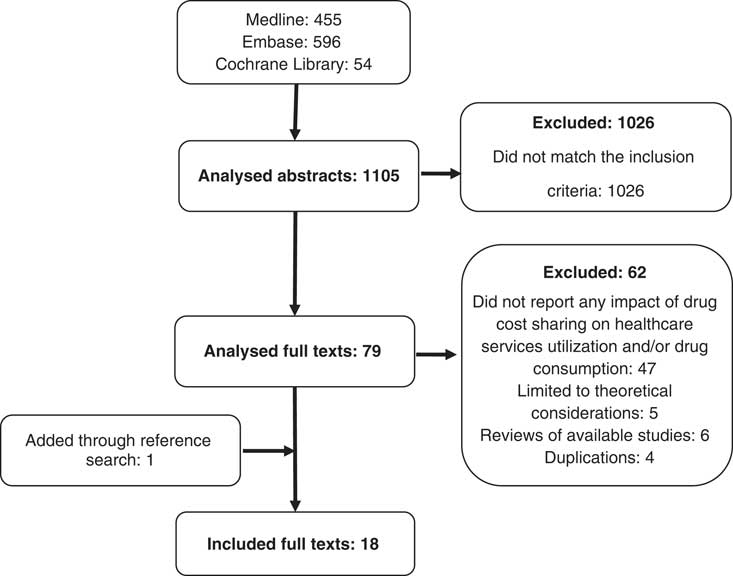
The systematic literature search identified 1105 records. Based on title and abstract review, 1026 papers were excluded from further analysis as they did not match the inclusion criteria. In total, 79 articles were assessed for relevance. Full text reviews indicated 62 additional publications that did not fulfill the study objective. The majority of the excluded studies (47) did not report any drug cost sharing making an impact on health care service utilization and/or drug consumption. Others were limited to theoretical considerations (five) or reviews of available studies (six). A total of four duplications were found. One study was identified and added through reference searches. The final review included 18 publications (Figure 1).
Flow chart of the publication selection process.

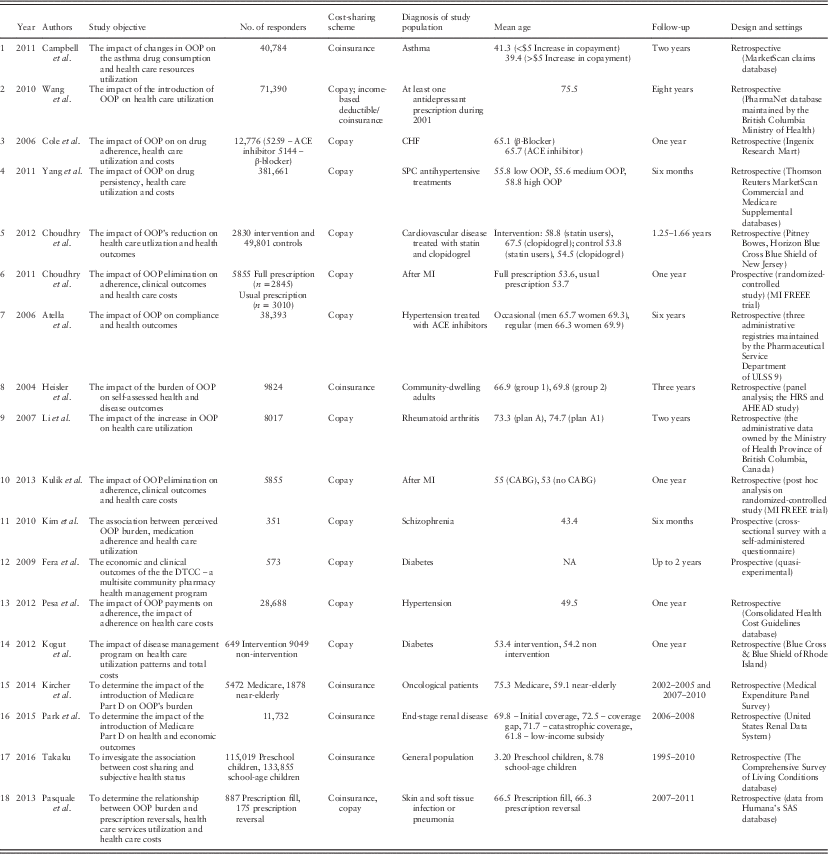
The key characteristics of the included studies are presented in Table 1. The number of patients varied from 573 to 381,661. Out of 18 publications, 15 were retrospective and three were prospective design studies. The majority of retrospective studies were related to US settings (11), and two used Canadian databases. There was also one publication from Japan and also one from Italy. Prospective studies included randomized-controlled trials as well as cross-sectional and quasi-experimental design, all of which were conducted in US settings.
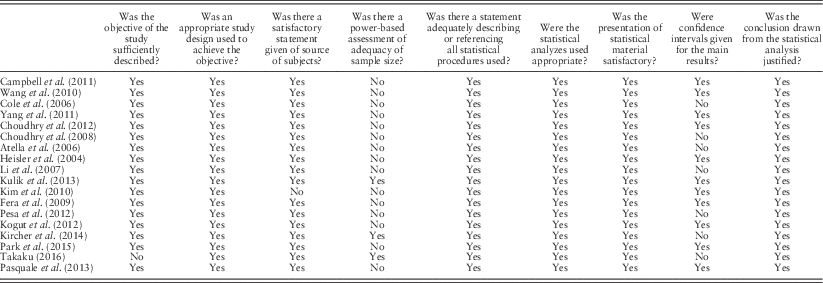
The quality review of included studies with Gardner’s checklist

The follow-up period varied from six months to 15 years. The age of the population studied differed as well. The youngest were preschool children studied by Takaku (average age 3.2) and the oldest were seniors treated with antidepressants analyzed by Wang et al. (average age 75.5) (Wang et al., Reference Wang, Patrick, Dormuth, Maclure, Avorn, Canning and Schneeweiss2010; Takaku, Reference Takaku2016).
The majority of included publications studied the change in copayment mechanisms. Only seven analyzed the impact of coinsurance policies. In one case, the system of deductibles was reviewed.
The analysis of included studies with Gardner’s quality checklist reviewed that the majority of criteria were met successfully in all cases (Table 1). The power-based assessment of adequacy of sample size was the only criterion unfulfilled across most of the included studies. In no case, however did the number of unmet criteria did exceed two, hence no publication was regarded as of poor quality.
As many as 16 out of 18 of the included studies were disease specific and focused on depression, diabetes, rheumatoid arthritis, schizophrenia, asthma, cancer, renal disease and a wide range of cardiovascular failures. The remaining two related to health care recipients in the United States and Japan without any condition-specific indications (Table 2).
Empirical studies included in the review examining the association between OOPs for drugs and health care services consumption as well as health outcomes

OOP=out-of-pocket payments; ACE=angiotensin-converting-enzyme; CHF=chronic heart failure; SPC=single pill combination; HRS=Health and Retirement Study; AHEAD=Asset and Health Dynamics Among the Oldest Old; MI=myocardial infarction; CABG=coronary artery bypass grafting; DTCC=Diabetes Ten City Challenge.
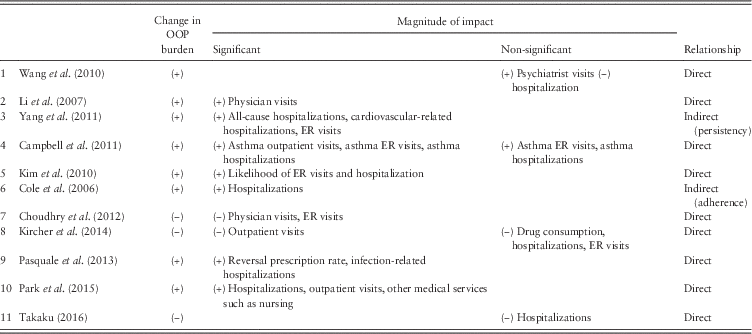
There were 11 publications regarding the association between drug cost sharing and health care utilization patterns, the majority of which reported a direct relationship. An indirect impact through adherence and persistency were the subject of analysis on two occasions (Cole et al., Reference Cole, Norman, Weatherby and Walker2006; Yang et al., Reference Yang, Kahler, Fellers, Orloff, Chang, Bensimon, Wu, Fan and Yu2011). Statistically significant results were found in nine articles. While seven studies analyzed the impact of the increase of drug cost sharing, the remaining two looked into the consequences of its reduction. Outpatient and inpatient services as well as emergency room (ER) visits, were among the health care services affected by the change in the cost-sharing policy (Table 3).
Empirical studies included in the review examining the association between a change in cost sharing for drugs and health care utilization patterns

OOP=out-of-pocket payments; ER=emergency room.
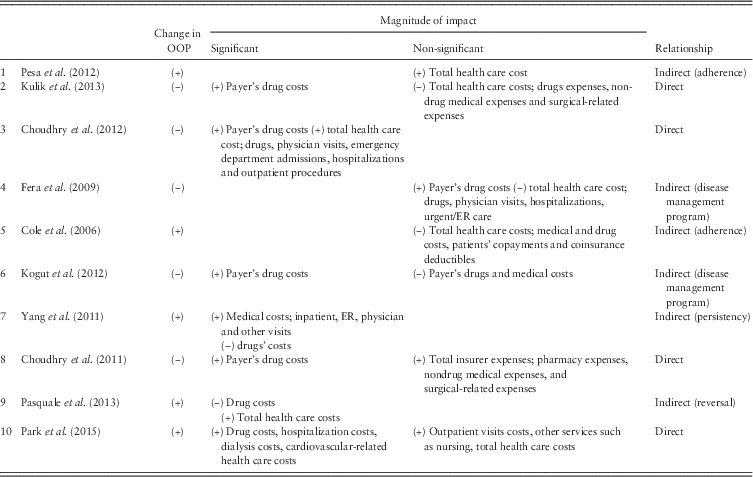
In total, 10 publications were concerned with the association between drug copayments and health care costs (Table 4). While a direct relationship was reported on three occasions, an indirect one was studied in seven cases. In the latter group, four examples looked into the impact of drug cost sharing through adherence and persistency, two related to disease management programs and one was concerned with prescription reversal. The association was found statistically significant in seven articles, of which four reported an impact beyond the drug budget itself. In the first case, Choudhry et al. (Reference Choudhry, Avorn, Glynn, Antman, Schneeweiss, Toscano, Reisman, Fernandes, Spettell, Lee, Levin, Brennan and Shrank2012) found an 8% increase in both medical and drug costs after drug copayment reduction for statin patients. At the same time, however, no significant impact was found with respect to the total spending related to the budgets of both payers and patients (Choudhry et al., Reference Choudhry, Avorn, Glynn, Antman, Schneeweiss, Toscano, Reisman, Fernandes, Spettell, Lee, Levin, Brennan and Shrank2012). In the second case, Yang et al. reported that persistency was lowest among those with high copayments, which resulted in an additional three-month health care cost increase of $277 as measured by the change from the baseline (Yang et al., Reference Yang, Kahler, Fellers, Orloff, Chang, Bensimon, Wu, Fan and Yu2011). The third example was the one presented by Pasquale et al., who compared total health care costs incurred in the 30 days following hospital discharge for skin and soft-tissue infections or pneumonia patients for the group who could not afford treatment with oral linezolid vs the group who filled in the prescription. The results indicated significantly higher total costs for the former group (Fowler et al., Reference Fowler, Chen, Thurton, Men, Rodriguez and Donohue2013). Finally, Park et al.’s study showed that those dialysis patients without low-income subsidy who reached the Medicare coverage gap tended to have 9% higher hospitalization costs compared with those who received a low-income subsidy (Park et al., Reference Park, Rascati, Lawson, Barner, Richards and Malone2015).
Empirical studies included in the review examining the association between a change in cost sharing for drugs and health care costs

OOP=out-of-pocket payments; ER=emergency room.
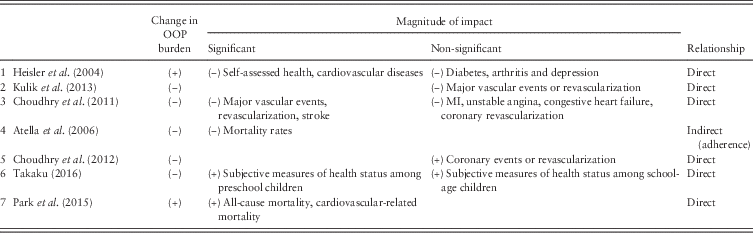
With respect to the association between drug cost sharing and health outcomes, seven publications were identified, of which six studied the direct and one studied the indirect relationship, respectively. In total, five articles reported statistically significant results. Choudhry et al. (Reference Choudhry, Patrick, Antman, Avorn and Shrank2011) demonstrated how a decrease in copayment levels leads to a reduction in the rates of cardiovascular events (Choudhry et al., Reference Choudhry, Patrick, Antman, Avorn and Shrank2011). Park et al. (Reference Park, Rascati, Lawson, Barner, Richards and Malone2015) and Atella et al. (Reference Atella, Peracchi, Depalo and Rossetti2006) revealed a significant relationship between drug cost sharing and mortality rates. Heisler et al. (Reference Heisler, Langa, Eby, Fendrick, Kabeto and Piette2004) and Takaku (Reference Takaku2016) found that the perceived OOP burden impacted self-assessed health in a statistically significant manner (Table 5).
Empirical studies included in the review examining the association between a change in cost sharing for drugs and health outcomes

OOP=out-of-pocket payments; MI=myocardial infarction.
Discussion
The review provided an interesting insight into the association between OOPs for pharmaceutical and health care consumption, and health care costs, as well as health outcomes. Across OECD countries, drug cost sharing constitutes on average 17% of total health care spending (OECD, 2015). The data indicates that the average OOP payment per capita grew from 220 US$PPP in 1990 to 713 US$PPP in 2011. There are a number of jurisdictions such as South Korea, Canada, Ireland, Spain, Switzerland and the United States where OOP payments have increased by more than 400 US$PPP in the last 20 years. In Switzerland and the United States the proportion of poor adults reporting private drug expenditures above 1000 USD per capita and year was 20 and 29%, respectively (OECD, 2009). Health care financing through direct patient contributions can especially be observed with respect to the reimbursement of pharmaceutical care. OECD data reveals that as much as 46% of the total spending on drugs comes from private sources (OECD, 2013).
Although the role of OOP payments is growing, their association with health outcomes and health care utilization patterns and costs has not yet been extensively studied. Only 18 studies were identified through the literature search, and the majority of these were retrospective in design. Accessibility of data seems to be the major obstacle to this kind of research. It requires longitudinal follow-up, which is scarce, especially in Europe. Among the included studies, there was only one conducted in a European setting. Unsurprisingly, 14 out of 18 studies related to the US market where claims data are commonly used for research purposes. In addition to that, there were also two publications concerning Canadian and one concerning Japanese settings.
Our descriptive literature review provides a new insight into the association between OOP payments for drugs and health care utilization patterns, as well as health care costs and health outcomes. In order to address the objective of the study, there are three key findings that should be highlighted.
First of all, the most impactful results reported were with respect to the impact of OOP pharmaceutical payments on health care utilization patterns. As many as nine out of 11 studies found statistically significant associations between drug cost sharing and the consumption of medical services. Interestingly, the majority of included publications focused on the consequences of an increase in OOP drug payments. The findings suggest that the bigger the OOP burden the fewer prescriptions filled, but the higher demand for health care services, such as outpatient and ER lists, as well as hospitalization. As Li argues, prescription drugs and physician visits are economic substitutes (Li et al., Reference Li, Guh, Lacaille, Esdaile and Anis2007). The underlying hypothesis is that an OOP burden may impact health state due to fewer drugs taken, and therefore may trigger patients to see physicians more often. As long as health care services are free of charge, patients are more likely to seek substitute treatment modalities for unacceptable drug costs. Such conclusions bear a lot of resemblance to the evidence published earlier. Soumerai et al.’s study revealed that the introduction of reimbursement limits for schizophrenia patients resulted in the reduction of psychiatric drug spending of $5.14 per Medicaid beneficiary per month. This was, however, more than offset by a corresponding increase of $139/month for the use of other psychiatric services (Soumerai et al., Reference Soumerai, McLaughlin, Ross-Degnan, Casteris and Bollini1994). Based on the review of 30 studies published in the period from 1974 to 2005, Gibson et al. also reported similar findings. They concluded that an increase in drug cost sharing significantly increased hospital admission rates for diabetes mellitus and older patients, although the opposite was found regarding congestive heart failure or coronary artery disease (Gibson et al., Reference Gibson, Ozminkowski and Goetzel2005).
Second, our review provided some evidence for the inverse relationship between OOP payments for pharmaceutical and health care costs. In total, seven out of 10 studies reported statistically significant results in this respect. It has to be noted however that the majority of cases were limited to the analysis of the association between the payer’s drug budget and pharmaceutical cost sharing. Similarly to our results, the analysis published by Engelhardt and Gruber showed that the introduction of Medicare part D resulted in a lower OOP burden but higher total pharmaceutical expenses. A reduction in OOP payment of 34 cent was associated with a one dollar increase in public spending on drugs (Engelhardt and Gruber, Reference Engelhardt and Gruber2011). As experts indicate, the larger the proportion of income spent on drugs, the higher the price elasticity (Lexchin and Grootendorst, Reference Lexchin and Grootendorst2004).
Interestingly, among the 10 articles included in our review with a focus on the relationship between total costs and drug cost sharing, only two reported statistically significant results. The first was a study by Pasquale et al. that looked into the consequences of excessive OOP drug expenditures. This study demonstrated that reversal patients had both adjusted mean medical costs and total health care costs significantly higher compared with those who filled in their linezolid prescriptions (Fowler et al., Reference Fowler, Chen, Thurton, Men, Rodriguez and Donohue2013). The second was a study published by Choudhry et al. that focused on the impact of a decrease in OOP drug spending, which showed that the reduction in copayments for cardiovascular medications increased total relative costs for insurers by 8% for statin patients. It should be underlined, however, that neither medical expense alone nor combined insurer and patient costs changed in a significant manner (Choudhry et al., Reference Choudhry, Avorn, Glynn, Antman, Schneeweiss, Toscano, Reisman, Fernandes, Spettell, Lee, Levin, Brennan and Shrank2012). Interestingly, among the studies analyzing the relationship between total costs and drug cost sharing, two found that a reduction in OOPs for drugs actually lead to lower utilization of outpatient visits (Choudhry et al., Reference Choudhry, Avorn, Glynn, Antman, Schneeweiss, Toscano, Reisman, Fernandes, Spettell, Lee, Levin, Brennan and Shrank2012; Kircher et al., Reference Kircher, Johansen, Nimeiri, Richardson and Davis2014). Evoking the definition of moral hazard, it is however rational to expect that less costly access to health care would lead to the excessive use of medical services and consequently increase the total health care budget. There is an example of a study published by Lillard et al. (Reference Lillard, Rogowski and Kington1999) that provides strong evidence for such a hypothesis. It was found that the introduction of supplementary drug coverage for Medicare beneficiaries before Part D implementation increased total health care spending by 20%. Given such mixed evidence, it is premature to conclude that a health policy aimed at a decrease in OOPs could be regarded as cost neutral with respect to overall health spending. The hypothesis of the inverse relationship between drug cost sharing and total costs cannot be thoroughly rejected either, and should be further explored in future research.
Third, this review tends to suggest that a decrease in the burden of OOPs might also improve patient health outcomes. Among seven studies that looked into this particular relationship, two did not find any association and five delivered statistically significant results. Three types of health outcomes were mainly reported. These were: subjective health, cardiovascular events and mortality. In the first group, it was the analysis conducted by Heisler et al. that revealed that those who experienced a burden of OOPs had relatively worse self-assessed health compared with others (OR 1.76; CI 1.27–2.44). Similarly, the results of Takaku’s (Reference Takaku2016) study were that reduced patient cost sharing translated into the probability of any symptoms being reported lowered by 2.8 percentage points among preschool children.
In the second group the study by Heisler et al. (Reference Heisler, Langa, Eby, Fendrick, Kabeto and Piette2004) reported a direct relationship between the burden of OOPs and cardiovascular outcomes (OR 1.50; CI 1.09–2.07) and Choudhry et al. (Reference Choudhry, Patrick, Antman, Avorn and Shrank2011) found that elimination of OOPs reduced the incidence of major vascular events or revascularization and stroke by 11 and 31%, respectively. In the third group, a retrospective database analysis conducted by Atella et al. (Reference Atella, Peracchi, Depalo and Rossetti2006) indicated how the abolishment of OOPs decreased the annual mortality rate from 3.4 to 3.2% for low-compliant patients in Italy. This was similar to the findings by Park et al. (Reference Park, Rascati, Lawson, Barner, Richards and Malone2015) who reported an increased risk of all-cause mortality (38.0% in the coverage-gap group and 24.5% in the group without low-income subsidy) and cardiovascular-related mortality (adequately 17.8 and 12.1%).
The evidence revealed regarding the impact of OOPs on health outcomes, is in line with earlier published studies. In a review conducted by Gibson et al. (Reference Gibson, Ozminkowski and Goetzel2005), a statistically significant decline in health status was found after an increase in Medicare copayment levels. At the same time, however, no association was found between a 25% coinsurance charge and mortality rates in Quebec. In addition to Gibson’s findings, Baker et al.’s (Reference Baker, Sudano, Albert, Borawski and Dor2001) study of the Health and Retirement Study showed an increased risk of a decline in overall health over four years as a result of lack of health insurance.
Although our study provides some insights into the consequences of drug cost sharing, our conclusions need to be tempered by the limitations of the review performed.
First, the majority of the identified studies were designed retrospectively based on claims data in US settings. Consequently, there might be jurisdiction specific bias introduced. More importantly however, some unobserved characteristics within the study population could bias the estimated effect of changes in drug cost sharing as well. For example, we could not consider whether patients behaved differently due to their comorbidities or the accessibility of OTC medications (Landsman et al., Reference Landsman, Yu, Liu, Teutsch and Berger2005). In addition to that, the change in cost sharing for one particular drug group might have an indirect effect on the consumption of pharmaceuticals in other disease areas which we did not account for. Unknown differences between intervention and control groups could have potentially biased our findings as well.
Second, a large number of the research studies included were disease specific which may limit the generalizability of the findings to other settings. In addition, the average age did not vary much, especially leaving the younger population outside of the scope of the review.
Third, an insufficient follow-up period may raise concerns about the long-term impacts of drug fees remaining unobserved.
Finally, there might be other studies fulfilling the inclusion criteria that were reported in ‘grey literature’ and hence unintentionally excluded from the review.
Despite the number of limitations, this review provides a valuable insight into the role of drug cost sharing in the health care system.
Although exploratory analysis was outside the scope of this review, it became apparent that adherence to medications plays a major role in the association between drug cost sharing and health care utilization patterns. The World Health Organization advocates compliance being an important contributor in ensuring effective pharmacological treatment in medical practice (Sabaté, Reference Sabaté2003). The elimination of OOP payments for drugs has been regarded as a method for reducing health spending in some patient groups through improved adherence (Choudhry et al., Reference Choudhry, Fischer, Avorn, Schneeweiss, Solomon, Berman, Jan, Liu, Lii, Brookhart, Mahoney and Shrank2010). As some experts have rightly pointed out, the problem of noncompliance is multifaceted and cannot simply be solved by the elimination of drug cost sharing. It must be addressed by other means as well, which should include, but not be limited to, follow-up appointments such as telephone calls (Hagström et al., Reference Hagström, Mattsson, Rost and Gunnarsson2004). Some experts recognize a decrease in OOP payments for drugs as a method of improving access to medical services as well. Value-based insurance design is a new approach in this respect. It does not only attempt to change out-of-pocket spending to increase medication adherence. It is a tool that selectively encourages or discourages the use of specific health care services based on their potential benefit to patient health, relative to their cost (Chernew et al., Reference Chernew, Juster, Shah, Wegh, Rosenberg, Rosen, Sokol, Yu-Isenberg and Fendrick2010). In other words, it uses OOP payments for pharmaceuticals as a tool to optimize the utilization of health care services and to ensure effective allocation of limited health care resources. The importance of adherence does not need to defend itself any longer. Value-based insurance design and other approaches will most probably gain more traction in the future due to the search for ways to secure optimal reimbursement of health care services with limited financial restrictions for patients.
Our review revealed that OOP payments for pharmaceuticals constitute an important health policy tool. Thus, various implications for the organization of health care systems may follow from the way it is deployed. On the one hand, OOPs are an important source of health care financing. On the other hand, excessive cost sharing may deter patients from the consumption of drugs and therefore may lead to irreversible and expensive disease consequences. Not only should health care policy makers plan cost-sharing policy from the perspective of the payers, but also from the viewpoint of patients. There are at least two reasons for this.
First of all, copayments for pharmaceuticals may limit the drug consumption of patients in the short term but create unexpected demand for healthcare services in the longer term. Unpreventable disease progression could be more expensive than the planned cash inflow from cost sharing.
Second, a drug cost-sharing policy adapted to a patient’s perspective will allow the achievement of an ultimate objective of the health care system, which is the improvement of individual health. As some experts claim, the reduction of financial burden to the patient may be regarded as a valuable approach to improving the health status of the general population (Choudhry et al., Reference Choudhry, Fischer, Avorn, Lee, Schneeweiss, Solomon, Berman, Jan, Lii, Mahoney and Shrank2008). It has a significant importance, especially when one considers equity in access to medicines as an important objective of a health care system.
In summary, this systematic review sheds new light on the impact of the burden of OOPs on the overall effectiveness of health care systems. It provides evidence that drug cost sharing may produce consequences that go beyond the household budget of the patient. The optimal system of OOP payments for pharmaceuticals needs to be designed from a holistic perspective. On the one hand, it has to prevent drug overconsumption, and on the other hand, it has to mitigate the risks of excessive burdens of OOPs.
Acknowledgment
None.
Financial Support
This research received no specific grant from any funding agency, commercial or not-for-profit sectors.
Supplementary materials
To view supplementary material for this article, please visit https://doi.org/10.1017/S1744133116000335