Introduction
Historical documentation of the third millennium BC occupation of the ancient city of Nigin, modern Tell Zurghul, in the ancient State of Lagash is attested thanks to the large amount of data provided by cuneiform sources of the rulers of the First Dynasty of Lagash.Footnote 1 However, recent excavations at the site by the Italian archaeological expedition of Sapienza University of Rome and the University of Perugia have so far yielded little archaeologically stratified evidence of the third millennium BC phases of Nigin:Footnote 2 in particular, no stratified and contextualised evidence of the mid- and second half of the third millennium BC (corresponding, in Mesopotamian terms, to the Early Dynastic Period IIIa–b) has been clearly and extensively identified. Indeed, the only third millennium occupational levels hitherto excavated date from the very beginning of the millennium: in Area A, a multi-functional building shows a quite extensive and well-preserved phase dated to the Jemdet Nasr Period and a phase (not fully investigated yet and partially covering the old levels) dated to the Early Dynastic I.Footnote 3 Another operation in Area A (trench 1), at the time of the first season of excavation in 2015, also yielded archaeologically stratified materials dating from the Early Dynastic Period (with pottery samples actually fitting in with the repertoire of the Early Dynastic Period III):Footnote 4 however, this context is mainly the result of accumulation levels with materials that have been dragged from more northerly areas by heavy winter rain.
Next to the pottery collected in the strata, that is in fact the widest archaeological evidence of the third millennium occupation of Nigin as verified in the field, other types of artefacts also point to the phase of the Early Dynastic Period at Nigin: two fragmentary pieces of sculpture, a broken cylinder seal, and four fragments of inscribed bricks. Not only are these iconographic and epigraphic documents fragmentary and incomplete, but they come from non-stratified or disturbed contexts and for this reason they provide indirect information (via the analysis of the iconography and the content of the stamped text) on the occupation at Nigin during the Early Dynastic Period.
All bricks and the fragment of a relief plaque were collected in the fill (stratum 812) of the large squared sounding that occupies the top of the small mound B;Footnote 5 the small piece of statue and the broken cylinder seal come from two surface strata (201 and 207) in Area E, on the southern slope of the main mound A of the site, and they are probably the result of landslip and erosion caused by deep, small streams that actually “excavated” lower earlier deposits.Footnote 6
The Visual Evidence
Although fragmentary, the three pieces of evidence of Early Dynastic art from Nigin not only confirm the already-known phase of occupation of the site during the third millennium BC, but they specifically point to a royal commitment. Indeed, one can even argue that the two preserved representations of human characters actually portray royal figures, while the third fragment could be quite reasonably attributed to a royal (or divine) statue. Based on stylistic considerations, all fragments can be dated to the late phase of the Early Dynastic Period, namely the Early Dynastic Period IIIb at the time of the rulers of the First Dynasty of Lagash.Footnote 7
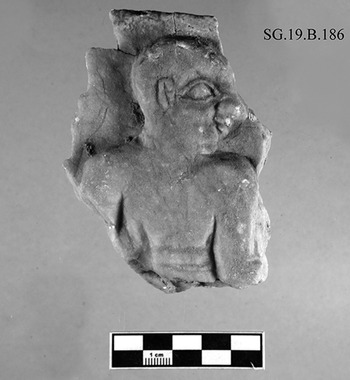
The fragment SG.19.B.186 (Fig. 1), broken on all sides, depicts a male figure. The head and the bust are fully preserved, while the left arm, the right forearm, and the lower part of the body are missing:Footnote 8 the object is clearly part of a typical limestone plaque relief of the Early Dynastic Period,Footnote 9 a very common and widespread type of item whose function, despite the wide diffusion in ancient Mesopotamia, is still enigmatic.Footnote 10 Although the drawing of the lines and shapes, particularly the details of the nose and mouth, are very smoothed,Footnote 11 the image recalls the contemporary plaque of Ur-Nanshe of Lagash where the ruler is depicted twice, standing with the basket on his head, and seated with a cup in his raised right hand.Footnote 12 Due to the state of preservation, it is quite difficult to reconstruct the original posture of the figure. Due to comparisons with the contemporary plaques from Girsu,Footnote 13 the male character can certainly be identified with one of the rulers of the First Dynasty of Lagash who, as we know from their royal inscriptions,Footnote 14 were actively involved at Nigin with extensive building programmes (the temple Sirara of the city goddess Nanshe and related structures as well as the digging of canals).Footnote 15
Fragment of plaque relief from Area B, SG.19.B.186 (photo of the Italian archaeological expedition to Nigin).

The figure is bare-headed and beardless and the portrayal fits with the common Sumerian visual conventions: head in profile, frontal view chest. Two horizontal parallel incisions might vividly indicate either the abdominals or part of the belt of the usual long tufted wool skirt. Unfortunately, the original position of the arms is completely missing, but I would like to suggest a possible interpretation. Observing the width of the chest, I would suggest that the male figure is represented seated, like Ur-Nanshe in the lower register of the plaque from Girsu.Footnote 16 Keeping the comparison with the plaque from Girsu, the left arm, stretched forward and slightly bent, was probably held in front of the face, raising a cup in his hand; the right arm was probably also bent, resting on the stomach. According to this hypothetical restoration of the missing parts, the plaque of Nigin enters into the typology of the banquet scene, a very common figurative theme in Early Dynastic Mesopotamian iconography.Footnote 17
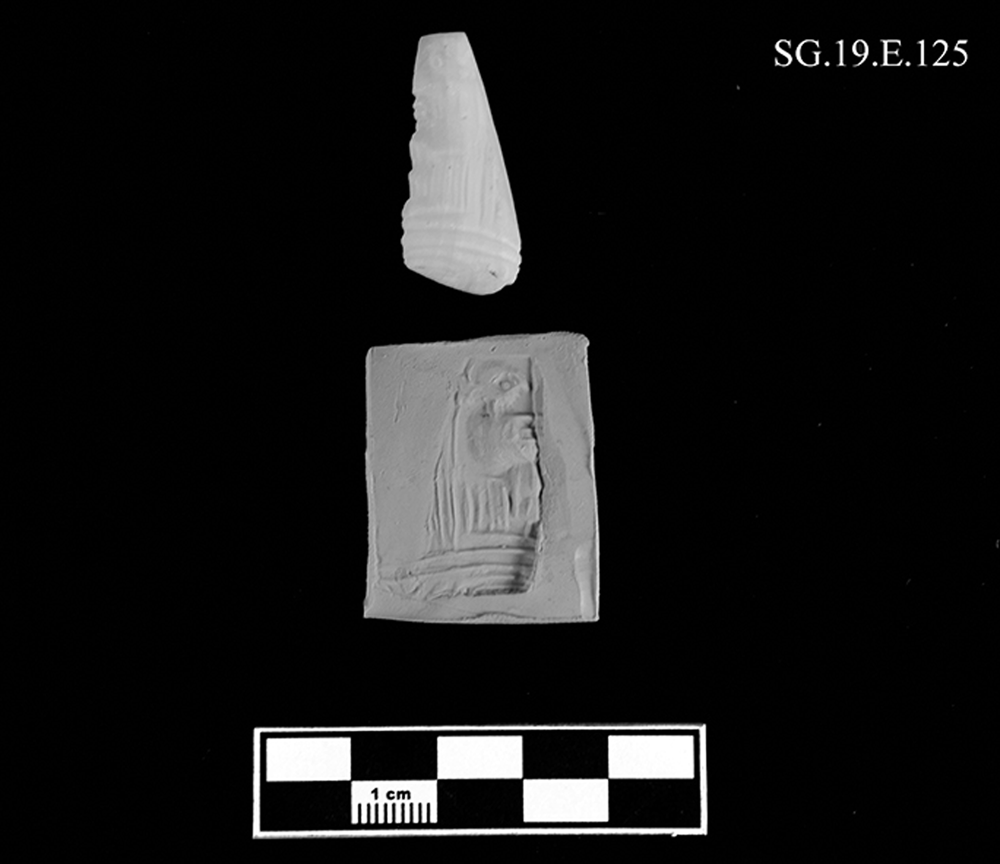
The object SG.19.E.125, a very fragmentary and strongly damaged cylinder seal (Fig. 2), also belongs to the same iconography of the banquet and chronological frame of the Early Dynastic Period. Only a very small portion of the original seal, made of white marble, is preserved.Footnote 18 Thanks to the double line that is visible at the lower edge, it is possible to reconstruct the original shape of the seal that was made of two registers,Footnote 19 the upper one showing the typical scene of banquet with two protagonists, a woman and a man, seated one in front of the other while drinking from a cup or from a common shared jar by using straws: the seal from Nigin only preserves the representation of the female character, seated on the left, facing right.Footnote 20 The woman wears a long dress that also covers her shoulder and she has her hair tied up.Footnote 21 Women are in fact commonly represented in relief plaques and cylinder seals while banqueting, together with a male counterpart or within a completely female context. When explicitly stated in the short inscriptions carved onto the seals, as for example with those from the Royal Cemetery of Ur, it is easy to identify the female character with the political and social position of queen.Footnote 22 At the same time, even when the inscription is not present, female characters can still be identified with queen and court ladies not only for the type of dress and hairstyle, but also just because they take part in a banquet that, as already mentioned, acquired a significant political meaning in Mesopotamia of the third millennium BC, as both a manifestation and consolidation of the ruling class.Footnote 23
Fragment of cylinder seal from Area E, SG.19.E.125, with modern impression (photo of the Italian archaeological expedition to Nigin).

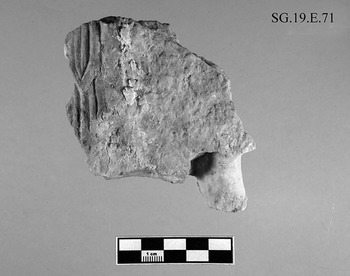
The fragment SG.19.E.71 (Figs. 3–4) is a very fragmentary element of a sculpture, more probably a statue in the round: broken on all sides, it represents two elements of the typical tufted dress (kaunakès).Footnote 24 The shape of the fracture actually seems to be a chip that has been intentionally broken. It is interesting to notice the presence of a sort of pivot and a small regular squared recess that seem to suggest that the piece was assembled into a larger composition.Footnote 25 The state of preservation, however, does not allow for any further more reliable possible interpretation.
Fragment of sculpture from Area E, SG.19.E.71, side view (photo of the Italian archaeological expedition to Nigin).

Fragment of sculpture from Area E, SG.19.E.71, frontal view (photo of the Italian archaeological expedition to Nigin).

The Epigraphic Evidence: Enmetena and the Gigunamah of Nanshe
Four fragments of inscribed bricks have been recovered out of context in the fill of a sounding at the top of mound B (see above).Footnote 26 Two fragments (a, b) bear the same inscription. The lines kept in the other two (c, d) may well be part of the same inscription of a and b. This is a previously unknown Early Dynastic IIIb inscription from the ruler of the First Dynasty of Lagash (Lagash I), Enmetena.Footnote 27
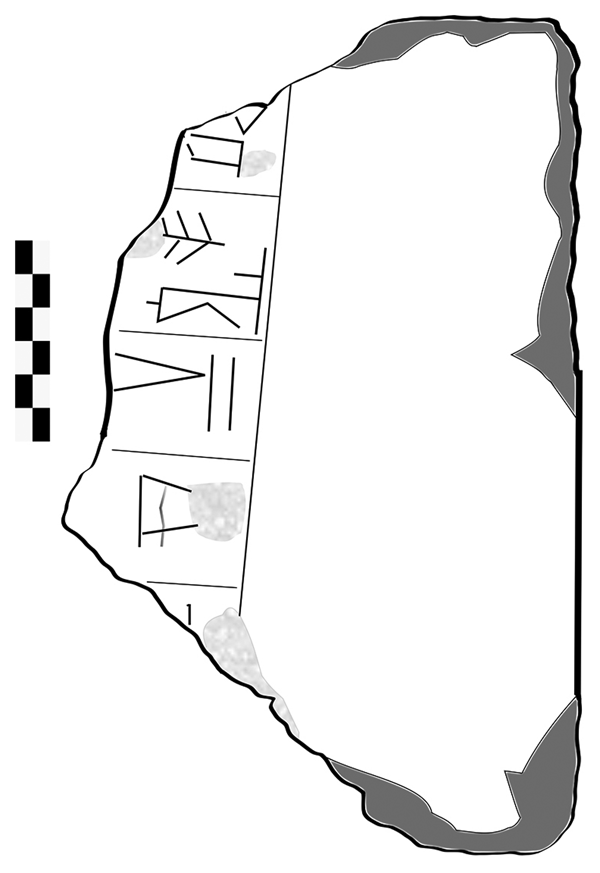
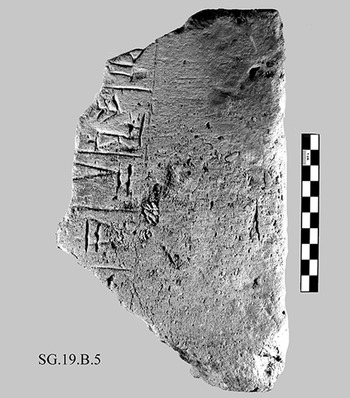
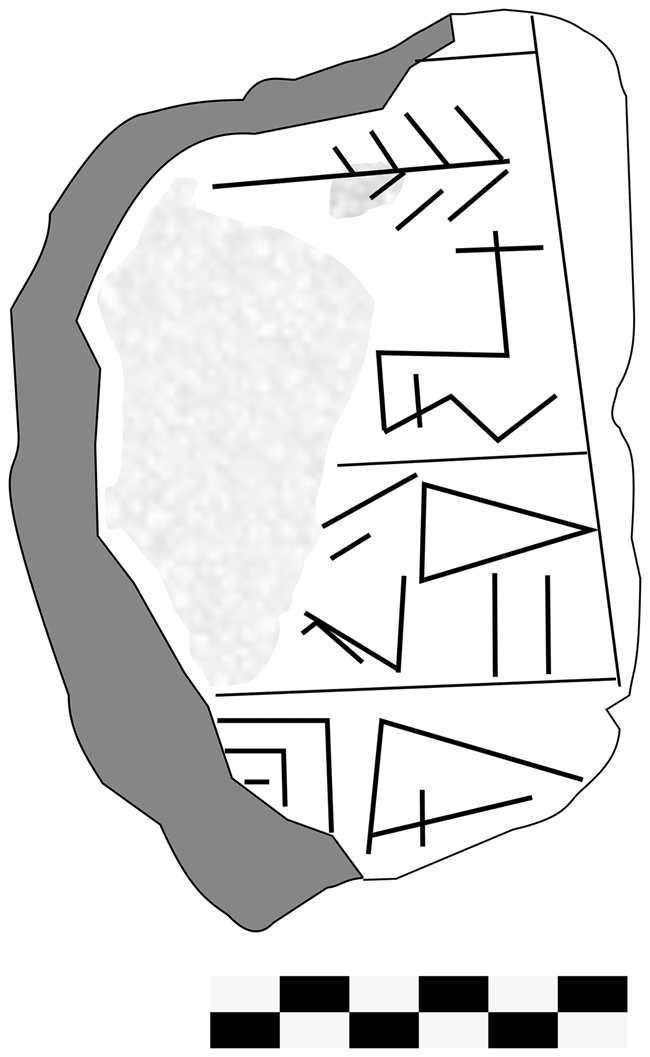
Of these the item numbered SG.19.B.5 (= a; H 21.5 cm, W 13.2 cm, THK 5.8 cm; Figs. 5–6) is the biggest fragment. The preserved part is the right border of the second of a two-column inscription. The upper border of the first and last case is not preserved, but from the shape and dimension of the fragment we can argue that the entire column is preserved in its length. This was composed of five cases or lines.
Drawing of the brick SG.19.B.5 by Lorenzo Verderame.

Fragment of baked brick from Area B, SG.19.B.5 (photo of the Italian archaeological expedition to Nigin).

i
(broken)
ii
1 [lagaš] ˹ki˺/-[k]aFootnote 28
2 [lu2 g]i/-[gu3-na]-mah
3 [… d]u3-a
4 [diĝir-ra]-ni
5 [dšu]l/-[MUŠxPA]
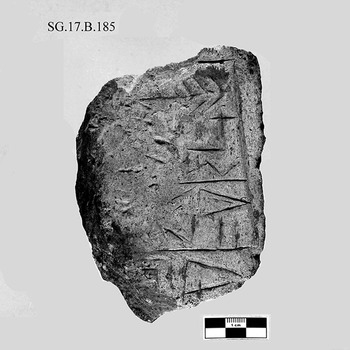
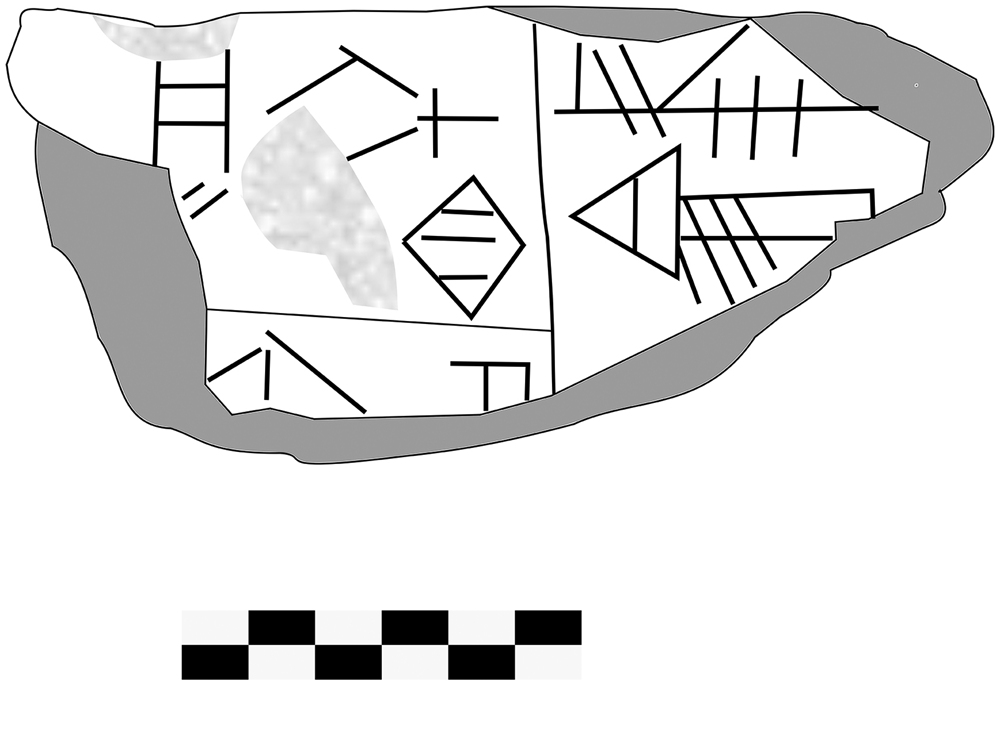
The fragment SG.17.B.185 (= b; H 13.6 cm; W 8.5 cm; THK 4.7 cm; Figs. 7–8) keeps part of the second column as well and it is parallel to the line 2-4 of SG.19.B.5 (a). Some signs are better preserved and help the reconstruction of the inscription. In l. 3, the broken sign may be the end of an AB shaped sign and could be possibly the sign for Nanše (ABxHA). The RA partially preserved in l. 4, followed by NI, is part of the expression «Šul-MUŠxPA is his god» (diĝir-ra-ni dšul-MUŠxPA),Footnote 29 common in the inscriptions of Enmetena, as well as in those of other rulers of Lagash I. The broken sign of SG.19.B.5 (a): ii 5, is a vertical wedge, which could be the end of the sign ŠUL.
Drawing of the brick SG.17.B.185 by Lorenzo Verderame.

Fragment of baked brick from Area B, SG.17.B.185 (photo of the Italian archaeological expedition to Nigin).

i
(broken)
ii
1 […]
2 [lu2] gi/-[gu3-na]-mah
3 [dnan]še du3-a
4 [diĝir-r]a-ni
(broken)
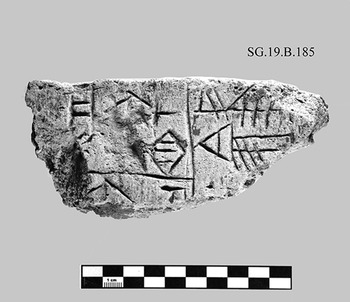
SG.19.B.185 (= c; H 12 cm, W 6.5 cm, THK 5.5 cm; Figs. 9–10) keeps two cases of the first column and one of the second. Thus, it is the piece that allows us to join, besides hypothetically, the four fragments together. The name and title of the dedicant, Enmetena ensi of Lagash, is preserved in the first column's cases. The signs LU2 and KA in the case of the second column complete the second line of the second column of SG.17.B.185 (b) and SG.19.B.5 (a).
Drawing of the brick SG.19.B.185 by Lorenzo Verderame.

Fragment of baked brick from Area B, SG.19.B.185 (photo of the Italian archaeological expedition to Nigin).

i
1 [e]n-me:te-na
2’ ensi2([PA].˹TE.SI˺)-
3’ [lagaški]
(broken)
ii
1 […]
2 lu2 [gi]/-gu3-[na-mah]
(broken)
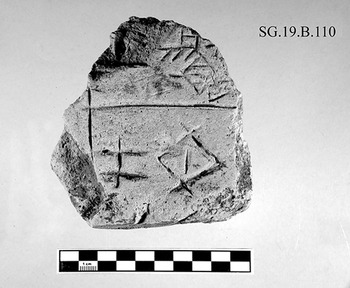
The lines of the fragment SG.19.B.110 (= d; H 9.2 cm; W 10.2 cm; THK 3.4 cm; Figs. 11–12) belong to the first column. The two preserved cases contain the name and part of the title of the fourth ruler of Lagash, Enannatum (I), father and predecessor of Enmetena. In the gap at the beginning of the first case there is enough space for a sign before the name of Enannatum. Being the title “son of Enannatum” (dumu en-an-na-tum2) common in the inscriptions of Enmetena, we can conclude that the fragment belongs to a commemorative inscription of this ruler. It has no parallel in the previous fragments, but it is plausible that it is part of the same inscription or even of the same brick.Footnote 30
Drawing of the brick SG.19.B.110 by Lorenzo Verderame.

Fragment of baked brick from Area B, SG.19.B.110 (photo of the Italian archaeological expedition to Nigin).

i
1’ [en-me:te-na]
2’ [ensi2-]
3’ [lagaški]
4’ [dumu] ˹en˺-a[n]/-na-tu[m2]
5’ ensi2(PA.TE.[SI])-
[(…)]
ii
-
(broken)
After ensi2 we expect a case containing the name of Lagash. The bottom line of the last case is broken. We cannot ascertain if the inscription continued with other cases in the first column or at the beginning of the second column. This latter option may solve the gap and the broken signs in the first case of the second column kept only in SG.19.B.5 (a), where the name of Lagash could be restored ([lagaš]˹ki˺/-[k]a).
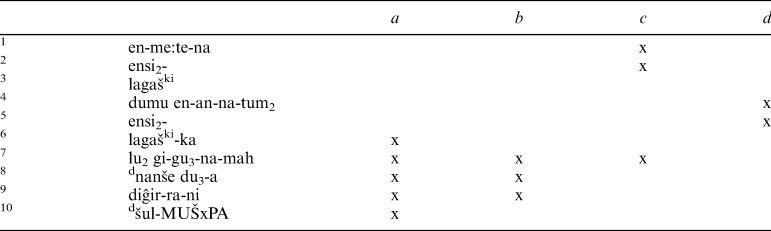
The following reconstruction of the inscription from the four fragments is hypothetical (Table 1). Particularly dubious are the beginning and the gap between the first and second column. The upper border of the first case of SG.19.B.185 (c) is not preserved and we don't know if this was the first line of the inscription or it was preceded by two lines containing the name and epithet of the god/ddess to whom the inscription was dedicated. However, the available space and the parallel with another inscription of EnmetenaFootnote 31 with similar structure supports the former hypothesis.
Hypothetical reconstruction of the inscription of Enmetena

The inscription would commemorate the building of the giguna-mah of NansheFootnote 32 by Enmetena, which is recalled in other inscriptions of this ruler.Footnote 33 While other gigunas are known from the same period, i.e. that of Ningirsu and that of Ninhursaga/Ninmah in the “sacred grove” (tir-ku3-ga),Footnote 34 only the giguna of Nanshe is called mah “great, lofty.”
The “lofty” temple terrace (giguna) of Nanshe is first mentioned in an inscription of Eannatum, who provided for Nanshe the “lofty giguna” with regular offerings.Footnote 35 Thus, the construction of the “lofty giguna” of Nanshe is to be ascribed to Eannatum, or one of the previous rulers, and Enmetena would have only rebuilt the structure.
Where was the “lofty giguna” of Nanshe located? The goddess had four main sanctuaries: the Sirara in Nigin; the Engur(ra) in Sulum; the Shagepada in Lagash; the Sheshegara in Girsu.Footnote 36 None of the texts mentioning the “lofty giguna” refer to the place where it was or gives any clue to its location. All scholars who have expressed an opinion regarding the matter are agreed in locating the “lofty giguna” in Nigin,Footnote 37 besides the lack of arguments in favour, which is now provided by the inscribed bricks here published.
Conclusion
The fragmentary evidence of the Early Dynastic Period at Nigin, as far as it is possible to reconstruct from the analysis of the data presented here, confirms the information available from the inscriptions of the rulers of the First Dynasty of Lagash and, at the same time, it provides further evidence for the existence of buildings and artefacts of the Early Dynastic Period. However, due to the state of preservation of the documents (fragments of sculpture and broken inscribed bricks that originally had to belong to buildings that are, very likely, no longer existing or are badly preserved), it seems plausible to suggest that a part of the Early Dynastic city has been destroyed or at least severely damaged. In any case, only further archaeological investigations, for example in Area A where a phase of occupation dating from the Early Dynastic Period I has already been identified, can bring additional data and clarify the state of preservation and the extension of the city in Early Dynastic Period: for example, whether the giguna was somehow linked to the main temple of the goddess Nanshe, and then its location on or nearby the main mound A could be plausible. Finally, because the bricks can be attributed to the ruler Enmetena of Lagash, one can therefore suggest that this is the king to be recognised in the male character depicted on the relief plaque: as a matter of fact, the bricks and the plaque relief all come from the same, disturbed, stratum of Area B, but they probably originally belonged to the same context.