Implications
Recognising the different roles played by livestock in the developing and the developed world is essential to understand the impact of livestock on livelihoods, economic development and the environment. The importance of this paper lies in providing a balanced account of the roles of livestock in developing countries. This kind of information is necessary to dissect the key issues in the often, ill-informed or generalised discussion on the current and future roles of livestock. Only by understanding the nuances in these roles will we be able to design more sustainable solutions for the sector.
Introduction
We are at a moment in time where our actions could be decisive for the resilience of the world food system, the environment and a billion poor people in the developing world, let alone for the fate of our planet. The society has realised that there are significant pressures on the world's food and ecological systems, where the alterations of global biogeochemical cycles could be irreversible and where new drivers, such as climate change, are likely to exert additional pressures for sustainably feeding 9 billion people in the future. At the same time, and especially in the developing world, the demand for livestock products is increasing, thus adding additional pressures on the world natural resources. Not surprisingly, the world is asking a big question: what should we do about livestock? There is an urgency to reduce the environmental footprint of livestock production while the world evaluates the choices for sustainably feeding the human population in the future.
This question requires a sophisticated and disaggregated answer. The sector is large. There are 17 billion animals in the world eating, excreting and using substantial amounts of natural resources, mostly in the developing world, where most of the growth of the sector will occur. The roles of livestock in the developing world are many, spanning from the social to the economic, to the environmental. At the same time, they can be positive (i.e. income) or negative (i.e. pollution). These roles can shift depending on location. For example, livestock can be polluters in one place, whereas in another they provide vital nutrients for supporting crop production. The picture is complex. Whether for its positive or negative roles, livestock are in the spotlight. It is essential to dissect the discussion on the roles of livestock, as the economic development of different countries, their structure of production, the demand for livestock products, the competition with other sectors and others shape these roles, making broad generalisations about the livestock sector useless (and dangerous) for informing the current global debates on food security and the environment. It is essential to deliver nuanced, scientifically informed messages about livestock's roles in relation to food systems, livelihoods and their economic and environmental performance.
This paper reviews the positive and negative roles of livestock in the developing world. It also discusses key factors that are likely to determine the future contribution of the sector to food security, environmental protection and economic growth. The paper proposes key actions for improving different aspects of livestock systems so that the positive roles outweigh the negatives.
Livestock and its socio-economic roles in developing countries
Livestock production, economics and trade
Livestock production in the developing world occurs in a wide range of heterogeneous production systems. These can range from pastoral/grassland-based systems, which occupy most of the land area and have low human population densities, through mixed crop-livestock systems, usually in areas suitable both for arable and livestock production and where the bulk of rural human population lives, and intensive systems usually in peri-urban/urban areas. Landless systems are also often found in urban areas. All these systems in developing countries produced about 50% of the beef, 41% of the milk, 72% of the lamb, 59% of the pork and 53% of the poultry, globally (Herrero et al., Reference Herrero, Thornton, Gerber and Reid2009). These shares are likely to increase, as most future growth in livestock production is projected to occur in the developing world (Bruinsma, Reference Bruinsma2003; Rosegrant et al,. Reference Rosegrant, Fernandez, Sinha, Alder, Ahammad, de Fraiture, Eickhout, Fonseca, Huang, Koyama, Omezzine, Pingali, Ramirez, Ringler, Robinson, Thornton, van Vuuren, Yana-Shapiro, Ebi, Kruska, Munjal, Narrod, Ray, Sulser, Tamagno, van Oorschot and Zhu2009). Most meat and milk in the developing world comes from mixed systems (Seré and Steinfeld, Reference Seré and Steinfeld1996; Steinfeld et al., Reference Steinfeld, Gerber, Wassenaar, Castel, Rosales and de Haas2006; Herrero et al., Reference Herrero, Thornton, Gerber and Reid2009). These systems play a very important role in global food security, as they also produce close to 50% of the global cereal output (Herrero et al., Reference Herrero, Thornton, Notenbaert, Wood, Msangi, Freeman, Bossio, Dixon, Peters, van de Steeg, Lynam, Parthasarathy Rao, Macmillan, Gerard, McDermott, Seré and Rosegrant2009 and Reference Herrero, Thornton, Gerber and Reid2010). However, the highest rates of increase in animal production observed in the last decades, and forecasted into the future, are in the intensive pig and poultry sectors of the developing world (Delgado et al., Reference Delgado, Rosegrant, Steinfeld, Ehui and Courbois1999; Bruinsma, Reference Bruinsma2003; Steinfeld et al., Reference Steinfeld, Gerber, Wassenaar, Castel, Rosales and de Haas2006).
Livestock production in the developing world is also an important economic activity. Livestock products are high-value products, especially when compared with crops. For example, the average global price of a tonne of red meat is more than 10 times higher than the price of soya bean, whereas that of milk is 70% higher (data from FAOSTAT, 2011). This makes milk and meat to rank as some of the agricultural commodities with the highest gross value of production (VOP) in the developing world (FAOSTAT, 2011). In the last decade, livestock have represented between 17% and 47% of the total agricultural VOP in developing country regions (range defined by South East (SE) Asia and Central America, respectively; FAOSTAT, 2011). Over the last 40 years, the value of livestock production has seen an average 2.7% growth per year in sub-Saharan Africa (SSA), 3.4% in Central America and 4.1% in SE Asia. These indicators of growth compare favourably with, for example, a mean annual growth in VOP of 1.2% in North America over the same period (FAOSTAT, 2011). These growth rates are largely a reflection of increased production in the developing world.
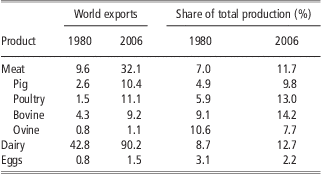
Trade is an important dimension in the economics of livestock. Local consumption dominates livestock product demand, and international trade is relatively small. However, international trade has increased in recent years as a result of trade liberalisation and lack of competitiveness and low technological change in some regions (Table 1; FAO (Food and Agricultural Organization), 2009). Dairy and eggs dominate trade, but meat exports are important for a handful of countries (i.e. Brazil, Thailand; FAO, 2009). Most trade of livestock products occurs within a country, with movements of animal products, inputs and services being very dynamic because of increased internal connectivity, transport networks, improved value chains and the increasing need to supply the growing urban populations.
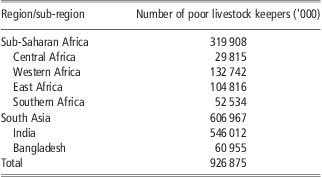
Number of livestock keepers living below US$2 per day
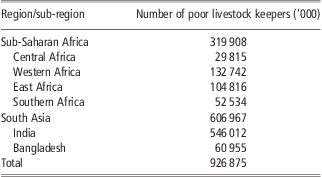
Sources: Staal et al., Reference Staal, Poole, Baltenweck, Mwacharo, Notenbaert, Randolph, Thorpe, Nzuma and Herrero2009 (updated from Thornton et al., Reference Thornton, Kruska, Henninger, Kristjanson, Reid, Atieno, Odero and Ndegwa2002).
Livestock and livelihoods in developing countries
Nearly 1 billion people living on <2 dollars a day in South Asia and SSA keep livestock (Table 2). More than 80% of poor Africans keep livestock, and between 40% and 66% of poor people in India and Bangladesh keep livestock (FAO, 2009).
Global trade in livestock products
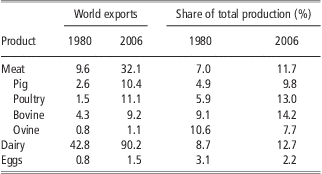
FAO = Food and Agricultural Organization.
Source: FAO (2009).
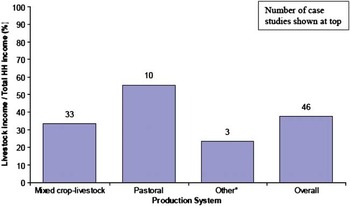
Livestock play multiple roles in supporting livelihoods. One of the most important is as a source of household income. According to nationally representative data from across the developing world, 68% of households earn income from livestock (Davis et al., Reference Davis, Winters, Carletto, Covarrubias, Quinones, Zezza, Stamoulis, Bonomi and DiGiuseppe2007). In their study, consisting mostly of mixed crop-livestock systems in 15 countries, livestock's share of rural household income ranged from 1.6% to 33.8% depending on the livestock-keeping objectives (traction, assets or production), the level of cropping, off-farm income and monetary transfers. The average share of livestock income was lower than that of crops, 12% v. 30%; however, it grew much faster than that of crops. Although the share of income from cropping remained stable or even declined, the share of income from livestock grew by 75% in Ghana between 1992 and 1998, by 110% in Vietnam between 1992 and 1998 and by 290% in Panama between 1997 and 2003 (Davis et al., Reference Davis, Winters, Carletto, Covarrubias, Quinones, Zezza, Stamoulis, Bonomi and DiGiuseppe2007). Staal et al. (Reference Staal, Poole, Baltenweck, Mwacharo, Notenbaert, Randolph, Thorpe, Nzuma and Herrero2009) analysed 92 case studies from the developing world (Figure 1) and found that livestock contributed, on average, 33% of the income in mixed crop-livestock systems, with higher incomes being associated with dairy and poultry production. They also reported average livestock incomes from pastoral production of 55% of total income. In a set of comparative studies with Maasai pastoralists, Burnsilver (Reference Burnsilver2009), Nkedianye et al. (Reference Nkedianye, Kristjanson, Radeny and Herrero2009) and Thompson et al. (Reference Thompson, Serneels, Ole Kaelo and Chevenix Trench2009) found livestock incomes ranging from 37% to 85% of total income. These depended on the level of diversification and market access of the studied groups. Bernues and Herrero (Reference Bernues and Herrero2008) found a similar range of incomes (37% to 88%) from livestock in systems with different degrees of crop-livestock integration and diversification in lowland Bolivia (the more diverse and integrated with crops, the lower the share of the total income; the more specialised towards dairy, the higher the share).
Average income derived from livestock in different production systems. Data from 92 case studies from the developing world. Source: Staal et al. (Reference Staal, Poole, Baltenweck, Mwacharo, Notenbaert, Randolph, Thorpe, Nzuma and Herrero2009).

Although livestock ownership is often seen as a sign of wealth – household typically move up the ‘livestock ladder’ from poultry to goats or sheep, to cattle/buffalo (Dercon and Krishnan, Reference Dercon and Krishnan1996; Ellis and Freeman, Reference Ellis and Freeman2004; Kristjanson et al., Reference Kristjanson, Krishna, Radeny, Kuan, Quilca and Sanchez-Urrelo2005; Deshingkar et al., Reference Deshingkar, Farrington, Rao, Sharma, Freeman and Reddy2008) – livestock's share of income was highest in the poorest income quintile, which shows that they are important to the poor as well (Davis et al., Reference Davis, Winters, Carletto, Covarrubias, Quinones, Zezza, Stamoulis, Bonomi and DiGiuseppe2007).
The growth in demand for milk and meat, mainly driven by urban consumers in developing countries, has been increasing in the last few decades and is projected to double by 2050 (Delgado et al., Reference Delgado, Rosegrant, Steinfeld, Ehui and Courbois1999; Rosegrant et al., Reference Rosegrant, Fernandez, Sinha, Alder, Ahammad, de Fraiture, Eickhout, Fonseca, Huang, Koyama, Omezzine, Pingali, Ramirez, Ringler, Robinson, Thornton, van Vuuren, Yana-Shapiro, Ebi, Kruska, Munjal, Narrod, Ray, Sulser, Tamagno, van Oorschot and Zhu2009). This rising demand for milk, meat, fish and eggs has generated jobs all along the livestock value chain, from input sales through animal production, trading and processing to retail sales.
Trading and processing jobs in the livestock sector are especially high in the informal sectors of countries in Asia and Africa, where most meat, milk, eggs and fish are sold (Grace et al., Reference Grace, Randolph, Olawoye, Dipelou and Kang'ethe2008) and where most of the people selling and buying livestock foods are themselves poor (Omore et al., Reference Omore, Arimi, Kangethe, McDermott, Staal, Ouma, Odhiambo, Mwangi, Aboge, Koroti and Koech2001; Kaitibie et al., Reference Kaitibie, Omore, Rick, Salasya, Hooton, Mwero and Kristjanson2008). Street food is a large part of the informal sector in most developing countries – the largest in South Africa (Perry and Grace, Reference Perry and Grace2009) – and therefore a major source of income and employment for the poor. Animal source foods are among the most commonly sold street foods (Perry and Grace, Reference Perry and Grace2009), and it is poor women who do most of the work preparing and selling these foods. It is estimated that up to 1.3 billion people globally are employed in different livestock product value chains globally (Herrero et al., Reference Herrero, Thornton, Gerber and Reid2009).
Livestock are often one of the main assets that rural households possess. Access to, control over and ownership of assets are critical aspects of well-being (Sherraden, Reference Sherraden1991; Carter and Barrett, Reference Carter and Barrett2006). Assets are stores of wealth that can be sold to finance investments such as school fees or in time of need such as an illness or drought. Assets can act as collateral and facilitate access to credit and financial services, as well as increase social status. In their study of ‘voices of the poor’, Narayan et al. (Reference Narayan, Patel, Schafft, Rademacher and Koch-Schulte2000) found that ‘the poor rarely speak of income, but focus instead on managing assets – physical, human, social and environmental – as a way to cope with their vulnerability’.
Accumulation of livestock assets is commonly followed by a shift to more non-farm income in comparison with farm-related income (Reardon, Reference Reardon1997; Barrett et al., Reference Barrett, Reardon and Webb2001; Ellis and Freeman, Reference Ellis and Freeman2004). For example, in a livelihoods analysis of four African countries by Ellis and Freeman (Reference Ellis and Freeman2004), the highest income quartile of the rural poor was found to have the highest livestock holdings, as well as the highest percentage of total income from non-farm sources. These authors conclude that ‘livestock is a substitutable asset than can be sold in order to invest in land or small businesses, and vice versa, non-farm income can be used to build up herds’.
Across the developing world, people keep livestock to earn income, increase their crop production (animals provide manure for fertilising crop fields and traction for ploughing and transporting goods to markets), store wealth and to feed their families. In the absence of banks and insurance policies, livestock serve as ‘piggy banks’, a way for people to save and store money and manage risk. Despite their multiple benefits, livestock are also associated with negative impacts on health (though food safety or zoonotic disease) and on the environment. Helping household to increase the benefits and minimise the risks associated with livestock can make an important contribution to improving livelihoods and reducing poverty.
Importance of livestock for women
Almost two-thirds of the world's billion poor livestock keepers are rural women (Staal et al., Reference Staal, Poole, Baltenweck, Mwacharo, Notenbaert, Randolph, Thorpe, Nzuma and Herrero2009), and in the recent past research has focused on the role of livestock for women, as well as the role of women in livestock production (Bravo-Baumann, Reference Bravo-Baumann2000; Njuki et al., Reference Njuki, Kihiyo, O'ktingati and Place2004; Herath, Reference Herath2007; Deshingkar et al., Reference Deshingkar, Farrington, Rao, Sharma, Freeman and Reddy2008; Flintan, Reference Flintan2008). The multiple roles that livestock play in livelihoods of the poor make generalising about women's roles in, and economic contributions to, livestock development problematic, and prioritising livestock research and interventions for women's development challenging (Niamir-Fuller, Reference Niamir-Fuller1994; Rangnekar, Reference Rangnekar1998; Livestock in Development (LID), 2004; Aklilu et al., Reference Aklilu, Almekinders, Udo and Van der Zijpp2008). However, there are a few key aspects that are important and for which there is evidence for the role of livestock and the role of women in livestock production including (i) livestock as an asset for women, (ii) roles of women in livestock production, (iii) roles of women in livestock marketing and (vi) role of livestock for food security and nutrition.
Livestock as an asset for women
Research on intra-household dynamics has shown that it is not only the total amount of household assets that determines developmental outcomes, but also who in the household controls the assets. Livestock are an important asset for women because it is often easier for many women in developing countries to acquire livestock assets, whether through inheritance, markets or collective action processes, than it is for them to purchase land or other physical assets or to control other financial assets (Rubin et al., Reference Rubin, Tezera and Caldwell2010). Livestock assets are, however, generally more equitably distributed between men and women than are other assets like land (Flintan, Reference Flintan2008).
Evidence from many different developing countries and covering many different small-scale livestock and agricultural production systems and livestock species reveals that poor women can and do own livestock. A common perception is that women are more likely to own small stock, such as chickens, sheep and goats, than larger animals, such as cattle, water buffaloes and camels. Although often the case, studies show that the type of species owned by women varies by region and culture and can be dynamic. In India, Heffernan et al. (Reference Heffernan, Misturelli and Pilling2003) found that, despite a common perception that only men own bullocks, they were of particular interest among landless women, who rented them to farmers. In pastoral areas of Ethiopia, a study documented women purchasing bulls (Rubin et al., Reference Rubin, Tezera and Caldwell2010), whereas in mixed crop-livestock systems men and women both own cattle, goats and sheep, although men own more (Yisehak, Reference Yisehak2008).
Men and women are also likely to differ in the types of breeds they own within a given species, with men more likely to have improved animals than women in dairy areas of Kenya (East Africa Dairy Development (EADD), 2008). Although a higher percentage of female-headed households than male-headed households own local cattle, the reverse was observed for (higher-yielding, genetically improved) exotic cattle, with 63% of male-headed households owning exotic cattle compared with 49% of female-headed households. These results are consistent with those from Rwanda, where 45% of male-headed households owned exotic cattle compared with 32% of female-headed households (EADD, 2008).
Men and women may also differ in the types of rights they have to livestock. For example, in many cases women control cattle milk when it is used for home consumption; however, they cannot sell it and keep the income (Valdivia, Reference Valdivia2001). Guèye (Reference Guèye2000), in a review of backyard poultry in Africa, states that women generally own and care for poultry; however, they can seldom take sole decision over the use of the birds or eggs (consumption, selling, exchange, etc.). McPeak and Doss (Reference McPeak and Doss2006) found that, among mobile pastoralists in northern Kenya, women had the right to sell milk; however, men were responsible for the overall herd and had the right to decide where the household would camp. Yet in other societies, for example, among the Nandi (Oboler, Reference Oboler1996), the women may have a say in sales decisions even though they do not ‘own’ the animals.
Women's roles in livestock production and their access to technologies and inputs
Men and women often manage different types of animals and are responsible for different aspects of animal care. Women and men also typically have different objectives for keeping animals, different authorities and responsibilities regarding animal management, and different abilities to access and use new information and improved technologies. Although there is great variability across systems and socio-economic contexts, women generally play a major role in managing and caring for animals, even when they are not the owners. Flintan (Reference Flintan2008) documents participation of women in every aspect of livestock management in different pastoral systems around the world. In intensive Asian livestock systems, more than three-quarters of livestock-related tasks are the responsibility of women (Niamir-Fuller, Reference Niamir-Fuller1994). In Nigeria, Ayoade et al. (Reference Ayoade, Ibrahim and Ibrahim2009) report that women feed and manage vulnerable animals (calves, small ruminants and sick, injured and pregnant animals), clean barns, milk cows and make butter and cheese, but are not involved in livestock marketing or managing livestock diseases. However, in Ethiopia, women clean cowsheds, milk cows, look after calves and sick animals, cut the grass and supervise the feeding and grazing of cows, make dung cakes, butter and cheese, and sell these products once or twice a week. Men, on the other hand, feed the oxen and take the animals for veterinary treatment when the need arises (Yisehak, Reference Yisehak2008). Njuki (Reference Njuki2001), in a study in central and eastern Kenya, found that women were more engaged in feeding of cattle, whereas men were more involved in watering and disease management. The total time allocation to dairy-related work did not, however, differ significantly between men and women.
Despite the role of women in livestock production, women have lower access to technologies and inputs than men. There are gender disparities in access to extension services, information and training throughout the developing world. A study in the Taurus Mountain villages in Turkey found that most women farmers had little access to information about animal production through public extension services (Budaka et al., Reference Budaka, Darca and Kantar2005). Similar findings have been documented in Cameroon, Ghana and Madagascar (Salman et al., Reference Salman, Morley and Ruch-Gallie1999), in Pakistan (Teufel et al., Reference Teufel, Kuettner and Gall1998) and in The Gambia (Jaitner et al., Reference Jaitner, Sowe, Secka-Njie and Dempfle2001). The reasons given for this lack of access to extension services by women included women's long workdays, which precluded them from engaging with, or searching out, extension officers, a neglect of women's needs and circumstances when targeting extension work, and widespread female illiteracy.
Technology change also affects men and women differently. Many interventions aimed at intensifying livestock production, such as shifting from grazing to stall-feeding or by keeping potentially higher-yielding, but also more demanding, breeds, increase the workload of women and girls, because the intensification lies in their traditional tasks (Okali and Sumberg, Reference Okali and Sumberg1985; Mullins et al., Reference Mullins, Wahome, Tsangari and Maarse1996; Wangui, Reference Wangui2008).
Women's participation in livestock markets
Women play important roles at different stages of livestock value chains, as producers, traders and as consumers. Among the Fulani societies in Ferlo, Senegal, milk production is entirely controlled by women, who have sole control also over the sale of any surplus and ini-dairies are often run by women. A study of evolving pastoral markets in northeastern Somalia (Nori, Reference Nori2008) documents the crucial role that women play in the commoditisation of pastoral camel milk. In northern Kenya, Coppock et al. (2006) note that self-initiated groups convened and managed by women have managed to access livestock markets. Women also serve an important role as processors and retailers. In most African countries, most street-food processors and vendors are women (Canet and N'Diaye, Reference Canet and N'Diaye1996). In addition to being one of the few income-generating activities open to poor women, the street-food sector is of great importance to the economy. This, however, poses a risk for women from zoonotic diseases. For example, in Zimbabwe, cooked meats posed the greatest health risk of all food sold on the street (Grace, Reference Grace2007) and a study in Harare found that 81% of the food vendors were women (Graffham et al., Reference Graffham, Zulu and Chibanda2005).
Evidence from East Africa shows that where and which milk is sold can determine whether or not women manage the milk income. Women have greater control over the evening milk than the morning milk and manage more income from milk sold at local markets and to neighbours and mobile traders than they do from milk sold to collection centres or chilling plants (EADD, 2008). Where a strong market value for milk and/or dairy products is established, women's roles in dairying can be enhanced and their labour refocused on marketing rather than production. Commercialisation can, however, lead to an erosion of women's control of livestock and livestock products.
Livestock, women and food security
Livestock contributes to food security in several ways, namely, (i) contributing to direct access to animal source foods; (ii) providing cash income from sale of livestock and livestock products, which can in turn be used to purchase food especially during times of food deficit; (iii) livestock ownership can contribute to increasing aggregate cereal supply as a result of improved productivity from use of manure and traction; and (iv) increasing livestock production can lead to lower prices of livestock products and, therefore, increased access to such products by the poor, especially poor urban consumers. Given women's traditional responsibility for household food security, their level of control over decisions about whether to sell or consume the family's animal products, as well as over how to use any income obtained from the sale of animal foods, could greatly determine the nutritional well-being of household members.
The role of livestock in enhancing and endangering human health
Direct and indirect links between livestock and human health
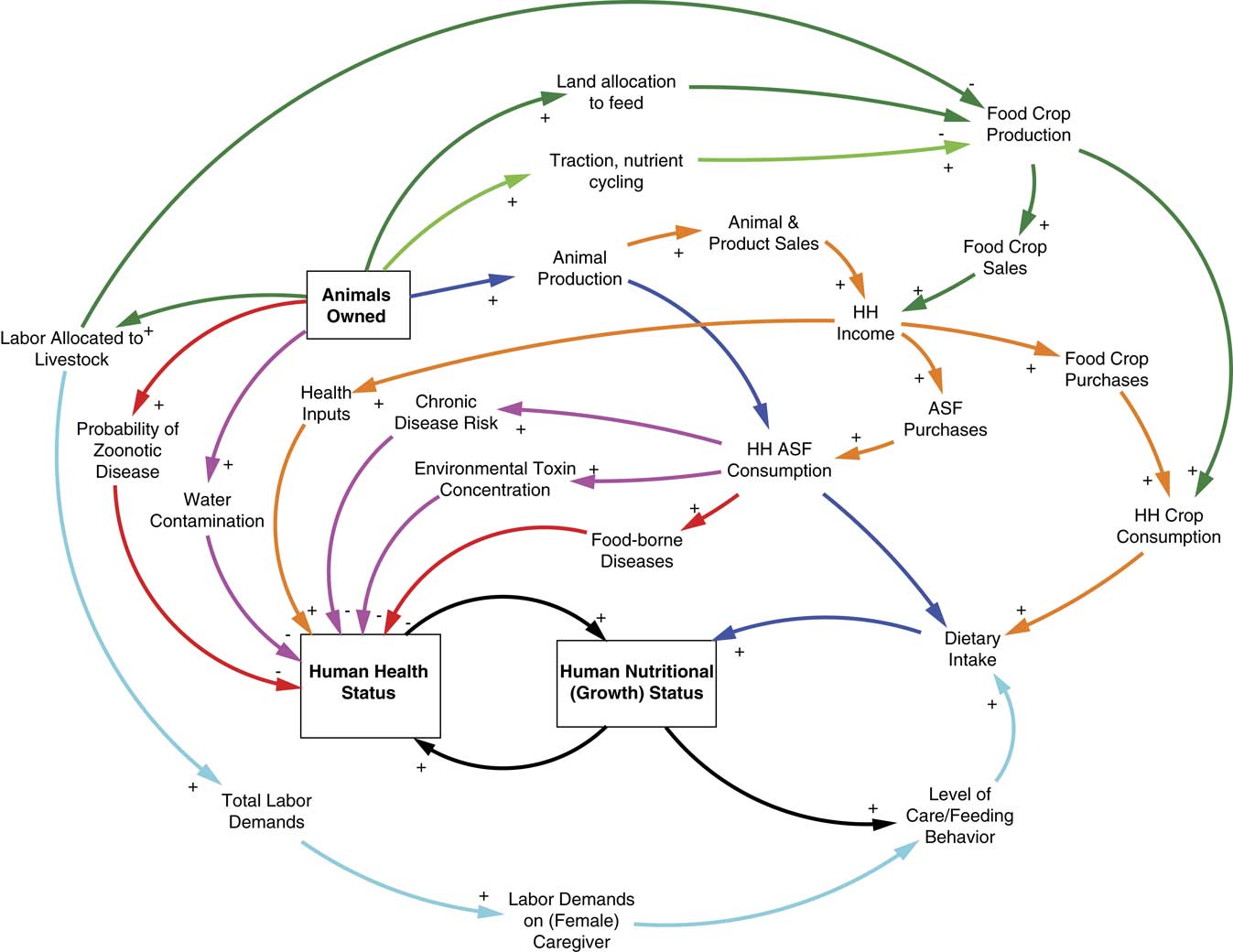
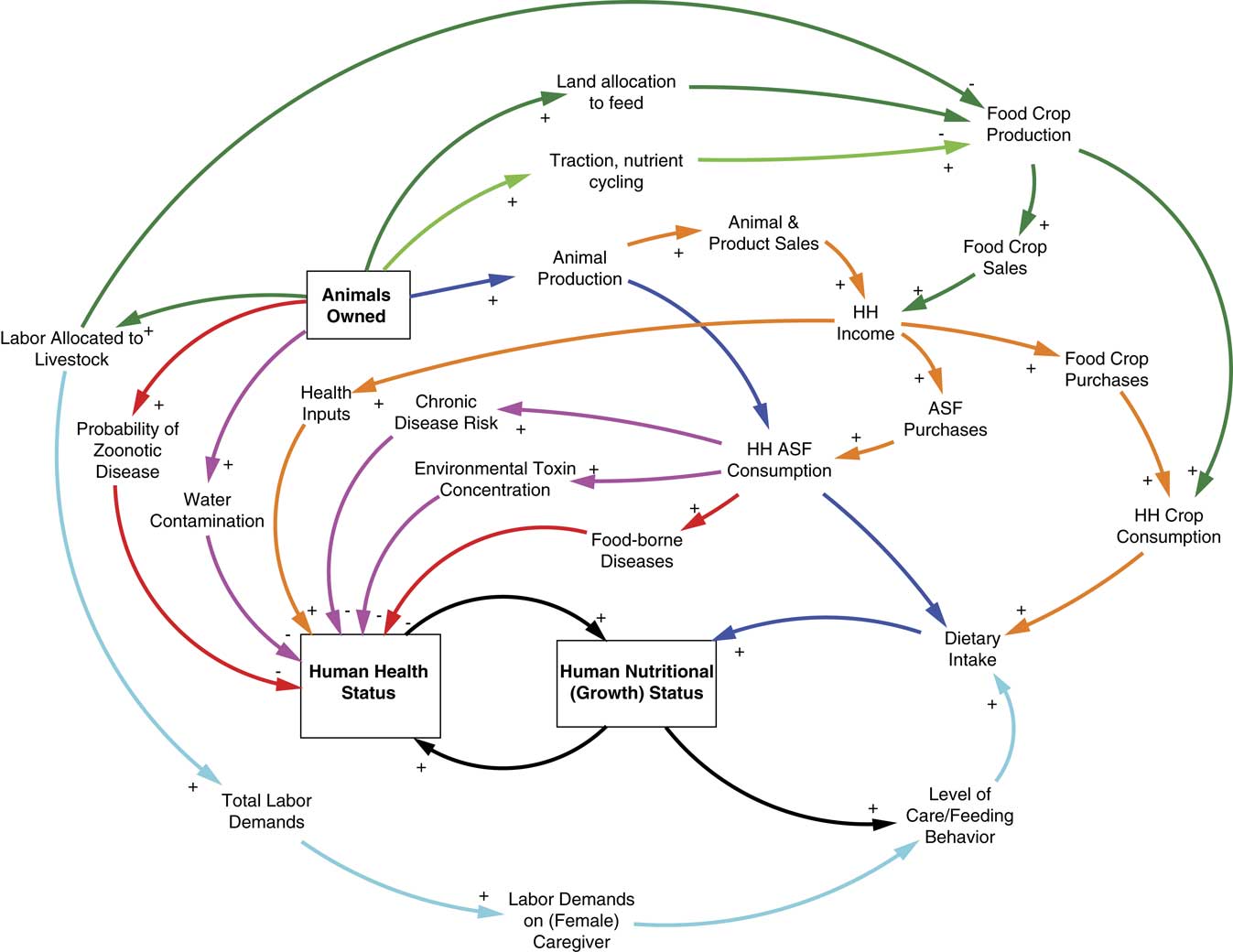
In developing countries, human health is inextricably linked to the livestock, which underpin the livelihoods of almost a billion people (see preceding sections). Livestock have an essential role in contributing to good health through providing animal source food, manure and draft power for plant source food, as well as income to buy food and health care. At the same time, livestock can lead to poor health if animal source foods contribute to poor diet and through providing a reservoir for diseases infectious to people (zoonoses). The relationship between livestock, human nutrition and human health are complex, with multiple synergistic and antagonistic links, some of which are detailed in Figure 2. For example, poor livestock keepers worldwide face daily trade-offs between selling their (relatively expensive) milk, meat and eggs to increase their household income and consuming the same (high-quality) foods to increase their household nutrition. Because animal source foods are so dense in nutrients, including micronutrients that help prevent ‘hidden hunger’, decisions in these matters have potentially large implications for the nutritional and economic health of households. Livestock contributes to food security and nutrition in various ways.
An example of the complex interaction between humans, livestock and diseases. Source: Randolph et al. (Reference Randolph, Schelling, Grace, Nicholson, Leroy, Cole, Demment, Omore, Zinsstag and Ruel2007).
Livestock and nutrition
In poor countries, livestock and fish make significant contributions to diets. In East Africa, for example, livestock provide on average 11% of energy and 26% of protein in poor people's diets (FAOSTAT, 2011). Fish, meanwhile, account for at least half the animal protein intake for the 400 million poorest people in Africa and South Asia (FAO, 2009). For some vulnerable groups, such as the world's 180 million pastoralists, the contribution of livestock products to diet is much higher; for example, among Nuer agro-pastoralists in Sudan half of the total energy intake of children aged <5 years comes from milk (Fielding et al., Reference Fielding, Gullick, Coutts and Sharp2000).
Although livestock and fish clearly make important contributions to overall food security, there is an even more important role of animal source foods in achieving nutrition, as opposed to food, security. Animal source foods are dense and palatable sources of energy and high-quality protein, important for vulnerable groups, such as infants, children, pregnant and nursing women and people living with human immunodeficiency virus with high nutritional needs. They also provide a variety of essential micronutrients, some of which, such as vitamin A, vitamin B12, riboflavin, calcium, iron, zinc and various essential fatty acids, are difficult to obtain in adequate amounts from plant-based foods alone (Murphy and Allen, Reference Murphy and Allen2003). Animal source foods provide multiple micronutrients simultaneously, which can be important in diets that are lacking in more than one nutrient: for example, vitamin A and riboflavin are both needed for iron mobilisation and haemoglobin synthesis, and supplementation with iron alone may not successfully treat anaemia if these other nutrients are deficient (Allen, Reference Allen2002). Micronutrients in animal source foods are also often more readily absorbed and bioavailable than those in plant-based foods (Murphy and Allen, Reference Murphy and Allen2003).
Consumption of even small amounts of animal source foods has been shown to contribute substantially to ensuring dietary adequacy and preventing undernutrition and nutritional deficiencies (Neumann et al., Reference Neumann, Bwibo, Murphy, Sigman, Whaley, Allen, Guthrie, Weiss and Demment2003). Extensive longitudinal studies in Egypt, Kenya and Mexico (Neumann et al., Reference Neumann, Bwibo, Murphy, Sigman, Whaley, Allen, Guthrie, Weiss and Demment2003) have shown strong associations between intake of animal source foods and better growth, cognitive function and physical activity of children, better pregnancy outcomes and reduced morbidity from illness. Consumption of adequate amounts of micronutrients, such as those that can be found in animal source foods, is associated with more competent immune systems and better immune responses (Keusch and Farthing, Reference Keusch and Farthing1986). Low levels of consumption of animal source foods by the poor are due to limited supply in some regions, such as SSA, as well as income constraints. It has been estimated that to effectively combat undernutrition 20 g of animal protein per person per day is needed, which can be achieved by an annual consumption of 33 kg lean meat, 230 kg milk or 45 kg fish (FAO, 2009).
In rich countries, consumption of animal source food has been linked to a number of high health burden chronic diseases including obesity, cardiovascular disease and cancer (McMichael et al., Reference McMichael, Powles, Butler and Uauy2007). Many developing countries are also facing a ‘double burden of malnutrition’, that is, the persistence of undernutrition along with the rapid rise of overnutrition and associated diseases. In South Africa, for example, over a quarter of rural children are stunted, whereas nearly 60% of women are overweight or obese (Toriola and Goon, Reference Toriola and Goon2012). Similar problems are also observed in developing countries with large, expanding middle classes (i.e. India, China, Brazil).
Livestock and infectious disease
In poor countries, infectious disease still accounts for around 40% of the health burden in terms of years lost through sickness and death (World Health Organization (WHO), 2008). Livestock directly contribute to this through the food-borne diseases transmitted through animal source foods, the zoonoses transmissible between livestock and people, and human diseases emerging from livestock. A recent estimate suggests that 12% of the infectious disease burden in least developed countries is due to zoonoses, and the majority of this is transmitted to people from livestock hosts through consumption of animal source foods, vectors or direct contact (Grace et al., Reference Grace, Mutua, Ochungo, Kruska, Jones, Brierley, Lapar, Said, Herrero, Pham Duc, Nguyen, Akuku and Ogutu2012). More indirectly, keeping of livestock affects agro-ecosystems in ways that influence their ability to provide health-provisioning services. This may be positive or negative. In some circumstances, livestock act as a buffer, for example, between trypanosomosis-carrying tsetse or malaria-carrying mosquitoes and people; in this case, livestock act as alternative hosts, effectively protecting people. In other cases, livestock are an amplifying host, for example pigs harbouring and multiplying Japanese encephalitis and thus increasing the risk it poses to people.
Food that nourishes can also contain biological and chemical hazards that sicken and kill. Food-borne disease is the world's most common illness and is most commonly manifested as gastrointestinal disease. Diarrhoea is one of the top three infectious diseases in most developing countries, killing an estimated 1.4 million children a year (Black et al., Reference Black, Cousens, Johnson, Lawn, Ruden, Bassani, Jha, Campbell, Walker, Cibulsklis, Eisele, Liu and Mathers2010). The great majority of cases (>90%) are caused by bacteria and viruses not chemicals, although the latter are often of more concern to the public (De Boer et al., Reference Conant and Paustian2005). In countries where good data exist, zoonotic pathogens are among the most important causes of food-borne disease (Thorns, Reference Thorns2000; Schlundt et al., Reference Schlundt, Toyofuku, Jansen and Herbst2004). Animal source food is the most risky of food commodities (Lynch et al., Reference Lynch, Painter, Woodruff and Braden2006), not surprising as meat and milk provide excellent mediums for microbial growth. Less is known about the aetiology of food-borne disease in developing countries; on the one hand, less animal source food is consumed, decreasing risk, but on the other hand surveys show far higher level of hazards in the animal source foods marketed. Food-borne diseases has been recently estimated to cost the United States $152 billion a year and Nigeria $3 billion (Scharff, Reference Scharff2010; Okike et al., Reference Okike, Grace and Hussni2010).
Most (61% of all) human diseases are zoonotic (i.e. transmissible between animals and humans), including many of the most important causes of sickness and death. Endemic zoonoses that prevail in poor countries are among the most neglected diseases. To give just one example, echinococcosis is responsible for 1 million lost DALYs in addition to human-associated economic losses (including medical costs, wage losses) estimated at US$1.9 billion and livestock losses of US$2.1 billion (Maudlin et al., Reference Maudlin, Eisler and Welburn2009). Sleeping sickness, rabies, leishmaniasis, cysticercosis, brucellosis and leptospirosis are other zoonoses of similar importance, which also have livestock reservoirs.
Zoonoses (diseases transmissible between animals and man) and diseases recently emerged from animals (mostly human immunodeficiency virus (HIV)-acquired immunodeficiency syndrome) make up 25% of the infectious disease burden in the least developed countries (Gilbert et al., Reference Gilbert, Lapar, Unger and Grace2010). Many other important human diseases, such as HIV, measles and smallpox, were originally diseases of animals but jumped species when people changed ways of farming and keeping animals. In the first epidemiological transition, unprecedented levels of globalisation, urbanisation, animal production and environmental degradation are driving new epidemics of infectious diseases, both familiar and novel. Currently, one new disease is emerging every four months, and 75% of these originate in animals (Jones et al., Reference Jones, Patel, Levy, Storeygard, Balk, Gittleman and Daszak2008).
Other important problems (whose indisputably important contribution to overall health needs to be better assessed) include: fungal toxins (mycotoxins) in animal source foods; use of water contaminated with animal waste for agriculture; misuse of agricultural chemicals and antibiotics in livestock resulting in direct toxicity and contributing to resistance to antibiotics for treating human infection; and the health impacts of alteration of ecosystems as the result of livestock-keeping. These impacts may be local or global. An example of the former is the small dams constructed for livestock watering in semi-arid areas with water-associated diseases such as schistosomiasis, whereas an example of the latter is the changing distribution of diseases as a result of the global warming to which livestock emissions contribute.
Identifying at-risk populations
The greatest burden of livestock-associated disease falls on poor producers, poor consumers and others involved in food value chain. The first population of critical concern are the vulnerable and marginalised that bear much of the burden of malnutrition and neglected tropical zoonoses. Although many of the poorest countries in SSA fit in this category, it also applies to less-favoured groups in better-off developing countries (e.g. tribal people in India). They are frequently politically and socially disempowered with little access to medical services. Undernutrition is widespread among this population and is implicated in the deaths of a third of all children under five (Black et al., Reference Black, Allen, Bhutta, Caufield, de Onis, Ezzati, Mathers and Rivera2008); an estimated 195 million children are too short for their age (stunted) and 129 million children are underweight. High-burden zoonotic diseases (sleeping sickness, cysticercosis, zoonotic tuberculosis) are at home in many of these populations. Diseases controlled in other places (e.g. rabies, brucellosis, hydatid disease) persist. There is often competition over declining resources, which may lead to intensified interaction between people, livestock and wildlife (e.g. around water sources in pastoral areas) and increased transmission of disease: in the world, 180 million pastoralists are at high risk.
The other population of concern are people living in rapidly intensifying and/or changing agriculture and food systems. These include the urbanising and rapidly developing systems of Latin America and SE Asia, but also areas of South Asia (e.g. the Karachi buffalo colony with more than 300 000 animals) and Africa (e.g. the bush meat value chain associated with opening up of the rainforests by road building). These systems are characterised by growing populations and standards of living, high demand for livestock products, relatively good market access but low levels of regulation. Retail transitions are important in some areas (e.g. Latin America, South Africa), in others preference for wet markets and traditional eating habits (e.g. consumption of wildlife) persist strongly (e.g. South Asia). This drives highly dynamic peri-urban production systems, as well as lengthening food supply chains. Malnutrition is less of a problem but problem, nonetheless; however, food- and water-borne diseases and environmental hazards are more important. Because these systems are highly dynamic, have high densities of genetically homogeneous livestock and high contact rates between people, livestock and wildlife, these systems are considered crucibles for the emergence of new diseases.
Livestock and the environment
The impacts of livestock on the environment have received considerable attention as the publication of the Livestock's Long Shadow study (Steinfeld et al., Reference Steinfeld, Gerber, Wassenaar, Castel, Rosales and de Haas2006). This study helped draw attention to the magnitude and scale of livestock's impact on land use, greenhouse gas (GHG) emissions and pollution among others, and it created a thrust for the sector's stakeholders to develop research agendas geared towards generating better data for the environmental assessment of global livestock systems, and to develop solutions for mitigating environmental livestock problems, and policy agendas more conducive to a greening of the sector by promoting regulation, increases in efficiency and others. Numerous publications exist on this subject (Steinfeld et al., Reference Steinfeld, Gerber, Wassenaar, Castel, Rosales and de Haas2006; FAO, 2009 and 2010; Herrero et al., Reference Herrero, Thornton, Gerber and Reid2009; PBL, 2010; Pelletier and Tyedmers, Reference Pelletier and Tyedmers2010; Thornton, Reference Thornton2010; Thornton and Herrero, Reference Thornton and Herrero2010; Bouwman et al., Reference Bouwman, Klein Goldewijk, Van der Hoek, Beusen, Van Vuuren, Willems, Rufino and Stehfest2011). Readers are referred to these for a more in-depth account of livestock's role in environmental regulation. What follows is a summary of the main livestock–environment interactions.
Livestock as users of land and water
Livestock systems are one of the main users of land. Steinfeld et al. (Reference Steinfeld, Gerber, Wassenaar, Castel, Rosales and de Haas2006) estimated that livestock utilise 3.4 billion ha for grazing and 0.5 million ha of cropland for the production of feeds (33% of arable land), globally. Of the grazing areas, 2.3 million ha (67%) are in the developing world. Expansion of pastureland at the expense of natural habitats in the developing world has been in the order of 330 million ha in the last 40 years (FAO, 2009). This phenomenon has occurred predominantly in Latin America, and is projected to increase by a further 100 to 120 million ha by 2050 under current practices (Smith et al., Reference Smith, Gregory, van Vuuren, Obersteiner, Havlík, Rounsevell, Woods, Stehfest and Bellarby2010). Cropland area in the same period expanded by 190 million ha and is expected to increase at a faster rate than rangelands to supply additional feed for monogastric production and more intensive ruminant production (Smith et al., Reference Smith, Gregory, van Vuuren, Obersteiner, Havlík, Rounsevell, Woods, Stehfest and Bellarby2010), which will require an additional 450 million tonnes of grain to meet demand for animal products by 2050 (Rosegrant et al., Reference Rosegrant, Fernandez, Sinha, Alder, Ahammad, de Fraiture, Eickhout, Fonseca, Huang, Koyama, Omezzine, Pingali, Ramirez, Ringler, Robinson, Thornton, van Vuuren, Yana-Shapiro, Ebi, Kruska, Munjal, Narrod, Ray, Sulser, Tamagno, van Oorschot and Zhu2009).
Land use is closely linked to water cycles. Not surprisingly, 90% of the water used by livestock is through the impacts of grazing and the production of feed. The fraction of drinking water accounts for <10% of the total (Peden et al., Reference Peden, Tadesse, Misra, Awad Amed, Astatke, Ayalneh, Herrero, Kiwuwa, Kumsa, Mati, Mpairwe, Wassenaar and Yimegnuhal2007). Recent research (Lannerstad et al., 2012) suggests that, globally, the production of feed for the livestock sector appropriates 5315 km3/year of evapotranspiration (ET; 9% of global evapotranspiration). The authors found that feed production from croplands uses 37% of the water for crop production, and the biomass consumed by livestock from grazing lands appropriates 32% of the total ET from grazing lands. The rest of the ET supports a range of key ecosystems services, which seems to be a key role that rangelands are playing globally. Enhancing this role through improved rangeland management could be of essential importance for enhancing global green water cycles (Rockström et al., Reference Rockström, Lannerstad and Falkenmark2007). At the global level, the aggregated virtual water content (VWC) of livestock products has an average value of 5.63 m3/1000 kcal. In contrast, VWC of vegetal products from croplands is estimated to be only 0.66 m3/1000 kcal (Lannerstad et al., 2012). Producing livestock products used on average nine times the amount of water that it took to produce calories from crop-based products. In their study, total VWC for individual products ranged from 1.50 m3/1000 kcal for pig meat up to 35.24 m3/1000 kcal for meat from dairy sheep & goats, with the range reflecting vast differences in intensity of production (feeds, agro-ecology, species, type of production systems and others). Green water represented 97% of the water used by livestock.
Livestock as emitters of GHGs
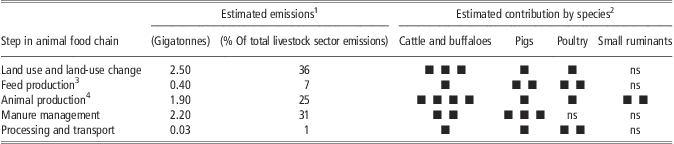
Livestock are an important contributor to global GHG emissions. Current estimates range from 8.5% to 18% of global anthropogenic GHG (O'Mara, Reference O'Mara2011), with the range reflecting methodological differences (inventories v. life cycle assessment), attribution of emissions to land use (Herrero et al., Reference Herrero, Thornton, Havlík and Rufino2011; O'Mara, Reference O'Mara2011) and uncertainty in parameter values (FAO, 2010). According to Steinfeld et al. (Reference Steinfeld, Gerber, Wassenaar, Castel, Rosales and de Haas2006), methane from enteric fermentation, nitrous oxide from manure management and carbon dioxide from land use contribute 25%, 31% and 36% to the emissions of the livestock sector, respectively (Table 3). Livestock in the developing world contributes 50% to 65% of the total emissions from livestock in the world. Emission intensities also vary and these are mainly related to the species (monogastrics more efficient than ruminants), products (milk, white meats and eggs more GHG efficient than red meat) and the productivity of the animals (the higher the productivity the lower the emissions per unit of product, FAO, 2010). These aspects are largely dependent on feed type, quantity, quality and provenance and the manure management system implemented. There is large heterogeneity in emission intensities in the developing world. However, in general terms, the following order usually prevails: industrial systems are less GHG intensive, and these are followed by mixed crop-livestock systems and by grazing systems. Emission intensities of systems in temperate tropical highlands are usually lower than in drier areas. Nevertheless, livestock systems in general terms generate significantly more emissions per kilocalorie when compared with crops. However, the mitigation potential in the livestock sector is very large (1.74 Gt CO2-eq per year, Smith et al., Reference Smith, Martino, Cai, Gwary, Janzen, Kumar, McCarl, Ogle, O'Mara, Rice, Scholes and Sirotenko2007), with land-use management practices (carbon sequestration in rangelands, land sparing impacts of reduced animal numbers/production intensification) representing over 80% of this potential (Smith et al., Reference Smith, Martino, Cai, Gwary, Janzen, Kumar, McCarl, Ogle, O'Mara, Rice, Scholes and Sirotenko2007). Most of the mitigation potential (70%) lies in the developing world (Smith et al., Reference Smith, Martino, Cai, Gwary, Janzen, Kumar, McCarl, Ogle, O'Mara, Rice, Scholes and Sirotenko2007, see Henderson et al., Reference Henderson, Gerber and Opyo2011 for a discussion on the topic).
Contribution of greenhouse gas emissions from livestock
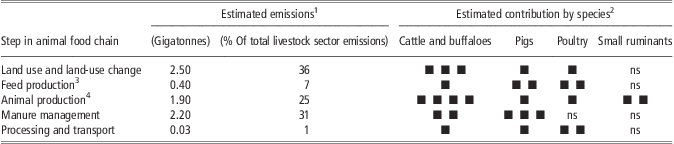
FAO = Food and Agricultural Organization; ns = not significant.
1Estimated quantity of emissions expressed as CO2 equivalent.
2▪ = lowest to ▪ ▪ ▪ ▪ = highest.
3Excludes changes in soil and plant carbon stocks.
4Includes enteric methane, machinery and buildings.
As presented in FAO (2009). Adapted from Steinfeld et al., Reference Steinfeld, Gerber, Wassenaar, Castel, Rosales and de Haas2006.
Livestock as nutrient recyclers
Livestock play an important role in accelerating ecosystems’ nutrient cycles. Bouwman et al. (Reference Bouwman, Klein Goldewijk, Van der Hoek, Beusen, Van Vuuren, Willems, Rufino and Stehfest2011) in a historical analysis of nutrient cycles show that it was the introduction of synthetic fertilisers that allowed the explosive increase in livestock production. Agriculture based only on the recycling of organic resources and supported on N fixing legumes could not have supported the current global production and consumption of animal protein. The widespread use of fertilisers has helped to intensify not only agricultural production, but also the rate of nutrient cycling, with accumulation of nutrients in certain environments creating threats for human health and nature (Sutton et al., Reference Sutton, Oenema, Erisman, Leip, Van Grinsven and Winiwarter2011).
Livestock has a very different role in the nutrient cycles in the developed-industrialised world and in the poor developing world. Although in large parts of Africa and East and SE Asia, agricultural production and nutrient cycles are closely related to local-scale recycling of organic residues (including animal manures), in Western Europe and North America crops are fully sustained on synthetic fertilisers and livestock production on the import of feeds produced sometimes thousands of miles away. In much of the industrialised world, the link between livestock and the land has been broken, with animals separated spatially from the places where their feed is produced (Naylor et al., Reference Naylor, Steinfeld, Falcon, Galloway, Smil, Bradford, Alder and Mooney2005).
Meeting the increasing demand of animal protein in the developing world requires managing nutrient cycles more efficiently. Expansion of agricultural land has lead to marginal increases of livestock production in parts of the developing world because the production systems remain low input and often the natural resources are poor or are degraded to a state that cannot support large outputs per unit of land. This, together with low investment in agriculture, makes places such as SSA to have experienced very little technological change in ruminant production in the last 40 years (FAOSTAT, 2011). In places with large human population density where most suitable land is already taken, increasing livestock production will compete with the production of food crops and will bring associated environmental costs. More intensive livestock production (e.g. dairy, fattening systems, monogastrics) may achieve higher technical efficiency. However, the concentration of animal wastes around urban centres raises serious concerns for water pollution and for GHG emissions, which may increase significantly in places of large livestock density (Gerber et al., Reference Gerber, Chilonda, Franceschini and Menzi2005).
Costs and benefits of cycling nutrients through livestock
Livestock wastes – considered a serious problem in the developed world – are a critical agricultural resource in large parts of Africa, where soils are inherently poor (Petersen et al., Reference Petersen, Sommer, Béline, Burton, Dach, Dourmad, Leip, Misselbrook, Nicholson, Poulsen, Provolo, Sørensen, Vinnerås, Weiske, Bernal, Böhm, Juhász and Mihelic2007; Rufino et al., Reference Rufino, Tittonell, van Wijk, Castellanos-Navarrete, Delve, de Ridder and Giller2007). Liu et al. (Reference Liu, You, Amini, Obersteiner, Herrero, Zehnder and Yang2010) estimated that manure contributes between 12% and 24% of the nitrogen input in nitrogen cycles in cropland in the developing world. Recycling of animal manures is practiced in most mixed crop-livestock systems, although efficiencies are rarely close to those of the developed world (Rufino et al., Reference Rufino, Rowe, Delve and Giller2006). Synthetic fertilisers are unaffordable for most small-scale farmers, who depend on the (poor) fertility of their soils to produce food crops, or on livestock to concentrate nutrients from the relatively large grazing lands.
Intensifying livestock production requires using additional nutrients to produce feeds. Nitrogen fixing legumes play a very important role in the developed world dairy industry, with soya beans produced in South America and the United States being fed as protein supplements in Europe. Research in the developing world has tried to implement this model of using legumes produced on farm on a local scale in, for example, African mixed systems with some success (Sumberg, Reference Sumberg2002), but not enough to supply the future demand for feeds.
Producing grain legumes or fodder legumes requires in certain soils the addition of P fertilisers, and there are GHG emissions associated with their production. Dual-purpose legumes such as cowpea may be used as food and feeds, and its production justified to contribute to income and nutrition (Singh et al., Reference Singh, Ajeigbe, Tarawali, Fernandez-Rivera and Musa2003). However, the production of feeds, including legumes, results in emissions to the environment (e.g. Chikowo et al., Reference Chikowo, Mapfumo, Nyamugafata and Giller2004; Baggs et al., Reference Baggs, Chebii and Ndufa2006) that must be accounted for by the livestock sector. Designing technologies for intensification requires in the developing world addressing the trade-off poverty reduction and environmental impact.
Nutrients, livestock manure, soils and poverty
Poverty has often been associated with poor soil fertility (Sanchez, Reference Sanchez2002), and problems of fertility are often not solved by just adding fertilisers, requiring sensible use of organic resources (Chivenge et al., Reference Chivenge, Vanlauwe and Six2011). In many farming systems, the production of food crops is directly or indirectly related to livestock production. Direct relationship arises from the need for animal manures to increase effectiveness of fertilisers applied to cropland (Vanlauwe and Giller, Reference Vanlauwe and Giller2006). Indirect relationship arises from the competition for biomass to restore degraded agricultural soils, or to feed growing livestock populations (Rufino et al., Reference Rufino, Dury, Tittonell, van Wijk, Herrero, Zingore, Mapfumo and Giller2011).
Although animal manure can be a very effective soil amendment, in systems where the land support livestock production its availability at the farm level is often very limited. This implies that designing technologies for soil fertility restoration only around the use of animal manure is unrealistic. Again, nutrients, including carbon, must be included in the trade-offs analysis. Increasing food security will require a sensible use of the natural resources, and in many places a clear strategy to store C and reduce emissions from livestock production.
Manure management and emissions
The size of the GHG emissions from manure depends mainly on collection and storage management. Across continents, the fate of manure excreted in housing facilities differ (Table 4). In Europe, strong environmental regulations led to recycling of large proportion of the excreted manure, partly in grassland and cropland and partly for biogas production (Oenema et al., Reference Oenema, Oudendag and Velthof2007). In Africa, in the extensive rangeland-based systems manure is not managed, whereas in the mixed systems most manure is not returned to grazing land. In intensive livestock systems, composted manure may be applied to fodder crops, but the large majority is applied to food and high-value crops (e.g. coffee, tea, tobacco).
Ranges of NCE in mixed systems of the developed and developing world

NCE = N cycling efficiencies.
The numbers show the fraction of N recovered and cycled in the next step.
Sources: 1Oenema (Reference Oenema2006); 2Gourley et al. (Reference Powell, Gourley, Rotz and Weaver2011), Powell et al. (Reference Powell, Gourley, Rotz and Weaver2010); 3 Rufino et al. Reference Rufino, Rowe, Delve and Giller(2006).
In highly populated areas of Asia, most manure is destined to different and competing uses such as organic fertiliser, feed for fish ponds, biogas production and biofuel (i.e. burnt for cooking). In the mixed intensive systems of North America, manure is not yet fully recycled. There are places where manure is indirectly discharged into water bodies (Centner, Reference Centner2011), or accumulated in constructed wetlands (Knight et al., Reference Knight, Payne, Borer, Clarke and Pries2000). Use of manure for biogas production is increasingly gaining attention, but it is not yet globally widespread (Cuellar and Webber, Reference Cuellar and Webber2008).
In Latin America, recycling of manure is not widely practised (León-Velarde and Quiroz, Reference Kunz, Miele and Steinmetz2004). This can be explained by: (i) access to cheap fertiliser is more widespread than in Africa and Asia, (ii) soils are inherently more fertile than in the other continents and (iii) expansion of agricultural land is still used to counteract poor soil fertility. Exceptions are urban and peri-urban areas (e.g. southern Brazil) where recycling of wastes into agricultural land, treatment of slurries and biogas production have been the result of the environmental concerns and the disconnection between livestock and the land than from the demand of the organic resources as soil amendments (Kunz et al., Reference Kunz, Miele and Steinmetz2009).
Livestock and payment for environmental services (PES)
The previous section explored the impacts of livestock on the environment. The negative environmental impact of the livestock sector could increase with the forecasted increase of demands for animal proteins in the developing world (FAO, 2007; Tarawali et al., Reference Tarawali, Herrero, Descheemaeker, Grings and Blümmel2011). As a result, there is increasing interest in incentive systems to promote more environmentally responsible livestock rearing practices. One of these options is the PES as an alternative instrument to enhance the delivery of environmental services, mitigate the disservices and promote income-diversification options for poor livestock keepers.
To date, most PES projects have focused on one or more of the following services: climate regulation, water conservation and hydrological services, maintenance of landscape beauty, and conservation and management of biodiversity or a ‘bundle’ of the previous services (Landell-Mills and Porras, Reference Landell-Mills and Porras2002; Wunder, Reference Wunder2005). Despite the fact that livestock is widely distributed in virtually all agro-ecosystems of the developing world, there are few examples of PES targeting livestock keepers.
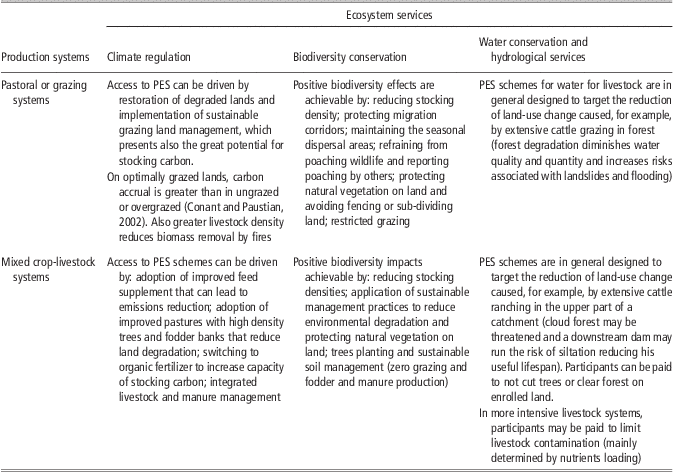
To what extent do PESs target livestock inclusive agricultural production systems in developing countries? What are potential and limitations for their implementation? Table 5 shows the opportunities for pastoral/grazing systems and for mixed crop-livestock systems to access to PES schemes: climate regulation, biodiversity conservation and water conservation and hydrological services. Opportunities in PES schemes for livestock inclusive agricultural systems are mainly driven by carbon market.
Linking ecosystem services and disservices from livestock with opportunities from payment for environmental schemes
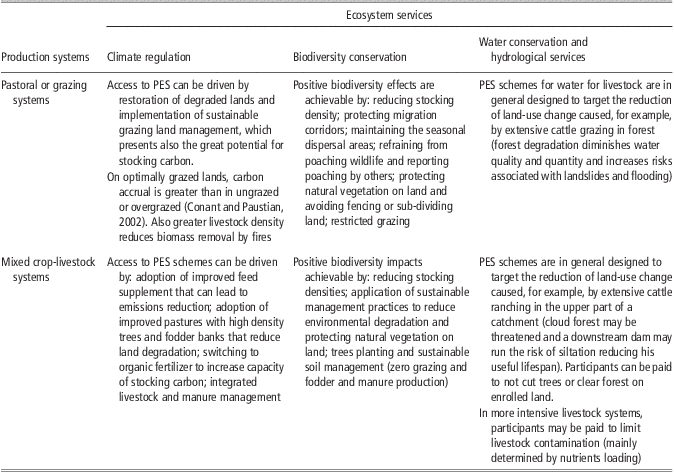
PES = payment for environmental services.
Adapted from Silvestri et al. (Reference Silvestri, Osano, De Leeuw, Herrero, Ericksen, Kariuki, Njuki, Notenbaert and Bedelian2012).
The implementation of PES schemes for livestock production systems can be favoured by the growing potential of the carbon market, the emerging efforts for the inclusion of PES in national policy frameworks, the increasing catalysing policy support of PES networks, research institutes together with the growing private sector participation and farmers’ involvement. In particular, PES schemes can be an incentive for the application of agricultural practices that can lead to GHG mitigation and an incentive for the implementation of sustainable land management practices that can reduce the pressure on the environment and help conserving biodiversity and protecting wildlife and ensure an equitable use and share of natural resources. Especially in the context of the developing world where future trends foresee an intensification of livestock sector, PES schemes may contribute in facilitating agricultural transitions (Silvestri et al., Reference Silvestri, Osano, De Leeuw, Herrero, Ericksen, Kariuki, Njuki, Notenbaert and Bedelian2012).
On the one hand, PES can benefit the poor directly, through the provision of increased cash flow and as a means of promoting household income diversification, and indirectly through social and cultural benefits (Grieg-Gran et al., Reference Grieg-Gran, Porras and Wunder2005; Pagiola et al., Reference Pagiola, Arcenas and Platais2005 and Reference Pagiola, Rios and Arcenas2008; Turpie et al., Reference Turpie, Marais and Blignaut2008). On the other hand, barriers such as (1) high transaction and investment costs, (2) weak cooperative institutions among poor providers, (3) low awareness, education and technical capacity and (4) not well-defined property rights can all limit the participation and PES benefits among poor providers.
For most PES programmes that involve crop and livestock producers, the income generated from the environmental benefit will only be a small share of household income, compared with the profits from farm production (FAO, 2007). In Africa, where close to half of the pastoralists earn less than US$1/day it is estimated that even modest improvements in natural resource management in the drylands may yield gains of 0.5 t C/ha per year,Footnote 1 which translates into US$50/year that can bring about a 14% increase in income for the pastoralist (Reid et al., Reference Reid, Thornton, McCrabb, Kruska, Atieno and Jones2004). Benefits from participation in carbon PES schemes might also be associated with increases in production creating a double benefit (Steinfeld et al., Reference Steinfeld, Gerber, Wassenaar, Castel, Rosales and de Haas2006). However, carbon markets will not automatically generate benefits for farmers and pastoralists without a proper institutional arrangement to support the participation of poor households.
Concluding remarks
The analyses presented here have demonstrated the complex balancing act of weighing the roles that livestock play in the developing world. On the one hand, we acknowledge that livestock is an important contributor to the economies of developing nations, to the incomes and livelihoods of millions of poor and vulnerable producers and consumers, and it is an important source of nourishment. On the other side of the equation, the sector has been criticised for its inefficiencies and environmental performance: large user of land and water, notorious GHG emitter, a reservoir of disease, source of nutrients at times, polluter at others and the list could continue.
Against this dichotomy, there is a sector that could improve its environmental performance significantly by sustainably intensifying, applying regulations and incentives to manage environmental loads and disease risks, diversifying income sources through payments for environmental services (as a reward for being the global stewards of large patches of land), and in cases by becoming more market-orientated to generate the pull-factors needed for increasing productivity. On top of this, value chain development, food safety standards and others could be catalysts to hence the role that livestock play in food systems globally (McDermott et al., Reference McDermott, Staal, Freeman, Herrero and van de Steeg2010).
There are several factors that could play a significant role in shaping the roles of livestock in the developing world in the coming decades. Some of them are:
The debate on whether or not to eat meat: This debate translates into poor food choices v. the food choices of the poor. The debate on human diets is dominated by the concerns of the developed world on the negative health impacts of livestock product overconsumption. This also applies for large parts of the middle classes of the developing world, who overconsume animal products and are obese, diabetic and suffer from heart disease. Evidence shows that these sectors of society should reduce the consumption of animal products as a health measure. However, the debate needs to increase in sophistication so that the poor and undernourished are not the victims of generalisations that may translate into policies or reduced support for the livestock sector in parts of the world where the multiple benefits of livestock outweigh the problems it causes. This does not mean that we should take as given the projected trajectories of animal consumption proposed by the so-called ‘livestock revolution’. They are not inevitable. Part of our responsibility is to challenge these future trajectories, and ensure that we identify levels of consumption and nutritional diversity for different parts of the world that will achieve the best compromise between a healthy diet that includes livestock products (or not), economic growth, livelihoods and livestock's impacts on the environment. No mean feat, but certainly a crucial area of research.
Efficient and market-orientated smallholders v. large-scale consolidated farms as engines for feeding the world: Large parts of the food systems of the developing world have as a starting point the smallholder mixed crop-livestock farmer or the vulnerable pastoralist. Some of these systems produce a significant amount of food, mostly for local consumption, have significant, exploitable, yield gaps in crops and livestock, and in many cases they have low opportunity costs of labour. If livestock is to be used as an engine for poverty reduction, it is essential that these producers become market-orientated. Hence, investment in developing efficient value chains (including market development, service provision, adequate institutional support, etc.) should be high in the development agenda, to create incentives for smallholders to integrate in the market economy, formal or informal. Advocates of large-scale farming argue in favour of the higher efficiencies of resource use often found in these systems and how simple it is to disseminate technology and effect technological change. True, when the market economy is working. If common sense prevailed, the answer to this question should lead to the coexistence of a thriving environmentally responsible, diversified, commercial smallholder sector that helps feed the world and lifts people out of poverty, together with a large-scale efficient livestock sector that efficiently produces food while generating enough employment for rural people. The balance between these ways of farming is likely to be different in different regions of the world, but understanding where the balance should lie for achieving socially and environmentally goals is still the question that merits significant research. This is still an open question because we lack comprehensive information on the impacts of different farming avenues and their future evolutionary pathways on water cycles, biodiversity, social aspects (nutrition, incomes, employment), coping with production risks (i.e. climate variability and change, commodity prices) and others.
Competitiveness of the smallholder sector: The degree of competitiveness of smallholders against imports from countries that can produce vast amounts of animal products, at lower production costs, will be a crucial factor to determine the success of many men and women livestock farmers in the developing world, especially as the volume of traded livestock products increases because of trade liberalisation. Formal and informal markets will need to ensure the supply of cheaper, locally produced, safe livestock products to adequately compete. This implies a significant reduction in transaction costs for the provision of inputs, increased resource use efficiencies, and very responsive, innovative and supporting institutions for the livestock sector in developing countries (FAO, 2009).
The success of paying for environmental services: PES schemes as an income diversification strategy for mitigating climate change or for protecting important regional or global goods that regulate essential biogeochemical cycles have received a lot of attention recently. However, not many successful examples exist with smallholder livestock producers or pastoralists. Proofs of concept that test how these schemes could operate in very fragmented systems, with multiple users of the land or in communal pastoral areas, are necessary. Research on fair, equitable and robust monitoring and evaluation frameworks and mechanisms for effecting payments schemes that work under these conditions is necessary. The promise of PES schemes as a means to deliver the income diversification for the poor, and natural resource protection necessary to produce food while protecting the world's ecosystems, is yet to be seen on a large scale.
The ability of the sector to adapt to climate change and to mitigate green house gas emissions: Climate change is likely to cause severe impacts on livestock systems and on poor vulnerable producers. The capacity and speed of adaptation of smallholders will play an important role in defining the contribution of livestock to livelihoods under climate change. At the same time, in a low carbon economy, it will be essential that the sector mitigate GHG effectively in relation to other sectors. Demonstrating that these options are real with tangible examples is essential to generate the evidence for increasing the investments in climate change adaptation and mitigation for the livestock sector. This becomes more imperative as the global food system prepares to become part of the climate change negotiations.
Institutional and market mechanisms for reaching smallholders: The reality is that livestock production in the developing world is largely fragmented and disorganised. Underinvestment in extension systems and other support services has rendered poor producers disenfranchised to access key support systems necessary for increasing productivity and efficiency, or in cases important safety nets for reducing vulnerability (i.e. to drought/famines). The poorer farmers are unlikely to be able to respond sustainably to the increased demands for animal products without increased public investment in innovation and support platforms, as these are essential to foster the technological change required to increase productivity and link them to markets (McDermott et al., Reference McDermott, Staal, Freeman, Herrero and van de Steeg2010). More advanced farmers or larger farmers in the developing world are likely to rely on the private sector for these support services. It is essential that the roles of women in production and trading of livestock products and in controlling livestock assets be taken into consideration when designing these institutional mechanisms.
Trade-offs and investments: The multiple social roles of livestock in the developing world may lead to compromise solutions that prevent the attainment of maximum environmental efficiencies, such as lowering GHG intensities. Balancing these roles and articulating them well is essential, as in the face of stern public opinion in favour of protecting global environmental goods, instead of local livelihoods, could create an investment climate that promotes more intensive, and environmentally efficient systems in the future, to the detriment of the poor smallholder farmer.
On the other hand, there are other aspects that will play an important role in shaping livestock production in the developing world, such as animal welfare and ethics and the magnitude of intensification in livestock production systems, technological surprises and access to them, and agricultural policies and the economic environment in the developed world. It is also essential that the informal and formal retail sectors gain the consumers trust as safe providers of livestock products for urban and rural consumers.
Balancing the multiple roles of livestock in the developing world and contrasting them with those in the developed world is not simple. The disaggregated evidence by region, species, production system, value chain, etc. needs to be generated. Messages need to be well distilled, backed by scientific evidence and well articulate to avoid making generalisations that more often than not, confuse the picture and ill-inform policy. Livestock's roles are simply not the same everywhere. The roles, whether good or bad, need to be accepted by the scientific community. Research agendas need to use the livestock bads as opportunities for improvement, while continuing to foster the positive aspects. These are essential ingredients for society to make better-informed choices about the future roles of livestock in sustainable food production, economic growth and poverty alleviation.
Acknowledgements
This paper is an ILRI output reported under the following CGIAR Research Programmes: CRP3.7 – Livestock and Fish and CRP7 – Climate Change, Agriculture and Food Security.