Introduction
Many threatened lichens are restricted to old forests. However, the ecological basis for this pattern is not yet well understood (Scheidegger & Werth Reference Scheidegger and Werth2009). For example, the old growth associated lichen Lobaria pulmonaria seems to depend on a particular microenvironment created by old forest structures (e.g. Lesica et al. Reference Lesica, McCune, Cooper and Hong1991; Kuusinen Reference Kuusinen1996), but may suffer from low dispersal ability (Walser et al. Reference Walser, Zoller, Büchler and Scheidegger2004; Öckinger et al. Reference Öckinger, Niklasson and Nilsson2005). However, the establishment phase is also a critical stage in the lichen life cycle (Bailey Reference Bailey, Brown, Hawksworth and Bailey1976) and may limit the distribution of threatened species. For example, Werth et al. (Reference Wagner, Werth, Kalwij, Bolli and Scheidegger2006) suggested that ecological constraints at stand level, rather than limited dispersal ability, reduce the establishment success for L. pulmonaria. Likewise, Hedenås et al. (Reference Hedenås and Ericson2003) assumed that mainly establishment structured the local distribution of the asexually dispersed old forest lichens Collema furfuraceum and Leptogium saturninum.
Large diaspores in vascular plants and bryophytes have a higher probability of establishment than small diaspores (Moles & Westoby Reference Moles and Westoby2004; Löbel et al. Reference Löbel, Snäll and Rydin2009). A higher success of establishment of large diaspores may counteract the advantage of small diaspores in dispersal, especially if habitat fragmentation causes alteration in habitat quality (Löbel et al. Reference Löbel, Snäll and Rydin2009). Lichens reproduce vegetatively by diaspores such as isidia (30 µm–1mm) and soredia (20–50 µm) (Nash Reference Nash1996). The larger isidia have more available resources than the smaller soredia, and isidia will presumably be more successful than soredia at the establishment stage.
The environmental conditions during diaspore attachment have to match the species ecological niche (Harper Reference Harper1977). Chlorolichens (containing green-algae) can activate photosynthesis from water vapour alone, whereas cyanolichens (containing cyanobacteria) require liquid water to initiate photosynthesis (Lange et al. Reference Lange, Kilian and Ziegler1986). Cyanolichens are usually more abundant in sheltered and humid sites (Forman Reference Forman1975). It is therefore probable that diaspores containing cyanobacteria establish most successfully on sheltered branches (i.e. short branches) of trees located near streams, whereas diaspores containing a green-algal photobiont show a greater flexibility in their ecological amplitude and range distribution (Goward Reference Goward1994). The Lobarion community is usually associated with trunks of well-buffered trees having a bark pH of 4·2–4·8 (Kermit & Gauslaa Reference Kermit and Gauslaa2001). A low bark pH (< 4·0) might limit the establishment of cyanolichens in particular, owing to limitations of nitrogenase activity (Fritz-Sheridan Reference Fritz-Sheridan1985). Propagules might also fail to establish and develop because they become outcompeted by faster growing epiphytes (Zoller et al. Reference Zoller, Frey and Scheidegger2000), or they die because of invertebrate grazing. Asplund & Gauslaa (Reference Scheidegger2008) suggest that juvenile L. pulmonaria thalli are particularly vulnerable to mollusc grazing, as they are less well defended by lichen compounds than large thalli. The establishment process is a critical stage in a lichen life cycle and a high loss of diaspores may occur (Hilmo & Såstad Reference Hilmo and Såstad2001).
The Boreal rainforest in Central Norway represents a unique environment of international importance. Several lichen species have their only or main European populations in these forests (Holien & Tønsberg Reference Holien and Tønsberg1996). A number of them are red-listed (e.g., Pseudocyphellaria crocata and Ramalina thrausta); Erioderma pedicellatum is even included in the global red list (Kålås et al. Reference Kålås, Viken and Bakken2006). The most important threat is habitat loss and forest fragmentation due to logging. Between 1993 and 2006 logging took place in 34 % of the 264 known boreal rainforest sites in Norway (Holien & Prestø Reference Holien and Prestø2008). Most forest patches are smaller than 20 ha (Storaunet et al. Reference Storaunet, Rolstad and Groven2000). In a long term perspective, the survival of threatened species in this landscape depends on their ability to disperse between suitable forest patches and to establish and reproduce in the surrounding regeneration forest. An understanding of factors regulating population size and distribution is required for designing an appropriate habitat management aiming to maintain the diversity of lichens. Population biology can contribute greatly to develop appropriate conservation strategies for lichens (Scheidegger & Werth Reference Scheidegger and Werth2009), but is insufficiently known for old forest lichens.
In this study we focus on the tripartite Lobaria pulmonaria (L.) Hoffm. with a green alga as the main photobiont, and the bipartite cyanolichen L. scrobiculata (Scop.) DC. Lobaria pulmonaria is limited mainly to old forest by a spatially aggregated distribution pattern, whereas L. scrobiculata in the studied area also occurs in regeneration forests (Hilmo et al. Reference Hilmo, Holien, Hytteborn and Ely-Aastrup2009). Both species reproduce mainly clonally by symbiotic diaspores. Lobaria pulmonaria disperses with coarse soredia and corticated cylindrical propagules referred to as isidioid soredia (e.g. Scheidegger Reference Scheidegger1995) or isidia (e.g. Gauslaa Reference Gauslaa2006). Lobaria scrobiculata disperses by smaller soredia. The diaspores of L. pulmonaria contain only the green-algal photobiont, whereas soredia of L. scrobiculata have cyanobacteria.
In the oceanic region of boreal forests we tested the following hypotheses: 1) sown diaspores of Lobaria pulmonaria establish more successfully than those of L. scrobiculata; 2) establishment is more successful in old natural stands than in younger plantations; 3) the cyanobacterial soredia of L. scrobiculata are more susceptible to environmental alterations than the green-algal propagules of L. pulmonaria. In order to identify potentially critical environmental factors for establishment we studied the importance of bark pH, distance to stream, tree size, and canopy openness for both species. Our assumption relies on earlier findings that success of establishment has been shown to be higher for large diaspores than for smaller diaspores (Hilmo & Såstad Reference Hilmo and Såstad2001; Löbel et al. Reference Löbel, Snäll and Rydin2009) and that green-algal lichens show a greater flexibility in ecological amplitude than cyanolichens (Goward Reference Goward1994).
Methods
Study area
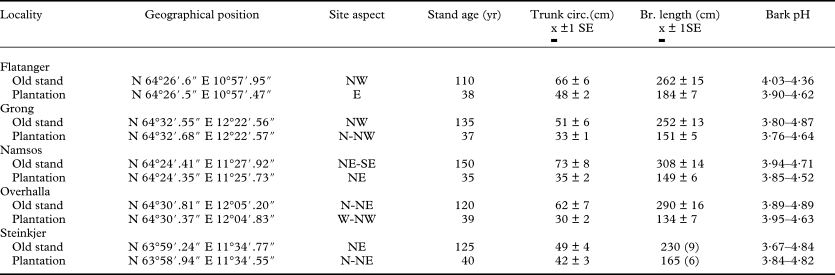
The field experiment was carried out in Flatanger, Grong, Namsos, Overhalla and Steinkjer (Table 1), all located in the core area of the coastal spruce forests of Central Norway. The sites were confined to the eu-oceanic section of the boreal zone (Moen Reference Moen1999). The mean annual precipitation for the period 1961–1990 was 1033 mm at Steinkjer, 1240 mm at Flatanger, 1275 mm at Grong, 1340 mm at Namsos and 1375 mm at Overhalla (Førland Reference Førland1993). Data for 2005–2007 at Namsos and Overhalla show mean annual precipitation of 1415 mm and 1370 mm, respectively (Norwegian Meteorological Institute). All study sites were well below the highest post-glacial sea level at 140–150 m above the present level.
Geographical position, site aspect and stand age (yr) for the selected sites. Mean trunk circumference (Trunk circ.) at breast height, mean branch length (Br. length) and bark pH range for the experimental trees and branches at each site are given (n = 20)

At each of the five localities (Flatanger, Grong, Namsos, Overhalla and Steinkjer) one old Picea abies forest and one younger even-aged plantation of P. abies were selected to study the importance of stand age on establishment success. The stands, both the old stands and the plantations, were located in ravine valleys.
Age of the old forest stands, estimated from cores of 3 of the largest trees in each stand, varied between 110 and 150 years. However, the oldest trees have been shown to be considerably older, for example 284 years at locality Namsos (Dølaelva) (Storaunet et al. Reference Storaunet, Rolstad, Gjerde and Rolstad1998). The maximum tree age of old forest patches in the area ranges from 149–291 yr (Storaunet et al. Reference Storaunet, Rolstad and Groven2000). Trunks and branches of Picea abies in these old stands host a distinct lichen community rich in cyanobacterial and rare lichens [e.g., L. pulmonaria, Pseudocyphellaria crocata and Ramalina thrausta (Holien & Tønsberg Reference Holien and Tønsberg1996; Rolstad et al. Reference Rolstad, Gjerde, Storaunet and Rolstad2001)]. The forest structure was multi-layered and some selective logging and windfalls in the past have formed gaps. The forest is managed through small-scale forestry operations.
The age of selected plantations varied between 35–40 yr. Tree and stand structure of planted stands is described in Hilmo et al. (Reference Hilmo, Holien, Hytteborn and Ely-Aastrup2009). The epiphytes in these young stands represented a pioneer community dominated by Hypogymnia physodes, H. tubulosa and Platismatia glauca (Hilmo et al. Reference Hilmo, Holien, Hytteborn and Ely-Aastrup2009). Lobaria pulmonaria did not occur in the selected plantations, whereas small populations of L. scrobiculata were observed in some stands. The plantations formed even-aged monocultures with low structural diversity. Retention trees have not been used in the studied area and the main forestry practice has been clear-cutting. Forest rotation is on average 80 years.
Experimental design
Within each of the 10 sites, one plot was located on the slope of the ravines. Forest edges were avoided. The plot was directed parallel to the stream and covered the slope, from the ravine bottom to the top. The plot size varied from 1900–3250 m2 in the old natural forests and 800–1250 m2 in the plantations, depending on the density of trees. Within each plot, 20 trees of Picea abies, > 20 cm in trunk circumference (> 6·4 cm in trunk diameter) at breast height, were randomly selected. Some of the largest trees in the old forest were avoided because the lowest branches were difficult to reach for the sowing experiment. For each tree selected, we measured distance (m) to the stream in the ravine bottom and trunk circumference at breast height. One living branch, attached to the trunk at 2 m height (or as near as possible), was selected for the transplantation experiment. For the experimental branch, we measured branch length (cm) along the branch main axes from the base to the tip. Bark pH for each experimental branch (n = 200) was measured in a cut segment, 6 cm long and 7–9 mm thick, within 2 days after collection. If epiphytes occurred on the cut segment these were removed before measurement. The cut ends were sealed with melted wax before the cut segment was immersed in 6 ml 25 mM KCl for 1 h as described in Gauslaa & Holien (Reference Gauslaa and Holien1998). Mean trunk circumference, mean branch length and pH range for the experimental branches are presented in Table 1.
For each experimental Picea abies branch at the two localities Grong and Namsos (n = 80), we quantified the canopy openness by use of hemispherical digital images (Englund et al. Reference Englund, O'Brien and Clark2000). One digital hemispherical image was taken from a horizontal position at each branch where the diaspores were sown, with the north indicated. The images we captured were taken with a Nikon Coolpix 4500 camera with a Nikon Fisheye Converter (FC-E8). Images were analyzed by HemiView 2.1 (Delta-T Devices, Burwell, Cambridge, UK) to compute three measures of light exposures reflecting the canopy openness; direct, indirect and global site factors (Anderson Reference Anderson1964; Gauslaa et al. Reference Gauslaa, Palmqvist, Solhaug, Holien, Hilmo, Nybakken, Myhre and Ohlson2007). The indirect site factor is the proportion of diffuse solar radiation reaching a given location relative to a location with no sky obstructions (Gauslaa et al. Reference Gauslaa, Palmqvist, Solhaug, Holien, Hilmo, Nybakken, Myhre and Ohlson2007).
Transplantation of diaspores
Lobaria pulmonaria and L. scrobiculata rich in symbiotic diaspores were sampled within the study area. The thalli were air-dried before the diaspores were brushed off. Whereas all diaspores in L. scrobiculata were soredia, the diaspores of L. pulmonaria were mainly cylindrical corticated isidioid soredia. The diaspores were stored at 5° C for up to 3 days before use. On each experimental branch of Picea abies (n = 200) diaspores of L. pulmonaria and L. scrobiculata were sown separately in two spots (3 × 8 mm) on the outermost part of the branches. The distance between the two sowing areas varied between 25 and 40 cm. Before sowing diaspores, all lichen thalli were removed from the spots and in an area of 10 cm around the spots. Small depressions were made to increase the roughness of the bark. The diaspores were sown directly on the branches, and each spot was 100 % covered with propagules (see Hilmo & Ott Reference Hilmo and Ott2002). The two species were sown once in a mixed sequence on the branches. Immediately after transplantation the sown area was gently sprayed with water. The experiment started in August 2005 and ended in September 2007.
Measuring success of establishment
Two years after sowing, the branches with diaspores were sampled and brought to the laboratory. The sown patches were examined under a stereo microscope with a 1 × 1 mm grid placed in the ocular. This grid covered 4 × 10 mm of the branch, including the sown area (3 × 8 mm). The success of establishment for each branch was given as the number of 1 × 1 mm squares with diaspores or juvenile thalli established.
Statistical analyses
To test if the success of establishment differed between the two species, sown on the same branch, we used a paired test (Wilcoxon signed rank test, Crawley Reference Crawley2002).
The importance of the environmental parameters was tested for each species separately and for each species two separate data sets were analyzed statistically. The first analysis addressed the influence of locality, successional stage (old versus young forests), trunk circumference, distance from streams and bark pH on establishment success (n = 200). The second data set evaluated the importance of canopy openness (measured as indirect site factor at two localities only) and branch length on establishment success (n = 80). The response variable in both analyses was the number of 1 × 1 mm squares colonized by diaspores on each branch.
After the inspection of residuals against fitted values and normal probability plots, our dataset showed overdispersion and had many zero values (more than expected for Poisson or negative binomial distributions). Therefore, we fitted zero-altered negative binomial (ZANB) and zero-altered poisson (ZAP) generalized linear models (Zuur et al. Reference Zuur, Ieno, Walker, Saveliev and Smith2009). ZAP was only fitted for the importance of canopy openness and branch length in L. scrobiculata. A zero-altered model is a two part model consisting of a positive and a zero part. In the positive part of the model, the positive observations (including only colonized branches) were modelled by using either truncated negative binomial or Poisson distributions. In the zero part of the model, the data are considered as zeros versus non-zeros and a binomial model is used to model the probability for a non-zero value to be observed.
To avoid overparameterization, we fitted models up to two-way interactions. In all cases, the models were reduced to a minimal adequate model by deleting non-significant terms, beginning with the second order interaction terms. The Akaike Information Criterion (AIC) was used as a measure to compare the suite of different models. The model with the lowest AIC value was considered to be the most parsimonious model. All the analyses were carried out in the R statistical package (R Development Core Team Reference Scheidegger2008).
Results
The success of establishment of Lobaria pulmonaria and L. scrobiculata
Two years after sowing, Lobaria pulmonaria and L. scrobiculata had become established in 75·3 % and 51·0 % of the experimental branches, respectively (n = 200). The mean number of 1 × 1 mm squares where diaspores had established was 5·8 (± 0·5) for L. pulmonaria, compared to 2·4 (± 0·3) for L. scrobiculata. When branches with no colonization were omitted, the number of squares with diaspore establishment was still higher for L. pulmonaria (7·7 ± 0·5) than for L. scrobiculata (5·0 ± 0·5). Diaspores of Lobaria pulmonaria established significantly better than those of L. scrobiculata in the old forests (z = 4·913, P = <0·001), as well as in the young stands (z = 5·215, P = <0·001). The highest frequency of colonized 1 × 1 mm squares on one branch was 85 % for L. pulmonaria compared to 67 % for L. scrobiculata.
The importance of locality and successional stage
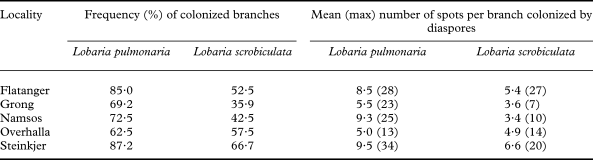
The number of branches where diaspores established differed between the localities (shown by the zero part of the model) for both L. pulmonaria (z = −2·224, P = 0·026) and L. scrobiculata (z = −2·112, P = 0·035). A significant effect of locality was also found when including only colonized branches (shown by the positive part of the model) for L. pulmonaria (z = 2·123, P = 0·034) and L. scrobiculata (z = 2·345, P = 0·019). The mean number of 1 × 1 mm squares colonized was highest at Steinkjer for both species, and L. pulmonaria was more successful than L. scrobiculata in all localities (Table 2).
The frequency (%) of branches on which Lobaria pulmonaria or L. scrobiculata established at each locality, and the mean and max number of squares in each branch (n = 40) where diaspores had established (colonized branches only are included)

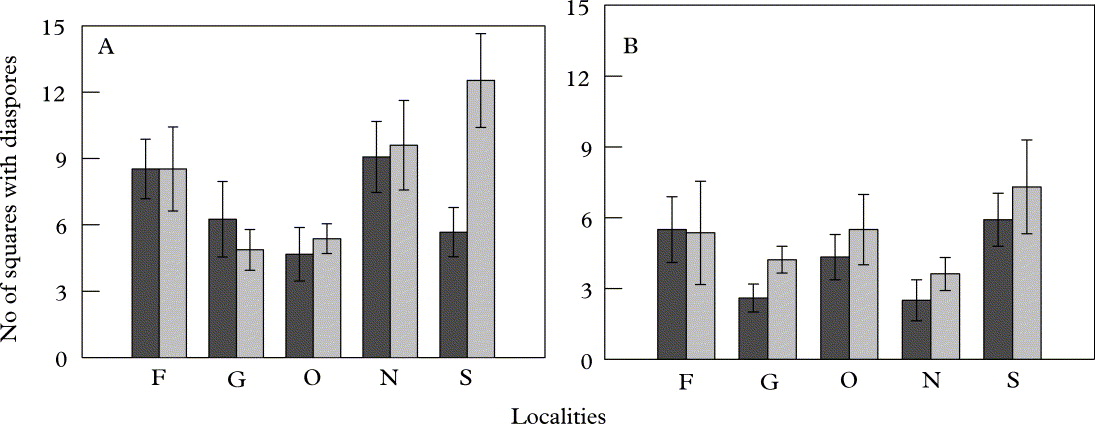
Establishment for both species was often higher in plantations than in old forests (Fig. 1), though not significantly higher (P >0·050). A significant interaction between locality and successional stage for L. pulmonaria (z = 2·269, P = 0·023) showed that the effect of forest age was modified by locality. The contrast was high in Steinkjer (see Fig. 1).
Mean (±1 SE) number of squares (1 × 1 mm) with established diaspores of Lobaria pulmonaria (A) and Lobaria scrobiculata (B) at locality Flatanger (F), Grong (G), Overhalla (O), Namsos (N) and Steinkjer (S). Light grey columns: young plantations; dark grey columns: old natural forests. Only colonized branches are included.

The importance of environmental factors
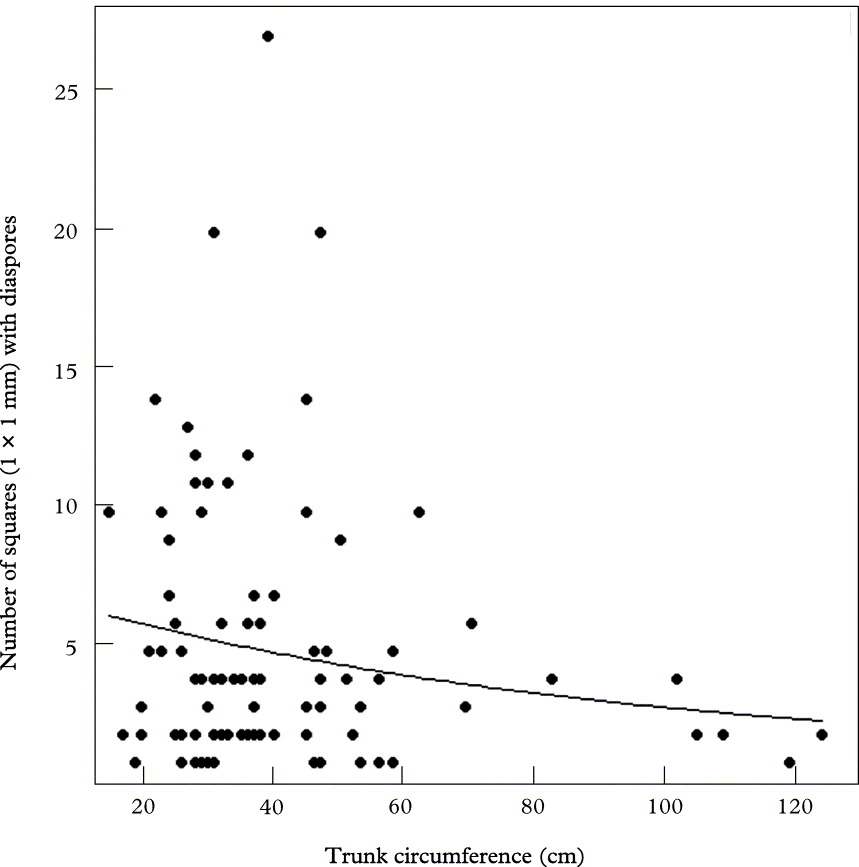
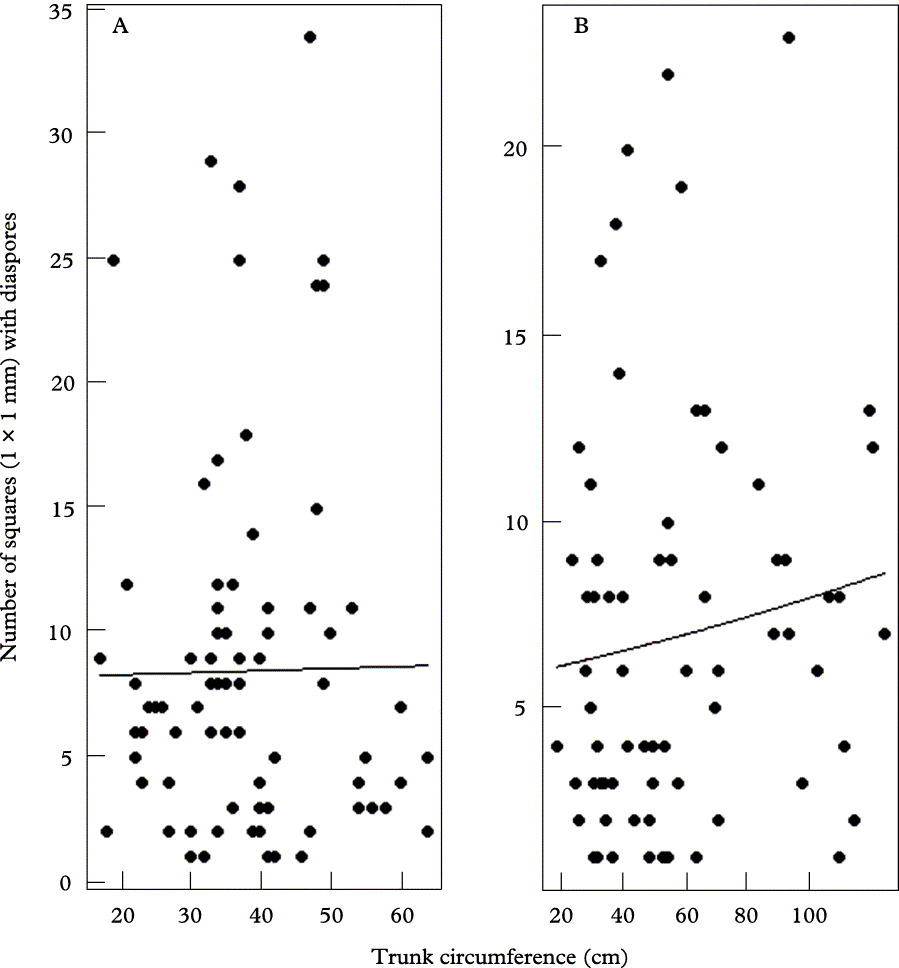
The success of establishment for L. scrobiculata depends on tree size. The probability of being colonized decreased with increasing trunk circumference (zero-part of the model, z = −2·969, P = 0·003). There was a similar trend for colonized branches, as the number of squares with established diaspores decreased by trunk circumference (the positive part, z = −2·587, P = 0·010). The highest success of establishment occurred on small trees (30–50 cm circumference; Fig. 2). In L. pulmonaria, the probability of being colonized was not affected by tree size (P = >0·050). However, for colonized branches an interaction between trunk circumference and successional stage was found (z = −2·343, P = 0·019): The number of squares with established diaspores increased faster with trunk circumference in old compared to young stands (Fig. 3).
The relationship between trunk circumference and number of squares with established diaspores of Lobaria scrobiculata. Only colonized branches are included.

The relationship between trunk circumference and number of squares with established diaspores of Lobaria pulmonaria. A, young plantations; B, old natural forests. Only colonized branches are included. Note the different scale of the axes.

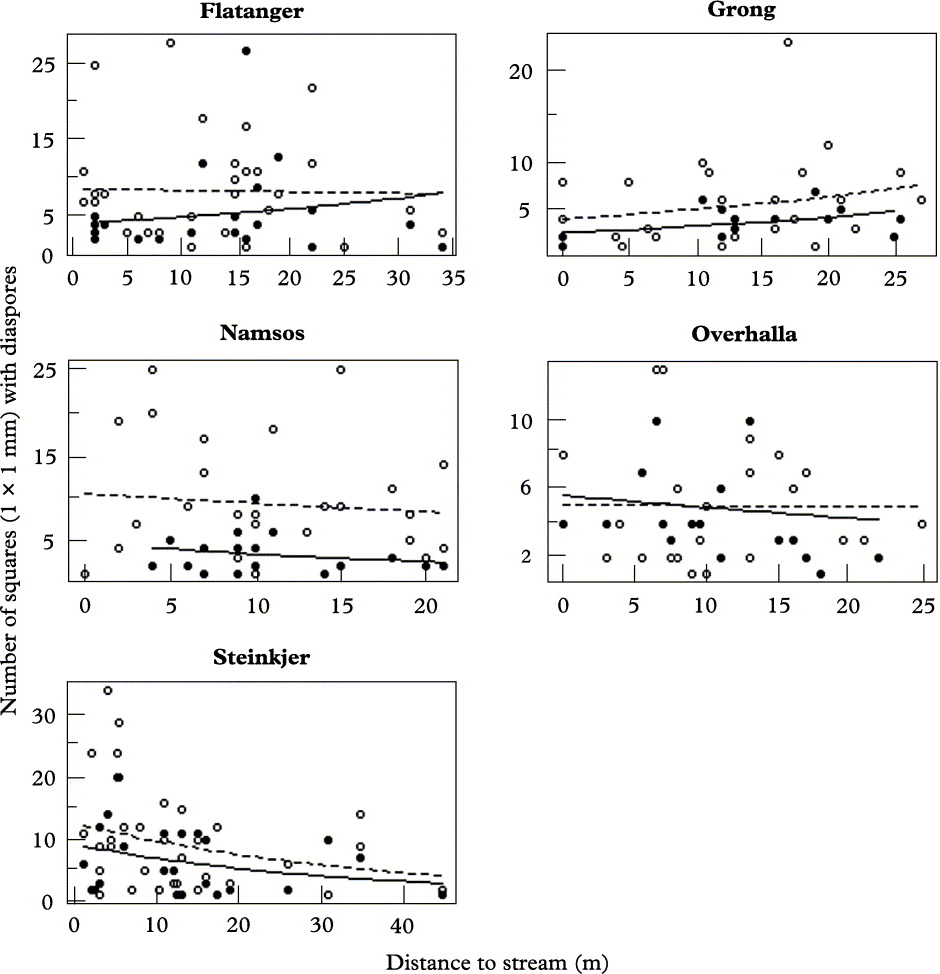
The establishment of L. pulmonaria and L. scrobiculata was not influenced by distance to nearest stream (zero-part and positive part, P >0·050). Including only colonized branches, a significant interaction between locality and stream distance was found for both L. pulmonaria and L. scrobiculata (Fig. 4). This was expressed by an increase in success of establishment by increasing stream distance at locality Grong for L. pulmonaria (z = 2·246, P = 0·025). For L. scrobiculata the establishment success decreased with stream distance at Steinkjer (z = −2·940, P = 0·003).
The relationship between stream distance (m) and number of squares with established diaspores of Lobaria pulmonaria (open circles and dashed lines) and Lobaria scrobiculata (closed circles and full lines) at each locality. Only colonized branches are included. Note the different scale of the axes.

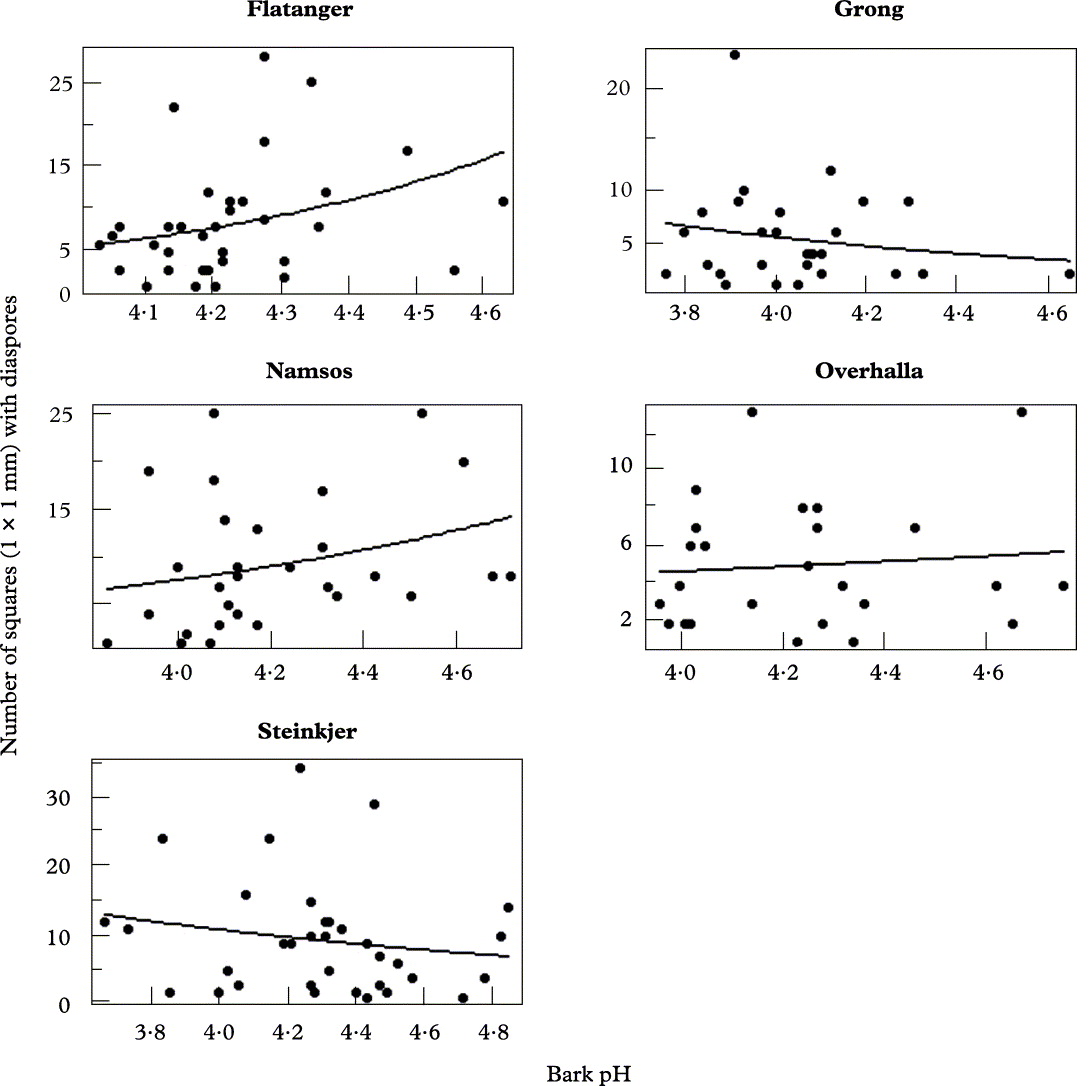
The pH of the individual twigs varied from 3·7 to 4·9 (median 4·2). For L. scrobiculata bark pH alone did not influence the probability of diaspore colonization (zero-part of the model, P >0·050) or the success of establishment on colonized branches (the positive part, z = −1·913, P = 0·056). A significant interaction between bark pH and locality occurred for L. pulmonaria, expressed by a decrease in success of establishment with increasing pH at Grong (z = −2·122, P = 0·003) and Steinkjer (z = −2·194, P = 0·028, Fig. 5).
The relationship between bark-pH and number of squares established with diaspores of Lobaria pulmonaria at each locality. Only colonized branches are included. Note the different scale of the axes.

The bark pH did not differ significantly between the old and young stands (Wilcoxon rank-sum test, P = 0·416), but varied significantly between the localities (Kruskal-Wallis rank-sum test, P = 0·0002). The mean bark pH was 4·05 at Grong, 4·15 at Namsos, 4·20 at Flatanger, 4·24 at Overhalla and 4·31 at Steinkjer.
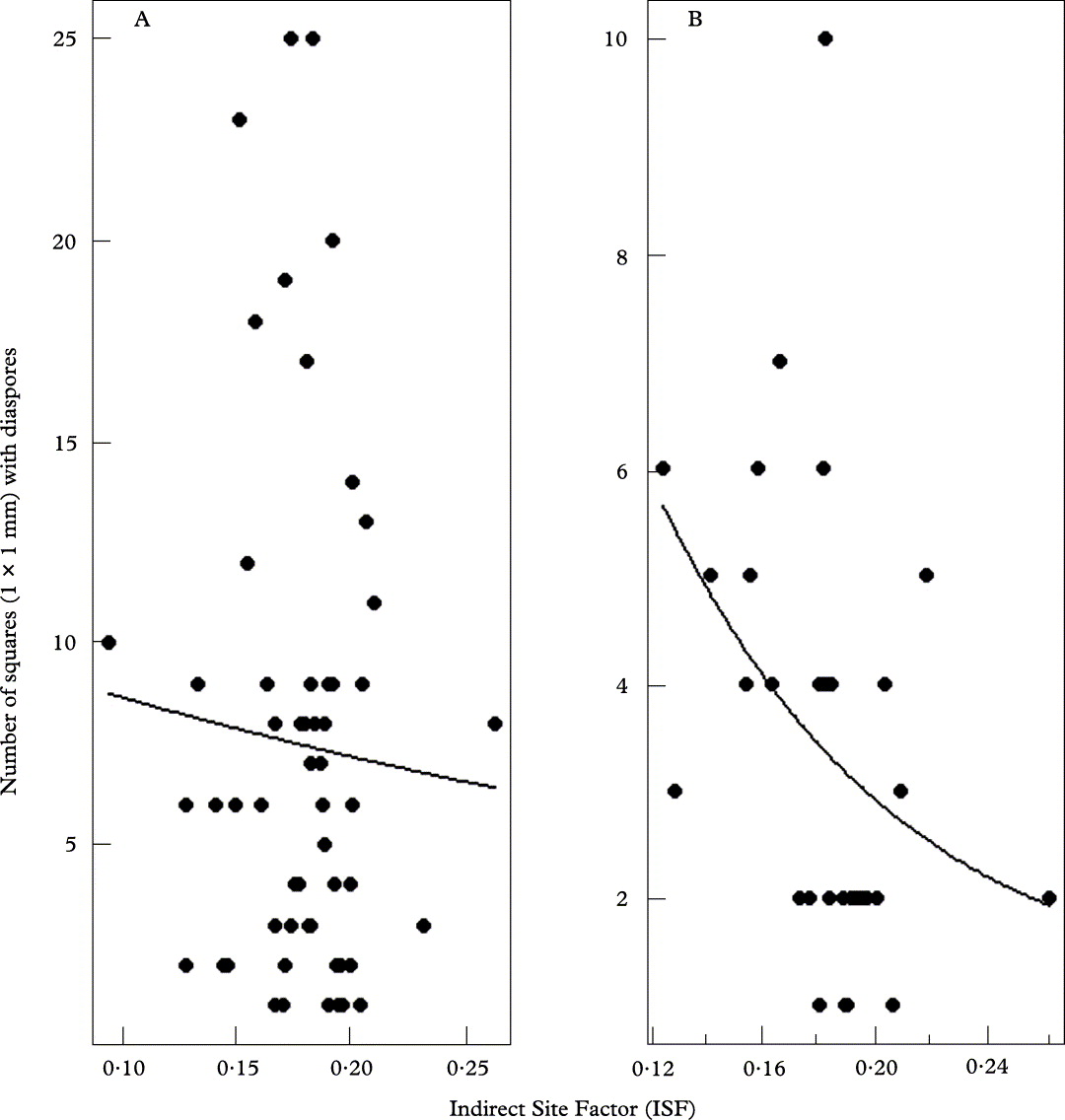
The mean indirect site factor (ISF), reflecting the canopy openness, showed a low level of variation and did not differ between the young (0·181 ± 0·006) and old stands (0·183 ± 0·003, P = 0·172). ISF did not influence the probability of colonization of L. pulmonaria or L. scrobiculata at a branch level (P > 0·050). However, on colonized branches establishment success decreased with increasing ISF. The number of 1 × 1 mm squares established with diaspores slightly decreased with increasing canopy openness for both L. pulmonaria (z = −1·994, P = 0·046) and L. scrobiculata (z = −2·405, P = 0·002, Fig. 6). Finally, the zero-part of the model showed that branch length influenced the success of establishment of L. scrobiculata (z = −3·004, P = 0·003). The probability of being colonized decreases with increasing branch length. The mean length of branches with no diaspore colonization was 239·3 cm, compared to 179·2 cm for the colonized branches.
The relationship between indirect site factor (ISF) and number of squares with established diaspores of Lobaria A, L. pulmonaria; B, L. scrobiculata. Only colonized branches are included. Note the different scale of the axes.

Discussion
Establishment success of Lobaria pulmonaria and L. scrobiculata
Our results clearly show that Lobaria pulmonaria established more successfully than L. scrobiculata in plantations as well as in old forests, despite the fact that L. scrobiculata is much more common in Scandinavian boreal rainforests. The different establishment success may result from species-specific differences in diaspore properties and thallus development. It is probable that the well-developed cortex of the sown diaspores of L. pulmonaria, for example, makes them more resistant to drought and high light levels. Diaspores of L. pulmonaria are also larger than the soredia of L. scrobiculata, and presumably they have more resources for the establishment phase. The soredia of L. scrobiculata degenerate and develop an undifferentiated mass of tissue before the stratified organization appears, while corticated propagules such as isidia have been shown to develop directly into new thalli after attachment (Hilmo & Ott Reference Hilmo and Ott2002). This direct development is probably an advantageous strategy for thallus development, compared to juvenile development from soredia. Finally, propagules of bipartite cyanolichens may have narrower ecological niches than propagules with green algal bionts. The ability of green algal bionts to activate photosynthesis from water vapour alone may increase their ecological amplitude compared to purely cyanobacterial lichens that require liquid water for rehydration (Lange et al. Reference Lange, Kilian and Ziegler1986). We believe that these morphological and physiological traits cause the higher success of establishment of L. pulmonaria, relative to that of L. scrobiculata. Our results indicate that L. scrobiculata is presumably establishment limited, whereas establishment limitations were less obvious for L. pulmonaria in boreal rainforests. Though long-distance dispersal, as well as local dispersal, has been reported for L. pulmonaria (Wagner et al. Reference Wagner, Werth, Kalwij, Bolli and Scheidegger2006; Werth et al. Reference Werth, Wagner, Gugerli, Holderegger, Csencsics, Kalwij and Scheidegger2006) we suggest that the formation of large propagules in L. pulmonaria may facilitate local dispersal with high establishment rate, whereas the soredia in L. scrobiculata maximize dispersal distance at a cost of lower establishment success. The higher success of large L. pulmonaria diaspores, compared to smaller soredia of L. scrobiculata, is consistent with a trade-off between dispersal distance and establishment success as also suggested by Löbel et al. (Reference Löbel, Snäll and Rydin2009) for epiphytic bryophytes.
The importance of environmental conditions for establishment success
We have shown that the distributional pattern of Lobaria, being more common in old forests than in young, cannot be explained by poor conditions for establishment in young plantations (Fig. 2). A successful establishment in all the five young stands studied shows the ability of Lobaria to establish in early succession Picea abies stands. Likewise, Sillett et al. (Reference Sillett, McCune, Peck, Rambo and Ruchty2000) found higher establishment of sown Lobaria oregana propagules on young, smooth-barked branches than on old, rough-barked branches of Pseudotsuga menziesii. Finally, diaspores sown of the old forest lichens Platismatia norvegica and L. scrobiculata efficiently colonized P. abies branches in a young stand even in a drier suboceanic climate (Hilmo & Såstad Reference Hilmo and Såstad2001). Thereby, old forest lichens do not necessarily depend on the particular microenvironment created by old forest during the establishment phase.
The results show that good sites for establishment of L. scrobiculata are small trees (20–50 cm in trunk circumference) with short branches and a shading canopy. The high branch density on small trees (Hilmo et al. Reference Hilmo, Holien, Hytteborn and Ely-Aastrup2009) shelters the soredia from excess wind and rain before they become anchored to the substratum by outgrowing hyphae. A high canopy cover may also create a humid microclimate favourable for cyanolichens such as L. scrobiculata (Green et al. Reference Green, Büdel, Heber, Meyer, Zellner and Lange1993). It is unlikely that the branch length effect is due to differences in bark roughness. Irrespective of branch length the sown area, at the outermost part of the branches, represented a young bark substratum characterized by a smooth surface.
Also for L. pulmonaria the most suitable sites to establish were branches on small trees. In contrast to L. scrobiculata, the establishment of L. pulmonaria slightly increased with trunk circumference in old forest stands. Thus, a safe site for diaspore establishment could be found on large trees, with a low branch density in the lower canopy (Hilmo et al. Reference Hilmo, Holien, Hytteborn and Ely-Aastrup2009), as well as on smaller plantation trees. This suggests that diaspores of L. pulmonaria can cope with a wider ecological amplitude than those of L. scrobiculata. However, a slight decrease in establishment success with the increasing indirect site factor indicates that an open canopy does not facilitate diaspore establishment in L. pulmonaria. This was unexpected because adult L. pulmonaria thalli grow fastest below open canopies and are limited by low light in young stands (Gauslaa et al. Reference Gauslaa, Lie, Solhaug and Ohlson2006, Reference Scheidegger2007). Therefore, the optimal niche for establishment differs from the environmental conditions that promote growth of mature thalli. The reasons for such a discrepancy are not clear.
The lack of significant differences in ISF between young and old stands in the present study might be a result of the way the hemispherical images were captured. The images were captured just above the sown area of each experimental branch. Thus, each image is strongly influenced by the canopy branches immediately above the experimental branch. Gaps in the forest, commonly found in the old stands, are therefore of less importance for the calculated ISF.
According to Kermit & Gauslaa (Reference Scheidegger2001), a rich Lobarion community grows on P. abies twigs with a bark pH of 4·2–4·8. Most of our 200 experimental branches, varying in pH from 3·7 to 4·9, are within the reported range, which may explain the lack of pH-effects on the probability of Lobaria colonization. In addition, both species established on the most acidic experimental branch (pH 3·7), presumably because of a high rainfall pH. Neither did the distance to the nearest stream influence the colonization probability. In oceanic environments where the precipitation and the air humidity are high, stream proximity may be less important. Lidén & Hilmo (Reference Scheidegger2005) showed that the abundance of the suboceanic lichen Platismatia norvegica declined with increasing stream distance only in continental fringe habitats. Other environmental factors may play a role. For example, branches exposed to rain and snow abrasion are probably not safe sites as diaspores are particularly vulnerable before outgrowing hyphae attach them to the bark (Scheidegger Reference Scheidegger1995; Hilmo & Såstad Reference Hilmo and Såstad2001). For both species the locality Steinkjer with the highest number of colonized branches correspond to the locality with the lowest precipitation. The clear effect of locality on establishment success emphasizes the need for including several sites in studies on establishment processes.
Conservation of old-forest associated lichens in managed forests
Long term survival of epiphytic lichens in forested landscapes depends on their ability to track the dynamic network of tree patches (Snäll et al. Reference Snäll, Pennanen, Kivistö and Hanski2005). The species ability to colonize and reproduce before a stand is logged is influenced by life history characteristics as well as spatial arrangement and age composition of the patches at a landscape level. The successful colonization of the young plantations shows that the quality of regeneration units within the oceanic region does not limit the establishment phase of Lobaria. Young plantation trees, characterized by a high branch density, represent a suitable habitat for establishment of sown diaspores. This is promising also in terms of incorporating plantations in landscape reserves. Our findings differ from Öckinger & Nilsson (Reference Scheidegger2010) who suggest that young trees might not constitute a suitable substratum for L. pulmonaria. However, the potential of plantations as a future habitat for maintaining viable populations of old forest lichens such as L. pulmonaria is still uncertain for the following reasons: 1) The long generation time (average age required for producing diaspores) reported for L. pulmonaria may not be compatible with the short rotations practised in managed forests. Scheidegger & Goward (Reference Scheidegger2002) reported that Lobaria pulmonaria starts to produce diaspores (i.e. whether ascospores, soredia or isidia) at an age of about 35 years. However, the generation time, which is a key factor for a species ability to survive in temporary habitats, is poorly known in lichens. 2) This study has shown that the set of environmental conditions promoting establishment differs from the optimal conditions for the subsequent growth phase. The success of establishment decreases with increasing canopy openness, whereas growth rate is fastest below open canopies (Gauslaa et al. Reference Gauslaa, Lie, Solhaug and Ohlson2006, Reference Scheidegger2007). Thinning after the canopy has closed could be a way to optimize growth rates of established thalli. However, this should be tested experimentally and the effect evaluated for each species of interest. Hedenås & Ericson (Reference Scheidegger2003) found that selective thinning of aspen could be a suitable method for preserving cyanolichens confined to more sunlit aspen stands, while species confined to shady late-successional stands was negatively affected. 3) A successful colonization of a regeneration stand depends on a sufficient diaspore flow. It is therefore important to conserve vital populations of threatened species in adjacent old forests. The observed discrepancy between the higher diaspore colonization success of L. pulmonaria and the very low natural abundance in plantations (Hilmo et al. Reference Hilmo, Holien, Hytteborn and Ely-Aastrup2009), is probably due to low supply of diaspores into the regeneration stands. Thus, the distances between sources of propagules and regeneration stands should be minimized by remnant tree practices or selective cuttings as suggested by, for example, Peck & McCune Reference Peck and McCune1997, Sillett & Goslin Reference Sillett and Goslin1999 and Hedenås & Hedström Reference Hedenås and Hedström2007.
We thank the forest owners, the local forest authorities, Tor Aursand and Aksel Håkonsen, for permission to carry out the field work. We are also grateful to Trond Magne Storstad and Per Vesterbukt for field assistance. The work was funded by the Norwegian Research Council.