1. Introduction
Global trade is undergoing a fundamental change due to the widespread adoption of digital technology, in particular the Internet.Footnote 1 Entities that previously were unable to engage in trade – small and medium enterprises and those in the developing world – due to the high upfront cost, border complexities, and distance barriers are now able to enjoy the benefits of trade.Footnote 2 Moreover, every industry is now a digital industry.Footnote 3 Financial services are now delivered by fintech, transportation is being automated, and energy is becoming decentralized. All of these developments are lowering costs for consumers and unlocking new opportunities for businesses. Moreover, all of these developments are occurring on a global scale.Footnote 4 But, this positive story is limited by the reality that we live in a world of national governments and national regulatory structures. Divergent national rules on technical, social, and policy issues challenge the global opportunity provided by the Internet.Footnote 5
Unfortunately, the global trading system has not evolved to meet the needs of modern Internet-enabled trade. The multilateral negotiation process at the World Trade Organization (WTO) has been in stasis for over 20 years – with the notable exception of the 2014 Trade Facilitation Agreement.Footnote 6 The WTO continues to express interest in addressing the needs of the Internet with a group of about 70 countries agreeing at the 2017 ministerial meeting in Argentina to begin exploratory work on an e-commerce trade agreement.Footnote 7 This work is in its introductory stages, however, and it is not at all clear if thorny regulatory issues around privacy, security, free speech, or fintech will be tackled. Moreover, bi-lateral and plurilateral negotiations regularly claim that they are going to tackle ‘21st century issues’.Footnote 8 Many bi-lateral negotiations have occurred over the past 20 plus years since the founding of the WTO, but the vast majority of the resultant rules from trade negotiations continues to focus on the traditional tariff, subsidy, and preferencing issues.Footnote 9
The challenge for the modern trading system is that the issues raised by global Internet-enabled commerce are largely regulatory in nature.Footnote 10 The thesis of this paper is that resolving these regulatory issues will require cross-border regulatory cooperation, which is always a tremendous challenge, particularly when it touches upon issues that relate to citizens’ most fundamental interactions, including speech, finance, energy, and transportation.Footnote 11 Moreover, the actors that need to be involved in regulatory cooperation are different from those that typically engage in a trade negotiations. Trade negotiators differ from regulatory negotiators. The typical mentality of a trade negotiation (e.g. ‘I lower my tariffs on beef and you lower your tariffs on cotton’) will not work for removing the major the barriers that currently inhibit digital trade.Footnote 12 A more nuanced approach focused on the concept of mutual recognition will need to be utilized. Regulatory cooperation has its shortcomings, including issues with national integration, divergent regimes, and enforcement. But, it may be the only way to fully realize the positive potential of Internet-enabled trade.
This paper encourages policymakers, industry, and non-governmental stakeholders to push for international discussions around the most challenging issues in the digital economy towards a mentality of regulatory cooperation and away from the ‘horse-trading’ nature of traditional trade negotiations. All stakeholders need to understand that the Internet has the potential to positively impact the global economy precisely because it is global, decentralized, and bottom-up in nature.Footnote 13 We must pursue international policymaking from the approach of maintaining such principles, while continuing to protect the fundamental concerns, such as stability, privacy, and security, of national policymakers.
This paper will proceed in three sections. Section 1 will provide context by demonstrating the fundamental shift in the global economy that is taking place as a result of the Internet. Section 2 will describe the challenges that domestic and international policymakers are facing in their attempts to provide governance structures for digital commerce. Section 3 will propose a framework of regulatory cooperation as the best path forward for addressing the needs of the global Internet economy.
2. The digital economy is the economy
In 1995, eBay was launched as a global online marketplace and began the global online e-commerce revolution.Footnote 14 Millions of businesses – large and small – from around the world have used platforms like eBay, Alibaba, MercadoLibre, and Jumia to sell their goods across borders and around the world.Footnote 15 For decades, those in the global trading world have used ‘e-commerce’ to describe the impact of digital technology on traditional trade.Footnote 16 But, this term reduces digital technology to simply making retail transactions more efficient.Footnote 17 The term ‘e-commerce’ is no longer accurate to describe what is occurring in the global economy. Internet technology is transforming every aspect of the global economy.Footnote 18
Let us look at the financial services sector as an example. Consumer and small business financial services have typically involved an in-person transaction with a visit to a bank branch. The smartphone and the Internet, however, have transformed the financial services experience.Footnote 19 Now a fintech service based in the US can help a customer living in Brazil send money to a family member in Portugal. A fintech service based in China can help a business located in Senegal access credit from financiers located in Australia. Emerging markets, in particular, will leapfrog the traditional financial services model and go directly to this more decentralized global model for consumer and small business financing.Footnote 20
The financial services sector, however, is not an anomaly. The same changes are occurring in the broader services sector.Footnote 21 An accountant based in Mumbai can now offer her services to a business in Buenos Aires. A teacher in Madrid might have a group of language students who live in Xi'an. And, a solo practitioner architect who traditionally might only be able to design buildings in her hometown of Mexico City is now designing a skyscraper in Munich without ever leaving her office. Services that used to be considered non-tradable, like education and healthcare, are now tradeable.Footnote 22 Moreover, services tasks that traditionally required some in-person interaction, usually by a large trusted firm, can now be performed remotely by a business of any size.Footnote 23 Lee Branstetter reports that 32% of US online service providers export their services.Footnote 24 A staggering number when compared with the fact that less than 1% of US businesses engage in exporting.Footnote 25
Even beyond the services sector, the changes wrought by the Internet are fundamental. In the manufacturing sector, Internet-enabled devices can now report on malfunctions in devices and those devices can be repaired or redesigned remotely.Footnote 26 In the transportation sector, the physical aspects of a car are becoming less valuable than the software that enables most of the functionality in the car, and soon may be responsible for driving the car.Footnote 27 Finally, in the agriculture sector, data scientists and farmers are working together to analyze a myriad of information about weather, temperature, soil condition, and a variety of other elements to adjust farming tactics during the growing season and to increase yield.Footnote 28
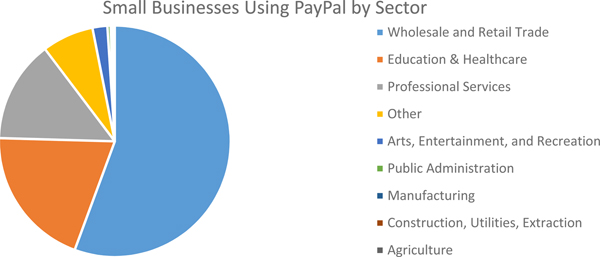
Research published by PayPal provides data to support the anecdotes above. In an analysis of nearly 30,000 small business in the US, the research found that businesses in nearly every sector were trading online (Figure 1).Footnote 29 Many of these sectors are services that previously were considered ‘non-tradable’ because they required physical connection in order to be delivered. Moreover, these businesses were growing and exporting at rates previously unimaginable for firms of their size.
Sectoral Analysis of US Small Businesses Using PayPal

This transformation of the global economy is still in its early stages. Traditional firms are just beginning to embrace Internet technology.Footnote 30 Large Internet companies are beginning to enter traditional sectors.Footnote 31 Moreover, technology startups are just beginning to enter more regulated sectors, such as healthcare. Steve Case named his most recent book after this phenomenon of technology disrupting traditional industry sectors, which he dubbed the ‘Third Wave’.Footnote 32 But, Case also notes the ‘Third Wave’ of the Internet will be very different from the first and second because the sectors being affected are often regulated, meaning that technology alone may not be able to solve problems; a keen understanding of the regulatory landscape will also be required.Footnote 33
3. Digital trade raises challenges for national and international policymakers
The impact of technology on the global economy is raising fundamental questions of jurisdiction, applicability, and enforcement for domestic regulators.Footnote 34 The digital economy is also presenting a challenge to international policymakers who have struggled to come together around particularly sensitive regulatory issues that have arisen as a result of the Internet.Footnote 35 These challenges are not entirely new, but the scale and breadth of the issues being raised by the Internet is unprecedented.
Regulators have the very challenging job of analyzing an industry sector to ensure that business practices in that sector are not harming consumers or the overall sector. They also must protect against information imbalances, moral hazard, and consolidation concerns.Footnote 36 Regulators are rarely elected officials, but instead are appointed or employed by elected officials to create and enforce rules over a specific sector or set of issues. There is typically a central regulator that sets out broad governing rules and local regulators that can tailor these rules and enforce them. The Internet economy is a decentralized system with a broad range of actors often engaged in a cross cutting set of sectors, making it very difficult for the traditional regulatory system to tackle.Footnote 37 There is clearly a mismatch between the traditional regulatory system and the digital economy. This tension has impacted both domestic policymakers and international policymakers.
3.1 National policymaking
There are a range of specific challenges that national regulators are facing due to the rise of the Internet. First, nations are limited in their purview by their sovereign borders, and the borderless Internet raises questions about the jurisdiction of nation-states.Footnote 38 The typical method for providing certainty and trust – through enforcement of rule of law – was the ability to physically fine or arrest an entity if it broke the law. That enforcement method, however, is challenged when the entity resides in the jurisdiction of another sovereign.Footnote 39 Jurisdiction is of course a precursor issue to determining if the substance of a particular law applies.
Second, national regulators struggle with the digital economy because regulations are typically built around a single regulator managing a certain type of entity engaging in a specific type of activity. For example, a central bank would manage banks as these were the entities traditionally associated with financial services. In the same way, a taxicab commission monitored taxicab companies providing transportation, or a hotel commission managed lodging services. Regulations could be designed around these key actors in order to provide certainty in the system. Technology is enabling the convergence of sectors, which makes it increasingly difficult for a single regulator to manage a single actor engaged in a specific behavior.Footnote 40 Regulators are now struggling to force these new Internet entities into the existing structures in order to exercise oversight.
Third, when a national regulator makes a decision about how to classify or adjust the activities of an entity in the digital economy, it immediately forces other domestic regulators to revisit their similarly situated laws. This regulatory competition does have merits, but for foreign entities it creates a patchwork landscape that is highly difficult to operate in, particularly when the Internet itself does not operate in that patchwork manner. It can also create an environment where a government might create additional barriers in order to match or exceed the actions of other countries.Footnote 41 Regulated entities are able to offer a universal service from a technical perspective, but due to the constantly shifting regulatory landscape, the service cannot truly be offered on a universal basis.Footnote 42
Lastly, national governments typically mandate local licensure in order to offer legal, accounting, medical, and several other types of services.Footnote 43 Traditionally, the local nature of these licenses was not a problem, as only a local practitioner could in fact offer those services. Foreign entities might have to contract with a local entity in order to provision the service, or send local employees who could then be subject to local licensure. This is no longer the case. The Internet enables the provision of a range of services entirely through a remote channel.Footnote 44 But, when licensure demands a local presence then those service cannot be legally offered on a purely cross-border basis.Footnote 45
3.2 International policymaking
The problems are equally vexing in the international policymaking sphere. The multitude of stakeholders involved in the international system makes it highly complex to create meaningful outcomes.Footnote 46 Negotiations at the multi-lateral World Trade Organization (WTO) level have stalled for over a decade, again with the notable exception of the Trade Facilitation Agreement.Footnote 47 Some argue that this stasis is not an issue for digital trade because the General Agreement on Trade in Services (GATS) provides a template through which most digitally delivered services would be covered.Footnote 48 There is some evidence to support this claim. In 2003, Antigua and Barbuda brought a claim against the United States for blocking Internet gambling services.Footnote 49 When the US responded that it did not allow the cross-border transmission of Internet gambling services, the dispute settlement body at the WTO found otherwise. The US was found to have committed to ‘other recreational services’, which was sufficiently like gambling services provided over the Internet to provide jurisdiction.Footnote 50 Ultimately, the WTO appellate body found in favor of Antigua.
Unfortunately, the Gambling case may not be a panacea for the problems of international policymaking and the Internet. Classifying a service like Uber as like a traditional transportation service or an information service is a first-order challenge for GATS. This classification exercise is likely to become increasingly complex as technology changes the way in which to offer, or support, traditional service provisions.Footnote 51 Beyond the classification problem lies the large variety of exceptions that the GATS is subject to, including security, privacy, and public order.Footnote 52 These exceptions can often be used to thwart challenges to ill-fitting domestic regulation. Moreover, regulation in the digital economy is often related to these core national policymaker concerns (e.g. privacy) for which there are exceptions. Even if the classification and exception challenges are overcome, there remains the challenge of actually achieving redress through the WTO dispute settlement system. It has been 15 years since the Gambling case and Antigua has yet to achieve redress.Footnote 53 In the fast-moving world of Internet technology, a decade and a half dispute resolution process is simply an untenable.
Finally, there is the overarching problem that WTO rules and enforcement are meant to combat tactics that are overtly or subvertly trade restrictive (i.e. differential in the way that foreign actors are treated vis-avis domestic actors).Footnote 54 However, the intention behind many domestic regulations is not to be trade restrictive, yet the way they are written, or applied, can be highly problematic for the functioning of the digital economy.Footnote 55 Take the example of the Chinese Internet firewall. An excellent piece by Tim Wu written in 2006 describes how a WTO case could be brought against China for its firewall.Footnote 56 And, yet, to this day no case has been brought. There are a wide variety of explanations for this fact, but one might be that the firewall is applied equally to Chinese companies as it is domestic companies, and, therefore, it is not a problem from a trade law perspective.Footnote 57 Yet, actors in nearly every part of the economy, from a wide variety of countries, regularly raise concerns about the firewall.Footnote 58
The existing international system is pushing for change to deal with some of the challenges of the digital economy. Seventy WTO members recently pledged to initiate exploratory work toward future talks on trade-related aspects of e-commerce.Footnote 59 The group includes 15 G20 economies, several smaller developing economies, and represents about 80% of global trade.Footnote 60 The group has an ambitious mission – the beginnings of a negotiation on e-commerce – but the specifics of what will be negotiated are still uncertain.
The major challenge for trade policymakers, however, will be in how to address the core regulatory issues that are often the crux of digital economy concerns. Trade negotiations discussing digital trade have been able to address issues like copyright terms or tariffs on electronic transmissions.Footnote 61 These issues involve a relatively straightforward exercise in terms of finding a common language on which to agree. Moreover, they are not fundamental issues to citizens of the countries. But, when it comes to issues like privacy, security, financial transactions, consumer protection, cybersecurity, speech, or other fundamental issues, it is difficult to imagine how a regime focused on harmonization of rules – such as the global trading regime – could be successful.Footnote 62
Another shortcoming of the trade negotiation process is that it often excludes stakeholders that are arguably the most important when it comes to digital economy issues, namely consumers or individual citizens.Footnote 63 Concerns around privacy or deceptive financial practices are the result of consumers and individual citizens being taken advantage of and then demanding that their government respond. These issues are often tackled by in-country regulators who are tasked with protecting the interests of local consumers. Consumers rarely have a seat at the table in trade negotiations, despite recent efforts by some governments to expand stakeholder access to trade negotiations.Footnote 64 This lack of stakeholder engagement is in part why there is often a domestic backlash to trade agreements. Moreover, while there are global regulators in certain sectors (e.g. the Basel Committee in financial services), there are no global cross-sectoral regulators who are tasked with protecting all consumers.Footnote 65
The fact that trade law contains hard-and-fast rules that are then negotiated by supra-national bodies also makes it difficult for national governments to make significant commitments on important issues. Rules on economic issues like competition have seen some progress through trade negotiation, but again the more fundamental socio-political issues have been difficult to tackle.Footnote 66
Another challenge for traditional trade negotiations is that domestic legislation can be quite divergent from the language being agreed in the negatiations.Footnote 67 Again, the disconnect between trade negotiators and individual citizens becomes apparent. Technical negotiators might be able to come to an agreement, but that agreement must be politically palatable to each nation.
Despite these challenges, trade negotiators have achieved progress in removing regulatory barriers in certain sectors. Telecommunications, intellectual property, and agriculture are areas where trade commitments have been made that harmonize regimes and create binding commitments. Yet, trade policymakers have struggled to create hard and fast rules on more fundamental regulatory issues such as financial services and environmental issues. Trade law in the services context also explicitly excludes rules around privacy and security, which again are fundamental issues for the digital economy.
International policymaking outside of the trade context has also made progress in creating greater international regulatory coherence. Marco-financial issues can be tackled at fora like the G20, Bank of International Settlements, and Basel Committee.Footnote 68 Environmental issues were tackled in the Paris Climate Accord. Yet, again, some of the issues that represent core challenges for the digital economy – privacy, cybersecurity, speech, fintech – do not have a good international forum for discussions or for achieving meaningful progress.
3.3 A case study on data protection
Data protection laws provide an interesting dynamic through which to view the challenges that the Internet poses for both domestic and international law making. The Internet enables an unprecedented level of data collection and usage. These data enable Internet services to better understand customer preferences and produce unique insights that then lead to new processes or services. However, the collection and usage of personal information also raises data protection concerns. The sensitivity of data being collected by Internet companies and the insights they might produce can yield negative outcomes for citizens. Moreover, the usage of the data for actions that could be detrimental for citizens is another concern. Large-scale data breaches raise the most alarm because there is very little insight into the entities that procure these data and how that information is then used. These concerns are leading to data protection laws that are seeking to provide appropriate privacy protection for individual citizens.
Data protection requirements can, however, be a tremendous challenge for digital trade. Most onerous is when data protection requirements include some form of physical localization.Footnote 69 The benefit of the Internet is the ability to remotely offer a service, eliminating the costs associated with a physical footprint. Localization requirements essentially remove the differentiator that the Internet provides. Data protection laws can impede digital trade Regulations on encryption using a specific technology, minimizing certain types of data, and deleting other types of data can all be challenges for entities engaged in digital trade.Footnote 70 Moreover, segmenting consumers based upon where they live in order to comply with domestic regulations can be a challenge because an IP address may not always conform with where an individual lives.Footnote 71 Data protection laws can entail hefty fines if broken and make operating certain types of business models cost prohibitive.
At the national level, there is no shortage of activity in the data protection sphere. The most notable recent development is the ratification of the General Data Protection Regulation (GDPR) in the European Union, which was implemented in May 2018.Footnote 72 The regulation was adopted in part as a response to the digitization of the economy and the concern about how organizations are managing personal information.Footnote 73 There are discussions in the US around enhancing data protection regulation to combat efforts by foreign governments to impact elections.Footnote 74 South Africa has recently setup a data protection authority.Footnote 75 A Chinese court is currently hearing a case against search engine Baidu for collecting user information without permission.Footnote 76 The Indian government has released a white paper on a new data privacy and protection framework for India.Footnote 77
It is also noteworthy that before the GDPR, the EU Data Protection Directive was implemented by national governments in a variety of ways.Footnote 78 The GDPR is a single harmonized regulation that applies to all member states. But, the GDPR is not the only development in the international policymaking arena related to privacy. The Asia Pacific Economic Cooperative (APEC) created the Cross-Border Privacy Rules (CBPR), which although a voluntary privacy code of conduct for cross-border data transfers in the Asia-Pacific region, once commitment has been made, the commitment becomes enforceable .Footnote 79 Private sector companies have received approval for CBPR compliance and governments have signed to enforce the code of conduct as it is adopted.Footnote 80
There is also a paradigmatic example of regulatory cooperation in the privacy ecosystem. The US privacy regime and the European privacy regime have key differences. The US uses a sectoral approach to privacy, creating differential requirements based upon the industry and type of data being collected.Footnote 81 This is different from the comprehensive approach to privacy demonstrated in the EU GDPR. The US also has multiple regulators for privacy with divergent legal bases. Despite the differences in these two regimes, the US and EU successfully agreed upon the Safe Harbor Framework in 2000.Footnote 82 Then due to a legal challenge and increased concerns with the viability of the Safe Harbor framework, the US and EU again came together in 2015 to create a new framework entitled Privacy Shield.Footnote 83 Notably, the Privacy Shield was agreed to by the US Department of Commerce and the EU Commissioner for Justice, Consumers, and Gender Equality instead of the United States Trade Representative and DG Trade in the EU.Footnote 84 The Privacy Shield enables a regulated entity involved in data collection to certify with its national regulator that it is in compliance with the privacy principles in the agreement to receive an exemption from having to comply with the foreign entities law for cross-border data transfers.Footnote 85 The enforcement mechanism for the Privacy Shield is domestic law rather than international law.Footnote 86 All of these elements provide a template for the type of regulatory cooperation that this paper advocates – see Section 3.
One final thought on why addressing the challenges of digital trade are so important. The challenges of regulation in the digital economy, at both the national and international level, are particularly acute for smaller businesses.Footnote 87 Larger businesses often have the capacity – legal resources, lobbying relationships, and physical infrastructure – to comply with a wide variety of regulatory barriers. But, these divergent national regulatory regimes have the potential to eliminate the cross-border activities of small business, and in fact deter them from trading altogether.Footnote 88 An approach focused on regulatory cooperation provides a path to tackling some of the international policymaking challenges related to digital trade and therefore enabling small businesses to continue to benefit from digital trade.
4. The regulatory cooperation opportunity
There is no question that the WTO has had an impact on domestic regulation by member states and the behind-the-border restrictions these regulations might impose. This impact dates back to the General Agreement on Tariffs and Trade in 1947.Footnote 89 Nations were compelled to create more transparent regulations and avoid overtly discriminatory restrictions. But one of the major challenges in WTO-style negotiations is that they pursue harmonized hard-and-fast rules that all parties agree to. The challenges in the regulatory space that digital trade is creating are too complex to be addressed through a harmonization regime. Instead, international policymakers must utilize a regulatory cooperation approach with the goal of mutual recognition rather than harmonization. Mutual recognition agreements place domestic regulators in a primary position and enable regulated entities to operate across borders while only being subject to domestic regulation. This approach should be transparent in its processes, bring national regulators to the table , and maintain an open forum for dialogue so that updates and reforms can be made.
4.1 What is regulatory cooperation?
There is no consensus in the literature surrounding concepts such as regulatory harmonization, cooperation, interoperability, and mutual recognition. These terms can also be used interchangeably, which can lead to confusion. Defining terms at the outset is key. Examples of each term are given in an effort to provide more clarity.
• Regulatory Harmonization – This is the typical goal of trade negotiations, to arrive upon a single rule for all parties to follow (e.g. copyright term length in the US–Australia Free Trade Agreement).Footnote 90
• Regulatory Cooperation – this is a broad term and can encompass a range of interactions from discussions and shared learnings to binding language subject to enforcement (e.g. US–Mexico High Level Regulatory Cooperation Council).Footnote 91
• Interoperability – This term is borrowed from pure science disciplines and is more granular than cooperation; it refers to exchanging information between divergent regulatory systems in order to move towards a system that works effectively for all systems (e.g. European Directive on Railway Regulation).Footnote 92
• Mutual Recognition – Each country maintains its own set of regulatory standards, but agrees to recognize the standards of the other countries as being equivalent to its own (e.g. the US–EU Privacy Shield).Footnote 93
These are difficult to define terms and should be subject to additional scholarly research to further assess their meaning. However, the key purpose of defining them in this paper is to draw attention to the distinction between harmonization and cooperation. Regimes that involve international cooperation are distinct from regimes focused on harmonization in that rather than aiming at explicit principles and corresponding hard rules, they aim to establish international regimes with rules based on agreement and cooperation. The primacy of domestic regulators in the formation and implementation of such regimes helps to limit some of the sovereignty concerns that have plagued traditional trade agreements.Footnote 94
4.2 Why a regulatory cooperation regime for digital trade?
It is the primacy of domestic regulators and policymakers that enables a regime that practices cooperation to have a better chance of success in the resolution of issues surrounding digital trade. Domestic regulators are unlikely to relinquish control to international policymakers over fundamental issues such as privacy, security, and financial consumer protection. Domestic regulators are accountable to their citizens and feel that their own laws are best placed to protect their citizens. Regulatory cooperation, even in its most concrete form – mutual recognition – does not undermine the effectiveness of domestic law.Footnote 95 Fear of losing control is an understandable reason to avoid alternative forms of regulation.Footnote 96 But, the regulatory cooperation mindset being proposed in this paper does not require regulators to relinquish control. Instead, regulators will be better placed to take action against activities that concern them because jurisdictional hurdles will no longer prevent action. Regulators will be able to work with their counterparts to tackle problematic behavior, because local enforcement is far more likely to cooperate when cooperation is the focus of the regulatory process. This combination of practicality and effectiveness makes regulatory cooperation an attractive option for tackling some of the challenges in digital trade.
There are other benefits to a regulatory cooperation approach. Regulatory cooperation – particularly when resulting in a mutual recognition agreement – has a concrete outcome. Although mutual recognition involves hard and fast rules with clear enforcement, they are domestic rules. Regulatory cooperation can also enhance trust between nations and facilitate information flow.Footnote 97 Trust is key to any regulatory regime, domestic or international, and regular discussions and cooperation can help to build the trust that is required for hard and fast rules to be enforced.
There are examples around the world where regulatory cooperation – with a focus on mutual recognition – has led to concrete outcomes on challenging issues. There is an example of India negotiating with Italy to allow Indian professionals to Italian certification to carry out services remotely.Footnote 98 The EU–Canada Air Transport Agreement in 2009 set out to create a mutual recognition regime for airline safety standards.Footnote 99 The US Securities and Exchange Commission has an agreement with the Australian Securities and Investment Commission to provide an application exemption for a stock exchange that is already regulated by the counterparty.Footnote 100
There are no doubt shortcomings in regulatory cooperation agreements. Mutual recognition agreements have traditionally only been successfully negotiated on a bilateral or regional, rather than multilateral, basis.Footnote 101 A piecemeal approach to international policymaking could threaten to create a spaghetti bowl of tangled arrangements as regulators engaged in a regulatory cooperation exercise can be unfamiliar with the standards being utilized by their counterparts in another country, making it difficult to assess whether those standards can be recognized.Footnote 102 This can lead to agreements to be created solely between ‘like-minded’ nations that already operate similar regulatory regimes. Mutual recognition agreements can also disadvantage firms from countries that are not a party to the agreement as they still have to adhere to multiple sets of standards.Footnote 103 There is also an argument that mutual recognition agreements might be a violation of WTO obligations as a result of the disadvantages for non-signatories.Footnote 104 There is an argument that mutual recognition could lead to competitive deregulation because firms would move to countries with more strict regulations to those with looser regulations, but that also have a mutual recognition agreement.Footnote 105 There is no clear process for, or body involved in, creating or reviewing workable mutual recognition agreements, as the WTO does for trade agreements. Moreover, there are clear incentives for having mutual recognition between like-minded governments. It is less clear how rivals, or those from developed and developing countries, might come to a cooperation agreement. Agreement only between similarly situated nations could lead to trade distortions.Footnote 106 Finally, there is no universal enforcement body that is responsible for mutual recognition agreements.
Despite these limitations, this paper argues that regulatory cooperation – with the goal of mutual recognition – is the best method for resolving the most challenging issues currently plaguing digital trade. The process of trade negotiations, and in particular the GATS has done a tremendous job of setting certain baseline standards for how countries approach services regulation. Developing countries in particular have no doubt created more transparent, balanced, and fair regulation as a result of the GATS.Footnote 107 But, when dealing with many of the contentious issues surrounding digital trade, the effects of trade law may be limited. The WTO was simply not designed to make international regulatory standards.Footnote 108 That is why this paper recommends pursuing a new strategy focused on regulatory cooperation and mutual recognition.
4.3 How should regulatory cooperation discussions be carried out?
The first step in any regulatory cooperation exercise will be to agree upon the goals behind the existing domestic regulation. In many cases, different countries will actually have the same regulatory goals and may just be adopting different methods to achieve those goals.Footnote 109 If these goals are mutually agreed upon. then any discussions will begin from a strong foundation and can proceed from there.
Next, the primary goals of the cooperation agreement should be set out. In particular, cooperation discussions should include mutual recognition, but this may not always be achievable, particularly when nations have divergent histories and goals. Falling short of mutual recognition does not mean discussions should be nixed. information sharing can lead to trust and capacity building that could set the stage for a more concrete future discussions.
Any discussions as part of the regulatory cooperation agreement should be conducted in a highly transparent manner. Transparency in discussions serves to build trust not only between regulatory authorities, but also between the nations (and their citizens) that is necessary to support cross-border regulatory collaboration.Footnote 110 Transparency can avoid some of the complications that have plagued trade agreements.
The right players must be a part of the discussion if an agreement is expected to be reached. Regulatory negotiators need to be in the primary seat at the table for the discussion. Information gaps – both internal and external – have been a challenge that have hampered regulatory cooperation agreements in the past.Footnote 111 The ideal principals at the table, therefore, would be those who are charged with the task of achieving cross-border regulatory cooperation. The position of regulatory negotiator does not currently exist, and one of the recommendations of this paper is the creation of such positions. Such individuals would be best placed to explain the regulatory goals and practices, and would also be able to receive and understand information about, and implications of, another country's regulatory practices. The typical domestic regulator does not have the incentive to consider the regulatory practices of another regulator, and that is why a specific position with the correct mandate would be needed.Footnote 112
Regulatory negotiators would need to be at the table because of the convergence of industries that technology is enabling.Footnote 113 For example, transportation and information technology ministers working together would be best suited to act as negotiators on cross-border regulatory standards for self-driving cars. Other stakeholders should also be a part of the process. Industry should of course have its voice heard in regulatory cooperation discussions, but so should consumer groups and other interested stakeholders. Engagement with these stakeholders must, again, be done in a transparent manner to avoid sowing mistrust.
The substance of the cooperation discussions should have a few guiding principles. Regulators should ensure that local regulations are technologically neutral – the regulation itself should not be focused on the specific technology being used.Footnote 114 Regulators must be able to get a full view into the practices of the regulatory processes of other parties to the negotiations. It is only with such transparency in language, practice, and implementation of a regime that trust can be built that would enable the approval of a mutual recognition agreement.
When it comes to enforcement, localized enforcement is the most feasible method. If local enforcement is discriminatory in any way, then an international dispute mechanism can be setup to act as arbiter.Footnote 115 But, the primary enforcement mechanism for most regulatory disputes should remain local.
There must also be an element of auditing and regulatory reviews included in any regulatory cooperation agreement. Trade negotiators have tremendous difficulty in updating the text of trade agreements based on changing circumstances; the recent renegotiation of the North American Free Trade Agreement is an example of this challenge.Footnote 116 Regulatory reviews of regulations have generally been used on a regular basis in a domestic context .Footnote 117 Technology can be helpful in achieving some of the auditing that needs to be done. The concept of Regtech is rapidly gaining notoriety.Footnote 118 Data can be gathered at rapid speed and potential risks can be tracked and reported in real time.Footnote 119 Regulators can leverage Regtech to promote transparency in auditing and to add confidence to a mutual recognition regime.
Trade negotiators can mandate that a forum for regulatory cooperation be created and perhaps even set a hard deadline for mutual recognition to be achieved. The Comprehensive Economic and Trade Agreement (CETA) between Canada and the EU can be viewed as an example for trade negotiators working on regulatory cooperation as it includes procedures for regulatory cooperation on a broad variety of sectoral issues.Footnote 120 But the language of CETA could be made stronger by specifying target dates for mutual recognition and setting up an official forum for the cooperation discussions to take shape.
Finally, mutual recognition agreements should pursue an open source strategy whereby new countries can easily join the agreement. Once enough members agree to mutual recognition, countries that are considering revising their domestic regulations might consider mirroring the regulation of a nation that is already part of the mutual recognition standard so as to immediately be eligible to join the cooperation agreement.Footnote 121
5. Conclusion
There is real urgency to begin to tackle some of the challenges of digital trade through regulatory cooperation. Trade negotiators are trying to tackle some of these problems, but are limited by the structure, processes, and history of the trade regime. Regulatory cooperation arrangements no doubt have shortcomings, but when they result in a mutual recognition agreement they can address fundamental regulatory challenges with a concrete and enforceable regime. Mutual recognition agreements are not easy to achieve due to concerns about information asymmetry, but technology, transparency, and vigilance can help to improve trust and enable domestic regulators to approve the processes of their foreign counterparts. The proliferation of mutual recognition agreements on thorny issues related to digital trade could help bring certainty to the digital ecosystem and unlock the full potential and growth of the digital economy.