1. Introduction
In settings with well-defined property rights and low transaction costs, economists expect private actors to eliminate inefficiencies through competition or through bargaining. Why does not the same reasoning translate easily into the political realm? How can we account for the emergence and persistence of institutions and policies that entail large social losses? A sizeable public choice literature explores failures of the political process to generate efficient outcomes, starting with Tullock's (Reference Tullock1967, Reference Tullock1975) seminal contributions. However, disagreement exists over the mechanisms through which the political process prevents efficiency-enhancing political bargains from occurring – including most prominently transaction costs,Footnote 1 rational ignorance,Footnote 2 problems of credible commitment,Footnote 3 to a failure of individual rationality in the political realm.Footnote 4
To elucidate that question, this paper provides a case study of failed subsidy reforms in Egypt. In 2012, close to one-third of the country's public spending – or 13 percent of GDP – was directed towards subsidies of consumer goods, ranging from diesel oil to tea. Besides the fiscal burden, subsidies disproportionately benefit the wealthier segments of the population, which makes them ill-suited as instruments of social assistance. They distort the supply of commodities and deter entry, resulting in poor quality and unreliable service. Subsidies also invite arbitrage, leading to leakages to black markets and to smuggling.Footnote 5 Yet, subsidies are embedded in Egypt's political landscape as the main tools of redistribution and attempts to reform the subsidy system in the past were met with popular resistance.
According to this paper, the lack of credibility can explain why subsidies have withstood reform. The costs of reform reversal and the costs of opportunistic seizure of the surplus of a reform – typically in the form of budgetary savings – by politicians have been low in Egypt. The public expect that any savings from a subsidy reform would end up being grabbed by the political elite and its cronies instead of being directed at the population, either in the form of a lower tax burden or increased provision of public goods. As a result, the government has never been able to commit credibly to a permanent reform of subsidies. Instead, only marginal changes have been enacted occasionally and then reversed. In the pre-Arab Spring Egypt, the costs of reform reversal were low because the one-party system provided very few genuine veto players that could block such policy reversals. Even after 2011, Egypt's politics suffered from credibility problems as well because, in general, new politicians in new democracies cannot easily make credible pre-electoral promises about policies.Footnote 6 As a result, problems of credible commitment in policymaking will likely plague Egypt regardless of how oblique is the country's journey towards an open political system.
The paper provides a discussion of how the lack of credibility could be overcome by appropriately designed reforms. In order to overcome the credibility problem, a reform of subsidies would need to be quick, irreversible and simple to implement. It should also involve an explicit mechanism for distributing the gains of the reform and be accompanied by complementary measures that would yield wide benefits to the population and improve the functioning of the markets for food and energy.
This paper fills gaps in several streams of literature. Firstly, it represents a new application of the research on policy credibilityFootnote 7 to a problem that has obvious relevance for policy in low- and mid-income countries. Its purpose is to provide an answer to the question frequently asked by public choice theorists – namely, why do efficiency-enhancing trades often fail to materialise in the political realm?Footnote 8 Besides commitment and credibility problems, the existing literature cites the impracticability of compensation schemes that would accompany changes in policy,Footnote 9 uncertainty over distributional effects of policy changesFootnote 10 or a status quo bias driven by incentives.Footnote 11
Secondly, the paper represents an addition to the literature on the evolution of policy and durability of reforms, which has so far focused mostly on the American context,Footnote 12 and much less on low- and mid-income countries, or transitional economies.Footnote 13 Poorer parts of the world, however, by offering a greater variation in policies and economic outcomes, both over time and across countries, represent a natural testing ground for different models of policy persistence. Moreover, as we have seen in Eastern Europe in the 1990s, political and economic transitions tend to create an environment in which many of the problems plaguing political decision-making are exacerbated. That applies particularly to the problems of credible commitment and more broadly to the incentive-compatibility of economic reforms.Footnote 14 As a result, during post-communist transitions, wholesale and rapid reforms were associated with better outcomes than piecemeal changes Footnote 15 – in line with the logic of Rodrik's (Reference Rodrik1988) idea of overshooting as a signal of credible commitment. What is more, gradual reforms were often a by-product of strong vested interests that captured the state apparatus in order to keep the inflationary spigot running.Footnote 16
The existing literature on reform durability has focused heavily on the institutional setting in which reforms are adopted, as well as the nature of coalitions adopting such policies. By adding an explicit emphasis on policy credibility, it is hoped that our approach can provide a more complete account of reform reversals than the ones commonly used in the literature. Finally, this paper makes a connection between the political economy of credible commitment and the sizeable literature on subsidy reforms,Footnote 17 where an explicit political economy focus is underplayed and where the problem of subsidies is represented as a technical one. Although the technical aspects of subsidy reforms are without any doubt important, the purpose of this paper is to focus the attention of researchers and policy practitioners on the details of the institutional context.
2. Reform reversals, reform paralysis, and lack of credible commitment
Economic policies are contracts between politicians and a decisive part of the population, needed for the politicians to control of the government. Through such contracts, politicians obtain the support that enables them to control the government apparatus, in exchange for policies that deliver benefits to the part of the population that is needed to control the government. As with other contracts, these are vulnerable to situations when politicians face incentives to deviate from the announced path.Footnote 18
A substantial part of the population derives net benefits from the existing subsidy system, even though these come at a deadweight cost. Disturbing the status quo by eliminating subsidies would impose cost on that part of the population, even though it would enhance economic efficiency. An elimination of subsidies does not necessarily imply that ordinary Egyptians will receive the surplus, either in the form of lower taxes or directed transfers. Instead, politicians may choose to appropriate the surplus created by the reform to themselves. To elicit support for reform, politicians must propose an explicit – and credible – mechanism for distributing the benefits of the reform, which would leave a decisive part of the population no worse off than in absence of reform. Even if a deal is reached, the public will have only imperfect mechanisms for monitoring politicians’ compliance with their proposal and penalising them if they fail to deliver.
However, the negotiations and calculations needed to make sure that the decisive part of the population is left no worse off are costly and take time. That, together with competing demands on politicians’ time and attention, can create a situation in which the surplus that politicians expect to appropriate from the policy change is outweighed by the costs of reaching a deal with the population.
Because the deadweight cost of a subsidy system extends over time, the benefits from the reform will not be realised all at once. As a result, those who consent to the reform will have to rely on a promise made by the politicians to share with them the benefits from the reforms as they accrue over time. Such promises can be broken because, at a later stage of the game, politicians may decide to redistribute the surplus from the reform opportunistically, violating their prior agreement with the population.
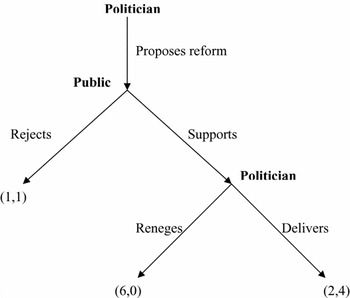
The situation is visualised on Figure 1, which mirrors the exposition in Coyne and Boettke (Reference Coyne and Boettke2009: 6). In the first stage of the game, the politician proposes a welfare-enhancing reform – i.e. an elimination of wasteful subsidies. In the second stage, the public decides whether to support the politician's platform or not. If the platform is rejected, both the politician and the public receive a default pay-off of 1, corresponding to the status quo. If the public supports the platform and the politician is elected, the politician has the option of either delivering on their promise, generating a pay-off of 2 to the politician and a pay-off of 4 to the voter. If the politician chooses to renege – e.g. by seizing the whole surplus from the reform – they will end up with a pay-off of 6, leaving the public with a pay-off of 0.
The problem of commitment.

In a one-shot game, the outcome (Supports, Delivers) is not attainable because in the final stage of the game the politician is tempted to hijack the surplus created by the reform by reneging, creating a classic time inconsistency problem. A rational public will reject the politician's reform proposal, resulting in an equilibrium that leaves room for a Pareto improvement, which is unattainable unless the structure of the game is changed in a way that precludes the politician from reneging in the final stage or makes reneging costly for him. The politician needs to find a way of making a credible commitment. The only subgame perfect equilibrium in the game is the one in which the public rejects reform, leaving both the public and the politician with a lower pay-off compared to the Pareto superior outcome that the reform would have brought if actually implemented.
While the situation depicted on Figure 1 describes a one-shot came, it is possible to extend its implications to a dynamic environment. It is possible to imagine that the continuation of a subsidy reform over time requires a repetition of the game above in each period. Even if the initial problem of reform implementation is overcome and the politician delivers, it is not clear that he will continue delivering in subsequent stages of the game. The government can be changed in an election and the commitment of new politicians to delivering may be in doubt. That would induce the public to play ‘reject’ in the following stage of the reform, leading to a repeal of the reform.
As Campos and Esfahani (Reference Campos and Salehi Esfahani2000) note, different mechanisms exist that can help politicians overcome such credibility problems. The general mechanism through which these mechanisms work is by decreasing the pay-off to the politician of seizing the surplus of the reform in the final stage of the game. The main testable prediction of this theoretical framework is that reforms will be more difficult if these commitment mechanisms are weak or unavailable.
(i) Gains sharing
As a rule of thumb, a large part of the efficiency gains generated by the subsidy reform will be related to budgetary savings. As a result, politicians might have discretion over the distribution of that part of the surplus. The main risk of the reform from the public's perspective is that the savings will be appropriated as rents by politicians. One way of overcoming that problem is for the politician to accompany the subsidy reform with a reduction of the tax burden, which would ensure that the savings are appropriated by the population. Alternatively, the government can create an explicit system of cash transfers that would direct a large part of the budgetary savings to the population, conceivably in a way that targets poor households rather than wealthy ones.
Tax cuts and the creation of a system of transfers both have the potential to create constituencies who will derive benefits from the new status quo, who will have stakes in the reform and who will oppose its reversal, making it more difficult for the government to repeal the reform or seize the welfare gains that the reform would generate. It would do so by changing the structure of the pay-off in the final stage of the game depicted on Figure 1. The politician would no longer have the option of reneging at no cost and capturing the surplus of 6, leaving the public with a pay-off of 0. Instead, the politician would have to propose a statutory repeal of the tax changes or of the compensatory mechanisms accompanying the subsidy reform – which would hardly command popular support.
(ii) Governance reforms
The subsidy reform may also be linked to governance changes that increase the cost of reform reversals. Such reforms may increase the number of potential veto players whose agreement is needed to revoke the reform, thereby making reneging on reform more difficult, enhancing thus the credibility of the reform. That can be achieved, e.g., by delegating the decisions over pricing of commodities to an independent regulator, instead of keeping them in the hands of the politicians. In other words, such governance changes would remove the power of politicians to renege in the final stage of the game by placing the node of decision-making into the hands of an independent regulator who does not face the same incentive structure and is unable to appropriate the created surplus for herself.
The costs of reversal can be increased by dismantling the administrative capability of the government to provide subsidies by closing down the relevant parts of the government apparatus. In a case where subsidy systems have co-existed with heavy regulation of entry, it is plausible that the elimination of government-protected monopolies and opening up of markets to competition would make reintroduction of subsidies or price controls more difficult or perhaps even plain impossible.
(iii) International agreements
Governments can use international treaties as a way of committing to certain policies. International treaties, or arrangement with organisations such as the European Union, World Bank or the International Monetary Fund (IMF), can offer substantial benefits to the governments. If they are conditional on governments’ pursuit and upholding of subsidy reforms, the costs of reneging for the government increase.Footnote 19 This mechanism would change the pay-off structure of the game by imposing costs on politicians for reneging in the final stage of the game depicted on Figure 1 and therefore decreasing the pay-off from reneging or from seizing the surplus. An obvious limitation of such arrangements is that they do not extend indefinitely over time. Once a particular structural adjustment programme of the IMF is completed, it will no longer prevent the government from reintroducing inefficient price subsidies.
(iv) Reputation
Politicians may use their reputation and their record of delivering on other policy-related promises to overcome the time inconsistency problem involved in removing subsidies. Politicians who have built a reputation for delivering on their promises will find it more costly than others to renege, and will be correspondingly less likely to do so. Unlike the previous commitment mechanisms, this would not change the structure of the game directly. Instead, this mechanism would give voters an opportunity to punish the politician in subsequent rounds of the game.
This mechanism exists only in competitive political environments where citizens can vote politicians out of office and is available only to politicians who have a record of delivering on promises. Furthermore, it requires a political environment in which it is possible to track politicians’ promises and monitor their performance. In other words, reliable channels of communication and feedback between politicians and the public must be established and the voters need to be able to gather information about the conduct of politicians. Such mechanisms, including a free pressFootnote 20 and institutions of civil society, may not be readily available in closed or uncompetitive political systems, and should not be taken for granted in new democracies either.
3. Egyptian subsidy system
The origins of Egypt's subsidy system can be found in the combination of weak institutions characterised by a lack of capacity to direct transfers to vulnerable groups, and a demand for redistribution from the general public.Footnote 21
This paper takes a narrow understanding of subsidies as measures ‘that keep prices for consumers below the market level or keep prices for producers above the market level or that reduce costs for consumers and producers by giving direct or indirect support’,Footnote 22 in contrast with their broader understanding which may also encompass tax subsidies, cash subsidies or transfers in kind. The economic effects of subsidies are straightforward. By imposing a price below the market clearing one, policymakers create shortages.Footnote 23 In response, governments intervene to increase the total supply of the commodity. For example, to keep the subsidised bread available, the Egyptian government provides subsidised wheat flour, which it either buys at world markets or is directly involved in producing.Footnote 24 Subsidies also create opportunities for arbitrage, especially if private markets exist on which the commodities in question are traded at unsubsidised prices.
Given these inefficiencies, why is it that the subsidy system in Egypt has been so difficult to reform? The stylised model presented in Section 2 predicts that reform will be impossible to implement – or reversed later – if politicians do not have access to relevant commitment devices or when those devices are weak. All four of the following commitment devices have been either absent or weak in the Egyptian context: (1) gains-sharing schemes accompanying the attempts at reform, (2) independent regulatory structures constraining the power of politicians to reintroduce subsidies, (3) international treaties or conditional arrangements with international organisations, (4) politicians that would use reputation on competitive political markets.
Background
After World War I, the Egyptian government started importing large quantities of wheat and selling them at subsidised prices in government-owned shops.Footnote 25 World War II led to the introduction of rationing of basic commodities, including wheat and sugar. After independence, subsidies of food, transport, housing, energy, water and health – and also to soap and cigarettes – became an essential element of the relationship between the government and Egypt's citizens. The agrarian reform of 1952 was a catalyst in that process and led to a direct involvement of the government in numerous aspects of food production and distribution.Footnote 26 Rationing was initially used, then removed, and finally reintroduced in 1966.
Table 1 provides information about the absolute size of subsidy spending in the Egyptian economy. Subsidies to petroleum products account for almost three quarters of the total spending on subsidies. The remainder is directed towards spending on food subsidies, most notably bread.
Spending on selected subsidies (millions of USD, current prices)27

Source: Egyptian Ministry of Finance (2012)
aGeneral Administration for Supply of Commodities, in charge of food subsidies.
*Budget only.
The cost to the public budget underestimates the opportunity costs of subsidies. Fattouh and El-Kattiri (Reference Fattouh and El-Kattiri2012: 38) argue that because of deadweight losses such opportunity costs – which encompass the social benefits from the alternative uses of scarce resources that are used towards subsidising consumer products – may amount to roughly twice the recorded financial costs of subsidies. And that estimate ignores the dynamic effects that subsidies have on the broader economy by encouraging overconsumption of certain sources of energy and food and deterring competitive entry. Artificially low prices also result in overconsumption, leakages, and black markets. Fattouh and El-Kattiri (Reference Fattouh and El-Kattiri2012: 25) note that while energy intensity has decreased in most industrialised countries around the world, it has been increasing in countries that use energy subsidies – including Egypt.
The excessive incidence of subsidies on high-income groups is pronounced in the case of energy subsidies.Footnote 28 Abouleinein et al. (Reference Aboulenein, El-Laithy and Kheir-El-Din2009) show that in both urban and rural areas the top 20 percent of households (as measured by expenditures) receive by far the largest share of the total subsidy spending, and the share of the benefits received by other households decreases with their wealth, as proxied by household expenditures. This discrepancy is even stronger in urban areas, where it is likely driven by multiple car ownership among the wealthiest households. Unsurprisingly, the gasoline subsidy is the most regressive.Footnote 29
Leakages, measured as differences between the observed supply and demand, are also significant. They represented 31 percent in the case of baladi bread in 2008/2009 (down from 40.8 percent in 2004/2005), and 20 percent in the case of sugar and cooking oil.Footnote 30
Benefits from food subsidies, directed in part to inferior goods, accrue more evenly across different segments of the population – particularly after the reforms of the 1980s and 1990s, which eliminated subsidies to food items that were consumed mostly by the wealthy Egyptians.Footnote 31 Food subsidies, however, tend to have an urban bias, which is driven partly by the fact that households in rural areas are able to supply their own food.Footnote 32
A history of failed reforms
An early reform of food subsidies was introduced by president Anwar Sadat in 1977,Footnote 33 following almost a decade of growth in subsidy spending during which subsidies covered a variety of new foodstuffs, including corn, rice, or frozen fish and meat.Footnote 34 Though the series of protests that followed were famously dubbed ‘bread riots’, the reform announced in January 1977 did not involve an increase in the price of coarse baladi bread nor a number of other staples such as lentils, beans, cooking oil and sugar. Subsidies were to be reduced on the more expensive fino bread, as well as the low-extraction flour from which it was made, rice, LPG, gasoline, cigarettes, and tea.Footnote 35 Riots that occurred lead the government to cancel the reforms and instead expand the subsidy system.
In the late 1980s and early 1990s, some reforms were put in place – mostly as part of a structural adjustment programme administered by the IMF. In 1990, the prices of agricultural products – except for sugar – were liberalised. Petroleum prices, set at 36 percent of international prices in 1989 were raised to 100 percent in 1994 (African Development Bank, 1999: xi). The specific changes to food subsidies included targeting by introducing two categories of ration cards, a reduction of the number of subsidised foodstuffs, a reduction of people eligible to receive ration cards,Footnote 36 phasing out of certain commodities and their replacement with less heavily subsidised alternatives, a reduction of size of subsidised bread loaves.Footnote 37
The real burden of food subsidy spending fell afterwards, but then started growing again.Footnote 38 In the 2000s, the government launched an extensive energy subsidy reform, increasing prices of gasoline and diesel oil and putting in place mechanisms for gradual electricity price increases, which took effect between 2005 and 2008. In 2008, natural gas prices were increased, and plans had been made for a complete elimination of energy subsidies by 2014. However, those efforts were abandoned in 2009 as the global economic crisis began to unfold, resulting in gradual increases in subsidy spending to unsustainable levels. In December 2012, the subsidy on 95-octane gasoline – used by the wealthiest Egyptians – was scrapped. Instead of generating the savings that the government had hoped for, however, it induced consumers to shift to 92-octane gasoline,Footnote 39 creating shortages. In March 2013, an increase of the prices of LPG was announced, by 60 percent for consumers and by 100 percent for businesses.Footnote 40 Since 2012, the country has been suffering from a diesel shortage, 70 percent of which needs to be imported. Given the high subsidisation rate on diesel, the government is responding to the existing fiscal pressures by purchasing less fuel – a solution that can be hardly seen as lasting.Footnote 41
While there has been no shortage of partial reforms, before and after the events of the Arab Spring, the successive Egyptian governments have failed either to end subsidies to food and energy or to prevent increases in subsidy spending following cuts to such spending. To show how the framework outlined above in Section 2 accounts for the failure of Egyptian governments to sustain subsidy reforms, one needs to provide evidence for the lack – or weakness – of commitment devices available to prospective reformers in the country.
(i) Gains sharing
A subsidy reform accompanied by an explicit gains-sharing mechanism makes it difficult for politicians to capture the surplus of the reform since that would require a repeal of the gains-sharing mechanism in question – such as a cash transfer programme or tax cuts. The attempts to reform the subsidy system in Egypt did not include a sizeable increase of the existing social safety nets. In 1977, the announcement of increases of subsidised food triggered riots because they were perceived as unfair. ‘Although the riots are commonly termed “food riots”, as noted above, they were in fact “equity riots” since the underlying issues had more to do with the perception that the policy change was unfair, rather than the actual policy change itself’ (Gutner, Reference Gutner2002: 18).
Nor were later attempts to curb subsidy spending accompanied by a sizeable increase in cash transfers to the population. As late as 2005, only 0.12 percent of GDP was spent annually on cash transfers and the size of the Social Fund for Development (SFD), which had been established as part of previous reforms was around 0.18 percent of GDP. (World Bank, 2005: iv)
(ii) Governance reforms
Governance reforms involving the creation of independent regulatory bodies, rules-based pricing mechanisms or full liberalisation of markets in question remove the discretion over prices from politicians’ hands, making it more difficult for them to renege. Since its independence, Egypt was governed as an authoritarian system dominated by one political party. Under Nasser, the Arab Socialist Union (ASU) effectively controlled the government. After its demise in the mid-1970s, the National Democratic Party (NDP) – originally the centrist group in the ASU – became the only effective political organisation in the country controlling all levels of government and public administration. As such, the number of veto players in the political process was limited, placing few formal constraints on the range of policies that could have been adopted. A government that is not accountable to a majority of the population faces few constraints if it decides to renege on its promises, whether they pertain to the distributional or other aspects of a reform. Arguably, that account characterises the Egyptian situation well. Policies were introduced and repealed at the sole discretion of the ASU or NDP, with very little constitutional checks and balance. Repeated reversals of reforms further eroded the public's trust of the government to seriously tackle the problem. Furthermore, the attempts to reduce subsidies in the past have not been accompanied by consistent attempts to depoliticise price-setting in the area of food or fuels, or to delegate those to an independent authority. A governance reform that would support the phasing out of subsidies could involve closing the relevant government agencies – the General Administration of the Supply of Commodities (GASC) or the parts of the Ministry of Petroleum in the case of Egypt. Such governance reforms have never been proposed.
In the area of energy, the elimination of subsidies would be aided by a privatisation and liberalisation of energy markets, making it more difficult for the government to re-impose price controls. So far there have been no signs of such liberalising reforms.
(iii) International agreements
International agreements, such as loans from international aid agencies, can increase the costs of reneging on the reform or of the seizure of the surplus of the subsidy reform as long as these are conditional on the pursuit of the reform. In the Egyptian context, the most obvious instances of international agreements that could increase the costs of reform reversal were the country's dealings with the International Monetary Fund (IMF), which has repeatedly conditioned its assistance to the country on a pursuit of a reform of the system of subsidies.
In Egypt, the IMF conditionality played a limited role as a commitment device. A famous early reform of food subsidies was introduced by president Anwar Sadat in 1977 as part of negotiations with the IMFFootnote 42 following almost a decade of significant growth in subsidy spending. During this period, subsidies came to cover a variety of new foodstuffs including corn, rice, frozen fish and meat, and other items.Footnote 43 The reform, which aimed to reduce subsidies on fino bread, low-extraction wheat flour, rice, LPG, gasoline, cigarettes, and tea,Footnote 44 was aborted following the riots that erupted in several Egyptian cities.
In 1987, another loan agreement was reached, conditional on the pursuit of reforms including cuts to subsidy spending. Because of no progress in reforms, the IMF terminated it shortly after the initial disbursement in May 1987. In 1991, however, after Egypt had agreed on a broad reform programme for the economy, the IMF approved a $372 million stand-by loan to support the reforms. This time around, significant reforms were introduced. In 1990, prices of agricultural products – except for sugar – were liberalised. Petroleum prices, set at 36 percent of international prices in 1989, were raised to 100 percent in 1994 (African Development Bank, 1999: xi). Subsidies were reduced and better targeted, and declined as a percentage of GDP from 3.8 percent in 1991/1992 to 1.6 percent in 1997/1998 (African Development Bank, 2000: 11).
As a result, the real burden of food subsidy spending fell, but started growing in the following years.Footnote 45 In other words, the effectiveness of IMF conditionality did not seem to extend beyond the duration of the structural adjustment programme. By the mid-2000s, subsidy spending had reached high levels again. Furthermore, the structural programme agreed on with the IMF did not include an explicit commitment to a specific distribution of the surplus from the reform, and hence did not mitigate the problem of opportunistic seizure of surplus, which is central to credibility problems.
(iv) Reputation
Reputation is a commitment device that can be used by politicians who want to seek re-election. Reputation bestows on them an electoral advantage and makes their promises credible because of the ability of voters to punish politicians who do not live up to their reputation by not re-electing them. In pre-2011 Egypt, such reputational mechanisms were absent because of the restrictions placed on electoral competition – namely, the country was under an effective one-party rule. Furthermore, the country lacked functional mechanisms monitoring politicians’ promises and deliverables – most importantly it lacked free media.
After the events of the Arab Spring, it would have been naïve to expect the quick emergence of reputational mechanisms. There is a sizeable literature describing commitment problems in emerging democracies.Footnote 46 Politicians in such settings have not yet created reliable channels of communication with their voters, which would allow them to make credible commitments on policy. Because they are either tied to the previous regime or are new to the political arena, they do not have a valuable reputation that could be used for the purpose of making commitments on policy.Footnote 47 The lack of political organisations and candidates who can make credible commitments about policy leads to political competition that revolves around patronage and distribution of special favours – and not around devising efficiency-improving reforms.
Alternative explanations
(i) Price volatility
It is plausible to argue that cash transfers are an inefficient form of redistribution if food and energy represent a large fraction of household expenditures and if prices of those commodities are volatile. In that case, a transfer of cash, even if indexed by inflation, might not guarantee that poor households will be able to purchase some minimal amount of essential goods and services. If that were the reason behind the failure to adopt a system of cash transfers in Egypt, then it would be puzzling why the existing redistribution occurs dominantly through price controls and subsidies and not through rationing. If uncertainty over the availability of essential commodities were the main concern, then it would be difficult to explain why the government indiscriminately subsidises the prices of any amount of the commodity that gets sold through the official market, instead of using the existing system of ration cards or tradable vouchers to guarantee a quantity of goods available to each individual or household.
True, Egypt has imposed rationing on some commodities – including food and liquefied petroleum gas – but not on all. A systematic introduction of ration cards for fuels, for example, has yet to materialise. Hence, if price volatility were the dominant concern, price subsidies would still be dominated by other policy tools, namely vouchers or explicit rationing.
(ii) Lack of administrative capacity
The use of subsidies can be related to the inability of the government to administer a system of transfers targeted at vulnerable groups within the population. This can be due to a lack of systematic, household-specific data on income, an inability of the government administration to perform proxy means-testing and so on. It is very likely that in the Egyptian context it would be problematic to set up a well-functioning system of social assistance, at least in the short run. In Jordan, which until recently appeared as a successful case of subsidy reform, the creation of a truly workable system of social assistance took years, since the creation of the National Aid Fund 1986, to changes that improved its targeting in the 2000s (Coady et al., Reference Coady, El-Said, Gillingham, Kpodar, Medas and Newhouse2006: 19–21). In Egypt, these difficulties are magnified by the sheer size of the population.
A lack of administrative capacity helps explain why subsidies arise as an alternative mode of redistribution, and why their transformation into a targeted system of social assistance does not occur. Although different methods for identification of poor households have long been entertained, including geographical targeting, electricity consumption or proxy means-testingFootnote 48 – they have never been deployed in the country on a larger scale. However, the existence of commodity subsidies represents a source of unexploited efficiency gains relative to a situation in which the government provided untargeted cash transfers to the population – a policy that would require only a very limited amount of administrative capacity. In other words, if the lack of administrative capacity were the binding constraint on reform, setting up an untargeted cash transfer scheme would still be an improvement over the existing system.
Furthermore, the example of Jordan suggests that the lack of administrative capacity is not on its own a binding constraint. Over several years, the Jordanian government invested in the expansion of the National Aid Fund, which largely replaced subsidies as an instrument of social assistance. The reintroduction of subsidies in 2010 was driven by the fears of political instability in the aftermath of the Arab Spring – not by administrative dysfunctions of the cash transfer programme.
(iii) Alternative public choice mechanisms
The existence of the subsidy system could be due to the presence of strong and organised special interests that have hijacked the political process for their own benefit. Although small groups within the Egyptian society derive a disproportionate share of benefits of the subsidy spending, an account relying on the presence of special interests needs to explain why the opposition to subsidy reforms has been almost uniquely driven by popular unrest. The existence of vested interests is not sufficient to explain the persistence of inefficient policies like Egypt's subsidy system. A causal mechanism needs to be outlined, which prevents political bargains from occurring.
Similarly, the idea of a ‘transitional gains trap’,Footnote 49 commonly advanced by public choice scholars as an obstacle to reform, appears incomplete as an explanation for the persistence of inefficient policies.Footnote 50 In Tullock's original interpretation, transitional gains are a barrier to reform because there is no feasible way of compensating the losers of the reform. But that is a testable claim, and its validity depends on the institutional environment and character of the policy reform in question. In the case of Egypt, contrary to Coate and Morris (Reference Coate and Morris1999), strong incentives seem to exist to deviate from the existing status quo – after all, the fiscal savings from removing wasteful subsidies would be considerable, not to mention the dynamic effects on the supply of commodities that are currently subsidised.
The distribution of surplus is often seen as a pressure point in reaching efficiency-enhancing bargains. Given that the incidence of benefits from the existing subsidy reform is well-documented, it seems unlikely that uncertainty over the distributional effects of the reformFootnote 51 would be a major factor hampering reform. Similarly, an ex ante disagreement over the distribution of the surplus from the reformFootnote 52 does not seem to be a decisive factor. With the possible exception of the wealthiest households,Footnote 53 which receive the bulk of the energy subsidy spending, most Egyptian households would benefit from a switch to universal, non-distortionary, cash transfers.
In short, the account presented in this paper is consistent with the standard public choice literature in the sense that it identifies a specific failure of the political process to deliver efficient outcomes. As in Acemoglu (Reference Acemoglu2003), the mechanism that enables inefficient subsidies to persist relies on the inability of the government to bind its future actions. While other factors might conceivably contribute to the failure of Egyptian politics to generate a sustained policy reform, this section has shown that the usual commitment devices have been weak or absent in the Egyptian context, making the story of repeated reform failure consistent with a model that relies on the lack of policy credibility as the main factor driving policy failure.
4. Policy implications
Taking the institutional deficiencies that lead to credibility problems – such as a lack of reliable channels of communication between politicians and voters – as given, appropriate design of reforms can help overcome the problem.
Specifically, a credible reform will need to be (1) complete, quick, and simple to implement, (2) accompanied by a compensation scheme directed at those segments of the population who are deriving net benefits from existing subsidies, and (3) accompanied by reforms that would improve the functioning of markets in commodities that are being subsidised. In some respects, these recommendations are consistent with the conclusions of different studies that have synthesised the lessons from subsidy reforms around the world.Footnote 54 However, putting credibility at the forefront of the discussion leads to a departure from an approach that sees subsidies as a technical problem that can be addressed by political fiat, particularly by stressing the need for a quick and complete reform.
(i) Completeness, speed, and simplicity
In the absence of credibility, incomplete and gradual reforms are vulnerable.Footnote 55 To signal its determination to reform, the government should opt for the costlier route of quick and complete reform, even though it can induce larger dislocations in the economy.
Besides signalling, a complete reform helps the government to tie its own hands. The quicker the reform, the earlier constituencies emerge that will find it in their interest to defend the new status quo. It is true that there are few examples of successful wholesale reforms of subsidies, but gradual reforms, as implemented in the Middle East and North Africa, tend to be reversed later. Although, in theory, a gradual reform may be the correct prescription for governments that can credibly commit to a reform path, over a number of years, it is unlikely to be an advisable path to follow in Egypt, precisely because of the difficulty of making a credible commitment.
Furthermore, a reformer would raise the costs of reversal by limiting the capacity of the Egyptian government to provide commodity subsidies, by closing down of government offices such as the General Authority for the Supply of Commodities or the sections of the Ministry of Petroleum in charge of price regulation of oil products.
Simple and radical reform would have the further advantage of avoiding the perils of reforms that place unreasonable cognitive demands on policymakers or multiple prices for a given commodity, which are difficult to maintain if opportunities for arbitrage exist.
(ii) Compensation
A successful subsidy reform will need to command the support of a large part of the population. This is difficult if the reform imposes economic costs on a large part of the population. One manifestation of those costs is the increase in poverty levels that would follow the elimination of subsidies without any accompanying compensation scheme.Footnote 56 However, it would not be only the poor households that would be affected by a removal of subsidies, but rather much broader segments of the population – something that needs to be taken into account in redesigning the existing social safety netFootnote 57 and introducing compensatory payments.Footnote 58 Besides extending aid to vulnerable groups, policymakers will also need to compensate a large part of the affected individuals in order for the reform to command popular support. The key to solving the subsidy problem in a way that is politically feasible and sustainable is therefore to exploit the savings involved in eliminating the subsidy system.
Back-of-the-envelope calculations regarding the compensation options for a subsidy reform in the country show that if 50 percent of the savings from eliminating all food and energy subsidies are to be used to compensate the population at large, then an average Egyptian household would receive $373 annually.Footnote 59 If larger savings are envisaged, available compensation becomes smaller – $224 if only 30 percent of the saved resources are redirected towards compensating the population. An untargeted system of cash transfers should be relatively easy to implement, given that Egypt has a system of ID cards in place.Footnote 60 The size of such transfers would be in line with cash transfer schemes existing in other countries. In Brazil – with a per capita income of roughly double that of Egypt – the basic monthly benefit provided by the scheme ‘Borsa Família’ is $31 (R$70).Footnote 61 In Jordan, with similar income levels as Egypt, monthly disbursements by the National Aid Fund (NAF) are between $56 (JD40) and $254 (JD180).Footnote 62 Targeted transfers in Yemen, a significantly poorer country, are of the amount of $20 (YER 4,000).Footnote 63
Once a system of discriminating between households based on their wealth is established, significant savings are possible while maintaining fairly generous cash transfers directed at the poorer segments of the population – if only three poorer quintiles of Egyptian households receive the cash transfers and 50 percent of the savings are used for transfers, then the average per-household compensation would be of the order of $622.
(iii) Complementary reforms
From the perspective of the Egyptian population, the subsidies for food and energy shield ordinary Egyptians from fluctuations in their prices which would otherwise adversely affect their welfare. Provided that spending on food and fuels represents a significant portion of consumer spending in the country, any changes to subsidies will need to be accompanied by credible anti-inflationary measures on the part of the central bank. Post-communist transitions can provide instructive examples, because large price liberalisations there created inflationary pressures, with which some of the countries coped better than others. In the months following the quasi complete price liberalisation in Czechoslovakia in 1991, the country managed to contain inflationary pressures by restrained monetary and fiscal policies.Footnote 64 To the extent to which monetary inflation creates uncertainty about price hikes of food and energy, a successful subsidy reform will likely require that the monetary pressures on prices be contained.
Although food prices in the country are driven by the international prices, substantial downward rigidity exists, which means that falls in the international prices of certain commodities are not translated into decreases in prices for Egyptian consumers.Footnote 65 Such downward rigidities are associated with non-competitive market environments. In the area of food, for example, various policies damage competition and ultimately contribute to food insecurity in the country. Although the country faces severe resource constraints when it comes to land and water, the government is encouraging the production of cereal crops, with per-hectare yields that are a fraction of the developing countries average.Footnote 66
While some progress has been made in reducing trade barriers in the region, fully integrated markets in food and energy do not exist in the Middle East and North Africa. The Egyptian government can on its own facilitate trade integration, however, particularly by removing the most direct barriers. The country ranks very poorly on World Bank's Logistics Performance Index (92nd in the world),Footnote 67 mainly because of complicated border clearance procedures, poor quality of road freight and railroads, and a lack of ability to reliably trace and track shipments.
The energy sector in the country has been marked by heavy-handed government involvement. The combination of subsidised prices and government-controlled refining and distribution of petroleum products deters entry and leads to persistent shortages.
The government-operated Egyptian General Petroleum Corporation controls a large part of oil production and upstream activities, including imports of crude oil and refining. Similarly, Egyptian Natural Gas Holding Company, run by the government, manages not only the exploration of natural gas, but also controls other aspects of the natural gas industry, including the use of liquefied natural gas. The government is involved heavily in downstream activities as well. In terms of sales of gasoline, 33.5 percent of the Egyptian market is captured by the government-run Misr Petroleum and another 30 percent is controlled by Petroleum Cooperative Society, Co., an arm of the Egyptian General Petroleum Corporation.Footnote 68
As a result, a subsidy reform in the area of energy ought to be accompanied by a systematic restructuring and privatisation of this sector. Different activities conducted by the Egyptian General Petroleum Corporation and other state-owned companies can be unbundled and privatised, and a liberalisation of prices need to take place. In this sense, Egyptians can learn from the successful subsidy reforms in countries where the removal of subsidies was accompanied by a thorough restructuring of the sector, improving access, quality and reliability of supply, and bringing in competition.
Furthermore, seemingly unrelated economic reforms could generate further support for the changes, especially among the urban poor. Currently, up to 17 million Egyptian live in informal areas around cities.Footnote 69 The informal nature of the dwellings reduces their value relative to situation where there are regularised property titles. So far, the attempts to regularise informal ownership in those areas have been isolatedFootnote 70 – yet evidence suggests that legalised property titles would empower the poor and enable them to use their dwellings in market exchanges, as collateral and so on.Footnote 71 An astute reformer could therefore accompany the necessarily difficult subsidy reform with titling reform, which would likely prove popular among poorer segments of the Egyptian society.
5. Conclusion
The puzzling existence and persistence of policies that entail demonstrably large social losses can be explained by the inability of prospective reformers to commit to a credible reform path.
Although the problem of policy credibility can be addressed by appropriate policy design, the severity of the subsidy problem in a country like Egypt is related to the institutional context in which the political process operates. The corollary is that policy problems, such as subsidies, may become easier to solve as Egypt, alongside with other Arab Spring countries, moves towards better functioning modes of governance. The chances of a sustained reform would be improved in a competitive political environment with politicians that are able to make credible pre-electoral promises. Similarly, delegating part of the power to veto a reform reversal to players outside of the political process – e.g. to independent regulators – would also increase the costs of reform reversal, provided that the governance structure is perceived as credible.
At the present time, Egypt's subsidy problem is driving the country towards an acute fiscal crisis and waiting for the emergence of a better functioning system of political governance seems a rather desperate option. Unfortunately, although the imminence of a fiscal crisis creates an incentive for politicians to act now, it does not fundamentally modify the structure of the commitment problem that they face. Hence, while we may expect temporary fixes to the subsidy problem, a lasting solution is nowhere in sight.