


The new journal promises to take its place among the special publications of the country.
—W.W. Willoughby (1906)
A considerable body of scholarship and opinion suggests that the practical and often reformist motives that animated early American social science foundered as a consequence of conservative tendencies inherent in professionalization. The claim is that the search for “objectivity” and scientific status has ultimately been at the expense of “advocacy” and even the pursuit of democratic values (e.g., Furner 1975). Although there is surely some truth to this thesis, it tends, if embraced as a general premise, to yield a misinterpretation of certain important aspects of the history of political science as well as of the social sciences as a whole.1
In recent years, a significant scholarly corpus has emerged on the history of the social sciences, including political science. For extensive bibliographical resources as well as a general overview, see, for example, Ross 2003 and Farr 2003. An elaboration of some of the themes and contexts represented in the present essay can be found in Gunnell 1993, 2004.
Today, someone might very well ask what Willoughby meant by “special” and wonder why the founders of the APSA expressed “a strong sentiment” (1905, 25) in favor of creating a new quarterly rather than choosing to adopt the Annals of the American Academy of Political and Social Science, which began publication in 1890, or the Political Science Quarterly, which was instituted at Columbia in 1886, as its official organs. At least on the surface, what Munroe Smith of Columbia had referred to in the first issue of the PSQ as the “domain of political science,” that is, the study of the “State,” was still embraced by those who established the APSA. Although the founding of the APSA in 1903 represented a recognition of, and commitment to, political science as an autonomous discipline, it was also the beginning of a redefinition of that discipline, and it reflected the experience of past failures of social science to achieve practical purchase. Part of the explanation for the manner in which the APSA in some respects distanced itself from earlier institutions involves the extent to which the creation of the profession was a rebellion against the discipline. This rebellion was in part an ideological insurgence as well as the beginning of a theoretical revolution involving the concept of the state and an attending methodological redirection. More importantly, it involved a strategic shift in dealing with the perennial and endemic issue of the relationship between the academy and public life.
THE WEBERIAN PARADOX
In 1885, when Richard Ely led the movement to create an American Economics Association, the first professional social science organization to break away from the reformist but ideologically and vocationally diverse American Social Science Association, he was in part revolting against the political and methodological dominance of laissez-faire doctrines defended by individuals such as William Graham Sumner. More significantly, however, he acted on the belief that professionalization would underwrite normative academic claims regarding public policy. Ely's assumption was that the new AEA, located primarily in the context of the university, which was becoming the seat of scientific authority, would lend greater practical influence to the claims of economists and, particularly, the quasi-socialist policies he wished to advance. His model was, to a large extent, derived from his perception of the role of the German professoriate, and particularly those historical economists associated with the Verein fur Sozialpolitik, during the last quarter of the nineteenth century (Ely 1884). Political scientists took definite notice of the fate of Ely and his organization as well as of similar efforts, such as that of his acquaintance, Jesse Macy, who had created the first, but short-lived, Political Science Association. Despite the ideological difference, Ely's approach was based on much the same understanding of the relationship between academic intellectuals and politics that had informed John Burgess's creation of the School of Political Science at Columbia. The formation of the APSA was inspired not only by a change in ideological perspective but also by a subtly yet crucially different image of the relationship between empirical science and normative judgments that was also emerging in the context of the German university.
Between the institution of the APSA and the appearance of the first issue of the American Political Science Review, Max Weber published his 1904 essay on “The ‘Objectivity’ of Knowledge in Social Science and Social Policy” in the newly created Archiv fur Sozialwissenschaft und Sozialpolitik, which he shared in editing. There is little to suggest any direct relationship between Weber's essay and the ideas of American political scientists, but in both theme and context there were a distinct family resemblance and mediated intellectual connections. Weber's argument was in part a response to the failure of the Verein and the ideological and methodological disputes that had characterized its history. Although he presented his essay as an intervention in controversies about the nature of social scientific explanation, he also explicitly addressed it to a wider public audience with the aim of vouchsafing the cognitive authority of academic social science. He stressed that the commitment of the journal was to the scientific pursuit of “the facts of social life,” but it was also concerned with “social policy” and “the training of judgment in respect of practical problems arising from these social circumstances.” This raised an issue about the compatibility of “aim” and “means” or, more specifically, about how the empirical claims of social science were related to, and could be reconciled with, political “value-judgments” and a “critique of socio-political work,” which were, at least de facto, the province of politicians and legislators (Weber, 359–60).
Weber (1904) pointed out that the social sciences “arose historically from practical perspectives” and, more specifically, for the purpose of making judgments about public policy. Although he did not elaborate this claim, he was historically accurate in recognizing that in both Germany and the United States the modern social sciences had taken shape as the confluence of two discursive tributaries: elements of academic moral philosophy devoted to civic education and other practical purposes; and ideologically informed reform movements that invoked the authority of science in their pursuit of various dimensions of social amelioration. As these tributaries coalesced in the context of the modern research university during the latter part of the nineteenth century and evolved as academic or “scientific” disciplines, they had failed, Weber claimed, to take full account of their new situation and to formulate adequately a “principled distinction” between “‘existential knowledge’” of what “‘is’” and “‘normative’” claims about what “‘should be.’” Weber argued that although a mistaken image of the unity of empirical and ethical claims had persisted among both social scientists and “practical men of affairs,” it was necessary to realize that two distinct forms of commitment were involved and that “the task of an experimental science can never be the determination of binding norms and ideals, from which in turn guidelines for practical application might be derived” (360–61).

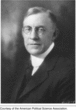
W. W. Willoughby, First Editor of the Review.
Weber's statement about the separation of fact and value was less a philosophical imperative than the recognition of an ineluctable difference, by the turn of the century, between the university and politics. It was, however, a difference that was often denied or neglected by his contemporaries, on both the left and right, who continued to speak politically from the podium. His point was not that it was logically incorrect or impossible for social scientists to engage in making value-judgments but rather that it was no longer a practicable role. In an increasingly ideologically and culturally pluralized society, the academy was in no position to perform this function. The university was no longer an integral part of the structures of political power, and, like society as a whole, it was politically heterogeneous. Furthermore, the dominance of philosophy within the academy was giving way to the specialized empirical sciences. An attempt by social scientists to persist in their moralizing attitudes would undermine their epistemic authority, which was the only kind of authority that they, in effect, now possessed and which was the only source of potential practical influence. Paradoxically, only by separating what Weber would later refer to as the “vocations” of social science and politics could the former have an impact on the latter. Weber, however, emphasized various ways in which social scientific knowledge could, in principle, constrain and direct policy decisions as well as the extent to which scientific investigation necessarily proceeded from the perspective of value-laden premises. The authority of social science nevertheless depended, he argued, on acceptance of the autonomy of empirical claims and on the professional status and independence of those who made such claims. The dilemma and solution that Weber articulated bore remarkable similarities to the situation attending the founding of the APSA.
DISCIPLINE AND PROFESSION
The primary issue that prompted American political scientists to break away professionally from historians and economists and form a separate association was not one of method. Historical and economic approaches to the study of politics were not significantly questioned, and political scientists had already defined their discipline in terms of a special subject matter. In fact, there was a commitment to maintain “harmonious relations” and continue a tradition of joint meetings (Willoughby 1904a). The principal concern that prompted this professional innovation revolved around the relationship between social science and politics. The AEA had, by the turn of the century, become increasingly conservative and once again dominated by the ideology of classical economic theory, and the American Historical Association was not only conservative but relatively uninvolved with public policy. Although the program at Columbia had, under the auspices of the arch-conservative Burgess, contributed significantly to the development of political science as a discipline, those who took the lead in establishing the APSA and the Review, much like Weber and those who edited the Archiv, belonged, for the most part, to a different generation and diverged markedly in their political and philosophical orientation. Above all, though, they were united by their dissatisfaction with the discipline's capacity to have an impact on politics.
Several individuals from Columbia, including Burgess and Frank Goodnow, were involved in the early 1903 meeting where it was decided to embrace the “whole field of Political Science” rather than create, as originally contemplated during the previous year, an American Society for the Study of Comparative Legislation. No one from Columbia, however, was on the subsequent committee designated to explore the choice between remaining professionally affiliated with the other associations or instituting a separate organization. The committee had sought reactions to these alternatives before convening the foundational session at the December meeting of the AEA and AHA in New Orleans. Here, Willoughby, a graduate of and an assistant professor at Johns Hopkins, emerged as the central figure in the formation and early development of the APSA. He and other principal architects of the Association were part of the younger cadre at Hopkins, including John Dewey, who were well aware of the fate of a prior generation who had attempted to use the academic forum as a vehicle of political persuasion. Like Weber, they recognized the anachronistic character of such a strategy. Herbert Baxter Adams, the founder of the program in History, Politics, and Economics at Hopkins, had embraced a vision of the academy that was similar to that of Burgess, but many of those who had been nurtured in that curriculum and sought to use their academic position to advance political goals (including Ely, Edward Bemis, Henry Carter Adams, Edward A. Ross, and John Commons) were exemplary cases of the practical failure of such a course of action as well as objects of conservative institutional and political prejudice. The age of the university mandarin speaking to and for a homogeneous society was past. This model had been not only represented in the traditional American university curriculum in moral philosophy but also imported from Germany by the émigré Francis Lieber, who can reasonably be labeled America's first political scientist, and it continued to inform the vision of individuals as ideologically diverse as Burgess and Ely. The principal actors in the formation of the APSA were seeking an effective practical role for social science, but they also were rejecting the stance of Kathedersozialisten. Doubt about the efficacy of this model was one of the basic reasons that Daniel Coit Gilman, the first President of Hopkins, had resisted efforts to incorporate the ASSA in the university.
The inquiries of the exploratory committee had concluded that there was indeed a wide demand for a new association “to take the scientific lead in all matters of political interest” and to “advance the scientific study of politics” (Willoughby 1904a). On its face, this claim did not contradict any prior principle of the discipline, but the strategy embraced and the ideology served would break sharply with prior commitments. Goodnow, the only representative from Columbia, was chosen to chair the foundational meeting in New Orleans, and Willoughby was elected secretary. It was finally decided that a separate association should be established, and new committees proceeded immediately to draft a constitution and nominate officers. Goodnow was elected President, and Willoughby Secretary-Treasurer. Woodrow Wilson, another Hopkins graduate, was named First-Vice-President, but he declined in view of his recent appointment as President of Princeton. The selection of Goodnow clearly signaled the identity of the new association. Although he had received his law degree from Columbia and taught administrative law at that institution for 30 years, before becoming the third President of Hopkins in 1914 and later an adviser to the first republic of China, he had been a central figure in educating the emerging generation, which included Charles Beard and Charles Merriam. He had also been one of the founders of the National Municipal League, which was devoted to the reform of local government and which was an outgrowth of the American Academy of Political and Social Science. The latter organization had been initiated by Edmund James at the University of Pennsylvania, who was an acquaintance of Ely, and it was designed to bring together political elites and social scientists. Like Wilson before him, Goodnow had famously advanced a distinction between politics and administration as part of a program of democratic reform that envisioned impartial experts executing the will of citizens. Moreover, in direct opposition to Burgess, he was one of the principal critics of the Supreme Court's obstruction of progressive social and economic legislation. Although the idea of separating administration from politics has often been interpreted, as in Weber's distinctions between science and politics, as a conservative stance, the motive was deeply embedded in a particular vision of how best to achieve social and political reform.
SCIENCE AND POLITICS
Willoughby served continuously as the Secretary-Treasurer, and guiding force, of the APSA until 1913, when he was elected President, and he was managing editor of the Review for the entire first decade of its publication. He had been a student of Wilson, who in turn had been a student of Ely. Willoughby endorsed the idea of progressive legislation, and although he has often been represented as a paradigmatic exponent of the nineteenth-century theory of the state, he, probably more than anyone else during the early years of the twentieth century, was instrumental in the conceptual transformation whereby the term “state” came to refer to the institutions of government rather than to a sovereign community behind the constitution. The latter concept of the state had been the core of the nineteenth-century theory of democracy, but it had also served, in the case of Burgess and others, as a rationale for limited government. When Wilson first claimed that “administration lies outside the proper sphere of politics” (1887), his concern was not simply with governmental efficiency and how it had been inhibited by institutions that “enthroned public opinion.” The problem was that that such opinion, so highly touted by James Bryce as the heart of American democracy, was, as Walter Lippmann and others would soon stress, not the opinion of any definable and observable entity. The so-called “sovereign mind,” Wilson pointed out, had “no definite locality” and tended to reflect only the “unphilosophical bulk of mankind.” What individuals such as Edwin Corwin (1929) and John Dickinson would later refer to as the “democratic dogma” (1930), the belief in the existence of and the need for the will of an American “people,” continued to inform the work of individuals as ideologically and philosophically diverse as John Dewey (1927) and William Yandell Elliott (1928). Even by the turn of the century, however, the “democratic realities” of a pluralist society, so vividly pictured by individuals such as Arthur Bentley, were pointing toward a new image of the relationship between political science and politics. For someone like Merriam, the task of a science of politics would be to create a public, whereas for the early pluralists, it was to understand and prescribe the role of government in a society characterized by diversity. In both cases, the impartial authority of science was deemed essential.
The movement that led to the creation of the APSA also involved a dispute about the nature of political theory. Although political theory had typically been viewed as a subject matter, that is, ideas in politics, what it represented as a part of political science, in addition to the study of the history of political thought, had been much less clear. This matter was not directly confronted until political theory was formalized by the APSA as one of the divisions of the field. Willoughby chaired the initial committee on political theory (one of six designated subfields), which included William Archibald Dunning of Columbia and the latter's student, Merriam, by now an assistant professor at Chicago; and, with Dunning, Willoughby was a principal in the creation of political theory as a distinct area of study. It was 15 years before anything that today would likely be categorized as political theory appeared in the Review, and what brought it to the fore was the crisis in democratic theory that had fully emerged by the 1920s. The first mention of “political theory” in a political science publication was a pejorative reference to “abstract political theory” in the Political Science Quarterly's 1895 retrospective (Jameson 1890, 213); political theory was viewed there as part of politics, and it was noted that “pure political theory, is quite alien to the American genius, which tends to scorn ultimate philosophy” (567). Perhaps more than anyone else, it was Willoughby who sought to provide an identity for academic political theory and to valorize it as a part of political science, and Merriam (1925) would pursue a similar goal. In his discussion of the formation of the APSA, Willoughby noted that political science could be viewed as consisting of three parts, the first of which was “the province of political theory or political philosophy, the aim of which is the analysis and exact definition of the concepts employed in political thinking,” that is, in political science (1904b, 108). He repeated this basic definition on a number of occasions, but his principal point was to distinguish political theory in political science from ideas in politics—in effect, to drive home the point that science and politics were two different vocations.
The Constitution of the APSA stated that the Association would “not assume a partisan position upon any question of practical politics,” even though such questions could be freely discussed among members. These individuals, like Weber, obviously held partisan positions, but they believed that they could not advance their cause by speaking as partisans. Willoughby stressed this idea from the outset, and his Weberian cast of mind was evident when, in the same year that he described the formation of the APSA, he directly confronted the formidable figure of Burgess. Willoughby differed from Burgess on ideological grounds, but he also began to question frontally the core claim of the traditional theory of the state, that is, that state and government were two different things. Willoughby's depreciation of this difference supported the idea of active and authoritative governmental policy, but his principal complaint was that Burgess consistently confounded the spheres of political theory and politics. This, Willoughby claimed, was evident in Burgess's distinction between “real” states (by which Burgess meant countries such as the United States, England, and Germany) and what he considered to be lesser forms of political organization. Burgess, Willoughby argued, was speaking less as a social scientist than as a statesman and attempting to deduce practical moral principles from “pure political theory,” which should properly be limited to an objective study of the state in all its dimensions and manifestations (1908).
In his presidential address at the first annual meeting of the APSA in 1904, Goodnow noted that a basic rationale for the autonomy of political science as a profession was to recognize, validate, and support a disciplinary identity, which was defined by its focus on subjects that had “not been systematically treated by the other societies,” namely, and primarily “the State.” The fundamental purpose of the Association and its “work,” however, were to achieve reciprocity between the “closet philosopher” and “those engaged in the active walks of political life” and to exert influence on the “world of action” (Goodnow 1904, 35). It could do this, he claimed, only by achieving the status of science, and he saw his own research in law as an example of the manner in which scientific knowledge provided a check on the tendencies of political theory “to soar in the empyrean realms of speculation” and thereby to turn political science into “a realm in which the political philosopher is to be permitted to roam at will, subject to no check on the exuberance of his fancy or caprice.” It was, he argued, important to be a “political scientist” and not a “mere political philosopher.” Political theory, he acknowledged, was nevertheless an important element of politics, because “however contemptuous may be one's belief in the practical value of the study of political theory, it is nonetheless true that every governmental system is based on some more or less well defined political theory” (37–38, 42, 45). Once again the emphasis was on distinguishing the realms of politics and political science—but for the purpose of gaining influence over the former.
Even allowing for rhetorical excess, it is evident that the formation of the Association constituted a basic strategic reformulation in which the authority of science, rather than, for example, neo-Hegelian claims about the meaning of human history were being advanced as a basis of social policy. The extent to which the Association represented a distinct theoretical break with the nineteenth-century theory of the state was less clear. Goodnow (1904), for example, noted that “one of the peculiar developments of American political practice has been the attempt to separate both in organization and action the sovereign State from the government.” Like many Progressives, he was still committed to the image of the “realization of the State will” through the “organs” of government (37–39). The prevailing concept of democracy still presumed a distinction between the people and the government with sovereignty residing in the former. It is, however, important to recognize the extent to which the anomalies of this theory were involved in the transformation effected by the creation of the APSA. It was one thing for political science to make “scientific” claims about the visible institutions and operation of government and quite another thing to profess to know and speak for the mind of an invisible public. Although the issues were not in the first instance primarily methodological, empiricism and the new strategy for achieving political impact were closely connected.
The same commitments were expressed by Henry Jones Ford, another central figure in the founding of the Association. Originally a newspaper editor, he lectured at Hopkins after the creation of the APSA and was subsequently appointed by Wilson to several administrative positions in the federal government. Like Wilson and Goodnow, he emphasized the need for effective administration, which, he argued, could be achieved by centralized government control and consolidation. In his discussion, at the second annual meeting of the APSA, of the “scope of political science,” Ford posed the question of whether the discipline would “ever supply general principles for the guidance of statecraft.” Although he lamented that at present there seemed to be “little if any connection between them,” he contended that the primary goal of the Association—even if it took “generations”—was “to bring political science to a position of authority as regards practical politics.” It was to do this, however, not on the basis of moral authority or as a representative of the public, but rather by putting the discipline on an “objective basis” that reflected the “reconstruction which the general body of science has undergone at the hands of inductive philosophy” (1905, 198, 203). He had complained that “ordinary political theory” was “oblivious” of facts (1904), and, like Willoughby, he criticized Burgess's restriction of the concept of the state to Western societies. Such a position, he claimed, reflected a tendency of the discipline “to gather its concepts from the mental deposits of our own rare experience” and to assume that they were “universal in their application and should guide enlightened statesmanship.” This, he argued, unduly narrowed the scope of the field and, in the end, had the effect of diminishing the possibility of making a connection to political practice. Political science, he suggested, was still suffering from a syndrome that characterized the end of the eighteenth century, when “the word ‘ideology’ was coined to discredit statecraft assuming to be founded on scientific theory” (202). He recommended that the discipline focus on an impartial study of “public authority” in all its forms and discover the laws of its operation and development. Scientific knowledge would, he affirmed, ultimately lead to social control.
Thus, the dilemma that faced the founders of the Association was how to eschew partisanship but gain authority in matters of public policy. This quandary was evident in the second presidential address to the Association at the third annual meeting, which marked the initiation of the Review. Albert Shaw, who succeeded Goodnow, was a journalist, editor of the Progressive Review of Reviews, advisor to Theodore Roosevelt, proponent of local government reform, coiner of the phrase “municipal socialism,” and another graduate of Hopkins and student of Ely. In announcing that “our Political Science Association has entered upon the publication of a quarterly review,” he emphasized once again that the subject matter of political science could not be studied “at the historian's table or in the alcove of the economist”(1907, 178). His principal aim, however, was to demonstrate that “this organization of ours is not partisan, sectional, or propagandist in nature” and that it was “not a body of reformers.” Its work was to be done “without bias and in the purely scientific spirit,” for “nobody cares any longer whether members of an association like this are classed as republicans or democrats; protectionists or free traders; nationalists, or states' rights men; socialists or individualists; municipal traders, or anti-public ownership men; for corporations, or against them; for or against trades-unionism.” He predicted that “without departing in the smallest degree from its scientific methods,” the work of the Association would “have an almost monumental character and importance.” He claimed that despite its non-partisan character, the Association consisted of individuals whose “point of view has not been merely that of detached scientific observers” and who were “willing and eager to see the results of their scientific study of political life and conditions converted to the practical ends of statesmanship.” Consequently, “the political scientist must lose no chance to influence the statesman on the one hand, and to supply intellectual pabulum to the people on the other hand” (180–81, 184–85).
The members of the new Association were in fact “a body of reformers,” many of whom did “care” and worry about their political commitments. It was fears regarding the motives and attitudes of these political scientists that Shaw wished to allay. The paradox inherent in the Association's simultaneous commitments to neutrality and relevance was evident in the tension between Shaw's own avowed objectivity and, for example, his advocacy of the “use of the State, that is, to say, of governmental power and agency, for the conduct or for the modification of tendencies in the economic life” (1907, 181). The early years of the Review were characterized by discussions that were far from impartial such as those revolving around “Negro suffrage” and the regulation of corporations.
The basic conception of the relationship between political science and politics that characterized the founding period of the APSA would be embraced by Merriam and the Chicago School and would remain at the core of the mainstream discipline through World War Two. The questions that were left unanswered were how, exactly, “objective science” was to yield normative results and how such results were to be imparted to and deployed by political actors. For those such as Merriam and Harold Lasswell, political science was to be a policy-science and, in some manner, find a way to speak truth to power, but exactly how this was to be achieved remained unclear. By the late 1960s, many had come to believe that the emphasis on science had obscured or overwhelmed practical concerns and that the “behavioral movement” or “revolution” constituted an intellectually and politically conservative disciplinary hegemony in which the biases of such values as normative pluralism were sublimated in “scientific” theories and methods. The principal challenge to the growing behavioral orthodoxy emanated from what had been the intellectual habitat of many of the principal figures of the discipline—the subfield of political theory. In a strange way, the scenario that had characterized the founding of the APSA was in some respects re-enacted.
For Willoughby and Merriam, political theory was the center of political science as a science, and, to a large extent, the study of the history of political theory, from its nineteenth century beginnings through the publication of George Sabine's paradigmatic text (1937), served as a provenance for both the discipline and the concept of American liberal democracy that it embraced. During the 1950s and 1960s, however, a significant and well-documented estrangement developed between many political theorists and the discipline as a whole. The dimensions of this alienation were complex, but part of what was involved was a new professional challenge to the discipline that once again called into question its relationship to politics.
THE REVOLT OF POLITICAL THEORY
In 1969, Sheldon Wolin presented an account of political theory as a distinct “vocation,” that is, a calling that he claimed was exemplified in the “vision” of “epic theory” manifest in the classic canon. He spoke for many when he urged the image of this vocation as an alternative to the approach of the “methodist,” which, he argued, characterized behavioral political science. Wolin advanced this vocation as an identity for political theorists whose principal mission, in his view, was to redress the lack of political relevance that had befallen the discipline as a consequence of its scientism and the complacency and quiescence engendered by the research agenda and tacit conservatism embedded in behavioralism. From Wolin's perspective, the better self of political science could at this point be redeemed only by reconstituting it as a separate vocation that embraced a different vision of democracy and spoke directly to matters of public concern and moral judgment.
What is instructive was Wolin's choice of the term “vocation,” which literally means profession, and it was Weber's references to the vocations of science and politics that resonated in his remarks. This was, however, an image that challenged Weber's conception of how the academy might achieve practical significance. Wolin construed political theory as mediating between politics and the academy, but his essay was to a large extent less a plea for a future course of action than the validation of a nascent professional persona that had been evolving for more than two decades. In some respects it was also a return to the belief, represented in the vision of individuals such as Ely, that practical moral claims could be fused with and predicated upon academic authority. Although Wolin was ideologically as far removed from someone such as Leo Strauss (Storing 1962) as Ely had been from Burgess, Wolin and Strauss, as well as others who, in the 1950s and 1960s, were instrumental in redefining political theory and institutionalizing it as an increasingly distinct form of scholarship, were at one in their conception of academic political theory as a repository of moral judgment regarding matters such as democracy and justice.
An irony of Wolin's (1969) challenge to discipline was that the idea of an epic tradition of political thought that he embraced and even the conception of political theory as both a subject matter and an academic practice were inventions of the discipline of American political science. Furthermore, his extensive genealogy of “methodism,” from the Greeks to modernity, did not actually include the history of American political science to which he attributed the contemporary manifestation. Wolin delivered the original version of his article as part of the inauguration of the Conference for the Study of Political Thought, which was devoted to extricating the study of the history of political theory from the confines of mainstream political science, but the presentation was made at the 1968 annual meeting of the American Political Science Association. It was subsequently published in the American Political Science Review, in the same issue in which David Easton, who had been the most articulate promulgator of the tenets of behavioralism announced, in his presidential address, a “new revolution” which involved a professional re-commitment that would, at least in the short term, redirect the discipline away from the further pursuit of “pure” science and toward more immediate practical concerns.
Easton's announcement of a “postbehavioral” era might have seemed a precipitous departure from his earlier emphasis on the priority of scientific pursuits, but he was calling less for change in the discipline than for a return to the professional orientation that had originally inspired and defined the APSA, that is, the commitment to an objective science with an end in action. Wolin's argument reflected concerns not unlike those Easton had voiced almost two decades earlier, even though Easton's solution to the “decline of political theory” (1951) had been to bring normative and empirical theory into a more symbiotic relationship rather than to view them as divergent vocations. Numerous significant disagreements were manifest in the juxtaposition of these articles, but what was most fundamentally involved was a conflict between strategies, deeply rooted in the history of the field, for bringing theory to bear on practice and pursuing democratic goals. Wolin's continuing attempts to give political theory a more separate organizational form and to use it as a vehicle for public advocacy and even, as in 1906, to mount a new journal (democracy) on such a professional premise, were relatively short-lived. The generalized hope for a more effective relationship to political life tended to devolve into professional enclaves, such as the Caucus for a New Political Science, and to surface at various points in dissident movements such as Perestroika. Easton's address was presented in the context of a professional and ideological crisis that threatened to rend the Association, but his recommendations, such as that for the creation of an international federation of social scientists that would serve as a guide to public policy, were as utopian as the vision of the founders of the APSA that they echoed.
CONCLUSION
One might argue that behavioralism was ultimately marked by a failure to remember what the original commitment to science had been all about, but the leaders of the behavioral movement, like their forebears, were at some level still convinced that the practical impact of political science depended on its claim to scientific authority as well as wary, particularly in the Cold War context of the 1950s, of combining science and partisanship. Although the mood represented by the new “policy turn” that followed Easton's presidential address may to some extent have been a pragmatic reaction to indigenous criticism, it was in part the discursive residue of a vision that attended the birth of the APSA. The critique of that position by political theorists such as Wolin (1969) and the rise of much of what came to be termed “normative political theory” were the resurgence of an early vision of the relationship between political science and politics and a return to the idea that social science could speak politically on the basis of moral authority.
A century after the founding of the APSA, the congenital dilemma continues to reverberate below the persistently diverging discourses of mainstream political science and political theory. Although the profession of political science continues to defend the idea of the discipline as a source of knowledge with practical significance, any distinct tactic for joining these realms seems nebulous. During the last quarter of the twentieth century, the subfield of political theory did not succeed in transforming the discipline of political science and continued to be torn between, on the one hand, the institutional benefits of the profession and, on the other hand, an allegiance to an emerging interdisciplinary field that has also struggled to come to grips with the contemporary relationship between academic and public discourse.



Comments
No Comments have been published for this article.