INTRODUCTION
Organizations are locations where attempts at racial equality are made, but they often fail or reproduce racial inequality in more covert forms (Acker Reference Acker2006; Bell and Hartmann, Reference Bell and Hartmann2007; Thomas Reference Thomas2018; Ward Reference Ward2008). Racial inequality can be reproduced through how general expectations around work are designed and implemented; that is, how rules and material/social resources are paired to differentially advantage some racial groups over others (Acker Reference Acker2006; Evans Reference Evans2013; Harlow Reference Harlow2003; Hochschild Reference Hochschild2012; Kang Reference Kang2003; Ray Reference Ray2019). Emotional labor is the occupationally required manipulation, production, and management of emotions in oneself and others, and is one way that formal rules are organized to shape how racial groups access resources (Evans Reference Evans2013; Evans and Moore, Reference Evans and Moore2015; Harlow Reference Harlow2003; Hochschild Reference Hochschild2012; Kang Reference Kang2003). While structural racism is linked to an affective economy (Ahmed Reference Ahmed2010; Lott Reference Lott2012), and emotions themselves have a racial economy (Bonilla-Silva Reference Bonilla-Silva2019), organizations play a distinct role in differentially mobilizing and controlling workers’ emotions through feeling rules. Feeling rules are the normative expectations of how emotions are to be appropriately expressed and produced, and their design and enforcement can maintain racial inequality (Wingfield Reference Adia Harvey2010).
Emotional labor and feeling rules are stratified on the basis of gender and race (Evans Reference Evans2013; Evans and Moore, Reference Evans and Moore2015; Harlow Reference Harlow2003; Hochschild Reference Hochschild2012; Kang Reference Kang2003; Pierce Reference Pierce1999; Wingfield Reference Adia Harvey2010). This leads to inequality in how people of color experience their work and advance in their positions, which contributes to a racially stratified labor market, even within high status or high prestige professional occupations (Bellas Reference Bellas1999; Harlow Reference Harlow2003; Tunguz Reference Tunguz2016). Race as a system of domination concurrently relies on and produces gender and class hierarchies (Collins Reference Collins2002; Collins and Bilge, Reference Collins and Bilge2016; Glenn Reference Glenn2002), which result in complex inequalities within organizations (Acker Reference Acker2006). While sexual orientation is also implicated in those processes (Acker Reference Acker1990, Reference Acker2006), heteronormativity has been given scant attention in relation to both emotional labor and its relationship to racial inequality within organizations. Thus, we ask: how are sexual orientation-based feeling rules applied differentially among Whites and people of color?
This paper addresses the racialized differences in how feeling rules are enforced and experienced across a multi-racial sample of seventeen full-time university LGBTQ resource center staff. Through an analysis of interview data, we demonstrate how Whites, even those with stigmatized gender and sexual identities, become the “affective ruler that measures and naturalizes white feelings as the norm” (Muñoz Reference Muñoz2006, p. 680). We find that staff of color are measured against this White homonormative emotionality (which centers cheerfulness and enthusiasm), and simultaneously constrained by racism (which disciplines displays of anger directed at the racism perpetuated by the university). We argue that racialized feeling rules, as corrective mechanisms within organizations to dampen critiques of inequality, maintain and reproduce racial inequality in the university.
We link LGBTQ centers’ differential enforcement of feeling rules to what James M. Thomas (Reference Thomas2018) calls diversity regimes. Diversity regimes are ways that universities can perform a commitment to racial equality, but fail to redistribute resources and power along racial lines. This benign commitment allows universities to ask, “How is our campus racist, how is our campus climate hostile, how are we reproducing racial inequalities, when we are so clear in our commitment to the values of equality, fairness, and multiculturalism?” (Thomas Reference Thomas2018, p. 145). Diversity regimes thus shift our focus to the processes that produce that inequality within organizations claiming to be committed to racial equality (Thomas Reference Thomas2018). By demonstrating how centers use race- and sexual orientation-based feeling rules to silence dissent, in work specifically dedicated to diversity, we demonstrate how emotional labor is a key aspect of an organizational structure that makes radical change within the university increasingly challenging.
Care Work, Emotional Labor, and Feeling Rules
The mission of University LGBTQ resource centers is to support and advocate for LGBTQ students’ wellbeing and academic success through educational programming and outreach, with explicit goals to support the development of LGBTQ students, faculty, and staff through emotional and social support. Day-to-day tasks for center staff involve administrative duties and meetings with university administrators, but the required crisis management must not be understated; students frequently seek out staff to address suicides, sexual assaults, bigotry from other students or faculty, and family issues. Centers thus require care work: tasks related to social reproduction, or contributing to the wellbeing of others, which can include helping to develop others’ capabilities (Duffy Reference Duffy2005; England Reference England2005). In this setting, care work also includes emotional labor (Harlow Reference Harlow2003; Hochschild Reference Hochschild2012). The noted costs of emotional labor for workers are alienation, feelings of inauthenticity, emotional exhaustion, and reduced sense of personal accomplishment (Erickson and Ritter, Reference Erickson and Ritter2001; Harlow Reference Harlow2003; Maslach et al., Reference Maslach, Schaufeli and Leiter2001; Morris and Feldman, Reference Morris and Feldman1996). The commodification of emotion within the university is unsurprising from a queer of color critique. As Roderick A. Ferguson (Reference Ferguson2012) argues, the administrative transformation of the university, along with its partnership with global capital, means that an “ethos of market tendencies” pervades all economic and social aspects of university life (p. 212). Thomas (Reference Thomas2018) further demonstrates how affective labor is central to how universities economize diversity, aiming to protect perceptions of their efforts by producing excitement and satisfaction, while silencing negative affects. The consequences of the commodification of emotion thus span beyond the individual mental-health effects; they also include retrenching racial and gendered inequality within an already stratified labor market (Boris and Klein, Reference Boris and Klein2015; Duffy Reference Duffy2011; Vora Reference Vora, Boris and Parrenas2010).
Emotional labor is key to how organizational inequality persists (Hochschild Reference Hochschild2012). One link between emotional performances across occupations are feeling rules. Feeling rules are the exertion of power over employees’ intimate, private emotion management and the enforcement of particular displays of emotion. These rules are how employers, through both formal means such as trainings and job descriptions, and informal means such as gossip, shunning, and ridicule, create and enforce expectations for how employees will manage emotions on the job (Hochschild Reference Hochschild2012). These rules outline which feelings should be felt, which feelings should be expressed, and how (Bericat Reference Bericat2016). Feeling rules are gendered and raced, and vary according to context (Harlow Reference Harlow2003; Kang Reference Kang2003; Wingfield Reference Adia Harvey2010). Professionals are argued to be privileged in the sense that they receive training on how to manage emotions and receive peer support of their emotional labor (Macdonald and Sirianni, Reference Macdonald and Sirianni1996). Studies that center on White women professionals and professionals of color point to an overall lack of support of, or no acknowledgement of, expertise and authority, and the expectation that deference be performed (Bellas Reference Bellas1999; Evans Reference Evans2013; Harlow Reference Harlow2003).
The majority of the emotional labor literature has focused on how gender impacts cisgender, most often White, women at work (Hochschild Reference Hochschild2012) and more recently, how race and gender impact cisgender men and women of color (Evans Reference Evans2013; Harlow Reference Harlow2003; Kang Reference Kang2003; Wingfield Reference Adia Harvey2010). Sexuality, while intimately connected to gender, race, and labor (Acker Reference Acker2006; Collins Reference Collins2002; Hames-García and Martínez, Reference Hames-García and Martínez2011; Holland Reference Holland2012), has been given scant attention. This is an important consideration because stigmas, negative stereotypes, and the lack of protective policies against hiring discrimination in many states means LGBTQ individuals already experience a disadvantage on the labor market in relation to heterosexuals (Mize Reference Mize2016; Tilcsik Reference Tilcsik2011). Further, “the worker” is presumed heterosexual by most theories, which obscures analysis of how heteronormativity is produced and sustained institutionally (Ward and Schneider, Reference Ward2009) in ways that result in disparate outcomes for LGBTQ workers (Acker Reference Acker2006; Mize Reference Mize2016). Scholars note that when a worker is not considered heterosexual, Whiteness remains the normative status, reproduced as a conventional and natural form of association and belonging (Halberstam Reference Halberstam2015; Muñoz Reference Muñoz2006; Self and Hudson, Reference Self and Hudson2015; Ward Reference Ward2008). This positioning of queer bodies and spaces as White is referred to as White homonormativity, and has consequences on how inequality is produced within organizations (Self and Hudson, Reference Self and Hudson2015; Ward, Reference Ward2008). As Tammie M. Kennedy (Reference Kennedy2014) argues, rather than critiquing the institutional arrangements and norms of society as heterosexist and racist, White homonormativity “creates hierarchies within LGBTQ communities where those mimicking heteronormative gender identities are deemed most “worthy” of receiving rights” (p. 121). This hierarchy of LGBTQ communities is also a racial one. This suggests that in the case of work organizations, the enforcement of feeling rules on the basis of race and sexual orientation would reinforce White homonormativity.
Inequality Regimes: How Racial and Gendered Inequality are Produced Inside Organizations
Organizations are neither gender- or race-neutral; they both constitute and are constituted by racial and gendered processes at the micro level (demographic identity, individual instances of prejudice or bias) and the macro level (processes of racialization and the reification of gender norms) (Acker Reference Acker1990; Ray Reference Ray2019). Victor Ray (Reference Ray2019) suggests that part of what renders organizations racial structures is their capacity to link rules and blueprints for accumulating resources with the distribution of material and social resources along racial lines. This process can work in service of inequality regimes, what Joan Acker (Reference Acker2006) describes as “interrelated practices, processes, actions, and meanings that result in and maintain class, gender, and racial inequalities” (p. 443). Here, inequality is defined as
systematic disparities in power and control over goals, resources, and outcomes; workplace decisions such as how to organize work; opportunities for promotion and interesting work; security in employment and benefits; pay and other monetary rewards; respect; and pleasures in work and work relations (Acker Reference Acker2006, p. 443).
How organizations arrange the general requirements of work and control the interactions of employees around race, gender, and sexual orientation are two of the key ways that inequality is maintained (Acker Reference Acker2006). Within universities, this can be achieved through efforts to control the effectiveness of dissent, where student activists are strategically incorporated into the bureaucracy against a backdrop of discourses which deny a hostile racial climate (Johnson Reference Johnson2020). A second, and related, way that inequality is maintained is through a broader performative commitment to diversity, typically manifesting as public impression management and staged performances of difference, such as the formation of diversity taskforces and committees, or public statements against racism (Thomas Reference Thomas2018, Reference Thomas2020).
Formal and informal rules, which are applied and implemented differently, discipline individuals by shaping life paths and choices, and shape the subsequent unequal distribution of resources (Hochschild Reference Hochschild2012; Ray Reference Ray2019), including in a university setting. It is clear that emotional labor is unequally distributed across race and gender, but the analytical link of that labor to the maintenance of complex inequalities within organizations, is the concern here. That is, power and authority within an organization’s formal hierarchy, and the treatment of marginalized employees who are tasked with performing the bulk of this labor, function as inequality regimes (Acker Reference Acker2006; Hochschild Reference Hochschild2012; Wingfield Reference Adia Harvey2010).
Scholars have established how feeling rules are unequally applied on the basis of race across of range of occupations, where people of color carry a heavier burden of emotion management, managing both work/role-related frustrations and everyday racism and sexism experienced on the job (Evans Reference Evans2013; Evans and Moore, Reference Evans and Moore2015; Kang Reference Kang2003; Wingfield Reference Adia Harvey2010). Whiteness, however, has not explicitly been analyzed within the emotional labor literature, despite the reality that feeling rules assigned to Whites are also racialized. Such an inquiry is important to investigate for several reasons. First, race is articulated, contested, and essentially made in everyday situations, including the mundane realities that play out at work (Embrick and Henricks, Reference Embrick and Henricks2015; Holland Reference Holland2012; Lewis Reference Lewis2003). Second, emotions play a role in the material, structural implications of racism (Bonilla-Silva Reference Bonilla-Silva2019); and emotions and their public and private management are shaped by political values external to the individual (Holland Reference Holland2012). Controlling the emotions of social actors such that people of color are perceived to be irrational, angry, or biased, while Whites’ emotions are seen as legitimate and rational (Muñoz Reference Muñoz2006), reproduces the racial order. Studies that do not examine the racial tasks of Whites within organizations may also reinforce the idea that race is something people of color bring into otherwise neutral organizations (Ray Reference Ray2019). Third, racial and gendered inequality do not merely exist in organizations; they are foundational to their structures (Acker Reference Acker1990; Ray Reference Ray2019).
METHODS
To explore emotional labor within University LGBTQ resource centers we conducted semi-structured interviews with seventeen full-time staff at university LGBTQ resource centers. To be sure, retrospective interview data cannot speak to the everyday routines, interactions, and workings of the centers. However, the focus here is how feeling rules, designed and enforced on the basis of race and sexual orientation, operate in shaping what staff believe they can feel, how those feelings are to be expressed in the context of their work, and how those rules shape the work White staff and staff of color believe they can do in relation to diversity. In this case, interviews provide the most appropriate method, by providing data filtered through the perceptive views (Creswell Reference Creswell2014) of the staff who must navigate how emotional labor is structured.
Why University LGBTQ Resource Centers?
At the time of data collection, 263 college and universities in the United States housed an LGBTQ resource center (Consortium of LGBTQ Higher Education 2018). LGBTQ centers provide an exaggerated case to analyze how sexual orientation functions within an organization, since sexual orientation is highly visible in the work and large numbers of LGBTQ individuals are employed. Other exaggerated cases exist, but the context of a university is promising for a few reasons. Universities are a heteronormative system (Acker Reference Acker1990) and a corporatized institution (Mills Reference Nicolaus2012). Student affairs professionals provide services aimed at improving the well-being of students, increasing retention and raising rankings, while also undertaking expert service work, using their expertise and authority to serve students as customers. Within corporate models adopted by universities, administrators are also concerned with regulating interactions with students to maintain the institution’s ranking (Johnson Reference Johnson2020; Mills Reference Nicolaus2012). LGBTQ resource centers provide a site to examine emotional labor on the basis of sexual orientation, with goals that align with universities’ diversity initiatives.
Participant Recruitment
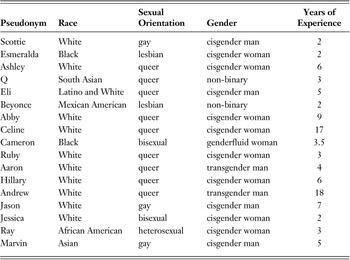
Our recruitment materials specified that we were focused on examining how staff members within university LGBTQ centers manage their emotions while at work. Once IRB approval was received, we posted the recruitment flyer within closed groups on Facebook for student affairs professionals and LGBTQ individuals working within student affairs. Both groups are popular with an active membership; the student affairs Facebook group has over 30,000 members, with over twenty new posts a day, while the LGBTQ student affairs group has 3200 members, with around ten posts a week. Typical posts within these groups include research opportunities, job postings, calls for papers, as well as resources for emotional and social support regarding issues such as emotional labor. Members of these groups might have been more willing to discuss their emotional labor because such topics were discussed within these groups. As a means of incentivizing participation, we offered individuals a twenty-five dollar Amazon gift card. For participants to be included within the study, they had to identify as being fluent in English, at least eighteen years old, and currently employed in a university LGBTQ center full time. Overall, seventeen interviews were conducted, recorded, and subsequently transcribed with staff from fourteen universities. Respondent demographics, including years of experience working full time in a LGBTQ center, are displayed in Table 1. We interviewed center directors, assistant directors, and various coordinators. Among these universities were private ivy league colleges; public state universities; large, public, flagship universities; and elite, liberal arts colleges. Universities were located in the Pacific Northwest, Northeast, South, Midwest, Mid-Atlantic, and Southwest United States. There were no religiously-affiliated schools or historically-Black colleges in our sample. While diversity work may be organized differently at such institutions, most LGBTQ centers are at predominately White and non-religious institutions. Future studies should address how diversity work around sexual orientation operates within other types of institutions.
Self-Reported Respondent Demographics

Data Collection
Interviews were conducted via telephone or video-conferencing platform. We note no substantive difference in the length of the interview or the degree of rapport established with respondents based on interview format. The interviews lasted for ninety minutes, with the exception of one interview lasting sixty minutes. Respondents were asked about their official job descriptions and day-to-day tasks; the characteristics of their LGBTQ center and university; the overall emotional climate in their workplace; how they minimized, produced, and managed their emotions as well as the emotions of others; and the dynamics of supervisors, senior administrators, coworkers, and students in these processes. The sample provided enough data to reach thematic saturation with regard to the general nature of emotional labor within the context of LGBTQ centers. That is to say that respondents noted the same feeling rules, perceived consequences of not following the rules, and the perception of how stereotypes and cultural tropes around sexual orientation shaped the emotional expectations of their work, and how their emotional labor was assessed by colleagues, supervisors, and administrators. Saturation was also met within both the White (n=10) and people of color (n=7) groups, which as John W. Creswell (Reference Creswell2014) notes, is possible between two to ten respondents. To be sure, people of color are not a monolithic group, and we do not seek to erase the differences in how racism may shape the emotional labor of different racial groups. The tropes of angry Black women (Collins Reference Collins2002; Durr and Wingfield, Reference Durr and Wingfield2011), quiet, timid Asians (Lee Reference Lee1999), and fiery Latinx people (Berg Reference Berg2002) are cultural scripts against which the emotions of people of color are measured (Ahmed Reference Ahmed2010), and may shape feeling rules. However, the purpose is to demonstrate how Whites’ emotions become the baseline for feeling rules within diversity regimes, perceived as rational and effective for the work of LGBTQ centers, and not how each racial group experiences feeling rules per se. While this sample does not provide sufficient cases to be considered generalizable, we find it provides important insights into how sexual orientation and race inform emotional labor and feeling rules within a professional workspace increasingly marked as a resource across universities.
Analysis
In developing our coding schema, we utilized Robert Bogdan and Sari Knapp Biklen’s (Reference Bogdan and Biklen2007) coding families, which oriented our analysis toward how respondents defined and understood their work environment, relationships, role, and the relationship among them. We focused on exploring which feeling rules were at play in LGBTQ centers; identifying how employees are socialized into understanding the benefits and consequences of compliance; and how respondents perceived their sexual orientation and race shape those interactions.
In an effort to protect the identities of our respondents, we do not provide position titles or institutional location, and all of the names are pseudonyms selected by the respondents. We found no discernible difference in the perspective of respondents with regard to the feeling rules they identified based on years of experience, position title, institution type or size, or geographic location. That is to say that a Center Director from a public university in the Pacific Northwest noted similar experiences, expressed similar feelings, and identified similar patterns in the racialized nature of their emotional labor, as a Student Development Coordinator at a private university in the deep South. We suspect that staff described feeling rules similarly, despite different organizational characteristics (such as university size, funding, leadership, or supervisor identity) because the key characteristic to impact emotional labor, including the design of feeling rules, is an organization’s goals (Hochschild Reference Hochschild2012) which are consistent across institution. Due to space constraints, the analysis of cisnormativity and how gender identities outside the gender binary impacted the experience of employees can be found in a subsequent paper.
Sadness, Trauma, and “The Unhappy Queer”: Sexual Orientation and Feeling Rules
Work in an LGBTQ center is deeply personal and political. Daily tasks for staff in this study included advocating for gender neutral bathrooms and pushing for official university documents to reflect students’ pronouns; helping students cope after a fellow student committed suicide or was harmed; providing students crisis support after high-profile hate crimes; and educating the campus community about the overall implications of homophobia and the needs of students. While not a comparative study of heterosexual and LGBTQ staff, our findings still explore the way sexual orientation shaped expectations of how respondents were expected to feel while performing this work. One of the ways heteronormativity functions is by positioning heterosexuality as the norm. LGBTQ resource centers as queer spaces are still nested within a broader heteronormative institution of a university (Ferguson Reference Ferguson2012). Expectations for emotions become focused on queer emotionality, but this is filtered through the lens of the “unhappy queer” trope. The unhappy queer trope is a cultural representation of LGBTQ identities as the embodiment of unhappiness, shame, deficit, and even as the culmination of parents’ failures (Ahmed Reference Ahmed2010). This notion of LGBTQ people as tangled in self-pity, terror, grief, and loss, represents LGBTQ identities as a purposeful deviation from the “promised happiness” of heterosexuality (Ahmed Reference Ahmed2010). The unhappy queer trope structures emotionality in two ways: staff are expected to counter this preconceived sense of grief and sadness through intense positivity and joy, while also tapping into the assumed inherent pain of queerness during trainings to evoke empathy from workshop attendees, what we refer to as performing trauma.
All respondents described performing happiness and pleasantness over and above heterosexual employees and LGBTQ employees working in other divisions of the university. Combatting the unhappy queer trope involved managing their own sadness from explicitly negative interactions with supervisors and administrators, and anger towards a homophobic campus climate. As Jason, a White, gay cisgender man explained:
I show joy and positivity… maybe I do play into the peppy, happy gay person stereotype… but it benefits the students and impacts the narrative about my center. People are like “oh, that’s a good space!” I pick to be happy… I still feel those bad feelings, but I’d rather pick a good mood. I don’t wanna spiral into dark spaces; you can’t act like everyone is out to get you. Sometimes there is queer inequity, but I pick to be happy!
Respondents also managed their sadness from consistently distressing encounters with students who were emotionally, financially, or socially suffering due to ongoing homophobia at the university. Key in managing this emotion was maintaining a positive demeanor, often in fear of being fired and therefore unable to help students. As Cameron, a Black, bisexual genderfluid person told us:
I worry about being too much, too Black, too bi[sexual], too genderfluid for other people. I’m often afraid of being perceived of being angry, or not thoughtful, or too negative. I think that revolves around how being liked means I’m safe. If I don’t make people mad, I can survive here. It’s like it’s replicating all of these systems I don’t agree with and am trying to move out of, while at the same time help students and others I serve navigate that. It feels lonely… there is a lot of capacity for pain.
Second, all respondents described needing to produce and perform trauma in training settings and formal meetings with university administrators, faculty, and staff. This entailed using dark and deeply personal traumatic experiences from throughout their own life and the lives of students to gain support and foster empathy from others. As Aaron, a White, queer transgender man shared: “I have a story I almost always share in workshops. My best friend has a tattoo of the word human because he’s afraid that if someone saw his transness before his humanity, they wouldn’t save his life.” Respondents found that empirical data alone rarely convinced faculty, staff, and administrators that substantive changes were needed on behalf of LGBTQ students. As Beyonce, a Mexican American, lesbian non-binary person told us:
My job requires justifying the need for LGBT education among faculty and staff, convincing them it’s in their best interest to be educated about these issues so they share it with their departments. To be effective, I have to elicit empathy. So, I share stories about students who struggle, and what being marginalized feels like. I have to prove a certain level of trauma can and has happened before faculty and staff can see why having education about issues would help. I relive my trauma in those sessions, and even students do it to make the point. You have to be really explicit about the harm it does.
Likewise Jessica, a White, bisexual cisgender woman, told us that while she can “bring up statistics” to educate others, she ultimately needs “people to understand the trauma of it all.” Jessica uses roleplaying exercises to try to get others to feel invalid and misunderstood, like LGBTQ students might feel. While the literature suggests that such expert (assumed heterosexual) service workers gain more training and have more institutional support for their emotional labor (Wharton Reference Wharton2009), this was not the case for respondents. That is, respondents never received training to prepare them for performing trauma or for managing the vicarious trauma caused by trainings and working with students. Instead, respondents were often left to process these experiences with partners and friends outside of their work environment. We found important distinctions in how the staff of color and White employees described experiencing these rules. Across race and gender, people of color describe similar emotional expectations at work, that along with White respondents’ narratives, demonstrate the racialized nature of feeling rules that would otherwise be singularly linked to sexual orientation.
White Anger and Enthusiasm for the Feeling Rules
Despite the everyday issues and catastrophes that arose at work, including students’ health crises, sexual assaults, and suicide, all staff perceived expressing misery or negativity as coming at a professional cost. To do so would threaten their ability to advocate for students and for their centers, as “happy-talk” maintains the comfortable tension of diversity discourses, where difference can be discussed separate from structural inequalities (Bell and Hartmann, Reference Bell and Hartmann2007). Indeed, a happy, positive demeanor was deemed necessary for maintaining relationships with staff and administrators who could work with them in the future to secure funds and influence policy decisions that centers did not have the ability to control themselves. Whites, however, discussed how they could be angry, within certain limits, because it signified passion for work. Expressing anger was a strategy that they believed benefited their students and their own reputation as hardworking, professional staff. As Scottie, a White, gay cisgender man said:
I don’t burn bridges or have righteous anger, but I use anger strategically. The expectation is that I’m hyper-outgoing and positive and passionate. If I’m in a meeting with other staff or even with an administrator, I can use anger to promote awareness that real people are impacted by institutions and policies.
Like other White respondents, Scottie described his anger as directed at the fact that inequality existed; this anger was used to bring an awareness of inequality to administrators and workshop participants, but was not directed toward the university as an institution responsible for that inequality or as one whose interventions were ineffective. Hillary, a queer cisgender White woman also noted,
I can’t be outraged after a taxing or an emotionally draining day… but being angry in trainings can work to make others feel angry at injustice… during workshops, I’ll show statistics about outcomes for different students and I’ll make it known that we should be angry at the small number of queer students and students of color.
White staff consider having passion for their work, in the form of following the feeling rules, as a useful skill in mobilizing others to care about issues their students generally face. White staff were aware that people of color were often not represented in meetings, so they described using their voices and position to advocate for students of color. Andrew, a White queer transgender man, shared: “I have White privilege, so it gives me the ability to not always silence my emotions. I’m in spaces where people of color aren’t, so I feel the need to speak up.” Indeed, respondents frame White privilege as a form of access to emotional expression, which they undertake as an obligation to “speak up” about issues of “race.” As Jessica noted: “My racial identity isn’t under attack, so I have a lot of capacity to talk to other people and be angry about race.” Displaying anger at “race” meant being angry that students of color experienced racism in general, but never within the university.
White anger did not manifest as addressing racism that staff or students encountered at the university, which we see as key to understanding the differential enforcement of feeling rules. Many White staff noted that racism frequently occurred during training sessions when a White participant would say something offensive about people of color, but none shared a story of intervening. Abby, a queer cisgender White woman, told us that anger needed to be negotiated carefully when interacting with educational training participants who might say overtly racist comments:
If some participants are abrasive or harmful, I have to deal with the person who is being impacted. So the desired outcome is diffusing, I have to be able to continue the workshop in an educationally productive environment, and manage the person who is feeling harmed, make them feel seen and heard. But I also have to provide support for the person who caused harm, I have to help them realize what’s happening. People are still learning, you know, it’s a process. They’re not intentionally harming someone so I can’t be angry with them, even when I feel angry. [Interviewer: What would happen if you didn’t diffuse the situation? What if you expressed your anger?] Oh, I would lose participants. They would leave or mentally check out. It’s really important for people to have positive experiences, then they encourage others to come to our workshops, and we can show a sustained need for our programming. Otherwise, we’d lose credibility and positive recommendations, and that could be enough evidence to the administrator that our center doesn’t need these programs, or even my position. So I need to be really objective with how I address race.
Abby described maintaining a positive experience for attendees as critical for her program’s and center’s success, without expressing concern for the possibility that racism left unchecked would lead attendees of color to experience her program negatively. Whites’ knowledge of their perceived objectivity toward “race” is therefore not to be confused with addressing racism; no White respondent provided an example of how they ever expressed anger toward racism in trainings or to their supervisors, or advocated on behalf of students or workshop attendees experiencing racism. On the contrary, as Hillary explained, “I don’t challenge people’s biases about race. [Interviewer: Why not?] I need people to trust me. I can’t be threatening.” Drawing attention to race as a signifier of difference or form of inequality outside the university, while not attending to the racism students and staff of color experience in-house, functions as an effective performance of a commitment to diversity (Thomas Reference Thomas2018) precisely because it does not address inequality. In fact, some White respondents also reported tempering students’ anger about racism, framing this as an aspect of their job. As Aaron told us: “A lot of what I do is de-escalate students. I’m moving them away from being angry reactionaries.” Similarly, Jason shared:
I’m all for folks being angry. Sometimes you can be angry and we can hold space for that, but if you want something done, here are ways to go about that. I tell students “you can’t let that come out when you talk to people, or else they’ll know you’re pissed. We can talk and theorize about why you’re angry, but we have to shift that to discursive practices.” I don’t tell them not to feel angry, but I help them manifest it into more calm, effective strategies where they can talk to people.
Anger has already been identified as an emotion that White professionals can express without significant repercussions (Wingfield Reference Adia Harvey2010); we expand on this work by further demonstrating that the content of anger is important in feeling rules enforcement. Within our study, White respondents could express anger at “race” as an abstract signifier of inequality out there in society, which just happened to impact students of color. Such a display is organizationally acceptable because it does not make demands on how the university would need to address that racism. This is because White staff’s anger is not directed toward the university as an institution conducive to racial oppression, even when students believe that is the case. This was even true for White center directors, who theoretically have more organizational power to address racism yet still choose to adhere to the feeling rules.
White respondents never voiced concern, critique, or an awareness for how their work allowed the university to maintain a façade. Instead, White staff are enthusiastic about following feeling rules, and do not ever suggest there might be something structurally wrong or ineffective with the rules themselves. To be sure, they were all exhausted, and most were quite sad in sharing their experiences and their fears of losing university support for the center. Their concern for the life-altering impact that would have on students was palpable. At the same time, they all believed they could thrive by following the rules, receiving professional development opportunities, awards, and promotions; thus, the feeling rules have served a key purpose of stifling critiques and maintaining business as usual. As Ashley, a White, queer cisgender woman, said “It’s about positivity and blind adoration for the university. I’m not going to be a Debbie downer. [Interviewer: Why?] Well, who gets end of career awards?” While all White respondents discussed the potential harm to students in not following rules, the people who White staff saw fired for not following these feeling rules were all staff of color.
In combating the unhappy queer trope to protect their centers, White staff may inadvertently reinforce White emotionality as the justification for racialized feeling rules. Ethnographic data would confirm how this White emotionality shaped the center, outcomes, and students more broadly, however, what is of interest here is how staff understand the feeling rules, especially the enforcement of those rules, and the rewards and consequences of disregarding those rules. White staff corroborate the narratives of staff of color, who perceive there to be a constant comparison to White queer staff’s emotionality, which acts as a proxy for professionalism. To be sure, organizations have distinct cultures and differentially distribute resources to begin with. But as Ray (Reference Ray2019) argues, race itself becomes a set of rules, where Whiteness is deemed a credential that people of color cannot access.
“That’s not me, I’m not positive all the time!”: Critiques of White Homonormativity
Every staff member of color discussed Whiteness as shaping feeling rules, highlighting White enthusiasm for the rules and the ways Whites could be angry and passionate. Staff of color simultaneously found that their anger and passion, typically directed at racism in the university or center, was not an acceptable way to express emotions. Beyonce shared the following:
My supervisor [a White man] is a self-proclaimed diva. He walks in and is loud; he just explodes sometimes and people think its passion…. He makes comments about me in public, that a Mexican butch should be less emotional because it frightens the neighbors.
Beyonce describes the audacious nature of Whiteness in how their supervisor both expresses emotions, but also so openly comments on the potential costs of Beyonce’s emotionality to their center. While the supervisor engages in dramatic diva behaviors, he makes it clear that Beyonce’s explosive anger and passion would be threatening to other staff. This enthusiastic, loud, and assertive diva behavior was also something others found they were measured against. Eli, a multiracial, gay cisgender man told us that: “People expect me to be out there, extrovert, happy, positive, Drag Race, yassss queen all the time! It’s a manifestation of what people assume the community to be. But that’s a White community, and that’s not me at all.” Eli described aspects of gay culture that have crossed over into the mainstream lexicon due to a popular TV show featuring drag queens, and the homonormative assumption of the gay community as a monolithic, happy, sassy group of White men. These cultural tropes create emotional expectations for staff of color to be especially happy and positive at work.
Adia Harvey Wingfield (Reference Adia Harvey2010) has shown that Black professionals are expected to adhere to the feeling rules that are equally applied to all staff—though they find it difficult to do so because of racism experienced on the job. Black professionals are also held to different emotional standards than White colleagues. Staff of color are thus put in a catch-22. While they are expected to display positivity, excitement, and passion for their work through anger at inequality in the abstract (a feeling rule applied to all staff), they find it difficult to do so because (1) White homonormativity is alienating and (2) they are not angry at race in the abstract, but rather at systemic inequality reproduced within the university setting. At the same time, they cannot express passion through their anger at racism. Marvin, an Asian gay cisgender man, captured this predicament:
When everything is good, I have to be this cheerleader. I have to pull people together and evoke empathy and support for the center by being really positive. But when it’s bad I have to be impartial and professional. I produce fake smiles and fake not showing frustrations, even when administrators are saying racist things… You just have to keep going. I don’t wanna be the angry person in the room when nobody else says anything. We all notice it; we share glances like “yea that was definitely problematic.” But I don’t wanna be the one to call someone out… Once, a colleague was talking about an area and used the word “ghetto,” so I was like “What do you mean ghetto?” I wasn’t jumping on him, I tried to calm myself and ask questions without sounding aggressive. But I was still told I was aggressive by other White colleagues. My supervisor—they’re super validating and supportive—but they agreed and told me it should have been a private conversation.
Racialized and sexual orientation-based feeling rules provide the formalized standards of what staff are expected to feel and what they are allowed to feel. As LGBTQ staff, they are expected to counter the unhappy queer trope by being enthusiastic and happy, but when this passion slips into an “explosive” domain of anger—and anger at systemic racism within the university, more specifically—staff of color are marked as intimidating and aggressive, which threatens their ability to maintain positive relationships necessary to supporting their centers.
Staff of color therefore find they cannot discuss racism in their work if they are to remain professional. As Eli later noted:
I hold on to so much anger about the racism facing my students that I can’t articulate. White colleagues can be really self-absorbed and their emotions are always more tolerated than mine. I know they’re holding onto trauma and feeling lonely and angry about things here, but that doesn’t provide me space to talk about my anger about how queer students of color suffer here. I have to be stoic, but also light and positive, if I’m going to maintain relationships with colleagues.
Eli and others described how colleagues, supervisors, and administrators frequently provided White staff the opportunity to express anger and have social support in meetings or informally around the center, which they did not find extended to themselves, especially with regard to feelings of anger and issues of racism. Staff found that even addressing racism without anger was still invalidated or dismissed. Esmeralda explained:
I don’t have high expectations with White people when dealing with racism. They throw around intersectionality, but they’re ignorant as to what it means. I’ve tried to discuss how I myself and students are mistreated due to our identities, and my supervisor said it wasn’t about race. I’m just not surprised anymore. They lack follow through and commitment to issues, but want to be the ones to get credit for standing up in spaces when it comes to racism.
Esmeralda offers an important counter narrative to White staff’s explanations for their passionate anger toward race and their mobilization of White privilege. Staff of color report that White supervisors frequently minimized their concerns of racism toward staff and LGBTQ students of color. Passionate White staff could “take credit” for bringing race to the fore, but staff of color drawing attention to racism the university was responsible for was dismissed by the same White staff who publicly prided themselves on acknowledging intersectionality. Cameron also found that talking about racism might be viewed as distracting from the mission of supporting LGBTQ students first, noting: “when students are racist toward me, or students seek support because they’re experiencing hate speech, those issues are not understood by my supervisor as relevant to our center. I’m left to absorb that emotional impact.” This contributes to the alienation staff of color feel at work on the basis of racialized feeling rules, but White staff and centers’ usage of intersectionality as an abstract, catch-all term for diverse identities also functions to support diversity regimes. Staff of color often described intersectionality as praxis aimed at addressing multiple forms of oppression but noted this was deemed antithetical to the goals of their centers. Such efforts would involve community organizing and supporting students’ protests, as well as collaborating across cultural and identity centers beyond competing for funds with other units. Diversity regimes do not support such initiatives; in fact, they rely on silos of units who have little formal integration (Thomas Reference Thomas2020) and, as respondents suggest, do not consider the multiple, simultaneous needs of LGBTQ students and staff of color.
While White emotionality contributed to the perception of staff of color as inherently angry, respondents also described how they were often viewed as “radical.” Radical meant pushing for initiatives that would fundamentally shift the resources within their universities, which was viewed as unfavorable by supervisors and administrators. As Q, a South Asian, queer nonbinary person explained:
There’s no way that I’ll never not be perceived as radical. I’m a person of color having reactions to very political and personal injustices and calling for real substantive changes. I can’t have reactions that aren’t seen as taking things too personally or too radical.
Respondents noted that “radical” was a stigmatizing label that implied an aversion to teamwork and collaboration, the foundation of professionalism in student affairs. Q described one such situation:
I had an administrator ask why another coworker was so aggressive and hostile in a meeting, and suggested formal processes be set in motion for my supervisor to address it. He clearly didn’t want to work with the person anymore. So, I’m constantly having to project this calm, accommodating, you-can-say-anything-and-it-will-be-fine attitude, unless I want to be reprimanded like that.
Respondents explained that supporting “aggressive activism,” which would threaten the slow and steady, but ultimately “non-effective,” bureaucratic processes, were grounds for being labeled as radical. Radical staff members of color, as all respondents learned through their years of experience, were routinely denied promotions, pushed out of their positions, and fired. Staff of color believe they are inherently at risk of being perceived as radical due to their race, which placed additional pressure on them to subdue feelings of anger and even passion for social change. For some, alleviating guilt or otherwise helping White supervisors and administrators feel like “good allies,” and managing abuse from White students was also a prominent feature of their emotional labor. As Cameron discussed:
An administrator once misgendered a student, and she and I had already had a few interactions where she used insensitive language or implied that students of color were deficient. I was really angry but I couldn’t show it. She just kept on, wanting me to talk her down and tell her she was ok.
Staff of color ultimately found that they were expected to perform a quiet, subdued passion for the daily, mundane tasks of work, which included emotional caretaking for their center.
As staff responsible for planning, coordinating, and implementing their universities’ diversity initiatives, all respondents navigated the same terrain of diversity regimes. Staff of color were hyperaware of how their respective university and center staged difference (Thomas Reference Thomas2018). Staff of color understood that their strategic deployment within their centers provided a façade for the university and for diversity work. That is, staff of color, but not Whites, believed that the work that they did was a performance of racial inclusiveness for the sake of the university’s impression management, staged for White colleagues, supervisors and administrators. White respondents did not view their roles as part of their university’s performance of equity work. While Whites believed following the rules was how they could thrive, staff of color felt they were operating in a broken system, and at best, they could survive and help students survive the university. As Marvin explained:
[…] I assert myself in situations when something is racist. Then I’m called aggressive and unprofessional. It’s certainly all whitewashed and colonized and ineffective. I’m only so careful because I think about the gay men of color who I support, and how hard it is for them… how they’re rejected because of their race. And how I’m able to show them it’s possible to be happy. Who else can do that work?
Marvin, like other staff of color, feels immediately disciplined for his expression of emotion in the form of stigmas directed toward his professional identity, stigmas which come at a professional cost. In this occupation, behavior labeled as aggressive is viewed as being unprofessional—an indicator that a staff member is not fit to work on a team. These behaviors may be viewed as detrimental to efforts of accessing resources for students, which staff fear will lead to termination. Yet Marvin, like all staff of color, continue doing this work because they believe LGBTQ students of color need positive representation and support.
CONCLUSION
We have argued that emotional labor is central to how racial inequality is perpetuated within organizations whose goals are aimed at diversity. In merging the work of scholars of sexuality, race, diversity work, and organizations, we explore how organizational inequality is possible through the formalization of feeling rules, which rely on race- and sexual orientation-based tropes around emotionality. We expanded on the emotional labor and diversity work literatures by showing that feeling rules are not just enforced differently based on race, but also that their enforcement underpins racial inequality within organizations, including ones that claim to be committed to equality. Whiteness is central to the design, enforcement, and adherence to these rules, which contribute to the ineffectiveness of diversity efforts and thus have organizational consequences according to respondents: Whites are able to advance in their positions, staff of color fear the termination they witness of other “radical” staff, and racism within centers and universities is left unacknowledged.
Respondents of color understood their strategic deployment within their centers and universities as providing a façade for diversity work. White respondents viewed their White privilege as providing them with the opportunity to advocate for students of color, but did not consider how the limited capacity to make structural changes to radically improve students’ experiences at the university paired with their privilege to “speak up,” and shaped the experiences of staff of color in important ways. White cisgender respondents, emotionally exhausted and unsupported by administrators, did not consider feeling rules mechanisms through which structural inequality persisted. Instead, they were enthusiastic diversity workers, following the feeling rules because they believed it would benefit themselves and students. This enthusiasm for performing the feeling rules allowed White respondents to thrive in their work, but it also established the benchmark for evaluation that staff of color must measure up to. To be clear, the organizational arrangements are what allow White staff to insist that following these rules was in part a way to succeed at their work, which was to support students; the differential enforcement of those feeling rules obscures the harm staff of color experience and the inability to craft radical interventions that would hold the university accountable.
Diversity regimes rely on the emotional performances of all diversity workers, who must stifle anger and perform trauma and positivity. Staff are responsible for performing a commitment to diversity, while being careful to not suggest programming that would shift resources on the basis of marginalized identities, or interrupt or address racism when they witness or experience it. As Arlie R. Hochschild (Reference Hochschild2012) argues, organizations design feeling rules to remove emotions that would threaten the routinized, efficient interactions they rely upon. Addressing racism, especially alongside homophobia, is threatening to the ideology of diversity that centers Whiteness and objectifies people of color as merely counts or representative of ideals of diversity (Mayorga-Gallo Reference Mayorga-Gallo2019). This is not just an issue in LGBTQ centers; critiques of racism and interventions from students of color and staff across other units of the university are strategically derailed through discursive practices and organizational decisions (Johnson Reference Johnson2020; Thomas Reference Thomas2018). What we add to this important work is a consideration of how universities are able to preserve these arrangements by linking cultural tropes of homosexuality (Ahmed Reference Ahmed2010) and racialized schemas of emotionality (Ray Reference Ray2019) to rules about how to feel and express feelings at work. The exertion of power over employees’ emotions is an aspect of the emotional economy, wherein people of color are alienated from their most intimate feelings and disciplined to compartmentalize their identities in service of the White, heteronormative neoliberal university (Ferguson Reference Ferguson2012). Feeling rules are thus part of how complex inequalities continue in centers and universities claiming to work in the name of equality, and may reproduce a racially stratified labor market over time through promotions, opportunities, and wage penalties. Future studies should trace the long-term organizational consequences of emotional labor within diversity work, especially in the wake of uprisings which have forced universities to engage in public impression management. The creation of initiatives and even increased funding of such centers are not likely to make a significant, meaningful impact within universities if the emotional labor of diversity workers remains designed around inaction, when feeling rules are designed to limit center staff’s capacity to address the inequality they were hired and trained to alleviate.