Implications
This study examined the impact of offering reduced phosphorus diets over a 4-year period on cow fertility and bone phosphorus status. Within this long-term study, no detrimental effects on either parameter was observed when a diet containing approximately 20% less phosphorus than recommended within the current UK feeding standards was offered. Offering a low phosphorus diet significantly reduced the quantity of phosphorus excreted in faeces.
Introduction
Although phosphorus (P) is an essential nutrient for both plants and animals, the loss of phosphates from agricultural systems contributes to the nutrient enrichment of water courses. Reducing the use of chemical fertiliser P and reducing the P content of the diet, are two options by which farm P surpluses can be reduced, the latter being particularly relevant on medium- to high-concentrate input dairy farms. However, offering P-deficient diets to dairy cows has been shown to have a negative effect on food intake and milk production (Valk and Sěbek, Reference Valk and Sěbek1999; Wu et al., Reference Wu, Satter and Sojo2000). Nevertheless, evidence from a number of relatively short-term studies indicates that diets containing low levels of dietary P can be offered with no detrimental effect on dairy cow performance (Valk and Sěbek, Reference Valk and Sěbek1999; Wu and Satter, Reference Wu and Satter2000; Odongo et al., Reference Odongo, McKnight, KoekKoek, Fisher, Sharpe, Kebreab, France and McBride2007).
More recently, in a study involving grassland-based systems of milk production, Ferris et al. (Reference Ferris, Patterson, McCoy and Kilpatrick2009) observed that food intake and milk output was unaffected when the P content of dairy cow diets was reduced over a 4-year period by proportionally 0.27 (from 4.9 to 3.6 g/kg dry matter (DM), approximately) during the winter, and by proportionally 0.17 (from 4.2 to 3.6 g/kg DM, approximately) during the summer. The long-term nature of this study was necessary as dairy cows can mobilise bone P reserves, especially in early lactation. However, if dietary P levels remain inadequate throughout the lactation and dry period, bone P reserves may not be replenished before a cow calves again, and, in fact, levels may become further depleted with subsequent lactations. The long-term effects of offering diets containing inadequate dietary P levels were highlighted in a study by Valk and Sěbek (Reference Valk and Sěbek1999), where deficiency symptoms (lower food intakes and milk yields) only became apparent during the second lactation of cows being offered a P-deficient diet. In a long-term study involving beef cattle, Shupe et al. (Reference Shupe, Butcher, Call, Olson and Blakem1988) observed spontaneous fractures of the vertebrae, pelvis and ribs with animals offered low P diets.
This study examines the long-term effects of offering the diets described by Ferris et al. (Reference Ferris, Patterson, McCoy and Kilpatrick2009) on dairy cow health, fertility and bone composition and on nutrient utilisation.
Material and methods
Overview
The companion study (Ferris et al., Reference Ferris, Patterson, McCoy and Kilpatrick2009) describes a 4-year experiment in which 100 primiparous winter-calving Holstein–Friesian dairy cows were used to examine the impact of dietary P level on cow performance. Primiparous cows were allocated to either ‘high’ or ‘low’ P diets (50 cows per treatment) within 36 h of calving, with cows remaining on the same P treatment throughout the experiment. Eighty cows commenced the study in year 1 (Group 1), completing four full lactations on the study, while 20 cows (Group 2) commenced the study in year 2, completing three full lactations on the study. Each year comprised a winter period, a grazing period, a late lactation period and a dry period. Full details of the diets offered, the management regimes imposed and the effect of diet on feed intake, milk production, tissue changes and blood metabolites have been presented by Ferris et al. (Reference Ferris, Patterson, McCoy and Kilpatrick2009). This study examines the effect of dietary P level on dairy cow health and fertility, bone composition and nutrient utilisation. In addition, the implications of the findings presented by Ferris et al. (Reference Ferris, Patterson, McCoy and Kilpatrick2009), and the results presented within this study, are considered in relation to rationing P for dairy cows, and in particular the most recent Agricultural and Food Research Council (AFRC) recommendations (1991).
Health monitoring
Cows with health problems were treated by either a veterinary surgeon or a member of Agri-Food and Biosciences Institute staff, as appropriate. All incidences of mastitis and lameness were recorded throughout the experiment, with an incidence defined as one in which an antibiotic treatment was used. Locomotion scores were assessed fortnightly from calving until turnout, and once every 4 weeks from turnout until drying off, as described by Manson and Leaver (Reference Manson and Leaver1988). A mean locomotion score for each cow was subsequently calculated for the periods from calving until turnout, and from turnout until drying off. On the same occasions that milk was analysed for constituents, as described by Ferris et al. (Reference Ferris, Patterson, McCoy and Kilpatrick2009), milk was also analysed for somatic cell counts (SCCs) using a Fossomatic method (Model 360, Foss Electric, Hillerød, Denmark).
Breeding programme
Throughout the experiment, the breeding season commenced during the first week of December, and finished on 10 May, 10, 20 and 20 June in years 1 to 4, respectively. Cows were bred by artificial insemination throughout the breeding season. No cow was bred before day 42 post-calving, while no cow was treated with fertility drugs before day 42 (year 1) or day 50 (years 2 to 4) post-calving. The exception to this was cows with uterine discharges/infection, in which case treatment was given as soon as the problem was identified. Cows which had not been seen cycling within 42 (year 1) or 50 (years 2 to 4) days post-calving were examined by a veterinary surgeon, and treated as appropriate.
During the first 50 days post-calving, milk samples were taken twice weekly from each cow (Monday and Thursday) for progesterone analysis. Milk progesterone concentrations were determined using an enzyme-linked immuno-sorbent assay kit (Ridgeway Science Ltd, Gloucestershire, UK), based on the method of Sauer et al. (Reference Sauer, Foulkes, Worsfold and Morris1986), as described in detail by McCoy et al. (Reference McCoy, Lennox, Mayne, McCaughey, Edgar, Catney, Verner, Mackey and Gordon2006). Interval to the commencement of luteal activity was defined as the interval from calving to the first of at least two consecutive increases in milk progesterone concentration of >3.0 ng/ml (Darwash et al., Reference Darwash, Lamming and Woolliams1997).
Bone analysis
Bone samples were collected from 63 cows culled during the course of the experiment, while at the end of the experiment, a bone biopsy was removed from a further 15 pregnant cows. Thirty-eight of the culled cows were slaughtered at a local abattoir following standard slaughter procedures. At post-removal of the internal organs, each carcass was divided longitudinally using a mechanical saw, with the cut approximately 10 to 20 cm ventral to the spinal column (right-hand rib cage). A handsaw was subsequently used to remove a 20-cm section of the twelfth rib, ventral from the point of the mechanical cut. Samples were placed on ice during transport back to the Institute, trimmed of flesh, and immediately frozen at −20°C. A further 25 cull cows were euthanased by lethal injection (100 ml intravenous injection of pentobarbitone) at the Hillsborough farm, and a 20-cm section of the twelfth rib (encompassing the section approximately 15 to 35 cm ventral of the spinal process) removed immediately using a wire saw. Sections of ribs were immediately trimmed of flesh, placed in self-seal polythene bags, and frozen at −20°C. A bench drill fitted with a 16-mm diameter ‘coring bit’ was subsequently used to remove a bone core from each section of the rib, with this core removed approximately 1.0 to 1.5 cm from the ventral end of each section of the rib.
A biopsy was surgically removed from the twelfth rib of a further 15 cows that were pregnant at the end of the fourth year of the study. The surgery area on the left side of the cow was clipped using mechanical clippers, shaven using a blade and scrubbed. Local anaesthesia was applied, and a longitudinal incision, approximately 5.0 cm long, made over the twelfth rib at a position approximately 35 cm ventral to the spinal cord. This incision was made through the skin, fascia and muscle down to the bone. A periosteum elevator was used to separate the periosteum from the rib, and an 18-mm diameter trephine was then used to remove a core, encompassing the full depth of the rib. After the core was removed, the periosteum and muscle layers were sutured separately with catgut, and the skin edges were closed with interlocking sutures, followed by a final suture. Antibiotics were used to minimise the risk of infection. Immediately after removal, the bone cores were placed on ice in a self-seal polythene bag, and then frozen at −20°C.
The rib cores obtained from the culled cows, and by surgical removal, were subsequently split longitudinally, and the soft trabecular bone was removed completely using sandpaper. The thickness of the two ‘discs’ of cortical bone was measured using digital callipers (and a mean thickness was determined), with these discs then stored at −20°C until subsequently analysed. In the case of the rib sections removed from the 63 culled cows, a mechanical band saw was used to remove a cross-section (approximately 0.5 cm wide) of each rib, immediately dorsal to the position from which the cores had been removed using the bench drill. This ‘cross-section’ was stored at −20°C until analysed.
During all analysis, the two cortical bone cores from each rib were treated as a ‘single sample’. Immediately before the analysis, the specific gravity of the bone discs and bone cross-sections were measured by weighing in air and in water, with specific gravity calculated as described by Beighle (Reference Beighle1999). The oven DM (ODM) of the bone was determined by drying at 100°C for 36 h. Following acid digestion, bone P levels were determined using a Perkin Elmer Flow Injection Analyser (Model FIAS 300, Perkin, MA, USA), with the measurement of the resultant molybdenum blue complex conducted at 700 nm via a Perkin Elmer Lambda 2 Spectrophotometer. Calcium was determined via a Perkin Elmer Atomic Absorption Spectrophotometer (Model 2380).
Nutrient utilisation
During the winter periods of each of years 2 and 4, the effect of dietary P level on ration digestibility and P utilisation was examined using eight dairy cows, four from each of the high and low P treatments. The cows used in years 2 and 4 were a mean of 114 (s.d. = 22.7) and 113 (s.d. = 19.7) days calved respectively, with these cows selected to have similar milk yields, live weights and condition scores to the average cow within each P treatment. On each occasion, cows were removed from their treatment groups two days before the commencement of the nutrient utilisation study and tied in individual stalls within a cowshed, while continuing to be offered their treatment rations. During year 2, two of the cows within each P treatment were offered the silage and concentrate components of the diet separately as in the main study, with the concentrate being offered in four equal feeds each day (at 0600, 1100, 1600 and 2300 h). The remaining cows in year 2, and all cows in year 4, were offered their ration in the form of a complete diet, with rations for each cow prepared individually using a mini-mixer.
Each nutrient utilisation study encompassed an 8-day period (6-day feeding period commencing 2 days before the first collection of faeces and urine) and a 6-day total faeces and urine collection period. Faeces were collected in a plastic collection tray (96 × 108 × 36 cm) placed behind each cow. Urine was collected into a 25-l plastic container via a flexible plastic tube, which was attached to a urine separation system. This was held in position over the vulva by attaching it using a ‘hook and loop’ self adhesive fastening tape to a ‘patch’ glued either side of the cow’s tail head. The total weight of faeces and urine produced during each 24-h collection period was recorded, and a sample of each (0.05 by weight) was retained for subsequent analysis. Faeces and urine samples were stored in a fridge (4°C to 6°C) until the final day of the collection period, when the six daily faeces samples and six daily urine samples from each cow were bulked. Throughout these nutrient utilisation studies, the silages and concentrates were mixed in the same proportions (DM basis), as offered within the main dairy cow feeding study during the week preceeding the digestibility study. Rations were offered ad libitum to allow a proportional refusal of approximately 0.05. Daily intakes of silages and concentrates were calculated assuming no preferential selection of either silage or concentrate from the mixture offered. All cows were returned to the experimental group on completion of each ration digestibility study. In year 2, one cow on the high P treatment was removed before completion of the nutrient utilisation study for health reasons, and returned to the main experimental group.
During the 6-day nutrient utilisation studies, milk samples were taken at each milking, bulked in proportion to yield for days 1 to 3 and 4 to 6, and subsequently analysed for gross energy (GE), nitrogen (N) and P concentrations. The single-bulked urine sample for each cow was analysed for GE and P concentrations, whereas the single-bulked faeces sample for each cow was analysed for ODM, acid detergent fibre (ADF), ash GE and P concentrations. Silages offered were analysed daily for ODM and GE concentrations, with a bulked dried sample for each of the balance periods analysed for P, ADF and ash concentrations. Concentrates offered were sampled daily, and samples subsequently bulked for the 6-day balance period, and analysed for ODM, GE, NDF, ADF, N and ash concentrations. Chemical analysis of feedstuffs were as described by Ferris et al. (Reference Ferris, Patterson, McCoy and Kilpatrick2009). Cows were weighted before, and on completion of the balance period, with the average live weight used in energy utilisation calculations.
Statistical analysis
Experimental data were analysed using GenStat, Version 11.1 (Payne et al., Reference Payne, Murray, Harding, Baird and Soutar2008). The effect of dietary P level on dairy cow health and fertility was analysed separately within each of lactations 1, 2, 3 and 4, with the analysis taking account of the fact that data for each of lactations 1 to 3 were recorded over two successive years (Groups 1 and 2). Binomial data (fertility parameters, and incidence of mastitis and lameness) within each of lactations 1 to 4 were analysed by binomial regression, with treatment differences tested using pairwise t-test. Continuous data were analysed by ANOVA as a two-treatment completely randomised design, with unequal number of replicates. The effects of dietary P level and lactation when bone was sampled, on bone composition data, were analysed using restricted maximum likelihood analysis, with lactation when bone was sampled tested for both linear and quadratic trends. The effect of dietary P level and day of lactation when bone was sampled, on bone composition data, was examined using regression analysis, with trends tested for both linear and quadratic effects. Nutrient utilisation data from years 2 and 4 were analysed separately, using ANOVA.
Results
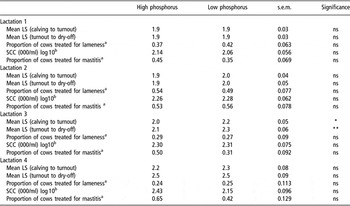
Mean locomotion scores (Table 1) during the periods from calving to turnout, and turnout to drying-off, were unaffected by dietary P level in lactations 1, 2 and 4 (P > 0.05), while being significantly higher with cows offered the low P diets in lactation 3 (P < 0.05 and P < 0.01, respectively). Dietary P level had no significant effect on either milk SCC, nor the proportion of cows treated for either lameness or mastitis in any of lactations 1 to 4 (P > 0.05).
Effect of dietary phosphorus content on locomotion score, somatic cell count (000/ml) and the proportion of cows receiving antibiotic treatment for lameness and mastitis

LS = locomotion score; ns = not significant; SCC = somatic cell count.
aOn at least one occasion.
bEntire lactation.
*P < 0.05; **P < 0.01; ***P < 0.001.
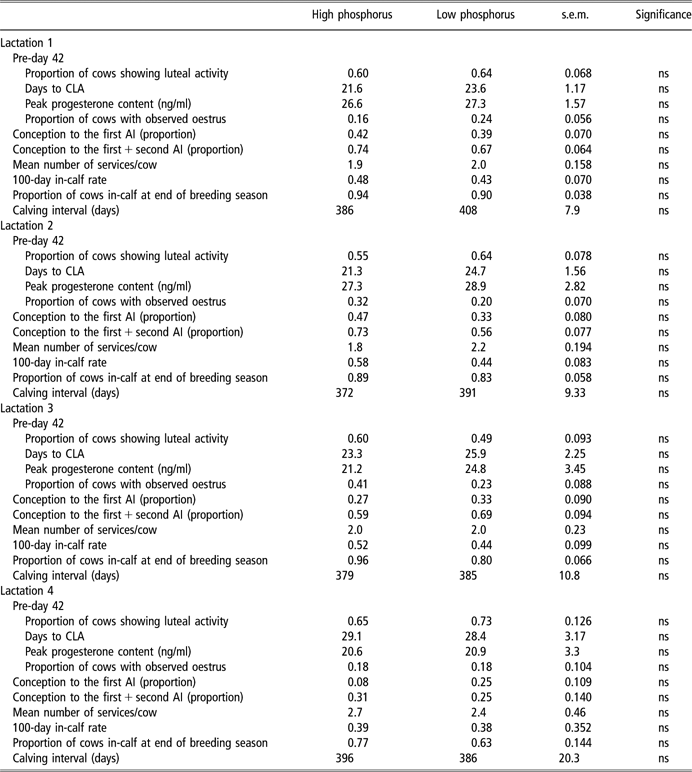
Treatment had no significant effect (P < 0.05) on any of the fertility parameters recorded before day 42 in any of lactations 1 to 4 (Table 2). In addition, none of conception rate, mean number of services per cow, 100-day in-calf rate and proportion of cows in calf at the end of the breeding season, or calving interval, was affected by dietary P level in any lactation (P < 0.05).
Effect of dietary phosphorus content on dairy cow fertility during each of lactations 1 to 4
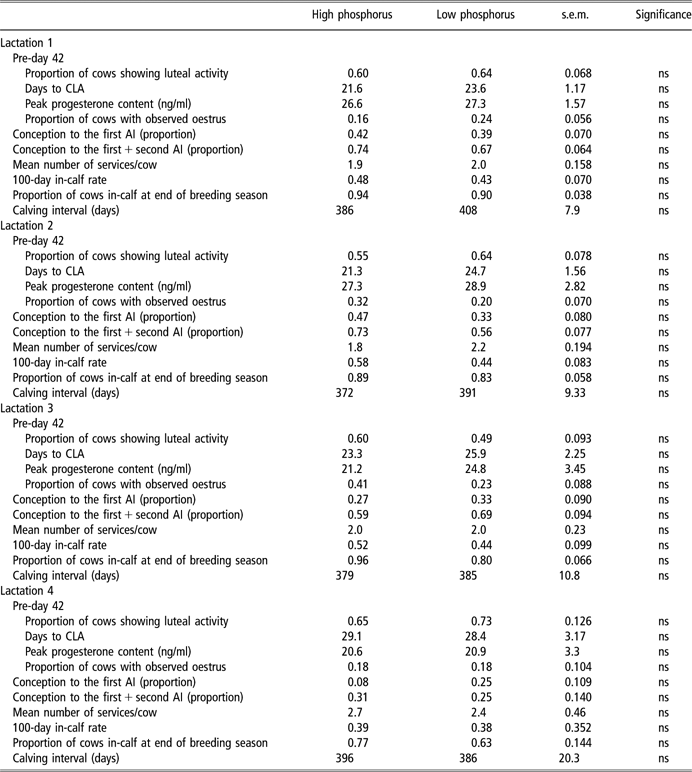
CLA = commencement of luteal activity; AI = artificial insemination; ns = not significant.
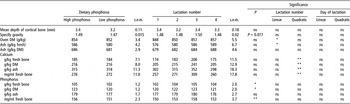
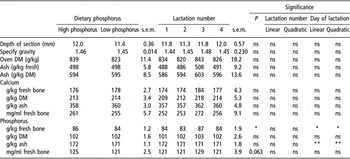
There were no significant interactions (P > 0.05) between lactation number and dietary P level, or between day of lactation when sampled and dietary P level, for any of the rib core or rib section parameters examined, with significance of interactions excluded from Tables 3 and 4. Dietary P level had no effect on the mean thickness of the cortical bone cores (Table 3), or on the DM, ash or Ca content of cortical bone cores (P > 0.05). However, the P content of cortical bone cores, when expressed on either a fresh (P < 0.05), DM (P < 0.05) or volume basis (mg/ml fresh) (P < 0.01), was significantly lower for cows offered the low P diets. There was a significant linear relationship between lactation number (P < 0.05) and the ODM and ash content of cortical bone cores, and a significant quadratic relationship between lactation number (P < 0.01) and the Ca content of cortical bone cores. There were no significant relationships between lactation number and the P content of the cores, or between the day of lactation when culled and any of the rib core parameters examined (P > 0.05). With the exception of the P content of fresh bone (P < 0.05), dietary P level had no significant effect on any of the rib section parameters (Table 4) examined (P > 0.05), although there was a trend for the P content of the rib sections, when expressed on a volume basis, to be lower for cows offered the low P diets (P = 0.063). There was no significant relationship between lactation number (P > 0.05) and any of the rib section parameters examined. However, there were significant linear and quadratic relationships between the day of lactation and the P content of the fresh bone (P < 0.05) and that of the ashed bone (P < 0.01). None of the other parameters examined was significantly affected by the day of lactation (P > 0.05).
Effect of dietary phosphorus level, lactation number when bone was sampled, and day of lactation when bone was sampled, on the composition of cortical bone removed from rib cores

ns = not significant; DM = dry matter.
*P < 0.05; **P < 0.01; ***P < 0.001.
Effect of dietary phosphorus level, lactation number when bone was sampled, and day of lactation when bone was sampled, on the composition of rib cross sections

ns = not significant; DM = dry matter.
*P < 0.05; **P < 0.01; ***P < 0.001.
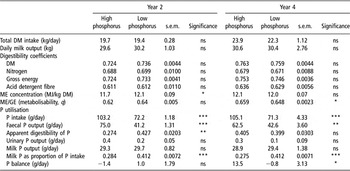
Dietary P level had no significant effect (P > 0.05) on any of the digestibility coefficients measured in either of years 2 or 4 (Table 5), while P intake and faecal P excretion was significantly higher with cows offered the high P diet in both years (P < 0.01). Phosphorus balance was significantly higher with cows offered the high P diet in year 4 (P < 0.05), while the apparent digestibility of P was significantly higher with cows offered the low P diet in year 2 (P < 0.01).
Effect of dietary phosphorus level on cow performance, ration digestibility and P utilisation, during years 2 (mean of 114 days post-calving) and 4 (mean of 113 days post-calving) of the main dairy cow feeding study

DM = drymatter; ns = not significant; GE = gross energy; ME = metabolisable energy.
*P < 0.05; **P < 0.01;***P < 0.001.
Discussion
Cow health
The results of this study provide no evidence that mammary tissue health, as assessed by SCC, and the incidence of mastitis, was affected by dietary P level. Similarly, Valk and Sěbek (Reference Valk and Sěbek1999) and Wu and Satter (Reference Wu and Satter2000) observed that dietary P level had no effect on incidences of mastitis. While Wu et al. (Reference Wu, Satter and Sojo2000) observed a numerically higher incidence of foot rot in cows offered a low P diet, Wu and Satter (Reference Wu and Satter2000) observed the reverse trend. Incidence of lameness in this study was unaffected by dietary P level, in agreement with the observations of Valk and Sěbek (Reference Valk and Sěbek1999). The higher locomotion scores observed with the cows offered the low P diet in lactation 3 is unlikely to have been of any practical significance, and, as it did not continue into lactation 4, was unlikely to have been diet related.
Cow fertility
In a review of data published between 1920 and 1960, much of it based on field observations and survey work, Ferguson and Sklan (Reference Ferguson and Sklan2005) traced the origins of the perception of a strong link between dairy cow fertility and dietary P levels. In more recent controlled studies (e.g. Call et al., Reference Call, Butcher, Shupe, Lamb, Boman and Olson1987; Brodison et al., Reference Brodison, Goodall, Armstrong, Gordon, McCaughey and Todd1989; Brintrup et al., Reference Brintrup, Mooren, Meyer, Spiekers and Pfeffer1993; Valk and Sěbek, Reference Valk and Sěbek1999; Wu and Satter, Reference Wu and Satter2000; Wu et al., Reference Wu, Satter and Sojo2000), fertility performance was largely unaffected by dietary P levels, although these studies were primarily designed to examine the impact of dietary P level on cow performance. While infertility was the primary reason for cows being culled in the current experiment (Ferris et al., Reference Ferris, Patterson, McCoy and Kilpatrick2009), none of the fertility parameters examined during lactations 1 to 4 was affected by dietary P level, in agreement with the findings of the studies highlighted above. Nevertheless, values for a number of the parameters examined, including conception to first and second AI, 100-day in-calf rate, calving interval (in lactations 1 and 2), and the proportion of cows in calf at the end of the breeding season (lactations 2, 3 and 4), were numerically lower with the low P treatment. However, as highlighted by Wu and Satter (Reference Wu and Satter2000), approximately 250 cows per treatment would have been required in order to detect a 10% difference in the fertility parameters examined within their study. Realising the limitations of examining fertility data from individual studies in isolation, these authors combined data from a number of experiments, involving a total of 785 cows, approximately 392 cows per P level. When reproductive performance was compared across low (3.2 to 4.0 g P/kg DM) and high (3.9 to 6.1 g P/kg DM) P diets, diet had no significant effect on days to first oestrus, days to first AI, days open, number of services per conception or pregnancy rate. Indeed, reproductive performance was unaffected in studies where dietary P concentrations of 2.4 g/kg DM were examined (Call et al., Reference Call, Butcher, Shupe, Lamb, Boman and Olson1987; Valk and Sěbek, Reference Valk and Sěbek1999), despite a reduction in cow performance with these low P diets. This is in agreement with the findings of Ferguson and Sklan (Reference Ferguson and Sklan2005), who modelled the relationships between dietary P and conception rates and dietary P and pregnancy rates across a range of studies. These authors concluded that dairy cattle could tolerate dietary P concentrations of between 2.0 and 3.0 g/kg DM, without reproductive performance being affected.
The numerically lower fertility levels recorded for a number of the parameters in the current experiment appear to have arisen from an unexplained delay (random error) in days from calving to conception with the low P diets in lactation 1. As a consequence of this delay during the first year of the study, cows on this treatment had a shorter breeding season in subsequent lactations, and as such a reduced likelihood of becoming pregnant. This delay in conception rate in lactation 1 occurred at a time when cows had been managed on a low P diet for between 3 and 6 months, and as such, dietary P levels would have been extremely unlikely to have had an effect.
This suggestion is supported by parameters derived from milk progesterone analysis, including the proportion of cows showing luteal activity before day 42 post-calving, the interval to the commencement of luteal activity, and the peak progesterone level during the first oestrus cycle. For example, in lactation 1, and indeed across the experiment, there was no evidence of low P diets having a negative effect on any of these parameters. Unlike parameters such as observed heats and conception rates, milk progesterone data reflect physiological changes within the cow, and are not dependent on human ‘intervention’. Recognising this, a number of recent studies have entailed detailed examinations of the effect of dietary P on oestrus behaviour and ovarian activity. For example, Lopez et al. (Reference Lopez, Wu, Satter and Wiltbank2004) using a radiotelemetric transmitter, observed that dietary P (3.8 and 4.8 g/kg DM) had no significant effect on the number of oestrus events recorded, the duration of the oestrus cycle, the duration of oestrus, the number of mounts within each oestrus or total mounting time within each oestrus. Similarly, using ultrasonography, Tallam et al. (Reference Tallam, Ealy, Bryan and Wu2005) observed that dietary P (3.5 or 4.7 g P/kg DM) had no effect on days to first post-partum ovulation or the diameter of dominant and ovulating follicles, corpus luteum development or blood progesterone concentrations during the voluntary weighting period, the latter in agreement with the findings of this study.
Bone reserves
Approximately 80% of P in the body of a dairy cow occurs in bones and teeth, principally as apatite salts and calcium phosphate (National Research Council (NRC), 2001). However, the mineral content of bone reflects the balance between bone formation and bone resorption, with bone loss occurring when resorption exceeds formation. Net resorption of bone in late pregnancy and early lactation is a normal consequence of the lactation process, and appears to be mainly driven by a rapid increase in demand for Ca for lactation (Braithwaite, Reference Braithwaite1983). However, resorbed bone P has an important role to play in meeting the P requirements of dairy cows, especially in situations where dietary P is inadequate. On the basis of an extrapolation of data for beef cattle, Wu et al. (Reference Wu, Satter, Blohowiak, Stauffacher and Wilson2001) suggested that a 600-kg dairy cow could mobilise between 600 and 1000 g P in early lactation, while Knowlton and Herbein (Reference Knowlton and Herbein2002) observed that between 5 and 25 gP/day was mobilised from body reserves during the first few weeks of lactation. Indeed, the importance of bone resorption is highlighted within the UK P-feeding recommendations (AFRC, 1991), which justifies the absence of a safety margin by suggesting that the skeleton should be relied upon to provide the necessary ‘elasticity’ between supply and demand. More recently, Ekelund et al. (Reference Ekelund, Sporndly and Holtenius2006) suggested that it may be possible to reduce the dietary supply of P to dairy cows in early lactation by optimising naturally occurring bone resorption, and thus reduce P excretion.
Although information on the effect of dietary P on dairy cow bone P reserves is limited, the available information is confounded by variations in sampling site and sampling methodologies. For example, while Brodison et al. (Reference Brodison, Goodall, Armstrong, Gordon, McCaughey and Todd1989) sampled tail bones, Beighle (Reference Beighle1999) and Wu et al. (Reference Wu, Satter, Blohowiak, Stauffacher and Wilson2001) surgically removed rib biopsies. However, Beighle (Reference Beighle1999) removed cores using a trephine, while Wu et al. (Reference Wu, Satter, Blohowiak, Stauffacher and Wilson2001) removed 20 cm rib sections. In common with Wu et al. (Reference Wu, Satter, Blohowiak, Stauffacher and Wilson2001), the twelfth rib was used as the sampling site in this study, the axial skeleton being sensitive to bone resorption and formation (Hill, Reference Hill1962). In addition, this permitted samples to be removed from cows at the end of the study without the need for slaughter. While Wu et al. (Reference Wu, Satter, Blohowiak, Stauffacher and Wilson2001) examined whole rib samples, comprising both cortical and trabecular bone, Beighle (Reference Beighle1999) examined cortical bone only as the quantity of trabecular bone within ribs, and the number of P containing red blood cells, is variable. To allow data from this study to be compared with previous findings, both whole rib cross-sections (comprising both trabecular and cortical bone) and cortical bone cores were analysed. While the mineral content of rib samples is known to vary somewhat along the length of the rib (Beighle et al., Reference Beighle, Boyazoglu and Hemken1993), for cows culled at the abattoir in this study, it was not possible to determine the exact site of rib sampling, relative to the vertebral attachment. Nevertheless, the location of the sampling site in this study is unlikely to have been more than ±10 cm, from a position 35 cm dorsal to the spinal process, and as such, variation in sampling site is unlikely to have had a significant effect on bone composition.
Bone-specific gravity has been advocated as a useful indicator of bone mineral status, by Little (Reference Little1972), observing a significant reduction in bone-specific gravity when beef cattle were offered a P-deficient diet for a 6-week period. Similarly, Shupe et al. (Reference Shupe, Butcher, Call, Olson and Blakem1988) recorded bone-specific gravities of as low as 1.06 in cattle offered P-deficient diets over a number of years, compared to that of 1.5 to 1.6 for non-depleted cows. However, in the current experiment, bone-specific gravity was unaffected by dietary P treatment (P = 0.077 for rib cores), in agreement with the findings of Wu et al. (Reference Wu, Satter, Blohowiak, Stauffacher and Wilson2001), and with values observed similar to those observed by Wu et al. (Reference Wu, Satter, Blohowiak, Stauffacher and Wilson2001). The mean ash content of the rib cross-sections in this study (498 g/kg fresh and 594 g/kg DM) were greater than those recorded by Wu et al. (Reference Wu, Satter, Blohowiak, Stauffacher and Wilson2001) for cows offered diets containing adequate P levels (479 g/kg fresh and 559 g/kg DM). However, while Wu et al. (Reference Wu, Satter, Blohowiak, Stauffacher and Wilson2001) observed a significant reduction in ash content with cows offered a diet containing 3.1 g P/kg DM, neither the ash content of rib cores nor rib cross-sections were affected by dietary P level in the current experiment.
The mean P and Ca content of the cortical bone cores in this study was 178 and 316 g/kg ash, similar to the respective values of 164 and 335 g/kg ash observed by Beighle (Reference Beighle1999). The P content of rib sections in this study, and of the whole bone sections in the study by Wu et al. (Reference Wu, Satter, Blohowiak, Stauffacher and Wilson2001) were very similar, with a reduction in bone P content (fresh basis and volume basis) observed with cows offered low P diets in both studies. Thus, while cows managed on low P diets experienced depleted P reserves, the extent of this depletion was small, and is unlikely to have resulted in a reduction in bone strength. This is supported by the findings of Wu et al. (Reference Wu, Satter, Blohowiak, Stauffacher and Wilson2001), who observed no reduction in bone strength (shear stress or fracture energy) with cows offered a diet containing 3.1 g P/kg DM, despite a reduction in bone P and ash content, and a concurrent reduction in milk yield in late lactation. Brodison et al. (Reference Brodison, Goodall, Armstrong, Gordon, McCaughey and Todd1989), in a study involving moderate yielding cows, observed that neither the Ca nor the P content of tail bones was affected when they were offered diets containing similar P levels as adopted in this study (3.6 and 4.4 g P/kg DM). Nevertheless, bone mineral contents observed by Brodison et al. (Reference Brodison, Goodall, Armstrong, Gordon, McCaughey and Todd1989) were quite different from those in this study, thus highlighting the need for a common sampling site and sample preparation methodology to be adopted if comparison of actual bone mineral contents are to be made between studies.
While it is generally accepted that cows resorb minerals from bone in early lactation, and replenish these in later lactation, neither bone ash nor bone Ca concentrations changed with stage of lactation in this study. This contrasts to the work by Benzie et al. (Reference Benzie, Boyne, Delgarno, Duckworth and Hill1959) with lactating sheep, in which up to proportionally 0.4 of skeletal ash reserves were resorbed by mid-lactation with P-deficient diets. This study was not specificially designed to monitor changes in bone mineral content with stage of lactation, with the majority of bone samples removed from cows in late lactation. Nevertheless, there was evidence that the P concentration in the ash of bone cross-sections (but not cores) declined during the months post-calving, and increased again in later lactation (Figure 1; P < 0.01; quadratic trend). However, this study provides no evidence of an interaction between dietary P level and stage of lactation, in terms of bone P concentrations. Similarly, Ekelund et al. (Reference Ekelund, Sporndly and Holtenius2006) observed that although serum cross-linked carboxyterminal telopeptides of type-I collagen (a marker of bone resorption) decreased as lactation progressed, while concentrations of osteocalcin (an indicator of bone formation) increased, their concentrations were not different for cows offered either high or low P diets in early lactation.
Relationship between the phosphorus content of the ash component of rib cross-sections and day of lactation when bone samples were collected (mean of lactations 1 to 4), across the two dietary phosphorus treatments (cows culled as infertile, □: cows culled for all other reasons, ▪).

This study provides a unique opportunity to examine the long-term effects of two different dietary regimes on dairy cow bone P reserves, although there was, in fact, no evidence of a cumulative depletion of bone P reserves over the duration of the study. Thus, it is likely that bone P resorbed in early lactation was largely replaced later in the lactation, or during the dry period. As such, the data provide further reassurance that the dietary P levels examined were sufficient for the needs of the cows, not only in terms of performance (Ferris et al., Reference Ferris, Patterson, McCoy and Kilpatrick2009), but also in terms of maintaining bone P reserves.
In dairying regions where P-induced eutrophication is a particular problem, the dairy sector will continue to face increasing pressure to further reduce P levels in dairy cow rations. While plasma P concentrations do not provide an accurate reflection of the P status of cows, having been observed to be within the normal range even when milk yield was reduced (Wu et al., Reference Wu, Satter and Sojo2000), bone may provide a more stable and reliable estimate of a cow’s P reserves. Surgically removed bone biopsies could provide an indication of the P status of a herd, and have in fact been advocated in the past for this purpose, although this is unlikely to be a practical option. However, the analysis of bone samples removed from casualty cows, or from healthy cows at slaughter, could be used to provide a measure of the long-term P status of a herd, particularly if dietary P levels must be further reduced to meet increasingly stringent legislative requirements. Bone P reserves are affected by many factors, and it is suggested that standards for different classes of livestock should be developed for specific regions or countries, much like the use of regional laboratory references for normal blood parameter levels. Consistency in sampling site and methodology of sample preparation is essential if bone analysis is to be used as an indicator of P status. While data from this study and the study by Wu et al. (Reference Wu, Satter, Blohowiak, Stauffacher and Wilson2001) provide an indication of ‘normal’ bone P contents for dairy cows, information on bone P levels that are indicative of either a marginal or P-deficient status appears to unavailable.
Nutrient utilisation
Rumen microbes have a requirement for P (Bryant et al., Reference Bryant, Robinson and Chu1959), and if this is not supplied through the diet, or from P recycled in saliva, microbial activity may be impaired. For example, P depletion has been associated with a reduction in microbial protein synthesis and organic matter digestibility in sheep and goats (Breves et al., Reference Breves, Hoeller and Lessmann1985; Petri et al., Reference Petri, Müschen, Breves, Richter and Pfeffer1988). However, dietary P level had no effect on the apparent digestibility of the DM, N, energy or ADF fractions of the rations offered in the current experiment, suggesting that rumen function was not impaired with the low P diet. Similarly, Valk et al. (Reference Valk, Sěbek and Beynen2002) observed that ration DM digestibility was unaffected when dairy cows were offered a ration containing approximately 2.4 g P/kg DM, despite a reduction in food intake and milk yield. Thus, it is likely that diets containing extremely low levels of dietary P are required before ration DM digestibility is impaired, with Satter (Reference Satter2003) suggesting that modern dairy cow diets never approach the low dietary P concentrations that can result in impaired microbial growth in the rumen.
Within the current nutrient utilisation studies, the apparent digestibility of P with cows offered the high P diets ranged from proportionally 0.27 (year 2) to 0.40 (year 4), indicating that between 0.60 and 0.78 of P consumed was excreted in faeces. While the apparent digestibility of P increased with cows offered the low P diet in year 2, in common with the findings of Knowlton and Herbein (Reference Knowlton and Herbein2002) and Ekelund et al. (Reference Ekelund, Sporndly and Holtenius2006), the apparent digestibility of P was unaffected by dietary P level in year 4, in common with some of the observations by Valk et al. (Reference Valk, Sěbek and Beynen2002). The inconsistent effect of dietary P level on the apparent digestibility of P appears to be largely due to differences in P retention between the 2 years.
Offering low P diets reduced faecal P excretions by proportionally 0.45 (34 g/cow per day) and 0.32 (20 g/cow per day) in years 2 and 4, respectively, an average reduction of 27 g/day. If this reduction in faecal P excretion is assumed for a 150-day winter feeding period for a farm stocked at 2.5 cows/ha, this represents a reduction in P excretion in faeces of 4.0 kg/cow, and 10.1 kg P/ha. Thus, reducing the P content of dairy cow rations to the extent adopted within the current experiment has the potential to have a significant impact on farm P balances, and thus the likelihood of P loss to the environment. In addition, Dou et al. (Reference Dou, Knowlton, Kohn, Wu, Satter, Zhang, Toth and Ferguson2002) observed an increased proportion of water soluble P in the faeces of cows offered high P diets, while Ebeling et al. (Reference Ebeling, Bundy, Powell and Andraski2002) showed that P runoff from slurry produced from cows offered a high P diet was considerably greater than for slurry produced by cows offered a low P diet.
Only a trace of P was excreted in urine and this agrees with the findings of previous studies involving ruminants (Wu et al., Reference Wu, Satter and Sojo2000; Valk et al., Reference Valk, Sěbek and Beynen2002; Knowlton and Herbein, 2002; Ekelund et al., Reference Ekelund, Sporndly and Holtenius2006), and reflects the fact that urine only becomes a significant excretory route for P when diets contain excessively high P levels. Phosphorus excreted in milk was unaffected by treatment and this reflects the fact that neither milk output nor milk P content was affected by dietary P level.
Practical implications
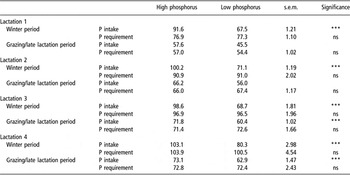
For each of the winter and grazing/late lactation periods described (Ferris et al., Reference Ferris, Patterson, McCoy and Kilpatrick2009), mean daily P intakes and P requirements were calculated for individual cows using either fortnightly (lactations 1 and 2) or weekly (lactations 3 and 4) production data (Table 6). Phosphorus requirements within each of these two periods were calculated according to AFRC (1991) for rations with a metabolisability (q) of <0.7 (Table 5), as the sum of P requirements for ‘maintenance’, milk production, growth, and, when appropriate, pregnancy. ‘Growth’ was assumed as the difference in post-calving liveweights between two successive lactations, or in the case of a cow that was culled, the difference between live weight at calving and the final live weight recorded before culling. Across the four lactations, mean P intakes for cows offered the low P diets were 26.5 g/day (26.9% – winter period) and 11.0 g/day (16.6% – grazing/late lactation period) lower than for those offered the high P diets. Consequently, P intakes for cows on the high P diets were proportionally 1.08 (winter period) and 1.01 (summer period) of calculated P requirements, while P intakes with the low P diets were proportionally 0.79 (winter period) and 0.84 (grazing/late lactation period) of AFRC (1991) P requirements. In addition, during the winter periods, the mean Ca/P ratios were 1.7 : 1 and 2.3 : 1 for the high and low P diets, respectively, while during the summer periods the mean Ca/P ratios were 1.9 : 1 and 2.2 : 1, respectively. Although close to the 2 : 1 Ca/P ratio recommended in the past, it is now known that cows can tolerate a wide range of Ca/P ratios, provided P intakes are adequate (AFRC, 1991).
Phosphorus intakes (g/day) and phosphorus requirements (g/day), the latter calculated according to the Agricultural and Food Research Council (AFRC; 1991) (q < 0.7), during lactations 1 to 4

ns = not significant.
***P < 0.001.
The lack of practically significant treatment effects on either cow performance (Ferris et al., Reference Ferris, Patterson, McCoy and Kilpatrick2009) or on cow health, fertility or bone P reserves within this study highlights that the current AFRC (1991) rationing system allows the requirements of dairy cows with lactation yields of between 7500 and 9000 kg/lactation to be met (for diets with q < 0.7). This agrees with the findings of Wu and Satter (Reference Wu and Satter2000) in a study involving very different diet types, who concluded that a dietary P content of between 3.3 and 3.7 g/kg DM was adequate for moderate-to-high production levels (7500 to 9000 kg/lactation). Indeed, the results of this study suggest that there may be opportunities to reduce the P content of dairy cow rations to levels lower than those recommended within AFRC (1991) as already highlighted by Valk and Sěbek (Reference Valk and Sěbek1999). These authors suggested that a dietary P content of 2.8 g/kg DM was adequate for cows producing 9000 kg milk per lactation, while recommending 3.0 g/kg DM in practice. However, these recommendations are extremely low, especially in view of the fact that P deficiencies have been observed with rations containing 3.1 g P/kg DM (Kincaid et al., Reference Kincaid, Hillers and Cronrath1981). Nevertheless, these new recommendations are currently being adopted within the Netherlands (Valk and Beynen, Reference Valk and Beynen2003), and it remains to be seen if these P levels can be achieved through diet formulation in practice, and if they are in fact adequate for dairy cows in the long term.
The results of this study indicate that dairy cows can be managed on winter diets based on grass/maize silage containing 3.5 to 3.9 g P/kg DM, and summer diets based on grazed grass containing 3.4 to 3.8 g P/kg DM without any apparent adverse effects on cow performance. Thus, there is considerable scope for the UK dairy industry to substantially reduce the P content of dairy cow concentrates, from the level highlighted earlier (7.2 g P/kg DM). However, accurate ration formulation with regards to P requires knowledge of the P content of the forage component of the ration, while in practice, normally only standard analysis values are available. The limitations of the latter are highlighted in the variation in P content of 36 Northern Ireland farm silages, sampled in 2003, which ranged from 1.4 to 3.9 g P/kg DM (mean, 3.1 g/kg DM; C.P. Ferris, Unpublished data). In addition, concentrate feed level will have a significant impact on overall ration P content. Thus, when advocating the adoption of low P concentrates, it is important that the concentrate P level adopted is adequate for forages of different P contents, over a range of concentrate feed levels. For example, a lower concentrate P content could be adopted when a forage with a high P content is supplemented with a high level of concentrates, compared to when a forage with a low P content is supplemented with a low level of concentrates. Thus, until a rapid low-cost P analysis system for forages is developed, caution is necessary when making significant reductions in concentrate P contents on farm.
Conclusions
The results of this study indicate that dairy cows can be managed on winter diets containing 3.5 to 3.9 g P/kg DM, and summer diets containing 3.4 to 3.8 g P/kg DM without any apparent adverse effects on cow health or fertility. While the P content of rib bones was reduced when cows were offered low P diets, there was no cumulative reduction in rib P content with cows offered the low P diet over successive lactations. Thus, cows with lactation yields of between 7500 and 9000 kg/lactation can be managed on diets containing low levels of dietary P without any effect on cow performance. Reducing dietary P level had no effect on the apparent digestibility of the rations offered, while P excretion to the environment was reduced by an average of 27 g/day.
Acknowledgements
This experiment was co-funded by the Department of Agriculture and Rural Development for Northern Ireland (DARD), AgriSearch, John Thompsons and Sons Ltd and Devenish Nutrition Ltd. Special thanks to Mr B. Hunter, Mr M. Davies and the staff of the Calf Unit and Dairy Unit for technical assistance, and Mr M. Porter and the laboratory staff for undertaking chemical analysis.