West African Islamic cultural heritage is recurrently overlooked or marginalized in scholarly, museological, and popular imaginaries, despite contemporary burgeoning Western attentiveness to Islam. Historically, Orientalists and/or Islamicists exclude West Africa, and anthropologists study West African Islam due to its alleged lack of written Arabic and Ajami texts (Loimeier Reference Loimeier2013; Saul Reference Saul2006), despite textual and material evidence to the contrary. Existing literature on the material expressions of West African Islam, largely edited volumes and museum catalogues, direct attention to Islamic West Africa, rather than Islam in West Africa, in other words, predominantly West African Muslim societies, and not those for whom Muslims comprise a minority (Adahl Reference Adahl and Sahström1995; Insoll Reference Insoll2003; Roberts and Nooter Roberts Reference Roberts and Roberts2003; for exceptions cf. Bravmann Reference Bravmann1974, Reference Bravmann1983, Reference Bravmann, Levtzion and Pouwels2000). Analytically, the “Islamization of Africa” and “Africanization of Islam,” standard nomenclature customarily employed to describe the simultaneous processes at play in West African Islam (Loimier Reference Loimeier2013), note the reciprocal relationship between Islam and pre-existing West African religious traditions shaped by local contexts, circumstances, subjectivities, and exigencies (Fisher Reference Fisher1973; Trimingham Reference Trimingham1980). Accordingly, West African Islam's material manifestations labeled “inauthentic,” “syncretic,” “vernacular,” and “popular” are considered, inter alia, antithetical to “classical” Islam. Notwithstanding, so-called classical Islam represents the embodiment of a locally synthesized form that, over time and with repetition, has come to be conceptualized as “classical.” Yet, Islam has incorporated and translated an assortment of pre-existing ideals to adjust in ways viewed as neither regression, apostasy, plurality nor heterodoxy. And, West Africa proves no exception. Indubitably, West African Islamic cultural heritage is the heritage of the “‘Othered’ religion par excellence” (Preston-Blier Reference Preston-Blier, Bates, Mudimbe and O'Barr1993:148).
This short commentary concerns the West African Sudanese masjid (mosque) as an object of archaeological ethnographic enquiry. Moving West African Islam's cultural heritage from the periphery to the center, the traditions I want to critique are long-standing, exclusivist Orientalist epistemologies and ontologies, more specifically, ways of classifying, knowing and understanding Islamic architectural heritage (Blair and Bloom Reference Blair and Bloom1994; Creswell Reference Creswell1958; Ettinghausen, Grabar and Jenkins-Medina Reference Ettinghausen, Grabar and Jenkins-Madina2001; Hillenbrand Reference Hillenbrand2004; for exceptions cf. Frishman and Khan Reference Frishman and Hasan-Uddin1994). It is not an overstatement to claim most contributions discussing West African masjids have been illustrated books with limited text (Morris and Blier Reference Blier and Morris2004; Schutyser et al Reference Schutyser, Dethier, Eaton and Gruner2003); there is a paucity of sustained research and analysis, though notable exceptions exist on select masjids, inlcuding, Great Mosque of Djenné (Mali), Nando Mosque (Mali) Larabanga Mosque (Ghana) (Apostos Reference Apostos2016; Bourdier Reference Bourdier1993; Bourgeois Reference Bourgeois1987; Cantone Reference Cantone2012; Marchand Reference Marchand2009; Prussin Reference Prussin1986). Departing from hegemonic, essentialist understandings as “Western, Eurocentric Authorized Heritage Discourse” (Smith Reference Smith2012), and informed by adopting a critical heritage approach (Harrison Reference Harrison2012; Rico Reference Rico2016), I hope to challenge us to think critically regarding the multiple, complex, diverse concepts, interpretations, and practices entangled within Islamic cultural heritage discourse, namely, architectural construction, management, destruction, and preservation.
****
In Islam, the masjid is its most iconic visual, material manifestation. In West Africa, the Sudanese-style hypostyle masjids preponderate, though as Prussin (Reference Prussin1986) notes, the designation “Sudanese” remains firmly embedded in French imperial lexis. Mud masonry knowledge, techniques and skills were transmitted from the Mediterranean littoral and North African Sahel to West Africa through the trans-Saharan trade (Prussin Reference Prussin1970). Archaeological evidence for dating early West African Sudanese adobe masjids is scant, although some knowledge can be gleaned from oral narratives and early travelers’ accounts.
An architectural adobe design and technology, earth construction techniques are labyrinthine and based on an established, comprehensive knowledge not only of architecture, but also earth's natural properties. Sudanese masjids exhibit striking architectural features and variations. Highly skilled architects, mostly associated with professional organizations frequently described as guild systems possessing mastery of knowledge concerning design, techniques, and materials, carry out construction. To be sure, knowledge of constructions’ mystical dimensions is a major component. In the past, enslaved and other low-status free individuals captured during conquest could attain important positions within building traditions. Nowadays, illustrious architects enjoy celebrated reputations extending beyond their local communities to other West African regions. Construction is conducted in the absence of finalized architectural plans, but it would be erroneous to suggest masjids represent “architecture without an architect,” since an architect's “signature style” is often evident in other nearby buildings. Specialists, comprising a chief mason and team, perform mudding. Typically, a chief and(or) imam instruct the principal mason, and the latter executes construction without architectural plans inscribed onto paper. Customarily, community members also participate in building work. Men and boys prepare binding mortar and plaster, whilst women and girls transport water necessary for clay molding. During the building season (January to March), many cities, towns, and villages evoke a sense of a gargantuan brick factory as uninhabited spaces transform into brick drying areas (Gruner Reference Gruner and Schutyser2003).
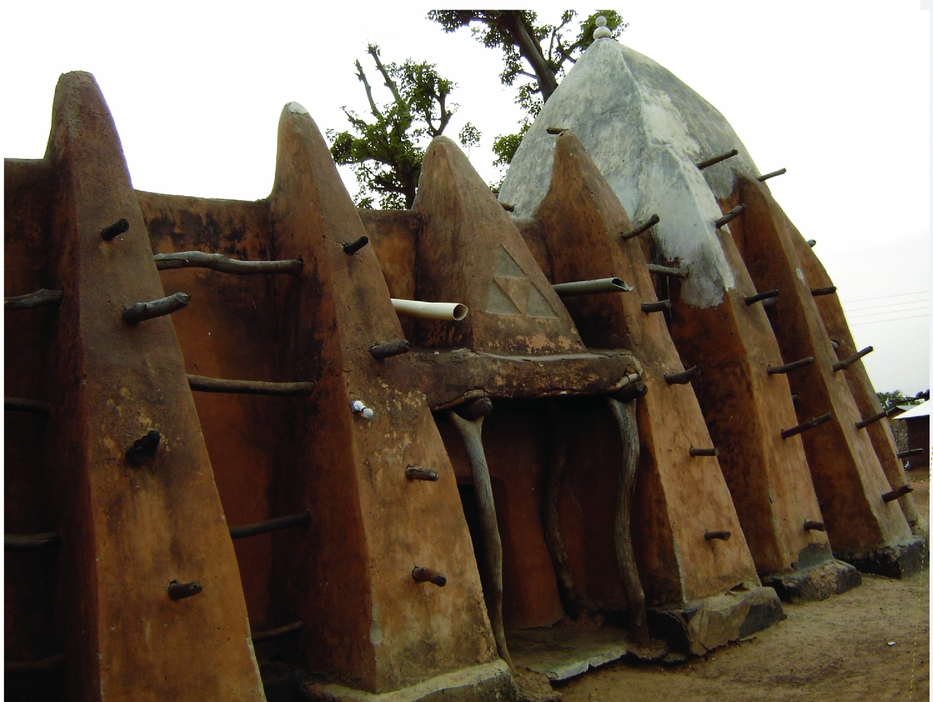
Architectural monumentality is accentuated, but domes and vaulted structures are almost non-existent. Pinnacles are inserted on the roof parapet. A wooden sloped roof accelerates rainwater drainage. Halved, hollowed palm stems and hand-pottered clay pipes act as waterspouts directing water away from the structure. Minarets are engaged in the façade and bundles of split palm wood or branches protrude at regular intervals. In addition to decorative function, wood also serves as permanent scaffolding for constructing walls and future renovations. Masjids possess a sculptured aspect with soft contours. Clay clumps applied by hand, together with finger marks, create a sensory skin effectFootnote 1 . Surface decorations are simple or elaborate. Constant synergy between light and shadow on exterior and interior walls contributes to the complete visual effect. The interior structure contains aisle supports and is typically unadorned. The building material laterite, a red clay earth, is rich in iron and aluminum oxides. Due to the regions’ hot, dry climate (apart from a short monsoon season), sunbaked earth renders the structure hard and resilient, simultaneously defining its surface and interior.
****
To insist on peculiar, context specific understandings of Islamic architectural heritage, betrays the nature of Islam as a global ummah (community). Therefore, there is a need to reconfigure Islamic architectural heritage, outside of Euro-Western Orientalist traditions—though, certainly, in recent years, it has spread to non-Euro-Western heritage organizations—for the most part, informed by art historical exceptionalist sensibilities. One of the most telling and detailed evidences is how creators are designated “artisans” or “craftsmen” as opposed to “architects,” and in turn what this means in terms of architecture produced, creativity, values (functional or aesthetic, high or low), in addition to skills. Clearly, there is a variation in skills and hands, but the arbitrary nature of hierarchies of skills and expertise consistent with formal and informal education is not necessarily recognized at all times and in all places. Certainly, the character and meaning of an “Islamic architectural tradition” is worth unpacking. Undeniably, monumentality is acknowledged. Islamic architecture (however defined), like all architecture, does not stand in cultural or religious isolation. West African “traditional” architecture informs and influences Sudanese masjids. Still, critiques of culture, authenticity, the invention of tradition and the idea tradition is based upon historical continuity, and not amenable to change or innovation are well understood. Yet, Sudanese masjids remain persistently situated outside Islamic architectural discursive traditions and are instead, cavalierly pronounced “sculpture” or a fusion between architecture and sculpture, for instance, “architecture with sculptural virtues, or rather architectonic sculpture” (Schutyser Reference Schutyser, Dethier, Eaton and Gruner2003:15). Adobe as material, also poses challenges for consideration. “The mud from which these buildings are made is itself a controversial substance that tests our conventional views of architecture. It is one of the most commonly used building materials in the world, and yet in our urban-dominated society it is seen, effectively, as dirt” (Morris 2003:1). What is more, the privileging of tangible cultural heritage means there is still a correspondence between an object's (or in this case, monument's) durability and the value(s) we attribute to it; many, western and scientific value systems assign prestige to material culture that withstands a long period of time and continues to look good (La Violette Reference LaViolette and Childs1994).
Within the context of management, preservation, and conservation, adobe masjids and their constituencies do not necessarily need or remain reliant upon a body of national elites or international, foreign “experts” vis-à-vis use, management, conservation, and preservation, contrary to Islamic architectural cultural heritage orthodoxies elsewhere. Materially ephemeral by nature, a re-mudding or re-claying community ceremony occurs annuallyFootnote 2 . Earthen material may be the rubble of a previous building, often demolished or from a new clay pit located nearby, and is mixed with organic matter such as straw, clay, or sand and water to strengthen the structure. It is important to note, recently, new masjids employ perforated cement plaster and burnt adobe bricks to ensure stability. In this way, restoration combines the material detritus of both contemporary and earlier constructions, producing a singular material assemblage that is a concatenation of old and new.
Conservation, Larabanga Mosque, Ghana. Photo by Rachel Ama Asaa Engmann (2005).

By the same token, each time a building is re-rendered, its outwardly visual, material actualization is subtly but intimately transformed, and in so doing, integrates temporal societal, individual, artistic, and generational influences and vicissitudes. Not quite a “timeless tradition,” rather, conservation and preservation collapses notions of African “tradition” and “modernity.” In this spirit, the “making and remaking” to quote Cantone (Reference Cantone2012), as well as managing of West African masjids by local communities is conjointly predicated on individual and communal subjectivities, knowledge, and practice. In so doing, it reveals contemporary post-colonial communities of interest and other vested stakeholder concerns with cultural heritage underscoring the politics of recognition concerning local, community and descendant agendas, priorities, needs and desires. As such, they regularly stand in contradiction to the interests of national, regional, religious, and global institutions, and organizations’ understandings of outstanding universal heritage and values—incidentally, many of whom, fund conservation and preservation initiatives. At times, local interests trump non-local interests, at others, locals complain foreign “experts” dictate and monopolize conservation and preservation plans, albeit often in partnership with local elite governments, administrators, and religious authorities. Destruction too, ushers in another set of complications, where yet again, interventions by individuals, as well as specific kinds of communities and groups take place. For example, the recent events in Mali, by Ansar Dine and Al Qaeda in the Islamic Maghreb attracted attention from the international heritage community, including UNESCO amongst others (Joy Reference Joy, Brumann and Berliner2016), with the ensuing political instability resulting in the suspension or termination of many architectural heritage conservation and preservation projects.
Hitherto, I have introduced some of the complexities and multiplicities of West African Islamic architectural heritage. Clearly, I have done little more than scratch the surface, though I hope it provides possibilities for a fruitful dialogue for just how it behooves us to rethink and reflect on the ways in which we define, classify, manage, preserve, and conserve Islamic cultural heritage on a grander scale.