Introduction
Conducting research on substance use disorder is ethically challenging,Reference Anderson and McNair 1 particularly when studying the effects of substance use during pregnancy on neonatal and childhood development. As part of a broader effort to address the opioid epidemic, the National Institutes of Health (NIH) funded a network of researchers through the Helping to End Addition Long-term (HEAL) initiative’s HEALthy Brain and Child Development (HBCD) Study. This study examines early neurological development after prenatal exposure to maternal substance use (including opioids). The NIH also encouraged examination of the attendant ethical and legal considerations for this controversial research. 2 State laws sometimes criminalize substance use in pregnancy or consider it a form of child abuse. Additionally, there is considerable stigma associated with opioid use. 3 In this context, there are psychosocial, economic, reputational, and legal risks to participants that are not straightforward to address. Including ethicists during study design and implementation was therefore recommended in the request for applications to plan the longitudinal research. HBCD research teams across the US have subsequently involved ethicists, albeit in different ways. 4 Notably, encouraging ethicist involvement in requests for applications is one of several different approaches to fostering ethics engagement in NIH-supported research. NIH has also promoted ethics engagement by providing supplemental bioethics research funding and earmarking funding dedicated to a particular scientific area for ethics research. 5
The nationwide attention to intentional, prospective ethics engagement across projects facing similar ethical issues presents an opportunity to build upon what is known about ethics engagement. There is limited guidance for how best to engage ethicists in research projects. While research ethics consultation services are available at many institutions and have received some scholarly attention,Reference Porter, Danis, Taylor, Cho and Wilfond 6 the many other ways ethicists can engage with research teams are less well-studied.Reference Sugarman and Bredenoord 7 In this paper, we draw from the approaches developed across the country for the HBCD study to better conceptualize the practice of ethics engagement and provide recommendations for how it can be done effectively. We first contextualize and define ethics engagement in research. Next, we provide examples from the HBCD network gathered from the request for applications, network meetings, our experiences, and an informal, exempt survey of engaged ethicists. Throughout the paper, we supplement what we learned from the HBCD network by using examples from existing literature to illustrate a broad spectrum of engagement approaches. Finally, we consider how to balance a fundamental tension in ethics engagement — the value of maintaining independence and objectivity versus the benefits of integration within a larger research team to understand the scientific and cultural context. We conclude by discussing relative strengths and weaknesses of different forms of ethics engagement.
In this paper, we draw from the approaches developed across the country for the HBCD study to better conceptualize the practice of ethics engagement and provide recommendations for how it can be done effectively. We first contextualize and define ethics engagement in research. Next, we provide examples from the HBCD network gathered from the request for applications, network meetings, our experiences, and an informal, exempt survey of engaged ethicists. Throughout the paper, we supplement what we learned from the HBCD network by using examples from existing literature to illustrate a broad spectrum of engagement approaches. Finally, we consider how to balance a fundamental tension in ethics engagement — the value of maintaining independence and objectivity versus the benefits of integration within a larger research team to understand the scientific and cultural context. We conclude by discussing relative strengths and weaknesses of different forms of ethics engagement.
Defining Ethics Engagement in Research
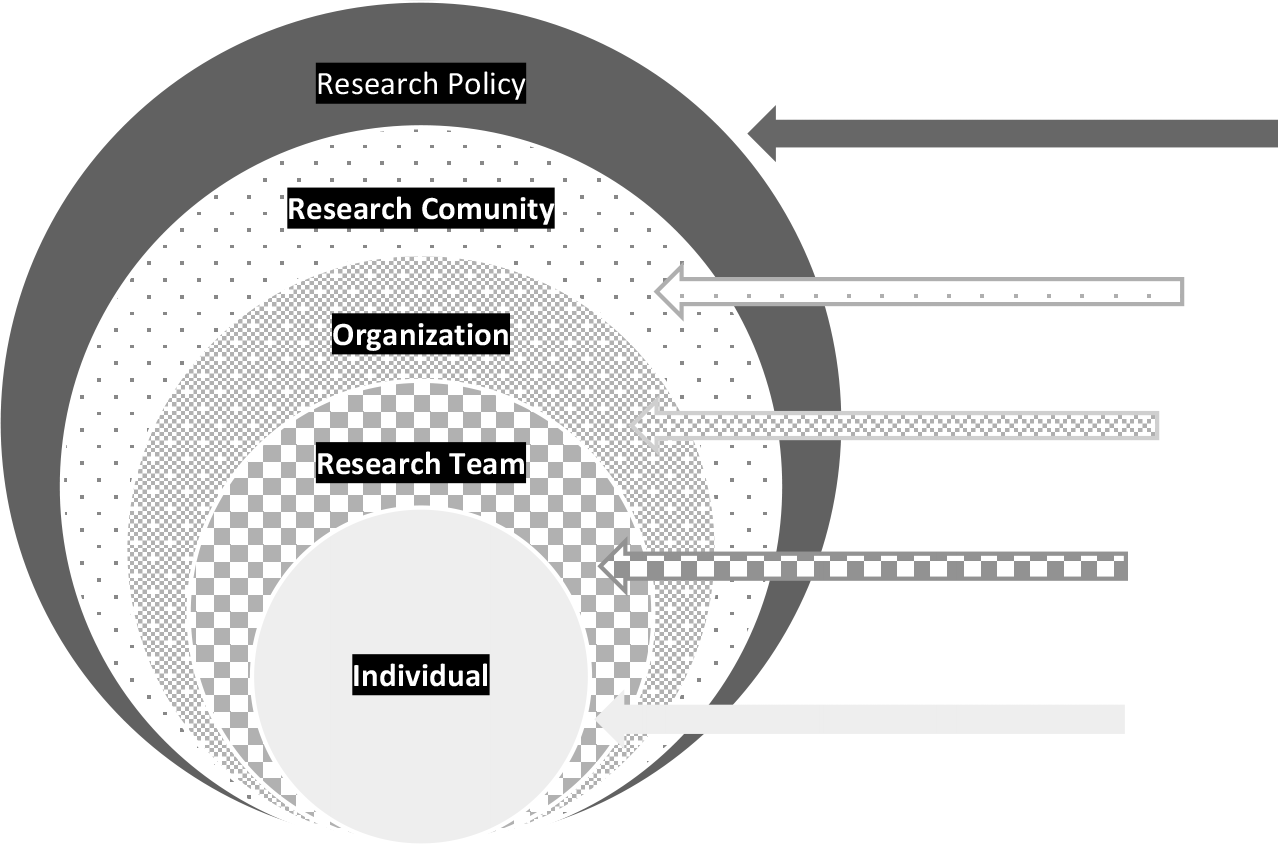
The ethical conduct of research involves applying moral principles, frameworks, and regulations along with awareness of the norms, conventions, and standards of different disciplines. The study and practice of research ethics has emerged in large part due to egregious acts of misconduct within biomedical research.Reference Levine 8 Ethics engagement can now involve research ethicists working across many different levels (Figure 1). Research must comply with the U.S. federal regulations when funded by the U.S. federal government, or if the researchers work at an institution that receives some U.S. federal government funding and has entered into an agreement to conduct all of its research under the same rules. 9 Human subjects research regulations promulgated by the Department of Health and Human Services are designed to protect research participants and ensure research has sufficient potential benefit to justify the risks. Regulations provide extra protections for groups identified as vulnerable. Enforcement of these regulations is often accomplished through institutional review boards and committees (e.g., Institutional Review Boards, 10 Conflict of Interest Committees, Institutional Biosafety Committees,Reference Petrella 11 etc.). Educational programs for researchers are also often required to provide those on the research team with the knowledge and skills needed to carry out the proposed work in accordance with the ethical guidelines and standards (e.g., trainings in human research protections and managing conflicts of interest). 12 Yet there are many gaps within this system.
Levels of Ethicist Engagement in Research

Perhaps more importantly, mere compliance with regulations is not sufficient to ensure research is conducted ethically. The current system of ethical oversight in the U.S. was vividly described by Carol Levine as “born in scandal, reared in protectionism.” 13 In other words, research ethics has historically taken a reactive, rather than proactive, stance. When new scientific advances emerge, existing regulations designed to respond to past misconduct may not provide the right guidance for the future. More generally, regulations can be slow to adapt to technological advancements, and Institutional Review Boards may lack the training or authority to go beyond existing regulations. Furthermore, some ethical issues may arise after regulatory approval. Although there are some structures to review the evolving social value and risks associated with ongoing research, such as Data and Safety Monitoring Boards, guidance for ethical issues that arise as trials are ongoing is limited.Reference Eckstein, Rid, Kamuya and Shah 14 Other important ethical issues are not covered by regulations, such as how to address risks to third parties not enrolled in research.Reference Kimmelman 15 Finally, legal and moral obligations may sometimes conflict.Reference Shah 16
To address these issues may require the additional expertise held by scholars specializing in research ethics. Research ethics involves application of moral principles to the domain and practice of research. Direct engagement between ethicists and research teams can help improve the quality and relevance of the research as well as the ethical work connected with it. To do this work, “one needs to become part of the very processes one studies.”Reference Landeweerd, Townend, Mesman and Landeweerd 17 The degree to which one becomes part of a team, however, can vary. Importantly, ethics engagement is different from ensuring compliance with policies or regulations. Compliance involves setting a “floor” for research activity — ensuring that a study does what is minimally required to be responsive to regulations. By contrast, engaged ethicists focus on what should be done within the range of what is legally permitted. In collaboration with legal experts, they can also recommend how to interpret ambiguous regulations when there are different principles to balance. Ethicists can even make recommendations about how to resolve potential conflicts between regulations or laws and ethical principles.Reference Shah and Porter 18
Some forms of engagement, including research ethics consultation (Figure 1), are limited in time and scope. For example, periodic consultation offers a less expensive and accessible option for research teams seeking guidance. Some research teams may welcome ethics involvement to improve the responsible conduct of their own research, but face disincentives due to increased costs or time. The consultation option can also help ethicists gain entry into projects that may need significant attention. When appropriate, an ethicist could make a case for greater engagement over time.
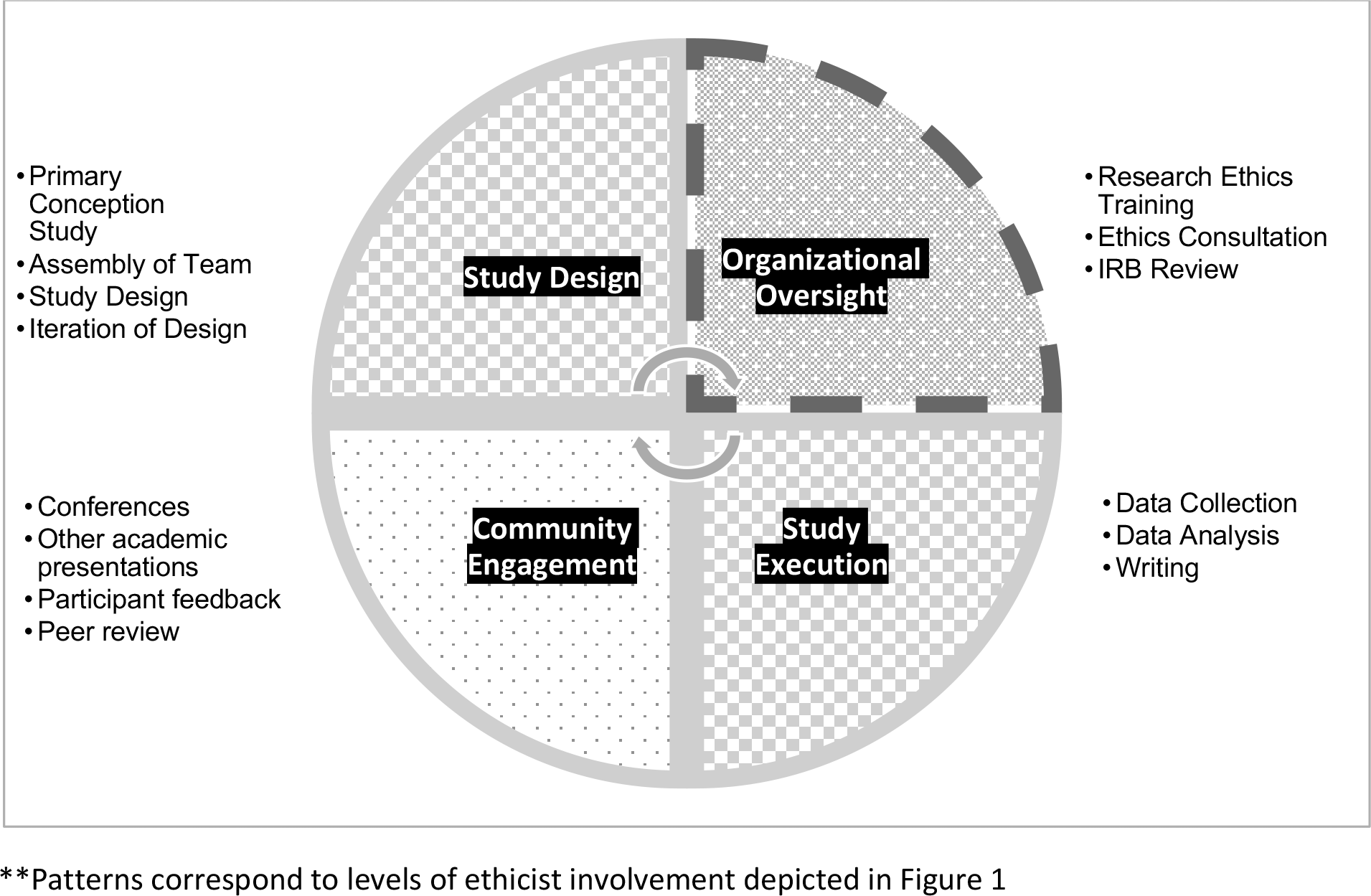
On the other hand, ethicists who are directly engaged in research as a member of research teams might conduct “research on research.” 19 Ethicists who engage with teams without conducting research of their own may do so in one of three main ways (Figure 2). First, some ethicists provide expertise, such as by helping identify ethical problems based on understanding of regulations and ethical principles, framing discussions, and finding defensible solutions. Ideally, ethicists functioning at this level can serve as critics lending an analytical eye to projects with an insider’s view and raise ethical concerns to help the researcher avoid ethical dilemmas and address challenges that arise. Some issues are trickier than others to address. For example, ethicists may have fundamental concerns that call into question whether the research should be done at all or introduce substantial costs or delays to address. This may be especially difficult to address for ethicists also funded by the research, as we will discuss further below.
Ethics Engagement Over Lifecycle of Research Project

Second, ethicists might help with capacity building. Ethicists can train scientists in ethics to enable self-regulation. For example, one ethicist within the HBCD network contributed to writing guidance to be applied across a 5-site consortium on: a) recruitment, enrollment, and retention; b) training for core staff; and c) innovative consent processes. This guidance could then be used by other members of the research team to guide ethical and responsible practices. Third, ethicists can perform community or public outreach by helping to bridge researchers and communities, communicating about the research with the public, and shaping the process and content of obtaining community input.Reference Jao and Mwalukore 20
Ethicists who conduct research of their own (sometimes referred to as “research on research”) may focus on either normative or empirical analysis. Normative (or “conceptual”) research does not require collecting data, but rather applying principles, analytical reasoning, and examples to reach conclusions about the ethical dimensions of an issue. This could involve determining which decisions or approaches are ethically defensible or providing a framework to guide action. Legal analysis is a related type of research that requires applying principles of legal reasoning to interpret existing laws. Policy research can involve building on legal analysis by recommending ways to develop or reform laws, as well as studying their application and interpretation. For example, one ethicist contributed to the national Ethics and Law Working Group by conducting normative analysis on the use of wearable technologies that passively record potentially sensitive biological, behavioral and environmental data about participants and, potentially bystanders. Another ethicist conducted an in-depth 50-state survey of laws governing substance use in pregnancy and postpartum to better understand the potential risks to HBCD participants. 21
By contrast, empirical research refers to research that involves the collection and/or analysis of data. Methodological approaches that are commonly used by ethicists are used by social scientists generally; approaches can be divided further into qualitative or quantitative methods. One example of qualitative empirical research in the HBCD involves conducting interviews with both pregnant women and researchers to identify barriers and best practices for studying infant development in the context of laws penalizing substance use in pregnancy. Interviews also explored what forms of recruitment are more or less acceptable to participants. An example of quantitative empirical research involved a national survey of obstetricians to learn how laws penalizing substance use in pregnancy affect the care they provide for pregnant patients, what barriers prevent them from referring patients to research, and how the COVID-19 epidemic has affected their ability to screen patients for substance use and refer them to medically assisted treatment.
Fundamental Tension in Ethics Engagement
Perhaps the fundamental challenge with ethics engagement is that a significant conflict of interest is built into the role of an ethicist directly engaged with a research team. Part of an ethicist’s job is to engage in critical reflection on controversial issues that may slow down or prevent certain research from proceeding. Ethicists who are fully integrated into teams may be dependent on that team for salary and other support, particularly in an environment where grant funding is required. This embeddedness may lead ethicists to assume the biases of the research team (See Figure 1). If an ethicist uncovers controversial issues that would be costly or time consuming to address, or otherwise counter to the objectives of the research team, they may be disincentivized to raise these issues. Additionally, some teams may not permit publication of analyses of ethical issues that were addressed (or potential harms avoided) if it could bring negative attention to the research or the institution. Some degree of independence can be important. Independence may give ethicists greater ability to provide genuine reflective critique and raise issues that may be uncomfortable or unwelcome, but important.
On the other hand, as previously mentioned, entirely independent ethicists may lack knowledge of the relevant science or technology or the culture within the field. Additionally, the nature of the interaction between the field and the community they serve may be hard to understand from the outside. Thus, closer engagement may be necessary to provide nuanced, practical, and actionable recommendations regarding research practices and methods. For example, an ethicist without context or experience may not appreciate the importance of providing a non-judgmental environment for the care of pregnant individuals with substance use that addresses their fears related to privacy and negative consequences. Research teams that fail to provide a non-judgmental setting could drive individuals away from engaging in research that is ethically informed. Many ethical challenges are simply not visible without a deep understanding of the subject under investigation. Aditionally, limited ethics engagement may not be sufficient to address all ethical concerns, but the fact that ethics engagement has occurred may give the appearance that a project is ethically sound, even if it raises serious concerns. Such a phenomenon has been described in the context of artificial intelligence as “ethics washing,”Reference Bietta 22 referring to situations where an ethicist is involved with a project in a superficial, distant way (perhaps with limited time funded or expected to be spent on the project) in order to reassure outsiders about the ethics of the project, and there is limited interest in having an ethicist involved to uncover and address ethical issues.Reference Metz 23
Closer engagement can also be important for building mutual trust. As Ashby and Morrell argue, “the process of understanding may require a relationship with the subject and its researchers, whereby the bioethicist becomes embedded in the area and indeed may achieve, or strive for, credibility and perhaps respect from the practitioners concerned and within the scientific community.”Reference Ashby and Morrell 24 Researchers who believe that ethicists are acting with integrity, with a good understanding of both the subject-matter and the importance of conducting the research, will be more willing to listen to ethical critiques and collaborate to address them. Alternatively, clinicians or researchers could themselves obtain in-depth bioethics training so they are able to see ethical issues with greater acuity. It is unclear, however, how many researchers have the time and desire to obtain rigorous ethics training and remain up-to-date in both their home discipline and the field of bioethics.
Finally, ethics engagement can also be beneficial for ethicists. Ethicists who work closely with research teams may learn more about the practice of research and the reasons for particular approaches. This knowledge can enable the ethicist to distinguish true ethical concerns from approaches unfamiliar to the ethicist that, nevertheless, could be appropriate under the right circumstances if adequate protections are in place. For example, an ethicist who was unfamiliar with human challenge trials, or studies that involve deliberately exposing participants to diseases, might assume these studies are always unethical without realizing there are ethical frameworks for conducting them responsibly. 25 Ethicists who engage with research teams can also obtain a better appreciation of the gap between principles and their application.Reference Miller 26 Ethicists may also learn from the experience in ways that can improve their own analytical abilities for future challenges. Moreover, some practices that have become normalized may be ethically problematic, and ethicists able to engage deeply may be better able to bring attention to this type of problem. Ethicists may need time with the research team to understand the science involved for these benefits of engagement to manifest. On the other hand, it is possible that greater objectivity will make it easier to identify practices that are problematic but, common and normalized within the field.
Striking the Balance Between Integration and Independence
Planning engagement that strikes the right balance between independence and integration is difficult. It may be easier for ethicists to manage conflicts of interest when there is external scrutiny to hold investigators accountable. For example, some have compared bioethics engagement to journalism. Journalists must maintain some degree of independence to retain credibility but can learn great deal from being embedded within the object of their study. In some cases, embedded reporting may even be necessary to do meaningful work. 27 Although journalists may face pressure from the objects of study to withhold important information, journalists have editorial staff to report to, fact-checkers reviewing their work, and ultimately must account to the public. Another discipline that faces similar pressures is biostatistics. 28 Biostatisticians who are employed by researchers may face pressure to massage findings, deviate from pre-planned analyses, or display results in a more positive light. Requirements to preregister hypotheses, set up ongoing review by data and safety monitoring boards that include statisticians, and submit results for peer review that includes independent evaluation of data are important checks and balances that can help maintain research integrity. The approaches of disciplines like journalism and biostatistics therefore suggest that it is important for ethics engagement to include transparency and accountability to individuals and communities other than the embedded ethicist herself.
Some teams may not need external accountability and are committed to conducting research with integrity even if it comes at a cost. For reaserch teams that need convincing, ethicists can appeal to external authorities who can impose consequences for research that is not ethically appropriate, such as Institutional Review Boards/Research Ethics Committees, journals that may not agree to publish ethically problematic articles, and future public scrutiny to explain the importance of their work. Ethicists may also benefit from being able to present their work at bioethics conferences and use colleagues as sounding boards. Engaging with colleagues from the field of bioethics can serve to reinforce the importance of existing norms and share strategies for withstanding external pressure.
One way to strengthen ethics engagement to counter the above challenges is to consider funding mechanisms such as those employed in HBCD. Yet, in the literature, there is limited discussion of whether ethicists are adequately funded for their work. One strength of the HBCD approach is that it provided a “carrot” for researchers to work with ethicists by making it clear applications including ethisists would be reviewed favorably for it. However, it can be difficult to anticipate what amount of an ethicist’s time will be required for a given study. For example, normative work that primarily involves engagement and learning, followed by providing expertise and guidance, is essential but easily undervalued — especially if not connected to specific research deliverables. Moreover, plans for how much time and resources will be devoted to ethics engagement in a funded study are typically developed before the ethical issues become clear. This suggests studies may budget much more or much less time than is required to do the work. During the planning phase of the HBCD, many ethicists acknowledged being un- or under-funded.
Some countries, such as Canada, explicitly make it a condition of funding genomic research that the project includes embedded research on ethical, economic, or environmental implications. 29 This is distinct from the HBCD approach because ethics engagement is explicitly required for genomic research to be funded, rather than merely being encouraged. However, engagement under the Canadian approach to funding genomic research can involve economic or environmental analysis; this could mean that some studies that could benefit from ethics engagement still do not have it. From the perspective of research ethicists, this requirement for engagement on the social implications of a research project from the start makes it easier for ethicists to have a steady portfolio of funding. On the other hand, Canadian research funds do not typically allow ethicists to be principal investigators on standalone ethics-focused projects. One upside of this financial security is that ethicists are more likely to be able to raise critiques or challenges that the research team may not welcome. Yet ethicists may have less autonomy to run independent research labs to conduct normative and empirical research and bioethics work. This in turn may limit their ability to develop a robust theory of how a particular type of research ought to be done. Indeed, the Canadian Institute of Health Research has faced criticism for its approach to incorporating ethics into its leadership structure and now consults with a Standing Committee on Ethics to improve its approach. 30
In the U.S., public research funding supports the creation of centers or large collaborations focused on ethics in particular areas, such as genetics. 31 Ethics engagement in most other scientific areas is not routinely written into funding applications except in discrete scientific areas, such as artificial intelligence or neurological research.Reference Greely, Grady and Ramos 32 Funding dedicated to ethics work beyond these areas typically requires administrative supplements, and these only apply when ethics research is being performed as part of the engagement of an ethicist. 33 Ethicists can more readily serve as independent investigators proposing their own projects, which could lead to larger ethics projects being conducted in the U.S. as compared with Canada, but also more uncertainty for ethicists reliant on research funding for their salaries. Mindful of the trade-offs involved, some recommend more guaranteed ethics support for projects that are truly independent. Arnason argues that, “[r]ather than embedding ethicists in scientific research projects, it would be preferable to support independent ethics projects through, for example, national research councils or the European Union funding bodies in Europe.”Reference Arnason 34 Per Arnason, the independence of ethicists is more essential to their value than the benefits that come from integration.
Recommendations for Optimizing Ethics Engagement Based on the HBCD Experience
It is important to strike the right balance between independence and integration in ethics engagement, particularly when resources are constrained, to ensure ethical analyses and critiques are as rigorous as possible. Returning to the example of the HBCD network’s approach to ethics engagement, some strengths of the approach taken are clear. For example, in the request for applications, “creative designs and innovative solutions” were considered important in three main areas, with legal and ethical considerations mentioned before scientific questions. 35 Researchers were prompted to seek outside expertise. Network meetings also consistently featured presentations by ethicists. After funding was awarded, the network created a separate working group composed of ethics and legal experts who served the purpose of sharing ideas, writing manuscripts, and providing opportunities for feedback on ongoing work. In phase II, the project’s program announcement indicate that the administrative core for the larger network would need to provide “dedicated expertise” and plans for addressing ethical issues, including those associated with participant risk and incidental findings.
In reflecting on the HBCD planning phase experience, several recommendations for future research emerged. We organize our recommendations based on the relevant stakeholders to whom they apply: sponsors, professional societies, research teams, and ethicists (Table 4). First, sponsors should invest in early and robust ethics engagement. The NIH highlighted the importance of ethics engagement starting with early planning meetings and extending to the request for applications. Perhaps most importantly, the NIH ultimately funded several applications that included ethics-related research projects. Second, the NIH created an inter-network Ethics and Law Working Group, providing ethicists with an opportunity to collaborate to identify, discuss and potentially resolve issues with a goal of strengthening the second phase of the HBCD study. Nevertheless, ethicists were generally underfunded with respect to the workload. Moreover, some ethicists may have been willing to take on less funding than necessary, with an eye towards being able to secure more funding in the second phase of the project. As well-intentioned as these ethicists might be, they may also be in conflict and incentivized not to raise significant ethical challenges that could derail the future project. This suggests that funders should evaluate expectations of those who are identified as the “ethics” experts on planning grants. Funders should then allocate sufficient funding and instruct reviewers to evaluate whether ethics engagement is appropriately funded to do the needed work.
Second, professional societies should help educate the public and researchers about the added value of ethics engagement in research. For example, the American Association for the Advancement of Science (AAAS) is a science advocacy organization with a mission to “advance science, engineering, and innovation throughout the world for the benefit of all people.” 36 In this role, AAAS could function as a hub to reach and educate scientific and engineering professional organizations about the distinctions between ethics, law, and societal dimensions of biomedical, bioengineering, engineering, and behavioral research, and the importance of early engagement with ethicists. Professional ethics societies like the American Society for Bioethics and Humanities and the World Congress of Bioethics could play complementary roles.
Third, research teams should recognize the importance of ethics engagement and independence. While some research teams have great sensitivity to ethical issues and less rigid hierarchies, others may be less amenable to critique and collaboration. Reform of the culture of research to foster cultivation of teams and investigators who endorse the importance of ethicsReference Grady and Fauci 37 may be one of the most important, longer-term solutions to support the use of ethics engagement to ensure the ethical conduct of research. Helping researchers value ethics in and of itself, however, can be difficult in a culture that prioritizes initial scientific discoveries over slower contributions to scientific knowledge. Research teams could also use both ethics consultations and embedded ethics work for their studies. External ethics consultation could help address potential bias by adding a more objective, second opinion on challenging and controversial issues.
Finally, individual ethicists can also advocate for the value added through ethics engagement and the importance of independence. Ethicists should evaluate prospective work and avoid ethics engagement in name only. Ethicists should endeavor to engage with teams that have a commitment to prospectively addressing ethical issues arising in the research, even if those issues may prove to be difficult to surmount. Ethicists can explain that their critiques can be opportunities for improvement that anticipate challenges in a way that could prevent projects from being derailed down the road. When it is done well, ethics engagement across the planning, conduct, and dissemination of research can enhance both integrity and trustworthiness.
Acknowledgements
The authors would like to thank Frank Miller for helpful comments on an earlier version of this manuscript.
Note
Professor Shah and Dr. Nebeker report grants from National Institute of Drug Abuse during the conduct of the study.