In the last decade there has been an increasing demand for new or improved strains to replace or complement existing starter strains currently used by the dairy industry. In fact, the use of non-specific commercial starter cultures in cheeses produced with pasteurized milk often results in the loss of typical characteristics in the finished products (Macedo et al. Reference Macedo, Tavares and Malcata2004).
Since the indigenous flora of milk and dairy environment seem to be a major factor in producing the specific properties of raw milk cheese (Macedo et al. Reference Macedo and Malcata1997; Freitas et al. Reference Freitas, Pintado, Pintado and Malcata1999), autochthonous cultures have recently been used to produce various cheeses in order to improve their organoleptic characteristics and quality (Ayad et al. Reference Ayad, Verheul, Bruinenberg, Wouters and Smit2003; Menéndez et al. Reference Menéndez, Godínez, Hermida, Centeno and Rodríguez-Otero2004). In particular, enterococci have been used to accelerate maturation and improve the organoleptic characteristics of Cebreiro (Centeno et al. Reference Centeno, Menéndez, Hermida and Rodríguez-Otero1999) and Feta cheeses (Sarantinopoulos et al. Reference Sarantinopoulos, Kalantzopoulos and Tsakalidou2002). Wild strains of Lactococcus lactis have been shown to positively affect the sensory characteristics of ewes' raw milk cheese (Centeno et al. Reference Centeno, Tomillo, Fernández-Garcia, Gaya and Nuñez2002). Lactobacilli have been successfully used to enhance the desirable characteristics of Manchego and Arzua-Ulloa cheeses (Menéndez et al. Reference Menéndez, Centeno, Godínez and Rodríguez-Otero2000; Poveda et al. Reference Poveda, Sousa, Cabezas and McSweeney2003).
The primary consideration before introducing adjunct cultures for traditional cheese production should be whether they would significantly contribute to an improvement of processing conditions and product quality with respect to: rapid or accelerated acidification, predictable fermentation process, desirable sensory attributes, improved safety and reduction of hygienic risks (Holzapfel, Reference Holzapfel1997).
Fiore Sardo is a PDO (Protected Designation of Origin) Italian cheese exclusively produced in Sardinia, according to ancient production techniques, using raw ewes' milk without the addition of starter cultures. The variety of microorganisms present in the milk and the artisanal procedure used in its production give products of widely varying quality. The use of adjunct cultures could therefore represent an appropriate approach to ensure a higher uniformity of Fiore Sardo production.
Previous works on Fiore Sardo cheese have revealed that its indigenous microflora is mainly constituted by homofermentative cocci and facultative heterofermentative lactobacilli: Lc. lactis subsp. lactis and Enterococcus faecium among cocci, Lactobacillus paracasei subsp. paracasei and Lb. plantarum among lactobacilli, were the predominant species isolated during ripening (Ledda et al. Reference Ledda, Scintu, Pirisi, Sanna and Mannu1994; Mannu et al. Reference Mannu, Comunian and Scintu2000).
In a recent study carried out in our laboratory, a total of 513 LAB strains isolated from artisanal Fiore Sardo cheese were identified at species level using physiological and biochemical tests and species-specific PCR (Cosentino et al. Reference Cosentino, Pisano, Piras, Deplano and Palmas2002). All strains belonging to the predominant species, namely Lc. lactis subsp. lactis, Ent. faecium, Ent. durans, Lb. plantarum and Lb. paracasei subsp. paracasei, were technologically characterized by determining acidifying, proteolytic and lipolytic activity, and 13 technologically interesting strains were selected to be used in experimental trials as adjunct cultures in Fiore Sardo cheese-making.
The aim of this work was to evaluate the effect of these autochthonous strains on the microbiological, physicochemical and sensory characteristics of Fiore Sardo cheese during ripening.
Materials and Methods
Preparation of the cultures for cheese-making
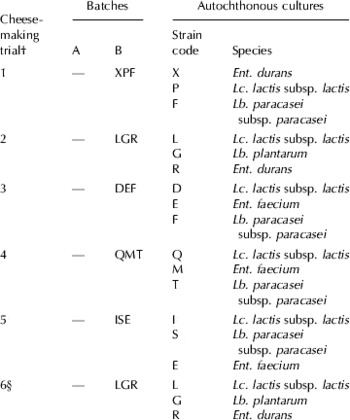
The 13 strains selected for Fiore Sardo cheese-making trials were used in five different combinations, as reported in Table 1. These strains did not produce antibacterial substances against each other (Pisano, unpublished data). Considering that the inclusion of enterococci in cheese as starters is a matter of debate for possible sanitary risks, the presence of potential virulence factors in our strains was evaluated (Cosentino et al. Reference Cosentino, Pisano, Corda, Fadda and Piras2004).
Protocol used in the cheese-making trials for Fiore Sardo cheese made (A) without and (B) with autochthonous cultures

† each trial was performed in duplicate, at intervals of 1 month
§ artisanal farm
Frozen stock cultures of each selected strain were used to prepare freeze-dried cultures as follows. After cultivation in appropriate medium (MRS, Oxoid, Basingstoke, UK for lactobacilli and M17, Oxoid, for cocci) for two consecutive transfers, the strains were checked for purity and inoculated (0·1%) in MRS or M17 broth at 30°C for 16 h. Each culture was centrifuged at 4600× g at 4°C for 20 min. Pellets were washed twice in phosphate-buffered saline (PBS; 137 mm-NaCl, 2·7 mm-KCl, 4·3 mm-Na2HPO4, 1·4 mm-K2HPO4; pH 7·3), resuspended in 50 ml reconstituted (110 g/l) skim milk powder (Oxoid) containing 50 g glucose/l and 10 ml glycerol/l, and incubated at 30°C in water bath for 12 h; then an equal volume of skim milk with 50 g glucose and 10 ml glycerol/l was added to the culture. Aliquots of 20 ml were transferred in sterile flasks and vacuum freeze-dried using an AdVantage freeze-dryer (VirTis, New York, USA).
The number of viable cells, before and after freeze-drying, were determined by the agar plate method. Just before plating, each sample of freeze-dried bacteria was resuspended in 20 ml of appropriate medium and kept at 30°C for 10 min. Serial dilutions of each sample were plated in duplicate and plates were incubated at 30°C for 24–48 h. About 109 cfu/ml (mean value 6·9±3·3×109) were present after freeze-drying process.
Cheese-making procedure
A total of six cheese-making trials were performed according to the technical disciplinary of Fiore Sardo cheese from January to May 2003. Table 1 reports the protocol used in the trials. Each trial was performed in duplicate at 1 month interval: five trials were carried out in a pilot plant and one (using LGR combination; Table 1) at an artisanal farm. For each trial, two different batches were manufactured from two vats of the same raw ewes' milk: a control batch (A) was made without cultures, a second batch (B) was made with the addition of autochthonous cultures.
In the pilot plant, each batch was made from 250 l raw ewes' milk while 125 l were used for the batches manufactured in the artisanal farm.
The freeze-dried cultures were resuspended in 2 l sterile milk and revitalized for 30 min at 30°C, prior to addition to the cheese vat to a final concentrations of about 106 cfu/ml milk. Then, 35 g lamb rennet paste/100 l was added to the vat and coagulation took place at 35°C within 20–30 min. The curd was cut and crumbled manually and kept in the vat for about 3 min; then the curd pieces were thinly cut into small pieces, the size of a rice grain, that were hand-pressed into moulds. After brine salting for 36 h (200 g NaCl/l), the cheeses were slightly smoked for about 20 d and then ripened for six months, in rooms temperature controlled at 15°C and 70% relative humidity.
From each batch, samples of fresh raw milk obtained just before manufacture and samples of 48 h, 1, and 6 month-old cheese were taken. Samples were transported to the laboratory under refrigeration and analysed on the same day.
Physicochemical analysis
Cheese samples were analysed for total solids (TS; International Dairy Federation, IDF 1982), moisture (calculated as 100-TS), NaCl content (IDF 1988), fat (IDF 1986) total nitrogen (TN) (IDF 1964) and protein (calculated as TN×6·38). The pH was measured with a HI8520 pH meter (Pool Bioanalysis Italiana, Milan, Italy) on milk and cheese samples (10 g aliquots) taken from at least three different places in the cheese block. Water activity (a w) was determined using a PAWKIT water activity meter (Decagon Devices, Washington, USA) in accordance with the supplier's instructions.
Microbiological analysis
Cheese homogenate, decimal dilutions, plating procedures and enumeration of total mesophilic bacteria, total coliforms, Staphylococcus aureus, lactococci, enterococci and lactobacilli were performed as previously described (Pisano et al. Reference Pisano, Fadda, Deplano, Corda and Cosentino2006).
Sensory analysis
Cheese samples at 6 months of ripening were subjected to sensory evaluation by a 6-members panel, trained in testing traditional Fiore Sardo cheese. The sensory evaluation was conducted with the aim of estimating the differences in the cheeses manufactured with adjuncts cultures compared with the control cheeses and detecting off-flavours and defects eventually caused by the adjuncts. The qualities judged were: cheese shape, cheese rind, color, interior openings, texture, smell, taste and aftertaste, scoring on a scale from 1 to 10 (1: very poor, 10: very good), as previously described (Ledda et al. Reference Ledda, Scintu, Pirisi, Sanna and Mannu1994).
Representative slices of 2 cm cheese samples were cut and placed in closed individual Petri dishes for 2 h before evaluation. Each tester was served the two cheese samples for each cheese-making trial (A and B), coded with a three digit code number and presented in random order.
Statistical Analysis
Microbial counts were calculated as number of colony forming units (cfu) per gram or ml of sample and reported as log10 cfu/g or ml. Calculations of Standard Error were also performed. ANOVA was performed on data obtained from microbiological and chemical analyses. Data on sensory analysis were submitted to Student's t-test. All statistics were performed using GraphPad Prism Statistics software package version 3.00 (GraphPad Prism Software Inc., San Diego, CA, USA). Statistical significance was inferred at P<0·05.
Results
Evolution of physicochemical parameters
Overall no significant differences due to adjunct cultures were found in the mean values of NaCl, fat, total nitrogen and protein content during ripening between experimental and control cheeses. The mean total solids content significantly increased during ripening showing slightly higher values in batches B, but significant differences (P<0·05) in total solids due to the addition of cultures were found only in batches elaborated with LGR combination. The increment observed in TS mean content was accompanied by a significant decrease in the moisture mean content during ripening (data not shown).
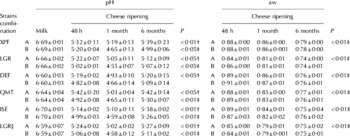
As shown in Table 2, in cheeses at 48 h, pH values decreased for each strain combination in both cheese batches by approximately 1·5 units and reached their minimum after 1 month, with the drop being most marked in batches B, then slightly increased at the end of ripening. The adjunct cultures factor significantly affected the pH evolution for each strain combination, alone or associated with ripening effect.
Evolution of pH and aw during manufacturing and ripening of Fiore Sardo cheese made (A) without and (B) with autochthonous cultures throughout ripening for each strains combination
Values are mean±standard error of duplicate cheese-making trials

† effect of adjunct cultures
‡ effect of ripening
§ artisanal farm
Water activity decreased significantly (P<0·01) during ripening and no differences were observed between the batches elaborated with and without adjunct cultures.
Evolution of microbial flora
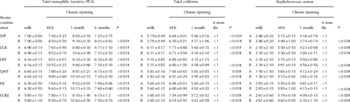
The evolution of the main microbial groups from raw milk throughout cheese ripening for each strains combination is shown in Tables 3.
Counts of the main microbial groups, expressed as log10 cfu g−1 or ml−1, during ripening of Fiore Sardo cheese made (A) without and (B) with autochthonous cultures for each strains combination
Values are mean±standard error of duplicate cheese-making trials


† effect of adjunct cultures
‡ effect of ripening
¶ adjunct cultures-ripening interaction
§ artisanal farm
Total mesophilic bacteria increased in the first month, then gradually decreased till the end of ripening in both batches. Mesophilic bacteria were significantly higher in all B batches due to the addition of autochthonous cultures.
Total coliform mean counts ranged from 3·65 to 6·11 log cfu/ml in milk, reached a maximum in 48 h-old cheeses, then significantly decreased until the end of ripening. The addition of autochthonous cultures had a significant effect on the level of coliforms throughout ripening in all experimental cheeses except for DEF cheeses.
Staph. aureus was detected at low levels (<3 log units) in milk, and in cheese followed a pattern similar to coliforms. Cheeses made with LGR and QMT combinations showed significantly (P<0·05) lower Staph. aureus mean counts throughout ripening.
In control cheeses, presumptive lactococci mean counts attained their maximum at 48 h, then significantly (P<0·01) decreased until the end of ripening. Significantly higher lactococci mean counts were observed for all experimental cheeses with respect to their controls throughout ripening. The combined effect of adjunct cultures and ripening showed a significant interaction in cheese batches made with XPF, DEF and ISE combinations on levels of presumptive lactococci (P<0·05, P<0·05, P<0·01, respectively).
Enterococci were detected in milk with mean counts not exceeding 3·3 log units. Enterococci reached mean values in the range of 6·80 to 7·80 log cfu/g at 1 month of ripening in control cheeses, then slowly decreased to 4–6 log cfu/g until the end of ripening. When Enterococcus strains were employed as a co-inoculum in experimental cheeses, significantly higher mean counts were detected, especially in the middle stages of ripening.
Presumptive lactobacilli showed an evolution similar to enterococci and represented the predominant microorganisms at the end of ripening, with mean counts between 5·80 and 7·07 log cfu/g and 6·50 and 7·97 log cfu/g in batches A and B, respectively. Both adjunct cultures and ripening significantly influenced lactobacilli mean counts in all trials. The combined effect of adjunct cultures and ripening was found to be significant in batches elaborated with ISE combination (P<0·05).
Sensory analysis
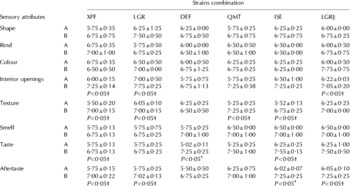
Results of sensory analysis carried out on cheeses at 6 months of ripening are presented in Table 4. As can be seen, interior openings obtained significantly higher scores (P<0·05) in batches manufactured with XPF and LGR combinations with respect to control batches. In most trials, significant differences between the two batches were detected for texture, taste and aftertaste.
Sensory analysis of Fiore Sardo cheese made without (A) and with (B) adjunct cultures at 6 months of ripening for each strains combination
Values are mean scores±standard error of duplicate cheese-making trials

† effect of adjunct cultures
§ artisanal farm
Discussion
The important role of the indigenous microflora on the manufacturing of different cheese varieties has been emphasized by numerous authors (McSweeney et al. Reference McSweeney, Fox, Lucey, Jordan and Cogan1993; Swearingen et al. Reference Swearingen, O'Sullivan and Warthesen2001; Centeno et al. Reference Centeno, Tomillo, Fernández-Garcia, Gaya and Nuñez2002; Macedo et al. Reference Macedo, Tavares and Malcata2004).
With regard to the chemical characteristics, the values for fat, protein, NaCl and total nitrogen content for the experimental cheeses were within the range set for artisanal Fiore Sardo (Pettinau et al. Reference Pettinau, Nuvoli and Podda1978). Particularly, the fat in dry matter mean content was always higher than 40%, which is the minimum value required for Fiore Sardo cheese according to the Technical Disciplinary (DPR 1974). It was therefore concluded that the addition of cultures did not influence the compositional parameters.
In control cheeses, all microbiological parameters showed an evolution comparable to that reported for Fiore Sardo and other raw milk cheeses with long ripening times (Macedo et al. Reference Macedo, Malcata and Hogg1995; Tavaria & Malcata, Reference Tavaria and Malcata1998; Freitas et al. Reference Freitas and Malcata2000; Vioque et al. Reference Vioque, Gomez, Sanchez, Mata, Tejada and Fernández-Salguero2000; Macedo et al. Reference Macedo, Tavares and Malcata2004; Pisano et al. Reference Pisano, Fadda, Deplano, Corda and Cosentino2006). In most of the experimental cheeses, the evolution of total mesophilic bacteria, total coliforms and LAB was significantly influenced by the addition of autochthonous cultures. The higher reduction of coliform population, observed in experimental cheeses compared with controls during ripening, can be attributed to the pH decrease as a result of microbial LAB activity as well as to the significant moisture decrease and the parallel increase of NaCl content due to brine salting, as previously reported (Gaya et al. Reference Gaya, Medina and Nuñez1983; Macedo et al. Reference Macedo, Tavares and Malcata2004).
With respect to Staph. aureus, significantly lower mean counts during ripening were detected in cheeses made with LGR and QMT strains combinations. The survival of staphylococci is influenced by factors other than solely pH, such as redox potential and inhibitory substances present other than lactic acid (Gaya et al. Reference Gaya, Medina, Bautista and Nuñez1988).
Enterococci have been reported to be one of the predominant microbial groups in fully ripened ewes' milk cheeses (Arizcun et al. Reference Arizcun, Barcina and Torre1997; Prodromou et al. Reference Prodromou, Thasitou, Haritonidou, Tzanetakis and Litopoulou-Tzanetaki2001). In our study, slightly higher enterococci levels were detected in experimental cheeses if compared with that observed by Sarantinopoulous et al. (Reference Sarantinopoulos, Kalantzopoulos and Tsakalidou2002) in Greek Feta cheese made with adjunct Ent. faecium strains. This fact is probably related to the use of pasteurized milk in Feta cheese-making process as well as to the inoculation rate of adjunct cultures.
The numbers of lactobacilli in experimental cheeses were in line with those observed by Macedo et al. (Reference Macedo, Tavares and Malcata2004) in Serra da Estrela cheese made with adjunct lactobacilli wild strains.
In agreement with other studies, a reduction in the number of lactococci has been noted during the ripening of both experimental and control cheeses. This decrease may be explained not only by the inhibitory effect determined by the low pH, and aw values, as well as high NaCl concentrations, but also by the interactions that occur between lactococci and non-starter LAB: Dasen et al. (Reference Dasen, Berthier, Grappin, Williams and Banks2003) found that lactobacilli adjunct strains and/or raw milk microflora may affect the survival of lactococci or other LAB in the cheese. Different and adverse environmental conditions due to the cheese-making processes as well as difference in inoculation rates could explain the lower lactococci level detected in our experimental cheese at the end of ripening compared with the levels found in Manchego cheese manufactured with pasteurized milk and the addition of a defined-strain starter culture including Lc. lactis subsp. lactis strains (Poveda et al. Reference Poveda, Sousa, Cabezas and McSweeney2003).
As for sensory analysis, the addition of autochthonous cultures significantly improved the scores in 6-month-old cheeses. In particular, the XPF, ISE, and LGR strains combinations resulted in the most effective improvement in texture, taste and aftertaste of the cheeses.
Our results demonstrated the beneficial effect of the addition of selected autochthonous cultures in accelerating the disappearance of undesirable flora and improving the typical sensory characteristics of Fiore Sardo cheese. In line with the observations of several authors, the utilization of natural adjunct cultures in the manufacturing of typical raw milk cheeses appears to be a promising tool in responding to the increasing demand for products with improved quality, safety and sensory characteristics.
This work was supported by a grant from the Italian Ministry of Scientific and Technologic Research, Plan «Agroalimentary products: dairy products», Cluster 08B, Project n°7: «Valorisation of typical ewes' milk products in Sardinia».