Introduction
Wheezing is common in early childhood. Almost half of children experience wheezing during the first year of life and 10% of children have asthma after 6 years of age. Reference Matricardi, Illi and Gruber1,Reference Martinez, Wright, Taussig, Holberg, Halonen and Morgan2 Early life exposures, including respiratory infections and airway inflammation, may lead to wheezing episodes in early childhood Reference Wright, Holberg, Martinez, Morgan and Taussig3 and contribute to recurrent wheezing. Reference Soh, Kim and Kwon4 However, the in utero environment including the levels of circulatory adipocytokine may impact lung and immune system development to influence children’s lung function, capacity to fight respiratory infections, and ability to resolve airway inflammation. Thus, identifying prenatal determinants of respiratory health is critical to develop novel interventions that lead to better respiratory health throughout life. Reference Ly, Gold, Weiss and Celedon5
Adipocytokines, which includes leptin and adiponectin, are secreted by both the mother and the fetus during fetal development, largely by adipose tissue, and may have developmental and immunoregulatory effects important to lung development. Reference Fantuzzi6 Leptin is produced by adipose cells and lung tissues in the fetus, Reference Bruno, Pace and Chanez7,Reference Vernooy, Drummen and van Suylen8 as well as by the placental trophoblasts, Reference Henson and Castracane9 and may influence lung function and the risk of lung diseases in early childhood. The sharp rise in cord serum leptin after 34-week gestation coincides with the rapid increase in the production of fetal lung surfactant, Reference Shekhawat, Garland and Shivpuri10 a complex mixture of phospholipids and proteins that is critical for gas exchange at the surface of lung alveolus, Reference Nkadi, Merritt and Pillers11 and its defective metabolism results in respiratory distress. In addition, animal and in vitro studies suggest that fetal leptin modulates pulmonary development by enhancing lung maturity, Reference Kirwin, Bhandari and Dimatteo12,Reference De Blasio, Boije and Kempster13 increasing lung weight, and stimulating surfactant protein synthesis. Reference Torday and Rehan14,Reference Torday, Sun, Wang, Torres, Sunday and Rubin15 Thus fetal leptin concentrations may have direct impact on lung function later in life.
Adiponectin, which is primarily produced by fetal subcutaneous adipose tissue, Reference Gauda and Master16 has antioxidant and anti-inflammatory functions in adults. Reference Fantuzzi6,Reference Torday and Rehan14,Reference Torday, Sun, Wang, Torres, Sunday and Rubin15 Less is known about the impact of human fetal adiponectin on lung development. Adiponectin-deficient mice exhibited an emphysema-like phenotype and increased levels of pro-inflammatory mediators that may contribute to the pathogenesis of inflammatory lung conditions. Reference Summer, Little and Ouchi17 In contrast, the lungs of mice that over-expressed adiponectin from conception onward were protected from oxidative and inflammatory injury in later life. Reference Konter, Parker and Baez18,Reference Sliman, Patel and Cruff19 Moreover, infants born preterm or small for gestational age, who have low concentrations of circulating adiponectin, are at increased risk for developing bronchopulmonary dysplasia from oxidative stress and inflammation, Reference Suursalmi, Korhonen and Kopeli20 although it is unclear whether in utero adiponectin has a direct impact on lung function and the development of lung diseases is independent of being born preterm or small for gestational age.
Little is known about the role of in utero adipocytokine concentrations on lung function during human childhood. Brenner et al. found no associations between cord blood adipocytokines and risk of wheezing disorders in early childhood in children of mothers with no history of atopy, Reference Rothenbacher, Weyermann, Fantuzzi and Brenner21 and reported that in children of mothers with a history of atopy, cord blood concentrations of adiponectin, but not leptin, were positively associated with risk of wheezing disorders in early childhood. However, we are unaware of any studies investigating whether in utero adipocytokines affect the risk for respiratory illness in later childhood or whether these two adipokines are associated with lung function. Thus, we investigated the associations of cord blood adiponectin and leptin with lung function and risk of wheezing disorders from ages 6 months to 8 years in a pregnancy and birth cohort.
Methods
We used data from the Health Outcomes and Measures of the Environment (HOME) Study, a prospective pregnancy and birth cohort designed to assess the impact of early life chemical exposures on child growth and development. Reference Braun, Kalloo and Chen22 From 2003 to 2006, study staff recruited women in the second trimester of pregnancy from nine prenatal care clinics affiliated with three hospitals in the greater Cincinnati, Ohio area. Inclusion criteria, recruitment, and follow-up have been described previously. Reference Braun, Kalloo and Chen22 Of 468 women enrolled, 389 women remained in the study until delivery of a singleton live birth. We conducted follow-up visits with participating children at ages 4 weeks, 1 through 5 years, and again at 8 years. The HOME Study protocols were approved by the institutional review boards of their participating institutions. All participating mothers provided written informed consent for themselves and their children.
Serum adipocytokine measurements
Umbilical cord venous blood was collected at delivery as previously described. Reference Hansen, Forbes and Buck23 Leptin and adiponectin concentrations in umbilical cord serum samples were measured using an enzyme-linked immunosorbent assay (ELISA) and BioTeckmicrotiterELx 808 plate reader. Each analytic batch included reagent blanks and low- and high-concentration quality control (QC) samples. The coefficient of variation (CV) of repeated QC measurements for leptin and adiponectin was approximately 11% and 17%, respectively. The limit of detections (LODs) were 0.8 ηg/ml and <2 µg/ml, for leptin and adiponectin, respectively. We used the machine-reading values for the seven samples below the LOD for leptin. All samples were above the LOD for adiponectin.
Childhood lung function
When children were 4 and 5 years old, trained research assistants attempted to collect at least three acceptable FEV1 measurements using a Piko-1 portable spirometer (nSpire Health Inc., Longmont, CO, USA). FEV1 was recorded in liters (resolution 0.01 l). We calculated the %FEV1 from the mean of three FEV1 measurements and multiplied the calculated %FEV1 value by 0.9 for children whose mothers reported their race as Black due to the established racial difference in FEV1. Reference Hsu, Jenkins and Hsi24–Reference Spanier, Kahn and Kunselman26 A total of 160 children had complete data available for cord serum leptin and adiponectin concentrations, covariates, and at least one measurement of lung function (FEV1).
Childhood wheeze
Trained research staff surveyed parents every 6 months from birth to age 5, then again at ages 6 and 8 to assess childhood wheeze. Reference Braun, Kalloo and Chen22 We used a question from the National Health and Nutrition Examination Survey, asking, “Has (child’s name) had wheezing or whistling in his/her chest, in the last 6 months?”. 27 A previous study has shown that 83.5% of parents correctly identified “whistling or squeaking” as the definition of wheeze. Reference Michel, Silverman and Strippoli28 A total of 281 children had complete data available for cord blood serum leptin and adiponectin concentrations, covariates, and at least one wheeze questionnaire.
Covariate assessment
We identified potential confounders of our exposure-outcome association based on a directed acyclic graph. Reference Shrier and Platt29 Trained research staff assessed maternal age, education, household income, parity, household income, maternal asthma, paternal asthma, maternal allergies, paternal allergies, pet ownership, living community at birth (rural, suburban, urban), and children’s race using standardized interviews. We abstracted children’s sex, birth weight, and gestational age from hospital medical charts. We calculated pre-pregnancy body mass index (BMI) using self-reported weight and height (or imputed weight if data were missing). Reference Verner, Gaspar and Chevrier30,Reference van der Laan, Polley and Hubbard31 We calculated gestational weight gain by taking the difference between weight at the last visit prior to delivery and self-reported pre-pregnancy weight, and converting it to weight gain for gestational duration z-scores using data from a contemporary cohort of US women. Reference Hutcheon, Platt, Abrams, Himes, Simhan and Bodnar32 We measured children’s weight and height during follow-up visits and calculated children’s BMI z-scores based on World Health Organization age- and sex-specific standard data. 33 We used cord serum cotinine concentration or maternal gestational serum concentrations of cotinine at birth (if cord serum cotinine was not available; 11%) to assess gestational tobacco smoke exposure. We measured child serum cotinine concentrations using previously described methods at ages 1–4 years to assess child secondhand tobacco smoke exposure. Reference Braun, Daniels and Poole34–Reference Bernert, McGuffey, Morrison and Pirkle36 The LOD for serum cotinine was 0.015 ηg/ml with a CV ranging from 3% to 4% at high concentrations (1 ηg/ml) to 10% at low concentrations (0.1 ηg/ml). Gestational tobacco smoke exposure was categorized as unexposed (< LOD), secondhand exposure (LOD to 3 ηg/ml), and active exposure (> 3 ηg/ml). Reference Braun, Daniels and Poole34,Reference Benowitz, Bernert, Caraballo, Holiday and Wang37
Statistical analyses
We began by describing cord serum adipocytokine and outcome measures (%FEV1 at ages 4 or 5 years; wheeze at birth through ages 5, 6, and 8 years: any wheeze ever vs. never reported wheeze, excluding those who did not respond) according to potential confounders of our exposure-outcome association. Then, we estimated the associations between continuous log2-transformed adipocytokine concentrations and %FEV1 outcomes using multivariable linear mixed models to account for the within-person correlation of repeated lung function measures. Next, we estimated the relative risk of wheeze with increasing continuous log2-transformed adipocytokine concentrations using modified Poisson regression with generalized estimating equations to account for the within-person correlation of repeated wheeze assessments. Reference Zou38 We analyzed each exposure (leptin, adiponectin) and outcome (%FEV1; risk of wheeze) separately. We adjusted for child sex, maternal education, maternal race, parity, pre-pregnancy BMI, cord serum cotinine (when available, or maternal serum cotinine at birth), child birthweight percentile, and gestational age in all models. Finally, we examined the dose–response relation of the associations between adipocytokines and respiratory outcomes using 3-knot restricted cubic polynomial splines. Reference Desquilbet and Mariotti39
Secondary analyses and sensitivity analyses
We included adipocytokine × sex interaction terms in our models to determine whether associations between adipocytokines and respiratory outcomes were modified by child sex because cord serum leptin concentrations have been reported to vary by child sex. Reference Vriens, Plusquin and Baeyens40,Reference Matsuda, Yokota and Iida41 We also included adipocytokine × visit interaction terms in our models to determine whether associations between adipocytokines and %FEV1 were modified by the time when FEV1 was measured. We considered p-values for interaction terms <0.20 as an indication that the association varied by sex or by visit. In addition, we adjusted for baseline (prior or at birth) gestational weight gain z-score, maternal asthma, maternal allergies, paternal asthma, paternal allergies, and living community at birth (rural, suburban, or urban), as well as child serum cotinine concentrations (averaged concentrations at ages 1–4 years) and pet ownership (time-varying at ages 1–5 years). However, the presence or directionality of the associations of some of these covariates with exposure and outcome is unclear. We conducted all statistical analyses using SAS version 9.4 (SAS Institute Inc. Cary, NC, USA).
Results
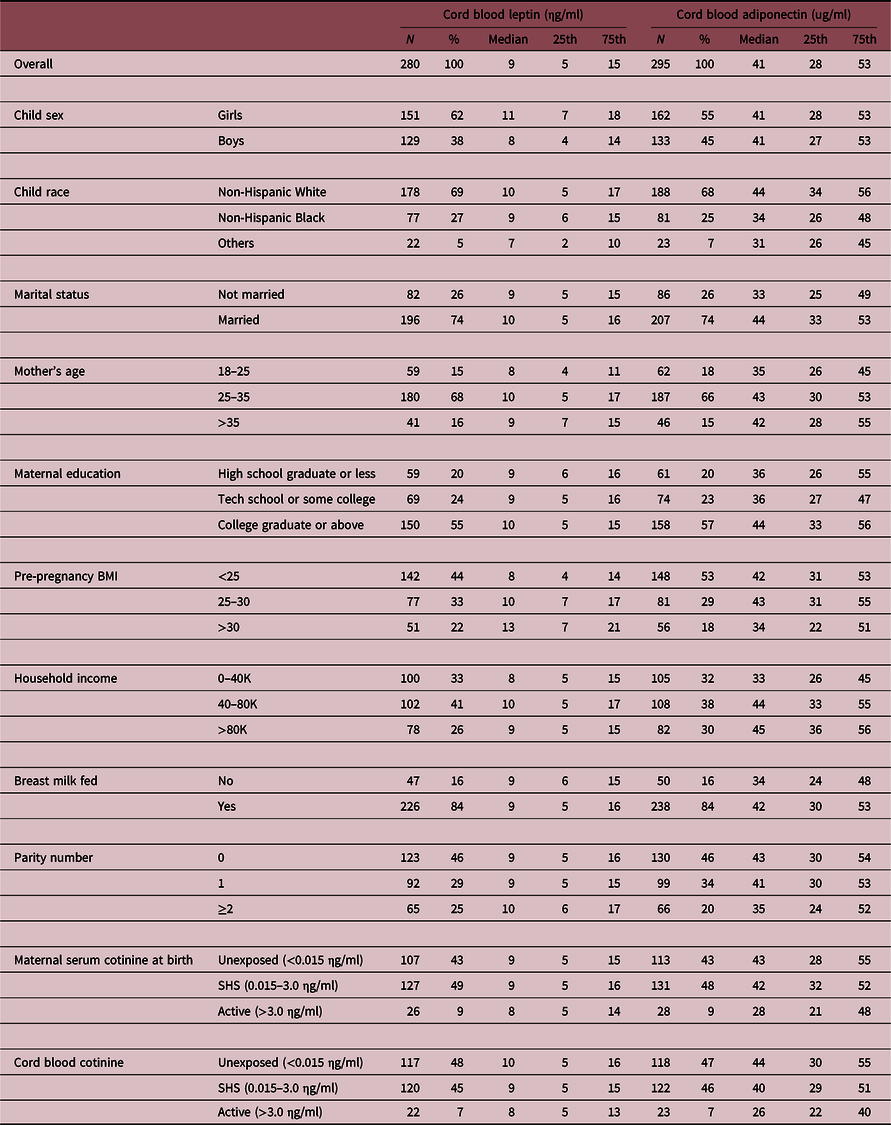
In the HOME Study, median (25th, 75th) cord blood serum leptin and adiponectin concentrations were 9.1 (5, 15) ηg/ml and 41 (28, 53) µg/ml, respectively (Table 1). Median cord serum leptin concentrations were higher among girls, mothers who were overweight or obese (BMI ≥ 25 kg/m2), and younger mothers (18–25 years). Median cord serum leptin concentrations were higher among non-Hispanic White than non-Hispanic black children. Average cord serum adiponectin concentrations were higher among children who were born to households with income greater than $80,000 per annum, but lower among children born to women who were married or higher parity. Our analytic sample included more non-Hispanic Whites (69% vs. 49%), less non-Hispanic Blacks (27% vs. 44%), more married mothers (74% vs. 54%), and more college graduates (56% vs. 44%) than the full HOME Study sample.
Descriptive statistics of cord serum leptin and adiponectin concentrations in the Health Outcomes and Measures of the Environment (HOME) Study children

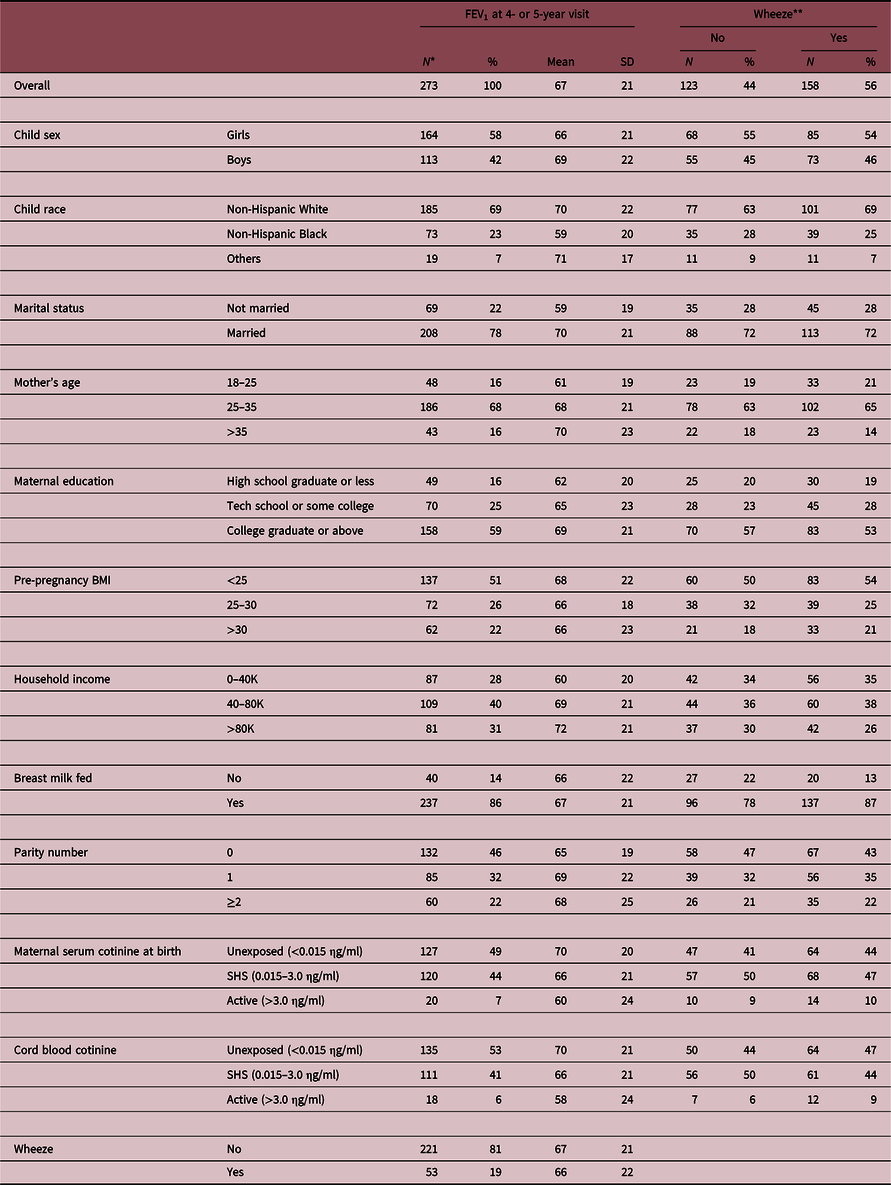
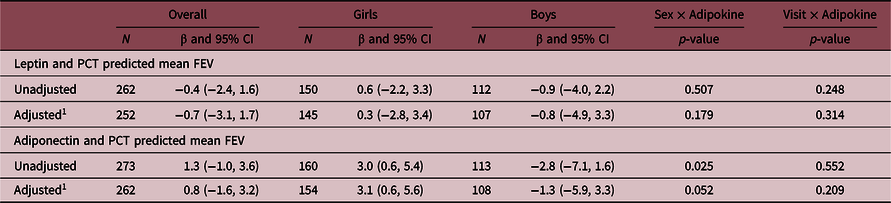
For the %FEV1 analysis, 160 children had 273 repeated spirometry measurements at ages 4 and 5 years. Forty-two percent of the children were males, and 69% were non-Hispanic Whites (Table 2), and 96% of children were born in urban or suburban areas. After adjusting for covariates, cord serum leptin was not associated with children’s %FEV1 (Table 3). The associations between leptin and %FEV1 did not differ by sex or by visit for %FEV1 measurements. Cord serum adiponectin was positively associated with %FEV1 among all children, but the 95% CI of the point estimate included the null value. The associations between adiponectin and %FEV1 did not differ by visit, but differed by child sex, where adiponectin concentrations were positively associated with %FEV1 among girls (β = 3.1, 95% CI: 0.6, 5.6), but not boys (β = −1.3, CI: −5.9, 3.3) (sex × adiponectin interaction p-value = 0.05) (Table 3). We observed linear associations of cord serum leptin and adiponectin with %FEV1 (P-value for non-linearity = 0.66 and 0.95, respectively.
Descriptive statistics of forced expiratory volume (FEV1) and wheeze in the Health Outcomes and Measures of the Environment (HOME) Study Children

* N for FEV1 at 4- or 5-year visit is number of repeats.
** Wheeze for any one of the visits (every 6 months for the first 5 years, and at 6 and 8 years of age).
Unadjusted and adjusted difference in the children’s calculated percent predicted forced expiratory volume (FEV) at ages 4 and 5, per log2-transformed increase in cord serum leptin or adiponectin concentrations, stratified by child sexa

aAdjusted model: we adjusted for neonatal birthweight percentile (<10%, 10%–90%, > 90%), gestational age (term or pre-term), maternal education (high school graduate or less, tech school or some college, college graduate or above), pre-pregnancy BMI (<25, 25–30, ≥30 kg/m2), parity (0, 1, ≥2), child’s sex (male, female), mother’s race (non-Hispanic White, non-Hispanic Black, others), and birth serum cotinine concentrations (<0.015, 0.015–0.3, >0.3 ηg/ml). N = no. of repeats. We considered p-values for interaction terms < 0.20 as an indication that the association varied by visit or by sex.
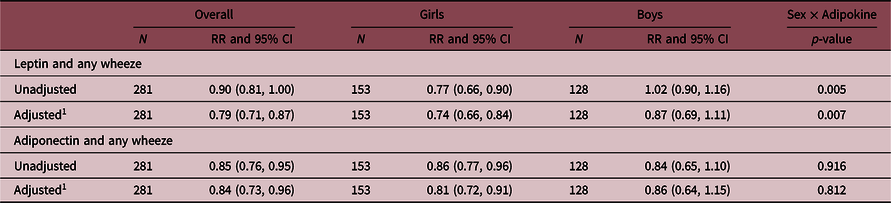
A total of 281 children had 2317 repeated measurements of wheeze every 6 months for the first 5 years, and at 6 and 8 years of age. Supplemental Table 2 describes the risk of wheeze for each of the 12 visits. Forty-three percent of the children were males, 70% were non-Hispanic Whites (Table 2), and 97% of children were born in urban or suburban areas. After adjusting for covariates, higher cord serum leptin was associated with lower risk of wheeze among all children (RR: 0.79; 95% CI: 0.71, 0.87) (Table 4), but the association was stronger in girls (RR = 0.74, CI: 0.66, 0.84) than boys (RR = 0.87, CI: 0.69, 1.11) (sex × leptin interaction p-value = 0.01) (Table 4). Cord serum adiponectin was associated with lower risk of wheeze in children (RR = 0.84, CI: 0.73, 0.96) (Table 3). Child sex did not modify this association (sex × adiponectin interaction p-value = 0.812). We observed linear associations of both cord serum leptin and adiponectin with RR for wheeze (P-values for non-linearity = 0.37 and 0.94, respectively).
Unadjusted and adjusted difference in the children’s relative risks for wheeze every 6 months from birth to age 5 years, then at ages 6 and 8 years, per log2-transformed increase in cord serum leptin or adiponectin concentrations, stratified by child sexa

aAdjusted model: we adjusted for neonatal birthweight percentile (<10%, 10%–90%, > 90%), gestational age (term or pre-term), maternal education (high school graduate or less, tech school or some college, college graduate or above), pre-pregnancy BMI (<25, 25–30, ≥30 kg/m2), parity (0, 1, ≥2), child’s sex (male, female), mother’s race (non-Hispanic White, non-Hispanic Black, others), and birth serum cotinine concentrations (<0.015, 0.015–0.3, >0.3 ηg/ml). We considered p-values for interaction terms < 0.20 as an indication that the association varied by sex.
Additional adjustments for maternal asthma, maternal allergies, paternal asthma, paternal allergies, pet ownership, child serum cotinine, and living community at birth did not substantially alter the associations between cord blood leptin and %FEV (Supplemental Table 1), and risks for wheeze (Supplemental Table 3). Similar results were observed for the associations between cord blood adiponectin and %FEV (Supplemental Table 1), and risks for wheeze (Supplemental Table 3) except for child serum cotinine adjustment. Adjusting for child cotinine concentrations attenuated the association between cord serum adiponectin and %FEV in girls (Supplemental Table 1), but did not alter the relationship between cord blood adiponectin and the risks for wheeze (Supplemental Table 3).
Discussion
We investigated the associations of cord blood serum adipocytokine concentrations with school-aged children’s respiratory function and risk of wheeze in the HOME Study. Leptin concentrations were not associated with %FEV1 in children, but higher leptin concentrations were associated with lower risk of wheeze in girls. In both boys and girls, higher adiponectin concentrations were associated with lower risk of wheeze and suggestively associated with higher %FEV1. However, the positive association between adiponectin and %FEV1 was stronger in girls compared to boys.
Our results differ from a prior study of German mother–child pairs that reported no associations of adiponectin and leptin concentrations in cord serum with risk of asthma or obstructive bronchitis among mothers who had no history of atopy. Reference Rothenbacher, Weyermann, Fantuzzi and Brenner21 These discrepancies may be due to the differences in the characteristics of the study populations (90% German; 28.9% of mother with pre-pregnancy BMI of 25 or higher), the age children were examined (within first 2 years of life) and the assessments of outcomes. The newborns in the HOME Study also had modestly higher concentrations of both cord serum leptin (9.1 vs. 7.9 ηg/ml) and adiponectin (41.2 vs. 30.2 µg/ml) concentrations than children in the German cohort.
Our results suggest that cord serum leptin is associated with lower risk of wheeze in children. Leptin, an adipocytokine produced by both the adipose tissue and the placental trophoblast, is involved in fetal lung development and in pulmonary surfactant secretion. Reference Henson and Castracane9 Pulmonary surfactant is a complex mixture of specific lipids, proteins, and carbohydrates, which is produced in the lungs by type II alveolar epithelial cells and is critical to support gas exchange in the lung alveoli. Reference Chakraborty and Kotecha42 Premature infants are at risk for developing respiratory distress syndrome at birth in part due to surfactant deficiency. Reference Chakraborty and Kotecha42 Fetal lung lipofibroblasts produce fibroblast pneumonocyte factor, a 10,000–20,000 molecular weight peptide that stimulates surfactant phospholipid synthesis by fetal type II cells. Reference Torday, Sun, Wang, Torres, Sunday and Rubin15 Leptin and its receptor are expressed by both fetal lung fibroblasts and type II cells in vivo. Leptin secreted by lung lipofibroblasts supports type II cell maturation and is critical for stimulating type II cell surfactant phospholipid synthesis via a paracrine signaling loop in rats. Reference Torday, Sun, Wang, Torres, Sunday and Rubin15 Furthermore, fetal rat lung explants treated with 1 ηg/ml leptin had enhanced surfactant protein B production. Reference Kirwin, Bhandari and Dimatteo12
Fetal cord blood leptin level rises rapidly after 34 weeks gestation in human fetus, Reference Stoll-Becker, Kreuder, Reiss, Etspuler, Blum and Gortner43 and the rapid increase in fetal surfactant production coincides with the rise in cord blood leptin. Reference Shekhawat, Garland and Shivpuri10 In fetal baboons, the expression of leptin receptors on type II epithelial cells upregulates during late gestation and was associated with increase in surfactant production. Reference Henson, Swan, Edwards, Hoyle, Purcell and Castracane44 Furthermore, exposing ovine fetuses during late gestation to exogenous leptin for 5 days increased serum leptin by 4.2 ηg/ml, which in turn promoted surfactant production and certain aspects of lung maturation including the reduction in alveolar wall thickness (critical for optimizing gas exchange by reducing alveolar diffusion distance), the density of secondary septal crests, and elastin content in alveolar walls, Reference De Blasio, Boije and Kempster13 but did not alter static lung compliance, maximal lung volume, lung compartment volumes, or alveolar surface area. Reference De Blasio, Boije and Kempster13 These prior results suggest that fetal leptin within the range of concentrations observed in this study (0.15–94.53 ηg/ml) may be associated with lower risk for wheeze in childhood, but may not be related to lung function.
Since cord blood leptin has been shown to positively associated with both birth weight and gestation age, Reference Stoll-Becker, Kreuder, Reiss, Etspuler, Blum and Gortner43 we speculate that the association between fetal leptin and respiratory outcomes may be a confounding factor of the association between birth weight and gestation age with respiratory outcome. However, the association between cord serum leptin and risk of wheeze remained similar when adjusting for both birth weight and gestational age, suggesting that cord blood leptin may be an independent risk factor for wheeze.
There is much less known about the mechanism by which adiponectin is involved in fetal lung development. In contrast to leptin, adiponectin is not produced by the placenta. Reference Gauda and Master16 Cord blood adiponectin concentrations increase 20-fold between 24 weeks and term gestation, Reference Kajantie, Hytinantti, Hovi and Andersson45 and do not follow the same trajectory during late gestation as cord blood leptin, suggesting that fetal adiponectin may have a differential impact on fetal lung development than fetal leptin. In mice, adiponectin is present in bronchoalveolar lavage fluid. Reference Summer, Little and Ouchi17 Genetically induced adiponectin deficiency from conception led to the development of emphysema-like phenotype, dilated airspace, and increased lung proinflammatory cytokines and matrix metalloproteinases expression, Reference Summer, Little and Ouchi17 suggesting that fetal adiponectin may play a critical role in the development of lung structure that can directly impact on lung function later in life. Furthermore, genetically induced adiponectin deficiency was shown exacerbate lipopolysaccharide-induced lung injuries through exaggerated inflammatory response in pulmonary vascular endothelium. Reference Konter, Parker and Baez18 In contrast, bovine lung endothelial cells treated with adiponectin (0.05–1.0 µg/ml) ameliorated hyperoxia-induced oxidative stress, Reference Sliman, Patel and Cruff19 and genetically induced overexpression of adiponectin that led to a 70 ηg/ml increase in bronchoalveolar lavage fluid adiponectin protected mice from hyperoxic-induced lung injuries and inflammation. Reference Sliman, Patel and Cruff19 Adiponectin has antioxidant and anti-inflammatory properties, Reference Fantuzzi6 and systemic inflammation has been shown to be inversely associated with lung function in humans. Reference Hancox, Gray, Sears and Poulton46–Reference Hart, Goldstein and Walia48 These previous work supports our findings that increasing cord blood adiponectin within the range of concentrations observed in this study (2.15–142.57 µg/ml) may be associated with increased lung function in early childhood. Furthermore, these prior findings also supported our observation that adjustment with child serum cotinine as a marker for secondhand smoke exposure attenuated the positive association between cord serum adiponectin and %FEV in girls, because secondhand smoke is associated with lung inflammation and function. Reference Birru and Di49,Reference Bhat, Kalathil and Bogner50
Adjusting for the averaged child secondhand smoke exposure from 1 to 4 years of age attenuated the association between cord blood adiponectin and %FEV, but not between cord blood adiponectin and the risk for wheeze. One plausible explanation is that differential mechanisms are involved in the associations between cord blood adiponectin, lung function, and risk for wheeze in early childhood. In addition, it is also possible that this may be in part due to potential selection bias in the HOME Study participants with %FEV measurements (N = 160) as compared to participants with risk for wheeze data (N = 281). Children with %FEV measurements were less exposed to secondhand smoke than the children with risk for wheeze data (53% vs. 44% unexposed, respectively; Table 2).
We observed sex-specific associations between cord serum adiponectin and %FEV1, as well as cord serum leptin and wheeze. It is plausible that there exists a sex dimorphism in fetal adipocytokine concentrations throughout the gestational period, where the increase in fetal adiponectin and leptin might occur sooner in girls than in boys, thus leading to differential associations with lung function later in life. Our sex-specific associations between cord serum adipocytokine and risk of wheeze provide a potential reason for the sex-specific risks of childhood wheeze that have been observed in published work, Reference Tse, Coull, Sordillo, Datta and Gold51,Reference Mandhane, Greene, Cowan, Taylor and Sears52 where boys more often developed childhood wheeze than girls.
Most of our participants were born in urban or suburban areas and most are non-Hispanic Whites, which may limit the generalizability of our findings. One of the limitations of our study is that this is a secondary analysis of an existing study with relatively small sample size, thus the analysis may be underpowered to detect small effect sizes. Another limitation of our study is that we only measured adipocytokine concentrations at birth. Since there are changes in adipocytokine concentrations and lung development during the pre- and postnatal periods, future studies should consider examining trajectories of adipocytokine concentrations from prenatal to childhood in relation to children’s lung function and related outcomes. Nevertheless, cord blood adipocytokines of term neonates can differ significantly from maternal serum, Reference Gauda and Master16,Reference Zhang, Lu, Huang, Jiao, Huang and Mao53 thus it is critical to define fetal adipocytokine exposure based on cord blood concentrations to investigate whether fetal adipocytokines may contribute to lung function and the risks for lung diseases later in life.
In summary, these results may provide insights into the potential impacts of fetal leptin and adiponectin exposure on lung development and function in early childhood. Cord blood leptin concentrations were associated with reduced risk of wheeze in girls. Cord serum adiponectin concentrations were associated with reduced risk of wheeze in both boys and girls, and possibly greater lung function, as measured by %FEV1. Future studies should confirm these findings, and laboratory or molecular epidemiology studies are needed to explore the underlying biological mechanisms. If our findings are confirmed, there is a potential to improve children’s respiratory function and reduce their risk for wheeze by intervening on potential modifiable factors of adiponectin and leptin concentrations, including maternal diet. Reference Ma, Lu and Ouyang54,Reference England, Jain, Holbrook, Schrader, Qualls and Mozurkewich55
Supplementary materials
For supplementary material for this article, please visit https://doi.org/10.1017/S2040174420000951
Financial Support
This work was supported by NIEHS grants P01 ES011261, R01 ES024381, R01 ES025214, R01 ES020349, and R01 ES014575.
Conflicts of Interest
Dr. Braun was financially compensated for serving as an expert witness for plaintiffs in litigation related to tobacco smoke exposures and received an honoraria for serving on an advisory board to Quest Diagnostics. Dr. Braun served as an expert witness in litigation related to perfluorooctanonic acid contamination in drinking water in New Hampshire. Any funds I receive from this arrangement were/are paid to Brown University and cannot be used for my direct benefit (e.g., salary/fringe, travel, etc.).
The rest of the authors declare no competing financial interest.
Ethical standards
All women in the Health Outcomes and Measures of the Environment Study provided written informed consent for themselves and their children after the study protocols had been explained. The institutional review boards (IRBs) of Cincinnati Children’s Hospital Medical Center and the cooperating delivery hospitals approved this study. The CDC IRB relied on the determinations made by the other IRBs.