Introduction
Interest in motivation to change in the context of eating disorders has grown strongly during the past two decades (Waller, Reference Waller2012). A large body of research supports the importance of a high motivation to change for several desirable clinical indices such as treatment engagement, treatment continuation, and decreases in eating pathology (e.g. Rieger et al. Reference Rieger, Touyz and Beumont2002; Martínez et al. Reference Martínez, Castro, Bigorra, Morer, Calvo, Vila, Toro and Rieger2007; Wade et al. Reference Wade, Frayne, Edwards, Robertson and Gilchrist2009; Castro-Fornieles et al. Reference Castro-Fornieles, Bigorra, Martinez-Mallen, Gonzalez, Moreno, Font and Toro2011). More specifically, motivation to change has been demonstrated to mediate the relationship between eating disorder symptomatology and treatment outcome (Bewell & Carter, Reference Bewell and Carter2008), and a low motivation to change has been shown to be a predictor of relapse (Ametller et al. Reference Ametller, Castro, Serrano, Martínez and Toro2005; Richard et al. Reference Richard, Bauer and Kordy2005).
At the same time, high drop-out rates and lack of engagement are major problems in the treatment of anorexia nervosa (AN) and bulimia nervosa (BN) (Bandini et al. Reference Bandini, Antonelli, Moretti, Pampanelli, Quartesan and Perriello2006; DeJong et al. Reference DeJong, Broadbent and Schmidt2012). These problems have been attributed to an extreme ambivalence towards change, with patients often acknowledging the disadvantages of their illness while simultaneously perceiving the disorder as fulfilling important psychological functions (Serpell & Treasure, Reference Serpell and Treasure2002; Schmidt & Treasure, Reference Schmidt and Treasure2006). Consequently, a generally low motivation to change in patients with an eating disorder has been extensively documented in the literature (e.g. Casasnovas et al. Reference Casasnovas, Fernández-Aranda, Granero, Krug, Jiménez-Murcia, Bulik and Vallejo-Ruiloba2007). Research also indicates disorder-specific differences, with patients suffering from AN showing fewer improvements in motivation over the course of treatment (Geller et al. Reference Geller, Zaitsoff and Srikameswaran2005) or being less motivated for change (Blake et al. Reference Blake, Turnbull and Treasure1997) than individuals with BN.
A noteworthy limitation of the research conducted to date is that motivation to change was often measured by a total global score rather than assessed according to each distinct symptom domain. Because of the complexity of eating disorders with respect to behavior, cognition, emotion, and the consequences of the illness, it would be misleading to suggest that eating disorder patients experience low motivation to change across all facets of their condition (Rieger et al. Reference Rieger, Touyz, Schotte, Beaumont, Russel, Clarke, Kohn and Griffiths2000; Rieger & Touyz, Reference Rieger and Touyz2006). For example, motivation to change binge eating has been shown to be uniformly high whereas motivation to change food restriction is considerably lower (Perkins et al. Reference Perkins, Schmidt, Eisler, Treasure, Berelowitz, Dodge, Frost, Jenkins, Johnson-Sabine, Keville, Murphy, Robinson, Winn and Yi2007; Geller et al. Reference Geller, Brown, Zaitsoff, Menna, Bates and Dunn2008). Thus, it would be inappropriate to allocate individuals to a single global stage of change as described in the transtheoretical model of change (TTM; Prochaska & DiClemente, Reference Prochaska, DiClemente, Hersen, Eisler and Miller1992), which defines six different levels of involvement in the change process (i.e. precontemplation, contemplation, preparation, action, maintenance, and termination). Instead, a symptom-specific measurement of motivation is required (Dunn et al. Reference Dunn, Neighbors and Larimer2003) that assigns a stage of change for each specific symptom domain of the eating disorder.
Because of the low motivation to change core eating disorder symptoms (such as dietary restriction, inappropriate weight control behaviors, and weight) and the relationship between higher motivation and more positive treatment outcome indices, several authors stress the importance of therapeutic interventions to enhance eating-disordered patients' motivation to change (e.g. Geller & Dunn, Reference Geller and Dunn2011). These include motivational interviewing (MI; Miller & Rollnick, Reference Miller and Rollnick2002) or adaptations thereof, such as motivational enhancement therapy (MET; Miller et al. Reference Miller, Zweben, DiClemente and Rychtarik1992). In the field of eating disorders, preliminary research on MI and MET has revealed promising results (Macdonald et al. Reference Macdonald, Hibbs, Corfield and Treasure2012), with an increase in motivation to change, a decrease in symptom severity, and greater treatment retention compared to control groups (Dunn et al. Reference Dunn, Neighbors and Larimer2006; Allen et al. Reference Allen, Fursland, Raykos, Steele, Watson and Byrne2012). However, in other studies MET was not found to be significantly better than various comparison conditions, as both the MET and comparison groups improved (Treasure et al. Reference Treasure, Katzman, Schmidt, Troop, Todd and de Silva1999; Dean et al. Reference Dean, Touyz, Rieger and Thornton2008; Wade et al. Reference Wade, Frayne, Edwards, Robertson and Gilchrist2009; Katzman et al. Reference Katzman, Bara-Carril, Rabe-Hesketh, Schmidt, Troop and Treasure2010; Geller et al. Reference Geller, Brown and Srikameswaran2011). At least some of these non-significant findings may have been due to methodological problems (Dray & Wade, Reference Dray and Wade2012), such as the higher proportion of patients undergoing cognitive-behavior therapy (CBT) compared to MET patients (18.4% v. 2.3%) in the action stage of change at pretreatment in the study by Treasure et al. (Reference Treasure, Katzman, Schmidt, Troop, Todd and de Silva1999), with action scores predicting a better outcome. Furthermore, as motivation to change was measured in a global manner in several of these studies, changes in specific symptom domains may have remained undetected.
In each of these studies, the interventions to enhance motivation to change were administered in a face-to-face setting. However, to reach a generally poorly motivated clientele, other formats, characterized by greater anonymity and ease of access compared to face-to-face settings, are warranted. Internet-based interventions afford these advantages (Andersson & Carlbring, Reference Andersson and Carlbring2003; Wesemann & Grunwald, Reference Wesemann and Grunwald2008). Although early interventions improve outcome (Reas et al. Reference Reas, Williamson, Martin and Zucker2000), the number of individuals with eating disorders who access evidence-based treatments is comparatively low (Hoek & van Hoeken, Reference Hoek and van Hoeken2003). In addition to ambivalence regarding change, barriers to help-seeking include a fear of stigma and a sense of shame regarding the illness (Becker et al. Reference Becker, Arrindell, Perloe, Fay and Striegel-Moore2010; Evans et al. Reference Evans, Hay, Mond, Paxton, Quirk, Rodgers, Jhajj and Sawoniewska2011). Also relevant to treatment-seeking is the fact that AN and BN usually manifest during adolescence (Keski-Rahkonen et al. Reference Keski-Rahkonen, Hoek, Susser, Linna, Sihvola, Raevuori, Bulik, Kaprio and Rissanen2007, Reference Keski-Rahkonen, Hoek, Linna, Raevuori, Sihvola, Bulik, Rissanen and Kaprio2009). As almost all young adults use the internet regularly (van Eimeren & Frees, Reference van Eimeren and Frees2011) and web-delivered interventions show the greatest effects in this age group (Barak et al. Reference Barak, Hen, Boniel-Nissim and Shapira2008), low-threshold online interventions may be best placed to bridge this gap in help-seeking.
Several internet-based interventions have been developed for people suffering from an eating disorder or for their carers (Grover et al. Reference Grover, Naumann, Mohammad-Dar, Glennon, Ringwood, Eisler, Williams, Treasure and Schmidt2011; Gulec et al. Reference Gulec, Moessner, Mezei, Kohls, Túry and Bauer2011; Sánchez-Ortiz et al. Reference Sánchez-Ortiz, Munro, Stahl, House, Startup, Treasure, Williams and Schmidt2011; Ruwaard et al. Reference Ruwaard, Lange, Broeksteeg, Renteria-Agirre, Schrieken, Dolan and Emmelkamp2013), with promising preliminary results in terms of achieving good outcomes. With regard to enhancement of motivation to change, to date only one uncontrolled study has investigated an online-delivered self-help program in eating disorders (Leung et al. Reference Leung, Ma and Russell2013). Although the study by Leung et al. (Reference Leung, Ma and Russell2013) provides initial support for the positive effects of internet-based interventions aimed at enhancing motivation to change, the causality remains unclear because of the lack of a control group.
As yet, no randomized controlled trial has evaluated the efficacy of an internet-delivered intervention of a motivational enhancement program in an eating-disordered population. Thus, the aim of the present study was to investigate the effectiveness of an online MET intervention in a randomized controlled parallel-group design with a waiting-list control condition. The primary hypothesis was that the online intervention ‘ESS-KIMO’ [‘Klärendes Internetprogramm zur Steigerung der Veränderungsmotivation bei Essstörungen’ (Internet program to clarify and enhance motivation to change in eating disorders)] would result in significantly greater improvements in motivation to change from pre- to post-treatment than the waiting-list condition. The secondary hypothesis was that ESS-KIMO would also reduce eating disorder pathology and increase self-esteem to a significantly greater degree compared to the control condition.
Method
Participants
Ethical approval for the study was obtained from the ethics committee of the German Psychological Society (Deutsche Gesellschaft für Psychologie, DGPs). An a priori power analysis indicated that a sample size of 68 participants would be sufficient to provide 80% power at α = 0.05 to detect small-sized differences between groups (Faul et al. Reference Faul, Erdfelder, Lang and Buchner2007). On the basis of research on drop-out rates from internet treatment (Christensen et al. Reference Christensen, Griffiths and Farrer2009), a completer rate of 50% was expected. For this reason, a minimum of 136 participants was needed to reach the targeted sample size.
Participants were recruited through media announcements including radio, newspaper, magazines, social networks, or other websites between March 2011 and March 2012. Applicants obtained study information on the ESS-KIMO website and were informed that they could withdraw from the study at any time. Participants who provided their consent were asked to complete several screening questionnaires online.
Inclusion and exclusion criteria
Females aged between 18 and 50 years who reported symptoms of AN or BN, such as dieting or compensatory behavior, were included in the program. Furthermore, eligible participants were required to have a body mass index (BMI) between 15 and 30 kg/m2.
The exclusion criteria consisted of an absence of compensatory or restrained eating behavior (i.e. no purging, dieting or exercising) and concurrent psychotherapy. Further exclusion criteria were severe depression, engagement in self-injurious behavior during the past year, lifetime intention to commit suicide, current psychotic symptoms, dissociation, and alcohol or substance abuse.
Screening measures
Biographical Information Questionnaire (BIQ; Lange et al. Reference Lange, Schrieken, van de Ven, Bredeweg, Emmelkamp, van der Kolk, Lydsdottir, Massaro and Reuvers2000b)
Demographic information was assessed with the BIQ and included the participants' age, gender, information about current or previous psychological treatment, marital status, housing situation, educational level, and experience with the internet and computers.
Short Evaluation of Eating Disorders (SEED; Bauer et al. Reference Bauer, Winn, Schmidt and Kordy2005)
Eating disorder symptomatology was screened with the SEED, which consists of five items assessing body weight and height to calculate BMI, fear of gaining weight, body evaluation, compensatory behaviors, and binge eating. Good convergent and criterion-related validity, and sensitivity to change, have been demonstrated for the SEED, which has shown moderate correlations with the Eating Disorder Inventory (EDI; Garner et al. Reference Garner, Olmstead and Polivy1983).
Center for Epidemiologic Studies Depression Scale (CES-D; Radloff, Reference Radloff1977)
This 20-item questionnaire was used to assess the level of depression. Good internal consistency for the CES-D has been reported for clinical samples (Cronbach's α = 0.90). Potential participants were excluded if their score met or was above the cut-off score of 35. Self-injurious behavior and risk of suicide were assessed by three additional items: lifetime self-injury, self-injury during the past year, and lifetime intention to commit suicide.
Somatoform Dissociation Questionnaire (SDQ-5; Nijenhuis et al. Reference Nijenhuis, Spinhoven, van Dyck, van der Hart and Vanderlinden1997)
Dissociative symptoms were assessed using this five-item questionnaire. The internal consistency of the SDQ-5 is good (Cronbach's α = 0.80). Potential participants were excluded if they met or scored above the cut-off score of 8.
Dutch Screening Device for Psychotic Disorder (SDPD; Lange et al. Reference Lange, Schrieken, Blankers, van de Ven and Slot2000a)
The risk of psychosis was indexed using the seven-item SDPD. The SDPD has a high internal consistency (Cronbach's α = 0.82) and is a valid predictor of psychotic episodes. Potential participants were excluded if they met or scored above the cut-off for the Dutch norm group of 13.
Alcohol Use Disorders Identification Test (AUDIT; Babor et al. Reference Babor, Higgins-Biddle, Saunders and Monteiro2001)
The German version of the AUDIT (Rumpf et al. Reference Rumpf, Meyer, Hapke, John, Glöckner-Rist and Rist2010) was used as a screening tool for alcohol abuse. The AUDIT consists of 10 items and support has been found for its psychometric properties, including Cronbach's α ranging from 0.75 to 0.94 (Skipsey et al. Reference Skipsey, Burleson and Kranzler1997; Karno et al. Reference Karno, Granholm and Lin2000; Rumpf et al. Reference Rumpf, Hapke, Meyer and John2002). The present study used a slightly higher cut-off, with a value of 10, than the standard cut-off of 8 (Reinert & Allen, Reference Reinert and Allen2007), as too many potential participants would otherwise have been excluded.
Drug Use Disorders Identification Test (DUDIT; Berman et al. Reference Berman, Bergman, Palmstierna and Schlyter2005)
Substance abuse was screened using the DUDIT, which comprises 11 items. The instrument has good internal consistency, with Cronbach's α = 0.80. Potential participants were excluded if they scored at or above the cut-off of 10.
Outcome measures
Stages of Change Questionnaire for Eating Disorders (SOCQ-ED; Rieger et al. Reference Rieger, Touyz and Beumont2002; Ackard et al. Reference Ackard, Croll, Richter, Adlis and Wonderlich2009)
Motivation to change as the primary outcome variable was measured with the German version of the SOCQ-ED (von Brachel et al. Reference von Brachel, Hötzel, Schloßmacher, Hechler, Kosfelder, Rieger, Rueddel, Braks, Huber and Vocks2012). The SOCQ-ED assigns a stage of change for each symptom domain of the eating disorder. It comprises 13 items measuring motivation to change: (1) the importance attributed to body shape and weight, (2) the fear of becoming fat, (3) the avoidance of certain foods, (4) food and weight preoccupations, (5) feelings associated with food intake and avoidance, (6) weight gain in problematic areas, (7) weight gain in general, (8) binge eating, (9) loss of control while eating, (10) dieting, (11) excessive exercise, and (12) purging. The final item assesses (13) motivation to commence treatment for the eating disorder. For each item, the respondent is required to select among seven different response options; six for the possible stage of change according to the TTM (i.e. precontemplation, contemplation, preparation, action, maintenance, and termination) and one for the possibility to exclude an irrelevant symptom domain. The SOCQ-ED can be applied to patients with AN, BN, and eating disorders not otherwise specified (EDNOS). Support has been found for the psychometric properties of this instrument, including Cronbach's α = 0.75 and a 6-week test–retest reliability of r tt = 0.42–0.78, and correlations with the Eating Disorder Examination Questionnaire (EDE-Q; Fairburn & Beglin, Reference Fairburn and Beglin1994; Hilbert & Tuschen-Caffier, Reference Hilbert and Tuschen-Caffier2006; Fairburn, Reference Fairburn2008) are low to moderate (r = −0.21 to −0.33) (von Brachel et al. Reference von Brachel, Hötzel, Schloßmacher, Hechler, Kosfelder, Rieger, Rueddel, Braks, Huber and Vocks2012).
Pros and Cons of Eating Disorders Scale (P-CED; Gale et al. Reference Gale, Holliday, Troop, Serpell and Treasure2006)
The German version of the P-CED (von Brachel et al. Reference von Brachel, Hötzel, Dörries, Striegler, Braks, Huber and Vocks2011) is a 67-item decisional balance scale that was administered to assess the perceived benefits and burdens of change. Eight subscales assess the perceived advantages of eating disorder symptoms (‘Safe/Structured’, ‘Appearance’, ‘Fertility/Sexuality’, ‘Fitness’, ‘Communicate emotions/distress’, ‘Special/Skill’, ‘Boredom’, ‘Eat but stay slim’), which are summed to yield a ‘Pro’ score. Six subscales index the perceived disadvantages (‘Trapped’, ‘Guilt’, ‘Hatred’, ‘Stifles Emotions’, ‘Negative self-image’, ‘Weight and shape’), which are summed to form a ‘Contra’ score. Items are assessed on a five-point scale ranging from 1 = ‘strongly agree’ to 5 = ‘strongly disagree’. Psychometric properties of the Pros and Cons of Anorexia Nervosa Scale (P-CAN), a slightly modified version of the P-CED that was designed for patients with AN only, are acceptable, with Cronbach's α = 0.68–0.89 and a test–retest reliability of r tt = 0.60–0.85 (Serpell et al. Reference Serpell, Teasdale, Troop and Treasure2004).
Self-Efficacy Scale (SES; Schwarzer & Jerusalem, Reference Schwarzer, Mueller and Greenglass1999)
Self-efficacy was measured with the 10-item SES, which assesses perceived self-efficacy on a four-point scale ranging from 1 = ‘not at all true’ to 4 = ‘exactly true’. Cronbach's α ranges from 0.76 to 0.90 (Schwarzer et al. Reference Schwarzer, Mueller and Greenglass1999).
Rosenberg Self-Esteem Scale (RSES; Rosenberg, Reference Rosenberg1965)
Self-esteem was measured with the German version of the RSES (von Collani & Herzberg, Reference von Collani and Herzberg2003), which consists of 10 items answered on a four-point scale ranging from 1 = ‘totally disagree’ to 4 = ‘totally agree’. The authors reported internal consistencies of Cronbach's α = 0.72–0.84.
EDE-Q (Fairburn & Beglin, Reference Fairburn and Beglin1994; Fairburn, Reference Fairburn2008)
Eating disorder symptomatology was assessed using the German version of the EDE-Q (Hilbert & Tuschen-Caffier, Reference Hilbert and Tuschen-Caffier2006). The EDE-Q consists of 22 items that yield scores on four subscales (‘Restraint’, ‘Eating Concern’, ‘Weight Concern’, and ‘Shape Concern’) along with a global score. Items are measured on a seven-point scale ranging from 0 = ‘not at all’ to 6 = ‘markedly’. The EDE-Q also asks about some eating disorder core behaviors (e.g. binge eating and purging) and their frequency during the past 28 days. The EDE-Q subscales demonstrate good internal consistency (Cronbach's α = 0.85–0.93) and a 3-month test–retest reliability between r tt = 0.68 and r tt = 0.74 (Hilbert et al. Reference Hilbert, Tuschen-Caffier, Karwautz, Niederhofer and Munsch2007).
Intervention
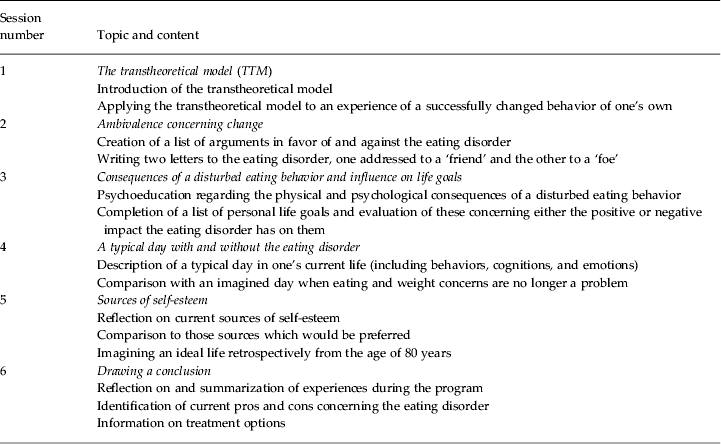
The web-based program ESS-KIMO focuses on enhancing motivation to change based on the TTM (Prochaska & DiClemente, Reference Prochaska, DiClemente, Hersen, Eisler and Miller1992) and uses the principles of MI (Miller & Rollnick, Reference Miller and Rollnick2002). It comprised six weekly online sessions, each lasting approximately 45 min. The intervention is based on treatment components that have been successfully applied to enhance motivation to change in face-to-face settings (Schmidt & Treasure, Reference Schmidt and Treasure1997; Dean et al. Reference Dean, Touyz, Rieger and Thornton2008) and were adapted for internet delivery. Based on the results of previous research (Ritterband et al. Reference Ritterband, Cox, Gordon, Borowitz, Kovatchev, Walker and Sutphen2006; Barak et al. Reference Barak, Hen, Boniel-Nissim and Shapira2008), we used an individualized online intervention in the form of a closed website with screening for inclusion and exclusion criteria, interactive elements and graphical presentations. Each session required participants to complete writing tasks relating to the topic of the current session and to applying this to their own situation. Participants were instructed to weigh the positive ( = benefits) and negative ( = costs) aspects of their eating disorder, to reflect on its different symptoms and to evaluate the associations of the symptoms with each other. The specific contents of the sessions are displayed in Table 1.
Content of the six sessions

All participants received individualized feedback for their written pieces by the first two authors, as this has been shown to improve adherence to and efficacy of online interventions (Schmidt et al. Reference Schmidt, Landau, Pombo-Carril, Bara-Carril, Reid, Murray, Treasure and Katzman2006). Feedback was standardized by predefined text elements that were adapted individually, and its provision including guidance took, on average, 80 min for each participant for the whole program. Different feedback was given for those behaviors, cognitions and emotions associated with pre-action stages of change and those belonging to later stages of change. In particular, in the first session of the program, participants received detailed feedback on the baseline assessment concerning their initial stages of change for the different symptom domains as measured with the SOCQ-ED. Similarly, in the last session they received feedback about their changes on the motivational assessment from pre- to post-test.
As previous research found no difference between synchronous (e.g. a chat session) and asynchronous communication (e.g. by email) (Barak et al. Reference Barak, Hen, Boniel-Nissim and Shapira2008), participants were able to log in for their next session after 1 week and read their individual feedback without the therapists being logged in simultaneously. They were invited to log in via an automatically sent email. If no login was recorded during the next day, up to three reminder emails were sent. Participants assigned to the control group were contacted by email after a waiting period of 8 weeks. The email invited them to answer the post-assessment questionnaires online. After completing the questionnaires, control participants were given access to the intervention.
Procedure
Potential participants who were excluded from the program during screening were provided with information regarding alternative support services. Eligible participants were provided with a username, which could be changed after the first login, and a password to access the website. They were randomly assigned to the intervention group (IG) or a waiting-list control group (CG) based on a computer-generated randomization. Assessments were completed before and after the intervention or the waiting period, respectively. Participants were only able to progress to the next page of the diagnostic battery after they had answered each respective question.
Data analysis
Data were analyzed using SPSS version 20 (IBM, USA). Two-sample t tests and χ 2 tests were performed to compare the IG and CG concerning their drop-out rate, their demographic characteristics, and their scores on the EDE-Q, SOCQ-ED, P-CED, SES, and RSES at baseline. To test for differences between the two groups in the pre–post changes, completer analyses were calculated in the form of two-way analyses of variance (ANOVAs) with the between-subjects factor time (pre- v. post-) and the within-subjects factor group (IG v. CG). Additionally, ANOVAs for intent-to-treat analyses were conducted, applying the baseline-observation-carried-forward (BOCF) method. In the case of significant time × group interactions, post-hoc pairwise comparisons were conducted separately for each of the two groups using a t test (repeated measures). The significance level was set at p < 0.05. To reduce the risk of not rejecting a false hypothesis (Abt, Reference Abt1987), no adjustment for multiple testing was performed.
Results
Participant flow
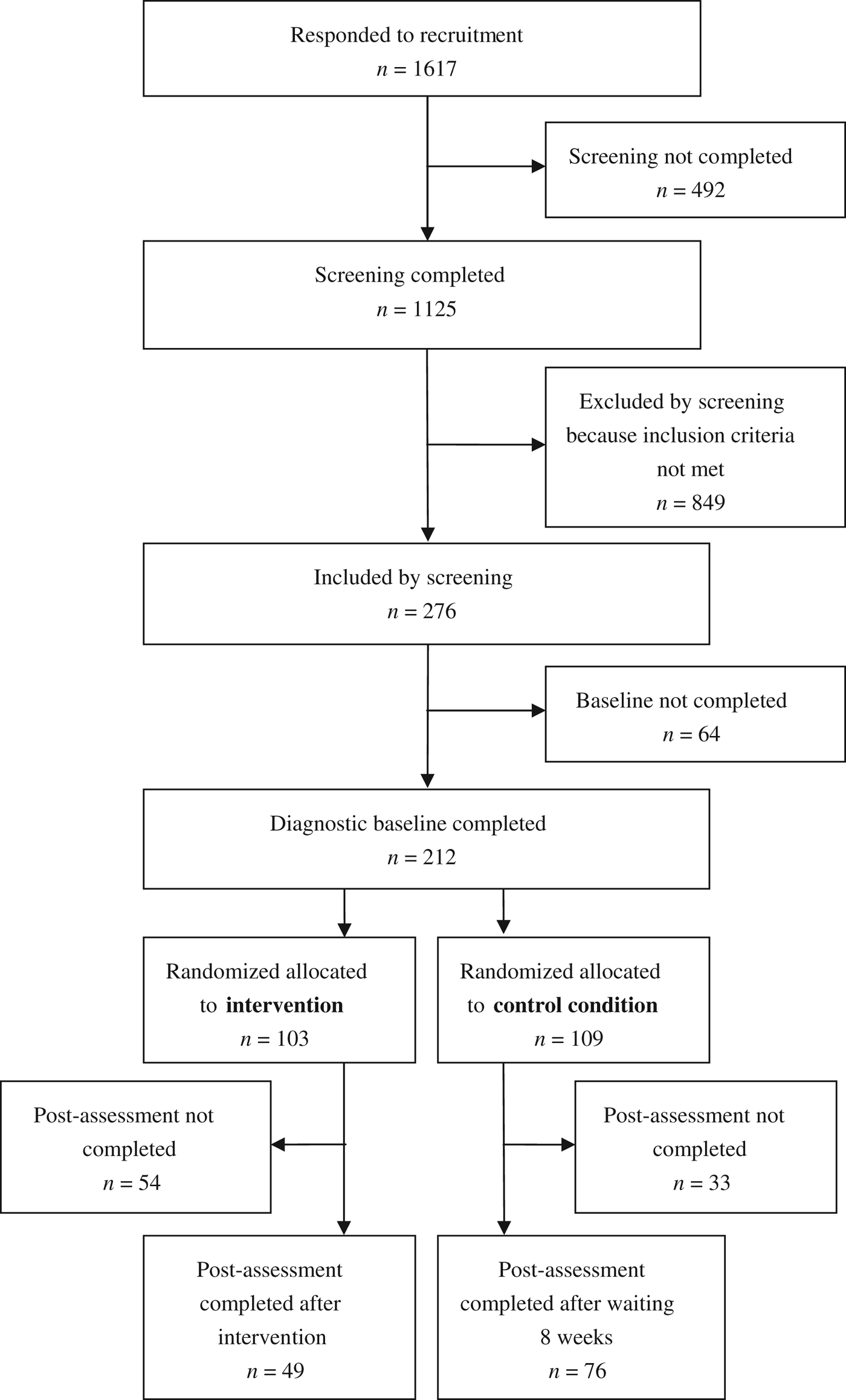
Figure 1 shows the CONSORT diagram (Schulz et al. Reference Schulz, Altman and Moher2010) describing the flow of participants through the trial. The total drop-out rate from baseline to post-assessment was 41% (n = 87 individuals). Of these participants, 54 (52%) were in the IG and 33 (30%) were in the CG. A group comparison indicated that the drop-out rate was significantly higher in the IG than the CG (χ 2 = 10.74, p < 0.001).
CONSORT diagram of participants' flow through the trial.

Baseline demographic and clinical characteristics
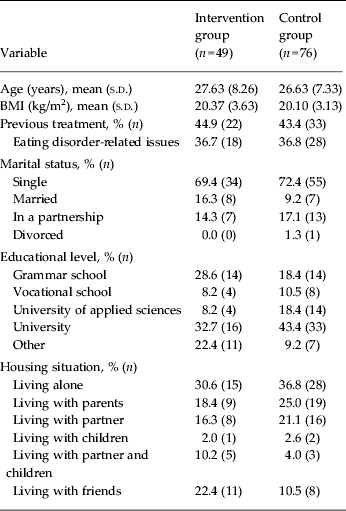
The baseline demographic characteristics of the sample are shown in Table 2 and the questionnaire scores at baseline are displayed in Table 3.
Sample characteristics

BMI, Body mass index; s.d., standard deviation.
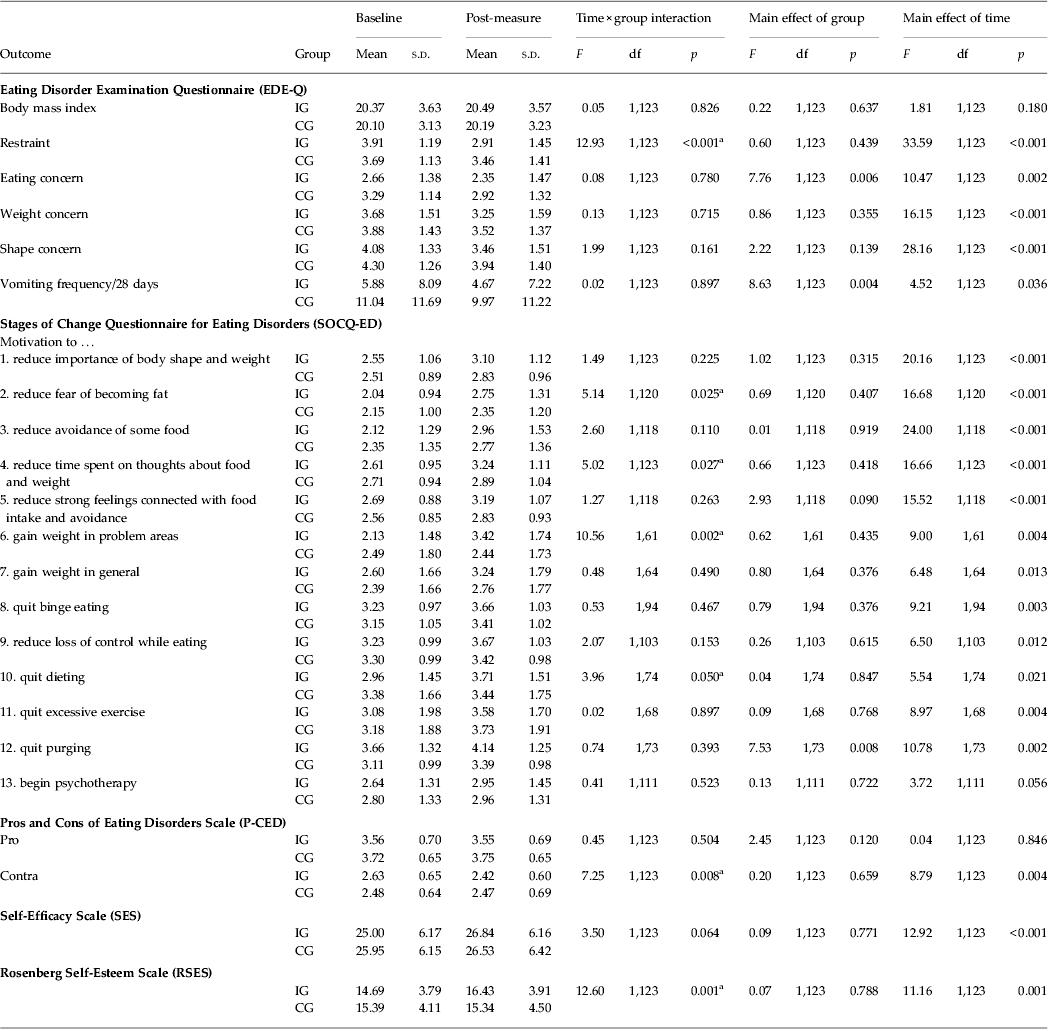
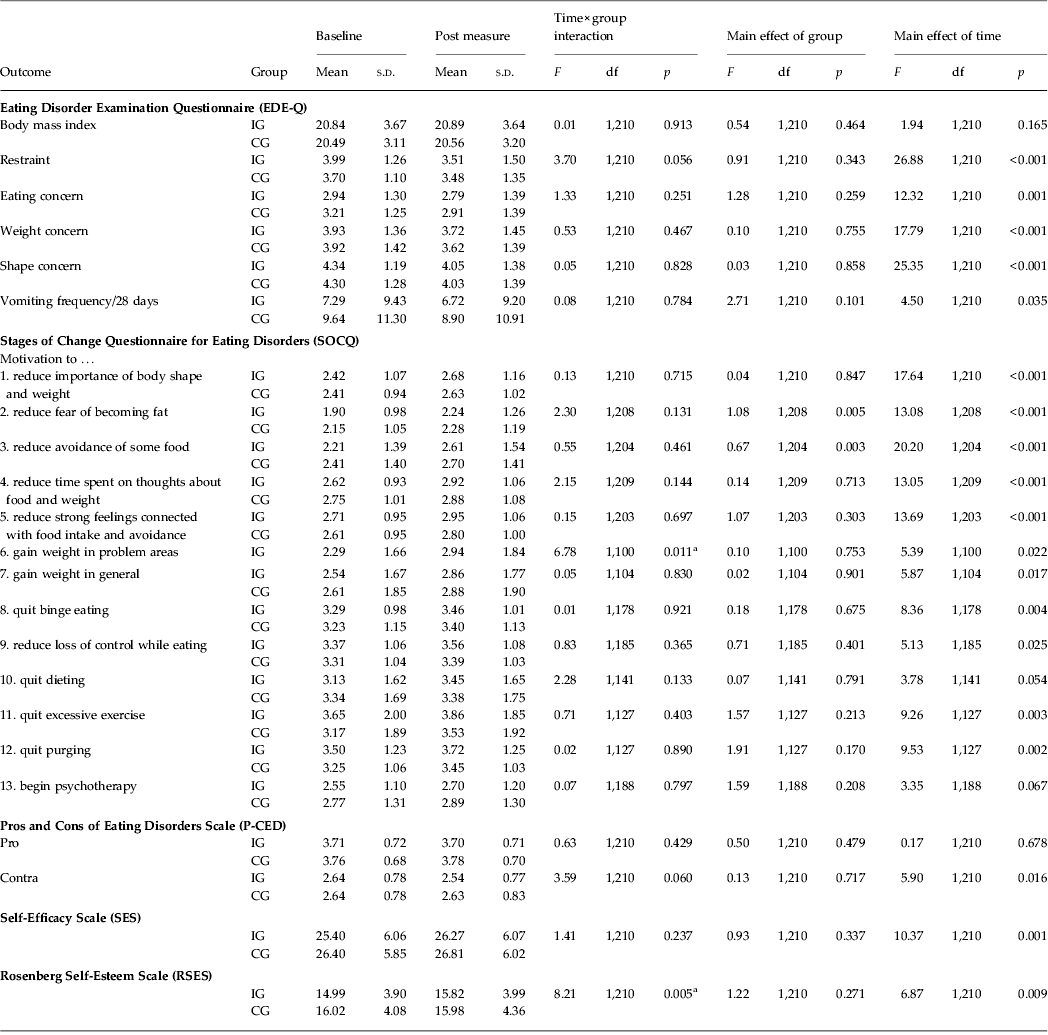
Means, standard deviations, and results of the ANOVAs for the completer analyses

IG, intervention group; CG, control group; s.d., standard deviation; df, degrees of freedom.
a Significant difference between baseline and post-measure for IG but not for CG.
At baseline, the IG and CG did not differ significantly in age, BMI or frequency of previous treatment. Furthermore, the groups did not differ significantly in baseline values on the P-CED, SES, and RSES. However, the CG reported significantly higher scores on the EDE-Q subscale ‘Eating concern’ (t 123 = −2.78, p = 0.006), significantly lower scores (i.e. less motivated) on SOCQ-ED item 12 (motivation to quit vomiting; t 73 = 2.04, p = 0.045) and a significantly higher frequency of vomiting (t 123 = −2.70, p = 0.008) than the IG. There were no significant group differences at baseline on the three remaining EDE-Q subscales ‘Weight concern’, ‘Shape concern’ and ‘Restraint’ or the 12 other items of the SOCQ-ED. Baseline symptom severity as measured by the EDE-Q is comparable to German eating disorder norms, where mean values are in the range 2.90–4.07 for ‘restraint’, 2.60–3.39 for ‘eating concern’, 3.19–3.73 for ‘weight concern’ and 3.73–4.19 for ‘shape concern’ (Hilbert & Tuschen-Caffier, Reference Hilbert and Tuschen-Caffier2006).
Completer analyses
Table 3 displays means and standard deviations of the pre- and post-scores on the SOCQ-ED, P-CED, SES, RSES, and EDE-Q in the two groups along with the results of the two-way ANOVA with the factors time and group.
SOCQ-ED
Concerning the primary outcome variable, significant time × group interactions were obtained for SOCQ-ED item 2 (motivation to reduce one's fear of becoming fat), item 4 (motivation to reduce preoccupations regarding food and weight), item 6 (motivation to gain weight in specific, problematic body parts), and item 10 (motivation to quit dieting). Post-hoc t tests showed that the motivation to change these problem behaviors increased significantly from pre- to post-assessment in the IG (SOCQ-ED 2: t 47 = −3.51, p = 0.001, d = −0.75; SOCQ-ED 4: t 48 = −4.28, p < 0.001, d = −0.66; SOCQ-ED 6: t 23 = −3.89, p = 0.001, d = −0.87; SOCQ-ED 10: t 27 = −2.48, p = 0.020, d = −0.52), whereas no changes were detected in the CG (SOCQ-ED 2: t 73 = −1.65, p = 0.104, d = −0.20; SOCQ-ED 4: t 75 = −1.42, p = 0.159, d = −0.20; SOCQ-ED 6: t 38 = 0.20, p = 0.840, d = 0.03; SOCQ-ED 10: t 47 = −0.32, p = 0.751, d = −0.04). Furthermore, for all items, the main effect of time reached statistical significance, thus indicating a symptom reduction from pre- to post-assessment across both groups, except for SOCQ-ED item 13 (motivation to begin treatment). A main effect of group was found for SOCQ-ED item 12 (motivation to quit vomiting), indicating that motivation to quit purging was higher in the IG than in the CG across the two measurement points.
P-CED
A significant time × group interaction was detected for the ‘contra’ score. Post-hoc t tests revealed an increased endorsement of the burdens of the eating disorder in the IG between baseline and post-assessment (t 48 = 3.531, p = 0.001, d = 0.33) whereas ‘contra’ scores remained stable in the CG (t 75 = 0.222, p = 0.825, d = 0.02). The main effect of time also reached statistical significance for the ‘contra’ scores. There were no significant effects of group, time, or their interaction on ‘pro’ scores.
SES
The ANOVA revealed no significant time × group interaction, indicating that changes in self-efficacy from pre- to post-assessment did not differ between the two groups. By contrast, the main effect of time did reach statistical significance, whereas the main effect of group did not. Thus, both groups displayed a significant increase in self-efficacy from baseline to post-assessment.
RSES
The time × group interaction reached statistical significance. Post-hoc t tests revealed that, from pre- to post-assessment, a significant increase in self-esteem emerged in the IG (t 48 = −4.75, p < 0.001, d = −0.46) whereas scores did not change significantly between baseline and post-assessment in the CG (t 75 = 0.16, p = 0.873, d = 0.01). Furthermore, the main effect of time was significant, with a significant increase in self-esteem from pre- to post-assessment.
EDE-Q
A significant time × group interaction emerged on the subscale ‘Restraint’. Post-hoc t tests revealed that participants in the IG showed a significant reduction in restrained eating from pre- to post-treatment (t 48 = 5.44, p < 0.001, d = 0.84) whereas ‘restraint’ scores remained stable in the CG from baseline to post-assessment (t 75 = 1.90, p = 0.061, d = 0.21). For all EDE-Q scales, there was a significant main effect of time, indicating reductions from pre- to post-treatment across the two groups. The main effect of group was significant for the subscale ‘Eating concern’, with higher scores in the CG relative to the IG across the two measurement points.
Additional intent-to-treat analyses
Table 4 displays means and standard deviations of the pre- and post-scores for the intent-to-treat analyses (BOCF) on the SOCQ-ED, P-CED, SES, RSES and EDE-Q in the two groups along with the results of the two-way ANOVA with the factors time and group.
Means, standard deviations and results of the ANOVAs for the intent-to-treat analyses (BOCF method)

BOCF, Baseline-observation-carried-forward; IG, intervention group; CG, control group; s.d., standard deviation; df, degrees of freedom.
a Significant difference between baseline and post-measure for IG but not for CG.
Significant time × group interactions were detected for the RSES and the SOCQ-ED item 6 (gain weight in problematic areas). Post-hoc t tests showed that the motivation to gain weight in problematic areas and the RSES scores increased significantly from pre- to post-assessment in the IG (SOCQ-ED 6: t 47 = −3.41, p = 0.001, d = 0.37; RSES: t 102 = −4.28, p < 0.001, d = 0.21) whereas no changes were found in the CG (SOCQ-ED 6: t 53 = 0.20, p = 0.839, d = 0.02; RSES: t 108 = 0.16, p = 0.873, d = 0.21). The EDE-Q subscale ‘Restraint’ and the P-CED subscale ‘Contra’ barely missed the significance level for the time × group interactions. The main effect of time reached statistical significance for almost all outcome variables except for the BMI, SOCQ-ED items 10 (motivation to quit dieting) and 13 (motivation to begin treatment), and the P-CED subscale ‘Contra’. A main effect of group was found for SOCQ-ED items 2 (reduce fear of becoming fat) and 3 (reduce avoidance of some food).
Discussion
The purpose of this randomized controlled trial was to examine the effects of a structured web-based intervention (ESS-KIMO) aimed at enhancing motivation to change in women with eating disorder symptoms. The primary finding of the completer analyses is that, as hypothesized, participants in the IG reported a stronger increase in motivation to change problematic behaviors (such as dieting or refusing to gain weight in problematic areas) and cognitions (such as fear of becoming fat and preoccupation with food and weight) compared to participants in the CG. Additionally, the intervention resulted in significantly greater improvements on a range of core and associated eating disorder characteristics. Specifically, individuals who received the intervention reported significantly greater reductions in restrained eating and greater increases in the perceived burdens of their eating disorder and in self-esteem from pre- to post-intervention relative to those in the CG.
Given the high prevalence of motivational deficits in individuals with an eating disorder (e.g. Casasnovas et al. Reference Casasnovas, Fernández-Aranda, Granero, Krug, Jiménez-Murcia, Bulik and Vallejo-Ruiloba2007) and the fact that these deficits are related to a range of poorer clinical indices (e.g. Wade et al. Reference Wade, Frayne, Edwards, Robertson and Gilchrist2009; Castro-Fornieles et al. Reference Castro-Fornieles, Bigorra, Martinez-Mallen, Gonzalez, Moreno, Font and Toro2011), the findings of the present study support the utility of an online program as a potential first step in engaging eating disorder patients in the change process. The significant increase in motivation to change restrictive eating as a result of the intervention is especially noteworthy given that the egosyntonic nature of dieting has been identified as particularly problematic in the treatment of eating disorders (Perkins et al. Reference Perkins, Schmidt, Eisler, Treasure, Berelowitz, Dodge, Frost, Jenkins, Johnson-Sabine, Keville, Murphy, Robinson, Winn and Yi2007; Geller et al. Reference Geller, Brown, Zaitsoff, Menna, Bates and Dunn2008). For instance, one study found that the extent to which participants did not want to make changes in their dietary restriction was the most consistent predictor of a poorer short-term clinical outcome (Geller et al. Reference Geller, Drab-Hudson, Whisenhunt and Srikameswaran2004).
In addition to having a positive impact on motivation to change key aspects of an eating disorder, the intervention also resulted in a positive shift in decisional balance. Relative to the CG, participants in the IG reported a greater increase in their endorsement of the burdens of eating disorder symptoms. An increase in the perceived cons of an eating disorder has been associated with movement from the precontemplation to the contemplation stages of change, and may therefore be particularly helpful in early-stage intervention (Rieger et al. Reference Rieger, Touyz and Beumont2002). However, the present study found no changes concerning endorsement of the perceived benefits of eating disorder symptoms. These results are consistent with previous research finding that the degree to which individuals with an eating disorder endorsed positive consequences of their disorder did not vary across the pre-action stages of change (Cockell et al. Reference Cockell, Geller and Linden2003). Nevertheless, a reduction in the perceived benefits of the disorder has been associated with movement into the action stage of change (Rieger et al. Reference Rieger, Touyz and Beumont2002). Thus, intervention strategies that can effectively decrease the degree to which the eating disorder is perceived as beneficial are needed.
In addition to inducing positive shifts in the level of motivation to change and decisional balance, the IG yielded a significantly greater increase in self-esteem relative to the CG. Self-esteem has been theorized to be among the key factors maintaining eating disorder symptomatology (Fairburn et al. Reference Fairburn, Cooper and Shafran2003). In addition, frequent dieting and restrictive eating are deemed to be among the most important and empirically established risk factors for developing and maintaining an eating disorder (Fairburn et al. Reference Fairburn, Cooper and Shafran2003; Jacobi et al. Reference Jacobi, Hayward, de Zwaan, Kraemer and Agras2004; Parkinson et al. Reference Parkinson, Drewett, Le Couteur and Adamson2012). Thus, it is noteworthy that six sessions with a pronounced focus on motivational enhancement were able to partially improve these aspects of an eating disorder.
Concerning self-efficacy, no significant time × group interaction was found. As the SES measures self-efficacy in a global sense and is not eating disorder specific, it may have lacked the sensitivity to detect changes compared to the other, more symptom-specific measurements used in this study (Ochsner et al. Reference Ochsner, Scholz and Hornung2013). As such, future research should use a scale modified to assess self-efficacy concerning overcoming an eating disorder and its various symptom domains.
Some results of the completer analyses (e.g. the significant increase in self-esteem and motivation to gain weight in problematic areas) also remained significant in the intent-to-treat analyses. However, no significant changes were detected in terms of motivation to change dieting, fear of becoming fat and preoccupation with food and weight, restrained eating, or perceived burdens of the eating disorder from pre- to post-intervention. When interpreting the results of the intent-to-treat analyses, it is noteworthy that the last value observed was carried forward for 41% of the participants. Furthermore, as outcome measures were only assessed at pre- and post-test, post-scores were substituted by those collected at pre-test in all of these cases, which assumes a very poor outcome for drop-outs. However, it is possible that at least some of these participants might have benefited from the sessions they attended.
When interpreting the results of this study, several limitations should be taken into consideration. First, there was a high drop-out rate, which is consistent with the treatment of eating disorders in general (Bandini et al. Reference Bandini, Antonelli, Moretti, Pampanelli, Quartesan and Perriello2006; DeJong et al. Reference DeJong, Broadbent and Schmidt2012). High drop-out rates are also not uncommon for online approaches (Eysenbach, Reference Eysenbach2005; Christensen et al. Reference Christensen, Griffiths and Farrer2009; Melville et al. Reference Melville, Casey and Kavanagh2010). Research is therefore needed to identify those patients who are most vulnerable to discontinuing online treatments and to develop effective treatment retention strategies.
Another limitation of the present study is that eating disorder diagnoses were not validated through the use of structured interviews and relied instead on self-report questionnaires. As a consequence, it was not possible to address differences in responsiveness to the intervention between different eating disorder diagnoses in the present study. For instance, as patients suffering from AN are generally less motivated to change compared to those with BN (Blake et al. Reference Blake, Turnbull and Treasure1997), they may have needed more support. Moreover, because of the qualitative differences in perceived benefits and burdens between AN and BN (Serpell & Treasure, Reference Serpell and Treasure2002), diagnosis-specific online interventions might be promising.
Furthermore, the wide age range of the participants (from 18 to 50 years) might have had an impact on the results of the present study, as older study participants might not be as comfortable with the medium of the internet as younger adults (van Eimeren & Frees, Reference van Eimeren and Frees2011). Conversely, an older chronological age has been shown to predict a higher motivation to change (Casasnovas et al. Reference Casasnovas, Fernández-Aranda, Granero, Krug, Jiménez-Murcia, Bulik and Vallejo-Ruiloba2007). These age-related differences suggest that age-adapted interventions might yield improved outcomes.
To conclude, the present study, which to our knowledge is the first randomized controlled trial on the efficacy of a web-based program to enhance motivation to change in women with eating disorder symptoms, provides support for the efficacy of such interventions in terms of increasing motivation to change and self-esteem and also reducing various eating disorder symptoms. The results indicate that online interventions, with their anonymity and ease of access, might provide a promising treatment adjunct by preparing an ambivalent patient population for face-to-face treatment. Online interventions are able to foster motivation to change and to achieve initial symptomatic relief at a low cost and independent of time and place.
Acknowledgments
This work was supported by the German Research Foundation (DFG), Grant no. VO1750/1-1. We thank A. Lange and the Interapy team for giving us permission to use their Interapy screening battery and C. Knaevelsrud for providing us with the German translation of these items. We also thank all participants of ESS-KIMO.
Declaration of Interest
None.