


Most of us probably think we know what resentment is: a lingering grievance; an envious, ugly anger. We almost certainly think we know it well enough to diagnose it in others. For many, this understanding likely owes something to Friedrich Nietzsche, for whom Ressentiment—the French word he uses for lack of a German equivalent—is the anger of the weak, the anger of those who cannot or will not express their anger. Repressed and sublimated, resentment turns against the subject's body, corroding its organs like an autoimmune condition: “nothing burns you up faster than the emotions of resentment [Ressentiments-Affekten]. Anger, sickly vulnerability, powerlessness to take revenge, the lust, the thirst for revenge, every kind of poisonous troublemaking” (Ecce Homo, “Wise” 6).Footnote 1 Strictly, no one feels this kind of resentment: one feels moral superiority, a clean conscience, virtue. Ressentiment is the Nietzschean unconscious. Here Nietzsche goes beyond any ordinary understanding of resentment. And yet there too resentment often entails misrecognition, a sense that resentful people do not perceive their resentment. A diagnosis of resentment tends to function as a rhetorical and political weapon: to call someone resentful is to discount the reasons for that feeling, discrediting what might otherwise be validated as anger.Footnote 2
Both Nietzsche's word and its English cognate once meant something very different. Sometimes resentment designated a vehement fury; more often it was tied to other experiences altogether. For Thomas Browne, the word names the emotional effect of tragic stories (40). Henry Vaughan writes that God can “resent” love, anger, or pity (98). Ben Jonson's 1631 play The New Inn tells of a husband who learns “over-late, to resent the injury” he has done his wife: that is, to feel it as an injury, and to repent (*4r). Like the word feeling, resentment concerns all emotion; like feeling, it draws emotion close to sensation. How did resentment lose this—to us—messy combination of meanings? How did it lose its status as a word for all feelings to become only an ugly anger? In what follows I will fill in that story, showing how a word for sensory response could double as a word for anger, what it meant for those meanings to part ways, and why that parting is a significant event in the history of emotion. The word resentment harbored the seeds of a new paradigm of anger, tied to a new sense of anger's social content. I will pursue that claim through three stages: first, I will use digital tools and a large-scale archive to analyze what early modern writers wrote about when they wrote about resentment; second, I will follow the word into new forms of physiology and matter theory and new ways of thinking about the nature of anger; and third, I will read literary history as the most extended and imaginative investigation of this changing set of concerns in the sociality of anger.
According to a logic as old as the Iliad, formalized by Aristotle and Aquinas, and echoed in early modern treatises on the passions and in imitations of ancient epic and tragedy, anger is a desire for revenge for a perceived slight, and it derives from a sense of superior worth grounded in an ostensibly objective order of things.Footnote 3 For Aristotle, orgē is a response to a “slight” given “without justification,” and it presupposes the special value of the angry self (On Rhetoric 1378a30–1378b1, 1378b25–1379a5).Footnote 4 Aristotle also distinguishes orgē from “being indignant,” to nemesan, which, like envy, aims at “an equal and a like” (1386b20). Orgē “assumes asymmetrical power,” Daniel Gross argues (3).Footnote 5 This does not exhaust the ancient terminology of anger.Footnote 6 There was a tradition of distinguishing different kinds of anger, some of which look like modern resentment: Aristotle describes four kinds of people with four characteristic angers, including one that remains concealed for a long time (Nicomachean Ethics 1126a10–28); a late Stoic text defines six kinds of anger including kotos, an anger that persists until an occasion of revenge is found (Pseudo-Andronicus of Rhodes 230–31); Aquinas cites John of Damascus's division of anger into “wrath, ill-will, and rancor,” where “rancor”—furorem—clearly descends from kotos (1a2ae.46.8, arg. 1). But it is orgē with its sense of the angry self's special status that remained central to ancient debates over anger.Footnote 7 This is what the Stoics target when they argue that anger is weakness, not strength: “Everything weak is by nature given to complaint,” Seneca argues (1.13.5); anger is “womanish and childish,” the sign of a mind “given to chronic distress, like sore and sickly bodies that groan at the lightest touch” (1.20.3).Footnote 8 Stoic texts take aim at a broad range of received narratives about anger, which they distill into the idea that—as Cicero writes—“one who does not know how to become angry cannot be considered a real man” (4.43). Stoic critiques of anger are directed at patriarchs, judges, slaveholders, men in positions of authority, in Seneca's case maybe even an emperor (Fillion-Lahille 198, 280). The question of anger and women is presented as being less about the anger of women themselves than about whether angry men become like women: women's anger is so fully delegitimized that simply to associate anger with women is to discredit it (Seneca 1.20.3).Footnote 9 The anger of the disempowered seems nearly invisible in the face of the presumption that “[a]nger hath a privilege,” as Kent says in King Lear—though that play quickly proves him wrong (Shakespeare, King Lear 2.2.68).
That Kent is so wrong is part of my story: the story of an increasing concern with unprivileged anger. Anger was becoming newly questionable. When Aquinas organized the passions into the concupiscible and irascible faculties, he insisted that irascibilis (the irascible power or faculty) was not the same as ira, or anger, but he treated anger as the most important irascible passion and in effect implied that half our affective life is ruled by more or less angry feelings (1a2ae.46.1 ad 1).Footnote 10 René Descartes, by contrast, barely mentions anger till nearly the end of Les passions de l’âme (The Passions of the Soul), in articles on indignation and colère (475–81). The first belongs to those who are “never content with the worldly position they were born to or have attained” (Passions of the Soul 274); the second comes in two forms, a short-lived, conspicuous anger belonging to the “kindly and loving,” and a secretive anger belonging to the “proudest, basest, and weakest” (276).Footnote 11 Anger's privilege was coming undone. In England, this unsettling of the discourse on anger should be traced to the same social changes that were unsettling received ideas of honor and status: the waning military function of the aristocracy; the centralization of state power; the expansion of commercial society; the consolidation of a more heterogeneous social elite; changing codes of gender; and, building on all of this, emerging discourses of civility, delicacy, taste, and politeness that promised to make sense of the new social and economic alignments.Footnote 12 Anger was a flash point of changing social codes and changing structures of emotion in the period that witnessed the emergence of the modern state and a modern consumer society.
Resentment's links with sensation and sensibility install a kind of anger at the roots of life: for William Harvey, the capacity for anger becomes a criterion for distinguishing animate from inanimate. Harvey thus also imagines anger in very different terms: from a cognitive judgment with a somatic correlate, anger becomes a bodily response; from a passion that indexes the special status of the feeling being it becomes a propensity of all flesh; from a sign of the subject's power of action it becomes a form of reactivity or vulnerability.Footnote 13 Resentment is the ancestor of eighteenth-century concepts of sentiment and sensibility, which offer naturalized accounts of ethics and sociality.Footnote 14 It belongs to a moment when such accounts were already on the agenda, from new versions of Aristotelianism and Galenism to a recovered Stoicism and Epicureanism to new forms of vitalism.Footnote 15 But in that earlier moment the language of resentment never provided a secure basis for ethics or sociality, nor did resentment later became a “moral sentiment.” Adam Smith excludes resentment, anger, and hatred from the sympathetic transmission of feeling, arguing that when we see such feelings expressed we tend to resist them, not share them: in fact they provoke “disgust” (1.1.1.7, 1.2.3.5).Footnote 16 Resentment's restriction to an ugly anger is a concomitant of the effort to turn sensibility from a natural fact into a moral ideal.
Some of the clearest signs that anger was being rethought come from literature. The passions, I argue elsewhere, were in the early modern period seen to demand narrative: the only full analysis of a passion is a circumstantial narrative enabling an act of judgment calibrated to the case in question; narrative is the discursive mode that attends to the particular event in its uncertain relationship to general rules and categories.Footnote 17 As a practical experiment in the relations of passion and action, narrative presupposes problems in the theory of the passions even as it offers a means of exploring those problems by linking passions to the worlds that produce them and the agents who feel them. Narrative both generates and defines differences in affective experience. In this essay I argue that a shift of concern in the sphere of anger makes itself visible in literary history in the development of a plot form largely unattested in antiquity: tragic intrigue, in which the deceptions familiar from ancient comedy became the basis for tragic dramas. The plot of tragic intrigue is a crucial element of the literary history of anger in the early modern period; in such plots, Shakespearean drama, in particular, emerges as a significant investigation of anger and power.
It may be that modern resentment owes a direct debt to Shakespeare. Nietzsche was an avid reader of that “wild genius” (Ecce Homo, “Clever” 3), to whom he gestures in his account of how history made possible “[t]he breeding of an animal which is entitled to make promises” (On the Genealogy 2.1).Footnote 18 The key moment appears as an imagined scene. “[T]o impress repayment as a duty and obligation sharply upon his own conscience,” a debtor offers his creditor as security something over which he would still have power even if he were to lose everything else: “his body or his wife or his freedom or even his life.” Nietzsche singles out the body as the key instance: “the creditor could subject the body of the debtor to all sorts of humiliation and torture—he could, for example, excise as much flesh as seemed commensurate with the size of the debt.” What this “alien” transaction really offers is “a sort of pleasure”: the creditor can “vent his power without a second thought on someone who is powerless,” gaining an “enjoyment” that “will be prized all the more highly, the lower the creditor stands in the social order.” Thus the creditor “partakes of a privilege of the masters” (2.5).Footnote 19
Though he cites Roman law, Nietzsche is clearly thinking of The Merchant of Venice and has in mind both the notorious pound of flesh and the situation of the Jewish moneylender who dreams of cutting that pound of flesh from the body of a man who has humiliated and abused him for years (Large 60n1; Critchley and McCarthy 11–12). That he would think of Merchant here is hardly surprising, given the emphasis on Jewishness in On the Genealogy of Morals: at one level we are simply retracing the steps of a virulent anti-Semitism.Footnote 20 But maybe there is also an insight here, if we read this encounter in terms of differential structural positions in systems of social power and situate both Merchant and Genealogy as part of a history in which the anger of the disempowered became an object of concern. To suggest that Nietzsche was thinking of Shakespeare is perhaps also to suggest something more: that Shakespeare is Nietzsche's distant collaborator; that he is among the early investigators of a form of anger for which he inherited no real models from the past but of which he left models for the future; and, most broadly, that dramatic emplotment is a way of thinking about the social life of the passions. In what follows I take Shakespeare and Nietzsche as reference points in a history of resentment written in three dimensions: a history of language, a history of the more specialized language of physiology, and literary history.
Tender Resentments
Resentment may derive from the postclassical Latin resentire, which the Oxford English Dictionary dates to the fifth century and calls rare (“Resent”); I have found no trace of that word, though forms of it appear in all Romance languages by the sixteenth century.Footnote 21 The first lexicon to use the English word—though not to define it—is John Florio's 1611 Italian-English dictionary, which glosses Risentíre as “to recover feeling or sence againe” and “to resent, to feele or shew a motion, an offer, a remembrance or effect of some wrong received” (“Risentíre”). Entries for resentment appear in English lexica from the mid–seventeenth century. For Thomas Blount in 1656, a resentment is “a full taste, a true feeling, a sensible apprehension” (“Ressentiment” [Glossographia]); for Edward Phillips in 1658, it is “a sensible feeling, or true apprehension” (“Resentment, or Ressentiment”); for Elisha Coles in 1676, “a true and sensible apprehension” (“Resentment, Ressentiment”). If in French and Italian one meaning of ressentir / risentire is sentir / sentire, in English resentment seems to double the word sentiment, first attested in the time of Geoffrey Chaucer. There are traces of repetition in resentment, as we can see from Florio—to resent is “to heare, to feele or smell againe” (“Risentíre”)—and the Grande dizionario della lingua Italiana: risentire means to feel an emotion newly or again (“Risentire,” def. 7); a risentiménto is a rekindling of a feeling (“Risentiménto,” def. 9). In resentment, we feel again what we have felt before. Perhaps this explains its links to repentance (“Risentire,” def. 6): in repentance we return to our prior acts with a new understanding that causes them to live in us differently than before.
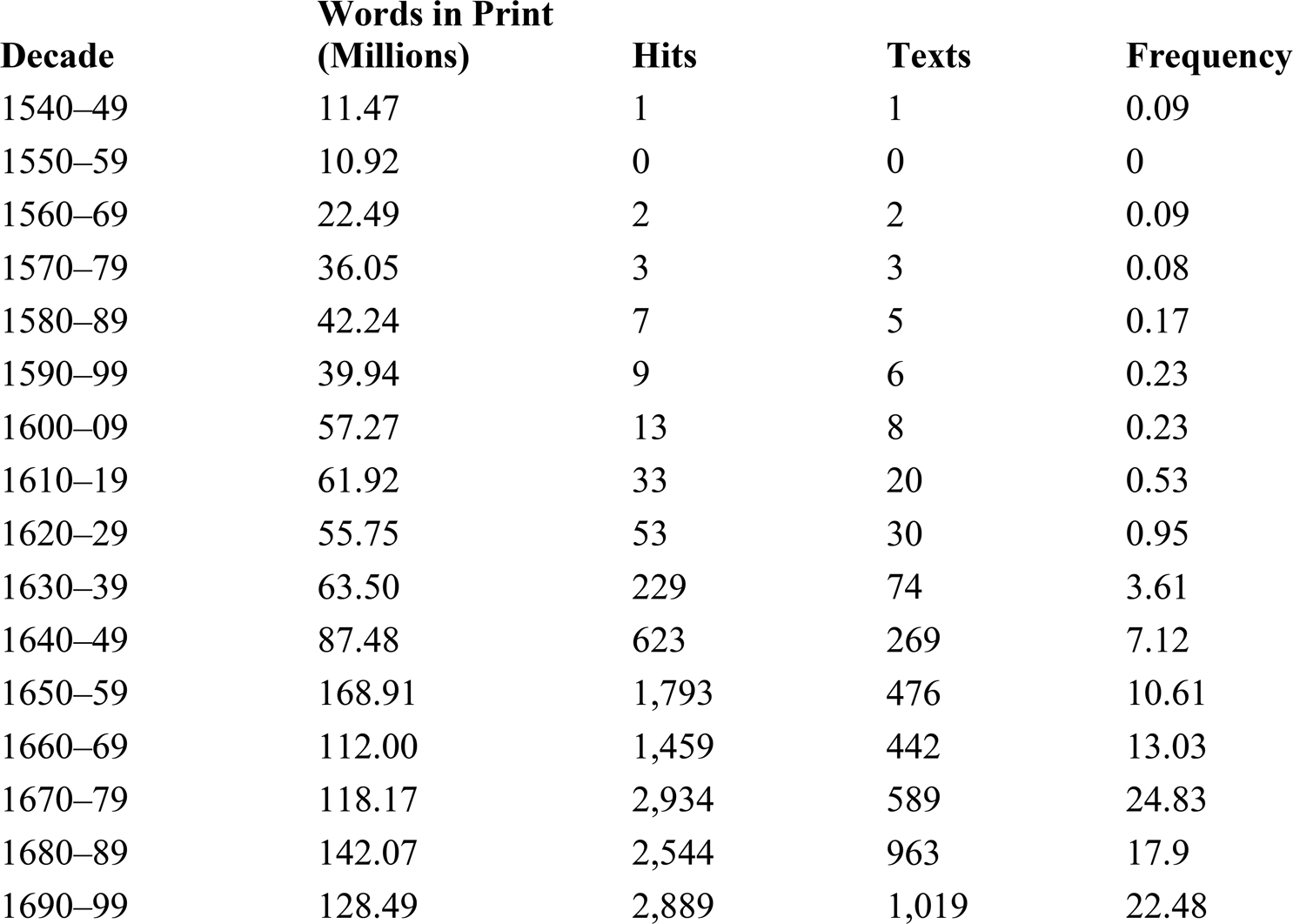
We can get a sense of what English writers did with resentment from the uses of the word in the part-of-speech-tagged version of Early English Books Online (EEBO)—the primary digital archive of early printed books—available through the Corpus Query Processor (CQPweb) created by Andrew Hardie at Lancaster University (cqpweb.lancs.ac.uk/eebov3/).Footnote 22 CQPweb is a linguist's tool that enables more sophisticated forms of search and more sophisticated ways of parsing results. The CQPweb search re[s,ss]ent* finds all words that begin “resent” or “ressent,” with whatever terminations; after culling some French words, OCR errors, and forms attested only once, and focusing on the period from the 1540s—the decade when the first real hit appears—to 1699, it finds 12,592 hits distributed across 3,907 titles.Footnote 23 CQPweb allows us to chart the path of resentment into English, focusing not on raw hits but on frequency of use calculated in relation to the total volume of material in the archive for a given unit of time (fig. 1). When the frequency revealed through this search rises from 7.12 in the 1640s to 24.83 in the 1670s, those numbers take into account the difference between the 87 million words in the archive for the earlier decade and the 118 million words in the archive for the later one: frequency understands the numbers returned by a search in relation to changes in the print market, so we can be reasonably sure these changes are not simply reflections of global shifts.
Results for the CQPweb search re[s,ss]ent*, 1540 to 1699, as last performed 16 October 2021. Square brackets indicate alternative letter-strings; the wildcard * allows for terminations of any length.
The search _JJ <<3>> re[s,ss]en[t,ti]ment* finds adjectives that appear in a three-word window on either side of resentment: the aim is to locate constructions of the form “adjective-noun,” but also cases where two adjectives are used, or an article or possessive intervenes, or the adjective follows the noun, as in the phrase “resentments so X.” This search sketches the qualities of resentment as they are evoked across the early modern print archive (fig. 2). The results are strikingly dominated by the phrase “just resentment(s),” at 13.37 percent of the total. In the search _JJ <<3>> passio[n,ns], by contrast, “just passion(s)” represents only 0.15 percent of returns. If resentments are passions, they are passions construed as positive grounds for ethical action. In part, “just resentment(s)” confirms the emphasis in English lexica on the truth of resentment. It also positions resentment as appropriate anger. A character in Ralph Freeman's 1639 Imperiale claims a “just resentment of my wrongs” (E3r); the 1640 text of Gilbert Saulnier Du Verdier's Le romant des romans speaks of a man who has a “just resentment” of his niece's “dishonor” (61). The phrase encodes the values of a masculine honor culture. In France, ressentiment was part of a vocabulary of aristocratic anger, as when in Pierre Corneille's Le Cid Don Diègue apostrophizes, “Agréable colère! / Digne ressentiment à ma douleur bien doux!” (“Pleasant anger! / Worthy feeling so sweet to my pain!” [qtd. in Braden 147; trans. modified]).Footnote 24 Colère is a “digne ressentiment,” a feeling worthy in itself and attesting the worth of the one who feels it. Aristotle would have understood.
“Frequency breakdown” of the top twenty results for the CQPweb search _JJ <<3>> re[s,ss]en[t,ti]ment*. This search finds all adjectives (_JJ) appearing within three words to either side of the search term re[s,ss]en[t,ti]ment*.

Of the remaining adjectives, great (2), deep (3), high (7), and violent (20) indicate that resentment is paradigmatically intense. Lively (15) marks it as vivid and forceful. Just (1), due (12), and true (18) signal forms of approbation. Grateful (4) and generous (16) indicate that resentment can be a felt recognition of benefits, a usage reflected in seventeenth-century letter-writing manuals.Footnote 25 Ill (5) and angry (13) show that it can be a recognition of wrongs, sad (10) that it opens up other terrains of negative feeling. Private (6) and particular (17) suggest its sphere is personal. Of the thirty-five co-occurrences with full (14), all but two are forms of the phrase “full of resentment(s),” which figures resentment as a substance in the container of the body, a common construal of passion in the early modern period and emotion in our own (Kövecses 65–68). Finally, tender (9) turns resentment into a natural vulnerability, a way of being open to painful touches.
I want to emphasize that last point. When Seneca imagines anger's tenderness in terms of “sickly bodies that groan at the lightest touch,” he means to discredit it. Here, tenderness is positive.Footnote 26 In some ways “tender resentment” underscores something implicit in resentment, whose structure, as re-sent-ment, draws the angry response close to sensation and perhaps especially touch. For Richard Flecknoe, “delicate resentment” means being “sensible of everie little touch” (C1r). In Leonard Digges's 1622 translation of Gonzalo de Céspedes y Meneses's Gerardo, the title character is asked to tell his “Tragedy” and replies that his soul “cannot but resent”—that is, feel—“the blow” this request inflicts on him, as with “[a]ll wounds” carelessly touched (2F1r). Montaigne describes the feeling transmitted in theatrical performance as a “ressentiment bien vif,” a “lively and feeling-moving,” as Florio translates: a “fureur” (“furie”) that “espoinçonne” (“prickes and moves”) those who feel it (Essaies 232; Essayes 115).Footnote 27 Resentment pushes passion close to sensation. It describes passionate responses as paradigmatically true. And it links two things that seem very different: the angry male self of a Renaissance honor culture, and the delicacy of the feminized, implicitly bourgeois subject of the discourse of sensibility. Anger was becoming a matter not only of strength and status but also of private feeling and delicate vulnerability.
Irritated Spirits
This tenderness is underscored in the places where resentment encounters a set of terms used in physiology for motions of the spirits, blood, or organs: irritation, excitement, provocation. Irritation had been part of physiology since Galen, who uses various words, usually translated with forms of irritare, to name a provocation that incites an organ to discharge an “alien burden” (qtd. in Temkin 298).Footnote 28 For Owsei Temkin, the language of irritation imbues physiology with psychology: “The various parts behave like irritated people” (295). But the boundary between physiology and psychology was being rethought in the seventeenth century, and the spirits were central to that.Footnote 29 Most narrowly, the question was whether the spirits participate in the nature of the soul or should be analyzed in the same way as all matter. Behind that lay the problem of how matter itself should be understood.Footnote 30 In its links to the Latin terminology, resentment got caught up in these debates. One place this happens is William Harvey's Exercitationes de generatione animalium, his late book on the reproduction and growth of living creatures. Harvey examines the spot of blood, or punctum saliens, that forms in a developing chicken egg, and provokes it: “By his various motions,” the English text tells us, the blood “discovers his resentment of the affronts [irritantis injuriam] which any thing casts upon him, and the friendships of such as cherish him” (Anatomical Exercitations 282).Footnote 31 Harvey prods the punctum with “a needle, probe,” his finger, or “any other thing that could molest, and disorder” it, watching it “declare many symptoms of its resentment [varia sensùs indicia]” and arguing that it “doth (as an Animal) Live, Move, and Perceive” (95).Footnote 32 “Upon every touch, be it never so gentle,” the punctum is “variously provoked, and disturbed,” just as all “sensative bodies” are (94). In fact we do not have “any other signs to distinguish an animate and sensitive creature, from a dead and senseless one, then by its motion provoked from some offensive object [motum à re aliquà irritante excitatum]” (350).Footnote 33
In the next century Albrecht von Haller would distinguish sensibility from irritability: the former is conscious and depends on the nerves; the latter is unconscious and belongs to all muscle fibers.Footnote 34 For English physiologists the division was not so clear. And yet Harvey separates the responses that concern him from ordinary sensation. A later exercise argues that there is a kind of natural motion that is “not performed without all sense” insofar as the fact of motion implies that the part has been “excited, provoked [irritentur], and altered,” but without the involvement of brain or nerves (Anatomical Exercitations 348).Footnote 35 In this “kinde of sense, we do not perceive our sensation” but are like those who are “distracted by some violent Passion”—that is, “insensible of all pain” and in fact of anything that “meets their senses” (351). “Whatsoever by diversity of motions makes warre against those things that enrage [irritamenta] and molest it, must needs be indowed with sense” (348);Footnote 36 but this “Natural Touch” differs from “the Animal sense of Touching” (351). Anger is proof of the presence of life, but the kind of anger that can be ascribed to a spot of blood in a three-day-old chicken egg differs vastly from Corneille's “digne ressentiment.”
Harvey was not alone in postulating a world of angry matter. In 1677 Francis Glisson coined the term irritabilitas for a responsive capacity of the nerves or even all matter, though like Harvey he distinguished this perceptio naturalis from the perceptio perceptionis that belongs to the living animal (2.7.3).Footnote 37 In De anima brutorum (The Soul of Brutes), Thomas Willis—the great anatomist of the brain and nerves—identifies the animal soul with a subtle matter in the body having two elements: a “Vital or Flamy part” that is “rooted in the Blood” and is “scarce sensible,” though “great Passions” can “disturb” it; and a “Sensitive” part “diffused within the Brain and … Nerves” that “perceives all Impressions” (Soul 55–56).Footnote 38 The animal soul consists of “most subtle, and highly active” particles; it “frames the Body” and “actuates, inlivens, and inspires the whole” (6), operating like a ferment or fire (29).Footnote 39 “The first beginnings of Life proceed from the Spirit Fermenting in the Heart, as it were in a certain little punct,” Willis writes in his essay on fermentation (Medical-Philosophical Discourse C3r). In his essay on fevers, he notes that blood “impregnated with Sulphur” and mixed with the spirits becomes “Fermentable” and undergoes “effervescency” or “accension,” becoming “inflamed” and producing the body's “vital heat” (I2r).Footnote 40 Later he describes a “fury” and “intestine war of the blood,” claims that blood shares “the Nature [of] things quickly irritable” (I4v), and tells of a patient whose blood “fell into a rage” (N2v). Perhaps this is all metaphor: as Georges Canguilhem writes, Willis had a “quasi-poetic intuition of the sources and principles of vital motion” (70; my trans.). But such passages raise again the problem of how—or whether—to talk about parts of the body without endowing them with a kind of psychology.
The chapter of De anima brutorum on animal knowledge offers a sweeping account of passion as an irritation of the nerves. The “Impressions” of “sensible things” are carried by the spirits to the “corpora striata” and the cortex, creating imagination and memory (T. Willis, Soul 35–36).Footnote 41 Then “other reflected Species” are “struck back” to the “corpora striata,” “as a Flood sliding along the Banks of the shore, is at last beaten back”: “when as these Spirits presently possessing the Beginnings of the Nerves, irritate [irritant] others, they make a desire of flying from the thing felt, and a motion of this or that member or part, to be stirred up”; in fact “almost every Motion of the animated Body is stirred up by the Contact of the outward Object” (36).Footnote 42 When both sensation and passion are traced to manifold irritations of the spirits, the result suggests that all our experiences are at root impingements, abrasions, more or less damaging forms of touch. We find here a hallmark of the later culture of the nerve: the insistence that sensation and passion are all—however slightly—wounding.Footnote 43
Such irritations may underlie the claim of Willis's most famous student—John Locke—that “uneasiness” is the only source of human motivation, our sole “spur to action” (2.21.31).Footnote 44 In the French text of Locke's Essay read by Gottfried Wilhelm Leibniz, Daniel Heller-Roazen notes, “spur” is “aiguillon,” which means both “goad” and “thorn”; commenting on Locke, Leibniz's stand-in, Theophilus, argues that “la nature nous a donné des aiguillons du désir comme des rudiments ou éléments de la douleur, ou, pour ainsi dire, des demi-douleurs ou (si vous voulez parler abusivement pour vous exprimer plus fortement) de petites douleurs inaperceptibles” (“nature has given us thorns of desire as the rudiments or elements of pain or, so to speak, half-pains or (if you want to speak inappropriately in order to express yourself more powerfully) little imperceptible pains”; Nouveaux essais 2.20.6; my trans.).Footnote 45 As Heller-Roazen notes (200), this echoes a claim in Leibniz's preface. All things are in motion, from which Leibniz infers that we too are in motion and that “at every moment there is in us an infinity of perceptions, unaccompanied by awareness [aperception] or reflection,” because these “alterations in the soul” are “too minute and too numerous, or else too unvarying” (Preface 53). Leibniz connects these unperceived perceptions to the tiny prickings that drive us to action: “these minute perceptions … determine our behaviour in many situations without our thinking of them”; “insensible perceptions are as important to pneumatology [pneumatique] as insensible corpuscles are to natural science [physique]” (56). Leibniz, Nietzsche suggests, has invented a corporeal unconscious (Fröliche Wissenschaft 5.354, 357). Nietzsche himself was reading physiology when thinking about “Ressentiment” (Emden 88–98). “Wir kennen einen Zustand krankhafter Reizbarkeit des Tastsinns” (“We know of a condition of morbid irritability of the sense of touch”; Antichrist 29; my trans.), he writes, “eine übergrosse Reizbarkeit der Sensibilität, welche sich als raffinirte Schmerzfähigkeit ausdrückt” (an “excessive sensibility that shows itself in a refined talent for pain”; 20; my trans.). Standing on the other side of the culture of sensibility, he targets and inverts its values, using its own physiological language to do so.
The fiery, fermentative, or pricking qualities of animate flesh impart an angry tonality to life. This link between resentment and life separates anger from the social content it bears for Aristotle or Seneca. To trace anger to basic bodily processes is to turn it from a mark of privilege into a natural fact belonging to all living animals. It is also to turn it from a proof of power to evidence of reactive vulnerability. This does not eliminate anger's social dimension. Rather, it constructs it around a different kind of agent with a different power of action: a lesser figure who cannot claim preeminence and whose anger is not a mark of privilege. In Harvey, Leibniz, and Montaigne, one image recurs at the center of their thinking about the responsive capacities of the living body: the prick of a needle or thorn, which puts tenderness at small wounds at the center of the question of anger and life.Footnote 46 Perhaps the most famous thought experiment centered on that image appears in The Merchant of Venice. But to see the significance of that moment, we need to locate it in literary history, which must be conceptualized in its own terms before it can be correlated with the linguistic and physiological trajectories sketched so far.
If You Prick Us
The literary form most obviously concerned with anger is epic. Anger is the first word of the epic tradition: mēnis, a Greek word for the wrath of gods or heroes. The Iliad treats the anger of Achilles as a devastating but inescapable part of a social and natural world conceived as a fixed totality: the anger of the great is written into the order of things, its tragic effects inseparable from its greatest glories.Footnote 47 Since Virgil, if not already in Homer, and especially in early modern epic from Torquato Tasso to John Milton, anger was also subjected to ethical scrutiny (Burrow; Dilmac; Most). To Milton, the whole epic tradition appears as a series of errant angers (9.13–19).
Against this background, I want to set the emergence of the most important early modern plot of anger, the plot of tragic intrigue. The ancient model for early modern tragedy is often said to be Seneca; but Seneca offers little guidance for how to construct a play.Footnote 48 “‘Plot’ in the sense in which we find plot in the Spanish Tragedy,” T. S. Eliot writes, “does not exist for Seneca” (65). “What the Renaissance learns about putting plays together it learns elsewhere,” Gordon Braden argues: that is, from the comic intrigues of Plautus and Terence (104). Alfred Harbage, Lorna Hutson (Invention 131), and Lucas Erne (84–85) all confirm this: the crucial innovation of early modern tragedy occurred when playwrights appropriated for tragedy a version of the plot of comic intrigue. Adele Scafuro defines the “forensic disposition” of ancient New Comedy as a habit of inferential inquiry into the acts and minds of others (25–30). Tragic intrigue provides plays like The Spanish Tragedy and Hamlet with their narrative engines: the process by which, having discovered his son's murder, Hieronimo dissembles his feelings, bides his time, and works to discover those responsible; or the process by which Hamlet tries to “catch the conscience” of Claudius (Shakespeare, Hamlet 2.2.601). As Hutson argues, tragic intrigue puts real pressure on what cognitive scientists call “mentalizing”: the work of drawing inferences about motives and intentions (Invention 128–45).Footnote 49 It also raises questions about the status of our knowledge of others, producing a sense of inwardness in part by problematizing our access to “that within which passes show” (Shakespeare, Hamlet 1.2.85).Footnote 50
The plot of tragic intrigue looks like an objective correlative for something like Norbert Elias's account of an emerging late medieval and early modern structure of feeling produced by urbanization, the growth of commerce, and the centralization of state power. Elias's description of the skills of the courtier or the economic “new man” might apply to any number of stage intriguers: “[t]he moderation of spontaneous emotions, the tempering of affects, the habit of connecting events in terms of cause and effect—all these are different aspects of the same transformation of conduct” (370).Footnote 51 The idea that the period between 1500 and 1800 saw a decisive shift in the norms of behavior and feeling—especially for elite men—has been canvassed many times since, not necessarily with reference to Elias. For Mervyn James, the key element was a shift in the honor culture deriving from the nobility's increased dependence on the crown; for Anna Bryson, it was the growth of a new urbanity belonging to both court and city. Scholars of “politeness,” “sensibility,” and “taste” like Lawrence Klein, Paul Langford, J. G. Barker-Benfield, and Simon Gikandi have described an emerging set of values and behaviors associated with the formation of a more expansive elite engaged in commerce and consumption and defined less by birth than by forms of cultural competence and cultivated leisure.Footnote 52 These histories rarely address anger directly, but they suggest an increasing problematization of the expression of anger, linked to the changing composition and function of England's elites.Footnote 53
Plots of tragic intrigue are a perfect vehicle for this problematization of anger. “With the new developments” in tragic plotting, Braden writes, “comes, at best, an intensified sense of the density of human interrelations, by which the characters are bound together inside their common story” (124). Intrigue presupposes diminished power of action in a crowded social world. Already in ancient New Comedy, Scafuro argues, the “forensic disposition” is “most fully developed” in “slaves” and the “socially marginal” (326). From Thomas Kyd's Hieronimo to Shakespeare's Iago, tragic intriguers are often figures somehow displaced within a status hierarchy. They are seldom radically marginalized. But in one way or another they feel overlooked, subordinated, or caught between competing forms of status and value: bastards, decayed gentlemen, landless prodigals. Literary critics conventionally call them “malcontents,” emphasizing their envy or frustrated ambition (Watson 170). But the questions raised by tragic intrigue are implicit in a basic narrative situation: someone is wronged who, because of their placement in the social world, is incapable of direct response, and so operates by “closely and safely fitting things to the time,” as Hieronimo puts it (Kyd 3.13.26).Footnote 54 Even Hamlet acts from a position of relative disempowerment when he confronts the crimes of the man who now is king. The deferral of response and the concealment of feeling are the intriguer's defining skills as well as the keys to the construction of the plot.Footnote 55
It is not quite the case that there were no ancient models for this. Ancient epic had space for minor figures whose feelings are never dignified with the name of anger: thus in the Iliad Thersites rails “for no good reason” (Homer 2.248). A more significant model lies in the central scenes of Euripides's Medea, when Medea pretends to accept Creon's decree of banishment. As she tells the chorus of Corinthian women, she has “some gain in mind, / some ruse”: “I will kill in silence, by deceit” (377–78; 399 [Svarlien]). This scene ends with an event unprecedented on the ancient Greek stage. Medea addresses herself: “spare nothing that is in your knowledge, / Medea: make your plan, prepare your ruse” (409–10).Footnote 56 Just before the catastrophe she again addresses part of herself: “Oh no, my spirit [thume], please, not that! Don't do it” (1080).Footnote 57 “True soliloquies existed not at all in tragedy before Euripides,” Bruno Snell writes, seeing here “a modern psychological, individualistic moral consciousness” (120, 121). Perhaps, though already in Homer characters address their heart or spirit: their thumos, a word that could also mean anger.Footnote 58 In Medea, self-address is born from deception as much as from anguished conscience. Inwardness emerges with the need for secrecy: that is, intrigue. What drives this is Medea's recognition of her position. She is the daughter of a king and granddaughter of a god, but in the play's crucial collisions her position is defined in relation to Jason, to Creon, to Corinth—a husband, a king, an alien city—and her actions are conditioned by her awareness of that. “This is your city,” she tells the chorus (256). The play ends with her mounting the platform usually reserved for the descent of gods, but its central events are forged in the experience of disempowerment. This relative disempowerment, this placement between contradictory social positions, is crucial to both resentment and tragic intrigue.
Ancient and early modern accounts of the passions all describe anger as fast. “Anger's in a hurry,” Seneca writes (1.18.1); it “marcheth not a slow pace,” per Jean-François Senault (2D8r); it is a “brief madness,” according to a famous formula (Shakespeare, Timon 1.2.28). For Seneca, “delay” is anger's “great cure” (2.29.1). But in plots of tragic intrigue, anger slows down. In fact, delay characterizes the kind of anger in question: a secretive anger that works toward a deferred fulfillment. Seneca treats concealment as therapy: anger should be “kept concealed” even though doing so causes “great distress”; “we should modify its telltale signs, relaxing our expression, softening the voice, slowing our step,” until “our inner state comes to conform to our outward appearance” (3.13.1–2).Footnote 59 In tragic intrigue, concealment is both the problem and a—wholly strategic—solution. “Cease thy plaints,” Hieronimo instructs Isabella after they discover their son's body, “Or at the least dissemble them awhile” (Kyd 2.5.60–61). We have traveled a long way from the Tamburlaine whose anger is immediately legible: “Upon his brows was portrayed ugly death, / And in his eyes the fury of his heart” (Marlowe 3.2.72–73).
Shakespeare sometimes contrasts the intriguer's feeling with epic anger. When in King Lear Kent claims that “anger hath a privilege,” he means it is exempt from rules because it punishes violations of rules: it is privileged because it defends privilege. This scene is altogether about status, as Kent assaults and mocks Oswald as an inferior who has risen above his place. It is also a disaster, landing Kent in the stocks and frustrating his mission: Kent finds himself on the other side of a power divide, facing antagonists who do not recognize his claim to privilege as Lear's messenger.Footnote 60 When Lear feels his own inability to answer injuries, he descends into furious abuses of language:
“Noble anger” lashes out against injuries given by subordinates—here, daughters, women, subjects—but finds itself incapable of action, incapable even of arresting a disintegration of self Lear feels as feminization. The false magic of his curses and the fantasy that his passions are mirrored by the cosmos appear like vestiges of a vanished world, out of place in a play ruled by more mundane abuses of language. The other model of anger in the play never calls itself that, and perhaps that is part of the point. We glimpse it in Edmund: an envious anger sparked by his position as an illegitimate son, expressing itself as a critique of status, but nursed in secret, dissembled as love, and acting through lies and forged letters. When anger is hidden in this way, is it still quite the same thing?
The contrast between epic anger and the intriguer's more questionable state of feeling shapes Shakespeare's Othello as well. By the end of act 3, scene 3, Iago has pushed Othello into an explosion of rage that culminates in an image comparing his “bloody thoughts” to the icy water that rushes from the Black Sea into the Mediterranean (3.3.457). This is both an epic simile and a Marlovian way of expressing strong feeling in cosmic terms. Iago's feelings, by contrast, are famously uncertain. Critics often say he resents. Samuel Johnson describes “the cool malignity of Iago, silent in his resentment, subtle in his designs” (200). Catherine Belsey refers to his “racist resentment” (159), Lynne Magnusson to his “resentment against the speech of others” (172).Footnote 61 The reasons for this resentment have seemed too many and too shifting for clear diagnosis: hence Samuel Taylor Coleridge's famous appeal to “motiveless Malignity” (315). But intrigue almost necessarily problematizes questions of motive. The deferral of action, the concealment of intentions: these are not just veils drawn between us and a full knowledge of the passions.Footnote 62 They qualitatively alter the passions themselves.
Reading Shakespeare's Titus Andronicus as an early experiment in tragic intrigue, Hutson argues that this kind of plot “enables distinct kinds of emotional effect,” eliciting “strong feeling” by “emphasizing characters’ partial, uneven, and often merely conjectural knowledge of one another's thoughts and hidden actions” (Invention 105). She focuses on the play's investigators, but the effect also marks its criminals. The play's most visible intriguer is Aaron, who as a “Moor” associated with the defeated Goths is doubly othered in Rome; Tamora gets the play's most famous invocation of revenge—“I'll find a day to massacre them all” (1.1.455)—but it is Aaron who manages that revenge. “I have found the path,” he tells Chiron and Demetrius (1.1.611). He means this literally, but the place in the forest where he instructs them to rape Lavinia and bury Bassianus materializes the “plotting” that is both his characteristic activity and the vehicle for the play's plot.Footnote 63 The play racializes this when Aaron connects his melancholy and his intelligence to his Blackness (2.2.30–39).Footnote 64 It also invites us to think about this as tactics: tragic intrigue requires someone who, because of their placement in the social world, has learned to conceal anger and work by manipulation—of people, probable signs, documents.
The Merchant of Venice is one of Shakespeare's most extensive early investigations of anger and power. “You call me misbeliever, cut-throat dog, / And spit upon my Jewish gaberdine,” Shylock tells Antonio early on (1.3.103–04); “You … did void your rheum upon my beard, / And foot me as you spurn a stranger cur” (109–10). The scene is about the feelings that accumulate through quotidian acts of violence accruing over unspecified stretches of time. Hutson argues that such evocations of extradramatic time help produce an illusion of interiority, inviting inferences about the prehistories of characters that contextualize their onstage acts (Invention 124). The notorious problem here is that Merchant seems to give Shylock too richly imagined a past, for a play that will demand his subjugation (Kastan 98–102; Shapiro 130–33).
In act 3, after Jessica abandons him, Shylock returns to his feelings about Antonio: “He hath disgraced me, and hindered me half a million, laughed at my losses, mocked at my gains, scorned my nation, thwarted my bargains, cooled my friends, heated mine enemies—and what's his reason? I am a Jew” (3.1.43–46). This sets up his most famous words. “Hath not a Jew eyes? Hath not a Jew hands, organs, dimensions, senses, affections, passions?” (46–47). Shylock appeals to a shared bodily life. We have the same senses, affections, and passions because we have the same eyes, hands, organs, bodies: “If you prick us, do we not bleed? If you tickle us, do we not laugh? If you poison us, do we not die? And if you wrong us, shall we not revenge?” (50–52). Critics and performers sometimes mark a strong shift here, as if we should say “yes” to the first three questions and “no” to the last.Footnote 65 Against this I want to insist that Shylock is right: if revenge is not an impulse born into the flesh, if it is not in some sense natural, then the act of letting it go has no value. Only universal vengefulness gives mercy meaning. For Shylock as for Harvey or Leibniz, the pinprick is a concentrated image for a resentful vitality that belongs to all living bodies. But Shakespeare dramatizes the social content of that idea: its relationship to the anger of marginalized social agents.
In the trial scene, Shylock refuses to explain his reasons for insisting on the bond whose fulfillment would kill Antonio:
This is not just humoralism: it is a complete elimination of passion's cognitive aspects. Passions were traditionally defined as thoughts: embodied thoughts, erratic thoughts, but thoughts nonetheless.Footnote 66 Among the passions, anger was the most erratic but also the most cognitive: what makes anger anger is the thought of injury and the desire for revenge.Footnote 67 Shylock renders his passion reasonless. He also perplexes its causality: “affection / Masters oft passion, sways it to the mood / Of what it likes or loathes” (49–53). There is a minor crux here—the quarto reads “Maisters of,” not “Masters oft”—but all versions of these lines reference a series of entities that seem broadly synonymous: affection, passion, mood, liking, loathing. Perhaps “mood” here means “mode” in the musical sense, recalling the bagpipes: affection makes passion dance—“sways it”—to the tune affection sets (“Mood,” def. 3a). That still leaves “affection” causing “passion.” Insofar as early modern writers distinguished passions and affections, affections were seen as more moderate, so it is hard to see how this explains Shylock's “lodged hate” (Shakespeare, Merchant 4.1.60).Footnote 68
Perhaps Shylock aims to cut short a debate about his actions he thinks is rendered moot by the bond. Perhaps he is ashamed to rehearse his past humiliations. Perhaps he knows the Christian court will not hear his reasons as reasons. Or perhaps this is sheer dramatic exigency: Shylock becomes inscrutable when the play needs us no longer to understand him. Whatever the reason, Shylock hides, in the moment of exacting his revenge.Footnote 69 He hides when concealment seems unnecessary. And his refusal of reasons encourages a flurry of “mentalizing”: an urgent sense that there is more to know. That interpretive energy also turns on those who judge him. Portia, as Balthazar, finds a loophole that releases Antonio from the bond. But saving Antonio is not enough: Shylock must be punished, expropriated, forcibly converted. The result of Portia's legal logic and Antonio's “mercy” (4.1.374), this is a judgment in which mercy and revenge seem indistinguishable. “The truth of the play is revenge,” René Girard argues. “The Christians manage to hide that truth even from themselves” (247). And yet it is Shylock's anger that appears discredited in the play, a process surely facilitated by the way he seems in the trial scene to let go of the idea that it might have any reasons behind it at all.
One might continue with other Shakespeare plays, asking for instance what happens to Katherine's anger after the end of The Taming of the Shrew and her—performed?—discovery of women's weakness: “My tongue will tell the anger of my heart,” she insists in act 4 (4.3.79); then, in act 5, “now I see our lances are but straws” (5.2.179).Footnote 70 Does the anger she expresses in the earlier moment disappear? And if not, what happens to it? The question of anger and power shapes Timon of Athens as well, perhaps Shakespeare's play most entirely about anger. In act 3, scene 6, a scene from the subplot that punctuates and comments on Timon's descent into rage, Alcibiades defends “a friend … who in hot blood / Hath stepped into the law” to the senators (11–12). The scene is both a trial and a treatise on anger. Alcibiades defends “noble fury” (18), echoing Cicero when he asks, “[W]ho is man that is not angry?” (57). The senators counter, “He's truly valiant that can wisely suffer” (31). These quasi-Peripatetic and quasi-Stoic positions are complicated by the power relations at work. Alcibiades is a soldier in the service of a city government, the senators the rulers of that city; but their rule is disconnected from the direct exercise of military power, and their forms of revenge, too, are indirect. “We are for law,” one senator insists (86); challenged by Alcibiades, the senators banish him, asking, “Do you dare our anger?” (95). The scene starts with two positions on anger but ends with two kinds of anger: one that responds to injury with joy at the chance to exercise itself—“I hate not to be banished, / It is a cause worthy my spleen and fury,” Alcibiades announces (111–12)—and one that hides behind law. Like Merchant, the scene anticipates the critique of virtues as it would be practiced by “La Rochefoucauld und jene anderen französischen Meister der Seelenprüfung” (“La Rochefoucauld and the other French masters of soul searching”; Menschliches 1.2.36; my trans.), as Nietzsche calls them: systematic demonstrations of how apparent virtue can be driven by secret cruelty and anger.Footnote 71
The gap between Shakespeare and Nietzsche is of course enormous, and I will not try to fill it here. All I hope to have established is that the emergence of a language of resentment that turns anger into a property of the living flesh was accompanied and even preceded by the development of a plot form that gave new attention to the anger of disempowered social agents. Across a series of Shakespeare's plays, elements are at work that would also shape Nietzsche's thinking: the anger of agents caught between contradictory forms of status; an anger that belongs to the living flesh; an anger that has lost its relationship to privilege; an anger that hides behind legal or economic instruments. Shakespeare's experiments with tragic intrigue are an effort to imagine the narrative shape of a kind of anger different from that projected in most received forms of epic or tragedy. The resonance between Shylock's pinprick and the pins wielded by Harvey is accidental, but it indicates the broader direction of the theory of the passions between 1600 and 1800: from passion as a cognitive fact to emotion as a physiological one. It also suggests that this theoretical shift should, among other things, be seen as part of a social process. To think about anger as a condition of the flesh is to think about it in a new way. It is to take the anger of weaker social agents as a matter of concern. The genealogy of resentment needs to begin with the linguistic, conceptual, literary, and social conditions that made it possible to identify it as a particular kind of anger in the first place. To trace those conditions is to describe the emergence of a modern social and affective world of which Nietzsche's theory is itself a part.



