Introduction
Recent reports indicate a high prevalence of alcohol and substance misuse among Irish teenagers. The Irish Society for the Prevention of Cruelty to Children (ISPCC) conducted a survey among 9746 young people aged 12–18 years in 2009 (Mongan, Reference Mongan2011). Over two-fifths (45%) reported that they currently drink alcohol, even though it is illegal to do so under the age of 18 years. An online study of 508 16–20-year olds conducted by UNICEF Ireland in late 2010 showed 82% female respondents and 69% male respondents reported that they drank alcohol (UNICEF, 2011). More than one-third of respondents reported that they had taken drugs at some point. There was no significant difference in the reporting of drug consumption between the two genders. The European School Project on Alcohol and Drugs study (ESPAD, 2011) involved 2207 Irish 15–16-year-old students, of whom, 80% boys and 81% girls reported that they had consumed alcohol at some point in their lives.
A retrospective study of 9832 Irish interviewees aged 15–64 from the pooled samples obtained from two population surveys (National Advisory Committee on Drugs, 2006, 2008) showed that the average age of first drinking fell steadily and significantly across birth cohorts from the late 1930s to the early 1990s (Smyth et al. Reference Smyth, Kelly and Cox2011). This change was significantly greater in females. Per capita alcohol consumption was very highly negatively correlated with the median age at which each birth cohort commenced drinking (Smyth et al. Reference Smyth, Kelly and Cox2011). A survey by Long and Mongan of 5991 respondents in 3897 households found that more than half (54%) of 18–75-year-old drinkers were classified as harmful drinkers which equates to 1.35 million harmful drinkers in Ireland (Long & Mongan, Reference Long and Mongan2014). A total of 75% of all alcohol consumed in Ireland in 2013 was done so as part of a binge drinking session and one in five (21.1%) drinkers engage in binge drinking at least once a week (Long & Mongan, Reference Long and Mongan2014)
Tarrant et al. (Reference Tarrant, Younger, Sheridan-Pereira and Kearney2011), reporting on a study of nearly 500 pregnant women in Dublin, found that over 35% said they consumed alcohol. In a survey of ~5000 non-Indigenous Western Australian women between 1995 and 1997, 60% reported drinking in pregnancy and 4% reported drinking at ‘binge’ levels (defined as five or more standard drinks per occasion during pregnancy by Colvin et al. Reference Colvin, Payne, Parsons, Kurinczuk and Bower2007). In another study of women’s attitudes, women were found to be more likely to intend to drink during pregnancy if they were unaware of the risk of harm associated with prenatal alcohol consumption (Peadon et al. Reference Peadon, Payne, Henley, D’Antoine, Bartu, O’Leary, Bower and Elliott2011). In addition to the high risk of Foetal Alcohol Spectrum Disorders, alcohol consumption by women in early pregnancy, and by both men and women at the time of conception, can increase the risk of spontaneous abortion, still-birth, premature birth and low birth weight (Hutchinson et al. Reference Hutchinson, Mattick, Braunstein, Maloney and Wilson2014). Children exposed to alcohol have an increased risk of prenatally acquired cerebral palsy.
Prenatal and postnatal drug misuse by the mother is associated with special health and care needs of drug-exposed new-borns, with complications for the mother, the child’s development and with communication deficits in the mother-infant dyad (Kelley, 1992; Howard, 1994; Beckwith et al. 1999). A review of the literature by Hogan (2011) shows that because the biological impact associated with prenatal substance exposure can be confounded with environmental influences, for example associated with maternal drinking during childhood, it can be difficult to distinguish a particular role for foetal exposure. According to Hogan (2011) it appears that parenting skills, child-rearing practice and family life are likely to deteriorate when parents misuse drugs. The review shows that there is a heightened risk for maladjustment among children of drug and alcohol-dependent parents. However, not all children of this group develop these tendencies (Hogan, 2011). The literature identifies two domains – social competence and self-regulation as key antecedents to positive adjustment (Hogan, 2011). Current epidemiological patterns of alcohol and drug use among children whose parents misuse substances shows that parental substance misuse raises the risk of drug and alcohol use during adolescence and is a risk factor for adult drug and alcohol misuse (Hogan, 2011). This review also shows that children of drug misusers and of alcoholics are more likely to exhibit early-onset alcohol misuse and illicit drug misuse than their peers. Age of exposure to parental substance use appears to be an important factor in determining the impact on offspring. Exposure during adolescence conferred a threefold risk that was highly significant clinically and statistically (Hogan, 2011).
Another review by Hutchinson et al. (Reference Hutchinson, Mattick, Braunstein, Maloney and Wilson2014) this time focusing only on alcohol disorders, states that a large body of empirical evidence shows that children of alcohol abusing parents are at elevated risk for a range of maladaptive outcomes in childhood, adolescence and into adulthood. They reviewed literature on the relationship between parental alcohol use disorders and disturbances in physical health, psychological and emotional development and behaviour, and cognitive development of their offspring. They also looked at research on the increased risk for alcohol abuse and dependence in children exposed to parental drinking problems. Literature reviewed showed that children of problem drinking parents had an increased likelihood of accessing healthcare or hospitalisation (Hutchinson et al. Reference Hutchinson, Mattick, Braunstein, Maloney and Wilson2014). Research demonstrated a consistent relationship between parental alcohol use disorders and psychological, emotional and behavioural problems in offspring. Children of alcohol abusing parents generally report two main types of problems: outwardly directed externalising problems, including symptoms of attention deficit hyperactivity disorder, oppositional defiant disorder, conduct disorder and antisocial personality disorder; or, inwardly directed internalising problems, including symptoms of anxiety and depression. The literature examining cognitive deficits in children with alcohol-dependent parents is inconsistent (Poon et al. Reference Poon, Ellis, Fitzgerald and Zucker2000). While a number of studies have documented deficits in intellectual or academic performance and/or cognitive functioning others have not. Children of alcohol abusing parents are at elevated risk for alcohol use problems in adolescence and adulthood (Hayes et al. Reference Hayes, Smart, Toumbourou and Sanson2004). While not all children exposed to parental alcohol abuse will go on to develop problems, research on clinical and treatment samples suggests their risk is approximately four times higher than children not exposed to parental alcohol abuse (Chassin et al. Reference Chassin, Pitts, DeLucia and Todd1999; Jacob et al. 1999). It is likely that both biological and environmental risk factors play a role in the development of alcohol use disorders among children with alcohol-dependent parents (Hayes et al. Reference Hayes, Smart, Toumbourou and Sanson2004).
Maternal alcohol misuse has previously been reported to affect offspring mental distress, whereas no similar effect was shown for paternal alcohol misuse (Rognmo et al. Reference Rognmo, Torvik, Ask, Røysamb and Tambs2012). Given the reduction in social constraints on female drinking in Ireland we were interested particularly in the effects on young Irish people of maternal alcohol/substance misuse. Lieb et al. (Reference Lieb, Merikangas, Höfler, Pfister, Isensee and Wittchen2002), suggest that it is more likely that girls will become problem drinkers if it is their mother, rather than their father, who is abusing alcohol. Other studies have indicated that maternal alcohol/substance misuse may have a greater effect on the risk of development of alcohol/substance misuse and other adverse outcomes in children than paternal alcohol/substance misuse (Yule et al. Reference Yule, Wilens, Martelon, Simon and Biederman2013). On the other hand, the Norwegian Young-HUNT 3 survey (2006–2008) showed that both boys and girls with alcohol misusing fathers were more likely to report high levels of alcohol intake compared with others of the same age and gender (Haugland et al. Reference Haugland, Holmen, Ravndal and Bratberg2013). It was only among the girls that high frequency of drunkenness was associated with maternal alcohol misuse.
In this paper we explore the association between parental and adolescent alcohol and substance misuse by examining the responses of 3000 Irish young people who took part in the second phase of the Child and Adolescent Self-harm in Europe (CASE) study (Sullivan et al. Reference Sullivan, Arensman, Keeley, Corcoran and Perry2004). Specifically, we sought to answer the following research questions:
1. Is adolescent substance misuse equally common in boys and girls?
2. Does parental substance misuse increase the risk of adolescent substance misuse?
3. If present, is the magnitude of the increased risk similar if the parental substance misuse is maternal or paternal?
4. Is the magnitude of the increased risk similar if the parental substance misuse affects one or both parents?
5. Is the magnitude of the increased risk similar for boys and girls?
6. Does parental substance misuse increase the risk of adolescent substance misuse after adjusting for other family problems and the adolescent’s psychological characteristics?
Methods
Data were collected using a standard, internationally validated, anonymous questionnaire designed for the CASE study. The questionnaire is known as the ‘Lifestyle and Coping Questionnaire’ and includes questions about lifestyle, coping, problems, alcohol and drug use, deliberate self-harm, depression, anxiety, impulsivity and self-esteem (Madge et al. Reference Madge, Hewitt, Hawton, de Wilde, Corcoran, Fekete, van Heeringen, De Leo and Ystgaard2008).
Schools in the Cork and Kerry areas were randomly selected using the SPSS statistical package. In the selection of schools, consideration was given to:
∙ The geographical location of the school (Cork City, Cork or Kerry County)
∙ Whether a school was single sex or co-educational.
For each of the schools selected, a letter and information sheet was sent to the principal. If approval was given to conduct the survey, fifth year and transition year classes were invited to be surveyed, as they were made up primarily of 15–17-year olds.
Consent for students to take part
A letter was sent to the parents of the students in the selected classes along with an information sheet and an opt-out form. The information sheet described the survey, and the topics covered in the questionnaire, including contact details of relevant services. Parents completed and returned the opt-out form if they did not wish their child(ren) to take part.
Procedure
The questionnaire was completed in a class setting in 20–30 minutes, with usually, two or three researchers present. An introduction emphasised anonymity and confidentiality of the study and the voluntary nature of students’ participation. It was clarified that they were free to choose whether to complete all or part of the questionnaire and that their choice had no bearing on their schoolwork.
After this, there was a discussion to allow the students to debrief and explore relevant issues as they wished. Each student also received a resource kit, which provided the students with information about issues that were raised in the questionnaire, along with relevant support services in their local area.
Measures
Parental substance misuse
Two questions regarding parental substance misuse were included in the second’ phase of survey (n=3000); as follows:
1. ‘Has your mother had problems with alcohol/drugs’
2. ‘Has your father had problems with alcohol/drugs’
The results of those who answered were analysed by gender and for outcome measures including alcohol/substance misuse and deliberate self-harm.
Adolescent alcohol and drug misuse
The young people were asked if they ever drank alcohol. Using a series of tick box answers, they were asked to indicate the number of alcoholic drinks they would have in a typical week and the number of times in the past month and in the past year that they had so much to drink that they were really drunk. They were asked whether they had taken illicit drugs ever, in the past year and in the past month. They were asked to indicate the number and the type of drugs they had taken during the past year. We describe the adolescents’ responses to these questions. We collapsed categories of two alcohol-related and two drug-related questions to form the following variables indicating alcohol and drug misuse:
∙ Adolescents were considered to misuse alcohol if they drank more than five alcoholic drinks in a typical week (equivalent to weekly binge drinking or multiple drinking episodes each week). Adolescents were not considered to misuse alcohol if they did not drink or drank no more than five alcoholic drinks in a typical week.
∙ For the second alcohol misuse variable, adolescents were considered to misuse alcohol if they had more than 10 occasions in the past year where they had so much to drink that they were really drunk.
∙ The first drug misuse question considered adolescents positive if they used illicit drugs in the past month (considered a proxy for current drug misuse).
∙ The second drug misuse question considered adolescents positive if they used more than one illicit drug in the past year, that is poly-drug misuse.
Psychological measures
A short version of the Hospital Anxiety and Depression Scale was used (White et al. Reference White, Leach, Sims, Atkinson and Cottrell1999). The clinical thresholds were used to categorise the teenagers as normal, possible disorder and probable disorder (White et al. Reference White, Leach, Sims, Atkinson and Cottrell1999). Impulsivity was assessed by six items from the Plutchik Impulsivity Scale (Plutchik & Van Praag, Reference Plutchik and Van Praag1989) and self-esteem was measured using an eight-item version of Robson’s self-concept scale (Robson, Reference Robson1989). In the absence of defined clinical thresholds, tertiles (i.e. lowest, middle and highest thirds) were used to classify teenagers as having low, medium and high levels of impulsivity and self-esteem.
Ethical approval
Ethical approval was granted by the Research Ethics Committee of the Faculty of Cork Teaching Hospitals. The National Suicide Research Foundation is registered with the Data Protection Agency and complies with the Irish Data Protection Act of 1988.
Statistical analysis
Categorical variables were summarised using frequency counts and percentages. Psychological scale scores were summarised using the mean and standard deviation. χ 2 tests were used to assess the evidence of associations between pairs of categorical variables. Logistic regression analysis was used to assess the strength of the associations between categorical independent variables and the dichotomous dependent variables: adolescent alcohol misuse and adolescent drug misuse. The associations are reported as odds ratios with their 95% confidence intervals and p-value. The standard 5% level of statistical significance (p<0.05) is used throughout.
Results
Participants
In total 39 schools and 3881 Irish adolescents participated in the Child and Adolescent Self-harm in Europe (CASE) study (Sullivan et al. Reference Sullivan, Arensman, Keeley, Corcoran and Perry2004). The parental substance misuse questions were added after the survey had been piloted in 13 schools. These questions were therefore included in the questionnaire administered in 26 schools to a total of 2716 adolescents. The study sample consisted of almost equal numbers of boys (1347, 49.6%) and girls (1361, 50.1%). Gender was not indicated by eight (0.3%) adolescents. Half (51.0%) of the adolescents were 16 years of age, with 15 and 17-year olds making up 27.9% and 20.5%, respectively. Age was not indicated by 15 (0.6%) adolescents.
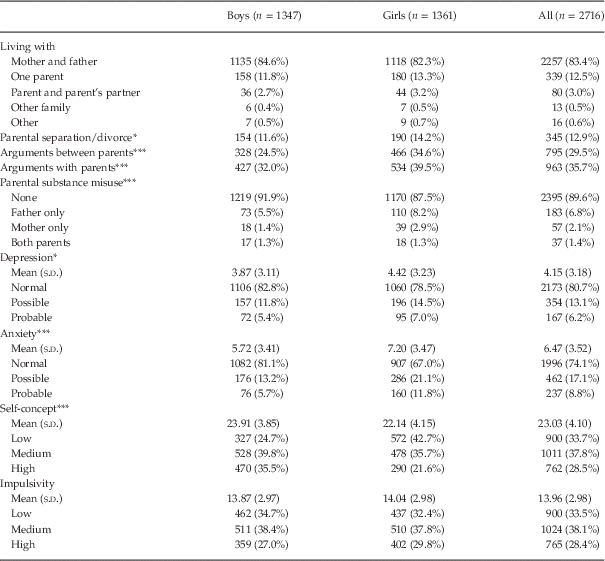
The vast majority of the adolescents were living with both parents (Table 1). Approximately one in eight teenagers had experienced parental separation or divorce; one in three reported serious arguments or fights between and with their parents and one in 10 reported parental alcohol/substance misuse. All four parental problems were more often reported by girls. The experience of parental alcohol/substance misuse related to the father (n=222, 8.3%) more often than the mother (n=95, 3.5%). Thirty-seven adolescents (1.4%) reported that both parents had problems with addiction. Overall, 6.2% and 8.8% of the young people exceeded the cut-points for probable depressive disorder and anxiety disorder, respectively. Depression and anxiety levels were more evident in girls than boys. The sexes were similar in terms of impulsivity whereas higher self-concept was associated with boys.
Family and psychological characteristics of the study sample

Percentages are adjusted for missing data
*p<0.05, **p<0.01, ***p<0.001 for gender difference.
Adolescent behaviour relating to alcohol and drugs
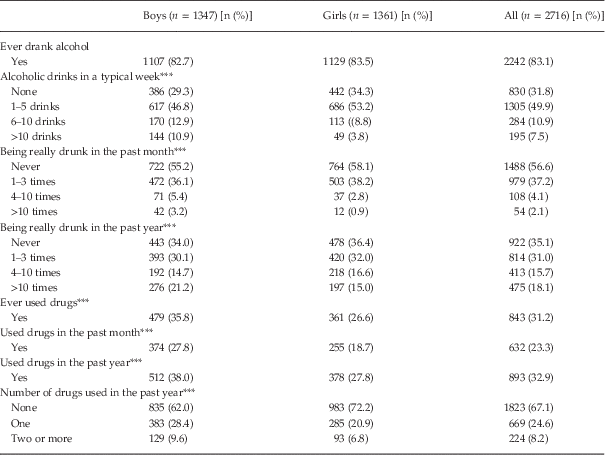
While all participants were below the legal age to drink alcohol, the vast majority had done so and the boys and girls did not differ in this regard (Table 2). Similar proportions of boys and girls were currently drinking but boys were drinking more heavily both in terms of number of drinks weekly (χ 2=65.411, df=3, p<0.001) and frequency of being drunk (past month: χ 2=29.513, df=3, p<0.001; past year: χ 2=17.039, df=3, p<0.001). Use of drugs was far less prevalent to use of alcohol (Table 2). Boys were more likely than girls to have used drugs ever and in the past month and in the past year and to have used multiple drugs.
Adolescent behaviour relating to alcohol and drugs
Percentages are adjusted for missing data
*p<0.05, **p<0.01, ***p<0.001 for gender difference.
Cannabis was the illegal drug most commonly used by the young people. Of the 632 adolescents who reported using drugs in the past month almost all (n=593, 93.8%) used cannabis, 11.7% (n=74) used ecstasy, the same proportion used speed, lysergic acid diethylamide (LSD) or cocaine (n=74, 11.7%) and 5.9% used an opioid (n=37). Among these adolescents taking drugs, cannabis was as common in boys (93.3%) as girls (94.9%; χ 2=0.672, df=1, p=0.412) whereas the other drugs tended to be taken more often by boys than girls (Ecstasy: 13.9% v. 8.6%, χ 2=4.066, df=1, p=0.044; Speed/LSD/cocaine: 13.6% v. 9.0%, χ 2=3.113, df=1, p=0.078; Opioid: 7.5% v. 3.5%, χ 2=4.289, df=1, p=0.038)
Association between substance misuse in parents and children
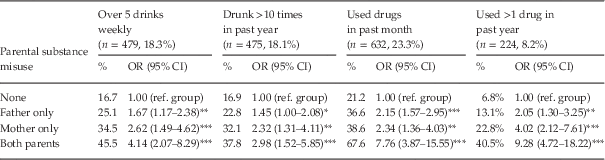
In the total sample, there was an 18% prevalence of alcohol misuse whether defined as typically drinking more than five alcoholic drinks weekly or being really drunk more than 10 times in the past year. The one-month prevalence of illicit drug use was 23.3% and the one-year prevalence of poly-drug misuse was 8.2%. For each of these measures of adolescent substance misuse, the prevalence was lowest if neither parent had problems with alcohol or drugs. The prevalence was significantly higher if only the father had such problems, higher still if only the mother had addiction problems and highest if both parents had addiction problems (Table 3).
Association between substance misuse in parents and adolescent children
*p<0.05, **p<0.01, ***p<0.001.
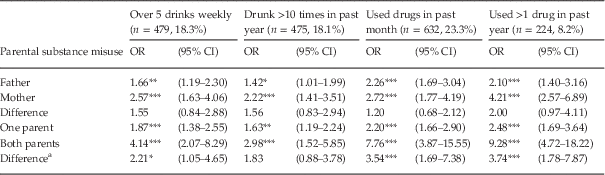
The mutually adjusted effects of paternal and maternal substance misuse on the risk of adolescent substance misuse were statistically significant (Table 4). For each measure of adolescent substance misuse, maternal substance misuse had the greater effect. Formal testing showed that the differences were not statistically significant, however, it was on the cusp with respect to poly-drug misuse for which maternal substance misuse had twice the effect of paternal substance misuse (OR=2.00, 95% CI=0.97–4.11, p=0.059).
Effects on the risk of adolescent substance misuse associated with the substance misuse of the father and the mother and of one or both parents
a Difference, expressed as an odds ratio, is the effect of one form of parental substance misuse compared with the effect of the other form of parental substance misuse (i.e. Mother’s misuse compared with father's; misuse by both parents compared with misuse by one parent).
*p<0.05, **p<0.01, ***p<0.001.
Adolescents whose two parents had alcohol/drug problems had approximately twice the increased risk of abusing alcohol compared with those with one parent misusing alcohol or drugs (Table 4). If both parents had alcohol/drug problems the risk of adolescent drug misuse was 3.5 times greater than if the parental substance misuse affected one parent.
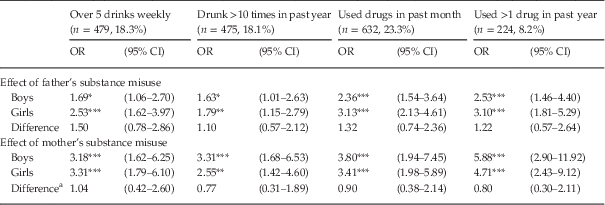
The effect of a father’s substance misuse on risk of adolescent alcohol and drug misuse was greater for girls than boys, but the difference was not statistically significant (Table 5). The magnitude of the increased risk associated with a mother’s substance misuse was similar for boys and girls.
Effects of father’s and mother’s substance misuse on the risk of substance misuse in adolescent boys and girls
a Difference, expressed as an odds ratio, is a comparison of the effect of the parental substance misuse on girls compared with its effect on boys.
*p<0.05, **p<0.01, ***p<0.001
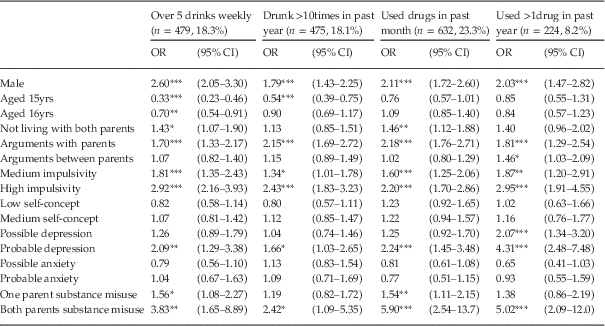
Finally, Table 6 shows the associations between parental substance misuse, other family problems and adolescent psychological characteristics and risk of adolescent misuse of alcohol and drugs. Even after adjustment for a wide range of factors, parental substance misuse was associated with increased risk of adolescent substance misuse. The association was most notable when both parents were affected and especially with regard to risk of adolescent drug misuse.
Effects on the risk of adolescent substance misuse associated with parental substance misuse, other family problems and adolescents’ psychological characteristics
The reference groups for the independent variables were: female; aged 17 years; living with both parents; not having arguments with parents; no arguments between parents; low impulsivity; high self-concept; normal depression score; normal anxiety score; and, no parental substance misuse.
*p<0.05, **p<0.01, ***p<0.001.
Discussion
The study has a number of limitations. Only two questions addressed parental substance misuse and they did not distinguish between whether the misuse was of drugs or alcohol and whether it was ongoing or not. The data were self-report so error in recall is a consideration. We did a series of statistical tests without adjustment for the increased risk of Type 1 error and therefore some statistically significant findings may have been spurious.
Despite these limitations, the paper adds information on the role parental substance misuse might have on young people’s risk of developing addiction in an Irish context, by answering a series of specific research questions. We found that adolescent substance misuse was more common in boys; parental substance misuse increased the risk of adolescent misuse of alcohol and drugs; the magnitude of the increased risk for misuse in the young people was marginally higher if the parent who was misusing substance was the mother rather than the father; the risk increased again if the parental substance misuse involved both rather than one of the parents, especially with regard to adolescent drug misuse; the increased risk was similar for boys and girls and parental substance misuse increased the risk of adolescent substance misuse even after adjusting for a wide range of other family problems and the adolescent’s psychological characteristics.
To place these results in context, recent reports indicate that Irish adolescents have very high rates of alcohol and substance misuse compared with their peers in the European Union (UNICEF, 2011). Our result that adolescent substance misuse is more common in boys is expected and is reported in many previous studies (UNICEF, 2011; Hibell et al. Reference Hibell, Guttormsson, Ahlstrom, Balakireva, Bjarnason, Kokkevi and Kraus2012; Haugland et al. Reference Haugland, Holmen, Ravndal and Bratberg2013). Our study was conducted in 2004 and despite drinking alcohol being illegal under the age of 18 years, the results of widespread drinking among teenagers, with 83% reporting having taken alcohol at some time and 68% drinking alcohol each week (Table 2), are similar to those reported by the ISPCC study of almost 10 000 young people aged 12–18 years in 2009 (Mongan, Reference Mongan2011) in which over two-fifths (45%) reported that they currently drink alcohol. From a positive perspective, Irish data shows a fall of 3 percentage points in the rate of lifetime use of any illicit drug between 2007 and 2011 and lifetime use of alcohol by Irish students decreased by 10%, from 1995 to 2011 (Hibell et al. Reference Hibell, Guttormsson, Ahlstrom, Balakireva, Bjarnason, Kokkevi and Kraus2012), so it may be that the situation has improved with a greater focus on the issue by national agencies for example the identification of the difficulties for children of living with substance misusing parents in the Governments National Children’s Framework Policy (Department of Children and Youth Affairs, 2014).
The aetiology of substance use in adolescence is likely to be multi-factorial and involve complex interplay among genetic, psychological and social determinants. Media reports tend to focus on factors associated with adolescents’ changing life experiences, including increasing affluence, greater exposure to advertisements for alcohol and the wider availability and acceptance of illicit substances throughout Irish society (O’Regan, Reference O’Regan2014). In contrast, this current study confirms the importance of family history in the development of alcohol and substance misuse problems. As stated in the National Advisory Committee on Drugs and Alcohol’s review of the literature ‘Children depend on their family to meet their physical, psychological and social needs and their economic security and well-being. All of these can be jeopardised by parents misusing substances’ (Horgan, Reference Horgan2011).
The information that parental substance misuse increases the risk of adolescent alcohol and substance misuse for both boys and girls is not unexpected as we are familiar with the social learning theory concept that young people will generally copy behaviour to which they are exposed (Savage, Reference Savage2009). In the ISPCC Study, one in ten young people surveyed stated that their parent/guardian’s alcohol use affected their life (Mongan, Reference Mongan2011). The effects of parental drinking described by the respondents included emotional impacts, misuse and violence, impacts on family relationships and changes in parental behaviour. On this basis it is important that, when treating parents with substance misuse problems, attention is given to the impact of these difficulties on their children. The Irish Government National Policy Framework for children and young people includes in its objectives that of recognising the importance of recognising ‘hidden harm’ and ensuring that children living with parental substance misuse are identified and supported within the HSE’s Addiction Services and by Tuslá, The Child and Family Agency (Department of Children and Youth Affairs, 2014). Given the high rates of alcohol consumption in the Irish population identified in the SLAN 2007 study (Morgan et al. Reference Morgan, McGee, Dicker, Brugha, Ward, Shelley, Van Lente, Harrington, Barry, Perry and Watson2009) where 45% of men reported that they drank at least 2–3 times a week compared with 29% of women, it is surprising that such a small percentage of young people responded that their parents misused substances (8.3% reporting paternal misuse, 3.5% reporting maternal misuse and 1.4% reporting that both parents misuse substances). It therefore seems likely that there is a large amount of harmful drinking among adults that goes unrecognised by young people, which may be associated with the general acceptability of excessive alcohol consumption in Irish society.
It has been shown that the increased risk of adolescent substance misuse is greater if maternal substance misuse rather than paternal misuse is present (Lieb et al. Reference Lieb, Merikangas, Höfler, Pfister, Isensee and Wittchen2002). It may well not have reached statistical significance because, thankfully, even with relatively large numbers of subjects only small numbers (n=95; 3.5%) report that they have had this experience. The explanation for this effect is likely to be due to the greater impact on dependent young people if their mother, who in this society is generally the main caregiver, is unable to parent her children due to the effects of alcohol or drugs. It has previously been noted that Maternal Alcohol abuse is more often associated with child neglect than paternal (Cleaver et al. Reference Cleaver, Unell and Aldgate2011). It may also be that the social acceptability of male drunkenness, as opposed to female, reduces the stigma for the young people and thereby lessens the overall negative impact for them. In keeping with the likely adverse impact on care-giving and role models, the risk is further increased if both parents have addiction problems, especially for drug misuse. The magnitude of the increased risk is similar for boys and girls and the increased risk remains even after adjusting for other family problems and the adolescent’s psychological characteristics
Conclusions
The results of this survey add important information to the current discussion about the increased rates of substance misuse among Irish teenagers. It is essential that wider family issues are identified and addressed by anyone attempting to reduce addiction issues in Irish young people and also that consideration is given to the impact of parental substance misuse on their children’s development.
Acknowledgements
The authors owe especial thanks to the staff and students who took part in the study. Thanks also to Carolyn Sullivan, Dr Ella Arensman, Professor Ivan J Perry, Eileen Williamson and all at the National Suicide Research Foundation as well as the National Suicide Review Group and the Ireland Funds who provided the funding.
Conflicts of Interests
None.