

Marine insurance played an integral role in the eastward expansion of Britain's trade empire, and reshaped commercial risk transfer practice in India and China in the late eighteenth and early nineteenth centuries. The natural perils of oceanic trade, compounded by war, pirates, and privateering, were made much more tolerable by premium-based insurance, which could eliminate the financial risk these perils presented. The value of marine insurance to commerce lies in its efficiency as a mechanism to transfer, or reduce by sharing, the risk of economic loss arising from the various perils faced when transporting goods. This efficacy led entrepreneurs and investors to meet demand for insurance facilities where it arose, allowing trade to proceed and expand, and resulted in the significant growth and rapid extension of European-style insurance infrastructure. More than a dozen insurers were formed in India between 1780 and 1810. By the 1830s, a mature network of insurance companies and agents provided cover at every important centre on the sea-lanes of the eastern empire, underwriting insurance in the tradition of the European law merchant.
As the grip of the East India Company (EIC) on the region's international commerce waned, and agency houses emerged to channel company servants' savings towards private trade, these new free merchants formed insurance companies that were embraced by both European merchants and their local trading partners.Footnote 1 Fledgling insurers delivered greater pools of capital to support risk, an improved knowledge-sharing network, and a tested framework for the provision of broad and flexible coverage. They were better suited to oceanic trade than native provisions for commercial risk transfer, which had developed to serve local transport, and much more convenient than London-based underwriting. The insurers were the earliest commercial joint-stock ventures launched in the region, and crossed ethnic, continental, and corporate boundaries to improve their effectiveness through broadened risk-sharing, including the recruitment of multi-continental, multiracial shareholder networks. The men capitalizing this crucial aspect of trade finance were active local merchants (whether British, Portuguese, Parsi, Muslim, or Hindu), alongside members of the expatriate colonial elite. The Canton Register argued in 1829 that ‘the progress of Canton as a centre of foreign trade is evidenced by the rise of marine insurance’, but the development of the insurers was not the product of gentlemanly capitalism driven outwards from the City of London, nor was it dependent upon the metropole (although the new insurers' practices were modelled on those employed there).Footnote 2 Instead, the insurers were a pragmatic and independent alternative to Lloyd's, and channelled primarily ‘Indian-derived capital’ into the business of imperial trade.Footnote 3
I
Modern premium insurance emerged in Italy in the middle ages. Unlike earlier forms such as respondentia, which incorporate the advance of trading capital, it promises only replacement capital in cases of actual loss, in exchange for a fee, or premium, stated as a percentage of the value of the whole indemnity purchased, and paid in advance by the insured. In practice, in exchange for the premium, the insured receives only a promise that the insurer will make compensation for losses, should they occur. It efficiently provides contingent capital, allowing merchants prudently to take risks greater than their own capital permits. Premium insurance was practised in London by Italian merchants as early as the 1430 s, and was well known among English merchants by the later sixteenth century.Footnote 4 Long-distance traders of the seventeenth century almost always purchased cover at least some of the time, and by 1700 marine insurance was commonplace. Throughout this period, the majority of underwriters were the merchants themselves, commonly known in London as ‘merchant-insurers’.Footnote 5 They used marine insurance to share the risks of ocean-going transportation. Their own capital was sometimes augmented by that of gentlemen investors, following the practice of Italian merchant-insurers.Footnote 6
As Britain's trade expanded, so too did its underwriting infrastructure, taking abroad elements including expanded risk-sharing, familiar contractual practice, longstanding dispute resolution and enforcement procedures, the organized dissemination of information necessary to market participants, formalized inspection of vessels, and the involvement of professional intermediaries. Another important distinction of London underwriting was its offer of very broad coverage against the perils of ocean-going trade. Accepted practice among London underwriters had led to contract standardization at least as early as the 1570s, when their customs were first formally codified.Footnote 7 Under a policy underwritten in 1582, silks belonging to the merchant Bartholomew Corsini were insured in London for a voyage from France, against perils both natural and man-made. The policy names numerous specific hazards including ‘all other p[er]illes, losses, & misfortunes, whatsoe[ve]r they be’.Footnote 8 A nearly identical list of perils has been included in policies almost ever since, and as far away as the American colonies and China.Footnote 9 By 1782, Calcutta printers were advertising the sale of blank ‘Policies of Insurance upon Ship, Merchandize, Ordnance, Tackle, &c. &c.’.Footnote 10 The perils list was identical. Lloyd's employed the wording until the late twentieth century. Lying behind it was a body of uniform custom based on the law merchant.
The Corsini policy also illustrates the long-established practice of multiple, individual, private underwriters sharing a specific risk. To reach the total policy value of £200, each of six underwriters assumed a share of the risk ranging from £16 6 s 4d to £50, and signed his name in the blank space under the printed policy wording (making him an ‘under-writer’ or ‘subscriber’). The underwriting of policies was often completed with the assistance of a professional broker, or by an employee familiar with the underwriters and acting as an in-house broker. In each case, the intermediary would recruit sufficient subscribers to their client's risk to obtain the level of cover desired. Twenty professional insurance brokers are listed in the 1740 edition of a London trade directory, alongside ten ‘insurance offices’ (brokers often styled themselves ‘office-keepers’ to avoid association with stock-jobbers), as well as scores of ‘brokers’ for whom no specific speciality is named.Footnote 11 By this time, London had secured its position as the chief underwriting centre for Western European merchants, and Lloyd's Coffee-house as the City's main locale for insurance trading.Footnote 12 It operated as a market of individual underwriters, rather than as a corporate insurer. A large proportion of individual insurance underwriters at Lloyd's were merchants who practised insurance as an integral part of the shared financing of the perils of their business.
Individuals dominated marine insurance. Underwriting by corporate bodies, in the form of partnerships, joint-stock companies, and mutual societies, was not significant until the nineteenth century, although companies began openly to compete with private underwriting in London in 1720, when the Bubble Act allowed ‘two several and distinct corporations’ (the Royal Exchange Assurance and the London Assurance) to underwrite marine risk under royal charter.Footnote 13 All other companies, societies, and partnerships were prohibited from the business, which prevented the formation of corporate insurers in places under parliamentary jurisdiction, such as the West Indian colonies, although the restriction did not extend to EIC territories. Critically, an exemption was made for private underwriting, which allowed the trade at Lloyd's to continue, and ultimately to flourish. The chartered companies captured little of the marine insurance market, however, and Lloyd's soon became London's epicentre of marine insurance. For example, insurance cover on the frigate Diana and its cargo for an 1807 voyage from Vera Cruz to England reached £656,000, of which £631,800 was underwritten by private underwriters.Footnote 14 The coverage provided for this single venture illustrates the enormous capital deployed collectively by individuals to support marine risk, as well as the ability of the Lloyd's market to garner subscriptions to the insurance policies essential to commerce.
British trade boomed in the late eighteenth century, and a very large percentage of it was insured. An 1810 parliamentary select committee on marine insurance estimated, based on policy stamp duty, that the total sum insured by underwriters in Britain in 1809 under marine insurance policies had been £162,538,905. This compares to an ‘official value’ of imports and exports (exclusive of ‘imports from the East Indies and China’) of £80,708,823, and a ‘real value’ estimated by the committee to be half as large again, £121,063,244.Footnote 15 EIC imports in 1809 of £1,655,282 were largely uninsured, although private trade with the East was routinely covered.Footnote 16 Imlah, in an attempt to isolate the ‘real’ value of British imports and exports, including re-exports, calculated a figure for 1810 of £149·4 million.Footnote 17 This figure is inflated by insurance premiums, brokerage, and freight charges, but excludes the value of bullion exports, which were generally insured, and thus suggests a total closer to the insured value of goods during the year. The insured value of ships themselves, which is excluded from trade figures, further inflates the total, as do insurances arranged outside Britain and those on coastal trade. Nonetheless, the select committee's estimate shows that the penetration of marine insurance in British trade was high. Few cargoes went to sea without cover.
II
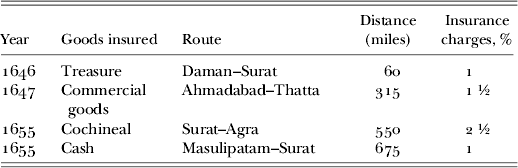
The development of insurance facilities was not unique to Europe. In India, insuring the dangers of trade was an established practice by the mid-seventeenth century. Known as bīmā, insurance was offered on goods in transit and cargo, as well as on hundis, merchants' bills of exchange, by sarrafs, local financiers. Habib has shown that ‘treasure, cochineal, commercial goods, and cash’ were insured by the sarrafs, with levels of premium varying based on the commodity insured and the distance of the transit (Table 1).Footnote 18 Specialist businesses called bīmāwālās traded exclusively in insurance and transport, and charged for their dual service in combination. These businesses were often extensions of family trading firms active within larger constellations of kin networks which dealt in general merchandise.Footnote 19 In his 1832 Memoir of central India, John Malcolm referred to ‘insurance companies’ at Oojein, Indore, and Mundissor, which covered goods while in inland transit, and which kept small corps for defence against plundering chieftains and bandits.Footnote 20 Saran suggested that insurance in India began to ‘flourish’ under the Emperor Jahangir, after he relaxed government monopolies over the business, and that bīmāwālās' premium rates were variable in wartime, because ‘the worth of the skill and the courage of the insurer’ was considered in pricing.Footnote 21 In addition, Subramanian and Nightingale have revealed a small but profitable respondentia market in Surat and Bombay from at least 1749, in which both local and European merchants borrowed from each other, sometimes on a subscription basis, to finance trade cargoes.Footnote 22
Insurance rates offered by India's bīmāwālā
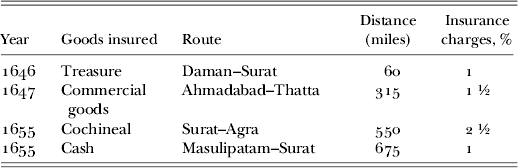
Source: Habib: ‘Potentialities of capitalistic development’, p. 71.
The bīmā business was mature and effective, but Parthasarathi's recent assertion that ‘the marine insurance markets in Gujarat and Britain appear to have operated on similar footings in the seventeenth and eighteenth centuries’ is shown, upon closer inspection, to be correct only on the most basic level. The systems shared a defining characteristic of premium insurance: the provision of only contingent capital in cases of actual loss, in exchange for a fee paid in advance, calculated against the value of the goods insured and the route of transport. In this way both bīmā and European-style insurance differed from earlier European forms which advanced capital for trade, but waived the debt in cases of loss. This parallel development supports Parthasarathi's argument that advanced regions of India possessed a dynamic commercial economy in the eighteenth century. However, the similarities go little further. Parthasarathi based his assertion on a comparison of Gujarat and London rates, but his India prices are a century older than his London sample; they reflect local rather than international shipping (inasmuch as these terms can be validly applied), and unlike European insurance, bīmā was offered and provided in conjunction with transportation services. Parthasarathi compared prices for insuring goods in transit on land with those for insuring goods on the high seas; the conditions of insurance cover were not comparable, and the London rates he used are drawn from a single, unrepresentative source.Footnote 23 Further, outside of the respondentia business, the European practice of sharing individual risks between multiple underwriters seems to have been absent in India, leading to ‘considerable capital and cash flow problems’ for the insurance of very big consignments, and marking a significant difference between Indian and European underwriting practice.Footnote 24 These differences meant that European-style insurance was better suited to long-distance, high-value trade, and provided greater and broader loss protection than its Indian counterpart. The disparity in practice also meant that European buyers were not sure of what to expect from their local insurers.
An example illustrates. Before the foundation of European-style insurers, EIC factors in India sometimes purchased insurance from bīmāwālās. A dispute between factors and unidentified local insurers in 1653 was referred to the governor at Surat. The factors, concerned about possible capture by the Dutch, had insured the vessel Supply for 7,500 rupees. Capture risk was routinely covered under London policies, but when Supply was taken the insurers refused to pay, citing its voluntary surrender. Upon appeal, the governor appointed four ‘banyans’ to examine the matter. They upheld the claim, but called for the Dutch to compensate the insurers. The governor would not enforce their decision. Perhaps displaying the frustration typical to one whose claim has been denied, the factors wrote that ‘these people seem inclined to take sides with the Dutch and satisfy their own greed out of the company's goods on shore’. As the dispute rumbled on, the British were advised that ‘there was little reason that the shroffs should make satisfaction, seeing the goods were lost upon our own ships, given up by our owne people to the Dutch’.Footnote 25
Despite its distance from India, London was the first important source of insurance for the ocean-going London–India–China trade conducted by private merchants outside the EIC, and for the ‘privilege trade’ of the Company's servants. Merchants present in London, or with agency representation or affiliated offices there, could, and frequently did, acquire cover in the City. In 1799, the agency house Law & Bruce purchased cover of £160,000 for the Indian-built Scaleby Castle for a voyage from Bombay to London, on behalf of the ship's joint owners in Bombay, a European agency house and a Parsi merchant.Footnote 26 Lloyd's underwriters' base rates were uniform for standard risks, but the price charged in individual cases was increased or reduced based on a multiplicity of factors: risk type (ship, goods, or specie); the voyage and the quality of vessel and competence of her master; recent political events local to the voyage; coverage details such as warranties, abatements, and limitations on average; broker involvement; the volume of insurance purchased by the buyer over time; the weather; and, from the buyer's perspective, the reputation (that is, credit-worthiness) and experience of the underwriter. Nonetheless, base rates were widely publicized. In 1797, insurance prices in London on ships to and from the East Indies were as follows:
To Bengal, Madras, China and home: £ 12·60 per £100.
To Bengal and China: 8·40 per £100.
Extra ships to the East Indies and home: 18·90 per £100.
Extra ships out: 10·50 per £100.
Extra ships from the East Indies to London: 15·75 per £100.Footnote 27
Insurers at Lloyd's also underwrote the ‘country trade’ along the India coasts and between India and China. The 1807 risk book of the Lloyd's underwriters Clagett & Pratt comprises a record of the insurance they sold during the year. It shows, for example, that the London agency Bruce & Co. bought cover in February for goods shipped from Canton to Bombay on the vessel Anna, six weeks later for goods on the return voyage, and shortly after for the next Bombay run.Footnote 28 Each entry in an underwriter's risk book reflects only one of many ‘lines’, or proportional shares, underwritten on specific risks. Edward Allfrey's 1809 underwriting records show that on 2 January he accepted lines worth £2,000 in total on three policies covering cargo belonging to Bruce & Co. while in transit from Calcutta to London. The same day, the underwriter John Janson insured £1,500 worth of Bruce & Co's cargoes for the same voyage.Footnote 29 Janson wrote lines on Bruce & Co. policies on thirteen occasions during the year; on three of these risks, Allfrey also participated.
III
The absolute value of the export trade from the region which might have been insured cannot be calculated from the extant record, but various estimates show trade values to have been substantial and growing during the period. Deane and Cole specified British ‘East India’ imports, at book value, of £1·7 million in 1780–1, rising to £5·8 million in the year 1797–8. Davis calculated British imports from Asia and China of £4·95 million in 1784–6, rising to £7·34 million a decade later, and to £11·8 million in 1814–16. Total trade in Canton, both EIC and private, including specie, was estimated by Greenberg to be approximately £3 million in 1820. A rough estimate of Calcutta's global imports and exports for that year, also including specie, can be calculated from figures published by Tripathi at about £5·8 million and £7·3 million respectively. Of course, companies did not limit insurance sales to goods shipped to Britain; John Jacob Astor, for example, insured with the Canton Insurance Company goods shipped from China to New York.Footnote 30
While obtaining insurance in London for this trade was simple enough for outbound ships, knowledge of the risk was less comprehensive, and thus insurance more expensive, for return voyages. It was even more complicated for the country trade, and for voyages between India and China, since underwriters in London had imperfect knowledge of the risks undertaken. In 1809, Janson charged Bruce & Co. £9·45 or £10·50 per £100 of cover for vessels returning from Bombay and Calcutta, while the rate from London to India was always £7.Footnote 31 The reasons for the difference are several: occasionally, insurance cover may have expired before the extent of the underwriters' liability was known, and often the names of vessels were unknown at the time of underwriting, so their seaworthiness and defences could not be assessed.Footnote 32 The challenge of underwriting Eastern trade from London was exacerbated by the lack of swift, ground-based communications between Britain and India, since the weekly packet had been halted by Anglo-French war. Further, Lloyd's could not provide claims payment in India, which local merchants and agency houses would have preferred in many cases.Footnote 33
Despite the advanced state of India's indigenous insurance sector, resident European merchants had turned, by the later eighteenth century, to local private underwriting which followed London's model. Driven by the perceived potential for easy profits (and in spite of the very real possibility of severe losses), private underwriting was flourishing. Evidence of its ubiquity lies in the widespread sale of blank insurance policy documents, and the emergence of multiple insurance brokers, including Robert Duncan, who in 1782 advertised his services in the India Gazette to Calcutta's ‘Merchants, and Captains of Ships and Vessels’.Footnote 34 On one extreme occasion, the merchant-captain Thomas Mercer simply advertised that he would accept subscriptions ‘for the Insurance of one Lack of Rupees, upon his Ship the Resolution, from Kidgeree to Madras, at a premium of 8 per Cent’ from any underwriters who cared to assume a share of the risk at that price.Footnote 35 However, individual underwriters presented an unknown credit risk to those buying only a promise to pay. In 1781, an anonymous correspondent to Hicky's Bengal Gazette complained bitterly of the rise of the practice of private underwriting:
When I reflect on the present state of private insurance and the number of desperate and needy adventures who, without being possessed of almost a single Rupee … plunge deeply into this alluring and attractive branch of business, I am filled with astonishment … Lately you can hardly shake a Plantain Tree, but out flies an under writer.Footnote 36
The large number of individual underwriters concentrated at Lloyd's in London, and the broad international pool of risks from which they drew to diversify their risk portfolio allowed individual underwriting to flourish there. In the small commercial centres of India, it could be neither as secure nor as effective. Thus local merchant-insurers, unrestricted by the provisions of the Bubble Act, coalesced into semi-formal corporate underwriting bodies, which was a first step towards solving the credit problem, and made buying insurance much easier. ‘The Society for the Insurance of Foreign Vessels’ announced in 1780 that, following a capital increase, it was to ‘Insure indiscriminately upon all English or Foreign Vessels, proceeding to and from the different Ports in India, or to Europe’.Footnote 37 The Amicable Insurance Association, associated with the prominent Calcutta merchant Joseph Barretto, was launched two years later.Footnote 38 Some insurance groups operated and advertised without even adopting a name, such as the ‘New Insurance Society for underwriting Policies on Ships or Merchandize’, established in Calcutta in July 1782 and associated with Thomas Adams, a resident merchant and ship's captain.Footnote 39 Such associations amounted to little more than a formalization within syndicates of private underwriting by individuals, but they initiated the formal organization of the business, and provided a larger and more secure source of risk transfer than limited communities of individual underwriters taking on relatively undifferentiated risks.
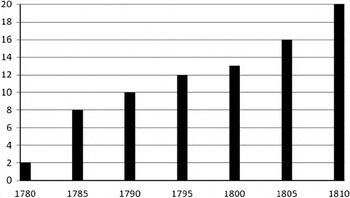
Corporate insurance formations surged in the following years. The establishment of joint-stock insurance companies took this process of institutional development a step further. The Calcutta Insurance Company, operating since at least 1780 as ‘a society of Gentlemen for the purpose of underwriting Policies of Insurance, for Ships, Merchandize’, had paid-up capital of Rs 250,000 by 1782, making it rather more than a syndicate of underwriters.Footnote 40 As the decade progressed, these corporate insurers proliferated in British India as joint-stock companies under formal articles of co-partnership. Considering the relatively small size of the established communities, foundations occurred at a dramatic pace. From two in 1780, the total number of company foundations had reached twenty by 1810, with companies established in Calcutta, Bombay, and Madras by 1785 (Figure 1). Their paid-up capital was typically invested in EIC and other metropolitan bonds, or was loaned through mortgages, or both.Footnote 41 A secondary market in the insurers' shares quickly developed, allowing gentleman investors to participate passively in the marine insurance business which directly provided the contingent capital necessary for commercial expansion.Footnote 42 Through insurers' investments, the joint-stock form also channelled gentlemanly capital indirectly into the imperial project.
Number of insurance companies operating in India and China, 1780 to 1810Sources: see text. Total may include companies dissolved.

Risk capacity – the total value of risks which can safely be insured based on an individual insurer's available capital, or that of an insurance market – offered through indigenous structures and ad hoc underwriting had been insufficient to meet the growing demands of merchants trading on an oceanic dimension. The ability to raise large sums through small contributions is widely accepted as a key advantage of the joint-stock structure,Footnote 43 and the model was soon widely adopted by insurers. These institutional improvements did not prevent failures. When the Lady Munro, sailing from Calcutta to Hobart Town, sank near the Island of Amsterdam in 1833,Footnote 44 the resulting claims swamped the Ganges Insurance Company, which made a final cash-call on shareholders, then ceased operations.Footnote 45 Nevertheless, corporate insurers improved capitalization and transparency, and can only have made the underwriting market more secure.
The introduction of European-style companies had other benefits for customers. The imported methodologies and law merchant governing insurance practice, as honed in London, were more clear and familiar to British merchants, had been proved efficient there over centuries of use, and offered very broad cover. Dispute resolution procedures under the system were efficient, and also well understood; Bombay and Calcutta newspapers regularly reported insurance-related legal cases heard in London, which helped insurers and their customers to keep abreast of precedents. In short, the recreation in India of the insurance practices developed in London meant that foreign residents were able to purchase exactly what they were expecting. The articles of co-partnership of the Ganges, launched in 1791, illustrate the possible expectation gap between the indigenous and the European insurance product:
The [insurance] Business, being almost entirely in the Hands of the native bankers, who are guided solely by Caprice and Custom, without any knowledge of the true principles of assuring as practised in European Governments; and as in particular, a Custom, prevails which is the source of continual Suits in the Supreme Court and Courts of Adawlut, viz. ‘That Goods sunk and recovered, however damaged, absolve the Insurer.’Footnote 46
Demand for local insurance provision continued to grow with trade, such that by 1810, local merchants in the key commercial centres of India and China were able conveniently to insure their ocean-going commerce in the conventional European way. The efficacy of these facilities was made clear through the testimony of John Barr of East India agents Paxton, Cockrell, Trail & Co. to an 1810 House of Commons select committee:
William Manning (enquiring): It was, then, for the purpose of insuring the country trade in India, that the insurance companies there were established?
John Barr: Yes, and also to insure the risks from India to England.
William Manning: Do you believe it would be practicable to insure the country trade in India, without the existence of some insurance companies there?
John Barr: I do not.Footnote 47
European-controlled agency houses lay at the centre of the new Indian joint-stock insurance company sector. Agency houses first appeared in the 1780s; fifteen were operating by 1790. They provided personal finance and investment services to EIC servants in India, managed relationships with Indian merchants, operated in local and inter-Asian trade, and invested in local industries such as shipbuilding, plantations, and salt production. Webster described the agency houses and the EIC as ‘so close that they were effectively partners in the Imperial project’.Footnote 48 Marine insurance was a logical extension of these activities, as the agency houses possessed the capital, contacts, and expertise necessary to meet local insurance demand. They developed India's new insurance infrastructure within a few years of their own establishment, managed the insurance companies they created, and typically remained large minority shareholders in them, collecting additional shareholders from among local private men of means, and from merchants both native and foreign. William Milburn, in his 1813 account of ‘Oriental Commerce’, compiled a list of ten insurers and agencies operating in Calcutta and the agency houses with which they were associated. It shows that all the major houses were involved in the business.Footnote 49 Many individual investors were active in more than one insurance company. For example, William Harington, Henry Burnaby, and Alexander Cockburn, whose agency in 1801 was the lead shareholder in the Old Madras Insurance Company, were in 1802 among the leading individual owners of the Equitable Insurance Company, launched that year, with the Honourable Basil Cochrane, merchant, victualler, and senior EIC representative in Fort St George, and another twelve prominent citizens of the city.Footnote 50
Joint-stock insurers formed under the auspices of the agency houses soon dominated the underwriting landscape. According to Singh, six insurers operated in Calcutta alone in 1804, eight in 1808, and fifteen in 1832.Footnote 51 However, among them he cited the Canton Insurance Office, which was represented there only through agency. In insurance jargon, agency is an authority granted to individuals, or typically in India in this period to affiliated agency houses, to underwrite and accept insurance risk on behalf of an insurance company, against their capital, in exchange for commission (typically 5 per cent of the premium according to records of the Canton Insurance). Insurance companies' reach was extended significantly through agency to all major entrepots in the region, such that by 1810 at latest, the Canton Insurance had agents in Manila, Macao, Singapore, Calcutta, Bombay, and Madras, and later in Melbourne. The various companies and their agents tended to charge the same rates for similar risks, and joined together to take lines on large contracts, thereby allowing local markets to cover larger risks, to spread them more widely amongst the underwriting community, and thus to diversify their risk portfolios. Companies also spread and diversified risk by accepting it as agents on behalf of other insurers, usually those established in different Presidencies, as well as for their own accounts. For example, the Bengal Insurance Company announced in 1788 that is was henceforth to accept risks on behalf of the Bombay Insurance Society.Footnote 52
William Russell of the Bombay agency house David Scott & Co. reported twelve insurance companies operating in India in 1810, including seven in Calcutta, five in Madras, and a branch of the Calcutta Insurance Office in Bombay.Footnote 53 However, his evidence represents an incomplete knowledge, since the Bombay Insurance Society was certainly underwriting then, and continued until 1865.Footnote 54 Milburn provided an idea of the scale of the companies, reporting that ‘the Calcutta Insurance Office insured, from its establishment in 1798 to the spring of 1809, to Europe £2,411,157, the whole of which, in case of loss, was payable by their agents in London, being on an average about £220,000 per annum’.Footnote 55 A more precise account of the volume of business undertaken by local insurers was provided early in 1809, when the merchants, shipowners, and underwriters of Bombay published several resolutions to recognize the success of Royal Navy convoys. Between May 1805 and October 1808, Bombay's marine insurers, public and private, insured ships and goods worth £6·7 million, in exchange for premiums of £445,000 (an average premium rate of roughly 6·6 per cent), paid losses of £130,000 (of which £61,000 were attributed to captures by enemy vessels), and thus shared profit of £314,000 (although this simple accounting fails to recognize expenses such as the 5 per cent agency commission, a further commission paid by insureds to their brokers or correspondents – typically 0·5 per cent of the sum insured – and conventional commercial overheads). Rates for shipments between Bombay and China had fluctuated between 12 per cent and 8 per cent from 1789 to 1805, but, following the organization of convoys, stabilized at 8 per cent in the years to 1808. Further, insurers returned a portion of premiums paid equal to 3 per cent of insured values to customers that successfully completed voyages in convoy.Footnote 56 At this time, Clagett was underwriting India–China risks in Lloyd's at six or seven guineas per cent.Footnote 57 London was cheaper, but the accessibility and local claims-payment facilities provided by Bombay underwriters must have been deemed by many buyers to be worth the premium.
Despite the success of convoying, war exacted a toll from the new insurers of India. Between 1798 and 1807, seven insurance companies established in Calcutta paid claims of more than £1·7 million against losses arising from enemy capture. The addition of losses incurred by insurers in Bengal and Madras brought the total to £2,089,640. In the first two months of 1807, claims against Calcutta insurers for twenty ships captured in the Bay of Bengal the previous September–October ‘amounted to upwards of £300,000 sterling’.Footnote 58
Firms such as Fergusson, Fairlie & Co. of Calcutta and Scott, Tate & Adamson of Bombay worked in close alliance with houses such as Baring & Co. in London, which collected their remittances and provided finance, and with agency houses established at Canton.Footnote 59 In the field of insurance, this allowed the new insurers of India and China to provide claims payment in London, such that in December 1792 the Calcutta Insurance announced it was ‘to render [the] Office of as much utility as possible’ by establishing correspondence with Messrs Boehm & Co. of London.Footnote 60 In 1798, the Old Madras announced a similar arrangement with the same firm.Footnote 61
Both Rungta and Smallwood claimed that the new insurers of India and China were entirely British, which may have been true of their nature, but was not true of their ownership.Footnote 62 The economic role of Indian merchants had increased with the Gujarat–China trade, especially among Parsis, who evinced ‘the most successful case of assimilation by the British in Asia’.Footnote 63 Locals acted as both financiers and inland purchasing agents, first for cotton, later for opium, the rising commodity of trade with China.Footnote 64 Soon, local shipowners, particularly Parsi, but also Muslim and Hindu, became important participants in regional trade, owning twenty Bombay-registered ships by 1792.Footnote 65 Such men were also to participate in the extension of the marine insurance industry that supported trade and empire. For example, Jamsetjee Jeejebhoy, a prominent Bombay trader in cotton and opium, was both a customer and shareholder of the new insurers which provided risk transfer facilities for his primary business.Footnote 66
In 1792, the shareholders in the Bombay Insurance Society included twenty-two Europeans, four Parsis, and two Hindus.Footnote 67 Ten years later, the role of native merchants as insurance capital providers had increased: shareholders included twenty-three Europeans, twelve Parsis and four Hindus. Parkinson stated that during this period ‘the whole mercantile community of Bombay … numbered about forty-five. Of these less than twenty were white men.’Footnote 68 If accurate, a large minority of the merchant community was involved in the venture. The group included both merchants and shipowners, as well as several members of Bombay's European social aristocracy and its EIC servants. Among them were the former governor, the sheriff, the senior partners in Bombay's leading agency houses and native shipbuilding firms, and three non-residents with strong links to the Presidency's trade. One of these was the prominent merchant and EIC director David Scott, a friend of Pitt whose role in influencing imperial policy is well known.Footnote 69 He alone among the group fits the Cain and Hopkins conception of a metropolitan gentlemanly capitalist.Footnote 70 The group instead comprised Bombay's mercantile and European colonial elite, and reflects what may be described as peripheral gentlemanly capitalism. The agency-house partnerships served as bankers and indirect investment vehicles for EIC servants, and were assisted by Indian merchants.Footnote 71 In contrast, the joint-stock nature of the new insurers offered a direct investment opportunity under a model that was much older than anyone has claimed for gentlemanly capitalism: the drawing by merchants upon the capital of other men of means to expand the resources available in case of loss.
IV
The advantages of having insurance available, and insured losses payable, in Canton prompted resident foreign traders, from 1801 at least, to form temporary associations of private underwriters to cover ships and their cargoes for up to 12,000 Spanish dollars.Footnote 72 That year, the merchant house Reid, Beale & Co. wrote to a pair of merchants in Manila that
individuals [in Canton] are often inclined to take risks by insurance – several Gentlemen agreed among themselves to underwrite to the amount of 10,000 or 12,000 Ds in one ship according to the risk voyage. This you will observe is quite a temporary association, but while it exists, you may rely on the most perfect good faith being observed.Footnote 73
With demand rising, in 1805 the arrangement was formalized as the Canton Insurance Company, forerunner of the Canton Insurance Office. The company, styled legally as a co-partnership of shareholders, but in function a joint-stock company, was created by Beale Magniac & Co. (which became Jardine Matheson & Co), and was managed, usually on a rotating, five-year basis, with the agency's key Canton competitor, Baring, Moloney & Robarts (which became Dent & Co). At the end of each operational period, in the common fashion, the Canton Insurance was wound up, to be reconstituted with a new, although typically extremely similar, shareholder grouping. It was in this incarnation of the Canton Insurance that the custom of international shareholding was established in China. Unlike the agency houses, which were owned by their principals, sometimes including partners in Britain, the insurers had a wide shareholding, in order to create a large risk pool and a wider capital base, and thus a greater capacity to underwrite insurance risk.
The capital backing the Canton Insurance was substantial. A September 1820 letter from the ‘Sixth Canton’ to new shareholder Palmer & Co., a Calcutta agency house, illustrates. ‘We shall depend upon your obligingly arranging to put a sum of 10,000 or 12,000 £ into the hands of the Agents in question, to meet any possible losses, as soon as you conveniently can.’Footnote 74 Thus, with sixty shareholders, insurer's paid-up capital is implied to have been between £600,000 and £720,000. Demand for premium insurance arose not only from European traders active in China: local merchants quickly adopted the offering. Between January 1816 and December 1817, the hong merchants Howqua, Keetshing, Kinkqua, and Waqua purchased cover from the Canton Insurance, indirectly adding, through premiums, local Chinese capital to the risk pool.Footnote 75
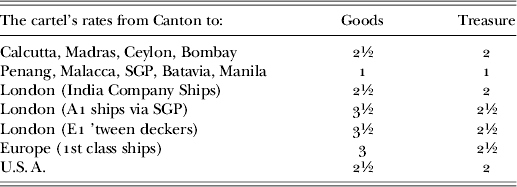
Supplementing the local risk transfer facilities of the Canton Insurance were several agencies of the Calcutta-based companies, which extended to China the reach of the agency houses which created them, as well as diversifying the risks assumed, and spreading them over a wider territory. Agency was often granted to companies which simultaneously operated or represented competing insurers. Thus, in 1829, Magniac & Co. managed the Canton Insurance, and had been appointed the local agent of five insurance companies based in India. Whiteman & Co. had agency for the Ganges, and John Templeton for the Asiatic. With the establishment of these companies, premiums in Canton were ‘not much higher than Lloyd's’ (Table 2).Footnote 76 As in India, insurers typically did not compete based on price, but underwrote according to agreed rates of premium, co-operating to provide insurance for risks which approached the largest underwritten at Lloyd's. By 1831, the Canton Insurance was working with local agents of the insurers established in India to combine their risk-carrying capacity to grant policies of ‘over £200,000, any one bottom [vessel]’.Footnote 77
Rates charged by the new insurers in India and China, 1831, per cent
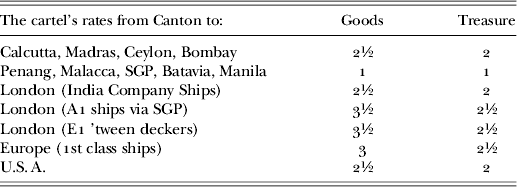
Note: Rates were charged as a percentage of the policy value, and adjusted based on specific details of the vessel, the cargo, the route, the coverage, etc. SGA = Singapore.
Source: Canton Register, 2 Jan. 1831.
Like the Bombay Insurance Society, the Canton Insurance had a similarly diverse ownership structure. Its 1832 shareholder register shows that equity in the company was distributed in part among merchants with whom the insurer's sponsors, the leading Canton agency houses, conducted business. This group included many non-Europeans. For example, Parsi merchants in Canton and Bombay were prominent among the shareholders in 1836.Footnote 78 One in five shareholders was non-European; between them they held 13·5 per cent of 200 shares.Footnote 79 Unlike the agency houses, which tended to be partnerships formed between British or other European colleagues, and in contrast to Parsi, Muslim, and Hindu businesses, which were usually family groups, the insurance companies had multi-continental, multiracial shareholder groupings, which often placed native merchants and investors alongside European and British expatriates.
The selection of shareholders was biased towards merchants who would also be customers. In an 1835 letter to Messrs Timothy Wiggan & Co., appointing the firm as general agents for the Canton Insurance in London, the company wrote: ‘16 shares are appropriated for distribution among shareholders in England, in selecting whom you will of course give a preference to those parties who may be most likely to benefit the office by the extent of their business.’Footnote 80 Thus, it would be other merchants who could expand the risk pool, rather than those with idle capital (gentlemanly or otherwise) who were sought as investors in the mother country. The proprietors could afford to be choosy, as the shares were sought-after. In 1837, the Canton Insurance wrote to Messrs D & M Rustomjee, active trading partners of Jardine Matheson & Co., ‘We are favoured with your letter intimating your wish to become interested in the Canton Insurance Office, but regret having no shares to spare at the moment. We shall endeavour to reserve one for you … should a vacancy occur.’Footnote 81
Profit was certainly an attraction. In 1836, the Canton Insurance recorded a surplus of $143,813, or about $700 per share, doubling to $289,530 in 1837. In 1838, when the vessels Antonio Pereira and Ruby were lost, the insurer paid total claims of $202,780, but total premiums of $296,432 still yielded an operating profit.Footnote 82 The insurers prepared for such eventualities by reserving profits from earlier years, although it was not always possible to pay dividends: We ‘regret sincerely to observe the heavy losses to the present Society, which we fear cannot wind up more than square’, the Canton Insurance wrote to its agents in 1823.Footnote 83
In 1831, five agency houses and several European and Parsi private traders were operating in Canton, but Jardine Matheson & Co. and Dent & Co. together controlled about two-thirds of the trade.Footnote 84 They were especially important when it came to exporting Indian opium to China. This business, which burgeoned from 1,000 chests in 1773 to more than 23,500 in 1832, whether in ‘official’ EIC opium or ‘contraband’, was routinely insured.Footnote 85 Premiums were based on the value of the cargoes. Annual sales increased almost 150 per cent between 1828 and 1833, and by 1836 total opium imports at Canton fetched $18 million. However, the price impact of increasing competition meant that total receipts had increased only 47 per cent in the six years to 1833.Footnote 86 Assuming a peacetime insurance price of 2·5 per cent, and full penetration of cover for the sale-value of opium shipped, the premiums paid for insuring this trade between India and China would have exceeded $250,000 in 1827–8, reached $380,000 in 1832–3, and $450,000 in 1836.
The details of thousands of insurance policies underwritten by those insurers in which Jardine Matheson & Co. had an interest – as shareholder, manager, or agent – survive in its archive. For example, the policy register of the Canton office of the Bombay Insurance Society shows that in August 1824 the Parsi trader Framjee Ruttonjee insured for shipment ‘20 Chests of Company's Malwa Opium’. Numerous entries record the insurance of cargoes of opium ‘off Lintin for one month’.Footnote 87 These inexpensive policies provided the merchants with cover to protect their investment in the drug during the period between its arrival at the Lintin trading centre and its eventual collection by Chinese buyers. William Jardine promoted similar cover to his Bombay trading partner Jeejebhoy in a letter of 1833. ‘In effecting your Insurance on returns in Sycee [silver], you should if possible include the risque on board the receiving ships at Lintin while the silver is there waiting a conveyance to India. The time might be limited to thirty days, as is customary in the Tenth Canton, our small office.’Footnote 88
From 1760 until the opening of additional ports under the 1842 Treaty of Nanking, foreign trade with China was prohibited, except at Canton. By the 1830s, however, European traders frequently breached this restriction. The ‘private English’ went ever further afield to ensure safe sales of contraband opium at good prices, and insurance practice followed. In 1833, Jardine Matheson & Co. sent the independent Canton merchant James ‘The Laird’ Innes on three voyages up the China coast, to Fukien and Chekiang.Footnote 89 The expeditions served to expand markets, but also had a political purpose, as the European merchants at Canton grew increasingly frustrated with costs and restrictions which hampered trade.Footnote 90 Insurance practice followed this new trade pattern immediately. From 1832, the Bombay's policy register records increasingly frequent insurances covering Jardine Matheson & Co's opium shipments to ‘off the east coast of China’, and ‘treasure’ on the return voyage.Footnote 91
On 1 January 1835, when Jardine Matheson & Co. were managing the Canton Insurance, Dent & Co. established the Union Insurance Society of Canton, which began accepting business on 25 February that year.Footnote 92 The launch appears to have led Jardine Matheson to dissolve the old arrangements of alternating management of the Canton Insurance Company, and re-launch it as their chief insurance vehicle, changing the name to the Canton Insurance Office. Despite this, the shareholder structure remained similar: Dent & Co. held eight shares in the ‘new’ Canton Insurance at its launch in 1836.Footnote 93 So similar was the organization that the articles of co-partnership of the new company were based on those of the old, the model surviving in the letter book of the Tenth Canton, where the articles are recorded, and the words ‘Tenth Canton Insurance Company’ amended in pencil to read ‘Tenth Canton Insurance Company Office’.Footnote 94
Jardine Matheson & Co. also operated a private underwriting account, Jardine Matheson & Friends. Launched in 1829, its thirty-six shares were held by nineteen shareholders, men who fell among the agency's closest partners. Usually about twenty shares were held by the partners of the firm, a handful more by ships' captains employed by the agency house, and the rest by its most important or trusted business partners, especially its Indian native partners. It was clearly an exclusive operation, and probably assumed only the highest-quality risks, allowing this close-knit group to garner greater profit from the business of insurance. As with the Bombay Insurance Society and the Canton Insurance, it was a local initiative which operated entirely independently of metropolitan influence or interest, formed pragmatically to benefit an exclusive group of Canton merchants, and existed despite the small European presence in the trading port.
In China as in India, the practices supporting the efficient operation of European-style premium-based insurance provision quickly followed the establishment of permanent trading agencies. New insurers in the East insisted upon maintenance, and thus on the safety of the ships insured. A letter from the Canton Insurance to Turner & Co., a substantial shareholder in the insurer, comments on the condition of one of its vessels:
Our surveyor … declares most clearly & distinctly that ‘she requires to be refastened; as without that all the caulking which could be given to her would be of no use’ … we received … copy of a survey held in behalf of the Commercial Insurance Company of Calcutta … in which [the surveyors] declare ‘it is therefore our opinion that the vessels bends and topsides +c. be caulked, and bolt heads chinced all round, and an extra bolt or two put in some of the butts where it may be required, she will receive all necessary repairs, and be stanch and strong, and fit to perform her destined Voyage’.Footnote 95
The legal conventions behind European insurance practice, rooted in the law merchant, also arrived in Canton from London. In 1835, Jardine wrote to Robert Lyall, principal of the Canton Insurance's Calcutta agents,
I confess I cannot keep face with the Committee [of the Canton Insurance] in quietly disposing of property over which they had no authority that I can discern … Such would have been the case, I believe, had the property been insured at Lloyd's, their agents being prohibited from accepting of abandonment … It may appear to you a great presumption on my part to question the conduct of parties who probably acted under legal advice.Footnote 96
V
Oceanic trade in the age of sail was a particularly perilous occupation. The threats posed by men and the seas were compounded by time and distance. Premium-based, European-style insurance could make tolerable many of the financial risks of long-distance maritime trade, but to do so the instrument needed to be cost-effective and sufficiently flexible to meet the many uncertainties faced by merchants in the late eighteenth and early nineteenth centuries. Underwriters in London had adapted Mediterranean insurance practices to create a system which answered merchants' needs when they were in Britain, or indeed when they were close to hand in Western Europe. However, when insurance demand was remote, as India and China, time and distance diminished the cost-effectiveness of London's marine insurance product. The answer was to establish insurance companies on the spot, as and where demand arose. By launching multiple insurers that shared risks underwritten from Bombay to Canton, the merchants were able to develop a broad risk pool that returned the efficiencies of London, and allowed trade to continue and expand. The benefits were quickly recognized by local traders, and seized upon in preference to local risk-sharing structures.
While these new companies were rooted in the European insurance tradition as practised in London, neither the motivation to form them nor the capital which backed them originated in the metropole. Instead they were an initiative of peripheral gentlemanly capitalism which saw merchants and local expatriate elites unite in their creation and continued funding, such that insurance-company shareholding mirrored the trading partnerships which emerged between European residents and local traders. This ‘colonial connection’ underpinned the success of Bombay's Parsi merchants, just as the regional China trade relied upon the financing and organization of supply by local merchants and bankers.Footnote 97 In this environment, where the discrete business practices and cultures of Europeans and Indian peoples overlapped, the community as a whole adopted the most efficacious alternative. In the case of risk transfer, this was to embrace the system of marine insurance developed in Europe and fine-tuned over several centuries of development in London. The enthusiastic investment, through shareholding, by Indian merchants in the new insurance companies formed, illustrates the depth of the partnership. Indian ‘buy-in’ to the new insurance system was literal, as well as figurative, and illustrates the indigenous merchant community's broader participation in the imperial project. The connections drawn to facilitate marine insurance provision also exhibit great breadth: through both shareholding and agency representation, the new insurers of India and China drew together distant merchant communities with interested Europeans to form an international pool of capital to fund the risks of ocean-going commerce.
The joint-stock form explicitly adopted by the entrepreneurs behind the new insurers – those who formed the Madras Insurance Company in 1785, for example, advertised their deposit of ‘capital, or joint stock, of Sixty Thousand Pagodas [Rs 225,000]’ – was something of a watershed in colonial India's business history.Footnote 98 Bayly has argued that uncertainties of the legal environment prevented Indian enterprise from accruing the potential commercial advantages of ‘spreading risk outside kin, caste, and local “moral communities” of the merchants' until after 1850.Footnote 99 According to Kling, the management of joint-stock insurance companies by agency houses to 1834 ‘provided the organizational model for the later managing agency system’ which dominated European business in India the second half of the nineteenth century.Footnote 100 Joint-stock banking emerged only in 1840, with the establishment of the Bank of Bombay.Footnote 101 However, in the specific case of insurance companies, early adoption of the joint-stock form allowed these advantages to be exploited decades earlier than in other fields of finance. While ‘internal trade did not demand capital and risk-taking beyond the capacity of the merchant institutions as they already existed’, farther-reaching trade clearly did, as the broad adoption of European-style insurance under the joint-stock form shows.Footnote 102
The development of the new insurers of India and China was unique within the British empire. Extensive evidence of private underwriting in the American colonies exists for the period before independence; local brokerage firms were formed as early as 1721 to intermediate, and practice followed that of Lloyd's (which remained the main supplier of insurance to the thirteen colonies). However, it was only after the break with Britain that the statutory restrictions of 1720 on marine insurance company formation were lifted in the United States; the Insurance Company of North America, its first, was incorporated by Philadelphia merchants in 1792.Footnote 103 No such developments occurred in the West Indies, where planters maintained close ties with Britain, and insurance was routinely provided from London by commission agents. Yet, it is unlikely that the lack of prohibition alone drove the formation of insurance companies in India and China. The presence and involvement of an indigenous mercantile community possessed of a familiarity with the concept and function of marine insurance, absent in the West Indies and the Americas, provided cross-fertilization.
‘Commerce is indubitably the grand Source, from whence is derived all that enriches, strengthens, and adorns a State; and without Insurance, that commerce could never have been promoted, nor carried on; ––nor can it ever proceed, unsupported by insurance’, the merchant John Weskett wrote in 1781.Footnote 104 In India and China during the period of burgeoning international trade, the arrival of efficient marine insurance was a foundation of the commerce on which Britain's eastern empire was constructed.