




No CrossRef data available.
Rewarding Impatience: A Bargaining and Enforcement Model of OPEC
Published online by Cambridge University Press: 19 May 2004
Abstract
In this article, I make two primary contributions to the literature on international cooperation. First, I present a simple version of Fearon's bargaining and enforcement model and show that impatience (as captured in the discount factor) can be a source of bargaining strength when the outcome of the bargaining phase is followed by an enforcement phase that resembles a prisoners' dilemma. Second, I illustrate how to apply this model to the question of the division of cartel profits within the Organization of Petroleum Exporting Countries (OPEC), particularly with regard to the relationship between bargaining strength and disparate time horizons. I find that for some critical threshold level, states that discount the future more heavily tend to receive better oil production offers than those that do not. I examine empirical evidence that suggests that countries in OPEC fall into the range where this proposition holds; in other words, relatively poor, populous countries and relatively unstable ones are allowed by OPEC to overproduce.I am grateful to Christino Arroyo, Jim DeNardo, Joe Gochal, James Honaker, Shuhei Kurizaki, Drew Linzer, Barry O'Neill, Art Stein, Hiroki Takeuchi, George Tsebelis, Jana von Stein, and two anonymous referees for helpful comments. I am especially indebted to Ken Schultz for his advice and to Randy Calvert for a helpful discussion during the 2003 EITM Summer Institute at Washington University in St. Louis.
Information
- Type
- Research Article
- Information
- Copyright
- © 2004 The IO Foundation and Cambridge University Press
Since the British sector of the North Sea came on line in 1975, many OPEC countries felt compelled to regain market share through rounds of unofficial discounting and sanctioned price cuts. By early 1983, the world oil market was in crisis, and a complete price collapse appeared imminent when the British National Oil Company further cut the price of North Sea crude by three dollars to thirty dollars a barrel.
Of all the OPEC nations, Nigeria competed most directly with the British, as both countries produced oil of similar grade and sold that oil predominantly to the European market. During the two-year period leading up to 1983, the Nigerian government, a new democracy, watched as sales of its nation's oil dropped from two million to less than one-half million barrels a day. During this same period, the government faced declining foreign exchange reserves, acute unemployment, and elections scheduled for August 1983. In an effort to drive down unemployment, Nigeria's Shagari regime expelled one million guest workers. It also considered entering into an International Monetary Fund rescue package, but the regime felt compelled to reject that option because the package required what would have resulted in a highly unpopular currency devaluation.1
New York Times, 17 February 1983, D1.
In response, Iran and Algeria called on Gulf producers to shoulder more of the burden by cutting their output further, allowing poorer OPEC countries larger production quotas.2
New York Times, 21 February 1983, A1.
New York Times, 23 February 1983, D1.
Why would large OPEC producers subsidize Nigeria in this way? Cooperation theorists might answer this question by saying that the long-term benefits of cooperation among OPEC members must have outweighed the short-term sacrifices required to hold the cartel together. More formally, neoliberal theorists have captured this answer in the idea of the shadow of the future. These theorists argue that a long shadow of the future sustains cooperation in the strategic games used to represent situations of conflict and cooperation.5
See Stein 1982; Lipson 1984; Axelrod 1984; Keohane 1984; and Oye 1986.
Fearon 1998. Powell makes a similar case, arguing that the effects of the shadow of the future in specific empirical contexts are sensitive to the temporal sequence of costs and benefits. See Powell 1999, 73.
Fearon models international cooperation as involving two distinct, yet interrelated parts: (1) a bargaining problem and (2) an enforcement problem. Fearon developed these distinct parts as two linked phases: in the first phase, states bargain over the particular deal that is to be implemented during the second phase. Fearon, however, does not address what happens when the two actors have vastly different discount rates. Although basic bargaining models have suggested that patient actors enjoy stronger bargaining positions,7
there are circumstances in which impatience enhances a player's bargaining strength.In this article, I develop a simple version of Fearon's model that suggests that when states bargain to determine an agreement and the subsequent enforcement phase of the game resembles a prisoners' dilemma, impatient players can earn a better outcome than their more patient rivals. I apply this model in an extended illustration of bargaining behavior within OPEC. Using data from OPEC over a thirty-six year period, I find empirical evidence to support the claim that impatient players earn better outcomes than their more patient rivals. This result corresponds with Olson's finding that “there is a systematic tendency for the small to exploit the large” though for different reasons.8
In the model I develop, a state's source of bargaining strength comes from its highly credible threat of defection from the organization, not from the benefits of free-riding. Cooperation is sustained by increasing the rewards to the smaller, less patient actor. In order to test the model, I develop a unique operationalization of the discount factor—an important theoretical component of the cooperation literature that is rarely rendered as a variable for statistical analysis. I also test the model using two additional measures of political instability that also serve as proxies for the discount factor.The article proceeds as follows. The first section presents a simple version of Fearon's model and explores the relationship between bargaining strength and time horizon. The second section serves as an applied illustration of the basic form model to the case of bargaining within OPEC. The substantive implications of the model and data analysis, as well as general conclusions, are the subject of the final section.
Simple Form Bargaining and Enforcement Model
The game presented here is a simple version of the two-state bargaining and enforcement game developed by Fearon.9
In the first stage, the two actors must bargain to decide among possible deals they will implement before they begin cooperating. In the enforcement phase that follows, states have a short-run incentive to defect while the other side cooperates, therefore, this phase is modeled as a repeated prisoners' dilemma.Players, Sequence of Moves, and Payoffs
There are two players, 1 and 2, that select a particular cooperative deal in the first phase of the game. Let R = [0,1] be the policy space and let each point in R represent a different cooperative arrangement. The states have conflicting preferences over deals in R, where each player wants to achieve the largest possible amount for itself. Let the utility for player 2 be called r and the utility for player 1 be 1 − r. Assume that player 1 moves first and offers player 2 some value of r. In this model, r is an endogenous variable, the level of which is chosen by the first player.
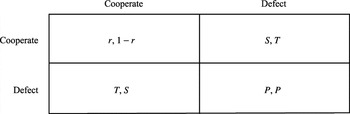
When the states manage to agree on a particular deal in the bargaining phase, they will next play a repeated prisoners' dilemma in the second phase of the game. Assume a standard prisoners' dilemma payoff structure such that T > r,1 − r > P > S where T is the temptation payoff, P is the punishment for both playing defect, and S is the sucker payoff for cooperating when the other player defects. The basic form of the enforcement game is presented in Figure 1.

Stage game of the enforcement phase (a prisoners' dilemma)
Cooperation in the Enforcement Phase
The first player offers some value r, such that the second player prefers cooperation to defection. What does r have to be to sustain cooperation? Grim Trigger—which answers any play of Defect with Defect for all future rounds—is an effective reciprocal strategy for enforcing cooperation. I assume that the deal is enforced with a Grim Trigger strategy.10
I have chosen to use the Grim Trigger strategy because it is the harshest penalty for noncooperation, thus, this strategy is a limiting case. See McGillivray and Smith 2000.

The relationship that I am most interested in exploring, however, is between r, the reward for cooperating agreed to in the bargaining phase of the game, and δ, the discount factor.11
Results are identical for player 1 who receives 1 − r.
Proposition 1: As a player's time horizon shrinks, the minimum offer needed to maintain cooperation goes up.
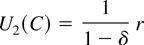
Proof of Proposition 1. The expected utility calculation for playing cooperate forever is:
The expected utility calculation for defecting once against cooperation is:
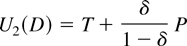
What is the lowest level of r such that cooperation might be sustained? Set the expected utility calculations equal to each other and rearrange:

Take the partial derivative of r with respect to δ:
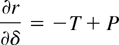
This derivative is always negative, by assumption, because the temptation payoff (T) exceeds the punishment payoff (P) under the assumptions of the prisoners' dilemma. This suggests an inverse relationship between the offer, r, and δ, the discount factor. In fact, less patient actors actually receive better offers than their more patient rivals in this bargaining setup. A lower discount factor makes the player's threat of defection highly credible, because a player that does not know if it will be in the game in the next period is unlikely to place a high value on future cooperation. Furthermore, this relationship is not dependent on choice of punishment mechanism. Imagine an equilibrium that takes the form of cooperation in any period where the other player has cooperated in the past. Let πi be the average per period value of the remainder of the game after a unilateral defection. Again, cooperation is sustained as long as r > T − δ (T − πi), where πi is replacing P from the special case of Grim Trigger. Any punishment strategy whose per period payoff is of the form πi < r (that is, where reward is better than the average punishment value) will demonstrate the same relationship between r and the discount factor, δ.
What are the implications of this finding? For situations where one believes that actors must bargain over the type of deal they will enforce in future periods, and this enforcement phase resembles a repeated prisoners' dilemma, impatience can help an actor to achieve a better outcome. This finding cuts against the conventional wisdom regarding the effect of the shadow of the future and is independent of Fearon's finding that a longer shadow of the future encourages actors to bargain harder.12
The significance of this result is considerably more interesting in the context of a substantive example. In the following section, I develop an extended illustration of this simple form bargaining and enforcement model where I provide theoretical and empirical support for the claim that impatience is a source of bargaining strength in OPEC.The Division of Cartel Profits in OPEC
Cartel dynamics provide a rich example of international cooperation that is best characterized as having both a bargaining and enforcement phase. An effective cartel accomplishes two basic tasks with respect to the commodity it delivers to market. First, it sets a price for the commodity that maximizes profits to the cartel. Second, it apportions profits among its members. This second task is a more uniquely political undertaking. That is, during the process of revenue apportionment, cartel members must tussle over the size of each member's share. This is a dynamic struggle involving threats by individual cartel members or groups within the cartel, brokering, and concessions that are motivated by a need to achieve a resolution, without which the cartel could not effectively function.
As a political institution, the cartel is inherently unstable. Its members must periodically reconvene to achieve stability; and each time they do, they must achieve consensus of opinion among members for the cartel to persist. Eckbo writes, “in a sample of international cartels that were temporarily successful but then broke down, almost half were destroyed by internal squabbling over how to share the profits.”13
One of the most notorious and politically significant cartels to have developed in the last half century is the Organization of Petroleum Exporting Countries (OPEC). The importance of oil as a driver of economic growth and prosperity cannot be overstated. Oil is the largest single commodity in international trade and is a strategic material in that economies could not replace it in the short term. Because more than 75 percent of the world's oil reserves are concentrated in the eleven countries of the OPEC cartel, much of the world depends on OPEC.
To an even greater extent, the eleven members of OPEC depend on OPEC and the organization's ability to maintain prices that yield high revenue. For many of these states, oil is practically their only source of income, providing not only the funds to finance long-term development projects, but also the resources required to meet current expenditures. The vast majority of OPEC countries remain 80 to 99 percent dependent on oil for their total foreign currency earnings.
Researchers who have studied OPEC, its policies, and its decisions have focused the majority of their attention on OPEC's pricing policies.14
See Doran 1980; Gately 1984; Ahrari 1985; and Adelman 1995.
Moran offers a notable exception to this statement. Moran hypothesized that tension between what he calls the “competitive fringe” of high population countries that continuously produce near capacity and the “core of balancers,” such as Saudi Arabia, that adjust production accordingly, could result in the downfall of the cartel. His focus, interestingly, is on determining the “threshold of pain” for key OPEC countries that are required to reduce their spending programs because of their subsidization of other OPEC countries. Moran does not, however, offer a formal model explaining continued cooperation; rather his focus is on the careful analysis of government five-year plans in order to determine when this tension between the “competitive fringe” and “core of balancers” might cause the cartel to fall apart. See Moran 1978.
While not dealing with the issue of cartel profit division directly, Alt, Calvert, and Humes discuss the strategic interaction between key oil producers and use OPEC as an example of hegemonic regime construction, focusing their empirical discussion on the period just following the collapse of world oil prices in 1986.16
They contend that Saudi Arabia, because of its lower production costs and vast reserves, has the ability to withstand periods of low prices providing them with the possibility of establishing a reputation for toughness from which they can subsequently profit. The authors argue Saudi Arabia's decision to substantially increase oil production beginning in late 1985 was part of a larger “mixed strategy” of occasionally overproducing to build this “tough” reputation.In this article, I argue that relatively wealthy OPEC countries, such as Saudi Arabia, pursued a much less risky long-run solution to the problem of OPEC cooperation; rather than punishing nations for noncompliance, wealthy cartel members found that increasing rewards actually served as a much more efficient means of inducing desired cooperation. A number of substantive factors motivate this alternative perspective. First, Alt, Calvert, and Humes argue that Saudi Arabia's decision to increase production in late 1985 was part of a larger mixed strategy to establish a reputation for hegemonic toughness. They point to increased production in 1977 and 1981 as further examples of Saudi initiatives to cut prices that were unsuccessful because of tight market conditions.17
Ibid., 457.
Second, from the vantage point of the authors writing their article before 1988, the costs of the price fall to Saudi Arabia may not have been entirely clear. While the authors acknowledge that the kingdom was under pressure to withstand the costs of such a strategy, they point to Saudi Arabia's massive cash reserves as well as the future benefits for its toughness as avenues for maintaining the strategy. By 1988, there were already hints that the Saudis may not have been able to withstand their price-cutting strategy and by the early 1990s the picture became increasingly clear. Living standards in Saudi Arabia—among the world's highest in the early 1980s—fell to the level of a middle-income country by 1993.18
Financial Times, 22 December 1993, 1.
Yamani 2000, 73.
Finally, one of the key implications of the Alt, Calvert, and Humes argument is that Saudi Arabia orchestrated the price fall so that the kingdom would be able to induce the kind of cooperation it wanted in the future. By creating a reputation for “toughness,” one would expect Saudi Arabia to earn a larger piece of OPEC profits after 1986 than it did before it orchestrated the price fall. In the empirical section of this article, I test this key implication of their argument and show that Saudi Arabia did not achieve a statistically significant higher level of crude production in the post-1986 era. In addition, the “increasing rewards to induce cooperation” effect that I describe remains substantively and statistically significant even after controlling for Saudi Arabia in the post-1986 era.
In the three sections that follow, I develop a model of bargaining within OPEC that focuses on increasing rewards rather than the effects of hegemonic coercion. The first section discusses preference heterogeneity within OPEC, particularly as it relates to roles in the bargaining protocol. The second section presents the OPEC bargaining and enforcement game as well as the solution to the game. The third section discusses the data and statistical models used for the empirical tests as well as the results of these tests.
Preference Heterogeneity Within OPEC
The formal structure of OPEC consists of four parts: (1) the conference, (2) the board of governors, (3) the secretariat, and (4) the economic commission. The conference—the main decision-making body within the organization—is made up of delegates, generally the oil minister from each of OPEC's eleven member countries. Twice a year, or more frequently if required, these delegates meet to decide on the organization's output level, general policy, and approval of new members. The conference also approves the governors from each member country to serve on the board of governors.
The organization operates on unanimity, suggesting the importance of each individual member country. The diversity of the countries in OPEC has been described as a source of potential weakness in the cartel.20
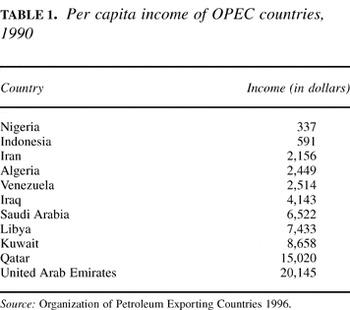
OPEC's eleven members—Algeria, Indonesia, Iran, Iraq, Kuwait, Libya, Nigeria, Qatar, Saudi Arabia, United Arab Emirates (UAE), and Venezuela—are highly heterogeneous in terms of population, financial needs, oil reserves, oil production capacity, and per capita income. Table 1 suggests that the UAE, Qatar, Kuwait, Libya, and Saudi Arabia tend to enjoy considerably higher per capita incomes than their less wealthy OPEC counterparts. Even countries with large, proven oil reserves, such as Iran and Iraq, have relatively small per capita incomes because of their sizeable populations.Per capita income of OPEC countries, 1990

These characteristics of the member states of OPEC closely track with what OPEC historians have identified as two fairly distinct groups that have emerged within the organization.21
Ibid.
The second group, led by Nigeria, Indonesia, Iran, and Algeria, has insisted that OPEC restrain its overall output in favor of higher immediate prices. These countries tend to have lower per capita incomes, lower oil exports per capita, and larger populations. While they have vital long-term development needs, these lower-income countries tend to be driven by the pressures of short-term financial problems that threaten to destabilize their ruling regimes.
Depending on the circumstances, OPEC members have shifted positions and changed alliances, but this two-group paradigm has tended to prevail in the organization over time.22
One analyst even likened OPEC to the medieval papacy, divided into rival camps; but rather than popes in Rome and Avignon, Riyadh and Teheran were the capitals; New York Times, 25 February 1983, D1.
OPEC Bargaining and Enforcement Model
The game presented here is an extension of the two-stage bargaining and enforcement game presented in the first part of the article. In the first stage, the two actors must bargain to decide among possible deals they will implement before they begin cooperating. In the enforcement phase that follows, states have a short-run incentive to defect while the other side cooperates, therefore, this phase is modeled as a classical repeated prisoners' dilemma.
Players
To capture the division of OPEC profits, I have developed a two-stage game in which there are two actors, “large” states and “small” states. In this context, a large state is one that falls into the first of the two typologies I described above—a state that enjoys high per capita income, considerable proven oil reserves, and supports moderate oil prices to maintain demand over the long term. These states include Saudi Arabia, Kuwait, Qatar, the UAE, and Libya.23
Long-time Saudi Oil Minister Ahmed Zaki Yamini's attitude toward forward thinking is captured in the following quotation, “In my public life, in my personal life, in everything I do I think long term. Once you start thinking short term, you are in trouble because short-term thinking is only a tactic for immediate benefit.” See Yergin 1991, 640.
Sequence of moves and payoffs
I model these two types of players in a sequential game where the large and small states each try to obtain for themselves the largest share of cartel profits, given their natural resource endowment. In any single given period, a state's expected utility is a function of both the world market price of oil (p) and the quantity of oil that the state produces (q). At the same time, however, the price of oil decreases as oil production increases. I assume that price is a decreasing function of production, an assumption made by others who have modeled the world oil market.24
The game is played as follows: the large state chooses a target price for which there is some quantity of oil produced that achieves that price. I normalize this target quantity to 1. The large state then offers some amount, z, as a proposed production level to the small state. Let z fall in the continuous interval [0,1] where an offer of 0 would mean that the small state would produce nothing and the large state would produce the quantity necessary to achieve the target price. An offer of 1 would mean that the small state could produce as much as would maintain the target price and the large state would produce nothing. All values between 0 and 1 are also possible offers, where 1 minus z would then be the large state's production level.
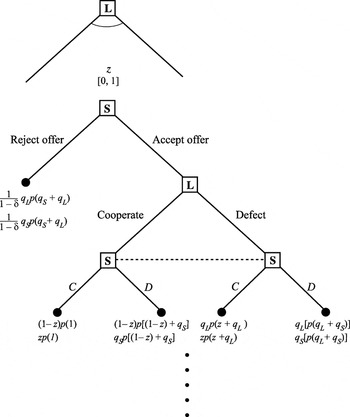
In the next move, the small state can choose either to accept or reject that offer. If the small state rejects the offer, the large and small states each receive the discounted value of their production when the price reflects each players' noncooperative production output. The noncooperative production outputs for large and small states, respectively, are qL and qS. These may, but need not, represent maximum production levels; their sum must exceed 1, the normalized target quantity. The discount factors are represented by δ (that is, δ measures patience) and δL > δS. If the small state accepts the offer, both players begin the enforcement phase of the game, in which the deal to which they agree determines their payoffs from cooperation. If the small state rejects the offer, both states produce at their maximum levels. Because each state may have a short-term incentive to defect on the agreement while the other cooperates, the enforcement phase of this game can be modeled as a repeated prisoners' dilemma. The extensive form of the game is presented in Figure 2.

Extensive form OPEC bargaining and enforcement game
In the enforcement phase, the payoff for mutual cooperation in a single round is 1 minus the offer, z, times the set price for the large state. The payoff for the small state, therefore, is simply z times the set price. If both states defect, it is assumed that they both produce at their noncooperative output levels, qL and qS. They earn a single round version of what they would get by rejecting the offer to begin with, PL and PS for the large and small states, respectively. The temptation payoff for each player (TL for the large state and TS for the small state) is to produce at its noncooperative output level, which might be maximum capacity, while the other player restrains production (thus raising the price). The sucker payoff (SL and SS), therefore, is to restrain while the other player produces at its noncooperative output level. Call RL and RS the payoffs for cooperating for large and small states, respectively.
The small state prefers TS > RS > PS > SS, traditional prisoners' dilemma (PD) preference orderings. TS, the temptation payoff, is equal to qS p[(1 − z) + qS] , the quantity the small state earns when it produces at its noncooperative output level and the large state restrains its production. This is larger than RS, the reward payoff, which is equal to zp(1); this amount is derived by multiplying z, the production offer, by the price when the target quantity is equal to 1. RS is larger than PS, the amount earned by the small state when both states produce at their noncooperative levels, qS [p(qL + qS)]. Finally, the small state dislikes earning SS, the sucker payoff. This payoff level is achieved when the small state restrains its production and the large state produces at its noncooperative level.25
The only further assumption needed regards the incentive compatibility bounds. The large state's offer to the small state, z, is assumed to have the following lower bound, qS [p(qL + qS)]/p(1), and is also (trivially) assumed to be less than the noncooperative small-state production output of qS.
The large state has either PD preferences (TL > RL > PL > SL), if its own production does not lower the price of oil, or Stag Hunt preferences (RL > TL > PL > SL), if both its own production and the small states' production have an effect on price. Under either set of preferences, Defect-Defect is a Nash Equilibrium of the stage game.
Sustaining cooperation
Under what conditions can cooperation be sustained? In this model, z is an endogenous variable, the level of which is chosen by the large state. The large state offers some value z*, such that the small state prefers cooperation to defection. What does z* have to be for the threat of all future defection to sustain cooperation? As before, I assume that the deal is enforced with a Grim Trigger strategy.
In order to find values of z* using this strategy, one would need to find the value of z such that the expected utility of cooperating forever was greater than the expected utility of defecting once against cooperation followed by mutual defection forever, and then solve for z. Additionally, the discount factor for the small state, δS, must meet the following condition in order for Grim Trigger to be a Nash Equilibrium with itself,

where TS is the temptation payoff, RS is the reward payoff for cooperating, and PS is the punishment for defecting for the small state.
More interesting, however, is the relationship between the offer, z*, and a country's discount factor, δ. Thus far, I have suggested that small states, with greater short-term pressure to meet budgetary demands, tend to discount the future more heavily than large states, which tend to be wealthy on a per capita basis and under less short-term pressure to maximize profits.
The question is how the small state's shorter time horizon affects the production offer that it receives from the large state. Inability to meet current financial demands by foreign creditors and domestic constituencies leaves a regime vulnerable to both external and internal rivals. Economic vulnerability causes the regime to discount the future more heavily. A lower discount factor makes the state's threat of defection highly credible, because a regime faced with being thrown out of office is unlikely to place a high value on future cooperation. This credible threat of defection means that large, more wealthy states induce cooperation through what amounts to a subsidization of the smaller, less wealthy states, yielding the following proposition.
Proposition 2: For δ > δ*, as a state's time horizon shrinks, the minimum offer needed to maintain cooperation goes up.
Proof of Proposition 2. The expected utility calculations for playing cooperate forever, and for defecting once against cooperation are as follows:
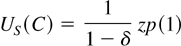

What does the large state's offer, z, have to be, for cooperation to be sustained? Set the two expected utility calculations equal to each other and rearrange:


Use PS in the place of qS p(qL + qS) for simplification purposes. Substantively, PS is what the small state earns when both the large and small states produce at their noncooperative levels:


Take the partial derivative of z with respect to δ. Use implicit differentiation because p is a function of z and z is a function of δ.

The numerator of the above equation is always positive, because the small state earns more when the large state restrains its production. The derivative p′ is always negative (by assumption).
Therefore, if the following condition holds, z′ with respect to δ is negative:

There is some critical threshold, δ*, that determines if the derivative is positive or negative. If δ > δ*, then z′ < 0 and if δ < δ*, then z′ > 0.
By the previous condition, one can also prove that there are values of δ greater than δ*, or, in other words, that there must exist some values for where ∂z/∂δ < 0. If δ is equal to one, then the condition holds. Therefore, δ* must be less than or equal to one. This suggests that there must exist some values of δ > δ*.
The proof of the proposition also suggests that there exists some critical threshold, δ*, where for values greater than the threshold, a less patient state receives a better offer and for values less than the threshold, a less patient state receives a worse offer. Furthermore, it is possible that p(1) > −qS p′[(1 − z) + qS] in which case z′ is less than 0 for all δ. If δ* is less than zero, then one would only observe the downward sloping portion of the nonmonotonic function.
The preceding proof suggests that the relationship between the discount factor and the equilibrium offer, z*, therefore, is nonmonotonic. What accounts for this split result? As the large state increases its offer to the small state, the reward for mutual cooperation (RS) goes up but the temptation payoff (TS) increases simultaneously because the large state is exercising increasing restraint over its production. Hence, the payoffs for defecting increase with the reward for cooperating. For δ > δ*, the second effect dominates, meaning that cooperation can be secured with higher offers; for δ < δ*, the first effect dominates meaning that cooperation is secured with lower offers.
Alternative model specification
An alternative specification of this model might have the entire stage game, both the striking of the bargain and enforcement of the deal, repeated in multiple rounds. This alternative specification more closely matches OPEC's reality, where the conference typically meets two or more times a year, depending on political and economic circumstances. Any deal is still enforced with Grim Trigger; that is, if either side defects in any period, both sides produce their maximum indefinitely. Adjusting the model in this way adds a degree of verisimilitude but does not change the preceding results.
In each period where the small state accepts the large state's offer, there exists an equilibrium of the form where the two states cooperate. Rather than a single z* decided at the organization's creation, there are a series of z* offers, one for each period in which the division of profits was renegotiated and exactly equal to the z* offered in the first period. The proof follows directly from the proof of Proposition 2. In periods where the small state rejects the offer, the large and small states each play their noncooperative strategy and earn the discounted value of their production, given maximum output on the part of both states.
Equilibrium Behavior and Empirical Analysis
The relationship between patience and production offer, therefore, depends on whether states have discount factors larger or smaller than the critical value, δ*. What determines a country's discount factor? Thus far, I have argued that cash-poor OPEC countries have lower discount factors as their survival depends on the ability of the state's leaders to meet immediate budgetary requirements. In equilibrium then, one would expect that for values of δ < δ* patient countries would receive better offers than impatient ones, and for values of δ > δ* patient countries would receive offers smaller than their impatient counterparts. This is because of the nonmonotonic relationship between z, the offer, and δ, the discount factor. On which side of the critical threshold, δ*, would one find most OPEC countries? Empirical evidence from the organization suggests an answer to this question, clarifying the game-theoretic result.
Data and model specification
To undertake a test of long-run behavior in OPEC, I have collected data for each of the organization's eleven members for the years 1960–95. A set of empirical tests predict a country's level of crude oil production in a series of models with three key explanatory variables: (1) per capita proven oil reserves, (2) whether regime transition occurred or did not occur in a country in a given year, and (3) the total number of past regime transitions.
I have chosen to use actual crude production rather than OPEC-designated production allocations as the dependent variable to avoid a number of important problems. Over the years, OPEC has devised various systems of rationing production among its members, but these attempts have not been consistent (that is, not applicable in all years of the study) and have been of only limited success. Individual members have continually opted to produce at levels that exceeded their quotas; in other words, they have “cheated.” By looking at actual crude production, one can measure each country's real-life output in a way that is more reliably reported and consistent. Additionally, using actual crude production as the dependent variable, rather than the quota value, allows for the possibility that the quotas may also reflect the mechanism that I am modeling, or in other words, that the quotas themselves reflect small country discount factors.
On the explanatory side, I control for an entirely exogenous factor that has been consistently relied on as an unbiased indicator for equitable allocation—a country's proven oil reserves. Proven reserves are the estimated quantity of crude oil that geological and engineering data demonstrate, with reasonable certainty, are known to be recoverable in future years from existing reservoirs under current economic and operating conditions. The basic idea is that countries with more potentially recoverable oil generally have the capacity, desire, and opportunity to produce petroleum today.
Next, I operationalize the discount factor. In Models 1, 2, and 3, I use a country's per capita proven oil reserves as a measure of impatience. Countries with more oil, per capita, have a longer shadow of the future than those with less oil on a per person basis and a country's oil reserves per person tends to be a good indicator of relative poverty or wealth in the organization. This variable has the additional benefit of being independent of crude production, unlike other measures of wealth such as per capita income.26
While it seems that per capita GDP may be a more straightforward way to operationalize this idea, in fact, it significantly complicates the statistical analysis. This is because there is a feedback effect between per capita GDP and crude production (the dependent variable). As crude production increases, per capita GDP also increases; the same cannot be said of per capita reserves, which is largely exogenous of crude production. In order to use per capita GDP, one would need to develop a simultaneous equations model that captures both effects.
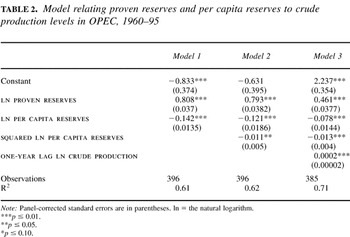
In Model 1, I include a country's proven oil reserves and level of reserves on a per capita basis as the explanatory variables. Model 2 includes the explanatory variables from the first model used with the addition of per capita reserves squared. I include this term to test for the nonmonotonic effect suggested by the comparative static result. Model 3 builds on Model 2 and is expanded to also include a lagged dependent variable term to check the robustness of the model.
I use a logarithmic transformation of the variables to correct for skewness and avoid the problem of heteroskedasticity. I conduct the empirical test using a least squares estimation technique that produces panel-corrected standard error estimates.27
Kennedy writes that fixed- or random-effects models are usually employed when the number of cross-sectional units is large and the number of time periods over which those units are observed is small. See Kennedy 1998. In this model, the reverse is the case (eleven countries, that is, cross-sectional units, observed over thirty-five years). Beck and Katz suggest the use of a procedure that estimates standard errors according to a robust procedure without adjusting the coefficient estimate for the analysis of this type of panel data. They argue that this procedure has a number of nice small sample properties when compared to the use of other estimation procedures. See Beck and Katz 1995.
The results of the empirical test are presented in Table 2. In the first model, the coefficients for both proven reserves and per capita reserves are significant at the 0.01 level and the signs on the explanatory variables are as expected. The results suggest that an increase in a country's per capita reserves results in less crude production, even after controlling for a country's level of proven reserves. The second model includes per capita reserves squared to test for the nonmonotonic effect predicted by the game-theoretic model. The coefficient on this variable is negative—as expected—and is significant at the 0.05 level. The coefficients on the other variables are also significant in this specification of the model. The third model builds on the second and includes a one year lag of the dependent variable on the explanatory side to test for robustness. Signs are as expected and all coefficients are highly significant.
Model relating proven reserves and per capita reserves to crude production levels in OPEC, 1960–95

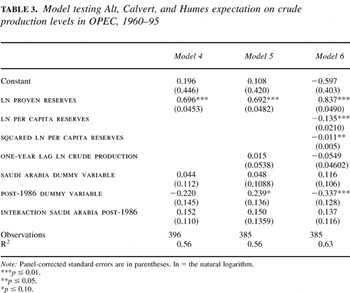
The models presented in Table 3 test the key expectations generated by Alt, Calvert, and Humes. The authors argue that Saudi Arabia orchestrated the 1986 price fall so that the kingdom would be able to create a reputation for “toughness” and achieve better cooperative deals in the future. One would expect, based on their argument, that Saudi Arabia received a larger piece of OPEC profits after 1986 than they did before 1986. Model 4 tests this hypothesis. After controlling for the level of proven reserves, the key interaction variable (interaction saudi arabia post-1986) is correctly signed but not statistically significant. Model 5 includes a one year lag on the dependent variable, crude production; again, the interaction term is not statistically significant.
Model testing Alt, Calvert, and Humes expectation on crude production levels in OPEC, 1960–95

Model 6 tests the Alt, Calvert, and Humes hypothesis while also controlling for per capita reserves and per capita reserves squared, the two factors that I have argued influence a country's level of crude production. The results suggest that while Saudi Arabia likely did not fare as badly as its OPEC counterparts in the post-1986 era, one cannot be statistically confident that the relationship that they posit exists. While the coefficient on the variable interacting Saudi Arabia and post-1986 is positive, it is not statistically significant. The key findings that I have presented—that an increase in a country's per capita reserves results in less crude production but that this relationship may be reversed for countries with the lowest discount factors—remain statistically significant at the 0.01 and 0.05 levels, respectively.
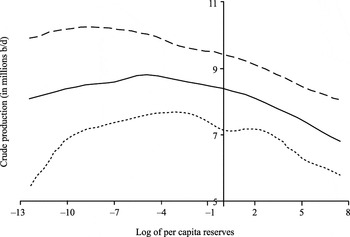
Figure 3 is a graph of the expected values of crude production as per capita reserves increases, with all other explanatory variables held at their means. Dotted lines represent the upper and lower bounds for a 95 percent confidence interval.28
These results are based on Model 2, which I consider to be the baseline model for this variable.

Expected values of crude production as per capita reserves increase
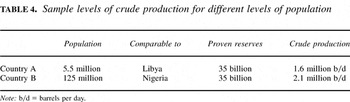
Table 4 presents sample levels of crude production for countries with different population sizes, holding reserves at the same arbitrarily chosen value. In this hypothetical example, “Country A” is comparable in population size to Libya and “Country B” is comparable in population size to Nigeria. I chose sample countries the size of Libya and Nigeria because both countries have approximately the same level of proven reserves, 35 billion barrels. Expected crude production for Country B is 30 percent more than for Country A, even though both countries enjoy the same amount of proven reserves.
Sample levels of crude production for different levels of population

An alternative proxy for the discount factor might be the number of past political upheavals, or if a country experienced a political upheaval in a particular year. Przeworski et al. code for both of these factors in their variables unstable and sttr.29
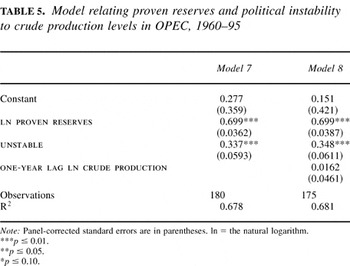
The variable unstable is a dichotomous variable coded 1 for all the years that a country experienced at least 1 regime transition between 1950 and 1990. sttr is the total number of past regime transitions. I test the effects of these two variables on crude production within OPEC using a number of different model specifications.In each model, I control for a country's level of proven reserves, as in the previous model specifications. Models 7 and 8 test the effect of the Przeworski et al. variable unstable; in years where this dummy variable is coded 1, regime transition took place. Table 5 shows the results of Models 7 and 8. Again, all empirical tests use a least squares estimation technique that produces panel-corrected standard error estimates.
Model relating proven reserves and political instability to crude production levels in OPEC, 1960–95

The coefficient on the variable unstable is positive and statistically significant; this suggests that in years of regime change, a country earns a higher level of crude production, even after controlling for its level of proven reserves. The coefficient on this variable remains statistically and substantively significant after including a one-year lag of the dependent variable.30
I do not test the squared version of the dummy variable unstable, because the squared variable would be perfectly collinear to the original unstable variable.
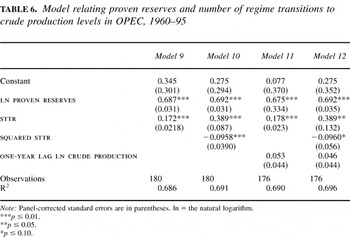
Models 9, 10, 11, and 12 test the effect of the Przeworski et al. variable sttr— the total number of past regime transitions—as a predictor of crude production. The results of these models are displayed in Table 6. Again, I control for each country's level of proven reserves in the models; this variable is positive and statistically significant in each specification, as expected. In Model 9, I test for the effect of sttr; the coefficient on the sttr variable is positive and highly statistically significant. This result suggests that as the total number of regime transitions that a country has undergone increases, so does that country's level of crude production within OPEC.
Model relating proven reserves and number of regime transitions to crude production levels in OPEC, 1960–95

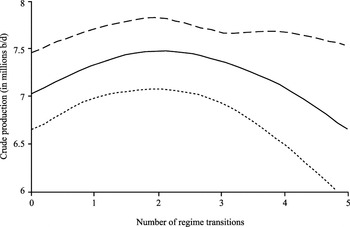
Model 10 tests the effect of the number of regime transitions (sttr) squared. The coefficient on this variable is negative, suggesting the nonmonotonic effect predicted by the game theoretic model, and the coefficient estimate is highly statistically significant. Figure 4 is a graph of the expected values of crude production as the number of regime transitions increase.31
These results are based on Model 10, which I consider to be the baseline model for this variable.

Expected values of crude production as number of transitions increase
Models 11 and 12 test the effects of sttr and sttr squared and also include a one-year lag of the dependent variable. All substantively relevant coefficients—proven reserves, sttr, and sttr squared—have the expected signs and are statistically significant.
I have argued that a country's level of per capita reserves reflects its discount rate with countries that are resource poor, per person, discounting the future more heavily. Using per capita reserves as a proxy for a country's discount rate, these findings suggest that countries with a higher discount factor receive a lower production offer. I also find that countries that either experience a regime change in a given year, or have experienced numerous regime changes in past years, earn higher levels of crude production than their more stable OPEC counterparts. In sum, the empirical results suggest that OPEC countries are actually in the state of the world where ∂z/∂δ < 0, or in other words, where values of δ > δ*, and less wealthy, shorter time horizon countries are offered better production offers to remain in the cartel. This finding sheds light on the expectations generated by the game-theoretic model.
Conclusions and Implications
In January 1984, Africa's largest democratic country, Nigeria, became Africa's largest dictatorship in a smoothly executed coup d'etat. President Shehu Shagari's government had fallen victim to the economic austerity that resulted from the 1983 oil glut. At the time, the New York Times noted that while “other OPEC countries were hit in the pocketbook; Nigeria, with a far larger population, was hit in the solar plexus.”32
New York Times, 4 January 1984, A18.
In this article, I have presented a simple form of Fearon's bargaining and enforcement model and shown that when a bargaining phase is followed by an enforcement phase that resembles a prisoners' dilemma, impatient actors earn better outcomes than their more patient rivals. I have modeled the division of cartel profits in OPEC, particularly with regard to the relationship between bargaining strength and disparate time horizons, as in the Nigeria example. I have argued that there are two types of states in OPEC, those with high reserves per capita (future-oriented states) and those with low reserves per capita (present-oriented states). I have modeled the distribution of cartel profits between these two groups in a two-phase game and argued that there is some optimal offer, z*, that the large state proposes to induce cooperation by the small state. I have also explored the relationship between this offer and the discount factor of the small state. I have found that there is some threshold level, where for values larger than δ*, states that discount the future more heavily tend to receive better production offers than those that do not.
Next, I examined empirical evidence that suggests that the countries in OPEC fall into the range where this proposition would hold. In other words, relatively poor, populous countries appear, both explicitly and tacitly, to be allowed by OPEC to overproduce. From a theoretical perspective, the findings of this article imply an unexpected result. Basic bargaining models, such as those of Fearon and Rubinstein, suggest that impatience (as captured in the discount factor) hurts the impatient player in the game. In the model I have presented, the impatient state is actually helped, because its threat of defection is highly credible. Within OPEC's negotiation structure, poverty is a source of bargaining strength and collusive agreements are sustained through forfeiture of production on the part of wealthier countries. This amounts to a “weakness as strength” story that is largely consistent with empirical evidence from OPEC's forty-year history.
This finding is also consistent with Olson's observation that the small are able to systematically exploit the large in collective action situations. Olson argues that the largest member, the member who would, independently, provide the greatest amount of the collective good, ends up bearing a disproportionate share of the burden for providing the collective good. The smaller member has no incentive to obtain any of the collective good at its own expense when the amount it gets free from the larger member is more than it would have purchased itself.33
My model comes to a similar conclusion but for different reasons. In the model that I have developed, the small state's source of strength comes from its highly credible threat of defection from the organization, not from free-riding.What are the substantive implications of the models I have presented? In the context of OPEC, these findings suggest that cartel maintenance boils down to richer, more future-oriented states subsidizing poorer states so that they might remain in the cartel. This pattern of behavior appears to have been sustained for more than thirty years and is likely to continue until the costs of the subsidy outweigh the benefits of maintaining the cartel.
In the broad context of international cooperation, the findings suggest that the shadow of the future can cut both ways under a variety of circumstances and for different reasons than one may have previously believed. If one assumes that problems of international cooperation have a common strategic structure that resembles the bargaining and enforcement model presented by Fearon, the effect of patience on international cooperation is not straightforward.34
Cooperation need not come about as a result of increasing punishment, and sometimes increasing the rewards is a more efficient way to elicit cooperation.References
REFERENCES
Adelman, M. A.
1995.
The Genie Out of the Bottle: World Oil Since 1970.
Cambridge, Mass.:
MIT Press.
Ahrari, Mohammed E.
1985.
OPEC and the Hyperpluralism of the Oil Market in the 1980s.
International Affairs
61 (2):263–77.Google Scholar
Alt, James E.,
Randall L. Calvert, and
Brian D. Humes.
1988.
Reputation and Hegemonic Stability: A Game-Theoretic Analysis.
American Political Science Review
82 (2):445–66.Google Scholar
Axelrod, Robert.
1984.
The Evolution of Cooperation.
New York:
Basic Books.
Beck, Nathaniel, and
Jonathan N. Katz.
1995.
What to Do (and Not to Do) with Time-Series Cross-Section Data.
American Political Science Review
89 (3):634–47.Google Scholar
Danielsen, Albert L.
1982.
The Evolution of OPEC.
New York:
Harcourt Brace Jovanovich.
Doran, Charles F.
1980.
OPEC Structure and Cohesion: Exploring the Determinants of Cartel
Policy.
Journal of Politics
42 (1):82–101.Google Scholar
Eckbo, Paul Leo.
1976.
The Future of World Oil.
Cambridge, Mass.:
Ballinger.
Fearon, James D.
1998.
Bargaining, Enforcement and International Cooperation.
International Organization
52 (2):269–305.Google Scholar
Gately, Dermot.
1984.
A Ten-Year Retrospective: OPEC and the World Oil Market.
Journal of Economic Literature
22 (3):1100–14.Google Scholar
Gately, Dermot,
M. A. Adelman, and
James Griffen.
1986.
Lessons from the 1986 Oil Price Collapse.
Brookings Papers on Economic Activity
1986 (2):237–84.Google Scholar
Kennedy, Peter.
1998.
Guide to Econometrics,
4th ed.
Cambridge, Mass.:
MIT Press.
Keohane, Robert.
1984.
After Hegemony: Cooperation and Discord in the World Political
Economy.
Princeton, N.J.:
Princeton University Press.
Lipson, Charles.
1984.
International Cooperation in Economic and Security Affairs.
World Politics
37 (1):1–23.Google Scholar
McGillivray, Fiona, and
Alastair Smith.
2000.
Trust and Cooperation Through Agent-Specific Punishments.
International Organization
54 (4):809–24.Google Scholar
Moran, Theodore H.
1978.
Oil Prices and the Future of OPEC: The Political Economy of Tension
and Stability in the Organization of Petroleum Exporting Countries.
Washington, D.C.:
Resources for the Future.
Olson, Mancur.
1971.
The Logic of Collective Action: Public Goods and the Theory of
Groups.
Cambridge, Mass.:
Harvard University Press.
Organization of Petroleum Exporting Countries (OPEC).
1996.
Annual Statistical Bulletin 1995.
Vienna, Austria:
OPEC Secretariat.
Oye, Kenneth, ed.
1986.
Cooperation under Anarchy.
Princeton, N.J.:
Princeton University Press.
Powell, Robert.
1999.
In the Shadow of Power: States and Strategies in International
Politics.
Princeton, N.J.:
Princeton University Press.
Przeworski, Adam,
et al.
2000.
Democracy and Development: Political Institutions and Well Being in
the World, 1950–1990.
Cambridge:
Cambridge University Press.
Rubinstein, Ariel.
1982.
Perfect Equilibrium in a Bargaining Model.
Econometrica
50 (1):97–110.Google Scholar
Stein, Arthur.
1982.
Coordination and Collaboration: Regimes in an Anarchic World.
International Organization
36 (2):299–324.Google Scholar
Yamani, Mai.
2000.
Changed Identities: The Challenge of the New Generation in Saudi
Arabia.
London:
Royal Institute of International Affairs.
Yergin, Daniel.
1991.
The Prize: The Epic Quest for Oil, Money, and Power.
New York:
Simon & Schuster.
Stage game of the enforcement phase (a prisoners' dilemma)
Per capita income of OPEC countries, 1990
Extensive form OPEC bargaining and enforcement game
Model relating proven reserves and per capita reserves to crude production levels in OPEC, 1960–95
Model testing Alt, Calvert, and Humes expectation on crude production levels in OPEC, 1960–95
Expected values of crude production as per capita reserves increase
Sample levels of crude production for different levels of population
Model relating proven reserves and political instability to crude production levels in OPEC, 1960–95
Model relating proven reserves and number of regime transitions to crude production levels in OPEC, 1960–95
Expected values of crude production as number of transitions increase
 You have
Access
- 20
- Cited by