Introduction
Eating disorders are complex and chronic medical illnesses characterized by abnormal eating behaviors that lead to significant morbidity, or even death, if left untreated (Berkman et al., Reference Berkman, Lohr and Bulik2007). While typically a disorder of young adults, eating disorders do recur in old age and can also occur de novo in late life (Beck et al., Reference Beck, Casper and Andersen1996). Eating disorders are often overlooked in the elderly, who may be especially at risk from the resulting complications. Given the significant morbidity and mortality associated with eating disorders in the elderly, and the wide range of health issues that arise secondary to eating disorders, including cardiac, metabolic, gastric, and bone conditions (Rome and Ammerman, Reference Rome and Ammerman2003), early recognition and proper treatment of eating disorders in the elderly are essential to reduce morbidity and improve the quality of life of affected elderly. (The definition of elderly is variably defined by authors; for the purposes of this paper, “mid-life” is defined as ages 39–59 and “elderly” or “late-life” is defined as age 60 or older, in accordance with most of the articles within this review.)
The exact prevalence of eating disorders in the elderly is unknown. One study of 475 community-dwelling elderly women aged 60–70 years found that 3.8% met diagnostic criteria for eating disorders. A study of elderly Canadian women reported that symptoms of disordered eating were present in 2.6% of women aged 50–64 years, and in 1.8% of women aged 65 years or older (Gadalla, Reference Gadalla2008). In an investigation of eating disorders in elderly outpatient males, a minority (11–19%) who were undernourished were found to have abnormal eating attitudes and body image, including inappropriate self-control around food (60%), unsuitable eating attitudes (26%), and distorted body image (3–52%) (Miller et al., Reference Miller, Morley, Rubenstein and Pietruszka1991). Further, Hewitt and colleagues (Reference Hewitt, Coren and Steel2001) examined over 10 million deaths in the U.S.A. over a five-year period and analyzed those in which anorexia nervosa was the primary cause of death or a secondary condition present at the time of death. They found 724 records that listed anorexia nervosa as a cause or condition of death, and determined that the risk per 100,000 deaths per year was lower on average for women over the age of 55 years (9.05) compared to younger women, aged 5–54 years (39.9). Conversely, the risk was higher for men over the age of 55 years (3.2) compared to younger men (2.7). The most significant finding was that the majority of deaths due to anorexia nervosa were in the elderly – 10% in the 55–64 age group, 12% in the 65–74 age group, and 28% in the 85 and older group.
Eating disorders in the elderly, including anorexia nervosa (AN) and bulimia nervosa (BN), can be divided into early onset (which continues or recurs in old age), and late onset (which develops for the first time later in life). Except for amenorrhea, the clinical features of eating disorders in the elderly are consistent with the Diagnostic and Statistical Manual of Mental Disorders IV-TR (American Psychiatric Association, 2000) criteria for eating disorders, including low body weight and fear of fatness in anorexia nervosa; binge eating and compensatory weight loss behaviors (e.g. self-induced vomiting, laxative misuse, binge eating, excessive exercise) in bulimia nervosa; and disturbed body image in both disorders. The diagnosis of eating disorder not otherwise specified (NOS) is reserved for those who do not meet full criteria for any specific eating disorders; hence, an elderly woman with all of the symptoms of anorexia nervosa, with the exception of amenorrhea, will be diagnosed with an eating disorder NOS rather than anorexia nervosa.
While clinical features are similar between eating disorders in the elderly and the younger population, there are differences in the psychological mechanisms that distinguish eating disorders in the elderly. An aging physical appearance, with age-related body changes, and changes in familial relationships are associated with the development of eating disorders in the elderly (Gupta, Reference Gupta1990). In a study that examined the relationship between apprehension about aging and a drive for thinness in men and women, a direct correlation was found between concerns with the effect of aging on appearance and the level of preoccupation with weight, dieting and exercise (Gupta, Reference Gupta1995). Several psychodynamic mechanisms have been postulated which must be explored when evaluating and treating older women with eating disorders. Zerbe argues that as women age they become increasingly devalued by a society where perceived value is tied to the physical attributes of younger women. Unconscious processes related to envy, loss, and preoccupation with body image may therefore manifest as eating disorder symptoms (Zerbe, Reference Zerbe2002; Reference Zerbe and Karbe2008a; Reference Zerbe2008b).
Other proposed causes of eating disorders in the elderly include the need for control and a plea for attention. Older adults with eating disorders may use eating as a control mechanism to regain power in their lives, a consequence of the loss of control that accompanies aging (Harris and Cumella, Reference Harris and Cumella2006). For some, eating disorders are a method of gaining control over loved ones through protest and by drawing attention to the discontent they feel for their current circumstances (Harris and Cumella, Reference Harris and Cumella2006). It has been further suggested that eating disorders in the elderly are a more extreme attempt at controlling one's life, a method of indirect suicide (Harris and Cumella, Reference Harris and Cumella2006). Precipitating events such as personal losses and life changes magnify the sense of loss of control in the life of an older adult, and eating disorders may be a method of coping with these stressful events (Cosford and Arnold, Reference Cosford and Arnold1992). One study of 193 patients found that older women gained more benefit from therapy targeting grief and loss than did younger patients (Forman and Davis, Reference Forman and Davis2005), suggesting that such issues may play a larger role in eating disorder syndromes in this population. Beyond the initial causes of eating disorders in the elderly, additional perpetuating factors have also been proposed, including social withdrawal, reduced outside interests, preoccupation with eating, and a sense of power over family members.
There has been debate over whether the incidence of eating disorders has been increasing. Differing methods, diagnostic criteria, changes in registration policy and methods of detection are among the possible reasons for divergent opinions. A recent review of the literature (Hoek and van Hoeken, Reference Hoek and Hoeken2003) concluded that the incidence of AN has increased over the past century, until the 1970s (Lucas et al., Reference Lucas, Beard, O'Fallon and Kurland1991; Reference Lucas, Crowson, O'Fallon and Melton1999). The incidence of AN is 8 cases per 100,000 population per year. Incidence rates for BN rose sharply in the early 1980s, likely related to recognition of BN as an official diagnostic category in DSM-III in 1977 (Soundy et al., Reference Soundy, Lucas, Suman and Melton1995). Estimated incidence of BN is 12 cases per 100,000 population per year. The increased recognition of eating disorders over recent decades has occurred mainly in a cohort of young “baby boomers” now rapidly swelling the ranks of the aged the U.S. population (Campbell, Reference Campbell1996), which likely will lead to an increase in the number of older adults presenting with eating disorders. It is therefore important for clinicians to be aware that eating disorders do occur in the elderly and that these conditions should be included in the differential diagnosis of unexplained weight loss. The purpose of this paper is to review all existing literature on clinical presentations, evaluations and treatments of eating disorders in the elderly and to present practical guidelines for clinicians in recognizing and managing eating disorders in the elderly population.
Methods
The databases of Ovid Medline(R), PubMed(R), the Web of Knowledge(R), and PsychINFO(R) were searched from inception through October 2008 to identify all published cases of eating disorders in those aged 50 years and over. The following search terms were used: eating disorders and elderly, geriatric eating disorders, anorexia nervosa and elderly, geriatric anorexia nervosa, late onset anorexia nervosa, anorexia tardive, bulimia and elderly, and late onset bulimia. Inclusion criteria were single or multiple case studies of eating disorders of any type, with an age criteria of 50 years and older, as well as general literature and reviews on epidemiology, etiology, treatment and management. The search was not limited to articles published in the English language, and included two articles in French. Bibliographies of all selected articles were reviewed for any relevant articles to identify additional studies.
Results
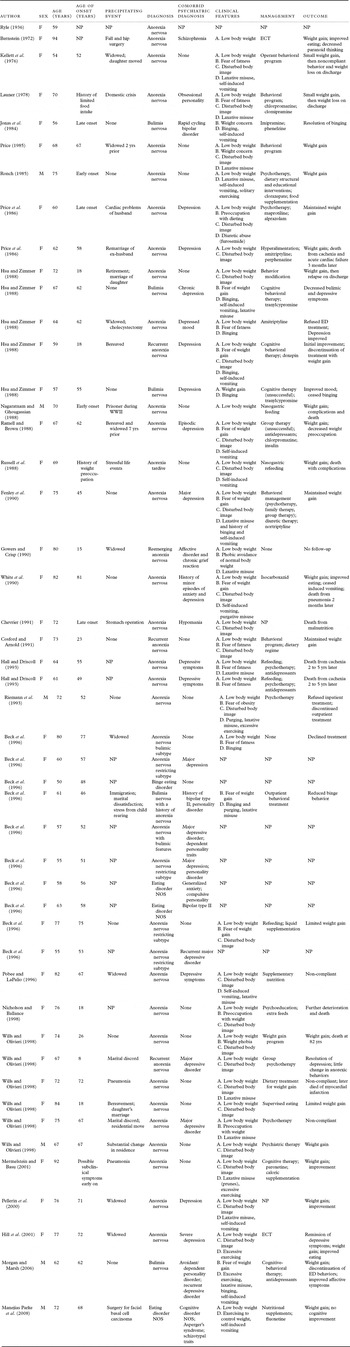
We found 48 published cases of eating disorders in individuals aged 50 years and older, and details are included in Table 1.
Case description of eating disorders in individuals over the age of 50 years

NP = not provided, ECT = electroconvulsive therapy, ED = eating disorder, NOS = not otherwise specified
Of the 48 cases, the majority (88%) were women (42 females and 6 males). The mean age was 68.6 years (range 50–94). When divided into age groups, there were 19 (40%) cases under the age of 65 (range 50–64) and 29 (60%) cases aged 65 or older. The majority of cases (56%) were diagnosed while an inpatient in hospital or in an intermediate care facility. The remainder either did not indicate the patients’ status at diagnosis (11%) or were diagnosed as outpatients (33%), most commonly within the setting of a specialized eating or weight disorder program.
The most frequent diagnosis was AN, present in 39 (81%) cases. Much less frequent were five (10%) cases of BN, three (6%) cases of eating disorder NOS, and one (2%) case of binge eating disorder. When considered by gender, the 42 (88%) women had AN in 35 (83%) cases and BN in just four (10%) cases, binge eating disorder in one (2%) case, and eating disorder NOS in one (2%) case. Of the six (13%) men, who ranged in age between 62 and 75 years, the majority (67%) had AN, except one (17%) who had BN and one (17%) diagnosed with eating disorder NOS.
Thirty-three (69%) had late onset eating disorders. Of these, 11 (33%) had an age of onset over the age of 65, 19 (58%) had age of onset under 65 (range 45–62), and 3 (9%) had unspecified age of onset. The mean duration of illness of late-onset eating disorders in which age of onset was reported was 6.4 years, ranging from less than 1 year to 30 years.
Ten (21%) cases had early-onset eating disorders, with ages of onset ranging from 8 to 26 years, which either continued or recurred in late life. The age of onset was unknown in three (6%) cases where histories of weight and food preoccupation of unknown duration were present. Of the early-onset eating disorders, mean duration of illness was 55.1 years, ranging from 41 to 66 years.
Of all 48 cases of eating disorders in the elderly, 26 (54%) reported that precipitating stressful events had occurred prior to the development of the eating disorder. Precipitating events in order of frequency were: 11 (42%) widowhood and bereavement, 5 (19%) marriage-related difficulties (marital dissatisfaction, domestic crisis, remarriage of ex-husband), 6 (23%) medical illnesses (surgery, pneumonia), 4 (15%) children-related issues (marriage of child, child moved away, stress from child rearing), 2 (8%) residential moves, 1 (4%) retirement, and 1 (4%) immigration.
Comorbid psychiatric disorders or a prior history of psychiatric disorders were reported in 29 (60%) of the 48 cases, and in some cases, more than one condition coexisted in a single individual. The most common psychiatric disorder was major depression, present in 20 of the 29 (69%) cases. This finding is consistent with literature that shows a strong association between risk of eating disorders and mood and anxiety disorders (Gadalla, Reference Gadalla2008). Other psychiatric disorders that were present less frequently included obsessional, avoidant, compulsive or dependent personality disorders (21%), bipolar disorder (14%), anxiety (7%), schizophrenia or schizotypal traits (7%), unspecified affective disorder (3%), hypomania (3%), cognitive disorder (3%), and Asperger's syndrome (3%).
Of the 48 cases, the majority (36 cases, 75%) received treatment, while 2 (4%) did not receive or declined treatment, and there was no specific information available on 10 (21%) of the cases. Of those who received treatment for eating disorders, the most common management strategy employed was a combination of behavioral and pharmacologic interventions in 14 (39%) cases, followed by behavioral interventions alone in 12 (33%) cases, pharmacology alone in 8 (22%) cases, and ECT in 2 (6%) cases.
Only 20 cases (42%) reported successful outcomes, as defined by improvement of eating disorder symptoms and/or maintained weight gain. A combination of behavioral and pharmacologic therapies was most successful (9 of 14 cases), and behavioral therapy alone (4 of 12 cases) and pharmacologic agents alone (5 of 8 cases) were fairly successful. ECT was performed in only two cases, and each time was successful. Successful pharmacologic therapy consisted of the use of antidepressants (11 of 15 cases showing improvement), antipsychotics (2 of 3 cases showing improvement), and benzodiazepines (2of 2 cases showing improvement).
Four (8%) cases showed initial improvement that was not sustained due to non-compliance. Twenty-three cases failed to show any improvement due to noncompliance. Ten (21%) cases resulted in death due to the eating disorder or its complications, including cachexia, pneumonia, and cardiac failure.
In addition to the 48 cases included in Table 1, we add a further case. This patient was a 73-year-old female who had recurrent major depression, no formal history of an eating disorder, but with a lifelong AN symptomatology of low body weight, preoccupation with weight, early satiety despite minimal food intake, anxiety with eating larger portions, fear of constipation with eating, daily use of laxatives, and lying about food consumption. She had no history of calorie counting, vomiting or bulimia. She presented to our facility with severely depressed mood, anhedonia, reduced appetite, weight loss, psychomotor retardation, excessive guilt, severe preoccupation with constipation, and a passive death wish. The depressive symptoms occurred in the context of worsening chronic medical problems. She required hospitalization in the psychogeriatric unit and was successfully treated with electroconvulsive therapy. Following resolution of depression, behavioral interventions along with continuation antidepressant treatment were implemented to address her eating disorder, including discussion of her eating habits, calorie counting, meal observations, and one hour post-prandial monitoring. This resulted in weight gain, and improved appetite and caloric intake.
Discussion
Our study on eating disorders in the elderly highlights three important issues. First, truly late-life onset eating disorders do occur in the elderly. Second, the most common eating disorders include ones complicated by other psychiatric issues. Finally, successful management targets both the eating disorder and comorbid psychiatric conditions with a combination of pharmacologic and behavioral interventions.
Although the term “late onset” covered various ages as a cut-off in the literature, in general, an onset after age 40 is considered late onset, and has been reported as early as 1930 (Berkman, Reference Berkman1930), although the earliest published case of an eating disorder in a truly older individual was that of a 59-year-old-woman in 1936 (Ryle, Reference Ryle1936). In this review, where age 50 was selected as a cut-off, published cases were mostly females, and more than half were truly geriatric in onset, i.e. the eating disorder occurred for the first time at age 65 years and older. Interestingly, the most frequently diagnosed eating disorder in older individuals was AN in both males and females. It is also important to note that the most common precipitating factors to illness were widowhood and bereavement, followed by marriage-related difficulties and medical illnesses, all of which are common but significant life events in the elderly.
The majority of cases reviewed here were diagnosed with AN (81%), followed by BM (10%), EDNOS (6%), and binge eating disorder (2%). These estimates of frequency deviate from values found within a group of 170 outpatients ranging in age from 18 to 65 years, where the most common diagnosis was eating disorder NOS (60%), followed by BN (35.5%), AN (4.7%), EDNOS (60%), and binge eating disorder (4.1%) (Fairburn et al., Reference Fairburn, Cooper, Bohn, O'Connor, Doll and Palmer2007). This dramatic difference emphasizes the restricted sample from which our values derive. The majority of published cases of geriatric eating disorders are those that reached medical attention only after severe weight loss or deterioration in health secondary to the eating disorder. As such, many are extreme cases that were recognized during hospitalization or admission to an intermediate care facility, rather than as outpatients.
Furthermore, while our literature search did not include the specific term “eating disorder NOS,” the general search term “eating disorder” would likely have captured even those with NOS. Historically, the terminology “eating disorder NOS” is a more recent term, while our literature search dated back to the 1930s. The term “bulimia” was only introduced into the American nomenclature with the publication of the DSM-III in 1980. DSM-IIIR then narrowed the definition of “bulimia” and added the designation “eating disorder NOS” (EDNOS) in 1987. The diagnosis changed again with DSM-IV in 1996. The Fairburn study (Fairburn et al., Reference Fairburn, Cooper, Bohn, O'Connor, Doll and Palmer2007) was based on precise diagnostic criteria specified in DSM-IV, which may be another reason for the variance.
The fact that AN represented the highest number of cases in our literature review is very interesting; perhaps with late-onset eating disorders, AN is “ushered in” more often by loss of appetite due to medical problems. While the symptomatology of eating disorders in the elderly is the same as that for younger individuals, except for amenorrhea, recognition of an eating disorder can be difficult in a complex geriatric patient. Weight loss may signal an undiagnosed medical illness or may be the result of a known medical condition and/or its pharmacologic treatment. Animal studies suggest that satiety mechanisms may be enhanced in the elderly due to sensitivity to cholecystokinin. In addition to medical illness, a psychiatric disorder may result in weight loss.
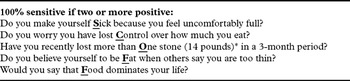
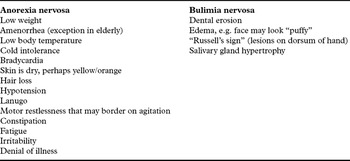
Careful history-taking is paramount, and often assistance is needed from family members to obtain the necessary information. A timeline should be established indicating the time frame for the weight loss, identifying concomitant physical and/or psychiatric symptoms and the temporal relationship, if any, to significant life events. The patient should be screened for a past history of eating disorders in adolescence and early adulthood. One of the most concise diagnostic questionnaires is the SCOFF (Morgan et al., Reference Morgan, Reid and Lacey1999), a five-question screening tool that has a sensitivity of 84.6% and specificity of 89.6 in the primary care setting (Morgan et al., Reference Morgan, Reid and Lacey1999) (see Table 2). A comprehensive physical examination and medical evaluation are essential to rule out physical or medical causes of unexplained weight loss before assuming an eating disorder to be the cause of the problem (Zerbe, Reference Zerbe2008b). Certain physical features may also point to an eating disorder (see Table 3). There is no specific laboratory test to help differentiate marked weight loss in a geriatric medically ill individual from one with an eating disorder.
SCOFF screening questionnaire for eating disorders*

*6.36 kg
Reproduced from the SCOFF questionnaire: assessment of a new screening tool for eating disorders (Morgan et al., Reference Morgan, Reid and Lacey1999) with permission from BMJ Publishing Group Ltd.
Physical signs and symptoms

Psychiatric evaluation should screen for common disorders associated with weight loss. Depression, anxiety, psychosis and cognitive disorders may resemble AN or BN in the elderly; a lack of the classic declaration of a desire to be thinner, weight preoccupation, or body image distortion will distinguish them from true eating disorders
Of the 48 published cases, approximately 20% died due to the eating disorder or its complications. Given the high mortality associated with an eating disorder in the elderly, once the diagnosis is suspected, evaluation should be expeditious and thorough. Once the diagnosis is made, treatment should be aggressive. Our review indicates that intervention with behavioral and pharmacologic therapy may be effective, and close follow-up is needed to ensure compliance with therapy.
In general, treatment strategies for eating disorders in the geriatric population are similar to those in the younger population. Initially, eliciting motivation to change by asking such questions as “What do you value?” and “How does your eating disordered behavior impact the things you value?” are helpful in developing the treatment plan. Nutritional rehabilitation is an essential next step: a dietitian works with the patient to establish and work towards weight gain. Cognitive behavioral therapy (CBT) is a very important part of treatment of eating disorders. Other forms of psychotherapy used include interpersonal, psychodynamic, and family therapy. Antidepressant, anti-anxiety and antipsychotic medications may be used in conjunction with CBT. Optimal treatment benefits are derived from a team approach, and family members should be involved and educated in treatment, and encouraged to take active roles in providing and supporting meals.
It is important to recognize that caring for elderly individuals with eating disorders involves some issues that are unique to the geriatric population. Rather than parents’ involvement, it will be the spouses or children who will be involved in their care, which may or not be advantageous depending on the quality of their social support system. Older individuals frequently have coexistent medical illnesses that may cloud the clinical picture of an eating disorder, and complicate its evaluation and management. Taking multiple medications for various medical conditions is commonplace, and the consequences of the eating disorder itself, or the use of psychotropic medications to treat the eating disorder and comorbid psychiatric conditions, may all lead to potential adverse effects or drug interactions. Cognitive impairment is common in the elderly, and its presence may limit the utility of some treatment strategies such as CBT. Age-related sensory deficits such as impairment in hearing and vision should be optimized so as not to limit the ability to participate in group therapies. Overall, it is important to look carefully for any issues that may potentially affect the treatment of eating disorders in the elderly, and management strategies should be adjusted accordingly.
There are limitations to our study. First, our sample size is small with only 48 geriatric cases of eating disorder identified, and these cases may represent only the extreme form of the disease. Secondly, the data are incomplete with inconsistent reporting in each case of age of onset, precipitating event, comorbid psychiatric diagnoses, management, outcome, and follow-up. Third, without a control group, this study is limited in its ability to show an association between any variable and the development of an eating disorder and between treatment and outcome. However, there are no other published studies that have thoroughly reviewed all existing cases of eating disorders in the elderly, and our review provides important insight into this condition by consolidating the available clinical information to date.
In summary, eating disorders do occur in the elderly, with anorexia nervosa being the most common. Depression is the most common comorbid psychiatric condition. A careful history and physical examination is essential for the diagnosis of eating disorders in the elderly. A combination of pharmacologic and behavioral interventions may be successful. Future controlled trials are needed not only to identify geriatric patients who may be at risk for an eating disorder but to identify successful treatment modalities.
Conflict of interest
None.
Description of authors’ roles
Maria I. Lapid formulated the clinical question, designed the study, conducted the literature review and collected all pertinent articles, interpreted the results, and drafted and revised the paper. Maria C. Prom conducted the literature review and collected all pertinent articles, interpreted the results, and drafted and revised the paper. M. Caroline Burton interpreted the results, and drafted and revised the paper. Donald E. McAlpine formulated the clinical question, designed the study, and drafted and revised the paper. Bruce Sutor formulated the clinical question, and drafted and revised the paper. Teresa A. Rummans formulated the clinical question, designed the study, and drafted and revised the paper.