Implication
It is a serious animal welfare issue that diets associated with gastrointestinal disorders and abnormal and stereotypical behaviour are fed to horses today. There is an urgent need for diets that support the natural digestive function and behaviour of horses. Such diets would reduce welfare problems and healthcare costs for the horse industry.
Introduction
Current practice in feeding performance horses worldwide is to use fairly late-cut forage, whereas, for example, in dairy production early-cut, high-energy forage is used. The high-energy requirements of many performance horses means that supplementation with more energy-dense feeds is necessary and more than 40% of the diet commonly consists of cereal-based, high-starch concentrates (Glade, Reference Glade1983; Redbo et al., Reference Redbo, Redbo-Torstensson, Ödberg, Hedendahl and Holm1998; Williamson et al., Reference Williamson, Rogers and Firth2007). This is a serious animal welfare issue, as low forage to concentrate ratios and high starch intake are associated with reduced gut microbial stability (Willing et al., Reference Willing, Vörös, Roos, Jones, Jansson and Lindberg2009), gastrointestinal disorders (Tinker et al., Reference Tinker, White, Lessard, Thatcher, Pelzer, Davis and Carme1997; Hudson et al., Reference Hudson, Cohen, Gibbs and Thompson2001; Luthersson et al., Reference Luthersson, Nielsen, Harris and Parkin2009) and abnormal and stereotypical behaviour (Gillham et al., Reference Gillham, Dodman, Shuster, Kream and Rand1994; Redbo et al., Reference Redbo, Redbo-Torstensson, Ödberg, Hedendahl and Holm1998; Waters et al., Reference Waters, Nicol and French2002). In addition, rhabdomyolysis has been associated with high concentrate intakes (MacLeay et al., Reference MacLeay, Sorum, Marsh and Sorum1999). We have shown in earlier studies that Standardbred horses in training can maintain BW and condition on high-energy, forage-only diets (Connysson et al., Reference Connysson, Muhonen, Lindberg, Essén-Gustavsson, Nyman, Nostell and Jansson2006 and Reference Connysson, Essén-Gustavsson, Lindberg and Jansson2010; Muhonen et al., Reference Muhonen, Lindberg J, Bertilsson and Jansson2009). We found no detrimental effect of increased CP intake (which may be associated with the use of high-energy forages) on plasma lactate concentration and pH during exercise, but urinary pH decreased and evaporative losses tended to increase (Connysson et al., Reference Connysson, Muhonen, Lindberg, Essén-Gustavsson, Nyman, Nostell and Jansson2006). However, the effect on exercise performance of forage-only diets compared with the traditional forage–concentrate diet (FC) has not yet been studied.
From a physiological point of view, the horse is adapted to continuous grazing of a forage-only diet (low in starch content) and has a well-developed symbiosis with the hindgut microbiota fermenting the forage fibres. This results in the production of energy-yielding substrates in the form of short-chain fatty acids (SCFA), and the proportion of acetate increases and propionate decreases when forage : concentrate ratio is increased (Hintz et al., Reference Hintz, Argenzio and Schryver1971; Willard et al., Reference Willard, Willard, Wolfram and Baker1977). This suggests that horses are well adapted to rely on fat metabolism and aerobic energy supply at rest, but probably also during exercise. The adaptation to, and importance of, aerobic substrate utilisation during exercise in Thoroughbred and Standardbred horses has been documented in a number of studies (Lindholm and Piehl, Reference Lindholm and Piehl1974; Wilson et al., Reference Wilson, Thornton, Inglis and Ainscow1987; Essén-Gustavsson et al., Reference Essén-Gustavsson, McMiken, Karlstrom, Lindholm, Persson and Thornton1989) and is also confirmed by the correlation between the performance of Standardbred horses and plasma lactate threshold (VLa4) (Persson, Reference Persson1983). Equine muscle also shows high plasticity with respect to its adaptation to energetic demands as a result of exercise training (Voiton et al., Reference Voiton, Navet, Lacombe, Sluse, Essen-Gustavsson, Hinchcliff, Rivero, Serteyn and Valberg2007). Therefore, it appears reasonable to assume that the substrate profile for efficient muscle energy metabolism in horses will comprise glucose, long-chain fatty acid (LCFA) from the diet or from body lipid stores (Pagan et al., Reference Pagan, Geor, Harris, Hoekstra, Gardner, Hudson and Prince2002; Geor, Reference Geor2006) and SCFA from hindgut fermentation of dietary fibre (Palmgren-Karlsson et al., Reference Palmgren-Karlsson, Jansson, Essén-Gustavsson and Lindberg2002). The aim of this study was to compare the effects of a high-energy forage-only diet with those of a 50 : 50 (dry matter (DM) basis) forage : concentrate (starch-rich) diet in terms of lactate threshold (VLa4), muscle glycogen concentration and metabolic plasma profile in Standardbred horses in training. The hypothesis was that the forage-only diet would increase plasma acetate concentration and VLa4.
Material and methods
Horses
Six Standardbred geldings in race training were used, which were aged 6.5 ± 0.4 years (mean ± s.d.). The average number of races in which the horses had competed was 27 ± 8, and the average racing record was 77.3 ± 0.8 s/1000 m. They had an initial BW of 515 ± 21 kg. The horses were kept at a training camp for harness racing 20 km south of Uppsala, Sweden. They were housed in individual stalls on wood shavings during the night and were kept together in a sand/clay paddock between 0800 and 1500 h on days without training. All horses had passed a flexure test before the study and were regarded as healthy. The experiment was approved by the Uppsala local ethics committee and was conducted in the period October–December 2007.
Experimental design
Diets
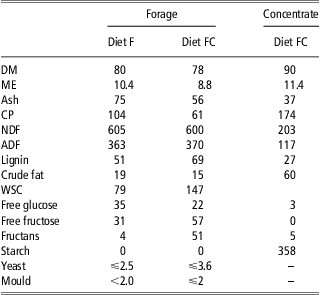
The horses were offered a forage-only diet (F) consisting of early-cut haylage (timothy, meadow fescue mixture; Table 1) and a mixed diet (FC) consisting of late-cut haylage (timothy, meadow fescue mixture) supplemented with concentrate (50 : 50 DM basis) in a 29-day change-over design experiment. Feed allowance was based on individual BW and was 13 to 17.4 kg haylage and 180 to 240 g sugar (only to ensure complete intake of the salt, mineral and vitamin supplements) for diet F and 6.3 to 8.4 kg haylage, 5.3 to 7.1 kg oats, 0.9 to 1.2 kg soy bean meal, 0.18 to 0.24 kg wheat bran and 90 to 120 g sugar for diet FC. The diets were estimated to be iso-caloric and iso-nitrogenous, and provided energy and nutrients according to requirements specified by National Research Council (NRC, 1989). Horses on both diets were offered a mineral and vitamin supplement (51 ± 2 g/day, Miner Röd, Krafft, Falkenberg, Sweden), NaCl (36 ± 1 g/day), and those on diet FC were offered ground chalk (calcium carbonate, 34 ± 1 g/day) in order to meet mineral and vitamin requirements specified by NRC (1989). Water was provided ad libitum from graded buckets. The forage allowance was fed in the afternoon and the concentrate and mineral and vitamin supplement (diet FC) at 1500, 2300 and 0600 h. With diet F, the mineral and vitamin supplement was fed at 2300 and 0600 h. Diet FC was introduced gradually during the experimental period (on days 1 and 2, horses were fed 50% of the F diet and 50% of the FC diet, and then the FC diet was increased by 10% per day until the full ration was reached on day 7). Diet F was introduced abruptly on day 1.
DM (%), estimated energy (MJ ME/kg DM), chemical (g/kg DM) and microbial composition (cfu/g fresh matter) of feeds in the experimental diets

DM = dry matter; ME = metabolisable energy; cfu = colony-forming units; F = forage-only diet; FC = forage–concentrate diet; WSC = water-soluble carbohydrates.
Training
The horses were given sub-maximal warm-up (3.5 to 5 km, heart rate < 200 beats/min) and intensive training (heart rate > 200 beats/min) on an oval or straight field track (∼0.6% incline) on days 2, 5, 7, 9, 13, 17, 21, 25 and 29 in order to maintain but not improve fitness. The intensive training consisted of interval training (four intervals of 600 m) or 1600 to 2000 m heats, and the training protocol was exactly the same in both periods.
Exercise test (ET)
On day 25 of each experimental period, the horses performed a standardised incremental ET on a treadmill (Säto, Knivsta, Sweden) located at a veterinary clinic 25 km from the training camp. The horses were transported to the clinic by trailer. All horses had prior experience of exercise on this treadmill (minimum two occasions).
Before ET, the horses were kept together in the paddock from 0730 to 1030 h and were then offered 1 kg of forage (diet F) and 1 kg of oats (diet FC). After this, water but no feed was offered until the horses returned to the stable at about 2400 h. This design was chosen because practical experience indicated that many horses do not consume any feed while at the racetrack. On the day after ET, all horses were fed at 0600 h as usual, but were kept in their stalls until 1100 h.
Exercise testing consisted of two phases. The first phase (warm-up, walk at 2 m/s for 3 min, trot 6 m/s for 5 min, trot 9.5 m/s for 5 min and walk 2 m/s for 3 min, no incline) was performed 25 min before the second phase, which consisted of 5 min of walk (0% incline) and then a stepwise increase in velocity (6.0, 7.0, 8.0, 9.0, 9.5 m/s) at an incline of 6.3% every second minute until the horses reached or exceeded a heart rate of 200 beats/min. Four horses reached 9.0 m/s and two reached 9.5 m/s. The horses walked for 5 min on the treadmill after the final step.
Sampling
Feed and water intake, BW and condition
Samples of concentrate were collected from each batch used in every period and samples of forage from each new bale opened and kept frozen at −20°C until analysis. The forage samples were pooled and analysed as one sample per feed and period. Feed leftovers were weighed and eliminated every day. Daily nutrient and energy intake was calculated using feed intake data and analysis of feeds and leftovers. Water intake (drinking) was measured on days 19 to 28.
BW was recorded before each training session, before the warm-up prior to ET, immediately after ET, on the day after ET (at 1100 h) and on days 27 to 29 (afternoon). Changes in body condition were assessed by a simple recording of whether the ribs were easy to palpate or not and whether they were visible during motion.
ET
Heart rate was recorded by a heart frequency meter (Polar RS800, Kempele, Finland) during exercise and manually post exercise with a stethoscope. Heart rate was measured before warm-up, during warm-up (9.5 m/s), immediately after warm-up, after 25 min of rest, during each incremental step, after 5 min walking on the treadmill and 10, 25, 55 and 85 min after the end of walking.
Breathing frequency was recorded before warm-up, directly after warm-up, after 25 min of rest, after 5 min walking on the treadmill and 10, 25, 55 and 85 min after the end of walking. Rectal temperature was recorded before warm-up, directly after warm-up, after 25 min of rest and 10, 25, 55, 85 min after the end of walking.
A jugular catheter was introduced under local anaesthesia (Carbocain 20 mg/ml, AstraZeneca AB, Sweden) before transport to the clinic, and blood samples (20 ml/sample) were collected in Li-heparinised tubes before warm-up, immediately after warm-up, after 25 min of rest, at the end of each incremental step, after 5 min walking on the treadmill and 10, 25, 55 and 85 min after the end of walking. A final blood sample was taken on the day after ET, at 1100 h. The blood samples were kept chilled until centrifugation and frozen at −20C° for later analysis. Samples collected for analysis of blood pH, and TCO2 and HCO3 were analysed within 10 min of collection.
Muscle biopsies were taken from m. gluteus medius at a depth of ∼6 cm according to the method described by Lindholm and Piehl (Reference Lindholm and Piehl1974). A local anaesthetic (Carbocain 20 mg/ml, AstraZeneca) was applied to the area and a nose twitch was used. Biopsies were taken before warm-up and immediately after ET, frozen in liquid nitrogen and stored at −80°C until analysis.
Analyses
Preparation and conventional chemical analyses (DM, nitrogen, NDF, ADF, lignin, water-soluble carbohydrate (WSC) and ash) of feeds were performed as described by Palmgren-Karlsson et al. (Reference Palmgren-Karlsson, Lindberg and Rundgren2000). Minerals were analysed with inductively coupled plasma optical emission spectrometry (ICP-OES; SS-EN 14538 : 2006, Ametek Spectro, Kleve, Germany). The metabolisable energy content of the forage was estimated by an in vitro method (Lindgren, Reference Lindgren1979).
Analyses of plasma, blood and muscle
Plasma insulin was analysed using an ELISA method (Mercodia equine insulin kit, Mercodia, Uppsala, Sweden). For quantitative determination of non-esterified fatty acids (NEFA), an enzymatic colorimetric method was used (ACS-ACOD method, Wako Chemicals GmbH, Neuss, Germany). Plasma urea, acetate and glucose concentrations were analysed with an enzymatic colorimetric/UV method (Boehringer Mannheim/R-Biopharm, Darmstadt, Germany), and lactate was analysed using an ELISA method (R-Biopharm GmbH, Darmstadt, Germany). Venous pH, TCO2 and HCO3 were analysed using an i-STAT®1 analyser (Abbott Laboratories, Abbott Park, Illinois, USA). Total plasma protein (TPP) concentration was measured using a refractometer (Atago, Sur-Ne, Tokyo, Japan) in samples taken before warm-up, before ET, 55 min after walking and the day after walking.
Muscle samples for glycogen analysis were freeze-dried and dissected free from visible blood, connective tissue and fat under a microscope before analysis. A sample of about 1 to 2 mg muscle fibre was boiled in 1 M HCl, and glucose residues were determined by fluorescence (Lowry and Passonneau, Reference Lowry and Passonneau1973).
Calculations and statistical analysis
The velocity at plasma lactate concentration 4 mmol/l (VLa4) was calculated individually from an exponential curve fitted by Microsoft Office Excel 2007.
All data were subjected to analysis of variance (GLM procedure in the Statistical Analysis Systems package 9.1; SAS Institute Inc., Cary, NC, USA) using the following model: Yijk = μ + αi + βj + γk + εl + (βγ)jk + eijkl, where Yijk is the observation, μ the mean value, αi the effect of animal, βj the effect of diet, γk the effect of sample, εl the effect of period, (βγ)jk the effect of interaction between diet and sample and eijkl the residuals; eijkl ∼IND (0, δ 2). The value used for significance within and between treatments was P < 0.05. Values are presented as least square mean ± s.e.m.
Results
General observations
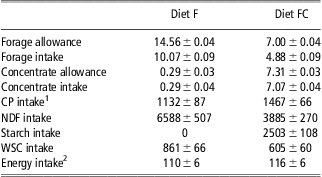
All horses completed the study. No health problems were observed, except in one horse that developed a fever 2 days into period 1 (resulting in three missed training sessions). There were leftovers on both diets (Table 2), and forage intake corresponded to 69% of the allowance on both diets, resulting in a forage : concentrate ratio of 40 : 60 for diet FC. A comparison of the in vitro digestible organic matter (IVDOM) of the individual leftovers and the feed samples collected on days 20 to 22 showed consistently lower IVDOM in the leftovers compared with the feed for diet F, but not diet FC (Diet F: feed = 78.3%, leftovers = 73.7% to 76.9%; diet FC: feed = 66.9%, leftovers = 63.7% to 69.6%), indicating selective feed intake in all individuals on diet F.
Daily feed allowance, feed intake (kg) and nutrient (g) and estimated metabolisable energy intake (MJ ME) during 29 days on a high-energy, forage-only diet (F) and a mixed forage–concentrate diet (FC) (LSmeans ± s.e.)

Body condition was similar in four individuals on both diets, but two individuals had higher body condition on diet FC (horse 1 changed from ‘ribs visible at motion’ to ‘not visible but easy to palpate’ and horse 2 changed from ‘ribs not visible at motion but easy to palpate’ to ‘not visible, not easy to palpate’). Mean BW was higher (P = 0.0006) for horses on diet F (519.0 ± 0.5 kg) than diet FC (516.0 ± 0.5 kg). Water intake was higher with diet F than diet FC (30.0 ± 0.5 v. 19.0 ± 0.5 l/day, P < 0.0001).
ET
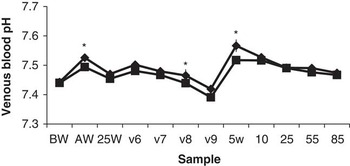
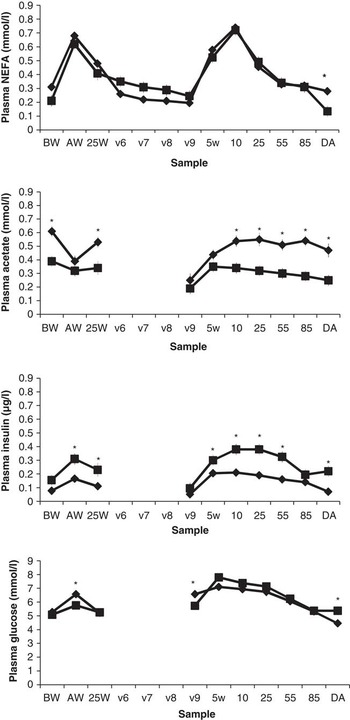
There was no significant difference in VLa4 between diets, although there was a tendency (P = 0.086) for higher VLa4 in horses on diet F (8.0 ± 0.1 v. 7.6 ± 0.1 m/s). Plasma lactate concentration was higher (P < 0.05) in horses on diet FC compared with diet F at the end of the 5-min walk and 10 min after the walk on the treadmill (diet FC: 8.1 ± 0.4 and 4.4 ± 0.4 v. diet F: 5.7 ± 0.4 and 3.2 ± 0.4 mmol/l). Venous pH (Figure 1), TCO2 and HCO3 (P = 0.0001) in connection with exercise were higher in horses on diet F compared with diet FC (pooled data for TCO2: 31.2 ± 0.2 v. 30.3 ± 0.2 mmol/l and HCO3: 30.0 ± 0.2 v. 29.1 ± 0.2 mmol/l). Acetate concentration was higher with diet F than diet FC (P = 0.0001) and plasma NEFA concentration on the day after ET was higher (P < 0.05) with diet F compared with diet FC (Figure 2). Plasma insulin concentration was higher (P = 0.0001) in horses on diet FC compared with diet F (Figure 2), and glucose concentration was higher (P < 0.05) with diet F immediately after warm-up and at 9 m/s, but lower (P < 0.05) on the day after ET (Figure 2). Muscle glycogen content was higher (P < 0.05) in horses on diet FC than diet F both before (644 ± 22 v. 560 ± 22 mmol glucosyl units/kg dry weight) and after exercise (546 ± 22 v. 473 ± 22 mmol glucosyl units/kg dry weight). There were no differences between the diets in heart rate (109 ± 1 and 111 ± 1 beats/min in F and FC, respectively), breathing frequency (62 ± 3 and 68 ± 3 beats/min in F and FC, respectively) or rectal temperature (38.5 ± 0.1 and 38.5 ± 0.1 beats/min in F and FC, respectively), before, during and after exercise (pooled data).
Venous pH before, during and after an incremental exercise test. Values (LSmeans ± SE) for six Standardbred geldings on a high-energy, forage-only diet (F; diamonds) and a 40 : 60 forage–concentrate diet (FC; squares). BW = before warm-up, AW = after warm-up, 25W = 25 min after warm-up, v6–v9 = incremental exercise test at velocities 6, 7, 8 and 9 m/s (treadmill incline 6.3%), 5w = after 5 min walk, 10, 25, 55, 85 min after the walk. The effect of diet was significant (ANOVA, P = 0.0001). *Indicates significant difference (P < 0.05) between diets for single samples.

Plasma glucosea, insulina, acetatea and non-esterified fatty acid (NEFA) concentrations before, during and after an incremental exercise test. Values (LSmeans ± s.e.) from six Standardbred geldings on a high-energy, forage-only diet (F; diamonds) and a 40 : 60 forage–concentrate diet (FC; squares). BW = before warm-up, AW = after warm-up, 25W = 25 min after warm-up, v6–v9 = incremental exercise test at velocities 6, 7, 8 and 9 m/s (treadmill incline 6.3%), 5w = after 5 min walk, 10, 25, 55, 85 min after the walk and DA = day after at 1100 h. a = no analyses for v6–v8 available. The effect of diet was significant for acetate and insulin (ANOVA, P < 0.0001). *Indicates significant difference (P < 0.05) between diets for single samples.

There were no differences in BW between diets before (diet FC: 509 ± 1 kg and diet F: 511 ± 2 kg) and after warm-up and ET (diet FC: 501 ± 1.0 kg and diet F: 500 ± 1 kg). The pre-exercise BW was not recovered until day 28 on both diets. Mean TPP during ET day and on the day after was lower with diet F than diet FC (64.6 ± 0.6 v. 67.0 ± 0.6 g/l).
Discussion
Horses fed the forage-only diet showed an altered metabolic response during exercise compared with horses on the forage–concentrate diet, and few, if any, effects likely to impair performance were observed. There was an increase in plasma acetate concentration on the F diet, as expected. Moreover, with this diet, plasma lactate concentration was significantly lower post exercise and there was a tendency for higher VLa4, indicating that aerobic energy utilisation may have improved. In addition, venous pH increased during exercise in horses on the F diet, which could counteract the acidosis induced by the exercise typically performed by racehorses. This indicates that high-energy, forage-only diets are an interesting alternative to conventional diets.
The increased plasma levels of acetate in horses on the F diet can be explained by more extensive hindgut fermentation due to higher fibre intake, and subsequent production of SCFA (Hintz et al., Reference Hintz, Argenzio and Schryver1971; Willard et al., Reference Willard, Willard, Wolfram and Baker1977). SCFA absorbed from the hindgut can be used as substrates in body tissue metabolism. Propionate may be primarily used to produce glucose in the gluconeogenetic pathway, whereas acetate and butyrate can be transformed to acetyl-CoA and then utilised as substrates for aerobic energy metabolism in the tri-carboxylic pathway in the muscle (Voiton et al., Reference Voiton, Navet, Lacombe, Sluse, Essen-Gustavsson, Hinchcliff, Rivero, Serteyn and Valberg2007). The latter also applies to LCFA that are metabolised through β-oxidation in the muscle. It has been suggested that long-term feeding of supplemental fat to exercising horses increases the mobilisation and speed of mobilisation of free fatty acids (FA), increasing the speed of uptake into muscle of free FA, lowering lactic acid production, imparting a glycogen-sparing effect and increasing pre-exercise muscle glycogen levels (Potter et al., Reference Potter, Hughes, Julen and Swinney1992; Harris and Harris, Reference Harris and Harris2005). However, there is a large variation in the effects reported in the literature, and only a few studies report direct benefits on performance traits (Geor, Reference Geor2006). Pagan et al. (Reference Pagan, Geor, Harris, Hoekstra, Gardner, Hudson and Prince2002) used a stable glucose isotope and showed that a high-fat diet can be glucose-sparing by increasing FA oxidation from body lipid stores during exercise, suggesting that performance could be improved. In the present study, no clear effect of the F diet on performance was observed, but there was a lowering of post-exercise plasma lactate concentration, confirming previous findings for a high-fibre diet (Palmgren-Karlsson et al., Reference Palmgren-Karlsson, Jansson, Essén-Gustavsson and Lindberg2002).
Waller and Lindinger (Reference Waller and Lindinger2007) reported profound plasma alkalosis, that is, a decrease in venous plasma hydrogen concentration and an increase in plasma TCO2 and HCO3−, after post-exercise oral administration of sodium acetate. These results were confirmed in the present study, where venous pH, TCO2 and HCO3− concentrations were higher in horses on the F diet. The alkalising effect of a forage-only diet may also be a direct result of the increased plant cell and organic acid intake typical of herbivores (Houpt, Reference Houpt1989). Plant cells contain organic anions (citric, oxalic, malonic and fumaric acids) that are electrically balanced by potassium and other cations. Citrate and other organic anions are oxidised to CO2 and H2O, but their breakdown requires hydrogen ions, which are derived from the hydration of carbon dioxide. Thus, as organic anions are oxidised, HCO3 is produced, which has an alkalotic effect on body fluid pH (Houpt, Reference Houpt1989). The possibility of counteracting the acidosis induced by intensive exercise by oral supplementation (generally with salts of HCO3−) has been studied for a long time, but the effects on performance are not unequivocal (Kelso et al., Reference Kelso, Hodgson, Witt, Bayly, Grant and Gollnick1987; Lawrence et al., Reference Lawrence, Miller, Bechtel, Kane, Kurcz and Smith1987; Schuback et al., Reference Schuback, Essén-Gustavsson and Persson2002). This may be the first study to show that there is a natural way of achieving this effect, although a positive effect on performance remains to be proven.
Plasma glucose levels were higher during exercise in horses on the F diet. The origin and importance of this elevation in glucose concentration for exercise performance is not clear, but endurance during both maximal (Lacombe et al., Reference Lacombe, Hinchcliff, Geor and Baskin2001) and sub-maximal (Farris et al., Reference Farris, Hinchcliff, McKeever, Lamb and Thomson1998) exercise is improved by glucose infusion, indicating that high blood glucose availability could improve performance. Alterations in glucose metabolism (both in tissue uptake and release from the liver) are likely to occur in horses on forage-only diets, based on the low insulin levels observed here and earlier (Connysson et al., Reference Connysson, Essén-Gustavsson, Lindberg and Jansson2010), and might be the reason for the elevated glucose levels during exercise. However, on the day after ETs, the plasma glucose concentration was lower in horses on the F diet and the NEFA concentration was higher. The importance of this is also unclear, but it might reflect the demand for glucose for resynthesis of glycogen and low dietary glucose availability (total daily intake of WSC and starch was ∼860 and 3100 g/day on diet F and FC, respectively) and increased utilisation of body fat for maintenance.
The low WSC intake might also have affected muscle glycogen synthesis (Lacombe et al., Reference Lacombe, Hinchcliff, Kohn, Devor and Taylor2004). Muscle glycogen content was lower (−13%) before and after ET in horses on the F diet, whereas relative glycogen depletion was similar. It is known that glycogen synthase is activated by insulin (Devlin and Horton, Reference Devlin and Horton1985) and the low insulin levels on the F diet might have been a limiting factor for glycogen synthesis. Further studies are needed to determine whether total muscle glycogen storage capacity is reduced on a forage-only diet or whether it is only the rate of synthesis that is reduced. It is important to note that all horses had trained ∼96 h before ET and that glycogen recovery might not have been complete. It is well documented that post-exercise recovery of glycogen stores takes several days in horses (Snow et al., Reference Snow, Harris, Harman and Marlin1987; Hyyppä et al., Reference Hyyppä, Räsanen and Pösö1997; Lacombe et al., Reference Lacombe, Hinchcliff, Kohn, Devor and Taylor2004). Although an exercise-induced reduction in muscle glycogen content of 80% has been shown to impair endurance during high-intensity exercise (Lacombe et al., Reference Lacombe, Hinchcliff, Geor and Baskin2001), the importance of a smaller reduction, such as that induced by the F diet in the present study, is not known. Interestingly, oral acetate supplementation of a typical hay-grain diet has been shown to enhance the rate of glycogen resynthesis during the initial 4-hour recovery period after muscle glycogen depletion (Waller et al., Reference Waller, Geor, Spriet, Heighenhasuer and Lindinger2009), but our data suggest that increased acetate availability does not maximally support glycogen repletion between training sessions. However, a recent study (Essén-Gustavsson et al., Reference Essén-Gustavsson, Connysson and Jansson2010) of horses on forage-only diets with different CP content showed that high CP forage increased muscle glycogen content compared with a forage providing the CP intake recommended by NRC (2007). This shows that CP is important for glycogen content and might have increased the glycogen content in horses on diet FC in the present study.
One argument against using forage-only or high-forage diets for performance horses is the risk of an unwanted increase in BW. This is probably based on the common perception that fibre is ‘bulk’ and perhaps also on knowledge of the water-holding capacity of plant fibres. In a study on riding horses (Ellis et al., Reference Ellis, Hollands and Allen2002), a forage-only diet increased BW and heart rate during sub-maximal exercise, suggesting that performance might be impaired. However, it should be noted that the energy content of the forage in that study was not high enough to support the energy needs of horses in race training and, accordingly, the digestibility was not high enough, thereby causing ‘bulk weight gain’. The present study showed no (ET days) or a limited (3 kg in pooled data) increase in BW in horses fed a high-energy forage diet. There was also no effect on heart rate and breathing frequency. It is likely that differences in chemical composition between forages are the reason for the differences in BW change in these studies. In the present study, the forage in diet F was early-cut and had high fibre digestibility, as reported by Ragnarsson and Jansson (Reference Ragnarsson and Jansson2011) for the same batch of forage.
Part of the increase in BW observed on a forage-only diet could also be due to increased plasma volume, as indicated by the lowered TPP. It has been suggested that the hindgut serves as a fluid reservoir and that fibre-rich diets increase this reservoir (Meyer, Reference Meyer1987). The change in TPP with altered fibre intake could therefore reflect changes in the equilibrium between the gut and the extracellular fluid. It has been shown that increased forage intake lowers TPP (Danielsen et al., Reference Danielsen, Lawrence, Siciliano, Powell and Thomson1995) and also that signs of dehydration (increased TPP) following feed deprivation are delayed in horses on a forage-only diet compared with those on a mixed diet (Connysson et al., Reference Connysson, Essén-Gustavsson, Lindberg and Jansson2010). However, BW recovery was similar on both diets in the present study. The results also showed that it may take 2 to 3 days for horses transported to an exercise event to recover their BW. The loss of BW on ET day was due to lack of feed intake (less than 60% of the allowance) and to fluid and faeces losses during transportation and exercise.
There is also anecdotal information that forage intake capacity is limited in performance horses. Horses in the present study consumed forage corresponding to 1.95% of BW and four of the horses maintained similar body condition on both diets. It is possible that the other two horses would have been maintained on a forage diet with slightly higher energy content (around 11 MJ metabolisable energy/kg DM). In all horses on the forage-only diet, the maintenance of energy intake and body condition was to some extent due to selection of the forage offered, as reflected in lower digestibility of leftovers from this diet. This contributed to higher energy intake on the forage-only diet and was probably an attempt to maximise energy intake.
Another concern about a forage-dominated diet for athletic horses is the increased heat increment of feeding. In the present study, this was probably reflected in the higher water intake on diet F. However, body temperature was similar, as would have been expected in a homeothermic animal, and it was not possible to draw any conclusions about evaporative fluid losses during exercise from the results, as only BW was measured before and after exercise (including sweat, faecal and respiratory losses).
No feed-related clinical or behavioural disturbances very observed during the study. Exercise temperament, novel object reaction, voluntary motion and post-exercise feeding (Jansson, Reference Jansson2010) were also evaluated in the present study, and numerical, but not statistically significant, differences were detected, with the exception of observations on post-exercise feed intake, which was more common on diet F. However, subjectively more aggression was observed in horses fed diet FC, especially in the afternoon when horses were fetched from the paddock (one at a time) to be put in their boxes, where feed was available. Therefore, our impression is that the FC diet might have affected behaviour (making horses more active and reactive), although the recording system used could not verify this.
In conclusion, the present study indicates that a high-energy, forage-only diet alters the metabolic response to exercise and, with the exception of lowered glycogen stores, appears to have positive rather than negative effects on performance traits of Standardbred horses.
Acknowledgements
The authors thank HästKraft AB and Lantmännen Box for providing the forages, and trainer Anna Svensson and the staff at Mälarkliniken, Sigtuna, Sweden, for assistance during the study. This research received financial support from Stiftelsen Svensk Hästforskning, Sweden.