Introduction
Life satisfaction refers to positive feelings and attitudes towards life, general happiness, as well as a sense of meaning and fulfillment (Chen, Lehto and Cai Reference Chen, Lehto and Cai2013). It has been frequently used to assess older adults’ quality of life and subjective wellbeing (Chen and Petrick Reference Chen and Petrick.2013). Given the rapid population ageing caused by low fertility rates and the lengthening of life expectancy, the wellbeing of the ageing population has become an important area for research and policy development in ageing societies (Meggiolaro and Ongaro Reference Meggiolaro and Ongaro2015). However, promoting later-life satisfaction has long been both a policy and practice challenge, as older adults are in the face of physical and cognitive functioning decline, role loss, isolation and diminishing resources (Burton-Jeangros and Zimmermann-Sloutskis Reference Burton-Jeangros and Zimmermann-Sloutskis2016). A steep decline in life satisfaction among those aged 70 and over has been observed in a study on life satisfaction across the lifespan using the data from two nationally representative panel studies in Germany and the United Kingdom (Baird, Lucas and Donnellan Reference Baird, Lucas and Donnellan2010).
Previous studies have identified a range of predictors of greater life satisfaction in older adults which include (a) socio-demographic factors such as a younger age (Borg, Hallberg and Blomqvist Reference Borg, Hallberg and Blomqvist2006), male gender (Gaymu and Springer Reference Gaymu and Springer2010) and higher socio-economic status (Read, Grundy and Foverskov Reference Read, Grundy and Foverskov2015); (b) indicators of better health status such as fewer chronic diseases, better activities of daily living and better self-care abilities (Gagnon and Patten Reference Gagnon and Patten2002); (c) active participation in social and leisure activities (Chen and Petrick Reference Chen and Petrick.2013); (d) personality attributes such as extraversion, neuroticism and conscientiousness (Parker, Martin and Marsh Reference Parker, Martin and Marsh2008); and (e) stronger social network, and family and social support (Lou Reference Lou2010). Findings of relevant literature, limitations and rationale of the present study are discussed below.
Self-image and life satisfaction
The potential of self-image mediating the effect of personality on life satisfaction has been recognised in several studies, but many of them focused exclusively on young adult students rather than older adults (e.g. Parker, Martin and Marsh Reference Parker, Martin and Marsh2008). Noting there was scant research on Chinese older adults’ perceived images of ageing, especially on how older adults perceived themselves, Bai, Chan and Chow (Reference Bai, Chan and Chow2012) further developed and validated the Chinese version of the Self-image of Ageing Scale, a 14-item psychometrically sound instrument, with reference to Levy's Image of Aging Scale (Levy, Kasl and Gill Reference Levy, Kasl and Gill2004). In the examination of the criterion-referenced validity of the scale, a positive bivariate correlation between older adults’ self-image and their life satisfaction was detected (Bai, Chan and Chow Reference Bai, Chan and Chow2012). However, whether such a positive correlation will remain statistically significant in a multivariate model after controlling for the confounding factors is yet to be examined.
Given the difficulty of implementing interventions to promote life satisfaction by changing one's personality (Parker, Martin and Marsh Reference Parker, Martin and Marsh2008), it is a better way to examine older adults’ perceived self-image and how it affects their life satisfaction, and develop services and programmes accordingly.
Intergenerational relationships and life satisfaction in older adults
Stronger social network, and higher levels of family and social support, have been found to predict older adults’ life satisfaction in various societies (Lou Reference Lou2010). With the work role loss in later life, family roles and intergenerational relationships are likely to become older adults’ primary sources of attachment and wellbeing (Stryker Reference Stryker1980). Previous research showed that positive aspects of parent–adult child relationships contribute to better wellbeing of parents while negative aspects of the relationships have detrimental effects (Ward Reference Ward2008). For instance, emotional support from adult children has been found to be negatively correlated with levels of depressive symptoms among older parents (Lang and Schutze Reference Lang and Schutze2002). The strong ties between parents and adult children may help buffer the effects of stressful issues (Ward Reference Ward2008).
Many studies on intergenerational relationships in China have focused on the impact of intergenerational or spousal relationships on the development of young children (e.g. Ngai et al. Reference Ngai, Cheung, To, Liu and Song2013). As filial responsibility of care for elders and harmonious family relationships have often been taken for granted in China, there is limited research which has examined the association between older adults' intergenerational relationships and their life satisfaction. Family structures and values are becoming diverse due to higher standards of living and education levels, urbanisation and changes in children's socialisation (Chow and Bai Reference Chow and Bai2011). New intergenerational tensions and contradictions may result from these changes. As a nation where the family is largely responsible for the wellbeing of its older adults and who holds the ‘face’ (mianzi) culture emphasising the relational and external environment in the shaping of a recognition ego, the impact of these changes may be even greater.
As a classic conceptual framework to understand intergenerational relationships, the solidarity model classifies intergenerational relationships into six essential facets including (a) associational solidarity (frequency and types of interaction); (b) consensual solidarity (agreement on attitudes and values); (c) affectual solidarity (positive sentiments and feelings); (d) normative solidarity (commitment to familial obligations); (e) structural solidarity (opportunity structure for intergenerational interactions); and (f) functional solidarity (exchanges of resources and support) (Bengtson and Roberts Reference Bengtson and Roberts1991). Studies within this framework tend to emphasise shared beliefs and feelings across generations, strong ties between parents and children, and the value of providing support.
However, the solidarity perspective has been criticised by its overly positive bias. In addition to the harmonious aspects, another line of research has identified conflicting intergenerational relationships, such as isolation, conflict, care-giver burden, antagonistic feelings towards one another and abuse (Birditt, Jackey and Antonucci Reference Birditt, Jackey and Antonucci2009; Guo, Chi and Silverstein Reference Guo, Chi and Silverstein2012; Prinzen Reference Prinzen2014; Yan and Tang Reference Yan and Tang2004). Lüscher and Pillemer (Reference Lüscher and Pillemer1998) suggest that the study on older parent–adult child relationships should move beyond this ‘love–hate relationship’. Intergenerational ambivalence, ‘the simultaneous coexistence and opposition of harmony and conflict in intergenerational relations’ could serve as an alternative perspective to guide future research on intergenerational relationships (Lüscher Reference Lüscher2002: 591).
Gender differences in correlates of life satisfaction
Gender disparities in levels of later-life satisfaction have frequently been reported in previous studies (Gaymu and Springer Reference Gaymu and Springer2010), but whether gender differences exist in correlates of life satisfaction remains unclear. With reference to the lifecourse perspective and the feminist perspective (Binstock Reference Binstock2007), socially constructed roles of men and women, and the gender-based division of labour in economic and family spheres in earlier life, may lead to distinct expectations, values and sources of wellbeing in later life (Burton-Jeangros and Zimmermann-Sloutskis Reference Burton-Jeangros and Zimmermann-Sloutskis2016; Gaymu and Springer Reference Gaymu and Springer2010; Lai and Bai Reference Bai2016). Thus, it is important to further investigate gender differences in the correlates of life satisfaction so as to inform the development of tailored policy and services (Burton-Jeangros and Zimmermann-Sloutskis Reference Burton-Jeangros and Zimmermann-Sloutskis2016; Meggiolaro and Ongaro Reference Meggiolaro and Ongaro2015).
Based on the survey data collected from adults aged 60 and above living in urban areas of China in 2014, this study examined (a) older adults’ self-image and perceived relationships with children; (b) the association between older adults’ self-image and life satisfaction, and that between their perceived intergenerational relationships and life satisfaction after controlling for relevant socio-demographic variables and health and self-care ability; and (c) gender differences in the correlates of life satisfaction. The findings of this study will facilitate a better understanding of older adults’ perceptions of themselves and relationships with children. This study can also help raise awareness among professionals and service providers about the influence of self-image and intergenerational relationships on older adults’ life satisfaction, and create better understanding of gender differences in the correlates of life satisfaction, which may inform future policy and programme development.
Design and methods
The context of China
With a total population of 13.6 billion, China is experiencing rapid population ageing due to low total fertility rate (1.55%) due to 35 years of the one-child policy and rising life expectancy (74.8 years at birth) (National Bureau of Statistics 2014). Older adults over 65 years increased from 4.9 per cent in 1982 to 9.7 per cent in 2013 which exceeded the internationally recognised threshold for an ageing society. Meanwhile, the old-age dependency ratio went up from 8.0 per cent in 1982 to 13.1 per cent in 2013 (National Bureau of Statistics 2014).
As a result of rapid modernisation, family systems in China have undergone rapid transformation in past decades (Chow and Lum Reference Chow and Lum2008). The average household size of a Chinese family declined from 4.41 in 1982 to 3.10 in 2010 (National Bureau of Statistics 2011). Intergenerational interactions and relationships in China are changing rapidly as well. On one hand, family dynamics and functions seem to be weakened by economic growth, political influence and social transitions; on the other hand, the tradition of filial respect and intergenerational obligations remains. Not only do adult children provide support for ageing parents, older people are also play an important role in the process of raising grandchildren (Goh Reference Goh2009). Both urban and rural families continue to serve as the main source of support for older adults (Zhang and Goza Reference Zhang and Goza2006).
Sampling
A three-step sampling was used in this study. Firstly, four cities were selected: Beijing (east), Guizhou (south-west), Hebi (middle) and Xi'an (north-east). These four cities are generally representative of China's diverse geographic areas and city sizes. Secondly, a sampling frame was set in each city based on the administration districts and units. For example, in Beijing, five districts were randomly selected, namely Chaoyang, Dongcheng, Fengtai, Haidian and Xicheng. Thirdly, each district was divided into census blocks and the lists of older adults living in selected blocks were obtained. Investigators recruited participants from each block, with the help of sub-district officials.
Data collection
Data were collected from 1,099 older adults from four cities (i.e. Beijing, Guizhou, Heibi and Xi'an) in China from January to October in 2014. The screening criteria were: (a) aged 60 years or above, (b) had at least one biological or adopted child, and (c) had normal cognitive functions. The participants were given a brief introduction on the aims of the study and informed that the information obtained would only be used for research purposes. Consent forms were obtained prior to the questionnaire survey and participants were well aware that they could terminate the survey at any time. On average, each questionnaire interview took around 40 minutes. Upon completion, they were given a small gift valued US $5 to compensate for their time and contribution. Given that some participants had poor eyesight or hardly received any education, face-to-face structured questionnaire interviews were carried out. Five undergraduate students and seven graduate students were recruited as interviewers from the School of Labour and Human Resources at the Renmin University of China.
Measurement
Four groups of independent variables were measured in the present study, including socio-demographic characteristics, health and self-care ability, self-image and intergenerational relationships. Life satisfaction was regarded as the dependent variable.
Socio-demographic characteristics
Socio-demographic information was collected including city, age, gender, marital status and self-rated economic condition. Age was reported as chronological age. Marital status was measured by a binary variable (0 = single/divorced/widowed, 1 = married) and economic condition was measured with self-rated financial status, ranging from 1 = very poor to 5 = very rich.
Health and self-care ability.
The Chinese version of instrumental activities of daily living (IADLs) and number of chronic diseases were used to assess older adults’ health and self-care ability. Self-care ability was measured by the Lawton Instrumental Activities of Daily Living Scale from eight aspects, including ability to use the telephone, shopping, food preparation, housekeeping, laundry, transportation, medications and capability of handling finances (Lawton and Brody Reference Lawton and Brody1969). The score for each item was either 0 or 1. The total score of the scale was 8. Number of chronic diseases was measured by a multiple-choice question ‘how many chronic diseases do you have?’ with nine options, such as cardiovascular, hypertension, etc. The score of this question ranged from 0 (having no such chronic diseases) to 9 (having all these chronic diseases).
Self-image
Older adults’ self-image was measured by the Chinese version of the Self-Image of Ageing Scale (SIAS-C) developed by Bai, Chan and Chow in 2012. This 14-item SIAS-C examined how older adults perceived themselves in five domains, including general physical health, social virtues, life attitudes, psycho-social status and cognition. Older adults were asked to rate the extent to which each statement matched with their perceptions about themselves. The scale vindicated a satisfactory level of internal consistency (Cronbach's α = 0.73), test–retest reliability (r = 0.87) and criteria-referenced validity (Bai, Chan and Chow Reference Bai, Chan and Chow2012). Cronbach's α of SIAS-C with the present sample was 0.81. The total self-image scores ranged from 14 (most negative self-image) to 70 (most positive self-image).
Intergenerational relationship
Both the solidarity and conflict aspects of the intergenerational relationships were measured in this study. Participants were asked to select one of their children to rate their relationship. The three items measuring the comforting aspect of the relationship were ‘How is the relationship between you and him/her?’, ‘How do you get along with him/her?’ and ‘How about the communication between you and him/her?’ Their responses were rated from 1 (very bad) to 6 (very good), with a higher score indicating greater solidarity in the intergenerational relationship. The three items concerning the negative/conflict aspect of the relationship included ‘How often does the conflict happen between you and him/her?’, ‘How often does he/she criticise you or consider your behaviour unacceptable?’ and ‘How often does he/she argue with you?’ Their responses were rated from 1 (very seldom) to 6 (very often), with a higher score indicating greater conflict in the intergenerational relationship. Both the solidarity and conflict scales had good internal consistency with Cronbach's α = 0.91 and 0.80, respectively.
Life satisfaction
The Chinese version of the Satisfaction with Life Scale (SWLS; Diener et al. Reference Diener, Emmons, Larsen and Griffin1985), an instrument designed for measuring subjective satisfaction with one's life, was used to assess older adults' life satisfaction in this study. It assessed five items along a seven-point scale (ranging from 1 = strongly disagree to 7 = strongly disagree). The scale demonstrated satisfactory reliability and validity (Diener et al. Reference Diener, Emmons, Larsen and Griffin1985), and has been widely used in Chinese societies (Bai, Hung and Lai Reference Lai, Bai, Al-Krenawi, Graham and Habibov2016; Huang Reference Huang2012). The total scores ranged from 5 to 35, with higher scores indicating a higher level of life satisfaction. In this study, the internal consistency of SWLS using Cronbach's α was 0.89.
Data analysis
Data analysis was performed by SPSS for Mac version 21. Descriptive and frequency analyses were conducted to describe respondents’ socio-demographic characteristics, health and self-care ability, self-image, perceived intergenerational relationship and life satisfaction. Chi-squared and independent t-tests were adopted to detect gender differences in the distribution of some characteristics. Bivariate correlations were then conducted between potential predictors and life satisfaction. Only factors that showed significant bivariate relationships with life satisfaction (p < 0.05) were further selected for entering hierarchical regression analysis. Before hierarchical regression analysis was conducted, the linearity of the correlation, homogeneity of variance of residuals and normal distribution for residuals were all tested, and no multicollinearity among the independent factors was found. To examine the gender differences in the correlates of older adults’ life satisfaction, hierarchical regression models were also conducted for male and female samples separately.
Results
Descriptive analyses of respondents’ characteristics
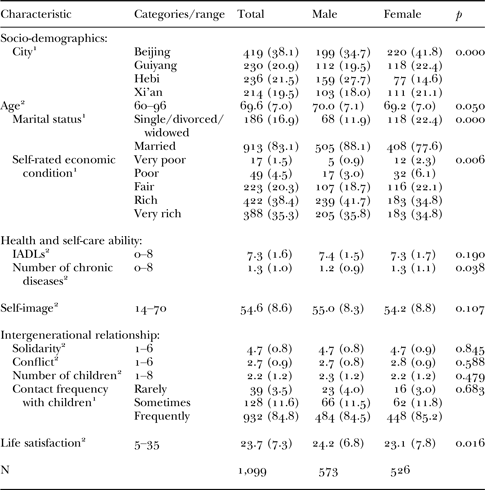
As Table 1 shows, the 1,099 respondents in this study came from Beijing (N = 419), Guiyang (N = 230), Hebi (N = 236) and Xi'an (N = 214), aged from 60 to 96 (mean = 69.6); 573 of them were male and 526 female. With regard to their marital status, 83.1 per cent of the respondents were married and 16.9 per cent of the respondents were single/divorced/widowed. For the self-rated economic condition, the majority of the respondents rated themselves as rich (38.4%) or very rich (35.3%). In terms of health and self-care ability, the mean score of IADLs and the mean number of chronic diseases was 7.3 and 1.3, respectively. With respect to their self-image, the mean score was 54.6 with the range from 14 to 70. The mean score of the solidarity and conflict aspects of intergenerational relationships was 4.7 and 2.7, respectively. The average number of children was about two, and the majority of the respondents kept close contact with their children (84.8%). In addition, results of chi-squared and independent t-tests showed significant differences between males and females in the distribution of city, marital status, self-rated economic condition, number of chronic diseases and life satisfaction (p < 0.05). Female participants were generally 0.8 year younger than males, and a larger proportion of them were single/divorced/widowed. With financial and health status inferior to their male counterparts, female participants reported slightly lower life satisfaction.
Respondents’ characteristics

Notes: 1. Values are N (%). 2. Values are means (standard deviation). IADLs: instrumental activities of daily living.
Correlational and hierarchical regression analyses to identify the correlates of life satisfaction
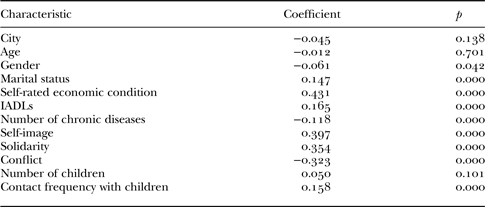
Associations between the 12 potential correlates of life satisfaction were calculated either by Pearson or by Spearman correlation coefficients. The 12 variables included city, age, gender, marital status, self-rated economic condition, IADLs, number of chronic diseases, self-image, solidarity, conflict, number of children and contact frequency with children. As Table 2 shows, respondents’ city, age and number of children were not correlated with their life satisfaction significantly. However, respondents’ marital status, self-rated economic condition, IADLs, self-image, solidarity and contact frequency with children were significantly and positively correlated with their life satisfaction, whereas negative correlations were observed between respondents’ life satisfaction and their gender, number of chronic diseases and conflict.
Correlations between potential predictors and life satisfaction

Note: IADLs: instrumental activities of daily living.
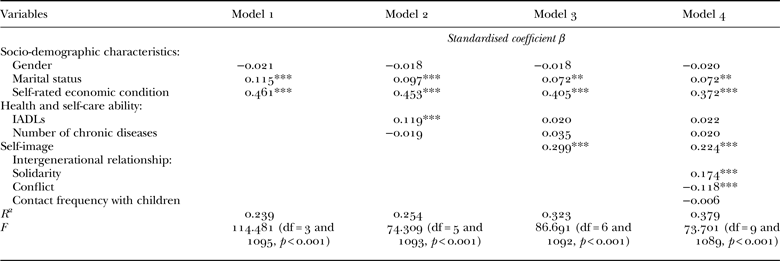
Based on the correlations above, hierarchical regression analysis was performed to examine the influencing factors of respondents’ life satisfaction. Respondents’ socio-demographic characteristics, including gender, marital status and self-rated economic condition, were first put into the regression model (Model 1). IADLs and number of chronic diseases indicating respondents’ health and self-care ability were included as the second block (Model 2). Respondents’ self-image was added into the third block (Model 3). Intergenerational relationship variables, including solidarity, conflict and contact frequency with children, were entered in the fourth block (Model 4).
In combination, respondents’ socio-demographic characteristics, health and self-care ability, self-image and intergenerational relationship explained 37.9 per cent of the variance in life satisfaction. As Table 3 shows, the associations between over half of the potential influencing factors and life satisfaction remained statistically significant in the multivariate model. The four blocks of variables introduced increases of 23.9, 1.5, 6.9 and 5.6 per cent, respectively, in explained variance of life satisfaction. Results of Model 1 showed that respondents’ marital status and self-rated economic condition were significantly associated with their life satisfaction; results of Model 2 showed that IADL was significantly related with life satisfaction after controlling for socio-demographic characteristics; results of Model 3 showed that respondents’ self-image was significantly correlated with life satisfaction after controlling for socio-demographic characteristics, and health and self-care ability variables; Model 4 further indicated that respondents’ solidarity and conflict were significantly correlated with life satisfaction after controlling for socio-demographic characteristics, health and self-care ability variables, and self-image. In summary, participants who were married, with higher scores of self-rated economic condition and self-image, more solidarity and less conflict with their children were more likely to enjoy higher life satisfaction.
Hierarchical regression analysis of life satisfaction

Notes: N = 1,099. Four models were conducted to examine the influencing factors of all the samples’ life satisfaction. IADLs: instrumental activities of daily living. df: degrees of freedom.
Significance levels: ** p < 0.01, *** p < 0.001.
Gender differences in the correlates of life satisfaction
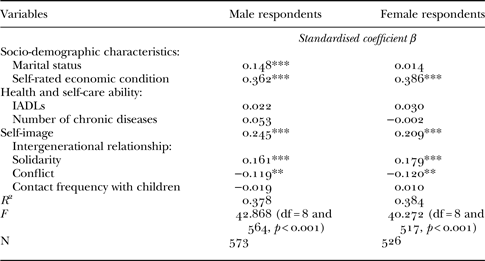
To find out gender differences in correlates of life satisfaction, two additional regression models were conducted for male and female sub-samples separately. As Table 4 shows, five potential influencing factors of life satisfaction, including marital status, self-rated economic condition, self-image, solidarity and conflict retained statistical significance in the multivariate context in the regression model for older men. In comparison, correlates of older women's life satisfaction were the same except that being married was not significantly predictive of a higher life satisfaction. In addition, the results in Table 4 further show that self-image was a more potent predictor for older men's life satisfaction, while economic condition and intergenerational relationships were more important correlates for women. The explanatory power of the models for male and female were similar, with explained variance of life satisfaction being 37.8 and 38.4 per cent, respectively.
Hierarchical regression analysis of male's life satisfaction and female's life satisfaction

Notes: Two models were conducted to examine the influencing factors of male's life satisfaction and female's life satisfaction. IADLs: instrumental activities of daily living. df: degrees of freedom.
Significance levels: ** p < 0.01, *** p < 0.001.
Discussion
This study contributed to the research on correlates of older adults’ life satisfaction by introducing two potential variables: self-image and intergenerational relationships. A significant positive correlation between self-image and life satisfaction in a multivariate model was confirmed; and solidarity and conflict models of intergenerational relationships were used to understand Chinese older adults’ perceived relationship quality. Gender differences in the correlates of life satisfaction were further investigated. Findings of this study revealed that Chinese older adults’ self-image and intergenerational relationships were significant correlates of their life satisfaction after controlling for certain socio-demographic characteristics, and health and self-care ability variables; while older men and women differed in the correlates of life satisfaction.
The findings about the significant correlation between older adults’ self-image and life satisfaction reflected the importance of improving older adults’ self-perception. People with a positive self-perception are more likely to be happy and content with their ability to control what is going on around them, and be optimistic about the ageing experience and future life (Bai, Chan and Chow Reference Bai, Chan and Chow2012; Bai and Chow Reference Bai and Chow2013).
However, age-based stereotypes and discrimination are embedded in our society, in which older adults are labelled as stubborn, useless, unproductive, a burden on society and so forth (Bai Reference Bai2014; Bai, Lai and Guo Reference Bai, Lai and Guo2016). As older adults’ self-image may deteriorate when they internalise such negative stereotypes, efforts should be made to help older adults to learn how to protect their self-concept against stereotyped expectations. More importantly, effective public education and programmes should be developed for older adults to explore and identify positive aspects of themselves and the ageing process, and to foster a more positive image of ageing in wider society.
It is also worthwhile encouraging soon-to-be older adults to address changes and challenges for old age more proactively by taking preparatory efforts with the help of family, friends, and governments at all levels. As perceived economic condition has always been identified as a potent predictor of older adults’ life satisfaction, policy should focus on stabilising their financial situation through multi-pillar retirement pension schemes (Bai, Hung and Lai Reference Lai, Bai, Al-Krenawi, Graham and Habibov2016). With better preparation in financial and health and care arrangements, ageing adults will adapt to old age better and have optimal self-esteem and confidence in leading a rewarding and satisfactory later life with dignity.
With the work role loss in later life, a warm relationship with adult children is likely to become an important source of older parents’ sense of self, attachment and life satisfaction (Stryker Reference Stryker1980). Consistently, findings of this study further revealed that older adults’ perceived relationship quality with their adult children was significantly correlated with their life satisfaction, with the comforting aspects of intergenerational relations contributing to higher life satisfaction, while conflicting aspects being detrimental to their life satisfaction. The fact that the quality of relationship with their adult children, but not the frequency of contact, was found to be a potent predictor of older parents’ life satisfaction reminds us that other than simply encouraging more interaction between older adults and their adult children, efforts to enhance the life satisfaction of Chinese older adults should focus more on improving the quality of intergenerational relationships.
With respect to gender differences, the results revealed that life satisfaction models do not apply to older men and women in exactly the same way. Inconsistent with previous evidence suggesting that income matters more for older men's life satisfaction (Bourque et al. Reference Bourque, Pushkar, Bonneville and Béland2005), a slightly stronger association between financial status and life satisfaction was observed for older women in this study, while self-image seemed to play a more important role for older men. Compared with their unmarried, divorced and widowed counterparts, married persons have often been found to enjoy greater life satisfaction in previous studies (Musick and Bumpass Reference Musick and Bumpass2012). However, in the present study the protective effect of marriage for life satisfaction was only detected in older men, not in older women. A possible explanation was that due to the long-lasting gender-related division of household labour and the traditional teachings of the ‘Three Obediences and Four Virtues for Women’ (Confucian ethics), men could reap more respect, benefits and protection from marriage. An alternative explanation was that compared with older men, older women are more likely to express and share their feelings with others, feel more comfortable in seeking formal and informal support, and build informal networks more effectively (Lai and Bai Reference Bai2016; Phillipson et al. Reference Phillipson, Bernard, Phillips and Ogg2001). When working with older men, especially single older men, social workers should pay special attention to their emotional needs, and help them to reconstruct their lives to relieve the feeling of depression when confronting widowhood or with the shrinkage of the non-kin network after retirement. As life satisfaction has also been found to be more strongly correlated with marriage for older men than women in other cultural contexts (Chipperfield and Havens Reference Chipperfield and Havens2001), similar service implications may work for them as well.
Findings of this study also revealed that intergenerational relationships significantly affect older men and older women's life satisfaction. Positive aspects of the relationships were found to have a stronger influence on older women's life satisfaction, while older men's life satisfaction was affected more by the conflicting aspects. The gender differences in the correlates of life satisfaction among older adults are indeed very complicated, and thus both researchers and practitioners should be sensitive to such gender differences, and take these differences into account in service and intervention programme development.
Limitations
Several limitations in the present study should be acknowledged. First, the use of a cross-sectional design limited the extent to which the causal relationships could be established. Second, limited by the space of the questionnaire, respondents were not asked to rate their perceived relationships with each child, and the views from children were not collected. Future studies could examine the intergenerational relationships in a more comprehensive way, preferably collecting views from both older parents and adult children. It is also worthwhile investigating further older adults’ relationships with their grandchildren and how they affect their life satisfaction.
Third, this study only included community-dwelling older adults from four selected cities. Due to the imbalanced development in China, rural older people have less access to institutional and welfare support than their urban counterparts (Bai Reference Bai2016). Their children leaving home to study or work in urban areas has changed the traditional family structures and ways of intergenerational interactions, and has posed challenges to the traditional role in providing care for older people (Chow and Bai Reference Chow and Bai2011). The participants of this study were likely to be healthier, wealthier and more active than their rural and institutionalised counterparts. One should be cautious about generalising the findings to rural and institutionalised older adults in China. Further research is needed to examine differences in life satisfaction and its determinants including self-image and intergenerational relationships between rural and urban older adults.
Acknowledgements
The data collection was supported by a Social Investigation Project ‘Life Quality and Care Needs of Older Adults in Urban China’ funded by Renmin University of China, while the data analysis was supported by the Department of Applied Social Sciences, The Hong Kong Polytechnic University (grant number G-UA6X and 1-ZVGD).