Both oxygen- and strontium-isotope ratios in human skeletal material have been used to reconstruct the movement of people across the Mesoamerican landscape. To date, most of these applications have been in the context of the great early New World city of Teotihuacan and the polities to which it was related. The occurrence and timing of individual geographic relocations has allowed the investigation of issues such as ethnic assimilation and maintenance in Teotihuacan (Price et al. Reference Price, Manzanilla and Middleton2000; White, Spence, and Longstaffe Reference White, Storey, Longstaffe and Spence2004; White, Storey, Longstaffe, and Spence Reference White, Storey, Longstaffe and Spence2004); foreign policy and relations (Buikstra Reference Buikstra2004; Buikstra et al. Reference Buikstra, Price, Wright, Burton, Bell, Canuto and Sharer2003; Spence et al. Reference Spence, White, Rattray and Longstaffe2004, Reference Spence, White, Rattray, Longstaffe and Blanton2005; White, Longstaffe, Spence, and Law Reference White, Longstaffe, Spence and Law2000; White, Longstaffe, Law, and Pendergast Reference White, Longstaffe, Law and Pendergast2001; Spence, White, Rattray, and Longstaffe Reference Spence, White, Rattray and Longstaffe2004); trade and economic organization (Spence, White, Rattray, and Longstaffe Reference Spence, White, Rattray and Longstaffe2004); and military structure (White et al. Reference White, Spence and Longstaffe2002). As an extension of this research, we present isotope data for the human remains excavated from the Moon Pyramid, Teotihuacan.
Previous analyses of oxygen-isotope ratios of the sacrificed guardians or warriors from the partly contemporaneous Feathered Serpent Pyramid at Teotihuacan provided direct evidence for earlier physical interaction between Teotihuacan and other parts of Mesoamerica that had been indicated by previous archaeological evidence. The isotope data indicated a highly complex military organization involving foreign soldiers who were mercenaries, were paying tribute, or had been recruited by the state (White et al. Reference White, Spence and Longstaffe2002). The data also affirmed the important role of the military in the early stages of state development. Dressed in military gear, these soldiers were placed in guardian position (sitting upright, facing outward) along the sides of the pyramid. Their position and symmetrical placement appear to represent symbolic protection of the state (Spence and Pereira Reference Spence and Pereira2007). The center of the pyramid contained higher-status individuals, all of whom had oxygen-isotope ratios indicating foreign origins and some of whom were interpreted as possibly Maya. Unlike the warriors, none of the high status-individuals had lived in the city long before death. It is possible that the victims of the Feathered Serpent Pyramid (particularly those in the center of the pyramid) were selected for their homeland regions by the state to represent its influence and demonstrate its powerful ideology to the rest of the Mesoamerican world. This behavior would be consistent with Saburo Sugiyama's (Reference Sugiyama2005) hypothesis that the Feathered Serpent Pyramid sacrifices were made to mark the inauguration of a Teotihuacan ruler (see also Sugiyama and López Luján Reference Sugiyama and López Luján2007), and the sacrifices symbolize both ideological power and the ability of the military to protect that power. By contrast, it is hypothesized that the Moon Pyramid was used for more religious reasons—that is, associated with the supernatural (Sugiyama Reference Sugiyama2005; Sugiyama and López Luján Reference Sugiyama and López Luján2007).
Much of the symbolism found at the Feathered Serpent Pyramid and Moon Pyramid is shared, but the scale of sacrifices and the form of body deposition is very different (Sugiyama et al. Reference Sugiyama, Cabrera Castro and López Luján2004). The mass sacrifice at the Feathered Serpent Pyramid is thought to have been a single event and probably included more than 200 individuals (men and women). By contrast, there are only 25 individuals (all men) from the Moon Pyramid sacrifices plus the recently discovered 12 individuals in Burial 6 (Sugiyama et al. Reference Sugiyama, Cabrera Castro and López Luján2004), and they represent a series of discrete events in a temporal sequence from circa a.d. 200 (contemporaneous with the Feathered Serpent Pyramid) to approximately a.d. 400. The social identities of these sacrifices differ among burials and range in status (Spence and Pereira Reference Spence and Pereira2007). For example, all of those in Burial 4 (and the most recently excavated Burial 6) were decapitated and deposited without offerings, regalia, or care, which suggests that they were captured enemies (Spence and Pereira Reference Spence and Pereira2007). Although it has been suggested that decapitation may symbolize rebirth or ideological renewal (Beck and Sievert Reference Beck, Sievert, Rakita, Buikstra, Beck and Williams2005), it has also been argued that destructive body treatment is an attempt to kill the soul or prevent its journey to an afterlife (Duncan Reference Duncan, Rakita, Buikstra, Beck and Williams2005). The latter purpose would make the most sense for Burials 4 and 6. However, Burials 2, 3, and 5 contained individuals whose offerings, treatment, or burial position suggest elite status. Although they were not decapitated, it is possible that their sacrifice involved special propitiation to the supernatural and/or ideological renewal and rebirth. Both types of sacrifice would be consistent with the hypothesized religious function of the Moon Pyramid. The residential histories of these sacrifices should not only aid the reconstruction of their social identities but also contribute to our understanding of the political and religious practices of the Teotihuacan elites, whose ruler(s) still remain enigmatic.
We have combined oxygen- and strontium-isotope data with the expectation that this methodology will provide finer definition of the geographic origins and places of relocation of the individuals in these burials. We have sampled a bone and a tooth from each individual, as well as a number of cranial bones found in fill. Details of the form, location, and size of each of the burials, their contexts, and their contents, which generally symbolize divine authority, militarism, and supernatural power, are found in Sabura Sugiyama et al. (Reference Sugiyama, Cabrera Castro and López Luján2004) and papers in this volume. The samples come from the building phases excavated to date and consist of four burial groups identified as Burials 2–5.
THEORETICAL BACKGROUND FOR ISOTOPE ANALYSES
Oxygen-Isotope Analysis
The interpretation of geographic identity from oxygen-isotope ratios in skeletal tissues is based on the assumption that the isotopic composition of water we drink reflects that of the physical and climatic environments in which we live and is incorporated into our tissues. Oxygen-isotope ratios (δ18O) are measured relative to the Vienna Standard Mean Ocean Water (VSMOW; Coplen Reference Coplen1994) and expressed in parts per thousand (‰) using the standard formula:

Climatic and geographic variables such as temperature, humidity, elevation, distance from the sea, and latitude influence the oxygen-isotope composition of both meteoric water (i.e., rain, snow, etc.) and recycled water (i.e., rivers, lakes, springs, wells; Ayliffe and Chivas Reference Ayliffe and Chivas1990; Yurtsever and Gat Reference Yurtsever, Gat, Gat and Gonfiantini1981). The oxygen-isotope composition of water (δ18Ow) is in turn reflected in biogenic phosphate (δ18Op), such as bone and enamel, via the equilibration of body water and body phosphate oxygen (Longinelli Reference Longinelli1984; Luz et al. Reference Luz, Kolodny and Horowitz1984). Imbibed water is the dominant source of ingested oxygen (Longinelli Reference Longinelli1984; Longinelli and Peretti Paladino Reference Longinelli and Paladino1980), but water and organic matter contained in food, metabolic water derived from food, and inhaled oxygen are additional sources (Luz and Kolodny Reference Luz and Kolodny1985; Luz et al. Reference Luz, Kolodny and Horowitz1984). Some variation in the δ18Op values of skeletal phosphate could be created by consumption of large quantities of imported food or drink, but it is expected that this will be a minor source of error.
Metabolic rate, species size, and flux of oxygen-containing substances—for example, perspiration, breath vapor, urine, and feces (Bryant and Froelich Reference Bryant and Froelich1995; Kohn Reference Kohn1996; Kohn et al. Reference Kohn, Schoeninger and Valley1996) as well as evaporative enrichment during cooking (Bryant and Froelich Reference Bryant and Froelich1995), can also influence δ18O values, but these variables are not expected to differ significantly between human populations.
Breastfeeding children likely have δ18O values in both phosphate and carbonate that are approximately .7‰ higher than adult values (White, Longstaffe, Spence, and Law Reference White, Longstaffe, Spence and Law2000; Wright and Schwarcz Reference Wright and Schwarcz1998, Reference Wright and Schwarcz1999) because of a trophic level effect. The true magnitude of this effect remains uncertain. For consistency with previous reconstructions involving Mesoamerican samples (White, Spence, and Longstaffe Reference White, Spence and Longstaffe2004; White, Longstaffe, Law, and Pendergast Reference White, Longstaffe, Law and Pendergast2001; White, Longstaffe, Spence, and Law Reference White, Longstaffe, Spence and Law2000; White, Storey, Longstaffe, and Spence Reference White, Storey, Longstaffe and Spence2004) we have adjusted the δ18Op values downward by .7‰ for all teeth that formed prior to ages three to four years, which is the commonly accepted weaning age in skeletal samples from this region (Table 1). The δ18Op values for enamel that formed pre- and post-weaning have been adjusted downward by .35‰ (Table 1). We acknowledge that the process of weaning can be lengthy and highly variable and that our correction is only an approximation.
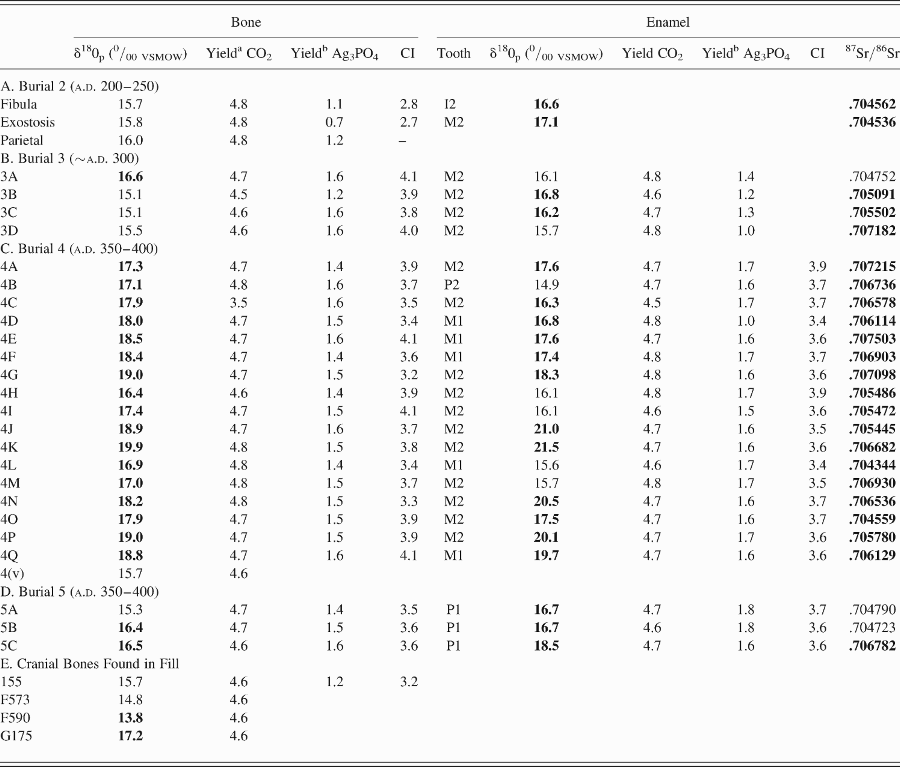
Phosphate oxygen-isotope and strontium-isotope results for bone and enamel from humans sacrificed at the Moon Pyramid

The δ18Op values have been adjusted downward by .35‰ for premolars and .7‰ for incisors and first molars, to account for nursing effect.
CI = Crystallinity Index; VSMOW = Vienna Standard Mean Ocean Water; v = extra cervical vertebra (atlas)
I2 = second molar; M1/M2 = first/second molar; P1/P2 = first/second premolar.
Samples in bold indicate foreign location.
aCO2 Yield is in µmoles/mg Ag3PO4.
bAg3PO4 Yield is in mg produced/mg starting material.
Acquisition of the δ18O values of water by bones and teeth occurs during mineralization. Teeth form as individual organs from five months in utero to approximately age 15. Thus, the enamel in each tooth mineralizes at a different time, and because it does not remodel, the isotopic composition of water imbibed during the time of tooth formation is permanently recorded. Therefore, the occurrence and approximate timing of relocations can be identified. Bone, however, is continuously mineralized and remodeled. As a result, when an individual velocates, bone δ18Op values will reset on relocation to reflect new water sources. The exact length of this process is unknown for both children and adults, but the half-life for turnover is currently estimated to be 2.9 years for trabecular bone and 23.1 years for cortical bone (Parfitt Reference Parfitt and Recker1983)—that is, these are the estimated times for half of the material in bone to be replaced.
The relationship between climate and the oxygen-isotope composition of animals has been explored for long-term changes (e.g., Ayliffe and Chivas Reference Ayliffe and Chivas1990; Bryant et al. Reference Bryant, Luz and Froelich1994; Daux et al. Reference Daux, Lecuyer, Adam, Martineau and Vimeaux2005; Huertas et al. Reference Huertas, Iacumin, Stenni, Chillón and Longinelli1995; Luz et al. Reference Luz, Cormie and Schwarcz1990) and short-term (seasonal) changes (e.g., Bocherens et al. Reference Bocherens, Mashdour, Billiou, Pellé and Mariotti2001; Cerling and Sharp Reference Cerling and Sharp1996; Fricke and O'Neil Reference Fricke and O'Neil1996; Frick et al. Reference Fricke, O'Neil and Lynnerup1995; Gadbury et al. Reference Gadbury, Todd, Jahran and Amundson2000; Koch et al. Reference Koch, Fisher and Dettman1989; Stuart-Williams and Schwarcz Reference Stuart-Williams and Schwarcz1997; Weidermann et al. Reference Weidemann, Bocherens, Mariotti, von den Driesch and Grupe1999). Such data have been used as the basis for investigating migratory patterns in fish, birds, and animals (e.g., Hobson Reference Hobson1999; Killingly and Lutcavage Reference Killingley and Lutcavage1983; Meyer-Rochow et al. Reference Meyer-Rochow, Cook and Hendy1992; Nelson et al. Reference Nelson, Northcote and Hendy1989), and humans in Mesoamerica (White, Spence, and Longstaffe Reference White, Spence and Longstaffe2002, Reference White, Spence and Longstaffe2004; White, Longstaffe, Law, and Pendergast Reference White, Longstaffe, Law and Pendergast2001; White, Spence, Stuart-Williams, and Schwarcz Reference White, Spence, Stuart-Williams and Schwarcz1998; White, Storey, Longstaffe, and Spence Reference White, Storey, Longstaffe and Spence2004) and elsewhere (e.g., Dupras and Schwarcz Reference Dupras and Schwarcz2001; Fricke et al. Reference Fricke, O'Neil and Lynnerup1995; Schwarcz et al. Reference Schwarcz, Gibbs, Knyf, Pfeiffer and Williamson1991). At Mesoamerican sites, control samples indicate a 2‰ range in intra-population variability. This range is not unlike that found in domestic cows and horses from a single location (Bryant and Froelich Reference Bryant and Froelich1995; D'Angela and Longinelli Reference D'Angela and Longinelli1990) and could be created by any of the abovementioned factors and/or the use of control samples that include different time periods and status groups.
Strontium-Isotope Analysis
The stable isotopes of strontium include 84Sr (∼.56%), 86Sr (∼9.87%), and 88Sr (∼82.53%). The isotope 87Sr is formed over time by the radioactive decay of rubidium (87Rb) and makes up approximately 7.04% of total strontium (Faure and Powell Reference Faure and Powell1972). Variations in the strontium-isotope compositions of natural materials are conventionally expressed as 87Sr/86Sr ratios. Strontium-isotope ratios vary with the age and type of rock as a function of the original 87Rb/86Sr ratio of a source and its age (Faure Reference Faure1986; Faure and Powell Reference Faure and Powell1972). Geologic units that are very old (>100 million years [m.y.]) and had very high original Rb/Sr ratios will have very high 87Sr/86Sr ratios today, as well as in the recent past (<1 m.y.). In contrast, rocks that are geologically young (<1–10 m.y.) and that have low Rb/Sr ratios, such as late-Cenozoic volcanic areas, generally have 87Sr/86Sr ratios lower than .706 (Rogers and Hawkesworth Reference Rogers and Hawkesworth1989). These differences may seem small, but they are exceptionally large from a geologic standpoint and far in excess of analytical error using Thermal Ionization Mass Spectrometry (TIMS;±.00001 for 87Sr/86Sr). Analytical procedures are described by Alex Bentley and colleagues (Reference Bentley, Price, Lüning, Gronenborn, Wahl and Fullagar2002) and Joseph Ezzo and colleagues (Reference Ezzo, Johnson and Price1997). Differences in the third decimal place of the 87Sr/86Sr ratio are usually significant in terms of human movement.
Strontium in bedrock moves into soil and ground water and through the food chain (e.g., Comar et al. Reference Comar, Russell and Wasserman1957; Elias et al. Reference Elias, Hirao and Patterson1982). Although local levels of elemental strontium in plant and animal tissue vary because of many factors, the isotopic composition of strontium is not changed (fractionated) by biological processes because of the very small relative mass differences among the strontium isotopes. Virtually all strontium in vertebrate organisms is found in the skeleton. Strontium is incorporated into bone as a substitute for calcium in the mineral hydroxyapatite (e.g., Rosenthal Reference Rosenthal and Skoryna1981; Schroeder et al. Reference Schroeder, Nason and Tipton1972). The strontium-isotope composition of human bones and teeth therefore matches that of the diets of the individuals, which in turn reflect the strontium-isotope compositions of the local geology. As is the case for oxygen isotopes, strontium is deposited as a permanent signature of the place of origin as tooth enamel forms in the fetus, infant, and child.
ANALYTICAL PROCEDURES
Oxygen-Isotope Analysis
Following the method of Hilary Stuart-Williams and Henry Schwarcz (Reference Stuart-Williams and Schwarcz1995), several chemical intermediaries (lead phosphate, lead sulphate) were used to remove calcium and organic material from approximately 30–35 mg of bone and enamel. F. Henry Firsching's (Reference Firsching1961) ammonia-volatilization method was used to isolate and precipitate silver orthophosphate (Ag3PO4), which was reacted with bromine pentafluoride (BrF5) at 600°C for ≥ 16 hours and converted to CO2 over red-hot graphite using a procedure similar to that of Robert Clayton and Toshiko Mayeda (Reference Clayton and Mayeda1963) and Ronald Crowson and colleagues (Reference Crowson, Showers, Wright and Hoering1991). The average yield of CO2 produced by the Ag3PO4 (4.65) approximates the theoretical yield (4.7µmoles/mg; Table 1).
A dual-inlet, triple-collecting, gas-source mass-spectrometer was used to measure the stable isotope ratios. Reproducibility of the δ18Op values for the standard, Aldrich Ag3PO4 (no. 33, 738-2) is±.3‰. Reproducibility of duplicate precipitations of Ag3PO4 is±.3‰.
Strontium-Isotope Analysis
The strontium-isotope ratios reported in this study were measured using instruments at the University of Wisconsin, Madison, and the University of North Carolina. Enamel samples were washed in weak acid and the surfaces removed mechanically and by ultrasonic etching, ashed for 12 hours (h) at 500°C to remove any organic fractions, and finally homogenized. A spike of Sr (strontium carbonate standard SRM-987, National Bureau of Standards, Washington, DC) was added to about 100mg of homogenized sample with a ratio of Sr:spike of 1:50. Samples were then solubilized overnight in 3mL concentration HNO3. After evaporation of the acid at 80°C, the remnants were solubilized again in 3mL HCl and passed through a cation exchange column (200–400 mesh, HCl as mobile phase) to separate rubidium from strontium. The 87Sr/86Sr ratio was determined by Thermal Ionization Mass spectrometry (TIMS).
DIAGENESIS
For oxygen isotopes, the possible diagenetic substitution of carbonate for phosphate in the mineral structure of skeletal tissues was investigated using the Crystallinity Index (CI). CI values were calculated using carbonate and phosphate absorbances produced using Fourier transform infrared (FTIR) spectrometry (Shemesh Reference Shemesh1990),

where A represents absorbances at 565 cm−1 (v4PO4), 605 cm−1 (v4PO4), and ∼ 595 cm−1, which is the valley between the two peaks. Nicolet 205 FTIR and data-processing software were used to obtain the CI data following standard methods.
Bone samples have average CI values of 3.7±.4, and enamel samples have average CI values of 3.6 ± .1 (Table 1). No statistically significant correlations were found between tissue δ18Op and CI values (for bone, Pearson's Correlation [Pearson's r] = .167, N = 27; for enamel, Pearson's r = .111, N = 20). Therefore it is unlikely that the original biogenic δ18Op values were altered by recrystallization during diagenesis. No statistically significant correlations were found between tissue δ18Op values and weight percent yield of Ag3PO4 from individual samples (for bone, Pearson's r = .115, N = 28; for enamel, Pearson's r = .057, N = 20). Therefore it is unlikely that either isotope was preferentially recovered during extraction of the phosphate and its precipitation as Ag3PO4.
Strontium-isotope studies have focused on tooth enamel rather than bone. Post-depositional contamination of tooth enamel (diagenesis) is normally not significant in strontium-isotope studies. Certainly, bone is more susceptible to diagenesis than the denser dental enamel (Kohn et al. Reference Kohn, Schoeninger and Barker1999, Molleson Reference Molleson, Gisela and Hermann1988; Vernois et al. Reference Vernois, Bao, Deschamps, Gisela and Hermann1988). Enamel is generally resistant to contamination and a reliable indicator of biogenic strontium-isotope ratios (e.g., Åberg et al. Reference Åberg1998; Budd et al. 2001; Kohn et al. Reference Kohn, Schoeninger and Valley1996, Reference Kohn, Schoeninger and Barker1999; Schoeninger et al. Reference Schoeninger, Hallin, Reeser, Valley and Fournellec2003). The presence of diagenetic strontium in an enamel sample could mask evidence for migration.
OXYGEN AND STRONTIUM ISOTOPES IN MESOAMERICA
This section provides a brief background on oxygen- and strontium-isotope variation in Mesoamerica relevant to studies of migration. Given what we currently understand about natural variability of climate and geology, we are using ranges of 14–16‰ for δ18Op values and .7046–.7049 for 87Sr/86Sr ratios to represent local Teotihuacan values. The range for δ18Op values was established using control samples from modern teeth from the Basin of Mexico (mean δ18Op = 15.0‰; Levinson et al. Reference Levinson, Luz and Kolodny1987), and the apartment compound of Tlajinga 33, Teotihuacan (mean δ18Op = 15.0±.5‰, range = 14.3–15.9‰ White, Spence, Stuart-Williams, and Schwarcz Reference White, Spence, Stuart-Williams and Schwarcz1998; white, storey, longstaffe, and spence Reference White, Spence and Longstaffe2004). The local 87Sr/86Sr ratios were established using the mean of nine rabbit bones (mean 87Sr/86Sr = .7046) from the site (Price et al. Reference Price, Manzanilla and Middleton2000). To put these control data into a larger Mesoamerican context, we will discuss the isotope ratios expected in skeletal samples from the two major regions of interest: the north, central, and western highlands of Mexico and the Maya area of the Yucatan, Guatemala, Belize, and Honduras.
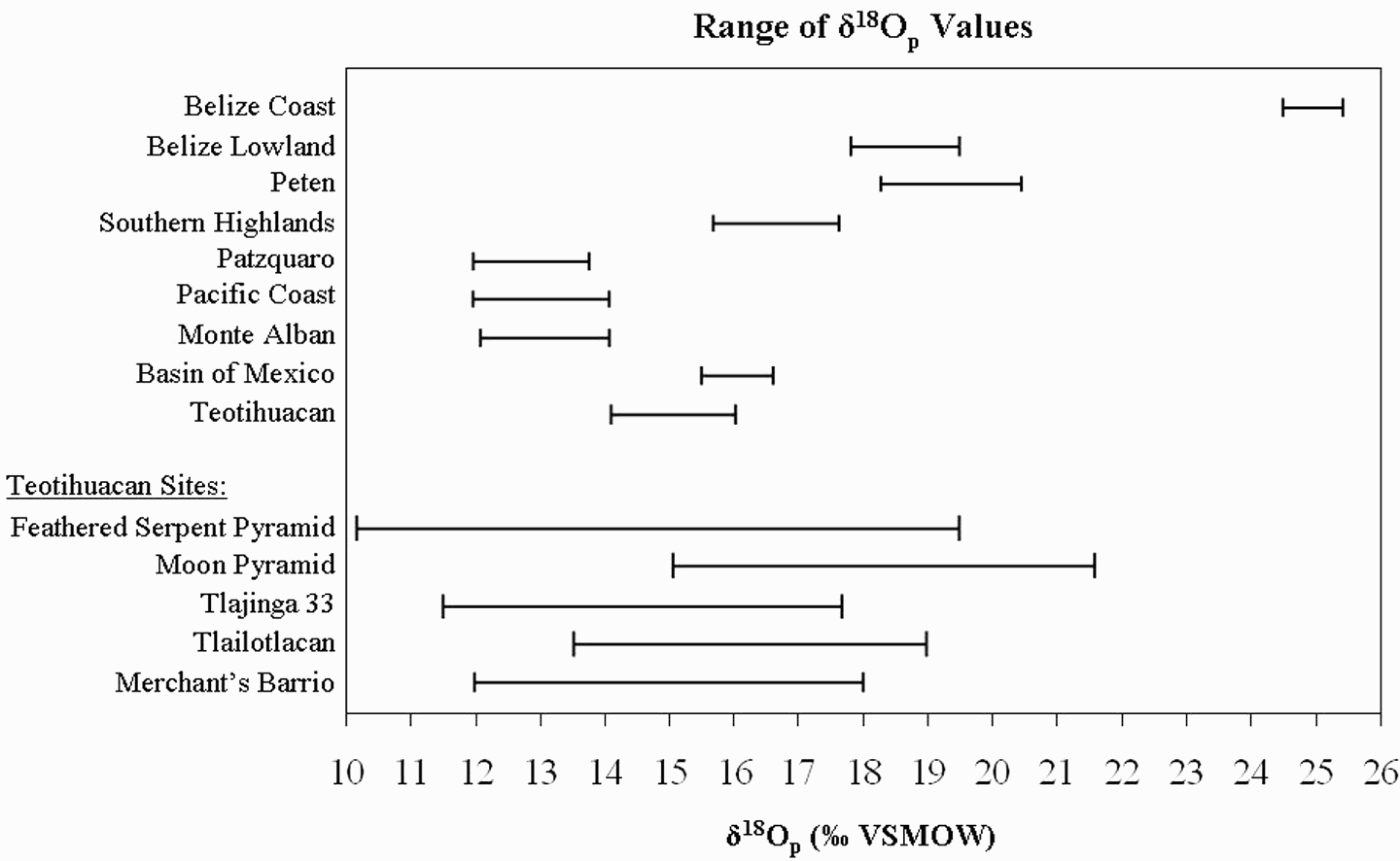
Because oxygen-isotope compositions vary with rainfall, temperature, humidity, and elevation across Mesoamerica, it is not surprising that 18Op values for Teotihuacan are distinct from some areas and overlap with others (Figure 1; Table 2). Ranges of 18Op values of control samples from the following areas indicate environments that are isotopically distinct: Monte Alban, Valley of Oaxaca (mean δ18Op = 13.0‰, range = 12.1–13.9‰); Lake Patzquaro sites, Michoacan (mean δ18Op = 12.8‰, range = 12.1–13.7‰); Rio Azul/Rio Bravo, Guatemalan lowlands (mean δ18Op = 19.9‰, range = 18.3–20.4‰); Altun Ha, Belize lowlands (mean δ18Op = 18.7‰, range = 17.8–19.5‰); Pacific Coast and Piedmont sites, Guatemala (mean δ18Op = 13.0‰, range = 12.1–13.9‰). The range of 18Op values from Teotihuacan overlaps substantially with the range of another site in the Basin of Mexico, Cholula (mean δ18Op = 15.8‰, range = 15.4–16.2‰), and marginally at the lower end of the range for Kaminaljuyu, which is in the southern highlands, Guatemala (mean δ18Op = 16.7‰, range = 15.6–17.7‰). Modern isopleths for oxygen isotopes are not well documented, but these data do conform to the expected model of oxygen-isotope behavior where low-lying, hot, humid, and/or rainy regions should have the highest values, and those at higher altitudes, or that are cooler and drier, should have the lowest values.
Inter-site variability in δ18Op values for human bone and enamel.

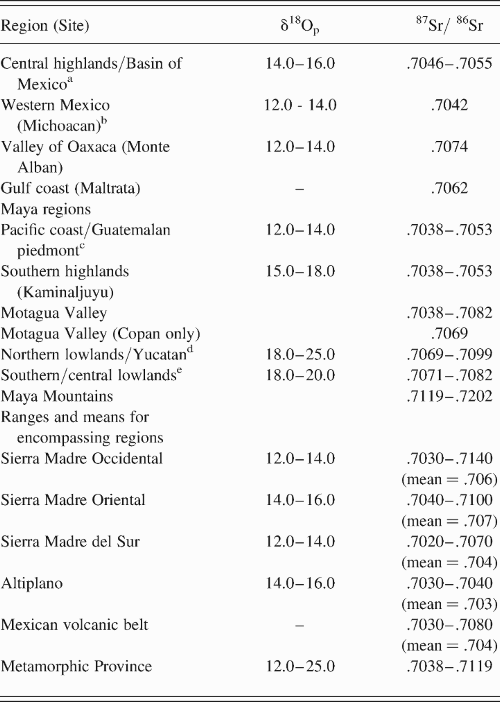
Combined isotope data for selected regions in Mesoamerica

Source: The data are from Hodell et al. Reference Hodell, Quinn, Brenner and Kamenov2004; Price et al. Reference Price, Manzanilla and Middleton2000; White, Spence, Stuart-Williams, and Schwarcz Reference White, Spence, Stuart-Williams and Schwarcz1998; White, Spence, and Longstaffe Reference White, Spence and Longstaffe2002, Reference White, Spence and Longstaffe2004; White, Longstaffe, Spence, and Law Reference White, Spence and Longstaffe2000.
aTeotihuacan, Chapantongo, Xico, Cholula.
bTzintzuntzan, Urichu, Atoyac, Guanajuato, Zacapu.
cBalberta, Montana, Abaj Takalik.
dEk Balaam, Campeche, Champoto'n, Calakmul, Tizimini.
eTikal, Piedras Negras, Palenque, Rio Bravo, Rio Azul, Altun Ha, Chau Hiix, Marco Gonzalez, San Pedro, Santa Rita Corazol.
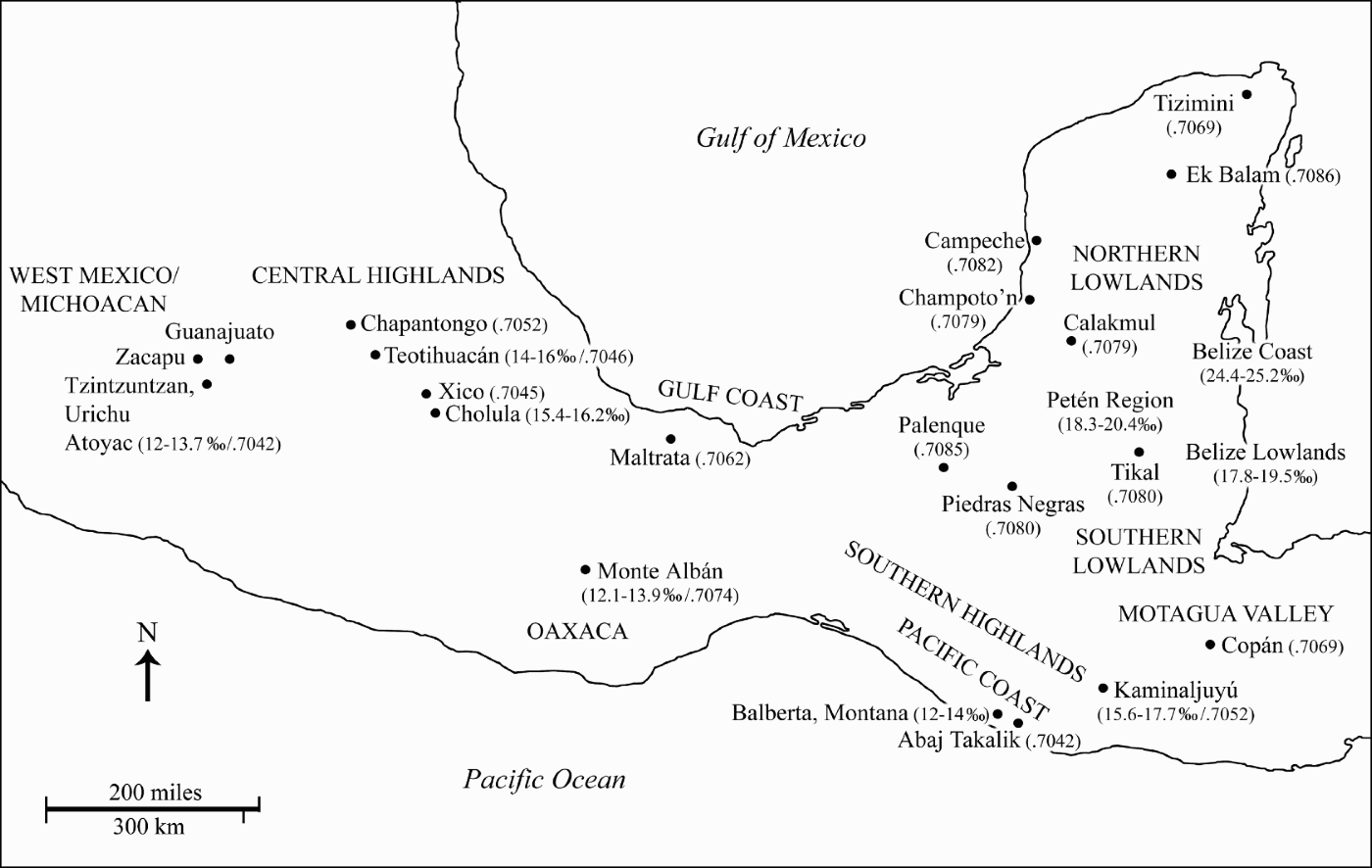
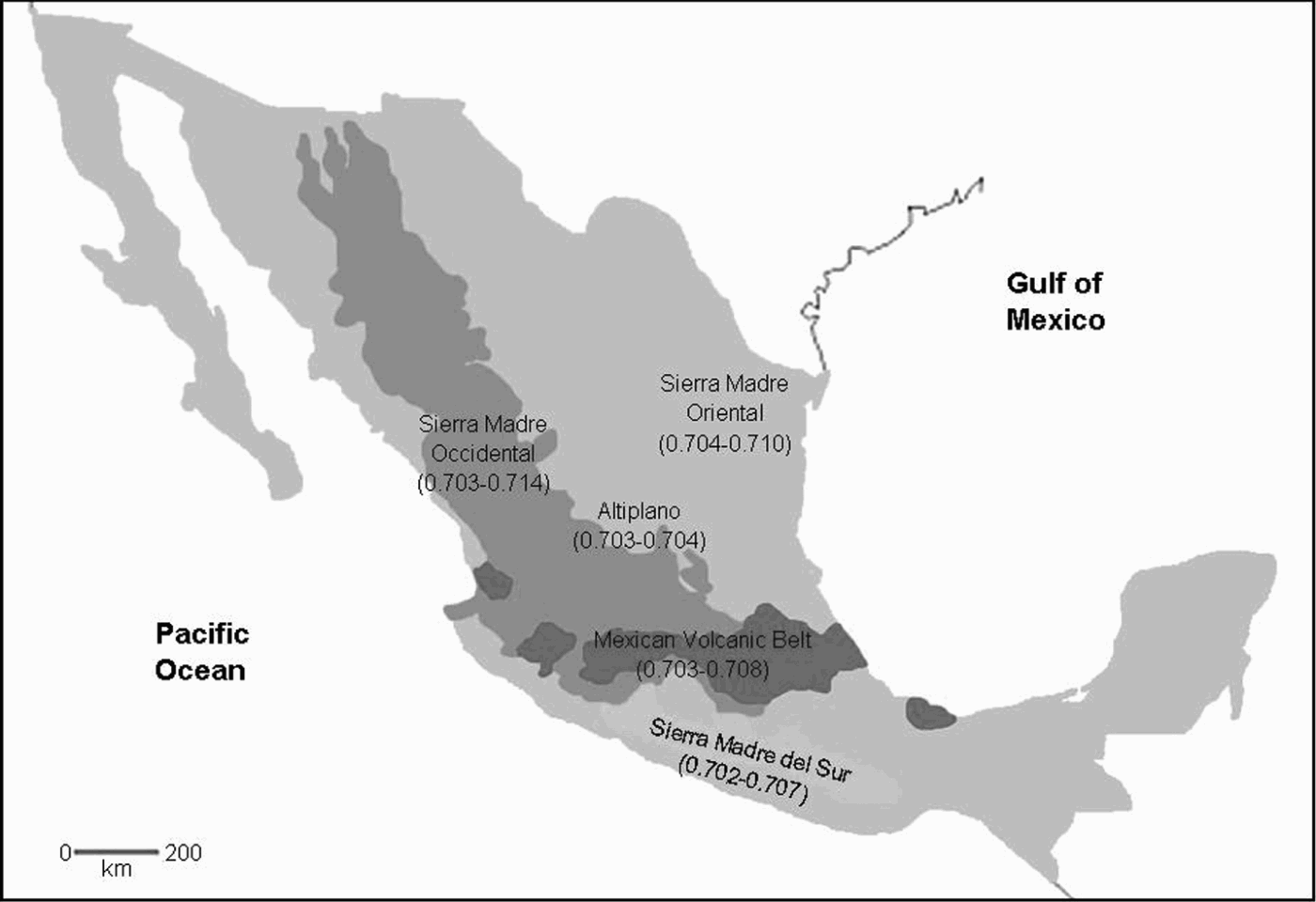
Variation in strontium-isotope ratios in Mesoamerica is created by its complex geology, which is a mixture of recent volcanic highlands and older marine sedimentary deposits, plus a variety of metamorphic rocks. Two major mountain ranges, the Sierra Madre Occidental and the Sierra Madre Oriental, dominate the highlands of central Mexico (Figure 2). The eastern range is predominantly Paleozoic sediments of marine origin, which are likely to have 87Sr/86Sr values close to those of Paleozoic seawater (.708). The western ranges are predominantly young volcanic rocks of rhyolitic and andesitic compositions and thus will have somewhat lower 87Sr/86Sr ratios. Ignacio Torres-Alvarado and colleagues (Reference Torres, Verma and Carrasco-Nuñez2000) report an average 87Sr/86Sr ratio of .7060 for the Sierra Madre Occidental.
Oxygen-isotope ratios of human bone and enamel, and strontium-isotope ratios of human and faunal samples from sites in Mesoamerica. (data from Price et al. Reference Price, Manzanilla and Middleton2000; White, Spence, and Longstaffe Reference White, Spence and Longstaffe2002, Reference White, Spence and Longstaffe2004; White, Longstaffe, Spence, and Law Reference White, Spence and Longstaffe2000; White, Spence, Stuart-Williams, and Schwarcz Reference White, Spence, Stuart-Williams and Schwarcz1998).

Between the Sierra Madre Occidental and the Sierra Madre Oriental lies the Mexican altiplano, with a 87Sr/86Sr ratio of .7032 (Torres-Alvarado et al. Reference Torres, Verma and Carrasco-Nuñez2000). The Cordillera and the altiplano are bounded on the south by the east–west-trending Mexican volcanic belt, for which 87Sr/86Sr ratios have been compiled (average 87Sr/86Sr = .7040; Torres-Alvarado et al. Reference Torres, Verma and Carrasco-Nuñez2000). Farther south is a region of more complex geology, the Sierra Madre del Sur, with Cenozoic volcanics, Mesozoic sediments, and more ancient metamorphic rocks. The 87Sr/86Sr ratios for the Sierra Madre del Sur volcanic rocks average .7041, but substantial local variability is anticipated, given the heterogeneous geology of this region.
The ranges in strontium-isotope data shown in Figure 3 are for very large areas. There is likely to be much greater isotopic contrast among the regions when the influence of the non-volcanic components has been determined. We have verified from our analyses of bone and enamel from humans and other animals that local variation in any given region is substantially less than the ranges shown here. It should also be noted that strontium-isotope ratios in rock commonly vary from the ratios measured for fauna and flora. For this reason, measurement of biologically available strontium, rather than geological strontium, is recommended (Price et al. Reference Price, Burton and Bentley2002; Sillen et al. Reference Sillen, Hall and Armstrong1998). David Hodell and colleagues (Reference Hodell, Quinn, Brenner and Kamenov2004) analyzed strontium-isotope ratios in water, plants, and soil from a wide variety of sites in the Maya area. These results are also used here to provide a baseline, with the caveat that data for biologically available strontium from fauna and humans were not part of Hodell's study.
Major geological regions of central Mexico with predicted strontium-isotope ratios based on rock type.

We have measured strontium-isotope ratios from five sites in the central highlands (Figure 2; Table 2). Average values for 87Sr/86Sr from these sites were: Teotihuacan = .7046; Chapantongo (Hidalgo) = .7052; Xico (Valley of Mexico) = .7045; and Tzintzuntzan (Michoacan) = .7042. These values range from .7042 to .7052, in line with the expected values from the geology of the area. Monte Alban (Oaxaca), which is at the southern end of the Sierra Madre del Sur, has a value of .7074, which fits well with values for that highland area.
The Maya region of Mesoamerica to the south is dominated geologically by the carbonate shelf of Peten, Guatemala, and the Yucatan Peninsula of Mexico. The bedrock of the peninsula is fairly well described. The oldest carbonates of Cretaceous age are found in the southernmost part of the peninsula and trend in a gradual cline northward to the youngest Quaternary carbonates on the northern periphery (Hess et al. Reference Hess, Bender and Schilling1986; Hodell et al. Reference Hodell, Quinn, Brenner and Kamenov2004). Because of this gradual, age-dependent trend in marine carbonates, the strontium-isotope characteristics of the region can also be inferred, tracking the well-established Tertiary/Quaternary seawater 87Sr/86Sr ratios, which should be approximately .7070 in the southern Cretaceous carbonates and trend gradually higher to .7092 in Quaternary deposits of the northern coasts. Hodell and colleagues (Reference Hodell, Quinn, Brenner and Kamenov2004) have documented this variation across the Maya area using samples of water, plants, soil, and rock. We have measured human and faunal skeletal tissue from a number of sites in this region, documenting this pattern of variation (Figure 2). It is therefore clear that strontium-isotope ratios in human samples from the Maya Lowlands should range between .707 and .709.
The carbonate-dominated lowlands of Yucatan and Peten are bounded to the south by the young volcanic rocks of the Guatemalan (southern) highlands. This region has much lower 87Sr/86Sr ratios (.7050–.7060) characteristic of young Cordilleran volcanic rocks throughout Mesoamerica. Measurements from Kaminaljuyu and Abaj Takalik have average values in line with the central highlands of Mexico (Teotihuacan, Chapantongo, Tzinztunzan, Xico), ranging from .704 to .705. Samples from numerous other sites from the Guatemalan highlands and the Pacific Guatemalan coastal plain and piedmont also have values within this range (Hodell et al. Reference Hodell, Quinn, Brenner and Kamenov2004).
In the southeastern part of the Maya region, in the Maya Mountains, and to the southeast of these mountains, are ancient metamorphic rocks that should have 87Sr/86Sr ratios much higher than elsewhere in the Maya area (>.710; Hodell et al. Reference Hodell, Quinn, Brenner and Kamenov2004). Our 87Sr/86Sr ratios for fauna from the northern and southern lowlands and the southern highlands agree with these expected values (Figure 2). Copan, in the Motagua Valley region of western Honduras, rests on a mixture of limestone and volcanic rocks, which is reflected in a 87Sr/86Sr ratio of .7069. The range of 87Sr/86Sr ratios (.7055–.7071) reported by Hodell et al. (Reference Hodell, Quinn, Brenner and Kamenov2004) for the majority of samples from this region are consistent with this value.
The expected ranges of combined oxygen- and strontium-isotope compositions of our samples are found in Table 2. These ranges should help to resolve some of the ambiguity arising among regions with similar environmental regimes, although we recognize that further sampling is needed to better understand variability in isotope compositions within regions.
RESULTS AND DISCUSSION
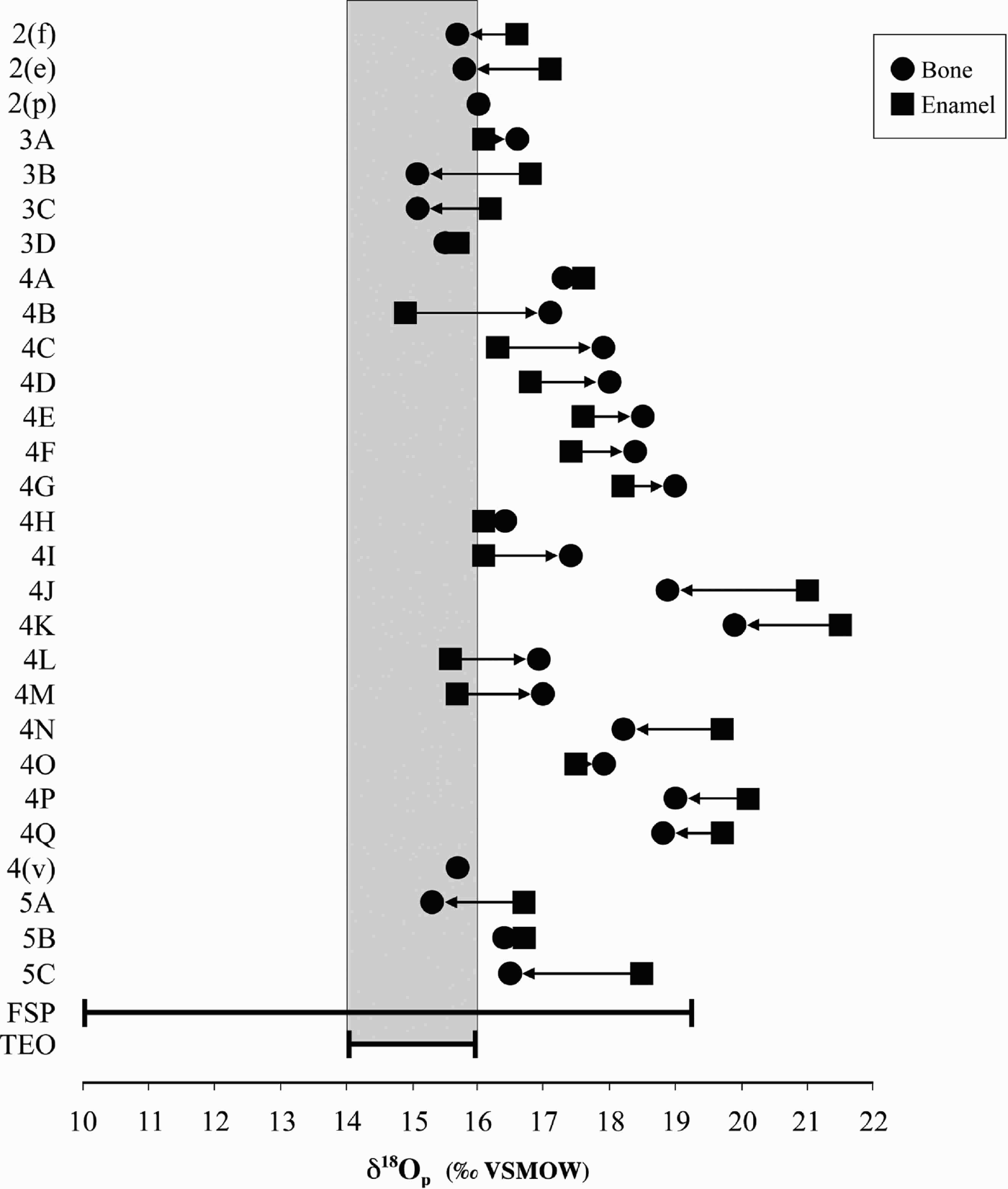
The oxygen- and strontium-isotope compositions of the samples used in our study are listed in Table 1. The oxygen-isotope values in this data set show a high degree of variability (Table 1; Figures 1, 6–7). Many of δ18Op values from the two pyramids overlap within a common range of 14.9–19.3‰, but the total range of δ18Op values at the Moon Pyramid (14.9–21.5‰) is markedly lower than that found at the Feathered Serpent Pyramid (10.1–19.3‰; Figure 4). Furthermore, each pyramid contains a geographically distinctive group of individuals. The Moon Pyramid does not appear to contain anyone from the following areas (which all have similar δ18Op values): western Mexico, Guatemalan Pacific coast/piedmont, or Oaxaca (Monte Alban). However, about half of the Feathered Serpent Pyramid sacrifices could have come from these areas—that is, they have values lower than 14.9‰. These individuals are not concentrated in any particular part of the Feathered Serpent Pyramid. By contrast, the Moon Pyramid contains a number of individuals who have δ18Op values not found at the Feathered Serpent Pyramid. These individuals have δ18Op values higher than 19.3‰ and were all found in Burial 4 (i.e., 4J, 4K, 4 N, 4P, 4Q). Although we speculate that they probably came from a hot, wet, lowland area, we cannot determine the location precisely. Possibilities include the Gulf coast and Maya Lowlands.
Bone and enamel δ18Op values for Moon Pyramid sacrifices compared with the Feathered Serpent Pyramid, Teotihuacan. Burial 2 includes two teeth and three bone samples from the same individual; 2(f) is paired with the second incisor, and 2(e) is paired with the second molar.

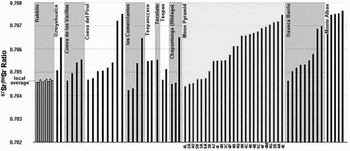
Strontium-isotope ratios for tooth enamel from the Moon Pyramid and other areas at Teotihuacan, along with a few samples from Monte Alban, are presented in Figure 5. These ratios are arranged in rank order by location within the site, and individual burial designations are indicated for the individuals from the Moon Pyramid. Most of the individuals from the Moon Pyramid were not born at Teotihuacan. Only five of the victims (2, 3A, 40, 5A, 5B) have strontium-isotope ratios directly comparable to the local signature, but only 3A has a δ18Op value that is close to the range for Teotihuacan. One strontium-isotope ratio is lower than the local Teotihuacan signature (4L), which falls within the range of the central highlands and is comparable to values from the site of Tzintzuntzan. The remainder of the strontium-isotope ratios is higher than the Teotihuacan signature. Sample 3B has a ratio of .7051, within the range reported for the central highlands (.7042–.7052). Four ratios around .7055 (3C, 4H–J) suggest that these four individuals came from the same location. This impression is strengthened by the fact that three of the burials were found adjacent to one another in Burial 4. The δ18Op value of 4J, however, indicates that he does not belong to this group (21‰ versus 16.1–16.2‰). Burial 4P has a strontium-isotope ratio of .7057; two burials (4D, 4Q) have values close to .706. There are then 11 values (4N, 4C, 4K, 4B, 5C, 4F, 4M, 4G, 3D, 4A, 4E) that show a continuous range between .7066 and .7074.
Enamel 87Sr/86Sr ratios for the Moon Pyramid compared with other locations in Teotihuacan and Mesoamerica.

The group of individuals with strontium-isotope ratios ranging between .7066 and .7074 is particularly interesting. The values fit with expectations for the Sierra Madre del Sur. However, the continuous range of values is rather surprising and might reflect residence in an area where diet was derived from very different sources. For example, a similar pattern has been observed in early Iceland, where a combination of marine and terrestrial food sources produce a similar continuum of values (Price and Gestsdottir Reference Price and Gestsdottir2006). Perhaps these 11 individuals came from a similar area where recent volcanic rocks are located near the sea and sources of marine food. One such region might be along the Gulf coast of Mexico, where the central Mexican volcanic belt reaches the Gulf of Mexico. Alternatively, these values also fall within the range that Hodell and colleagues (Reference Hodell, Quinn, Brenner and Kamenov2004) have named the Metamorphic Province (i.e., northern, southern, and central Lowland regions and some places in the northern highlands).
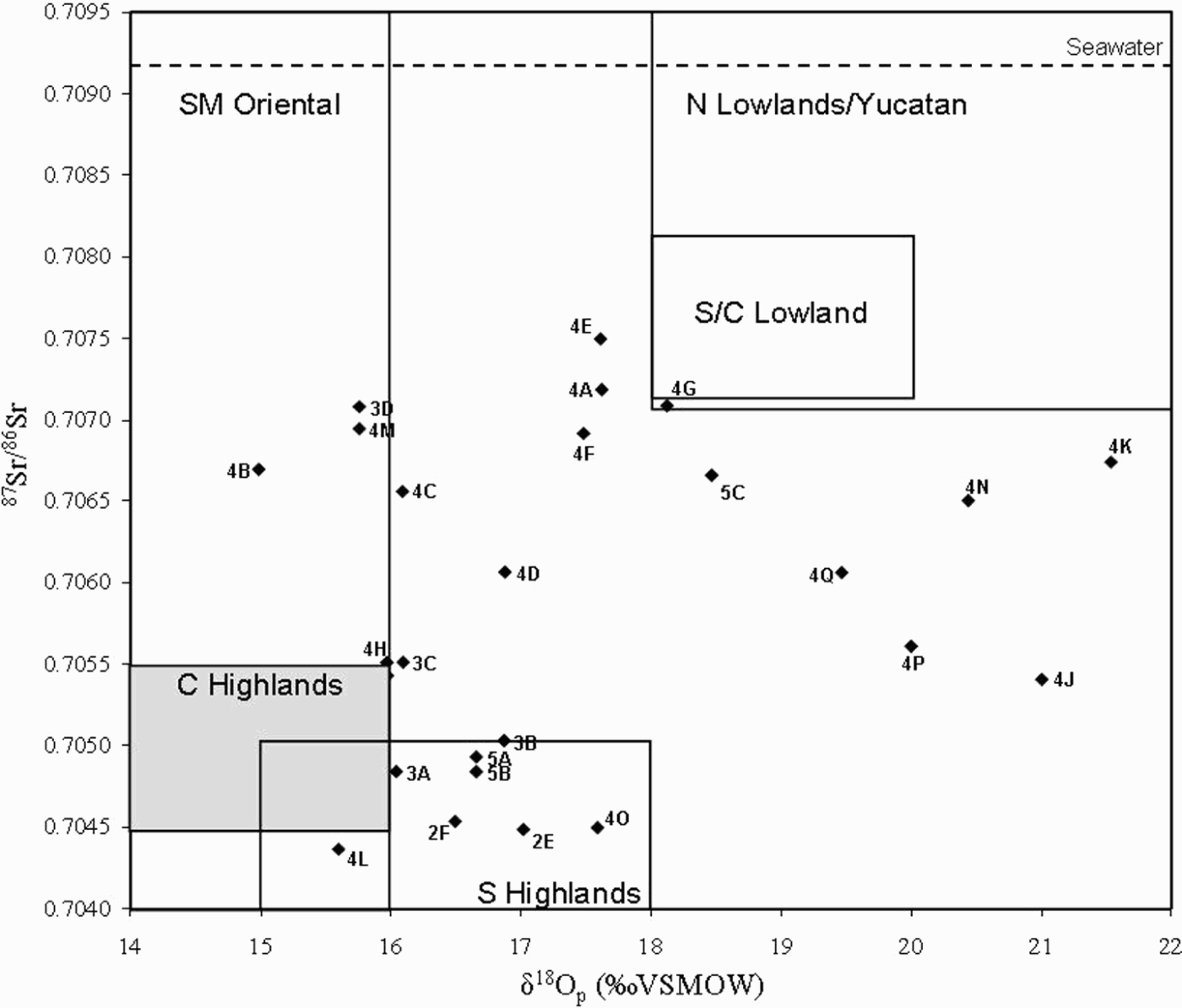
A scatter plot of the 87Sr/86Sr ratios and δ18Op values for the enamel samples is shown in Figure 6. Four clusters are discernible. A group in the lower portion of the graph (2[f, e], 3A–C, 4H–I, 4L, 4O, 5A–B) have 87Sr/86Sr ratios consistent with sites in nearby areas of the central highlands (e.g., Chapantongo, Tzintzuntzan, and Xico) or the southern highlands (e.g., Abaj Takalik and Kaminaljuyu), but their δ18Op values are more consistent with the southern highlands (e.g., Kaminaljuyu). Future analyses of central highland sites may expand the range of δ18Op values, but currently only one individual in this group (3A) has the combined values consistent with this area and could be from Teotihuacan.
Scatter plot of δ18Op values and 87Sr/86Sr ratios for enamel showing possible childhood locations of residence.

If we ignore individual 4D, there is a large group of individuals that have 87Sr/86Sr ratios between .7065 and .7075 and δ18Op enamel values lower than 19‰. There appear to be two distinct clusters represented here—one with lower δ18Op values and one with higher δ18Op values. The available data might suggest that the group with lower δ18Op values (3D, 4B–C, 4M) could fit within the range of the Sierra Madre Occidental, Sierra Madre Oriental, Sierra Madre del Sur, and Mexican volcanic belt (Figure 3). The group with the higher δ18Op values (4A, 4E–G, 5C) could be from what Hodell and colleagues (Reference Hodell, Quinn, Brenner and Kamenov2004) describe as the Metamorphic Province (range of 87Sr/86Sr = .7070–.7090) or the Gulf coast, if the earlier hypothesis that the combination of volcanic rocks and marine diet should create this range is correct. The sample from Maltrata provides promising support for this hypothesis (Figure 3), but more 87Sr/86Sr ratios and δ18Op enamel values from this area are needed to test it.
A third group of individuals has δ18Op values higher than 19‰ and 87Sr/86Sr ratios between .7055 and .7065. This combination also suggests an area dominated by volcanic rocks, located in more coastal lowland regions and/or regions of greater heat, humidity, and rainfall. The Gulf coast or Motagua Valley could be the homeland for these individuals, but the possibility remains that they came from an as yet unidentified region.
Burial 2
One high-status male, 40–50 years of age, was found in the dedicatory tomb from Building 4. At a.d. 200–250, this burial overlaps those in the Feathered Serpent Pyramid (a.d. 150–250). He shows some physical traits that are unusual for Teotihuacan (Periera and Spence Reference Periera and Spence2004; Spence and To Reference Spence and To2000) and was bound like the Feathered Serpent warriors, with his hands behind his back. The isotopic values of his second incisor (I2), which forms between six months and four years of age, and second molar (M2), which forms between ages three and seven, indicate that all of his early childhood was spent in the same location (Table 1), possibly elsewhere in the central highlands (e.g., Xico) or in the southern highlands (Figure 6). His bone δ18Op values, however, indicate that he moved to another location sometime after the formation of his second molar and that this location could have been Teotihuacan. The range and pattern of his δ18Op values are similar to those of many of the sacrificed warriors at the Feathered Serpent Pyramid. His parietal bone was sampled, as was his fibula and an exostosis, or bone growth, on his fibula that was caused by a wound, perhaps received in combat (Pereira and Spence Reference Periera and Spence2004). The exostosis would have been the most recently formed bone of these samples and provides an opportunity to see whether he was in another location when the wound was healing. As all three δ18Op values are quite similar, it appears that he received the wound—or, at least, healed from it—in the new location.
Burial 3
The four individuals in Burial 3 were dedications to the construction of Building 5, which dates to circa a.d. 300 and reflects a marked change in architectural style (Sugiyama et al. Reference Sugiyama, Cabrera Castro and López Luján2004). Individuals 3A–C were found in extended position, side by side. Individual 3D was placed in a flexed position to the side of this group, with symbols of authority laid at his head (disk) and feet (mat). All were bound, and each was accompanied by distinctive artifacts (Sugiyama et al. Reference Sugiyama, Cabrera Castro and López Luján2004). Of particular interest are the nose ornament in the form of a rattlesnake rattle (individual 3B) and the simulated human maxilla carved-shell pendant, much like those found on the “warriors” from the Feathered Serpent Pyramid (individual 3C). Both of these ornaments were also found among victims within the Feathered Serpent Pyramid.
Both δ18Op values and 87Sr/86Sr ratios for the second molar of individual 3A suggest that he could have spent his early childhood in Teotihuacan or somewhere nearby (Figure 5). Indeed, he is the most likely person among all of the Moon Pyramid sacrifices to have been locally born (Table 1). Because this individual is in his early twenties, and his bone δ18Op value is higher than his dental value, he either moved to another location in his late childhood, possibly the same area as individual 2 (i.e., the central or southern highlands), and became isotopically well equilibrated to that area, or he moved later in his youth to a different area and was still in the process of re-equilibration to the new environment when he died.
Individual 3B probably spent his early childhood in a different location. The 87Sr/86Sr ratio of his enamel is in the range of the central highlands or southern highlands, but his δ18Op value is more consistent with the southern highlands (Figure 6). By contrast, his bone δ18Op value is within the Teotihuacan range (Table 1), suggesting that he may have dwelled in the city (or somewhere else with the same isotopic composition) for some time before he died.
The δ18Op values and 87Sr/86Sr ratios of the second molar of individual 3C suggest yet a different origin, possibly the central highlands, southern highlands, or Motagua Valley area (Figure 6). His bone δ18Op value is exactly the same as that of individual 3B (Figure 4; Table 1), suggesting that they may have lived as adults in the same location (possibly Teotihuacan) for some time.
The place of origin of individual 3D is more mysterious. The δ18Op value of his second molar suggests that he may have come from Teotihuacan, but his 87Sr/86Sr ratios indicate that this could not have been the case. He could have grown up in the Sierra Madre Occidental, Sierra Madre Oriental, Sierra Madre del Sur, or possibly anywhere in Hodell and colleagues' (Reference Hodell, Quinn, Brenner and Kamenov2004) Metamorphic Province (i.e., northern, southern, and central lowland regions and some places in the northern highlands). There is no significant difference between bone and enamel δ18Op values, suggesting that he probably did not relocate after age seven. This individual is particularly interesting from a methodological perspective because the presence of both bone and enamel δ18Op values that are consistent with those of Teotihuacan contrast with 87Sr/86Sr values that indicate foreign residence. It illustrates the need for caution in interpreting either set of isotope data by itself and reminds us of the need to sample many more sites.
Burial 4
There are 17 skulls in this collection, plus one cervical vertebra (atlas, 4[v]). These were deposited during the construction of Building 6 and date to approximately a.d. 350–400. All of these individuals were male, with the possible exception of 4K and 4L (Michael Spence, personal communication 2006) whose sex could not be determined. There were no offerings associated with any of these individuals, suggesting that they may have been of lower status than the individuals in the other burials (Spence and Periera Reference Spence and Pereira2007). They also show a variety of cranial- and dental-modification styles that suggest diverse geographic origins (Periera and Spence Reference Periera and Spence2004). Their low status, mortuary treatment, and demographic and physical characteristics suggest that they were captured foreign soldiers (Spence and Pereira Reference Spence and Pereira2007). The cervical vertebra (4v), which was found between skulls M and L, did not belong to any of the individuals in the deposit. The δ18Op value of this individual is also unlike that of any of the others and consistent with local Teotihuacan values (Table 1). It clearly belongs to a separate person, who does not have a social identity in this context and will not be discussed further.
The isotopic compositions of these individuals are indeed highly variable. In terms of their childhood residential histories, there are several possible clusters. Individuals 4H and 4I are well paired for both δ18Op and 87Sr/86Sr enamel values and probably came from the same location, possibly the same place from which 3C originated—that is, the central or southern Highlands (Motagua Valley area; Figure 6). The δ18Op bone value, however, indicates that 4I moved to a different location (Table 1; Figure 4).
Individual 4B appears to have grown up in a different location from the other individuals in this burial, but 4A, 4E, 4F, and 4G probably lived in the same general region in their childhoods, which is still enigmatic, possibly the Gulf Coast or somewhere in the Metamorphic Province (Figure 6). These individuals were also placed next to one another in the deposit. In adulthood, 4B moved to a different location (possibly the southern highlands; Table 1; Figure 4).
Individuals 4O and 4L probably also lived in different general regions as children (Figure 6). It appears that 4O had a stationary life, but 4L moved to another location probably within the same region (Figure 4).
Individuals 4J, 4K, 4 N, 4P, and 4Q form another cluster in childhood that may represent the Gulf coast or possibly the Motagua Valley. Of these, individuals 4P and 4Q have δ18Op values that pair quite well in both childhood (enamel) and adulthood (bone), indicating origins in, and movement to, similar areas (Table 1, Figures 5, 7).
Five of the Burial 4 individuals (4A, 4H, 4J, 4O, 4P) show only small or negligible shifts (i.e., ≤1‰ ) from enamel to bone δ18Op values (Figure 4). We speculate that these individuals stayed in the same foreign location in which they grew up. There is no common pattern that suggests movement to a central location. None of these individuals grew up in Teotihuacan, and their bone δ18Op values do not indicate any degree of re-equilibrium to the Teotihuacan environment. Therefore, they must have traveled recently before their death or were brought from foreign lands, possibly for this ceremonial purpose. The diversity of their isotope ratios is consistent with Michael Spence and Grégory Pereira's (Reference Spence and Pereira2007) hypothesis that they were captured soldiers, probably from several military engagements. This pattern of residence contrasts with the locational histories of the occupants of Burials 2 and 3, most of whom have bone δ18Op values indicating residence in Teotihuacan for a long time before death.
Burial 5
The three individuals in Burial 5 were placed on top of Building 5 when Building 6 was being constructed. As a result, it is not clear whether they served a dedicatory or decommissioning function (Sugyama et al. Reference Sugiyama, Cabrera Castro and López Luján2004). They probably date to about a.d. 350–400. Sugiyama and colleagues (Reference Sugiyama, Cabrera Castro and López Luján2004) have noted that this burial is distinct not only in its placement, but also in its form and content. The three individuals appear to have been of very high social status, and there are several lines of evidence indicating a Maya origin. The seated, cross-legged “lotus” body position into which they were placed is common at Classic-period Maya sites (Agrinier Reference Agrinier1975; Kidder et al. Reference Kidder, Jennings and Shook1946). It is often found in artistic representations of Maya elites but is rare elsewhere in Teotihuacan. In addition, individuals 5A and 5B wore high-quality greenstone ornaments that include a style (the rectangular pectoral) that is artistically represented on the chests of Maya rulers and elites, and the greenstone has been traced to the Motagua Valley, Guatemala. The hands of these individuals were not bound behind the back, as in the other burials. Rather, their arms were placed in their laps near their crossed feet.
Individuals 5A and 5B were placed side by side, and each had the same adornment of greenstone earflares, beads, and rectangular pectorals. The δ18Op values and 87Sr/86Sr ratios of their first premolars are also almost identically paired, indicating that they probably lived in the same location from ages two to five (Figure 6). Their δ18Op enamel values suggest that this area could have been the southern highlands, but the 87Sr/86Sr ratios would indicate a Teotihuacan origin (Price et al. Reference Price, Manzanilla and Middleton2000). Copan could not have been their homeland (see Hodell et al. Reference Hodell, Quinn, Brenner and Kamenov2004; Price et al. Reference Price, Manzanilla and Middleton2000), but according to Hodell and colleagues (Reference Hodell, Quinn, Brenner and Kamenov2004), there is a tributary of the Motagua Valley that has a 87Sr/86Sr value consistent with their dental values. After their very early childhood, their residential histories diverge. Individual 5B did not relocate, but individual 5A has a bone δ18Op value that is consistent with Teotihuacan values and had probably lived in his new location for quite a long time (Figure 4; Table 1).
Individual 5C, who was placed apart from the other two occupants, had a different residential history. From ages two to five, he had lived elsewhere. This location could have been Copan, but it is also possible that he came from elsewhere in the Maya region or Metamorphic Province (Hodell et al. Reference Hodell, Quinn, Brenner and Kamenov2004; Table 2; Figure 6). His bone δ18Op value suggests that he moved after age five to the same location in which individual 5B lived (Figure 4; Table 1).
Miscellaneous Cranial Bones
Oxygen-isotope compositions were determined for four cranial bones found in fill (Table 1). It is possible that two of these bones (D70/155 and F573) belonged to local Teotihuacanos. The other two (F590 and G175) were from two different locations. The δ18Op value of one of these (F590) is outside the range of values found in the rest of the Moon Pyramid burials and is consistent with values found at Monte Alban, the Pacific coast, and perhaps Michoacan. The other (G175) is consistent with values from the southern highlands. The social or mortuary meaning of this material is discussed in Spence and Pereira (Reference Spence and Pereira2007); they suggest that these fragments pertained to individuals sacrificed at an earlier time or were unwittingly displaced from another location during the process of gathering and moving fill for the pyramid.
Inter-Burial Relationships
The locations from which sacrificial individuals were chosen was probably politically and/or ideologically significant. The only individuals who have enamel and bone δ18Op values consistent with movement to, and long-term dwelling in, Teotihuacan are 3B, 3C, and 3D (and possibly 2 and 5A), which leads us to speculate that they were locally acquired for sacrifice, as opposed to the others who appear to have been foreign captives.
An examination of the childhood histories of the sacrifices within the Moon Pyramid suggests that some of the same locations were chosen for representation during different time periods. For example, within the clusters identified earlier as different regions, the following sets of individuals have particularly close isotope associations and may have come from the same location within their respective regions: 4H, 4I, and 3C; 4M and 3D; 4O and 2; 4A, 4E, 4F, 4G, and 5C; 5A, 5B, and 3A, 3B. Thus, the origins of each successive burial are linked with the preceding burials. It is worthy of note, however, that Burial 4 also contains individuals (4J, 4K, 4 N, 4P, 4Q) with δ18Op enamel values that are higher than any others found at either the Moon Pyramid or the Feathered Serpent Pyramid. These high values may indicate the representation of an important new region in this elite ritual. The presence of this area in ceremony may have been short-lived, however, as such high δ18Op values have not yet been found anywhere else in Teotihuacan.
CONCLUSIONS
The combined use of oxygen- and strontium-isotope ratios in enamel and the comparison of enamel and bone provide a finer resolution of the environments involved in human geographical relocations. The childhood residences of the human sacrifices from the Moon Pyramid (with a few possible exceptions) were all foreign to Teotihuacan. There are four clusters of combined δ18Op values and 87Sr/86Sr ratios for enamel. Probable regions of origin for these clusters include other areas within the Basin of Mexico and the central highlands, as well as the Gulf coast, the Sierra Madre del Sur, and possibly the southern highlands, the Motagua Valley and the Maya Lowlands. The range of 87Sr/86Sr ratios is consistent with that found in previous studies of Teotihuacan sites. Although a wide range of δ18Op values in both enamel and bone has also been found elsewhere in Teotihuacan, and is largest at the Feathered Serpent Pyramid, there are a number of individuals in the Moon Pyramid who come from a location not yet found anywhere else in the city. These individuals have very high δ18Op values (i.e., higher than 20‰) and probably came from a low-lying, hot, humid/wet environment such as the Gulf coast. By comparison, the Feathered Serpent Pyramid contains a number of individuals whose geographic origins (as represented mainly by δ18Op enamel values) were not found in the Moon Pyramid. These excluded areas likely include Monte Alban, Valley of Oaxaca, western Mexico, and the Pacific coast/piedmont region of Guatemala. The range of δ18Op bone values representing adult residence is only slightly smaller than it is for childhood residence (δ18Op enamel), but the amount of individual relocation is remarkable. Only one individual (3D) continued to reside in his place of birth. There is no apparent patterning to this movement across the landscape—for example, to a central location like Teotihuacan, as occurred with the Feathered Serpent Pyramid. Thus, the sacrificial victims of the Moon Pyramid were taken from foreign locations that were not necessarily their homelands. This is most apparent in the unusual collection of crania in Burial 4. The consistency of foreign origin among the groups of sacrifices found in all levels of the Moon Pyramid strongly suggests that these individuals were either captured enemies or taken from polities under Teotihuacan control. The differences among the groups in their treatment, origins, and apparent status indicate that, unlike the soldiers found at the Feathered Serpent Pyramid who were possibly chosen symbolically to protect the state, the choices for sacrifice at different stages of the Moon Pyramid were made on the basis of the perceived need of a supernatural power—a need that may have been redefined several times during the use of the structure.
Acknowledgments
We thank the Consejo de Arquelogía of the Instituto Nacional de Antropología e Historia of Mexico and its presidents (Joaquín García-Bárcena, and Lorena Mirambell) for permission to export to Canada and to analyze the Moon Pyramid samples and many of those used for comparison in this article. We also thank Rubén Cabrera Castro and Saburo Sugiyama for allowing us to work with the Moon Pyramid samples. Grégory Periera and Michael Spence generously helped us with many of the details of this work. We also thank Richard Adams, Jennifer Blitz, Fred Bove, Rubén Cabrera Castro, Laura Cahue, Robert Cobean, George Cowgill, Patricia Fournier, Sergio Gomez, Elizabeth Graham, Norman Hammond, Linda Manzanilla, Jessica Metcalfe, Karyn Olsen, David Pendergast, Patricia Plunket, Evelyn Rattray, Frank and Julie Saul, Carlos Serrano, Michael Spence, Rebecca Storey, Gabriela Uruñuela, Mark Winter, and Lori Wright for providing samples from Mexican and Maya sites. We are grateful to Jim Burton, Barbara Hewitt, Kimberley Law, and Grace Yau for technical assistance. We thank Fernando Larrea for the Spanish translation. Funding for this research was provided by the Social Sciences and Humanities Research Council of Canada (Christine White, Michael Spence, Fred Longstaffe), the Canada Research Chairs program (Christine White), the U.S. National Science Foundation (T. Douglas Price), and the Natural Science and Engineering Research Council of Canada and the Canada Foundation for Innovation (Fred Longstaffe).