The Centers for Disease Control and Prevention (CDC) has reported that 51.4 million inpatient surgical procedures were performed in the United States in 2010. 1 Surgical site infections (SSIs) are the most common healthcare-associated infection, and it has been estimated that more than 500,000 SSIs occur in the United States each year, with an associated mortality approaching 25%.Reference Klevens, Edwards and Richards 2 – Reference Meeks, Lally and Carrick 7 While these numbers have been extrapolated from inpatient procedures alone, the actual number of SSIs is likely to be much higher because more than 30 million surgical procedures are performed annually in outpatient ambulatory surgical centers (ASCs). 8
The 1999 the CDC Surgical Site Infection Prevention guidelines designated the preadmission antiseptic shower as a category 1B (strongly recommended) clinical practice.Reference Mangram, Horan, Pearson, Silver and Jarvis 9 A study published in 2011 found that many of the early clinical studies, which reported no clinical benefit associated with preoperative antiseptic showering, were technically flawed, lacking in rigorous standardization.Reference Jakobsson, Perlkvist and Wann-Hansson 10 Several authors have noted that most of the early studies lack a patient compliance metric, which can minimize the benefit of any patient-centered intervention. The reasons associated with patient noncompliance often include failure to understand administrative instructions, use of unfamiliar medical terminology, social isolation, language barriers, low educational levels, illiteracy, and socioeconomic status.Reference Gignon, Ammirati, Mercier and Detave 11
Reminder-based interventions (repeated cues) have been shown to be beneficial in enhancing patient compliance (or adherence) to taking prescription medication.Reference Fenerty, West, Davis, Kaplan and Feldman 12 A recent study using short message service (SMS) texting, e-mail, or voicemail technology documented the benefits of using an electronic reminder to enhance compliance to a preadmission showering protocol using 4% aqueous chlorhexidine gluconate (CHG).Reference Edmiston, Krepel and Edmiston 13 The present study was designed to assess the impact of an electronic alert system (SMS texting, e-mail, or voicemail) on compliance to a standardized preadmission application of 2% CHG delivered using a polyester cloth containing 500 mg of CHG. The study was also designed to assess the impact of multiple (1, 2, 3, 4, and 5) applications of 2% CHG on skin surface concentrations at 5 separate anatomic sites. Compliance was evaluated using a colorimetric analysis to determine skin surface concentrations of CHG.
METHODS AND MATERIALS
Randomized Study Groups
The preadmission CHG skin application study protocol was reviewed and approved by the Medical College of Wisconsin Institutional Review Board. Following oral and written consent, study participants were randomized into 1 of 5 study groups. The participants were further randomized into 2 subgroups: Group A: 2% CHG, 1 application (morning) (N=20) with subgroup A1 (electronic alert group, N=10) and subgroup A2 (no electronic alert group, N=10); Group B: 2% CHG 2 applications (1 night/1 morning) (N=20) with subgroup B1 (electronic alert group, N=10) and subgroup B2 (no electronic alert group, N=10); Group C: 2% CHG 3 applications (2 nights/1 morning) (N=20) with subgroup C1 (electronic alert group, N=10) and subgroup C2 (no electronic alert group, N=10); Group D: 2% CHG 4 applications (3 night/1 morning) (N=20) with subgroup D1 (electronic alert group, N=10) and subgroup D2 (no electronic alert group, N=10); and Group E: 2% CHG 5 applications (4 nights/1 morning) (N=20) with subgroup E1 (electronic alert group, N=10) and subgroup E2 (no electronic alert group, N=10).
CHG Preadmission Cleansing Protocol
All study participants received both oral and written instructions on how to apply CHG to the body surfaces using a 2% CHG-coated polyester cloth containing 500 mg of CHG (Sage Products, Cary, IL). The participants were instructed not to use the cloths immediately after taking a hot shower but rather to wait 30–60 minutes before application. The 2% CHG cloths were provided in sealed packs with 2 cloths per package, and each participants was given 3 packages per application interval (total of 6 cloths) with instructions to use 1 cloth on each selected area of the body (biceps to wrist, abdomen, thighs to ankles). Participants were instructed to thoroughly apply the CHG-laden cloth to each designated surface for a minimum period of 1 minute followed by a repetition of the application process for an additional 1 minute using the reverse side of the polyester cloth. If the extra cloth was not used, it was discarded. The volunteers in groups A1, B1, C1, D1, and E1 were asked their preference for receiving an electronic alert prior to each application event (SMS text message, e-mail, or voicemail). The individualized reminders were entered into an Internet-based menu (PrepCheck Early Preop Prep Patient Reminder System, Sage Products, Cary, IL). The reminder options ranged from 1 to 4 nights, including the morning of the hypothetical surgery. All study participants were required to return to the Surgical Microbiology Research Laboratory in the Department of Surgery at the Medical College of Wisconsin within 3–4 hours after the last (morning) application of 2% CHG to assess skin surface concentrations. The participants were instructed that if they experienced any significant tingling or burning sensation following application of CHG, they should liberally rinse the affected area with water and immediately contact the principal investigator (CEE) or study coordinator (CJK). All participants were told to gently apply the CHG-laden cloth to all designated surfaces, avoiding any vigorous rubbing or harsh scrubbing of the skin surface because previous observations indicated that some individuals experience redness and/or irritation following vigorous application of the CHG-laden polyester cloth. The study volunteers were also instructed not to apply any lotions, oils, or creams to the prepared areas for the duration of the study because these surface agents mask the activity of CHG, interfering with colorimetric analysis. The timing and return for CHG skin-surface determination was scheduled for 10–14 days after informed consent, randomization, and receiving supplies. The volunteers were required to return all empty packaging as a required component of study completion.
Measurement of CHG Skin Surface Concentrations
The CHG skin-surface concentration assay is based on an adaptation of a US Official Monograph for the Identification of Chlorhexidine Gluconate Solution. 14 , Reference Edmiston, Krepel, Seabrook, Lewis, Brown and Towne 15 The standard method was modified to allow portability and ease of use by clinicians for point-of-use testing. In brief, a Bio-Swab (Arrowhead Forensics, Lenexa, KS) was used to sample a defined skin surface area (2 cm2 template) on the right–left antecubital fossae, the right–left popliteal fossae, and the abdomen by rolling the swab back and forth across the skin for 30 seconds, insuring that all free surfaces (including the top of the swab) of the sampling swab made direct contact with the skin surface. The swabs were then immediately placed in a screw-cap container to prevent desiccation before analysis. A volume of 100 µL freshly prepared indicator solution [5 parts 1% cetyltrimethylammonium bromide (Sigma-Aldrich Co., St. Louis, MO) and 2 parts sodium hypobromite (Fisher Scientific, Hanover Park, IL)] was added to each swab. A light pink to intense red color indicated the presence of CHG, with intensity of the color reflective of the relative concentration of CHG on the surface of the skin. The color reaction on each swab was compared to a freshly prepared CHG standard, which ranged between 2.5 and 10,000 μg/mL. The assay was read by an independent, blinded observer who compared test swabs with the CHG standard. A fresh standard solution was prepared daily prior to testing of volunteer sample swabs.
Statistical Analysis
The principle investigator was blinded to all randomization codes until the final participant was processed, at which point the codes were broken and individual groups were analyzed. Analysis of variance (ANOVA) and 2-sided t test were used to analyze the differences between the relative mean CHG skin-surface concentrations in groups A through E at the P<.05 level of significance. Statistical analysis was conducted using the MINITAB Statistical Program version 10 (Minitab, State College, PA).
RESULTS
A total of 6 study participants were noncompliant with the protocol; 4 participants (1 each from groups C2, D2, E1, and E2) failed to return for determination of skin surface CHG levels, and 2 participants (1 each from groups A1 and B1) broke protocol by deviating from the CHG application schedule. All of these 6 participants were replaced. None of the participants reported any significant tingling or irritation following single or multiple applications of 2% CHG; 2 participants (group B2 and D1) indicated a slight irritation but did not view this as a significant event requiring notification of the principle investigator or study coordinator.
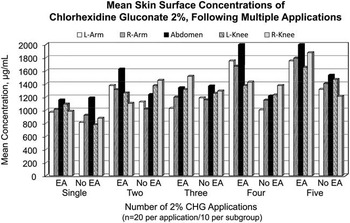
Table 1 documents the mean time differential between the last skin application of 2% CHG and skin surface analysis for study participants. No significant difference was observed in the mean time differential between final application of 2% CHG and laboratory analysis of skin surface concentrations between all study groups. The majority of the volunteers (99 of 100) returned to the laboratory within 4 hours of the last application of CHG for skin surface analysis. Figure 1 demonstrates the mean skin surface concentrations of chlorhexidine gluconate (CHG) following 1 application (group A), 2 applications (group B), 3 applications (group C), 4 applications (group D) or 5 applications (group E) of 2% CHG to left, right antecubital fossae, abdomen, and left, right popliteal fossae. Following 1 application of 2% CHG, no significant difference was noted in mean skin surface concentrations of 2% CHG between individuals who received an electronic reminder (alerted) and participants who were not prompted (non-alerted) to complete the application process (P=.08). A similar finding was noted for individuals in both the groups B and C (P=.54 and P=.67, respectively). However, mean skin surface CHG concentrations were significantly higher on sampled sites in groups B and C (alerted and non-alerted participants) than in the group A (P<.004). A significant difference in mean CHG skin surface concentrations was noted on designated sampling sites in participants receiving an electronic reminder in both groups D1 and E1 compared with non-alerted participants in groups D2 and E2 (P=.04 and P=.007, respectively).
Mean skin surface concentrations of chlorhexidine gluconate (CHG), µg/mL following 1, 2, 3, 4, and 5 applications of 2% using a polyester cloth containing 500 mg CHG; N=20 per application group/10 per subgroup; EA=electronic alert (SMS texting, e-mail or voicemail); EA vs no EA (P<.001).

Time Interval Between Last Application and Analysis of Chlorhexidine Gluconate, 2% Skin Surface Concentrations in Electronic Alert and Non-Alert Groups

NOTE. ANOVA, P=.315.
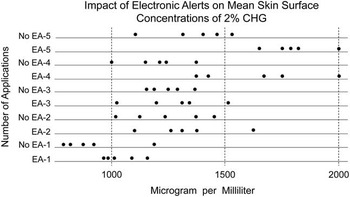
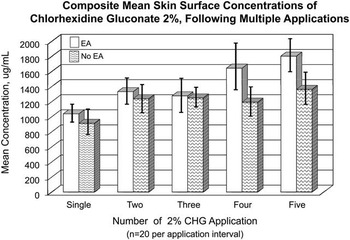
Figure 2 is a dot plot, documenting on each line the mean skin surface concentrations of CHG at 5 separate anatomic locations (reading left to right on each line; left, right antecubital fossae, abdomen and left, right popliteal fossae) following CHG application using a polyester cloth containing 500 mg of chlorhexidine gluconate. Notably, in participants applying CHG 2 or 3 times, skin surface concentrations ranged between 1,000 and 1,500 µg/mL regardless of whether an electronic alert was initiated. However, as the number of consecutive applications increased, electronic prompting resulted in a significantly higher skin surface concentration of CHG (ranging between 1,400 and 2,000 µg/mL) compared with the non-prompted comparator groups (ranging between 1,000 and 1,550 µg/mL). Figure 3 documents the mean composite (representing all 5 anatomic sampling sites) skin surface concentrations of CHG in alerted and non-alerted participants. In participants receiving an electronic reminder to apply the 2% CHG cloth to designated body surfaces, a significant increase in composite CHG skin surface concentrations was noted across all 5 study groups with the highest CHG concentrations observed in those participants applying 2% CHG 4 or 5 times (P<.001), whereas no significant difference was noted in composite skin-surface concentrations between groups B2, C2, D2, and E2 (P=.33).
Dot plot. Impact of electronic alerts on mean skin surface concentrations of chlorhexidine gluconate. Each line represents unique subgroup; circles represent reading from left to right: left, right antecubital fossae, abdomen and left/right popliteal fossae.

Composite mean skin surface concentrations of chlorhexidine gluconate (CHG), µg/mL Following 1, 2, 3, 4, and 5 applications of 2% using a polyester cloth containing 500 mg CHG; N=20 per group/10 per subgroup; EA=electronic alert (SMS texting, e-mail or voicemail); EA vs no EA, (P<.001).

DISCUSSION
Many healthcare facilities have adopted a preadmission antiseptic skin protocol in an effort to reduce the endogenous microbial burden on the skin of patients undergoing elective surgery with the aim of reducing the risk of surgical site infection (SSI). This widespread practice is a topic of controversy among healthcare professionals. Historically, the practice was designated by the 1999 CDC guidelines as a category 1B clinical practice and is strongly recommended.Reference Mangram, Horan, Pearson, Silver and Jarvis 9 However, no randomized clinical trials (RCTs) have documented the benefit of this practice as an effective strategy for reducing the risk of postoperative SSIs. To that point, a recent Cochrane Collaborative report stated, “This review provides no clear evidence of benefit for preoperative showering or bathing with chlorhexidine over other wash products, to reduce surgical site infection.”Reference Webster and Osborne 16 Several publications, however, have questioned the methodological and operational limitations of previously published RCTs and their ability to assess the therapeutic and mechanistic benefits of applying 2% or 4% chlorhexidine gluconate to the surface of the skin prior to hospital admission.Reference Edmiston, Krepel and Edmiston 13 , Reference Edmiston, Bruden, Rucinski, Henen, Graham and Lewis 17 – Reference Edmiston, Okoli, Graham, Sinski and Seabrook 20
The 2008 SHEA/IDSA SSI Practice Recommendation, while deferring to recommend a specific application policy, acknowledges that the optimal antiseptic benefits of CHG is dependent upon achieving adequate surface concentrations on the skin.Reference Anderson, Podgorny and Berrios-Torres 21 This provocative comment represents the pivotal argument for implementation of a standardized preadmission strategy for application of CHG to whole or selective body surfaces. Several factors should be considered when evaluating this low-risk and low-cost intervention: (1) CHG surface skin concentrations accumulate with repetitive application; therefore, a single application is unlikely to results in sustainable CHG concentrations sufficient to inhibit skin flora. (2) Standardization is an important component of any antiseptic body cleansing or showering process; without standardization, the therapeutic benefit of preadmission skin antisepsis is questionable. (3) A discussion of measuring patient compliance is often excluded from most preadmission antiseptic protocols, thereby marginalizing the benefit of this patient-centered process.
Chlorhexidine gluconate is available in 2 forms for preadmission application; 4% aqueous CHG formulation for showering and a 2% CHG polyester (500 mg CHG) cloth for post-shower application. Recently, 2 publications have addressed the standardization and compliance process for 4% aqueous CHG, suggesting (as for any medicinal process) that timing, dose, and duration can have a significant impact on achieving high therapeutic skin-surface concentrations of CHG.Reference Edmiston, Lee and Krepel 19 Furthermore, patient compliance can be enhanced using an electronic alert technology that provides SMS texting, e-mail, or voicemail to remind patients to shower with 4% aqueous CHG.Reference Edmiston, Krepel and Edmiston 13 The present investigation was designed to address the same questions using a polyester cloth that contained 500 mg of CHG (2%).
In the present study, multiple applications of the 2% CHG cloth resulted in a significant increase in skin surface concentrations of CHG (ANOVA, P<.001). The lowest documented concentration with a single application was 786.0 µg/mL (abdomen), while the highest was 1998.9 µg/mL (abdomen) following 5 consecutive applications over a 4-day period. The maximal mean composite skin surface CHG concentrations (Figure 3) in the alerted group following 1, 2, 3, 4, and 5 applications were 1,040.5, 1,334.4, 1,278.2, 1,643.9, and 1,803.1 µg/mL, respectively. A previous comparative study published by the present authors in 2010, following 2 consecutive applications using the 2% CHG polyester cloth, found a mean composite skin surface concentration of 1,745.7 µg/mL, representing a concentration in excess of 300 times the CHG minimum inhibitory concentration required to inhibit the growth of 90% [MIC90] of most staphylococcal (including MRSA) surgical pathogens.Reference Edmiston, Okoli, Graham, Sinski and Seabrook 20 The composite value reported in the present analysis following 2 applications was 1,334.4 µg/m. However, a comparison of MIC values for staphylococcal isolates, including MRSA recovered from postoperative surgical site infections within the previous 12 months (June 2014–June 2015) found no change in the CHG MIC90 (5.0 µg/mL) since the last analysis in 2010 (source: unpublished data, 2015 Surgical Microbiology Research Laboratory, Medical College of Wisconsin).Reference Edmiston, Okoli, Graham, Sinski and Seabrook 20 Therefore, using an MIC90 value of 5.0 µg/mL as a comparative benchmark, the composite (CHG concentration /MIC90) ratios reported for 1, 2, 3, 4, and 5 applications of CHG using the 2% CHG cloth in the EA group were 208.1, 266.8, 255.6, 328.8, and 360.6, respectively. These ratios are reflective of a substantial concentration of CHG on the surface of the skin that is effective against Gram-positive staphylococcal surgical pathogens, including drug-resistant strains.
In addition, use of an electronic alert system that allows for SMS texting, e-mail, or voicemail had a significant impact on improving patient compliance as measure by increased skin surface concentrations of CHG? Analysis of individual and composite sample site data documented that utilization of an electronic alert resulted in a significant increase in skin surface concentrations of CHG in the 4 and 5 CHG application groups; P<.04 and P<.007, respectively (Figure 3). The mean composite skin surface concentration in the single, 2 and 3 CHG application groups were higher in the alerted population compared to the group that did not receive an electronic reminder, but the values but did not reach statistical significance. The consensus regarding these findings suggests that utilization of an electronic alert system for the preadmission application of CHG using a polyester cloth containing 500 mg of CHG maximizes the composite skin-surface concentrations of CHG compared with a non-alerted population. The maximal benefit of the electronic alert system was derived when the application period was extended beyond 2 days, when some individuals were likely to have forgotten or truncated the final application process.
The findings of this study suggest an evidence-based metric for using a CHG-laden (500 mg) polyester cloth to enhance skin concentrations, resulting in a mean composite skin-surface concentration exceeding 1,300 µg/mL after just 2 applications. Achieving a maximal skin surface concentration of CHG using a 2% polyester cloth requires a thoughtful, standardized approach that includes a thorough and focused application process, the avoidance of any surface agents such as oils, creams, or lotions that mask or diminish therapeutic activity, and utilization of an electronic alert system to remind the patient to complete the preadmission skin antisepsis protocol. Our collective experience with the Surgical Care Project has clearly documented that poor compliance with guidelines and interventional protocols marginalizes the benefit of the best of evidence-based practices.Reference Edmiston, Spencer and Lewis 22 , Reference Leaper, Tanner, Kiernan, Assadian and Edmiston 23 The limitation of this study can be summed up as follows. Will the standardization of the preadmission cleansing process that includes the major elements of this study (i.e., multiple consecutive CHG applications combined with an electronic alert) in effect reduce the risk of SSI? Previous clinical trials have found limited or no benefit associated with taking an antiseptic shower prior to surgery, but these studies have documented flaws in both their operational and compliance components. The current study provides a pathway to improved patient compliance while maximizing skin surface concentrations of CHG, sufficient to reduce the microbial burden of wound-contaminating Gram-positive and Gram-negative microbial flora.
ACKNOWLEDGMENTS
Financial support. The study was supported in part by an unrestricted grant from Sage Products, Cary, Illinois. All comments and opinions in this manuscript represent the composition, review, and sole deliberation of the cited authors.
Potential conflicts of interest. C.E.E. and G.R.S. report having received an unrestricted grant from Sage Products, Inc. (Cary, IL). All other authors of the manuscript report no conflicts of interest relevant to this publication.