Surgical site infections (SSIs) account for approximately 20% to 80% of hospital-acquired infections, thus making it the most common hospital-acquired infection.Reference Leaper 1 , Reference Lewis, Moehring, Chen, Sexton and Anderson 2 Infections following total hip arthroplasty (THA) and total knee arthroplasty (TKA) are a serious postoperative complication with significant morbidity, mortality, and healthcare cost.Reference Minnema, Vearncombe, Augustin, Gollish and Simor 3 , Reference Kirkland, Briggs, Trivette, Wilkinson and Sexton 4 The Centers for Disease Control and Prevention’s National Healthcare Safety Network most recently published data, for 2006–2008, reported an infection rate following THA and TKA of 0.68% to 1.60%.Reference Edwards, Peterson and Mu 5 Ongoing surveillance for SSIs is an important strategy for SSI prevention.Reference Anderson, Podgorny and Berríos-Torres 6 SSI surveillance that involves infection control professionals (ICPs) and feedback to stakeholders has been shown to reduce rates of SSIs.Reference Brandt, Sohr, Behnke, Daschner, Rüden and Gastmeier 7 – Reference Wilson, Charlett, Leong, McDougall and Duckworth 9
Consistent case-finding methods are important in the reporting of THA/TKA SSI rates. Variability in hospitals’ efforts and resources for SSI surveillance can result in bias, with underreporting in hospitals with few resources allocated to SSI surveillance and higher rates being reported at hospitals with more resources for SSI surveillance.Reference Calderwood, Kleinman, Murphy, Platt and Huang 10 – Reference Haut and Pronovost 12 Because most SSIs develop after discharge, patients may seek treatment for an SSI at a different facility, and if this case is not reported to the procedure hospital it leads to underreporting.Reference Calderwood, Ma and Khan 11 , Reference Yokoe, Avery, Platt and Huang 13 Prior work has established that review of administrative data for diagnosis and procedure codes is an efficient and practical method for identifying SSIs.Reference Calderwood, Kleinman, Murphy, Platt and Huang 10 , Reference Calderwood, Ma and Khan 11 , Reference Gerbier-Colomban, Bourjault, Cêtre, Baulieux and Metzger 14 Creating a standardized approach improves case-finding and data quality and allows for robust interhospital comparisons.Reference Calderwood, Kleinman, Murphy, Platt and Huang 10 , Reference Calderwood, Ma and Khan 11
We conducted a retrospective cohort study on all acute care facilities in the province of Alberta, evaluating the use of diagnosis and procedure codes to identify potential THA/TKA SSIs requiring medical chart review.
METHODS
Alberta Bone and Joint Health Institute (ABJHI) provided data for all patients who had a primary, clean, elective THA or TKA performed at Alberta Health Services and Covenant Health (AHS/COV) facilities from April 1, 2013, through June 30, 2014 (n=11,774). ABJHI is a nonprofit third party organization that collates and maintains a provincial musculoskeletal data repository and provides feedback to physicians. Eligible patients were followed up for 6 months after THA/TKA per AHS/COV Infection Prevention and Control (IPC) Surveillance SSI protocol. Every patient with an eligible THA/TKA was linked to the Discharge Abstract Database (DAD) and to the National Ambulatory Care Reporting System by the AHS analytics department. All readmissions to any AHS/COV acute care facility within 6 months of the procedure date were identified by DAD linkage. All visits to ambulatory programs within 6 months of the procedure date where select anti-infective therapies (excluding viral and mycobacterial agents) were administered (Supplementary Appendix Table A1) were identified by National Ambulatory Care Reporting System linkage. By selecting for anti-infective therapies the list of potential SSI cases requiring review from the ambulatory data was reduced, because it was assumed if an infection was present the patient would receive at least one of these anti-infective therapies.
Diagnosis codes (International Classification of Diseases, 10th Revision, Canada) and procedure codes (Canadian Classification of Health Intervention) for each visit and/or readmission per patient were obtained from the linkages to DAD and the National Ambulatory Care Reporting System. DAD and the National Ambulatory Care Reporting System assign a maximum of 25 diagnosis codes and 20 procedure codes per hospital admit or ambulatory visit. A list of diagnosis and procedure codes used to identify potential SSI cases was created using codes identified in prior studies,Reference Haut and Pronovost 12 , Reference Yokoe, Avery, Platt and Huang 13 and internal comparisons using codes from SSI cases identified by ICPs across the province were considered in order to ensure local coding practices. For patients with multiple visits and/or readmissions, the ICP reviewed the last acute care encounter with a flagged diagnosis or procedure code. AHS/COV ICPs use National Healthcare Safety Network SSI definitions 15 when determining whether a patient meets SSI criteria.
AHS/COV IPC Surveillance is centralized using a web-based data entry platform, ensuring that each patient is counted only once. Patients already identified with a THA or TKA SSI using traditional IPC surveillance methods were excluded from the review because these patients were already captured by surveillance, unless the patient had presented again at a later date to rule out an upgrade in infection from superficial-incisional to a complex (deep-incisional or organ/space) SSI. The remaining patients were provided for medical chart review to the ICP at the facility where the patient had visited or been admitted.
The performance of traditional IPC surveillance and administrative data–triggered chart review was assessed along with the performance for each diagnosis and procedure code. The sensitivity and specificity of administrative data were assessed, using SSIs identified after review as the gold standard. In addition, the place of SSI identification for the cases captured in the study was assessed: either at the hospital where the procedure was performed (procedure facility) or at a facility other than the procedure facility (nonprocedure facility).
RESULTS
Administrative data identified 295 ABJHI patients at 49 AHS/COV acute care facilities. During the same study period, traditional IPC surveillance methods had identified 153 SSI cases. Of these 153 SSI cases, 133 (87%) were flagged with an eligible diagnosis or procedure code. Four patients with superficial-incisional SSI cases already identified by IPC were reviewed for potential upgrade in infection; however, they were excluded from the study analysis because they had not developed a complex SSI on subsequent review. One hundred sixty-two ABJHI denominator patients were included in this study and medical chart review was performed by an ICP. Linkage to DAD data identified 136 (84%) of these 162 cases as patients who were readmitted to acute care with eligible codes. The numbers of patients reviewed were distributed nearly equally between the 2 procedures (76 [47%] following THA and 86 [53%] following TKA).
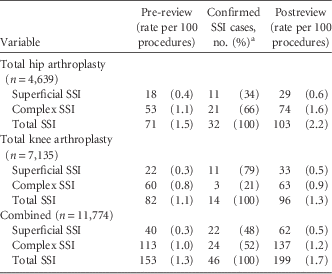
Overall, ICPs determined that 46 (28%) of the 162 reviewed cases met the National Healthcare Safety Network SSI definition (subsequently termed as confirmed SSI cases). More THA patients than TKA patients were confirmed as an SSI case (32/76 [42%] and 14/86 [16%], respectively). Of the 46 confirmed SSI cases, 22 (48%) were superficial-incisional and 24 (52%) were deep-incisional or organ/space (complex). However, complex SSIs were more readily identified following THA, with THA accounting for 21 (88%) of the 24 combined complex SSI (Table 1)
Surgical Site Infection (SSI) Cases and Rates Detected by Traditional Infection Prevention and Control Surveillance and With Administrative Data

NOTE. Percentages are calculated by column. Complex SSI means deep incisional and organ/space SSI.
a The additional SSIs found after infection control professional review of flagged administrative data cases.
.
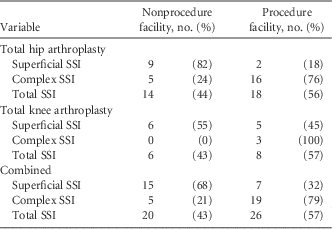
Of the 46 confirmed SSI cases, 20 (43%) were identified at an acute care facility other than the procedure facility; however, 16 (76%) of the 21 patients with a complex SSI following a THA were identified at their procedure facility (Table 2). For 22 superficial SSI, combined 15 (68%) were identified at a nonprocedure facility, with 9 (82%) of 11 for THA and 6 (55%) of 11 for TKA.
Cases by Surgical Site Infection (SSI) Type and Location of Patient Readmission

NOTE. Percentages are calculated by row. Complex SSI means deep-incisional or organ/space infections.
For THA/TKA performed from April 1, 2013, through June 30, 2014, there were 199 SSIs identified by both traditional IPC surveillance and administrative data. SSI rates prior to the study (pre-review) and SSI rates after the study (postreview) are shown in Table 1. For THA, diagnosis- and procedure code–triggered medical chart review and subsequent ICP confirmation yielded a 1.5-fold increase in total, superficial, and complex SSI rate. For TKA, there was a 1.2-fold increase in total SSI rate, a 1.7-fold increase in superficial SSI rate, and a 1.1 increase in complex SSI rate. For combined total SSI rate, there was a 1.3-fold increase, with 1.7-fold increase for superficial SSI rate and 1.2-fold increase for complex SSI rate.
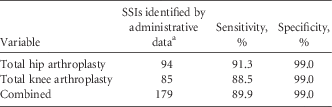
Of the 199 postreview SSI cases, 192 (96%) were identified after discharge. Of the postreview SSI cases, 76% were identified within 30 days of procedure, with a mean time to infection of 30 days and a median of 19 days. One hundred seventy-nine SSI cases (133 traditional IPC and 46 confirmed SSI) of the 199 post-review SSI cases were flagged by administrative data and confirmed by ICP review, with a sensitivity of 90% and specificity of 99% (Table 3)
Sensitivity and Specificity of Surgical Site Infection (SSI) Cases Detected by Administrative Data

a SSI cases flagged by administrative data and confirmed by infection control professional to meet National Healthcare Safety Network definition.
.
The performance of each diagnosis and procedure code is shown in Supplementary Appendix Table A2. One hundred sixty-two ABJHI denominator patients were identified using 18 codes (6 codes had no results). Of these 18 codes, 6 codes were associated with the confirmed SSI cases (4 diagnosis codes, 2 procedure codes). Forty-one percent of the confirmed SSI cases were identified by the T814 diagnosis code.
DISCUSSION
Using diagnosis and procedure codes to trigger medical chart review is an efficient strategy for identification of potential SSIs following THA/TKA.Reference Calderwood, Kleinman, Murphy, Platt and Huang 10 , Reference Calderwood, Ma and Khan 11 , Reference Gerbier-Colomban, Bourjault, Cêtre, Baulieux and Metzger 14 Case-finding and consistency of case-finding amongst facilities are improved with the addition of this approach to traditional IPC surveillance methods. This strategy captured 87% of SSI cases identified using traditional IPC surveillance; thus, it validated the list of diagnosis and procedure codes used as well as increased SSI case detection by 30%.
The proportion of reviewed cases confirmed by ICP review to meet National Healthcare Safety Network SSI definition was comparable with a previously reported study. Calderwood et alReference Calderwood, Ma and Khan 11 found 33% of hip arthroplasties and 20% of knee arthroplasties identified as potential SSIs by diagnosis and procedure codes were confirmed to be an SSI after medical chart review. In comparison, this study resulted in a higher proportion of confirmed THA SSIs (42%) and a lower proportion of confirmed TKA SSIs (16%). A more recent study found 50% of medical charts flagged using a restricted list of 6 International Classification of Diseases, 9th Revision diagnosis codes were confirmed as a complex THA SSI.Reference Calderwood, Kleinman, Murphy, Platt and Huang 10 Equivalent International Classification of Diseases, 10th Revision, Canada diagnosis codes were included in this study. In this study, 3 diagnosis codes identified 91% of the confirmed SSI cases. If a restricted list of these codes was used it would have resulted in 4 fewer confirmed SSI cases; however, 44 non-SSI cases would have not required review. It is important to balance the inclusion of codes broad enough to account for variations in coding practices and using a set of codes highly sensitive in identifying SSIs. Although the current list of administrative codes has high specificity, future assessment of included codes is necessary for further code optimization.
The time and resources required by ICPs for SSI surveillance are reduced when case-finding is performed using administrative data while ensuring case-finding is performed consistently across the entire network. SSI surveillance involves substantial time and resources for data collection, medical chart review, and patient follow-up, making these surveillance systems poorly cost-effective.Reference Wilson, Charlett, Leong, McDougall and Duckworth 9 , Reference Manniën, van den Hof, Muilwijk, van den Broek, van Benthem and Wille 16 , Reference Rioux, Grandbastien and Astagneau 17 It has been reported traditional IPC surveillance methods capture 1 SSI per 16 charts reviewed,Reference Calderwood, Ma and Khan 11 equivalent to 4 times more time spent compared with this study.
Because AHS/COV delivers healthcare in Alberta and AHS IPC Surveillance is a provincial program, it is a unique situation where postdischarge SSI surveillance at all AHS/COV acute care facilities across the province is possible. Most SSIs are identified by postdischarge surveillance,Reference Miletic, Taylor, Martin, Vaidya and Kaye 18 as this study highlighted 96% of the SSI cases were identified after surgery discharge. This is likely due to surgery hospitalizations being relatively short. For the ABJHI denominator, the mean length of stay was 4 days and the median was 3 days. Studies have noted that conducting SSI surveillance at only the operative hospital limits SSI surveillance and the hospitals will underestimate their SSIs.Reference Calderwood, Ma and Khan 11 , Reference Yokoe, Avery, Platt and Huang 13 This study supports this as 43% of the confirmed SSI cases were identified at a facility other than their procedure facility. This percentage is higher than the study conducted in California by Yokoe et al,Reference Yokoe, Avery, Platt and Huang 13 where 17% of the THA/TKA SSIs were identified at a nonoperative hospital. Furthermore, this study suggests the SSI category influences where the patient is likely to seek treatment, with complex SSI patients returning to the procedure facility.
The use of administrative data has limitations. Although 87% of cases identified by traditional IPC surveillance methods were identified using the diagnosis and procedure codes, 13% of IPC-identified cases were missed in the administrative data. Because most SSIs occur after discharge from the surgical hospitalization,Reference Miletic, Taylor, Martin, Vaidya and Kaye 18 the study focused on subsequent readmissions and could have missed SSI cases that developed during the surgical hospitalization. The use of select anti-infectives with the ambulatory data could have resulted in the exclusion of SSI cases because these are not mandatory codes for patient records. Furthermore, diagnosis and procedure codes are available only upon discharge; patients who were still admitted with an SSI at the time the data was requested would be missed. However, future studies will include the last 3 months of the previous study period to maximize data capture of those late-discharge patients over time.
Both the sensitivity and specificity for administrative data were relatively high at 90% and 99%, respectively. However, if the 295 SSIs identified by administrative data were used to calculate the combined SSI rate it would result in 2.5 per 100 procedures compared with the 1.7 per 100 procedures confirmed by ICP review. This finding supports other studies that indicate administrative data diagnosis and procedure codes are effective at identifying potential SSIs but that strategy alone would result in an overcall of SSIs.Reference Calderwood, Kleinman, Murphy, Platt and Huang 10 , Reference Calderwood, Ma and Khan 11 , Reference Gerbier-Colomban, Bourjault, Cêtre, Baulieux and Metzger 14 The sole use of administrative data for hospital-acquired infection surveillance is inappropriate and the results are inaccurate compared with the results using a standardized surveillance definition and trained reviewers.Reference Jhung and Banerjee 19 , Reference Goto, Ohl, Schweizer and Perencevich 20 Administrative data limitations include variability in clinical documentation and coder interpretation, contributing to inconsistencies in the ability of codes to identify hospital-acquired infections.Reference Jhung and Banerjee 19 Facilities differ amongst their medical practice, medical record documentation, and discharge coding; therefore, relying on administrative data for interhospital comparisons would be erroneous without further medical chart review.Reference Jhung and Banerjee 19
In summary, the use of administrative data diagnosis and procedure codes to identify potential THA/TKA SSI cases for further IPC review is an efficient strategy to enhance existing SSI surveillance. It improves case-finding and case-finding consistency, and it reduces time and resources needed for SSI surveillance, all of which contribute to a standardized and high quality SSI surveillance program. The study also highlights the importance of following THA/TKA patients beyond their procedure facility.
ACKNOWLEDGMENTS
We acknowledge the contribution of the infection control professionals and IPC physicians at the acute care sites in AHS/COV; the orthopedic surgeons in the province, who submit patient information to ABJHI for surveillance; and members of the IPC Surveillance, Analytics, and ABJHI teams for their work in data cleaning and extraction.
Financial support. Alberta Health Services.
Potential conflicts of interest. All authors report no conflicts of interest relevant to this article.
SUPPLEMENTARY MATERIAL
To view supplementary material for this article, please visit http://dx.doi.org/10.1017/ice.2016.53